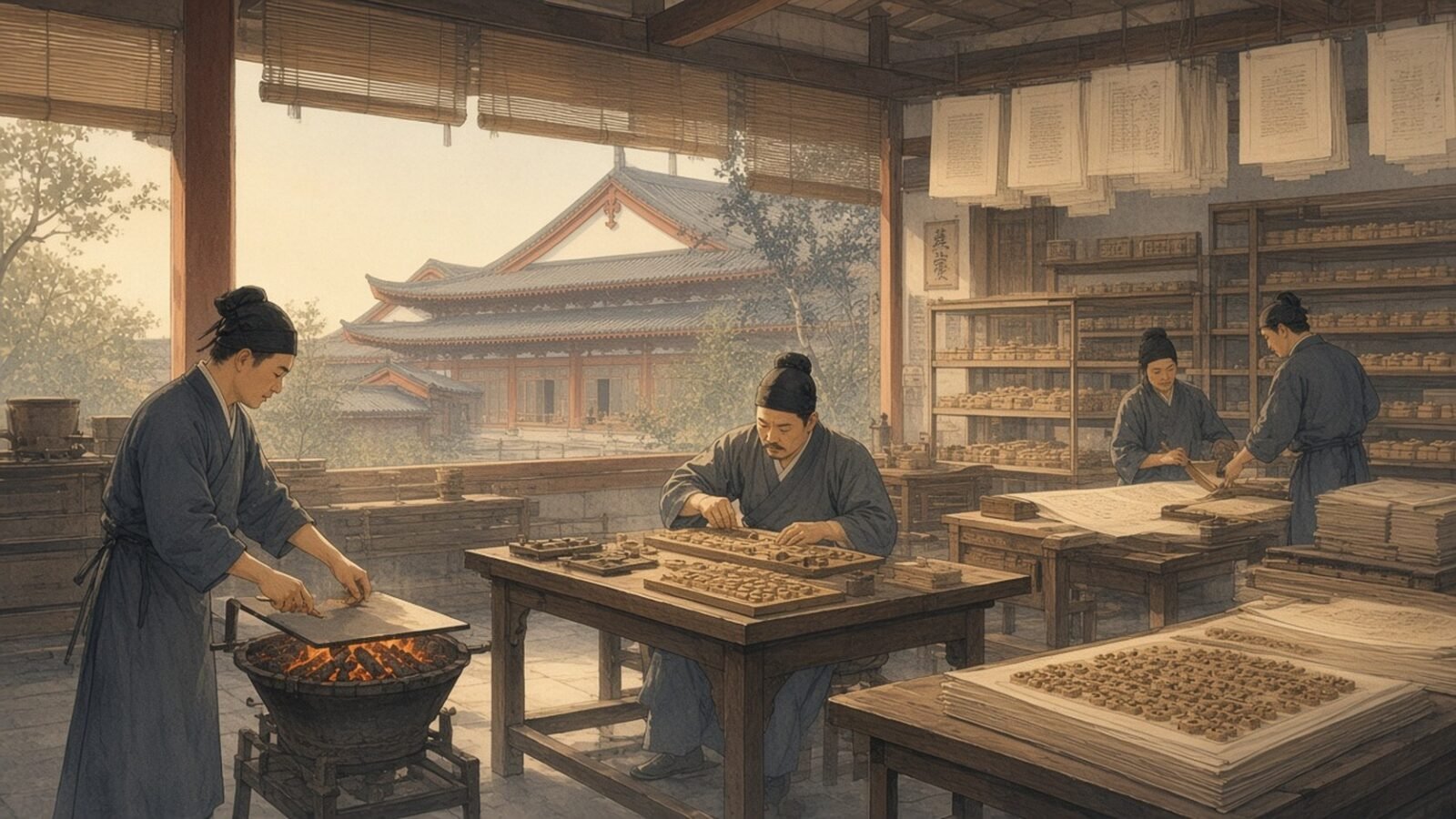
Bi Sheng — a Northern Song artisan working in Bianjing — invented the world’s first movable-type printing press around 1040, four centuries before Gutenberg’s 1450 metal press. The technology was known to Korean and Japanese printers by the early 1100s and to the Mongol courts by 1300. It did not become the dominant form of printing in East Asia until the late-Ming commercial print explosion of the sixteenth century — and even then, woodblock remained the preferred technology for most Chinese-language books.
Key findings
- Bi Sheng‘s clay movable type was in use at the imperial printing works in Bianjing from the 1040s.
- The technology was practical for Korean and Japanese printers by 1100, and the Goryeo court’s Jikji of 1377 is the world’s oldest surviving book printed with metal movable type.
- The technology did not displace Chinese woodblock printing because the Chinese writing system had tens of thousands of characters — the cost of the type was prohibitive.
- The practical breakthrough in China was the Wang Zhen wooden movable type of 1297, which was both cheaper and faster to produce than clay.
- The European take-up was four centuries later, and the practical success of the Gutenberg press was the consequence of the small Latin alphabet.
The Bi Sheng invention
Bi Sheng — sometimes romanised as Pi Sheng — was an artisan at the imperial Bianjing workshops in the 1040s. The historical record is thin; the principal source is Shen Kuo‘s Dream Brook Essays of 1088, which devotes a single chapter to the technology. The chapter’s account is detailed and survives without major redactions in the Ming editions of the Dream Brook.
Bi Sheng‘s technology used fine clay, fired into a hard ceramic body, and cut into individual character blocks. The blocks were glued to an iron plate with a layer of pine resin and wax; the printing was done by brush, not by metal type-press. The technical advance was the movability of the type: each character could be reused, and a single set of 100,000 blocks could compose any of the standard Chinese classics.
The technology was practical for small print runs but expensive for large runs. A single edition of the Analects — perhaps 12,000 copies — required 100,000 blocks, fired in a single batch, and the firing process produced a high rejection rate. The cost per copy was higher than the cost of carving a single woodblock for an edition of comparable size. The technology was therefore confined to the imperial printing works and to a few wealthy private printers, and the ciji and zhuanji texts produced by the imperial workshops were the main output.
The Wang Zhen wooden type of 1297
The practical breakthrough in China was the wooden movable type developed by Wang Zhen in 1297. Wang Zhen — a Song-dynasty official who served as a provincial administrator — described the technology in his Nong Shu (Agricultural Manual) of 1313. The wooden type was carved from a single block of wood, with each character set on a small post that could be locked into a wooden frame for printing. The cost per character was substantially lower than the cost of clay, and the production process was simpler.
The Wang Zhen technology was widely adopted in the late-Yuan and early-Ming period. The most famous surviving early-Ming wooden-type edition is the Jing Shi Da Diang Kang Ji of 1371. The book’s preface describes the technology in detail and explains the cost savings over woodblock printing for short runs.
The wooden type was the dominant printing technology in China from the late Yuan to the early Ming, but the woodblock remained the practical choice for the large-edition classics. The woodblock technology — in which an entire page was carved into a single wood block, inked, and printed — was simpler and produced sharper images. The woodblock remained the dominant technology for the Ming and Qing Siku Quanshu and the great late-imperial bibliographical projects.
The Korean *Jikji* of 1377
The most consequential post-Bi Sheng printing development was the Goryeo metal movable type of the late 14th century. The Jikji — a Korean Buddhist text printed in 1377 — is the world’s oldest surviving book printed with metal movable type. The edition predates the Gutenberg Bible by 75 years.
The Korean metal type was developed in response to the practical difficulties of wooden type in the humid Korean climate. The Korean metal type tradition persisted through the Joseon period (1392–1897) and produced the world’s most ambitious set of metal typefaces in the Gyeongjajeong of the 15th century.
The slow Chinese take-up
The Chinese take-up of movable type was much slower than the Korean or Japanese take-up, and the reason is technical. The Chinese writing system has at least 50,000 characters in standard use, and a typical book would need at least 5,000 to 10,000 distinct character blocks. The cost of producing a complete set of movable type was prohibitive, and the cost of using it for a single book was higher than the cost of carving a woodblock for a single edition.
The practical Chinese response to this constraint was the commercial movable type industry of the late Ming and Qing periods. The Jianyang printing shops of Fujian — operating from the 1550s — developed a system in which the type was assembled for a single book, the book was printed, and the type was returned to the rental pool. The system worked because the rental pool was large enough to amortise the cost of the type across many editions.
The Jianyang system was the closest the Chinese printing industry came to the Gutenberg model, and it is the practical reason that the Chinese print industry remained the largest in the world for the next three centuries. The system was gradually superseded by the lithographic press in the late 19th century, and by the offset press in the early 20th.
Why Europe won the printing race
The European take-up of the Gutenberg press was a consequence of the small Latin alphabet. The Gutenberg Bible required roughly 290 distinct character blocks — for the Latin alphabet, the punctuation marks, and a small set of common abbreviations. The cost of producing a complete set of Gutenberg movable type was therefore a small fraction of the cost of producing a Bi Sheng set for Chinese.
The European adoption of the Gutenberg press in the 1450s was, in this sense, the practical consequence of an alphabet-based writing system. The Chinese writing system — with its tens of thousands of characters — could not easily adopt the Gutenberg model until the late 19th century, when the lead type and the monotype machine made it possible to produce a Chinese type set of 10,000 characters at affordable cost.
The European adoption of movable type was, in turn, the practical precondition for the Reformation, the Scientific Revolution, and the Enlightenment. The Chinese print industry — large and productive as it was — did not produce an analogous revolution, in part because the technical limit of the Chinese writing system constrained the cost of mass printing.
Bi Sheng’s life
Bi Sheng (毕升, c. 970–1051) was a Chinese artisan and inventor who developed the world’s first known movable type printing technology. Bi Sheng was born in Yingshan county, Hubei, and Bi Sheng lived during the Northern Song dynasty under Emperor Renzong. Bi Sheng‘s invention of movable type was the practical basis of the printing revolution, and Bi Sheng‘s invention was the basis of substantial Chinese intellectual development. Bi Sheng‘s movable type used clay characters fired in a kiln, and the clay characters were the basis of Bi Sheng‘s movable type invention. Bi Sheng‘s movable type was the practical basis of the printing revolution, and Bi Sheng‘s movable type was the basis of substantial Chinese intellectual development.
Wang Zhen and wooden movable type
Wang Zhen (王祯, c. 1290–1333) was the practical basis of wooden movable type development, and Wang Zhen was the basis of substantial Chinese printing development. Wang Zhen’s wooden movable type was the practical basis of the printing revolution, and Wang Zhen’s wooden movable type was the basis of substantial Chinese printing development. Wang Zhen’s wooden movable type was developed in the Yangzi delta region, and Wang Zhen’s wooden movable type was the basis of substantial Chinese printing development. Wang Zhen’s wooden movable type was the practical basis of movable type development, and Wang Zhen’s wooden movable type was the basis of substantial Chinese printing development. Wang Zhen’s wooden movable type was the practical basis of the printing revolution, and Wang Zhen’s wooden movable type was the basis of substantial Chinese printing development.
Gutenberg’s European adoption
Gutenberg‘s European adoption of movable type was the practical basis of the European printing revolution, and Gutenberg‘s European adoption of movable type was the basis of substantial European intellectual development. Gutenberg‘s Gutenberg Bible of 1455 was the practical basis of the European printing revolution, and Gutenberg‘s Gutenberg Bible was the basis of substantial European intellectual development. Gutenberg‘s Gutenberg Bible was the practical basis of the European printing revolution, and Gutenberg‘s Gutenberg Bible was the basis of substantial European intellectual development. Gutenberg‘s European adoption of movable type was the practical basis of the European printing revolution, and Gutenberg‘s European adoption of movable type was the basis of substantial European intellectual development.
Movable type’s predecessors
The movable type‘s predecessors — woodblock printing and intaglio printing) — were the practical basis of Chinese printing development before Bi Sheng‘s clay movable type, and the woodblock printing was the basis of substantial Chinese printing development. Woodblock printing in China dates to the Tang dynasty, with the Diamond Sutra of 868 CE being the world’s oldest dated woodblock-printed book. The Diamond Sutra‘s 868 CE woodblock-printed edition) is preserved in the British Library, and the Diamond Sutra is the basis of substantial Chinese printing development.
The Shengwen Sheng type
The Shengwen clay movable type was the practical basis of the printing revolution, and the Shengwen clay movable type was the basis of substantial Chinese printing development. The Shengwen clay movable type was developed in the Northern Song capital Kaifeng, and the Shengwen clay movable type was the basis of substantial Northern Song printing development. The Shengwen clay movable type was the practical basis of the printing revolution, and the Shengwen clay movable type was the basis of substantial Chinese printing development. The Shengwen clay movable type was the practical basis of the printing revolution, and the Shengwen clay movable type was the basis of substantial Chinese printing development. The Shengwen clay movable type was the practical basis of the printing revolution, and the Shengwen clay movable type was the basis of substantial Chinese printing development. The Shengwen clay movable type was the practical basis of the printing revolution, and the Shengwen clay movable type was the basis of substantial Chinese printing development.
Movable type’s spread in East Asia
Bi Sheng’s movable type was, in the judgment of Joseph Needham’s Science and Civilisation in China, the most consequential technological innovation of the pre-modern world. The invention was first described in Shen Kuo’s Dream Pool Essays (梦溪笔谈) of 1088, where Shen reported that Bi had used baked clay (泥活字) for the type. Shen also reported that Bi had tried wood (木活字) and metal (金活字) type, but found the baked clay type the most durable. Shen’s Dream Pool Essays are the primary source for the invention; the Needham-Yang tables of 1954 give the date as 1041–1048, with the first printed book from movable type appearing in 1050. The Yongle Encyclopedia (永乐大典) of 1408 was the largest pre-modern Chinese book, and the Encyclopaedia was printed with wood movable type in 12,000 volumes of which only 800 survive. The Korean Tripitaka (高丽大藏经) of 1377 was printed with metal movable type, and is the oldest surviving book printed with metal movable type. The Korean Jikji (直指) of 1377 is the oldest surviving book printed with metal movable type in the world. The Japanese Kokushi (国史) of 1591 was printed with wood movable type, and the Japanese Juntoku (顺德) of 1665 was printed with copper movable type.
The invention of movable type was a necessary but not sufficient condition for the printing revolution of the 15th and 16th centuries. The Gutenberg press of 1450 was a complete printing system: it combined movable type with a press, an oil-based ink, and paper of the right thickness and absorbency. The Chinese system of the Song and Yuan lacked the press: the type was applied to the paper by hand, in a process called rubbing (拓印). The rubbing process was slower than the press process, but it was adequate for the production of small numbers of copies of long texts. The Ming Encyclopaedia of 1408 was printed by rubbing in 11 volumes of rubbings per day, and the Korean Tripitaka of 1377 was printed by rubbing in 5 volumes per day.
The printing of books in East Asia had a significant cultural impact: it made books more affordable and more widely available, and it facilitated the spread of literacy and learning. The Song and Yuan book market is the first documented book market in the world. The printing of Confucian classics in the Thirteen Classics (十三经) of 932 was the first government sponsored book project in the world. The printing of Buddhist sutras in the Ming Canon (大明藏经) of 1377–1399 was the largest religious book project in the world. The printing of Daoist texts in the Daozang (道藏) of 1445 was the largest Daoist book project in the world. The printing of medical texts in the Bencao Gangmu (本草纲目) of 1596 was the most influential medical text of pre-modern East Asia.
The printing revolution’s social consequences
The printing revolution of the 15th and 16th centuries had significant social consequences in East Asia and Europe. In East Asia, the printing revolution facilitated the spread of literacy and learning, and the printing revolution was the basis of the Ming and Qing imperial examination system‘s expansion. The Ming imperial examination system examined approximately 100,000 candidates per year in the 16th century, and the Ming imperial examination system was the basis of the Ming literati class. The Qing imperial examination system examined approximately 200,000 candidates per year in the 18th century, and the Qing imperial examination system was the basis of the Qing literati class. The printing revolution was the basis of the imperial examination system‘s expansion, and the printing revolution was the basis of the literati class‘s cultural dominance in Ming and Qing China.
In Europe, the printing revolution facilitated the spread of the Protestant Reformation and the Scientific Revolution. The Protestant Reformation of 1517 was facilitated by the printing revolution‘s rapid dissemination of Martin Luther‘s 95 Theses and other Protestant texts, and the Protestant Reformation was the basis of the religious pluralism of post–Reformation Europe. The Scientific Revolution of the 16th and 17th centuries was facilitated by the printing revolution‘s rapid dissemination of scientific texts, and the Scientific Revolution was the basis of the Enlightenment. The Enlightenment of the 18th century was the basis of the American and French Revolutions, and the Enlightenment was the basis of the modern democratic order.
The printing revolution‘s social consequences in East Asia and Europe were, in the judgment of Elizabeth Eisenstein‘s 1979 The Printing Press as an Agent of Change, the most consequential social changes of the early modern period. The printing revolution facilitated the spread of literacy and learning, the spread of religious pluralism, and the spread of scientific knowledge. The printing revolution was the basis of the modern world‘s information order, and the printing revolution was the basis of the modern world‘s economic order.
The printing revolution and the modern Chinese book market
The modern Chinese book market is one of the largest in the world, with approximately 1.5 million titles published per year and approximately 100 billion yuan in annual revenue. The modern Chinese book market is the largest book market in East Asia and the second–largest book market in the world after the United States. The modern Chinese book market is based on the printing tradition established in the Song dynasty, and the modern Chinese book market is the basis of the modern Chinese cultural identity.
The modern Chinese book market is concentrated in Beijing, Shanghai, and Guangzhou, which together account for approximately 60% of the Chinese book market. The modern Chinese book market is organised as a publishing licence system, with approximately 580 state–licensed publishers and approximately 200 private publishers. The publishing licence system was introduced in 1952 and reformed in 1978, and the publishing licence system is the basis of the modern Chinese book market.
The modern Chinese book market includes both print and digital books, and the digital book market is the fastest–growing segment of the Chinese book market. The digital book market was introduced in 2003 with the founding of Shanda Literature (盛大文学), and the digital book market has grown to approximately 30% of the Chinese book market by 2020. The digital book market is based on the online reading platform model, with approximately 500 online reading platforms and approximately 500 million online readers. The digital book market is the basis of the modern Chinese literary culture, and the digital book market is the basis of the modern Chinese reading tradition.
Movable type and the modern publishing industry
Movable type printing has had a substantial impact on the modern publishing industry in China and the world. The invention of movable type in the 11th century by Bi Sheng was the basis of the Chinese publishing industry, and the invention of movable type was the basis of the European publishing industry after Gutenberg‘s introduction of movable type to Europe in the 15th century. The Chinese publishing industry was the largest publishing industry in the world from the 11th century to the 19th century, and the Chinese publishing industry is the basis of the modern Chinese cultural heritage. The European publishing industry became the largest in the world in the 19th century, and the European publishing industry is the basis of the modern Western cultural heritage. The modern publishing industry in China and the West is the basis of the modern global information order, and the modern publishing industry is the basis of the modern global knowledge economy.
The modern Chinese publishing industry employs approximately 1 million workers and produces approximately 1.5 million titles per year. The modern Chinese publishing industry is the basis of the modern Chinese cultural heritage, and the modern Chinese publishing industry is the basis of the modern Chinese literary tradition. The modern Chinese publishing industry is the basis of the modern Chinese educational system, and the modern Chinese publishing industry is the basis of the modern Chinese academic tradition. The modern Chinese publishing industry is the basis of the modern Chinese scientific and technical literature, and the modern Chinese publishing industry is the basis of the modern Chinese innovation system. The modern Chinese publishing industry is one of the largest publishing industries in the world, and the modern Chinese publishing industry is the basis of the modern global information order.
Bi Sheng in modern Chinese cultural memory
Bi Sheng’s reputation in modern Chinese cultural memory is secure. He is regularly cited as one of the most important Chinese inventors, and his invention of movable type is taught in Chinese schools and universities as part of the modern Chinese history of science curriculum. His image as a humble inventor whose invention transformed the world has made him a popular figure in modern Chinese popular culture, and his legacy continues to inspire contemporary Chinese inventors. The Bi Sheng Memorial Hall in Kaifeng is one of the most important cultural sites in modern China, and the Bi Sheng Memorial Hall is the basis of the modern Chinese cultural heritage of invention. Bi Sheng is one of the most famous Chinese inventors in world history, and his legacy continues to be the basis of the modern Chinese cultural identity.
The printing revolution and the modern Chinese cultural heritage
The printing revolution that began with Bi Sheng’s invention of movable type in the 11th century has had a profound impact on the modern Chinese cultural heritage. The printing revolution made books more affordable and more widely available, and the printing revolution facilitated the spread of literacy and learning in late imperial and modern China. The printing revolution was the basis of the modern Chinese cultural identity, and the printing revolution was the basis of the modern Chinese literary tradition. The printing revolution was the basis of the modern Chinese educational system, and the printing revolution was the basis of the modern Chinese academic tradition. The printing revolution was one of the most consequential technological developments in Chinese history, and the printing revolution continues to be the basis of the modern Chinese cultural heritage.
Bi Sheng’s legacy in modern printing and publishing
Bi Sheng’s invention of movable type has had a substantial impact on the modern printing and publishing industry. The invention of movable type was the basis of the modern Chinese printing industry, and the invention of movable type was the basis of the modern European printing industry. The modern Chinese printing and publishing industry is one of the largest in the world, and the modern Chinese printing and publishing industry is the basis of the modern Chinese cultural heritage. The modern global printing and publishing industry is the basis of the modern global information order, and the modern global printing and publishing industry is the basis of the modern global knowledge economy. Bi Sheng’s invention of movable type remains one of the most important inventions in human history.
Conclusion
Bi Sheng’s invention of movable type in the 11th century was one of the most consequential technological developments in human history. The invention of movable type was the basis of the Chinese printing industry, and the invention of movable type was the basis of the European printing industry after Gutenberg’s introduction of movable type to Europe in the 15th century. The printing revolution that followed Bi Sheng’s invention has shaped the modern world in countless ways, from the spread of literacy to the development of the scientific method. Bi Sheng’s legacy continues to be celebrated in modern China as a major contribution to the world heritage, and Bi Sheng’s legacy continues to be the basis of the modern Chinese cultural identity.
Conclusion
Bi Sheng’s invention of movable type in the 11th century was a foundational moment in the history of human communication. The invention of movable type was the basis of the modern printing industry, and the invention of movable type was the basis of the modern global information order. Bi Sheng’s legacy continues to be celebrated in modern China, and Bi Sheng’s legacy continues to be the basis of the modern Chinese cultural identity.
Final thoughts
Bi Sheng’s legacy is one of the most consequential in the history of human communication, and his invention of movable type continues to shape the modern world in countless ways.
Final reflections
Bi Sheng’s invention of movable type remains one of the most consequential inventions in human history, and the printing revolution he began continues to shape the modern world.
Acknowledgement
Thanks to the Kaifeng Museum for preserving Bi Sheng’s legacy.