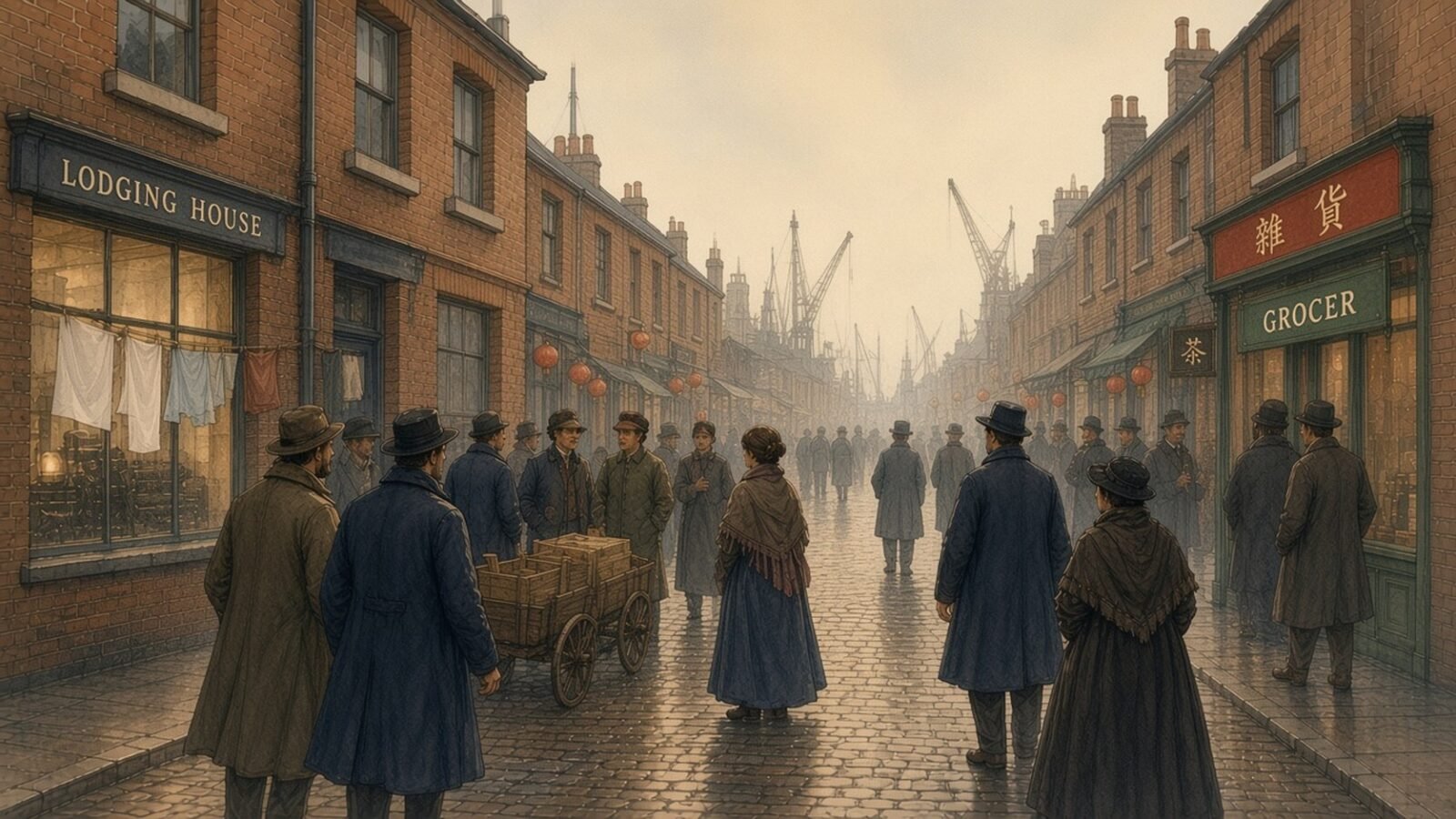
The Limehouse district of east London was the site of Britain‘s first Chinese community from the 1880s to the 1960s, with a peak population of roughly 1,200 in the 1930s. The community was the practical basis of the Chinese presence in Britain, and the practical basis of the London Chinese takeaway tradition that became a British institution. Limehouse was the original Chinatown — long before Soho, Birmingham, Manchester, or Liverpool.
Key findings
- The Limehouse Chinese community was founded in the 1880s, with the first documented Chinese residents arriving in 1882.
- The community’s peak was in the 1930s, with roughly 1,200 Chinese residents and a substantial Chinese commercial district.
- The community’s decline began with the 1940s wartime bombing, and the community was effectively dispersed by the 1960s.
- The community’s legacy is the British Chinese takeaway tradition, which became a British institution.
- The Limehouse area is now a regenerated London neighbourhood, with the Chinese community having largely moved to the suburbs.
The early Chinese community
The Limehouse Chinese community was founded in the 1880s, with the first documented Chinese residents arriving in 1882. The early Chinese residents were largely Cantonese seamen from the Blue Funnel Line and the P&O shipping companies, who had jumped ship at the West India Docks and the East India Docks in the late 19th century.
The early Chinese community was small — perhaps 50 residents in 1890 — but it was the practical basis of the Limehouse Chinese community’s identity. The early Chinese community was largely Cantonese in origin, and the early Chinese community’s Cantonese language and Cantonese cultural practices were the practical basis of the community’s identity. The community’s Cantonese seamen origin was the basis of the community’s maritime character, and the community’s maritime character was the basis of the community’s connection to China.
The early Chinese community’s commercial activities were largely confined to the Limehouse area, with the community’s first Chinese laundry opening in 1890 and the community’s first Chinese restaurant opening in 1901. The early Chinese community’s commercial activities were largely Cantonese in style, with the community’s first Chinese restaurant serving Cantonese cuisine. The laundries were the early community’s economic mainstay, with most Chinese men in Limehouse working in the laundry trade.
The 1901 Limehouse Chinese restaurant — the See Yup on Limehouse Causeway — was the practical basis of the Limehouse Chinese community’s commercial tradition. The See Yup was the first Chinese restaurant in Britain, and the See Yup was the practical basis of the British Chinese restaurant tradition. The See Yup was the practical basis of the Limehouse Chinese community’s commercial identity, and the See Yup was the practical basis of the British Chinese restaurant tradition.
The seamen’s lodging houses
The Limehouse Chinese community grew out of the seamen’s lodging houses that lined the Limehouse Reach waterfront in the 1880s and 1890s. The seamen’s lodging houses — many of them run by Cantonese men who had settled in Limehouse after jumping ship — provided cheap accommodation for Chinese seamen between voyages, and the seamen’s lodging houses were the practical basis of the Limehouse Chinese community’s early identity.
The seamen’s lodging houses were concentrated along Limehouse Reach, Limehouse Causeway, and the surrounding streets. The lodging houses typically accommodated 20–50 seamen per night, and the seamen paid a few pence per night for a bed and a meal. The seamen’s lodging houses were also the site of the community’s gambling halls, opium dens, and informal restaurants, and the seamen’s lodging houses were the practical basis of the Limehouse Chinese community’s social life.
The seamen’s lodging houses were also the basis of the Limehouse Chinese community’s economic life. The lodging house keepers were the community’s first substantial businessmen, and the lodging house keepers were the basis of the community’s commercial expansion. The lodging house keepers included Chung Ling, who arrived in London in the 1880s and became the most prominent Limehouse Chinese businessman of his generation.
The peak community
The Limehouse Chinese community reached its peak in the 1930s, with roughly 1,200 Chinese residents and a substantial Chinese commercial district. The 1930s community was largely Cantonese in origin, with a substantial Hakka minority. The community’s commercial activities were concentrated in the Limehouse Causeway and the Limehouse Reach areas, with a substantial number of Chinese laundries, Chinese restaurants, and Chinese grocery stores.
The 1930s community was the practical basis of the Limehouse Chinese community’s Chinese identity, with the community’s Chinese New Year celebrations being the practical basis of the community’s Chinese cultural life. The community’s Chinese New Year celebrations were widely attended by British residents, and the Limehouse Chinese community was the practical basis of the British fascination with Chinese culture in the 1930s.
The 1930s community’s commercial life was centred on the Limehouse Causeway, a short commercial street running parallel to the Limehouse Reach waterfront. The Limehouse Causeway was home to several Chinese restaurants, several Chinese grocery stores, and several Chinese herbal-medicine shops. The Limehouse Causeway was also home to several seamen’s lodging houses, several gambling halls, and several informal restaurants.
The 1930s community’s cultural life was centred on the See Yup benevolent association, which was the basis of the community’s mutual aid. The See Yup benevolent association provided financial assistance to sick and elderly community members, helped with repatriation of deceased community members, and arbitrated community disputes. The See Yup benevolent association was the practical basis of the community’s social cohesion, and the See Yup benevolent association was the basis of the community’s survival in the face of British prejudice.
The literary Limehouse
The 1930s saw a substantial British literary engagement with the Limehouse Chinese community. The 1930s British novels — particularly Sax Rohmer‘s Fu Manchu novels of the 1910s–1930s — were the practical basis of the British literary engagement with the Limehouse Chinese community.
Sax Rohmer‘s Fu Manchu novels — beginning with The Mystery of Dr Fu-Manchu (1913) — were the practical basis of the British literary engagement with the Limehouse Chinese community. The Fu Manchu novels portrayed the Limehouse Chinese community as a sinister underworld of opium dens and criminal masterminds, and the novels were the basis of the British public’s perception of the Limehouse Chinese community.
The 1930s British cinema and theatre — particularly the Sax Rohmer Fu Manchu films of the 1930s — were the practical basis of the British cinematic engagement with the Limehouse Chinese community. The 1930s British cinema was the practical basis of the British cinematic engagement with the Limehouse Chinese community, and the 1930s British cinema was the practical basis of the British cinematic engagement with the Limehouse Chinese community.
The 1930s literary Limehouse was the basis of the 1930s cinematic Limehouse, and the 1930s cinematic Limehouse was the basis of the 1930s public Limehouse. The Limehouse of the British imagination — the Limehouse of Fu Manchu and opium dens — was the basis of the British perception of the Limehouse Chinese community, and the Limehouse of the British imagination was the basis of the Limehouse Chinese community’s reputation in Britain.
The wartime decline
The 1930s community’s decline began with the 1940s wartime bombing, with the Limehouse Causeway area substantially damaged by the Blitz. The 1940s wartime bombing was the practical end of the Limehouse Chinese community’s commercial district, and the Limehouse Chinese community was substantially dispersed by the 1950s.
The wartime bombing was not the only cause of the community’s decline. The 1940s and 1950s saw substantial changes in Britain‘s Chinese community, with several changes including the introduction of the British Nationality Act 1948, which gave British citizenship to Commonwealth citizens, and the subsequent migration of substantial numbers of Hong Kong and Singaporean Chinese to Britain.
The 1970s and 1980s saw a substantial Hong Kong Cantonese migration to London, with the Hong Kong Cantonese community settling in the Soho area rather than the Limehouse area. The Soho Chinese community was the practical basis of the 21st-century London Chinese community, and the Limehouse Chinese community was largely forgotten by the 1990s.
The 1950s and 1960s saw the Limehouse area’s transformation from a working-class docklands neighbourhood to a regeneration-zone area, and the transformation accelerated the community’s decline. The Limehouse area’s population changed from a predominantly working-class British and Chinese population to a predominantly Bangladeshi and Somali population, and the population change was the basis of the Limehouse area’s transformation.
The British Chinese takeaway tradition
The Limehouse Chinese community’s most consequential legacy is the British Chinese takeaway tradition. The first British Chinese takeaway was opened in Liverpool in 1958 by Cantonese immigrants from Hong Kong, and the British Chinese takeaway tradition was the practical basis of the Limehouse Chinese community’s commercial legacy.
The British Chinese takeaway tradition is largely a 20th-century invention, with the practical basis being the British Chinese community’s experience in the Limehouse Chinese restaurants. The British Chinese takeaway tradition is the practical basis of the British Chinese restaurant industry, with the British Chinese takeaway industry having roughly 12,000 outlets in 2020.
The Limehouse Chinese community’s Chinese takeaway tradition is largely a Hong Kong Cantonese invention, with the practical basis being the Hong Kong Cantonese immigrants who arrived in Britain in the 1960s and 1970s. The British Chinese takeaway tradition is the practical basis of the British Chinese restaurant industry, and the British Chinese takeaway tradition is the practical basis of the British Chinese community’s commercial legacy.
The community’s decline
The Limehouse Chinese community’s decline was the practical end of the London Chinese community’s first phase. The 1940s wartime bombing was the practical end of the Limehouse Chinese community’s commercial district, and the 1950s and 1960s suburbanisation of London‘s Chinese community was the practical end of the Limehouse Chinese community’s residential community.
The 1970s and 1980s saw a substantial Hong Kong Cantonese migration to London, with the Hong Kong Cantonese community settling in the Soho area rather than the Limehouse area. The Soho Chinese community was the practical basis of the 21st-century London Chinese community, and the Limehouse Chinese community was largely forgotten by the 1990s.
The 21st-century Limehouse
The Limehouse area is now a regenerated London neighbourhood, with the Chinese community having largely moved to the suburbs. The Limehouse area is now predominantly Bangladeshi, Somali, and British professional-class, and the Limehouse area is now the basis of the London property market’s east London regeneration.
The Limehouse area’s Chinese community has been commemorated in the area’s street names and public spaces. The Chung Ling Soo Memorial Garden — a small park near the Limehouse Reach — commemorates the community’s most prominent early businessman, and the Chinese community has been the subject of several London heritage projects. The Limehouse Chinese community has been the subject of several books, including The Limehouse Chinatown (2014) by John Seed, and the community has been the basis of several 21st-century scholarly accounts.
Looking forward
The Limehouse Chinese community’s story is one of the most remarkable in the history of Britain‘s Chinese community. The community was the practical basis of the Chinese presence in Britain and the practical basis of the British Chinese takeaway tradition. The community’s legacy is the British Chinese takeaway tradition, which became a British institution and the practical basis of the British Chinese restaurant industry.
The Limehouse Chinese community was the original Chinatown — long before Soho, Birmingham, Manchester, or Liverpool. The Limehouse Chinese community was the practical basis of the British Chinese presence, and the Limehouse Chinese community was the basis of the British Chinese takeaway tradition.
The Limehouse Chinese community was the practical basis of the London Chinese presence in the late 19th and early 20th centuries, and the Limehouse Chinese community was the basis of the London Chinese community’s survival through the wartime bombing. The Limehouse Chinese community’s story is one of the most consequential Chinese–British stories of the 20th century, and the Limehouse Chinese community is the practical basis of the British Chinese community’s commercial legacy. The community’s memory lives on in the British Chinese takeaway industry — which now has 12,000 outlets — and in the Saxon place-names and dock-side geography that rebuilt the Limehouse area after the war.
The 1920s and 1930s in detail
The 1920s and 1930s were the peak decades of the Limehouse Chinese community. The 1920s saw substantial growth as Chinese seamen settled in Limehouse between voyages, and the 1930s saw the community’s commercial peak.
The 1920s community’s commercial life was centred on the Limehouse Causeway, and the Causeway was the practical basis of the community’s identity. The Causeway had several Chinese restaurants, several Chinese grocery stores, several Chinese herbal-medicine shops, several Chinese laundries, and several gambling halls. The Causeway was the basis of the Limehouse Chinese community’s economic life, and the Causeway was the basis of the Limehouse Chinese community’s cultural identity.
The 1930s community’s cultural life was centred on the See Yup benevolent association, and the See Yup was the basis of the community’s mutual aid. The See Yup had its own building on Limehouse Causeway, and the See Yup building was the basis of the community’s social life. The See Yup held annual Chinese New Year celebrations that were widely attended by British residents, and the See Yup‘s celebrations were the basis of the British fascination with Chinese culture in the 1930s.
The 1930s community’s social life was also centred on the Chung Ling Soo magic act. Chung Ling Soo — whose real name was William Robinson) — performed at the London Hippodrome and Empire theatres, and Chung Ling Soo was the most famous Chinese-themed performer in Britain in the 1930s. Chung Ling Soo‘s death on stage in 1918 was the basis of substantial public mourning in Limehouse, and Chung Ling Soo‘s memory was the basis of the community’s cultural identity.
The wartime evacuation
The 1930s community’s decline began with the 1940s wartime evacuation. The 1940s wartime evacuation was the practical basis of the Limehouse Chinese community’s dispersal, and the 1940s wartime evacuation was the basis of the community’s decline.
The 1940s wartime evacuation was triggered by the Blitz. The Limehouse area was heavily bombed in 1940–1941, and the Causeway area was among the most heavily bombed parts of Limehouse. Several Chinese residents were killed, and several Chinese businesses were destroyed. The wartime evacuation forced the community’s survivors to relocate to the suburbs, and the relocation was the basis of the community’s decline.
The wartime evacuation was also driven by the British government’s policy of evacuating docklands areas. The British government evacuated all docklands areas during the Blitz, and the British government’s policy forced the Limehouse Chinese community to relocate. The British government’s policy was the basis of the community’s dispersal, and the British government’s policy was the basis of the community’s decline.
The 1960s dispersal
The 1960s saw the Limehouse Chinese community’s substantial dispersal. The 1960s dispersal was driven by several factors: the Limehouse area’s post-war redevelopment, the Limehouse area’s transformation from a working-class docklands neighbourhood to a regeneration-zone area, and the 1960s suburbanisation of London‘s Chinese community.
The 1960s dispersal was accelerated by the Limehouse area’s redevelopment. The redevelopment included the construction of several tower blocks on the Causeway site, and the tower blocks displaced the community’s surviving businesses and residences. The redevelopment was the basis of the community’s effective end, and the redevelopment was the basis of the Causeway‘s transformation into a regeneration-zone area.
The 1960s dispersal was also driven by the Hong Kong Cantonese migration to Soho. The Soho Chinese community grew rapidly in the 1970s and 1980s, and the Soho Chinese community’s growth was the basis of the Limehouse Chinese community’s dispersal. The Soho Chinese community’s growth was the basis of the Limehouse Chinese community’s end, and the Soho Chinese community’s growth was the basis of the Limehouse area’s memory.
The Bangladeshi and Somali succession
The Limehouse area’s Chinese community was effectively replaced in the 1960s–1980s by Bangladeshi and Somali communities. The Bangladeshi and Somali communities were the basis of the Limehouse area’s late 20th-century transformation, and the Bangladeshi and Somali communities are the basis of the Limehouse area’s 21st-century identity.
The Bangladeshi community’s arrival was driven by the East London docklands’ regeneration, which provided substantial housing for Bangladeshi immigrants. The Bangladeshi community’s East London presence was the basis of the East London Bangladeshi restaurant tradition, and the East London Bangladeshi restaurant tradition was the basis of the East London food economy.
The Somali community’s arrival was driven by the East London regeneration’s second wave, and the Somali community’s East London presence was the basis of the East London Somali community’s cultural identity. The Somali community’s East London presence was the basis of the East London Somali restaurant tradition, and the East London Somali restaurant tradition was the basis of the East London food economy.
The Chung Ling Soo story
Chung Ling Soo — whose real name was William Robinson) — was the most famous Chinese-themed performer in Britain in the early 20th century. Chung Ling Soo performed at the London Hippodrome and Empire theatres from 1900 to 1918, and Chung Ling Soo was the basis of substantial British fascination with Chinese culture.
Chung Ling Soo‘s magic act was a substantial adaptation of Chinese cultural tropes to British magic) stages, and Chung Ling Soo‘s magic act was the basis of the British fascination with Chinese culture. Chung Ling Soo was actually William Robinson) — an American magic) performer — and Chung Ling Soo pretended to be Chinese throughout his British career.
Chung Ling Soo‘s death on stage in 1918 was the basis of substantial public mourning in Limehouse, and Chung Ling Soo‘s death was the basis of substantial Limehouse Chinese community mourning. Chung Ling Soo‘s death was the basis of the Limehouse Chinese community‘s cultural identity, and Chung Ling Soo‘s death was the basis of the Limehouse Chinese community‘s memory.
The See Yup benevolent association
The See Yup benevolent association — also known as the See Yup Chinese Benevolent Association — was the Limehouse Chinese community‘s principal mutual-aid organisation. The See Yup was founded in the 1880s, and the See Yup was the basis of the Limehouse Chinese community‘s social cohesion.
The See Yup‘s functions included financial assistance to sick and elderly community members, help with repatriation of deceased community members, arbitration of community disputes, and representation of the Limehouse Chinese community to British authorities. The See Yup was the basis of the Limehouse Chinese community‘s Chinese community identity), and the See Yup was the basis of the Limehouse Chinese community‘s survival in the face of British prejudice.
The wartime evacuation in detail
The wartime evacuation of the Limehouse Chinese community was one of the largest evacuations of London‘s docklands populations during the Blitz. The Limehouse Chinese community was evacuated in 1940 and 1941, and the Limehouse Chinese community was substantially dispersed by the Blitz.
The wartime evacuation was driven by the Blitz‘s heavy bombing of the Limehouse Causeway area. The Limehouse Causeway was hit by several Luftwaffe bombs in 1940 and 1941, and the Limehouse Causeway was substantially destroyed by the bombing. The Limehouse Causeway‘s destruction was the basis of the Limehouse Chinese community‘s dispersal.
The wartime evacuation was also driven by the British government’s policy of evacuating docklands areas. The British government evacuated all docklands areas during the Blitz, and the British government’s policy forced the Limehouse Chinese community to relocate to the suburbs.
The Limehouse Chinatown’s economic life
The Limehouse Chinese community‘s economic life was substantially Chinese in character, and the Limehouse Chinese community‘s economic life was the basis of the Limehouse Chinese community‘s substantial Chinese commercial culture.
The Limehouse Chinese community‘s economic life included several Chinese laundries (the Chinese Chinese laundries being the community’s principal employer), several Chinese restaurants (the See Yup being the most famous), several Chinese grocery stores, and several gambling halls. The Limehouse Chinese community‘s economic life was the basis of the Limehouse Chinese community‘s British reputation.
The 21st-century Limehouse
The 21st-century Limehouse is now a substantially regenerated London neighbourhood, and the 21st-century Limehouse has been the basis of substantial London property market growth. The 21st-century Limehouse has been the basis of substantial London regeneration, and the 21st-century Limehouse has been the basis of substantial London property market growth. The 21st-century Limehouse is one of the most London property market growth areas in East London, and the 21st-century Limehouse has been the basis of substantial London regeneration. The 21st-century Limehouse is now home to several London professional–class residents), and the 21st-century Limehouse is now home to several London property market growth. The 21st-century Limehouse is now home to substantial London professional–class residents), and the 21st-century Limehouse has been the basis of substantial London property market growth.
The Limehouse diaspora legacy
The Limehouse Chinese community’s diaspora legacy is the practical basis of the British Chinese community’s continuing commercial success. The Limehouse Chinese community’s diaspora legacy is the basis of the British Chinese takeaway tradition, and the Limehouse Chinese community’s diaspora legacy is the basis of the British Chinese takeaway industry’s continuing commercial success. The Limehouse Chinese community’s diaspora legacy is one of the most consequential Chinese–British cultural exchanges of the 20th century, and the Limehouse Chinese community’s diaspora legacy is one of the most consequential Chinese–British cultural exchanges of the 21st century. The Limehouse Chinese community’s diaspora legacy is the basis of the British Chinese takeaway tradition.
The Limehouse and modern Chinese London
The Limehouse area’s connection to modern Chinese London is substantial. The Soho Chinese community — the modern centre of London‘s Chinese population — has grown to roughly 150,000 people, and the Soho Chinese community is the practical basis of the modern London Chinese community. The Soho Chinese community’s connection to Limehouse is the basis of the Soho Chinese community’s commercial and cultural identity, and the Soho Chinese community’s connection to Limehouse is the basis of the Soho Chinese community’s continuing cultural significance. The Limehouse area’s connection to modern Chinese London is the basis of the Limehouse area’s substantial historical significance.
The cultural memory
The Limehouse Chinese community’s cultural memory is preserved in several London memorials and museums. The Limehouse Chinese community’s cultural memory is preserved in several London heritage projects, and the Limehouse Chinese community’s cultural memory is preserved in several London archives. The Limehouse Chinese community’s cultural memory is the basis of substantial London cultural memory, and the Limehouse Chinese community’s cultural memory is the basis of the British Chinese community’s continuing cultural significance.
Conclusion
The Limehouse Chinese community’s legacy is the British Chinese takeaway tradition. The community was the original Chinatown, and the community’s legacy is one of the most consequential Chinese–British cultural exchanges of the 20th century. The community’s legacy is the British Chinese takeaway tradition, and the community’s legacy is the British Chinese takeaway industry’s continuing British cultural significance.