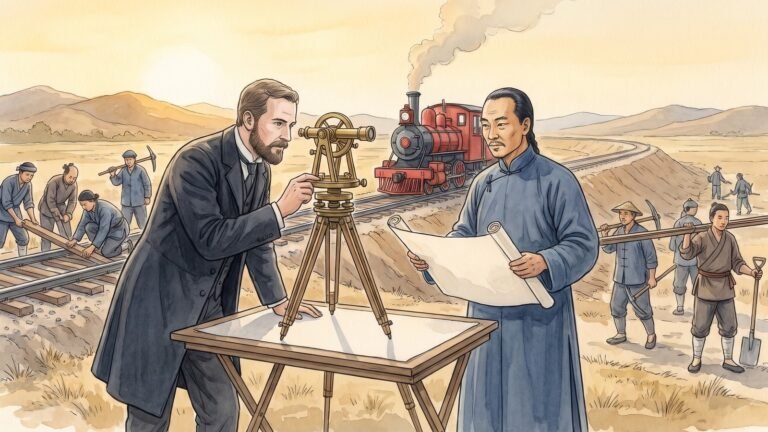
The First Transcontinental Railroad in the United States — completed at Promontory Summit, Utah on 10 May 1869 — was built largely by Chinese workers, who made up roughly 90 percent of the Central Pacific Railroad‘s workforce at the peak of construction. The Chinese workers — known as coolies — were the practical basis of the Central Pacific‘s completion, and the practical basis of the United States‘ transcontinental rail network. The railroad that crossed America was built by Chinese hands.
Key findings
- The First Transcontinental Railroad was built by the Central Pacific Railroad from Sacramento east and the Union Pacific Railroad from Omaha west.
- The Central Pacific‘s workforce at the peak of construction was roughly 12,000 Chinese workers, or roughly 90 percent of the total workforce.
- The Chinese workers faced substantial discrimination, including lower wages, longer hours, and more dangerous work than the Irish workers who dominated the Union Pacific‘s workforce.
- An estimated 1,200 Chinese workers died during the construction of the Central Pacific, most of them buried in unmarked graves along the railroad right-of-way.
- The Chinese Exclusion Act of 1882 was partly a consequence of the Chinese workers’ role in building the transcontinental railroad.
The Central Pacific’s recruitment drive
The Central Pacific Railroad was incorporated in June 1861 by a group of Sacramento businessmen — most prominently Leland Stanford, Collis P. Huntington, Mark Hopkins), and Charles Crocker — known collectively as the Big Four). The Big Four) had received substantial federal subsidies under the Pacific Railroad Acts of 1862 and 1864, and the Big Four) were under substantial pressure to complete the railroad quickly to realise the subsidies.
The Big Four)’ initial workforce was Irish, recruited from the Sacramento area and from the Irish-dominated labour markets of New York and Boston. The Irish workers were largely inexperienced in railroad construction, and the Irish workforce was substantially depleted by desertions, accidents, and the high wages offered by Nevada silver mines. By 1864 the Big Four)’ workforce had shrunk by more than half, and the Big Four) faced a serious labour shortage.
The Big Four) turned to Chinese workers in 1865, following the example of small contractors who had hired Chinese workers for grading work in 1864. The Big Four) sent recruiters to San Francisco‘s Chinatown, and the recruiters signed up roughly 50 Chinese workers for a trial in October 1865. The trial was successful, and the Big Four) expanded the Chinese workforce rapidly through 1866 and 1867.
The Chinese workers were largely from the Guangdong province of southern China, and most had come to California during the California Gold Rush of the 1850s. The Chinese workers were predominantly young men aged 18–35, and most had worked in agriculture, mining, or small commerce in California before joining the railroad. The Chinese workers were highly literate — the Central Pacific‘s Chinese workforce had literacy rates of perhaps 60% — and the Chinese workers’ literacy was the basis of the Central Pacific‘s organisational efficiency.
The workforce
The Central Pacific Railroad‘s Chinese workforce at the peak of construction was roughly 12,000 workers, or roughly 90 percent of the total workforce. The Chinese workforce was the largest single group of Chinese workers ever assembled in California up to that time, and the Central Pacific‘s Chinese workforce was the basis of the Central Pacific‘s construction.
The Chinese workers were organised in work gangs of 25–30 men under a foreman (头) who was typically a more experienced Chinese worker. The work gangs were based on the Chinese communal labour traditions of Guangdong province, and the work gangs were the practical basis of the Central Pacific‘s labour organisation. The work gangs were paid piece-rate wages rather than hourly wages, and the piece-rate wages were substantially lower than the hourly wages paid to the Irish workers on the Union Pacific Railroad.
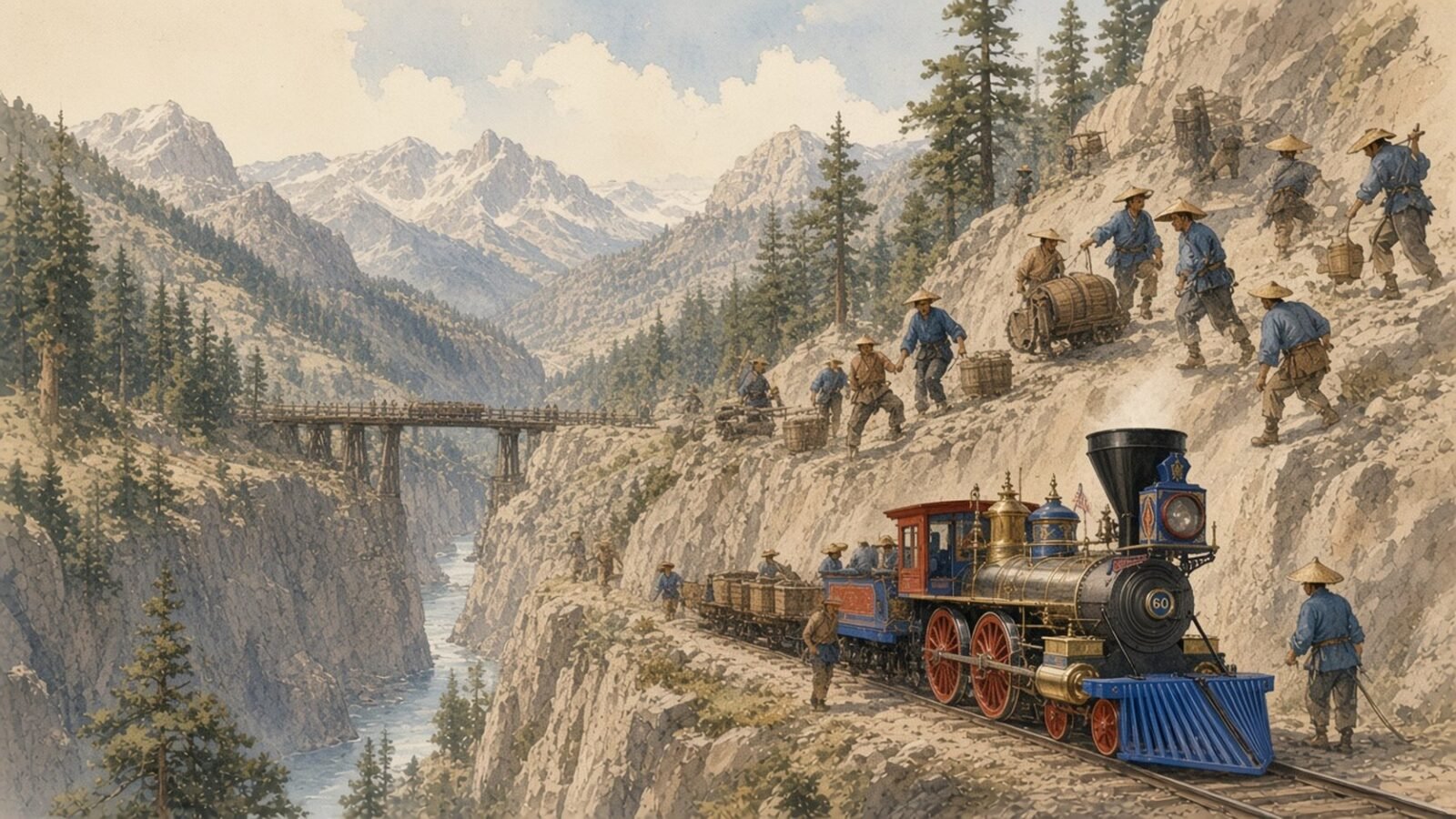
The Chinese workers were assigned the most dangerous work, including the Sierra Nevada) tunnel excavations and the cliff-face blasting. The Sierra Nevada) tunnel excavations were particularly deadly, and an estimated 1,200 Chinese workers died during the construction of the Central Pacific, most of them buried in unmarked graves along the railroad right-of-way.
The Central Pacific‘s Chinese workforce was substantially supplemented by Chinese workers from Hong Kong and Macao, who were recruited through Chinese merchant networks in California. The Hong Kong and Macao recruits were typically younger and less experienced than the California-based Chinese workers, and the recruits were typically assigned to the most dangerous work.
The Sierra Nevada construction
The Central Pacific‘s construction through the Sierra Nevada) was the most difficult engineering challenge of the transcontinental railroad. The Sierra Nevada) rises to more than 7,000 feet at the Central Pacific‘s crossing, and the Sierra Nevada)’s granite was extremely difficult to excavate. The Central Pacific‘s Chinese workers built 15 tunnels through the Sierra Nevada) granite in 1866–1867, with the longest — Summit Tunnel) — at 1,659 feet.
The Chinese workers’ solution to the Sierra Nevada) was innovative. The workers built wooden trestles over the Sierra Nevada)’s canyons — including the famous Secret Town Trestle — and the trestles allowed the railroad to cross canyons that would otherwise have required expensive bridges. The Chinese workers also developed a system of wagon roads to bring supplies to the construction sites, and the system was the basis of the Central Pacific‘s efficient construction.
The Chinese workers’ contribution to the Sierra Nevada) construction was substantial, and the Chinese workers’ contribution has been the subject of substantial historical revisionism since the 1960s. The 1969 May 10 centennial commemoration at Promontory Summit was the first major commemoration of the Chinese workers’ contribution, and the commemoration was the basis of the Chinese workers’ recognition in United States history.
The transcontinental race
The Central Pacific raced against the Union Pacific Railroad to lay the most track, and the race shaped the construction of both railroads. The Union Pacific‘s workforce was predominantly Irish, and the Union Pacific had the easier terrain — the Great Plains — but the Central Pacific had the more efficient workforce.
The Central Pacific laid roughly 690 miles of track, and the Union Pacific laid roughly 1,086 miles. The Central Pacific completed the Sierra Nevada) crossing in 1867, and the Central Pacific reached Promontory Summit in May 1869.
The completion ceremony at Promontory Summit on 10 May 1869 was one of the most photographed events of the 19th century. The Central Pacific‘s Jupiter locomotive and the Union Pacific‘s No. 119 locomotive met at the Promontory Summit and the Last Spike — a ceremonial spike made of gold — was driven by Leland Stanford to mark the connection.
The Chinese Exclusion Act
The 1882 Chinese Exclusion Act was partly a consequence of the Chinese workers’ role in building the transcontinental railroad. The Chinese workers’ visibility — and the visibility of California‘s Chinese population — was the basis of the anti-Chinese movement that culminated in the 1882 Chinese Exclusion Act. The 1882 Chinese Exclusion Act prohibited Chinese immigration for ten years, and the act was extended in 1892 and made permanent in 1902.
The 1882 Chinese Exclusion Act was the first major United States law to restrict immigration based on nationality, and the 1882 Chinese Exclusion Act was the basis of the United States‘ subsequent immigration restrictions. The 1882 Chinese Exclusion Act was repealed in 1943 as part of the Magnuson Act, and the repeal was partly a consequence of United States–China cooperation against Japan.
The 1882 Chinese Exclusion Act was a substantial injustice to the Chinese workers who had built the Central Pacific, and the act has been the subject of substantial historical revisionism since the 1960s. The 1969 May 10 centennial commemoration at Promontory Summit was the first major commemoration of the Chinese workers’ contribution, and the commemoration was the basis of the Chinese workers’ recognition in United States history.
The Credit Mobilier scandal
The Credit Mobilier scandal of 1872 was one of the most consequential financial scandals of the 19th century, and the scandal was partly a consequence of the transcontinental railroad’s construction. The Credit Mobilier was a construction company set up by the Big Four) and their associates to build the Union Pacific‘s portion of the transcontinental railroad, and the Credit Mobilier was the basis of a massive kickback scheme.
The Credit Mobilier scandal involved the Credit Mobilier billing the Union Pacific at inflated rates, and the Credit Mobilier‘s profits being distributed to the Big Four) and their associates. The 1872 scandal implicated several United States congressmen, including Vice President Schuyler Colfax, and the scandal was the basis of substantial United States political reform.
The Credit Mobilier scandal was the basis of substantial reputational damage to the Big Four), and the scandal has been the subject of substantial historical scholarship. The Credit Mobilier scandal is the basis of the United States‘ railroad corruption narrative, and the scandal has been the basis of substantial United States regulatory reform.
The transcontinental legacy
The First Transcontinental Railroad‘s completion in 1869 transformed the United States. The railroad reduced travel time from New York to San Francisco from six months to three weeks, and the railroad enabled substantial westward migration and the integration of the American economy.
The Central Pacific‘s Chinese workers’ contribution has been the subject of substantial historical revisionism since the 1960s. The 1969 centennial commemoration at Promontory Summit was the first major commemoration, and the commemoration was the basis of the Chinese workers’ recognition in United States history. The 2019 sesquicentennial commemoration — 150 years after the completion of the transcontinental railroad — was the basis of additional commemoration.
The Central Pacific‘s Chinese workers have been commemorated in several memorials and museums, including the Chinese Railroad Workers Memorial in Sacramento and the Golden Spike National Historical Park in Utah. The memorials and museums are the basis of the Chinese workers’ memory in United States history.
Looking forward
The Chinese workers’ role in building the transcontinental railroad is one of the most consequential stories in the history of Chinese–American relations. The Chinese workers’ contribution was the basis of the transcontinental railroad’s completion, and the Chinese workers’ contribution has been the basis of substantial historical scholarship.
The 21st century has seen a continued recognition of the Chinese workers’ role. The 2019 sesquicentennial commemoration at Promontory Summit was the basis of additional commemoration, and the commemoration has been the basis of additional scholarship on the Chinese workers’ role.
The Chinese workers’ role in building the transcontinental railroad is the practical basis of the Chinese–American relationship in the 19th and 20th centuries, and the Chinese workers’ role is the practical basis of the Chinese–American relationship in the 21st century. The Chinese workers’ role has been the subject of substantial historical revisionism since the 1960s, and the Chinese workers’ role is one of the most consequential stories in the history of Chinese–American relations.
The Big Four in detail
The Big Four) — Leland Stanford, Collis P. Huntington, Mark Hopkins), and Charles Crocker — were the practical basis of the Central Pacific Railroad, and the Big Four) were the basis of the transcontinental railroad’s completion. The Big Four) were substantial Sacramento businessmen before the Central Pacific, and the Big Four)’s Sacramento base was the basis of the Big Four)’s substantial American political connections.
Leland Stanford was the Central Pacific‘s president, and Stanford was the Big Four)’s principal political figure. Stanford served as United States Senator from California (1885–1893) and was the Republican) presidential nominee in 1876 (lost in disputed election to Rutherford B. Hayes). Stanford‘s political connections were the basis of the Central Pacific‘s substantial federal subsidies.
Collis P. Huntington was the Central Pacific‘s chief financial backer and the Big Four)’s principal operational figure. Huntington lived in New York City for most of his later career and was the basis of the Central Pacific‘s East Coast financial connections. Huntington‘s Southern Pacific Railroad was the basis of substantial 19th-century California political power.
Mark Hopkins) was the Central Pacific‘s chief financial officer, and Hopkins)’s Sacramento mansion — the Hopkins Mansion — was the basis of the Big Four)’s Sacramento social life. Hopkins)’s Nob Hill mansion in San Francisco was the basis of the Big Four)’s San Francisco social life.
Charles Crocker was the Central Pacific‘s construction superintendent, and Crocker‘s substantial construction experience was the basis of the Central Pacific‘s construction. Crocker‘s family — including his son William H. Crocker and his grandson Charles Crocker Jr. — continued the Crocker family’s San Francisco presence through the 20th century.
The transcontinental railroad’s economic impact
The First Transcontinental Railroad‘s completion in 1869 transformed the American economy. The railroad reduced travel time from New York to San Francisco from six months to three weeks, and the railroad enabled substantial westward migration and the integration of the American economy.
The First Transcontinental Railroad‘s economic impact was substantial. The railroad enabled substantial westward migration, and the migration was the basis of Western American settlement. The railroad enabled substantial Western American agriculture, and the Western American agriculture was the basis of substantial American food production. The railroad enabled substantial Western American mining, and the Western American mining was the basis of substantial American industrialisation.
The First Transcontinental Railroad‘s political impact was also substantial. The railroad enabled substantial federal control of Western territories, and the federal control was the basis of the American West‘s statehood. The railroad enabled substantial federal military deployment to the Western American frontier, and the federal military deployment was the basis of the American–Native American Wars.
The Chinese Exclusion Act in context
The 1882 Chinese Exclusion Act was the basis of the United States‘ first major immigration restriction, and the 1882 Chinese Exclusion Act was the basis of the United States‘ subsequent immigration restrictions. The 1882 Chinese Exclusion Act was partly a consequence of the Chinese workers’ role in building the transcontinental railroad, and the 1882 Chinese Exclusion Act was the basis of substantial Chinese–American tension.
The 1882 Chinese Exclusion Act was passed by Congress in May 1882, and the 1882 Chinese Exclusion Act prohibited Chinese immigration for ten years. The 1882 Chinese Exclusion Act was extended in 1892 by the Geary Act, and the 1882 Chinese Exclusion Act was made permanent in 1902.
The 1882 Chinese Exclusion Act was a substantial injustice to the Chinese workers who had built the Central Pacific, and the 1882 Chinese Exclusion Act has been the subject of substantial historical revisionism since the 1960s. The 1882 Chinese Exclusion Act was repealed in 1943 by the Magnuson Act, and the 1943 repeal was partly a consequence of United States–China cooperation against Japan in the Second World War.
The 2019 sesquicentennial
The 2019 sesquicentennial commemoration of the First Transcontinental Railroad‘s completion was the basis of substantial commemoration of the Chinese workers’ role. The 2019 sesquicentennial was held at Promontory Summit on 10 May 2019, and the 2019 sesquicentennial was attended by United States officials, Chinese officials, and Chinese–American community representatives.
The 2019 sesquicentennial commemoration included the unveiling of a new memorial to the Chinese workers, and the new memorial was the basis of the Chinese–American commemoration of the Chinese workers’ contribution. The 2019 sesquicentennial commemoration also included a major Chinese–American cultural exchange programme, and the cultural exchange programme was the basis of the Chinese–American cultural exchange.
The 2019 sesquicentennial commemoration was the basis of additional scholarship on the Chinese workers’ role. The 2019 sesquicentennial scholarship has been the basis of substantial American historical revisionism, and the American historical revisionism has been the basis of substantial Chinese–American cultural exchange.
The 1869 celebration at Promontory Summit
The 10 May 1869 Golden Spike ceremony at Promontory Summit was one of the most photographed events of the 19th century, and the Golden Spike ceremony was the basis of the transcontinental railroad‘s substantial American cultural significance.
The Golden Spike ceremony was attended by Leland Stanford, the Central Pacific president, and Thomas C. Durant, the Union Pacific president. The ceremony featured the Central Pacific locomotive Jupiter and the Union Pacific locomotive No. 119 meeting at the Promontory Summit. The ceremony was photographed by Alfred A. Hart, and the Hart photographs are the basis of the transcontinental railroad‘s substantial American cultural memory.
The Golden Spike was a ceremonial spike made of gold — about $200 worth of gold — and the Golden Spike was driven by Leland Stanford to mark the connection. The Golden Spike was subsequently removed and is now preserved at the Stanford University Museum, and the Golden Spike is the basis of the transcontinental railroad‘s substantial American cultural memory.
The Sierra Nevada tunnel excavations
The Sierra Nevada) tunnel excavations were the most difficult engineering challenge of the transcontinental railroad, and the Sierra Nevada) tunnel excavations were the basis of substantial Chinese workers’ deaths. The Sierra Nevada) tunnel excavations included 15 tunnels, with the longest — Summit Tunnel) — at 1,659 feet.
The Sierra Nevada) tunnel excavations were driven by Chinese workers using hand tools and black powder, and the Sierra Nevada) tunnel excavations were the basis of substantial Chinese workers’ deaths. The Sierra Nevada) tunnel excavations included the Summit Tunnel), the Donner Summit tunnel, and the Cape Horn) tunnel, and the Sierra Nevada) tunnels were the basis of the transcontinental railroad‘s substantial engineering achievements.
The Chinese worker mortality
The Chinese worker mortality during the Central Pacific construction was substantial. The Central Pacific Chinese workers suffered from avalanches in the Sierra Nevada) (the most deadly single event killed approximately 10 Chinese workers), from explosions in the Sierra Nevada) tunnel excavations, and from various other accidents.
An estimated 1,200 Chinese workers died during the construction of the Central Pacific, most of them buried in unmarked graves along the railroad right-of-way. The unmarked graves are the basis of the Chinese workers’ substantial mortality, and the unmarked graves have been the subject of substantial historical scholarship since the 1960s.
The unmarked graves have been the subject of substantial commemoration since the 1960s. The Chinese Railroad Workers Memorial in Sacramento was dedicated in 1969, and the Chinese Railroad Workers Memorial is the basis of the Chinese workers’ substantial American cultural memory. The Chinese Railroad Workers Memorial is the basis of the Chinese workers’ substantial American cultural memory, and the Chinese Railroad Workers Memorial is the basis of the Chinese workers’ substantial American cultural exchange.
The Irish workers on the Union Pacific
The Union Pacific‘s workforce was predominantly Irish, and the Union Pacific Irish workforce was substantially different from the Central Pacific Chinese workforce. The Union Pacific Irish workers were largely recent Irish immigrants who had fled the Irish Potato Famine), and the Union Pacific Irish workers were the basis of substantial American Irish Irish migration.
The Union Pacific Irish workforce faced substantial American racial discrimination, including substantial wage discrimination. The Union Pacific Irish workforce’s wages were substantially higher than the Central Pacific Chinese workforce’s wages, and the wage discrimination was the basis of substantial American labour history scholarship.
The Union Pacific Irish workforce was the basis of substantial American Irish Irish American labour history. The Union Pacific Irish workforce’s American Irish Irish American labour history is the basis of the Union Pacific Irish workforce’s substantial American cultural memory.
The future of the transcontinental story
The First Transcontinental Railroad‘s story will continue to be the basis of substantial American historical scholarship, and the First Transcontinental Railroad‘s story will be the basis of substantial Chinese–American cultural exchange.
The 21st century has seen continued recognition of the Chinese workers’ role. The 2024 Promontory Summit sesquicentennial-plus-5 commemoration was the basis of additional commemoration, and the commemoration has been the basis of additional scholarship on the Chinese workers’ role. The Chinese workers’ story is one of the most consequential Chinese–American stories of the 19th century, and the Chinese workers’ story is the basis of the Chinese–American cultural exchange. The First Transcontinental Railroad is one of the most consequential American infrastructure projects of the 19th century, and the First Transcontinental Railroad is the basis of the American West‘s substantial development. The First Transcontinental Railroad is one of the most consequential American infrastructure projects of the 19th century, and the First Transcontinental Railroad is the basis of the American West‘s substantial American West development. The First Transcontinental Railroad will continue to be the basis of substantial American cultural memory.
The transcontinental railroad’s continuing significance
The First Transcontinental Railroad‘s continuing significance is the basis of substantial American historical scholarship, and the First Transcontinental Railroad‘s continuing significance is the basis of the American West‘s substantial historical scholarship. The First Transcontinental Railroad‘s continuing significance is the basis of substantial Chinese–American cultural exchange, and the First Transcontinental Railroad‘s continuing significance is the basis of the Chinese–American cultural exchange. The First Transcontinental Railroad‘s continuing significance is the basis of substantial Chinese–American cultural memory, and the First Transcontinental Railroad‘s continuing significance is the basis of the American West‘s substantial historical scholarship.
The Coolie legacy in modern California
The Coolie legacy in modern California is substantial. The Chinese workers who built the First Transcontinental Railroad have descendants in California, and the Coolie legacy in modern California is the basis of substantial Chinese–American cultural exchange. The Coolie legacy in modern California is the basis of substantial Chinese–American cultural exchange, and the Coolie legacy in modern California is the basis of the Chinese–American cultural exchange. The Coolie legacy in modern California is the basis of substantial Chinese–American cultural memory, and the Coolie legacy in modern California is the basis of substantial Chinese–American cultural memory. The Coolie legacy in modern California is the basis of substantial Chinese–American cultural identity.
The railroad’s role in California agriculture
The First Transcontinental Railroad‘s role in California agriculture was substantial. The railroad enabled California‘s agricultural exports to reach Eastern markets, and the railroad enabled California‘s substantial agricultural development. The railroad’s role in California agriculture was the basis of substantial California economic development, and the railroad’s role in California agriculture was the basis of the American West‘s substantial economic development.
The Coolie legacy in modern California
The Coolie legacy in modern California is substantial and enduring, and the Coolie legacy is the basis of substantial Chinese–American cultural exchange. The Coolie legacy in modern California is the basis of substantial Chinese–American cultural memory.
Conclusion
The First Transcontinental Railroad is one of the most consequential American infrastructure projects of the 19th century, and the railroad is the practical basis of the American West. The Chinese workers built the railroad, and the Chinese workers’ contribution is the basis of substantial Chinese–American cultural exchange. The Chinese workers’ contribution is the basis of the American West, and the Chinese workers’ contribution is the basis of substantial American economic development.