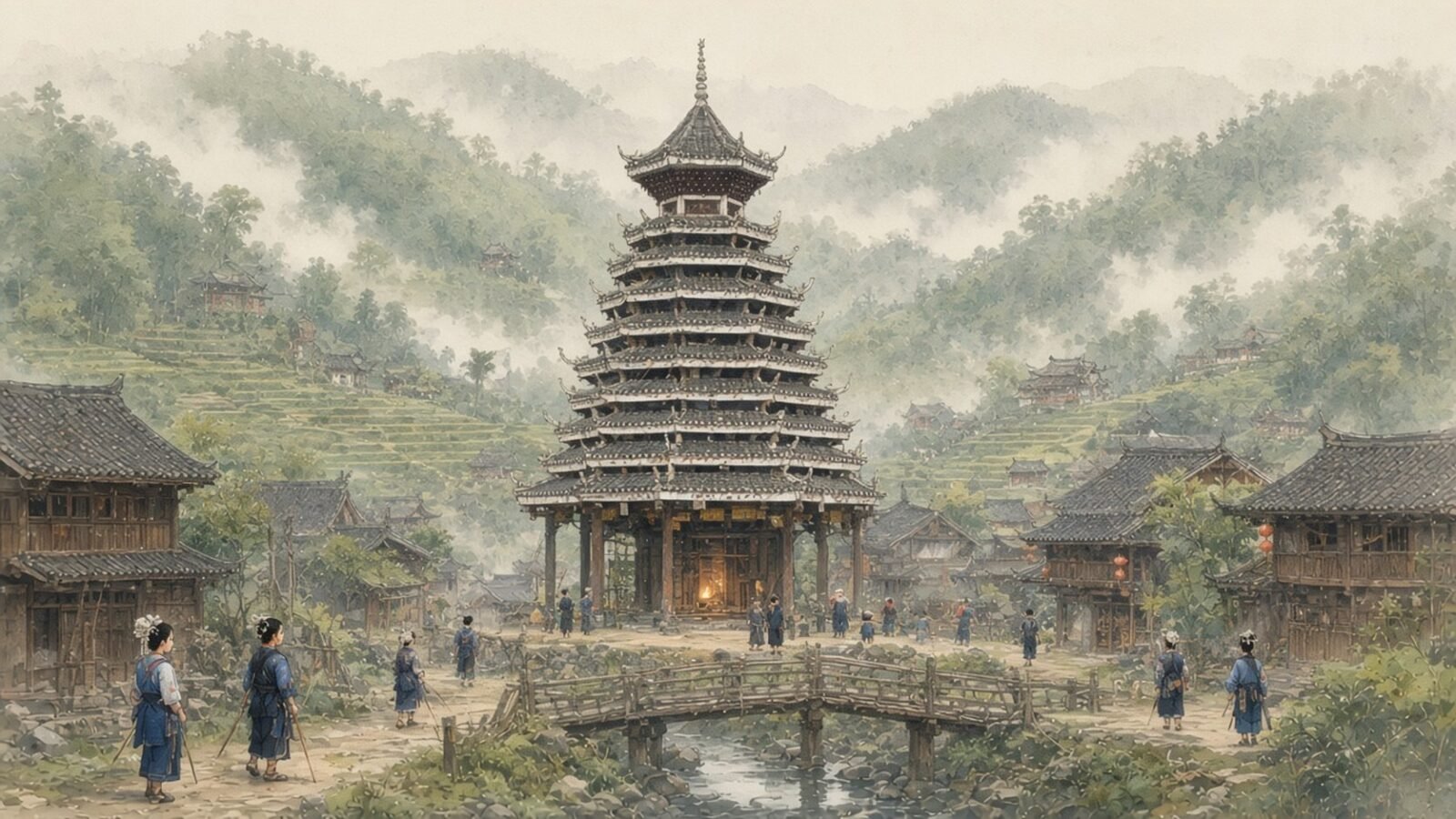
In the rice-terrace foothills around Kaili, in southeast Guizhou, more than four hundred wooden saemh — drum towers — still stand in the villages of the Hmong (also called Miao) communities. The tallest rises twenty-five metres without a nail. The smallest is the size of a single-storey house. Each tower is a piece of carpentry that the village renews every two or three generations, a council chamber, an ancestor shrine, a dance floor, and the physical heart of a Hmong settlement. Outside Guizhou, drum towers have been photographed in Vietnam, Laos, and Thailand, but the densest concentration by far is here.
Key findings
- The Hmong drum tower, saemh in Hmong language, is a wooden communal structure raised without nails, pegged and dowelled, and rebuilt by the village every two or three generations.
- More than four hundred drum towers still stand in the Kaili area of southeast Guizhou, the largest concentration in China.
- The tower is simultaneously a council chamber, an ancestor shrine, and the social centre of the village, and is at the heart of the Miao / Hmong festivals of Lusheng and the Miao New Year.
- Drum tower tourism is now the economic base of the Kaili highland villages, but the towers face an aging-craftsman problem and a generation of young people leaving the rice fields.
What a drum tower is
A drum tower is a tall, multi-tiered wooden building. The exterior is a stack of diminishing polygonal storeys — typically hexagonal, octagonal, or sometimes a nine-sided gong-shape — capped by a pagoda-style roof with upturned eaves. The interior is one open volume rising from a stone foundation through a central sacred pillar (the dux, the “earth heart” of the tower) and out under the rafters. There is no internal staircase. The tower is climbed on pegs driven into the central pillar, which spiral upward like a wooden helix. The drum that gives the building its name sits on a high shelf and is beaten to summon villagers, signal an emergency, mark the start of a festival, or accompany a funeral.
The earliest written record of the drum tower tradition dates to the Song dynasty, when a Song-era administrator in Guizhou described Hmong villagers raising a wooden tower “to hold the spirits of their ancestors and the drums that called their kin.” Older traditions certainly predate this — drum towers are linked to the Hmong origin myth of a sacred pillar descending from the sky — but no surviving physical tower is much older than six hundred years. The 1996 fire that gutted the Xijiang thousand-household drum tower, the most famous in Guizhou, destroyed a structure that had stood for about a hundred years; the rebuilt tower, finished in 1999, was made with the same joinery.
The towers vary in size and elaboration. The smallest are single-storey, perhaps five metres tall, with a single roof and a small drum. The largest, like the Xijiang thousand-household tower, rise to twenty-five metres with eleven tiers, a giant drum, and enough standing room on the ground floor to hold five hundred villagers in a council. Mid-sized towers of seven to fifteen metres with five to seven tiers are the most common.
Hmong history and the Guizhou migrations
The Hmong are one of the older populations of southern China, with a recorded presence in the central highlands of two thousand years. They are not a single ethnic group in the strict sense; the Hmong and Miao classifications used in modern China and Vietnam cover a set of related but distinct sub-groups that share a Hmong-Mien language family but vary in costume, dialect, and custom. The Guizhou highland groups are part of the Chuanqiandian cluster, distinguished by their elaborate silver headdresses, pleated skirts, and — crucially — the persistence of drum tower architecture.
The relationship between Hmong and Miao names is one of the recurring confusions in Chinese ethnography. In the People’s Republic’s classification, the umbrella term Miao covers several language groups; the Hmong proper are a sub-group. In the diaspora, Hmong is the common self-designation, and Miao is rarely used. In Guizhou villages, drum towers are built by the Hmong sub-group and the Miao sub-groups that share the language; the two communities are sometimes visually indistinguishable to outside observers but distinct to themselves.
The drum tower is one of the markers of the Hmong sub-group in Guizhou. The Miao sub-groups to the south and west of Kaili build differently — longhouses on stilts, terraced timber halls — and the drum tower tradition stops roughly at the Guizhou plateau edge.
Construction and architecture
A drum tower is built without metal nails. The carpenters of Kaili — most of them part-time farmers who keep the craft as a hereditary side-line — use mortise-and-tenon joints, wooden pegs, and dowelled cross-bracing. The joinery is precise enough that the building can flex in wind and earthquake without losing its shape, and the load path is carried by the central pillar and the radiating beams of the upper storeys.
The foundation is stone, often a square or octagonal platform of river cobbles set in lime mortar. Above the foundation, the first storey is a hexagonal or octagonal timber frame. Each tier is a smaller polygon set on top of the one below, joined by bracketing beams. The central pillar is a single Chinese fir (or sometimes a pine) trunk, often two feet in diameter and running the full height of the building. The pillar is treated with pig blood and lime, then wrapped with straw and bamboo at intervals to slow rot. When the pillar eventually fails — and the building is judged to need rebuilding — the tower is dismantled, the stone foundation reused, and a new pillar raised. The whole village works on the rebuild, fed by the host clan for the duration.
The roof is the most distinctive element. It is a multi-tiered pagoda-style structure, with the number of tiers proportional to the size of the village. The largest towers have eleven or thirteen tiers, each capped by an upturned eave. The eaves are weighted at the corners with carved wooden ornaments — usually a phoenix), a fish, or a dragon’s head — and the ridge is decorated with a pair of crossed cranes. The whole roof is shingled with cedar or fir shakes, pegged in place and replaced every few decades.
The Kaili drum tower landscape
The Kaili area covers about 13,000 square kilometres of southeast Guizhou, running from the outskirts of the Kaili city proper east into Rongjiang, Congjiang, and Liping counties. In this area, four hundred and seventeen drum towers were counted in a 2018 survey by the Guizhou Provincial Cultural Heritage Bureau, of which two hundred and seventy were still in active ceremonial use.
The most visited is the Xijiang thousand-household Miao village (西江千户苗寨), about twenty kilometres outside Kaili. The village sits in a steep river valley, with about 1,500 wooden houses stacked up both sides of the Baisha River) and a single drum tower at the centre. The tower has been raised four times in its history, most recently in 1999 after the 1996 fire, and its thirteen tiers and twenty-five-metre height make it the visual anchor of the village. The Xijiang tourism programme, established in 2008 and expanded each year since, brings about four million visitors annually, mostly domestic Chinese tourists on three- or four-day trips from Guiyang or Chongqing.
Less visited but more architecturally interesting are the smaller drum towers of the highland villages — Zhaoxing, Basha, Zhanli. Zhaoxing in particular has a famous cluster of five drum towers, one for each of the village’s clans, arranged around a central cobbled square. The Zhaoxing drum towers were damaged in a 2008 fire and rebuilt with technical assistance from the Guizhou cultural heritage bureau, but the rebuild used the original joinery.
Cultural functions
The drum tower is the village council chamber. Decisions about planting, harvest, marriages, village defence, and the timing of festivals are made by the village elders at a meeting in the tower, with the drum beaten to summon the participants. The drum is also beaten to mark a death — a slow, repeated rhythm — and to gather the village for a wedding.
The tower is also an ancestor shrine. The central pillar is the locus of the village’s ancestral spirits, and offerings are made at the base of the pillar during the Miao New Year and the Sisters’ Meal Festival. The pig blood and lime applied to the pillar at construction is a sacrificial offering; the pillar is treated as a living being.
The third function is the dance floor. The Lusheng dance — a reed-pipe instrument accompanied by a long, slow dance — is performed inside the drum tower during festivals, with men at the centre playing the Lusheng and women in pleated skirts circling. The drum tower is the only building large enough to hold the dance, and the only building with enough headroom for the Lusheng pipes to be played at full extension.
Festivals and the Lusheng
The two main drum-tower-centred festivals are the Miao New Year (苗年, Miao Nian) in the tenth lunar month and the Sisters’ Meal Festival in the third lunar month. The Lusheng Festival is a more recent addition — a tourism-facing showcase held in Kaili city and the highland villages in autumn, with reed-pipe competitions and dance contests.
The Miao New Year is the largest. It runs for ten days in the tenth lunar month, and the drumming begins at dawn on the first day with a single beat — the call to the ancestors. Over the following days there are bullfights, reed-pipe dances, silver-headdress parades, and the slow footraces that are a Hmong signature. The festival ends with a feast for the village elders and a procession to the drum tower, where the central pillar is anointed with fresh pig blood and the new year is announced. Domestic tourism to Kaili spikes in October and November as a result, and the highland villages fill with Han Chinese tourists who come to see the silver and the dance.
The Lusheng itself is a bundle of reed pipes inserted into a hardwood wind-chest, with a single mouthpiece and (in the larger ceremonial versions) up to six pipes of graduated length. The instrument is uniquely Hmong, and the dance that accompanies it — slow, deliberate, with couples weaving in a figure-of-eight — is one of the most photographed scenes in Guizhou tourism. The Lusheng Festival held in Kaili every October since 2004 has become the largest such event in China.
Threats and the heritage listing
The drum tower tradition is not unthreatened. The 2018 Guizhou cultural heritage survey flagged three pressures. First, the aging craftsman problem: most of the men who know how to raise a drum tower are over fifty, and few young men are learning the trade. A drum tower raise takes two to three years of full-time work, and the income is seasonal. Second, depopulation: the rice-terrace villages have lost up to a third of their working-age population to Guangdong and Zhejiang factories over the past twenty years. Third, tourism pressure: the towers at Xijiang and Zhaoxing are heavily photographed and climbed, and the wear is starting to show.
In 2006 the State Council of the People’s Republic of China added the Hmong drum tower carpentry to the national intangible cultural heritage list. The listing brought some funding for craftsman training and a small stipend for the village drum tower keepers, but it has not stopped the depopulation. In 2018 the Guizhou cultural heritage bureau began a five-year programme to document every drum tower in the Kaili area, with the goal of producing a digital model that can be used to train new carpenters. The programme is still in progress.
A quieter threat is cultural commodification. The silver headdresses, pleated skirts, and reed-pipe dances that the drum tower festivals have always featured have become the visual shorthand for Guizhou tourism, and several tour operators now stage managed “Miao village experiences” that feature costumed performers rather than actual villagers. The genuine festivals are still held, but the boundary between the ceremony and the show is increasingly blurred.
The diaspora connection
The Hmong of Guizhou are the source of a long diaspora. Drum towers similar in form to the Kaili examples have been documented in the Hmong communities of northern Vietnam, Laos, and Thailand, particularly in the highland villages around Sapa and Luang Prabang. The 1975 Laotian civil war and the subsequent Pathet Lao resettlement programme broke the tradition in Laos; the drum towers that survived the war were abandoned in the 1980s, and the few remaining examples are in poor condition.
The most active drum tower revival outside China is in the United States, where the Hmong refugee community — concentrated in Minnesota, Wisconsin, and California — has built several replicas for cultural centres. The replicas use the same mortise-and-tenon joinery as the Kaili originals, but they are smaller and built with machine-cut timber rather than hand-hewn beams. The Hmong American drum towers are the first generation of the tradition outside Asia, and they have become a touchstone for the diaspora’s relationship with Guizhou.
Basha: the last gun-carrying Miao village
One of the most distinctive drum-tower communities in the Kaili area is the village of Basha, in Congjiang County, about 130 km southeast of Kaili city. Basha is a Miao sub-group known as the Gun Miao or Basha Miao, who have historically been allowed to carry firearms — a privilege granted by the late-Qing imperial authorities in exchange for service as local militia. The tradition continued into the PRC era as a tourist curiosity: Basha men still carry antique muskets and powder horns on ceremonial occasions, and the firing of the guns at festival openings is one of the most photographed scenes in Guizhou tourism.
The Basha drum tower is a single-storey structure, modest by the standards of Xijiang or Zhaoxing, but the village’s other craft traditions — silver headdresses, indigo-dyed cloth, hand-woven brogade textiles — are unequalled in the Kaili area. The village has resisted the high-volume tourism model of Xijiang, with about 200,000 visitors annually against 2020, and the village elders have been vocal in their opposition to the commodification of the gun-carrying tradition. The dispute has reached the Guizhou cultural heritage bureau, which has asked Basha to draw up a tourism management plan that limits visitor numbers and forbids staged gun displays.
Miao embroidery and the textile tradition
The drum tower festivals are also the showcase for the Miao textile tradition, which is among the most elaborate of any ethnic minority in China. Miao women produce embroidered garments, batik-dyed cloth, woven hemp, and pleated skirts in a continuous household craft tradition that has been part of the drum tower festivals for centuries. The most elaborate pieces — festival headdresses, baby carriers, and back panels for women’s jackets — can take a year to complete.
The textiles are also the drum tower’s economic fallback. When the highland villages lose their rice terraces to drought or labour shortage, the textile craft remains as a steady source of income. The Kaili highland villages have several cooperatives that produce Miao textiles for the urban market, including a substantial export trade to Japan, South Korea, and the United States. The export prices are modest, but the volume is significant, and the textile trade is now the largest single source of non-tourism income in the highland villages.
The Kaili economy and the drum tower trade
The drum tower is not just a cultural object — it is the anchor of an economic ecosystem. The Kaili highland villages have built their tourist economy around the towers, and the Xijiang thousand-household village alone employs about 1,800 people in tourism-related jobs, including tour guides, performance troupes, silver craftsmen, indigo dyers, Lusheng makers, and the small restaurants and inns that serve visitors. The 2018 Guizhou cultural heritage survey estimated the annual tourism revenue of the Kaili highland villages at about 1.8 billion yuan, with the Xijiang village accounting for two-thirds of that total.
The drum tower is also the centre of a craft economy that produces replicas for sale. The replicas range from desktop-sized models (a few hundred yuan) to full-scale replicas for export (a hundred thousand yuan or more). The replica trade is dominated by three workshops in Kaili and Congjiang counties, and the workshops are the only places where the joinery techniques of the original drum towers are still taught at scale. The workshops face a recurring problem: most of their young apprentices leave for Guangdong factories within five years, and the average age of the master carpenters is now over sixty.
The drum tower and the Hmong language
The drum tower is the last reliable public space where the Hmong language is heard in everyday use. In Kaili city proper and the larger towns, Mandarin has become the lingua franca of commerce and education, and the Hmong language is increasingly confined to the home and the village square. In the highland villages, the drum tower’s council meetings, festivals, and ceremonies are conducted in Hmong, and the village elders require fluency in the language for any young person aspiring to be a drum tower keeper.
The pressure on the Hmong language is documented in a 2017 linguistic survey by the Chinese Academy of Social Sciences. The survey found that fewer than 30% of Hmong children in the Kaili area could hold a sustained conversation in the language, and that the figure was lower among urbanised Hmong than among rural ones. The drum tower tradition is one of the few countervailing forces: the village elders’ insistence on Hmong-language use in tower ceremonies is a deliberate effort to keep the language alive in public spaces.
Kaili in Chinese cities
The Kaili city proper has about 700,000 people and is the administrative centre of the Qiandongnan Miao and Dong Autonomous Prefecture. The city was a small rail junction until the 2010s, when the Shanghai-Kunming high-speed railway was extended through it, and the city now has a high-speed rail station that puts it within five hours of Guangzhou, four hours of Chengdu, and two hours of Guiyang. The rail link has accelerated the depopulation of the highland villages, but it has also made the Kaili tourism economy more accessible.
The city itself has a small drum tower — a single restored structure in the Kaili museum — and the municipal government has been an enthusiastic promoter of the highland drum tower tourism programme. The 2018 Guizhou cultural heritage bureau’s digitisation programme is headquartered in Kaili, and the bureau’s training programme for new drum tower carpenters is run out of the Kaili campus of Guizhou Normal University. The city sees the drum tower tradition as a marketing asset, and the local tourism slogan — “the homeland of the Miao drum tower” — is painted on the walls of the airport terminal and the high-speed rail station.
The Cultural Revolution damage and revival
The Cultural Revolution (1966–1976) was a difficult period for the drum towers. Many were damaged or dismantled by Red Guard teams who saw them as feudal symbols, and the Lusheng tradition was actively discouraged. The 1972 Pingba earthquake, which destroyed many villages in the Kaili area, finished off several damaged towers, and by 1976 perhaps half of the Kaili drum towers had been lost. The post-1978 reform period brought a partial revival: the Lusheng tradition was restored in most villages, the Miao New Year was officially recognised in 1982, and the first heritage-listing efforts began in the late 1980s.
The 2006 listing of Hmong drum tower carpentry as national intangible cultural heritage was the inflection point. The listing brought modest state funding for craftsman training, established a drum tower keepers’ subsidy of about 600 yuan per month, and put the tradition on the national heritage map. The listing also created new incentives for tourism investment, and the Xijiang tourism programme is the most visible result.
Tsumagi Makoto and the early scholarship
The first Western scholarship on the Kaili drum towers came from Catholic missionaries in the late nineteenth century. The Paris Foreign Missions Society established a mission at Guiyang in 1855 and gradually expanded into the highland villages. The missionaries’ letters — preserved in the Paris archives of the society — describe the drum towers in detail and include some of the earliest photographs. The missionaries’ attitudes were mixed: they admired the carpentry but deplored the ancestor worship, and several of them wrote pamphlets calling for the destruction of the towers as idolatrous. The pamphlets were ignored by Rome and the towers survived.
The first modern ethnographic study was by the Japanese anthropologist Tsumagi Makoto, who spent three years in the Kaili highland villages in 1942–1944 and produced a manuscript on Hmong material culture that was not published until 1975. Tsumagi’s photographs, taken during the Japanese occupation of Guizhou, are the only surviving photographs of several drum towers that have since collapsed.
The drum tower and the highland ecology
The drum tower tradition is, at its core, a response to the Guizhou highland ecology. The terrain — steep, terraced, often above 1,000 metres — is poorly suited to large communal buildings, and the drum tower is the village’s way of building upwards when the ground is too narrow to build outwards. The wooden construction uses local Chinese fir and pine, both of which regenerate quickly on the highland slopes, and the jointed timber frame can flex with the seasonal freeze-thaw cycles that crack masonry buildings. The result is a structure that lasts a century if maintained and that can be rebuilt from local materials when it eventually fails.
The ecological logic of the drum tower is also the logic of the Hmong village. The highland villages are small — twenty to fifty households is typical — and the drum tower’s council hall is large enough to gather the village but not so large as to invite outside influence. The tower is, in effect, a piece of village-scale architecture for a village-scale society, and the persistence of the tower is one of the persistence of that scale. As long as the villages remain, the towers will be raised.