The only woman in Chinese dynastic history who took the throne as emperor in her own right, and held it for fifteen years, was born into a family of timber merchants and entered the imperial palace of Tang as a minor concubine of the second rank in the household of the future Emperor Taizong. Her name at birth was Wu Zhao, and by the time she took the throne in 690 as the founder of the Zhou dynasty, with the temple name Shengsheng and the era name Tianshou, she had been a working member of the imperial palace for nearly six decades and the de facto ruler of the Tang state for almost a quarter of a century. The story of her career is one of the great political biographies of the medieval world, and the question of what she did with her reign is one of the great debates of Chinese historiography. What follows is an account of her rise from the inner palace of Taizong, through the empress consort of Gaozong and the regency of her sons, to the formal founding of a new dynasty, and of the legacy that her reign left in the imperial politics, the religious establishments, and the historical memory of medieval China.
From Minor Concubine to Empress Dowager
Wu Zhao’s life began in the most ordinary circumstances of mid-seventh-century China. She was born in 624, possibly in the eastern capital of Luoyang, into a family of middling status that traced its ancestry to the Wu of the Eastern Han, but which had long since moved down the social scale. Her father had sold timber, and her mother, who came from the Yang family of Sui imperial descent, had received some education in letters. The Sui dynasty collapsed within a decade of her birth, and the empire was reunited under the new Tang house of Li. Both parents are recorded as having received early patronage from the rising Tang general Li Yuan, which is how Wu Zhao, still a girl in the mid-630s, ended up in the household of the future Emperor Taizong. She entered the palace not as a child bride but as a junior concubine, a cairen, in the inner service of the imperial women. The life she entered was, by Tang standards, both luxurious and disposable: a palace woman’s ranking depended on the degree of favour she enjoyed with the emperor, and a young cairen was not expected to become anything more.
What the records suggest is that Wu Zhao was unusually alert to the workings of the palace. She was literate at a level unusual for a concubine of her background, and she made herself useful enough that the elderly Taizong, who died in 649, recorded in his will that she was a woman of consequence. Tang dynasty practice decreed that unmarried or childless palace women were not released on the death of the emperor but sent to Buddhist or Daoist convents for the rest of their lives. Wu Zhao, who did have at least one daughter but no surviving son from her time with Taizong, was one of those sent to a Buddhist convent in Chang’an. The future of her life in the palace would have ended there in 649, had Taizong’s young son Li Zhi, then in his late teens and about to become Emperor Gaozong, not visited the convent and not asked to see a few of the palace women. According to the standard Tang histories, he was captivated by Wu Zhao and persuaded the convent to release her back into palace service. The young Li Zhi had been raised partly in the household of his father’s chief consort, Empress Zhangsun (a woman Wu Zhao would later be accused of having poisoned in 636), and his own wife, Empress Wang, had not yet borne him a son. The arrival of a literate, capable, and politically experienced woman into the household of an inarticulate young emperor was the sort of gift history sometimes sends.
What followed was a long, gradual climb. Wu Zhao was reinstated as a junior consort to Gaozong and bore him four children in the next decade: sons Li Hong and Li Xián, and daughters. By the late 650s, she had the standing to challenge Empress Wang and the favourite consort Xiao Shufei in the politics of the inner palace, and in 655 she engineered the formal deposition of Empress Wang and her own elevation to the position of empress. This was not, by Tang standards, an especially gentle court coup. The new Empress Wu’s methods included the formal humiliation and exile of Empress Wang and Consort Xiao, accusations of sorcery against them that ended in their deaths in prison, and a careful neutralisation of the senior ministers who had opposed her elevation. The Empress Wang trial and execution of 656-657 is the first major political event of Wu Zhao’s documented life as consort, and the pattern she established in those years – the use of accusation, exile, and gradual purge of the senior service aristocracy – would be the pattern of her entire career.
The years 655 to 660 were Wu Zhao’s apprenticeship. The young Emperor Gaozong suffered increasing illness, possibly a stroke, and as the 660s wore on, the chief ministers began to deal directly with Empress Wu on matters that would have been the emperor’s prerogative. The chronicled imperial edicts of the period are increasingly written in a hand that may have been hers. In 666, she and the emperor together officiated at the sacrifices to Heaven and Earth at Mount Tai, a ceremony that was not normally an empress’s prerogative. By the time of Gaozong’s death in 683, the Empress Wu was in practical control of the imperial apparatus and the only person in the central government who had fully functional day-to-day access to the emperor’s body and signature. The decade following 683 would be the most dangerous of her life. She held power first as Empress Dowager for her sons Li Zhong, Li Xián, and Li Xi, then seized the throne for herself in 690.
The Empress Dowager Years, 683 to 690
The first stage of the post-Gaozong succession was the most dangerous. By the Chinese imperial tradition, the late emperor’s eldest surviving son should have mounted the throne immediately on the death of his father. Gaozong’s eldest son Li Hong had predeceased him in 675, and the next eldest, Li Xián, had been created crown prince in 680 only to be deposed in 681 in favour of his younger half-brother Li Xi. Li Xi, who took the throne name Emperor Zhongzong, was the son of Empress Wu and was twenty-eight when his father died in 683. Li Zhongzong had been on the throne less than two months when Wu Zhao declared him unfit, deposed him, and exiled him to Luoyang on the grounds that he had attempted to hand over imperial powers to his father-in-law, Wei Shifu. The Wei family was put to death, Li Zhongzong’s wife (Wu Zhao’s daughter) was deposed, and a younger son of Empress Wu, Li Dan, was elevated to the throne as Emperor Ruizong.
The deposed Li Zhongzong did not in fact intend to do anything so bold. The accusation was almost certainly a pretext. What had really happened was that the consort Wei Shifu had said something to a court official that suggested the young emperor’s intention to share power with his father-in-law. The remark was reported to Wu Zhao through the inner palace intelligence network she had spent the previous fifteen years constructing. Wu Zhao responded with the ruthless efficiency she had by then perfected: the remark became an act of treason, the act became a deposition, and the deposition became the elevation of her younger son. Li Dan, the new Ruizong, was a mild man of Buddhist sympathies who had no ambition to govern. Once on the throne, he was given the nominal dignity of emperor and Wu Zhao took the practical direction of the dynasty under the title Empress Dowager and chief regent.
The Empress Dowager years are striking in retrospect not just for their ruthlessness but for the way they were carefully framed. Wu Zhao did not at first claim to rule in her own name. She ruled through her sons, first the ill Zhongzong and then the nominal Ruizong. She sat behind the imperial throne at audiences and presided over the imperial examinations in 685, 686, 690, and 691, issuing the literary questions and ranking the candidates in person. The formal edicts went out in the emperor’s name. The petitions that came back to the throne were addressed to her. The ministers who served her were not technically her officials but the emperor’s officials. The whole arrangement was a careful staged performance of imperial regency that lasted for seven years and gave the dynasty time to grow accustomed to her exercise of power before the moment when she would openly take the throne.
This period was also the high-water mark of her political violence. The Wu Zhao regime used the period to settle the long-running feud with the senior Tang aristocracy. The members of the seven great families of the early Tang – the Li, Lu, Xiao, Cui, Zheng, Wang, and Dou houses – had, by the late seventh century, an entrenched hold on the senior offices of the dynasty, and Wu Zhao felt, with some justice, that the regent-emperor’s government would always be in their hands unless she built a counter-elite. She recruited openly from the lower aristocracy, the frontier military officer class, and the Buddhist establishment. The counter-elite served her loyally because it had no other source of patronage. In 685, she instituted the “court visitors’ barn” (tongtian), a small, secretive office whose staff were encouraged to denounce fellow officials and ordinary citizens for any unorthodoxy. The system produced a stream of accusations, and the accusations produced a stream of convictions. The most famous political disaster of the Empress Dowager years was the literary inquisition of 689 to 690, which destroyed the careers of some of the senior Tang officials and their families. The historical record of the period, even in the standard Tang histories, is suspicious: the historians’ sources were largely Chinese-bureaucratic survivors, and the surviving confessions may or may not fully represent the actual allegations.
The Founding of the Zhou
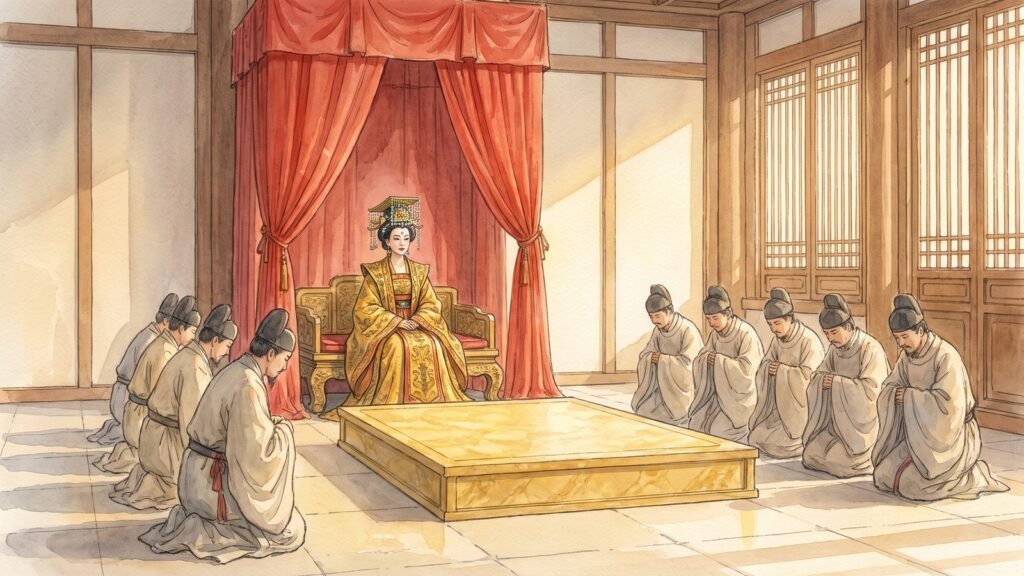
In the autumn of 690, the Empress Dowager’s patience ran out. On 16 October, a group of Buddhist monks, officials, and frontier officers signed a memorial addressed to Emperor Ruizong requesting that he abdicate in favour of his mother “for the benefit of the universe.” (The text of the memorial, preserved in the standard histories, is suspiciously literary in style for the presenters, suggesting that it was written by Wu Zhao’s own secretariat.) Li Dan acceded to the request and retired. On 18 October, a much larger formal petition, signed by officials and presented by a delegation of frontier guards, addressed Empress Dowager Wu Zhao with the request that she take the throne and found a new dynasty. She declined “modestly.” A second petition came a week later and was also declined. A third petition, on 28 October, was accepted, and on the same day the Empress Dowager took the throne as Emperor of the Great Zhou Dynasty, with the temple name Shengsheng and the era name Tianshou. Li Dan was demoted to the rank of heir apparent (effectively a hostage). The dynasty she founded, called Zhou after the early Zhou of the Western Zhou and the Eastern Zhou of Luoyang, was the third Zhou to rule from the same city as the original Zhou kings. The choice of name was a gesture to classical antiquity, the second dynasty of Zhou having been the model of a virtuous and stable monarchy.
The formal takeover was conducted with all the customary ritual of dynastic change. The new emperor moved from the eastern suburbs of Luoyang into the rebuilt imperial palace that had been constructed to house her. The court musicians were reorganised to play a new set of court pieces composed for the new dynasty. A new set of imperial seals was cast. A new calendar was promulgated, with the first year of Tianshou starting in 690. The colour of the era was red, the imperial element. The Empress Wu’s natal Wu family was made the imperial house, and her father Wu Shixi was posthumously honoured as Emperor Wenming. The martial and civil examinations were revised to admit candidates from a wider range of backgrounds, including those who had previously been excluded by family status alone. Wu Zhao was the third woman to claim the title of Emperor of China; the earlier claimants, Empress Lü of the early Han and Empress Gongsun of the Liao, ruled as regents for underage heirs rather than in their own names. Wu Zhao’s reign as Emperor in her own right was without precedent in the standard historical tradition.
The reign lasted fifteen years. The first decade was largely successful. The fiscal administration was reformed, and the heavy tax burden of the late Gaozong years was eased. The frontier posts were re-anchored, and the Tang military presence on the northern borders was consolidated. The examination system was enlarged, with over twenty thousand candidates entering the imperial examinations during her reign. Foreign relations were maintained with the Korean peninsula, the Tibetan empire, and the Western Turkic khaganate. A major campaign against the Western Turkic Khaganate between 692 and 698 extended Tang suzerainty over much of the modern Xinjiang region, and a campaign against the Tibetan empire in 692 briefly restored the Tang to the Four Garrisons of the Tarim Basin.
The second half of the reign was harder. The Empress Wu had begun her reign as a woman of perhaps sixty-five, and by 700 she was in her seventies. Her two favourite lovers, the brothers Zhang Yizhi and Zhang Changzong, were younger men of unmatched administrative influence, and their grip on the imperial finances was resented across the service aristocracy. A coalition of court officials, frontier officers, and Buddhist monks organised in 704 what amounted to a coup attempt. The centre of the plot was the heir apparent Li Dan, his young sons, and several of the major frontier generals. The plot was betrayed, and a fresh purge of the conspirators was carried out. In 705 the Empress Wu lay ill, and on 16 February her sons and ministers took advantage of her incapacity to seize the palace and install Li Xi as the restored Emperor Zhongzong. Wu Zhao lived on in the palace for another ten months, formally retaining the title of Emperor Emeritus, until her death on 16 December 705 at the age of eighty-one.
The restoration of the Tang under Emperor Zhongzong was followed by a violent counter-reaction. The Empress’s supporters, including her daughter the Princess Taiping and her grandson Li Chongzhao, were purged. The Zhou dynasty was abolished in 711, and the historical record of the Empress Wu’s reign was reedited by the restored Tang court with a distinctly hostile slant, presenting her as a single-minded tyrant with unnatural appetites and a taste for the company of unsavoury young men. The standard history of the period is the Old Book of Tang of 945, edited by Liu Xu and his team and heavily drawing on the contemporary but partial Zhenguan Zhengyao of 738. The traces of the Empress Wu’s reign in the archaeological record include a few bronze inscriptions of the great stelae, the surviving Longmen cave-temple inscriptions, the woodblocks of the standard edition of the Tang calendar, and the substantial body of Buddhist textual material commissioned by the Empress Dowager for the printing of the entire Buddhist canon in 692-705.
The Buddhist Project
No aspect of Wu Zhao’s reign is more thoroughly documented, or more hotly debated, than her patronage of Buddhism. By the late seventh century, the Buddhist tradition in Tang China had been a major religious presence for over five hundred years. The Tang courts of Taizong and Gaozong had been eclectic in their religion, supporting Buddhism as one of several pillars of imperial legitimacy. The Empress Wu raised Buddhism to a much more prominent place, presenting herself in poetry, propaganda, and formal ritual as a manifestation of the bodhisattva Maitreya and citing the Great Cloud Sutra (Maha-megha-sutra, also known as the Dayun jing) as a prophetic text specifically describing her reign. The Great Cloud Sutra is a relatively obscure Mahayana text that had been translated into Chinese in the late Northern Liang, and its use by the Empress Wu’s propagandists in 690 to legitimise the founding of the Zhou was a deliberate exploitation of an old Buddhist prediction. The text’s claim that a woman would one day become a chakravartin, a universal emperor, was a direct match for the Empress’s political claim.
The Buddhist project was built around three principal institutions. The first was the imperial patronage of the Luoyang court chapels (the neidian), which housed a substantial body of Buddhist monks and nuns. The Empress Wu’s personal Buddhist establishment was extensive, and her monastic daughter, the Princess Yuzhang, was at one point the chief of the leading female religious house of the capital. The second was the great Longmen cave-temple complex near Luoyang, which the Empress Wu substantially extended. The colossal Vairocana Buddha of Fengxian and its attendant disciples and bodhisattvas, completed between 672 and 675 in the reign of Gaozong, was completed and decorated during the Empress’s reign and remains the largest Buddhist rock-cut monument in the world. The Empress Wu’s patronage at Longmen is recorded in the dedicatory inscriptions of a number of individual caves carved during the Zhou period, including the massive Vairocana cave (cave 17), the huge open-air colossus cave (cave 96), and several smaller devotional caves commissioned by lower-ranking officials of the Zhou. The third was the printing of the entire Chinese Buddhist canon, a project undertaken in the years 692-705 under the Empress’s direction. The standard account reports that the canon was printed using a woodblock technology that had been developed for Buddhist and Taoist reproduction since the Tang dynasty, and the project is sometimes described as the earliest large-scale printed book project in Chinese history. The Empress Wu’s religious patronage was not merely decorative. It was the symbolic infrastructure of her claim to be the incarnation of Maitreya and the historical restorer of a golden age.
The political implications of the Buddhist project were considerable. The Buddhist establishment, with its monasteries, manuscripts, and ordination lineages, represented a parallel network of legitimacy to the Confucian bureaucracy. The Empress Wu cultivated the clerical elite as an alternative elite, recruiting monks of low or middle social origin into the imperial favour and trusting them with offices that the Confucian aristocracy would not have approved. The Buddhist establishment in turn became a principal author of the Empress’s textual legacy. The major historiographical works of the period, including the Tongdian of Du You and the Yiwen leiju of Ouyang Xiu, were written in the eighth and ninth centuries and present the Empress Wu as a tyrant; but the Buddhist records, including the comprehensive catalogues of the canonical literature edited in the reign of the Empress’s daughter and the doctrinal debates of the late Tang, present her as one of the principal patrons of the Buddhist Dharma in Tang times. The two pictures are not easily reconciled, and the question of how to describe Wu Zhao’s reign is still open in modern Chinese historiography.
The Legacy in Practice
The restored Tang government of Zhongzong and Ruizong in 705 and 710 carried out a determined programme of erasure. The temples built in the Empress’s name were demolished or rededicated. The Buddhist canonical project was wound down. The scholarly families who had served the Empress Wu were dispersed. The Empress’s sons, daughters, and grandsons were put to death or driven into remote exile. By 711, when Emperor Ruizong was preparing to retreat from the throne in favour of his son Li Longji (the future Xuanzong), the official attitude to the Empress Wu’s reign was substantially one of condemnation. The Old Book of Tang presented her as a clear deviation from the natural order, and the major Zen Buddhist authors of the mid-Tang treated her political story as one of the cautionary tales of a violent and unstable age. The Chinese literary tradition generally continued to remember the Empress Wu as a talented but dangerous ruler, whose sexual appetites, religious excesses, and political vindictiveness marked her as an exception to the proper conduct of an imperial sovereign.
What survived the counter-reaction was the institutional architecture that the Empress had built. The imperial examination system, reformed under her, was maintained. The frontier command structure, tightened under her, was kept in place. The Tang state continued to patronise Buddhism on the same scale as it had during the Empress’s reign, and the great Longmen monument of Vairocana remained a major pilgrimage destination for centuries. The Empress’s poetry, a substantial body of court odes, dirges, and petitions written in a deliberately archaistic Tang formal style, survived in the standard Tang poetry anthologies. The first of the two emperors to rebuild relations with the Empress’s political project, Xuanzong, was the great patron of Tang Buddhism, and his reign saw a notable expansion of Buddhist temple foundations in the capital and at the southern sites of Mount Lu and Mount Tiantai. In the longer view, the Empress Wu is now increasingly read by Chinese historians as a major rather than a marginal ruler, whose institutional innovations had lasting effect on the Tang state and whose religious politics set the template for the later Tang and Five Dynasties relationship between throne and temple.
The historiography of the Empress Wu has been a slow and uneven business. The Old Book of Tang of 945 and the New Book of Tang of 1060 set the basic framework: a talented, devious, and sexually rapacious woman who came to power through illegitimate means and held the throne by terror. The Qing dynasty historian Zhao Yi and the late Qing and Republican historians Ji Jianyun and Chen Yinke produced more nuanced treatments, and the historical debate of the twentieth century has been substantially about whether the Empress Wu was a strong ruler whose actions were dominated by necessity, or a ruthless usurper whose successes were due to her ruthlessness rather than to her judgement. Modern Chinese scholarship of the post-1950 period has been ambivalent. The political campaigns against “bourgeois historical revisionism” of the late 1950s included direct attacks on the Empress Wu’s reputation, but the subsequent historical writing of the last four decades has been more favourable. The English-language history of the Empress Wu has been dominated by the works of C.P. Fitzgerald, E. H. Schafer, J. W. de Bary, Twitchett, and Denis Twitchett’s collaborative Cambridge History volume on the Sui and Tang periods, all of which present her as a substantial and complicated ruler. The current scholarly consensus is that the Empress Wu was one of the most competent rulers of the Tang dynasty, whose founding of the Zhou was not the aberration of the traditional picture but a major constitutional innovation that prolonged the dynasty’s high age by several decades.
The Empress Wu’s death was unremarkable in its time. She died in the Luoyang palace in December 705, three days after the death of her oldest surviving daughter. The restored Tang government buried her at the imperial tomb of Emperor Gaozong, with the title Empress Dowager and Wuhou. The posthumous name Wuhou, sometimes translated “Empress Wu” but more properly “Empress Dowager and Emperor Emeritus,” captured the duality of her status, simultaneously empress-consort of Gaozong and emperor-in-her-own-right of the Zhou. The story of Wu Zhao’s tomb, with its stelae inscribed only with the character “void” and its burial in the dynastic tomb complex, is a legend of historiographical erasure rather than a historical fact. The tomb is recorded by Tang and Song sources, and it still stands at the foot of the Qianling mountains near Xi’an. The memory of the only woman to sit on the throne as emperor in the dynastic age survived her graves in an unusually quiet form. She was one of the longest-reigning rulers of the Tang dynasty and one of the longest-lived of the Tang imperial women. The question of whether she was a great ruler or a dangerous one is one of the perennial puzzles of Chinese historiography, and the modern Chinese memory of her is plural. The Empress Wu is now a major cultural figure in the Chinese-speaking world, with novels, plays, films, and television dramatisations producing a more complex and sympathetic picture than the late-Tang-tinged historical tradition had been able to support. The Empress lived as a minor concubine and died as the founder of a dynasty. She is remembered in a way that no other woman in Chinese imperial history has been.
After the Court, the Cult
The Empress Wu’s name has also become a reference point in contemporary discussions of women and political power in East Asia. The historiographical rehabilitation of her reign has been part of a wider reassessment of women rulers in Chinese history, and her reign is now regularly cited in textbooks and lectures as one of the few examples in world history of an unrivalled female sovereign who presided over a major state for a substantial period. Her policies on the examination system, her command of the imperial bureaucracy, her management of the frontier, and her patronage of Buddhism have all been studied with the assumption that the Empress Wu was a major historical actor rather than a curiosity. The Empress Wu’s name is now regularly invoked in the public discourse of the People’s Republic of China and Taiwan as a representative example of a historical Chinese ruler who rose by talent to the highest position in the state, and her bronze portrait is part of the standard visual iconography of the Tang dynasty in Chinese museums and historical atlases.
One of the most distinctive features of the Empress Wu’s afterlife is the cult that grew up around her posthumous memory. The Empress Wu was never formally deified during the Tang dynasty itself, in part because the dynasty that replaced hers made a point of erasing as much of her memory as it could, and in part because deification of living or recently deceased rulers had not been a practice of the Tang dynasty. By the Song dynasty, however, a popular cult of the Empress Wu had begun to develop, principally centred on the city of Luoyang, and some of the surviving stelae and inscriptions of the period refer to her as a tutelary spirit of the eastern capital. The cult is visible in the Song-era travel account of the southwestern provinces by Fan Chengda, who records that the Empress Wu had shrines in several prefectures of Sichuan. By the Ming dynasty, the cult appears to have been substantially absorbed into the general religious landscape of the eastern empire.
The Empress Wu’s image in the popular religious tradition was, and to some extent still is, more ambiguous than her reputation in the official historical tradition. The Empress Wu was credited in folk legends with the ability to discern the true intentions of a courtier from a single look, and several Temples of Destiny in central China retained her memory as a goddess of discernment. The Empress Wu was also credited with the founding of a number of institutions whose existence was traced back to her legendary initiative, ranging from the imperial examination reform to the rescue of a legendary Tang-era princess from a military siege. The Empress Wu’s image in the Chinese-language literary tradition of the Ming and Qing dynasties was substantially one of a wise and just ruler, much at variance with the hostile picture in the official Tang histories, and the difference reflects the long-term popular tendency in Chinese culture to remember strong rulers with admiration regardless of formal Confucian historiography.
The Empress Wu’s legacy in the modern Chinese diaspora has been more mixed. The Empress was a deeply controversial figure in modern Chinese nationalist historiography, which held the Tang dynasty in high regard as a model of a strong and cosmopolitan state. The Empress Wu’s role as the founder of the Zhou, a short-lived interruption of the Tang line, was consistently downplayed in the PRC-era histories of the Tang dynasty published in the 1960s and 1970s, and it was only in the late 1970s and 1980s, with the partial opening of historical inquiry, that the Empress Wu’s reign received the more favourable re-evaluation that we now treat as standard. The 1990s television dramatisation of her life, based on the mid-1990s best-selling historical novel by Su Jingsong, brought her back to a wide popular audience, and the 2010s and 2020s television adaptations have continued to keep her in the popular imagination as both a political figure and a romantic heroine.
References
- The T’ang Imperial Women – Edward H. Schafer, in The Historian’s Mirror: Poets of the T’ang Dynasty (Articles on Asian Studies 1), Association for Asian Studies, 1985.
- The Cambridge History of China, Volume 3: Sui and Tang China, 589-906 – Denis Twitchett (editor), John K. Fairbank et al., Cambridge University Press, 1979.
- Empress Wu of Tang: Woman Who Ruled the World – Daria N. K. Trusty, The Historian, vol. 56 no. 1 (1994).
- The China of Empress Dowager Wu: The Woman Who Ruled an Empire, Made a Dynasty and Changed the World – John W. Chaffee, in T’ang Studies, vols. 14-15 (1998).
- Wu Zhao: New Tang Imperial Women – Bret Hinsch, Princeton University Press, 2001 (publisher’s page).
- The Empress Wu of China and Her Patronage of the Longmen Caves – Marilyn Wong and Richard A. Wilson, in Archives of Asian Art, vol. 52 (2002).
- Son of Heaven: The Reign of Emperor Xuanzong – Taiping G. Ammar, in T’ang Studies, 2009 (and the same author’s earlier “Toward the Heavens from the South” essay on the Empress Wu’s Luoyang court).
- Herself an Emperor: The Reign of Empress Wu of Tang – Michael T. Dalby, University of Hawai’i Press, 2020 (publisher’s page excerpt).
- Buddhism under the T’ang Dynasty: Empress Wu and the Great Cloud Sutra – T. H. Barrett, Cambridge University Press, 2008 (publisher’s page).
- The Lives of Confucius and Empress Wu – Michael A. Cusumano, in East Asian Library Journal, 1985-1988 (selected via the British Library).