No culture has left behind a stranger set of objects than the bronze ritual vessels of early China. A single tripod cauldron from the late Shang can weigh more than half a tonne, cast in one pour, and carry a design of enormous symmetry and deliberate violence: a pair of staring eyes, a pair of horns, a jaw of interlocking fangs, all squared off and flattened into registers of spiralling ground. These are not kitchen pots. They are machines for making an ancestor present, and they were made with a technical discipline that no other Bronze Age in the world matched. For most of the twentieth century the story of Chinese bronzes was written as a single line running north from the early centres in the Yellow River valley to the great royal cemetery at Anyang, and the discovery of the Sanxingdui bronzes in the 1980s has made that story considerably more complicated. This essay follows the metal from the ore and the furnace to the interpretation, and asks what the Chinese Bronze Age was, when it began, who made it, and what it was for.
The Alloy and the Mountain
The Chinese words are worth starting with, because they preserve an important distinction that English blurs. Copper is tong, and the alloy of copper with tin is qingtong, green bronze, named for the colour that it turns on contact with the air. The name is accurate: the patina of an excavated Shang vessel is a vivid blue-green, and a scholar can recognise a Chinese bronze from a distance, in a photograph, by the colour of the corrosion. The alloy itself is not a single substance but a family of recipes. Early Shang bronzes, from the seventeenth and sixteenth centuries before the common era, can carry as much as twenty per cent tin, which produces a hard, pale metal that takes a fine cast surface. By the late Western Zhou the tin content in most workshop production had fallen to somewhere around ten to fifteen per cent, with the balance made up increasingly by lead, which lowers the melting point further and makes the metal easier to pour into a complicated mould. The shift is not a matter of taste. It is a change in the metallurgical recipe, and archaeologists can now use the tin and lead content of a vessel as a fingerprint to identify which workshop made it.
Both constituents matter for reasons that are as practical as they are metallurgical. Pure copper is soft and difficult to cast in thin sections, and it deforms rather than rings. The addition of tin hardens the alloy dramatically and lowers the melting point from something over one thousand degrees Celsius to a range that a prehistoric furnace could actually reach. Lead, added later and in greater proportion, does not harden the metal but makes it fluid, and fluid metal fills a fine mould. The Shang and Zhou founders were therefore not using a decoration metal. They had solved a manufacturing problem, and then hung every available symbol on the solution.
The geography of the raw materials is stranger than the geography of the finished objects. Copper occurs in workable quantities in the middle Yangtze valley, around what are now the mines of Daye in Hubei and Tongling in Anhui, and also in the copper deposits of Yunnan in the far southwest. Tin is scarcer in northern China and commoner in the south, in the south-western uplands of Yunnan, Guizhou and Guangxi, and there is a long scholarly argument about whether the earliest Chinese bronze was made from metal that had to be carried a very long way before it was poured. Lead is also a southern metal in these terms. That an early Chinese state could make a vessel of eight hundred kilograms out of copper that had travelled many hundreds of kilometres is a statement about the size of the political unit required to organise it, which is one reason the earliest substantial Chinese bronzes are found not at a royal capital but at sites like Erlitou, where the organisation looks more like a workshop federation than a state.
Erlitou, excavated since 1959 by the Institute of Archaeology of the Chinese Academy of Social Sciences at Yanshi in Henan province, is the earliest Chinese site that anyone can point to and say had bronze casting at all on a significant scale. It occupied a large walled enclosure on a low terrace above the Yellow River, and the excavated area has produced palace and workshop buildings, elite burials rich in jade and lacquer, and the debris of a bronze industry. The dates run from roughly 1900 to 1500 before the common era, though the boundaries are conventionally given more loosely. Because Erlitou has yielded no writing of any kind, the identification of the site with the Xia of the received historical tradition, the first dynasty of the sage-kings in the Book of Documents, remains a hypothesis and a contested one. The received tradition gives Xia a list of kings and a chronology; archaeology can offer a culture and a sequence but cannot confirm the names.
The excavators at Erlitou found something else as well, in 2003, in a quarter known as Xiaomintun: a bronze foundry area, where more than seventy thousand fragments of clay mould were recovered from a single deposit. The report, published in Science in 2006, described what was at the time the earliest large-scale bronze casting complex ever excavated anywhere, including in Europe and the Near East. It is a remarkable sample because a foundry is normally the least archaeological of things. Furnaces are broken, scrap is reused, the workshop floor is swept. Here the discarded mould sections survived in quantity, some still holding the adhering skin of the vessel they had cast, and the result allows the whole production sequence to be reconstructed, mould by mould, from the making of the model to the dressing of the finished vessel.
That discovery raises the question of when the Chinese Bronze Age actually begins, and the honest answer is that the chronology has been pushed steadily backwards as the sites get better studied. There is a conventional bracket of about 2000 to 771 before the common era, the end of the Zhou, and within it a Shang period conventionally running from about 1600 to 1046. The Shang is the first Chinese period that can be dated by its own documents, because it left writing. At Anyang, the site conventionally identified with the last Shang capital and excavated since 1928, the palace-temple precinct and the royal cemetery of the kings yielded thousands of inscribed oracle bones, on which the kings divined about harvests, war, childbirth and the weather. Those inscriptions anchor the Shang chronology in the way that nothing earlier can be anchored, and they make Anyang the high point of the bronze tradition: the enormous assemblages, the colossal vessels, the elaboration of the animal masks and, at the end of the period, the long dedicatory inscriptions that turn the objects into documents.
Anyang is also where the ambition of the period becomes clearest. The founding of the Shang in the plains of northern China was itself a conquest, and the institution that the conquest built was a ritual one: kings made war, and then they made ancestors, and the ancestors were honoured with bronze. The bronzes of Anyang are not decoration and not art in the modern sense. They are the apparatus of a claim, repeated in clay and metal across decades, that a lineage had the right to be at the centre of the world.
It is worth remembering, though, that the Shang plain was never the whole of the story. Along the middle Yangtze, in southern Jiangxi, tombs excavated at Xingan and Dayangzhou in the late 1980s and early 1990s held bronzes of the same date made in a markedly different idiom, with flatter forms, different animal conventions and a heavy emphasis on the bird rather than the beast. There was once a separate bronze culture in the south, with its own workshops and its own repertoire, and the relationship between it and the northern tradition is one of the standing problems of the subject. Sanxingdui, which sits further west still, turns that problem into the central question of the whole period.
The Mould and the Fire
The single most important technical fact about Chinese bronzes is that they were, for the great majority of the Shang and Zhou period, cast in a sectional clay mould, a method usually described in English as piece-mould or block-mould casting. The Chinese term is taofan, the clay mould. It is a different process from the lost-wax method familiar from Greek and Roman sculpture, and the difference is not a refinement but a different solution to a different set of problems.
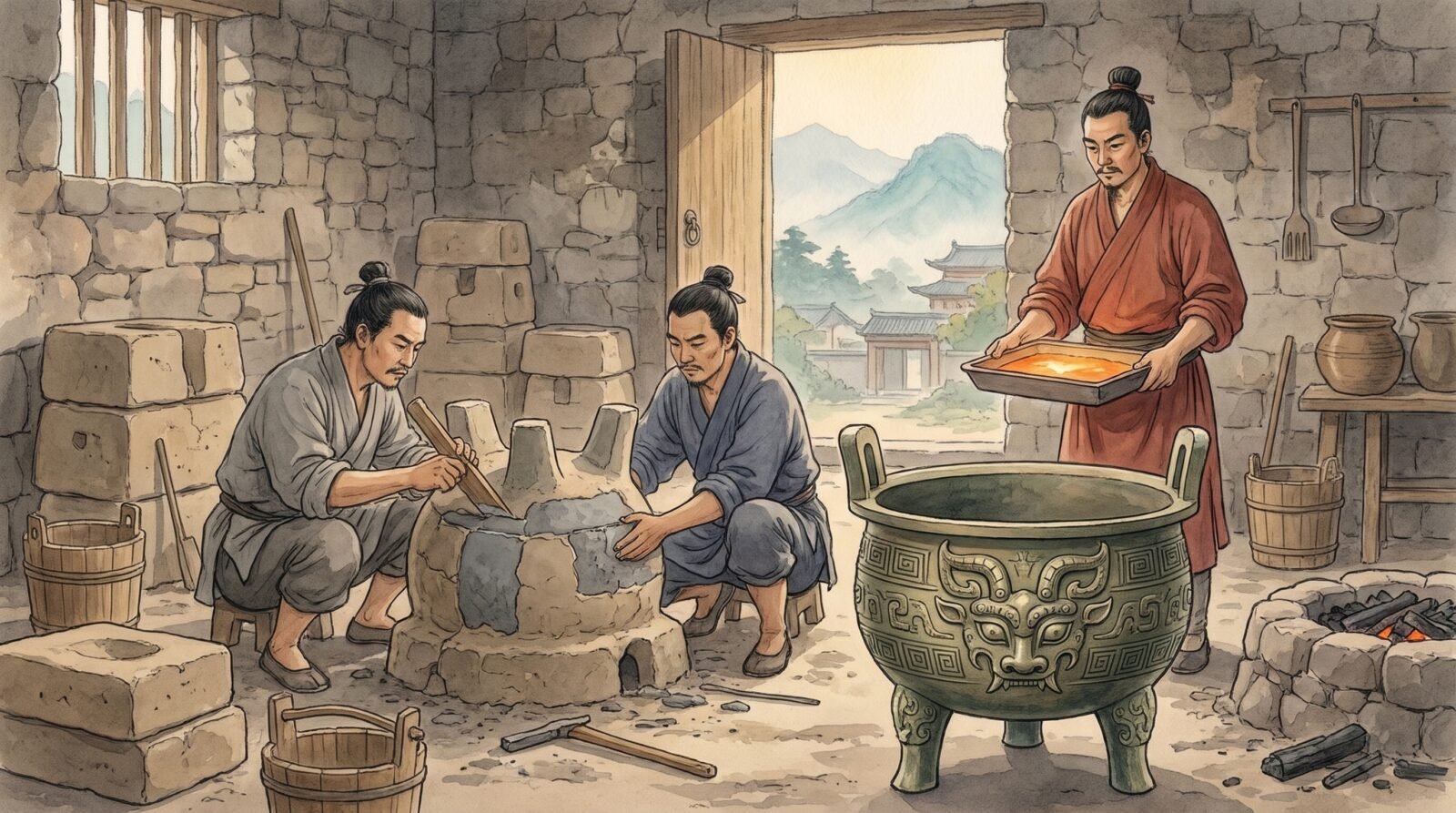
The sequence runs as follows. A model of the vessel, made of clay and usually made from the vessel itself or from a carved prototype, is pressed or worked into slabs of clay to produce the negative mould sections, the waifan. A second mould, the neifan, forms the hollow core. The sections and the core are assembled into a closed vessel, held together with clay spacers and with small ceramic pins, and the whole assembly is fired until it is hard enough to survive the pour. Molten metal, at a temperature somewhere between eleven and thirteen hundred degrees, is run into the cavity. When the casting has cooled, the mould is broken away, and the surface of the vessel is dressed, chased and polished. The mould is destroyed in the process, so a new one is needed for every vessel. But because the same model can be used again and again, a workshop with a good model can turn out a series of vessels that are very nearly identical, and the decoration, which was modelled in the clay in reverse, comes out in crisp high relief with no separate carving required at all.
That last point is why the Shang bronzes are so hard to imitate. The decoration is not applied to the metal. It is carved into the model, pressed into the mould, and transferred to the cast in a single operation, so the vessel is finished at the moment it is born. A modern examination of the mould fragments from Xiaomintun showed that the mould makers were themselves specialists, and that the whole operation was divided into a sequence of separate tasks carried out by different people: making the model, making the outer mould sections, making the core, assembling, firing, pouring, and finishing. A bronze from Erlitou was the product of a division of labour and a manufacturing schedule rather than of a single master.
The furnace was a serious piece of engineering too. Chinese founders used a vertical shaft furnace, tall and narrow, with bellows worked by teams of people, and the Shang examples excavated at Erlitou are modelled on a section of a bronze vessel, which is a neat inversion: the furnace was built in the shape of the thing it was making. The clay moulds were fired in the same kilns as the ceramic, and the temperatures required for a successful pour were within the capability of the technology, which is not a trivial observation when the metal in question needs to remain fluid long enough to fill a thin-walled cavity of several hundred kilograms.
The largest vessels make the scale of the enterprise plain. The Simuwu da fang ding, sometimes called the Houmuwu ding after the reading of its inscription, was cast for a Shang king and presented to his mother. It stands about 133 centimetres high, measures roughly 110 centimetres across the mouth and 79 centimetres across the body, and weighs about 833 kilograms. It carries a band of relief ornament around the neck that depicts a pair of standing beasts facing a central taotie mask, and the interior of the rim bears an inscription of forty-three characters. Producing it meant assembling a mould several metres high, mixing and pouring metal in a single fill of some five and a half tonnes, and doing so without an error, because a casting failure at that size would be an unrepeatable disaster. There is only one of them, and it was still in the ground until 1939.
Lost-wax casting did exist in China, certainly by the Spring and Autumn period, and it may have been used for forms that the mould method handles badly, such as the openwork and the complex undercutting of the later Zhou and Chu bronzes, and possibly for some of the Sanxingdui pieces. For the core of the Shang tradition, though, the piece-mould method was the technology, and the remarkable thing is how well it served. It produced standardisation at scale, it produced enormous pieces, and it produced a surface quality that no other Bronze Age matched. The limitation of the method is that the mould must be broken to be removed, so the same vessel cannot be cast twice from the same mould and the workshop must build a new mould for each. The expense of the mould fragments at Xiaomintun is the real measure of the cost of the system.
The Faces on the Vessels
Any discussion of Chinese bronze decoration runs into the same problem at once: everybody can recognise the motif and nobody agrees what it is. The dominant design is a symmetrical frontal face with huge bulging eyes, a pair of horns sweeping outward, heavy brows, a nasal ridge running vertically down the centre, and a jaw of squared fangs. It is set in a ground of squared spirals, the leiwen, conventionally called thunder pattern, which fills every empty millimetre of the surface. In English the motif is universally called the taotie, but that is a late and slightly misleading name. Taotie is one of the four evils of Chinese legend, a glutton, and the name was given to the motif by Song dynasty antiquarians in the eleventh and twelfth centuries who were naming things they had inherited rather than things they had made. The term the Chinese antiquarians of the Song more generally used for the design was shoumian, animal mask, and the modern scholarship tends to use that, or to describe the motif by its structure rather than by its supposed identity.
The most influential structural analysis was published by Chen Mengjia and Zhang Changshou in 1990, in a study of Shang and Zhou bronzes that has been built on ever since. They argued that the principal mask is not one animal but a composition of parts, assembled on a bilateral scheme, and that it is better described as a face constructed out of two profile animals seen from the side, joined at the centre line, with the central vertical flange acting as a nose. They also described the four-part structure that organises most Shang decoration: a central body, two flanking dragons of the kui type whose bodies trail away in profile, and a further inverted pair below forming the base. The animal is therefore not a depiction of a species at all. It is a construction, assembled out of conventional components, and it is the construction rather than any particular beast that makes it recognisable at a glance across a millennium and a half.
What the mask means is a different and much more contested question, and the range of the arguments is instructive because it shows how much of the interpretation of ancient China has been driven by what a particular scholar thought the Shang state was.
The influential modern reading was developed by David Keightley, the scholar who did most to make the oracle bones legible as historical documents. In his work on Shang religion he argued that the animals on the bronzes were not decorative or totemic in a simple sense but were helpers of the shaman, the ancestors or spirits who could be approached through wearing or embodying their form. On this reading the masks are the faces of animals as the medium sees them, and the impossibility of the combination, the horns and eyes and jaws of nothing that exists, is the point. The alternative reading, associated with the work of Chang Kwang-chih, treats the animals as static and dead, as specimens rather than creatures, and reads the frontal symmetry as evidence of a political order organised around corporate clan groups identified with animals rather than around individuals.
Others have looked upward rather than sideways. There is a long-standing line of argument that reads the animals cosmologically, relating the great dragon to the celestial pole and the four quadrants, supported in part by the fourth-century tomb reliefs at Mawangdui and at Xishuipo in Henan, which pair a dragon with a tiger and show the animals flanking a funerary diagram of the cosmos. A more sceptical school asks whether the motif was ever intended as an image at all, and whether the scholarly tradition of looking for a meaning in every element of the surface has manufactured one where the workshop had only a pattern. And there is a technical counter-argument, that the earliest forms of the design are not obviously faces, and that reading the mask as a face is a projection of the kind of observers who catalogued it in the Song.
Whatever the reading, the stylistic development is clear and is among the great continuities in the history of art. Early Anyang decoration is in flat relief, a shallow surface pattern in which the animal is legible as a silhouette and the ground is packed with squared spirals. The later Shang moves to deep relief, so that the eyes stand out in the round and the whole design gains a shadow. The Middle Zhou period thins the ground out and stretches the animals into elongated, ribbon-like forms. The Eastern Zhou revival, around the sixth century before the common era, produces an extraordinary ornamental richness, with interlaced and pierced work, and then the Chu bronzes take the process further into a mannered complexity in which the surface is a continuous filigree of intertwined dragons and serpents with no clear centre at all.
The Vessels of Power
The vessel types are a closed technical vocabulary, and it is worth naming the principal members because the Chinese names are exact and describe function precisely. The ding is the tripod cauldron, the oldest and heaviest of the family, for cooking meat and for the state ritual of offering. The gui is a bowl on a high foot, for grain, normally used in pairs. The jia is a three-legged vessel for warming wine. The jue is the small three-legged wine cup with a long spout and a post on the rim, of which several thousand survive from the Shang. The he is a pouring vessel for mixing wine with water. The zun is a tall wine container, the you a lidded wine vessel, the gu a slender beaker, the zhi a small goblet, the fou a wide-mouthed jar, and the lei a large covered wine jar. A Shang tomb does not contain a random assortment. It contains a set, and the size and number of the set is itself a statement about the occupant.
The inscriptions follow the same logic. The earliest vessels carry almost nothing, or carry only a small pictorial emblem belonging to a clan or a workshop, a mark like a badge in shape rather than a name in script. The emblem, the zuhui, is usually a short vertical inscription of one or two graphlike signs identifying a lineage, and it appears on the vessels in a position that varies with the shape of the piece. It is as close as the Bronze Age gets to branding, and a modern analyst with a catalogue of these marks can sometimes track a workshop, and sometimes a family, across dozens of vessels. By the late Shang, inscriptions become sentences: a vessel is given to an ancestor by a named son, and the vessel is to be used to hold sacrificial food for so many years. Some run to thirty or forty characters and more. The Simuwu ding carries forty-three, including the three-character clan emblem. These are not dedication formulae of a religious society; they are legal instruments with a date, a donor, a beneficiary and a term of use, and they are among the closest things the Bronze Age has to a public record.
The cauldron was the thing that mattered. The Nine Cauldrons of the received tradition, the jiuding, were said to have been cast by Yu the Great when he unified the realm, and to have passed from the Shang to the Zhou by right of conquest. They stand at the centre of Chinese political imagination as the emblem of legitimate rule, and the question of whether any historical set of nine existed has never been answered, because no excavated assemblage of nine cauldrons has ever been identified. What the Zhou actually did is more revealing. After the conquest of the Shang, conventionally dated to 1046 before the common era, the Duke of Zhou is credited with the reform of ritual that organised the remainder of the dynasty’s life, and the first element of that reform was to control the number and type of vessels a man might set out at a sacrifice. The canonical figures are nine cauldron sets for the ruler, seven for a feudal lord, five for a high official, three for a lower gentleman and one for an ordinary person. A man who set out nine ding was claiming a position in the world, and the claim was enforced by the number of cauldrons on his table.
The Western Zhou inscriptions are the best documentary evidence that survives for the political economy of the period. They are formulaic, dated, and usually name the ancestor being honoured, the king making the grant, the recipient, and the reward: cowries, land, horses, slaves, or more bronze vessels. They show a state that operated through ancestral ritual and that paid its officials in metal, and they show the same hierarchy described in the vessel sets. The system came under strain in the ninth century before the common era, during the crisis of the royal house, and it produced the most famous anecdote in the whole tradition. When a king of Chu asked the envoy of the Zhou court about the weight of the Nine Cauldrons, the question was a polite way of asking when the Zhou would lose them. The Zhou court was still alive in 771 before the common era, when a coalition of states ended it and the court moved east. The ritual system survived the move, and outlasted the dynasty that had invented it by several centuries.
In the Eastern Zhou the meaning of the vessel changed. The graded sets became a display of rank that the states competed to exceed, and the great assemblages of the Warring States period are as much about wealth as about ritual. The tomb of the Marquis Yi of Zeng, excavated in 1978 at Leigudun near Suizhou in Hubei and generally dated to the opening of the fifth century before the common era, held a set of sixty-five bronze bells with a combined inscription of around forty-seven hundred characters, together with chariots, weapons, a lacquer coffin and thirty-five jade ornaments. The bells are tuned to two pitches a third apart, a system the Chinese called the two-tone scale, and they are decorated with rows of interlocking coils and with the coiled serpentine dragons of the southern style. Among the inscriptions is one of thirty-one characters recording how the Zhou king, with the ritual vessels and the music of the court, confirmed the Marquis of Zeng in his authority over his own people. The bells are not only a hoard. They are a document.
None of this would have been readable without the scholarly tradition that classified the vessels, and that tradition is itself part of the story. The Song imperial catalogue of 1123 and the slightly earlier illustrated collection commissioned under Wang Chang treat the bronzes as a canon, assigning them to types and naming the types, and the Qing imperial catalogue of 1755 pushed the taxonomy further. Those catalogues created the vocabulary of five principal vessels, the ding, the gui, the jue, the jia and the zun, that still organises the subject in museums today. Much of what we call the Shang system of ritual bronzes is in fact a description created a thousand and two hundred years after the last of the objects was buried, by antiquarians working from a handful of pieces in private hands.
Sanxingdui and the Second Centre
In February 1986, workers cutting a drainage channel for a factory compound in Guanghan county, in the plain north of Chengdu, struck bronze. What they had hit was a burial pit filled with broken ritual objects, and over the following weeks two pits were excavated that yielded more than nine hundred artefacts. The most famous of them were the masks: bronze faces with enormous eyes that stand out on cylindrical stalks, each mask only the width of a human face, some of them with pupils, brows and ears modelled in the round, a few with a smile that is either tranquil or unbearable depending on how long you look at them. There were giant bronze heads with flat-topped hairstyles and cut-off necks, a standing human figure 1.68 metres high on a pedestal of ninety centimetres, and a bronze tree nearly four metres tall with three tiers of branches, each branch carrying a fruit and each tier a bird. There were gold masks, gold foil, jade sceptres and rods, and enormous quantities of worked ivory.
The discovery forced an immediate and unwelcome question. The site, named Sanxingdui, was identified with the ancient state of Shu, one of the polities that Chinese tradition places in the west, and it has no writing at all. The bronzes are dated by their metallurgy and their technology to the late Shang, roughly 1200 to 1100 before the common era, which is to say to the very end of the period that Anyang dominates. But nothing at Sanxingdui resembles anything at Anyang. The masks are not the Shang masks, the trees are not a Shang invention, the standing figure is not a figure of any kind in the Anyang repertoire. If the two were contemporary, and they are, then the Chinese Bronze Age had at least two large and sharply distinct centres, and the whole tidy line from Erlitou to Anyang that the textbooks drew for half a century was an artefact of where the archaeologists happened to dig.
The scale of the new work changed the picture again. Excavation was re-launched in March 2020 by the Sichuan Provincial Institute of Cultural Relics and Archaeology under a provincial project for the protection of the ancient Shu civilisation, and it has since uncovered six further pits adjacent to the original two, all rectangular, between three and a half and twenty square metres in area, dug under purpose-built cabins with an on-site laboratory. The results, reported in Antiquity in 2023, included a gold mask of some 280 grams with a gold content of about eighty-five per cent, and a kneeling figure that carries a wine vessel on its head, cast in separate pieces for the head, body, arms and legs and then joined, an engineering solution to a casting problem. The artefacts are being recovered in thousands. They were also broken before deposition. Small bronzes lie at the bottom of the pits and larger ones above them, ivory was used to pave the upper surfaces, and the deliberate destruction of the objects was a way of removing their value from circulation, a practice also known from the Shang.
No one has yet produced a reading of the Sanxingdui material that satisfies everyone, and the most useful summary is that the site forces a choice between two models that are less opposed than they first appear. The first treats Shu as a separate civilisation with its own bronze tradition, arising from a local culture and drawing on its own resources, in which case the Chinese Bronze Age is a conversation between at least two large centres and the later unification of the country under the Zhou was genuinely a surprise. The second treats it as an extension of Shang power, a colonial or peripheral station whose inhabitants retained their own religious imagery while taking part in a bronze economy that was technically Shang. Recent metallurgical work has complicated the picture further, suggesting that the alloy recipes at Sanxingdui were close to those of Anyang while the copper itself was sourced differently, which would imply that metal and knowledge travelled to the southwest more readily than finished objects did.
And then the age ends. The Shang collapse is conventionally dated to about 1200 before the common era, and the strongest archaeological evidence for it comes from a tomb at Anyang itself, the Huanwu or Discriminated Tomb, which was excavated between 2003 and 2005 and appears to have belonged to a person living in the last decades of the dynasty. The oracle bones record the attacks of peoples called Di and Kang from the west, and the Zhou, who had been waiting on the frontier, took the opportunity. The dynasty that had begun somewhere in the middle of the seventeenth century before the common era was over by 1046, and the Zhou would rule for eight hundred years. Iron followed slowly: Chinese iron smelting appears in the sixth century before the common era, becomes common in the Warring States, and only then does bronze stop being the metal of power.
What remains is the argument about what the Bronze Age was. The traditional answer, a state that discovered metallurgy and used it to consecrate its kings, has been complicated by Sanxingdui into something closer to a network of workshops, mine sites and river routes bound together by a shared technical language, in which the ritual meaning of the vessels changed from one centre to another. The vessels themselves have had a second life entirely. The mask that English calls the taotie is now the emblem of the Chinese state, cut into the national seal, drawn onto flags and coins and given out as a medal design, an ancient pattern that has been pressed back into service as a summary of a civilisation. It is the most successful piece of the Chinese Bronze Age that is still in active use, and it does not work because anybody decided to revive it, but because it was never really put away.
References
- Bronze Age China – the chronology of the period, the regional divisions and the major sites and cultures
- Erlitou – the early bronze culture of Yanshi in Henan, the Xia question and the Xiaomintun foundry
- Erlitou culture – on the section-mould casting process, the early bell and the systematic bronze industry of the site
- Yinxu – the last Shang capital at Anyang, the royal cemetery, the palace-temple precinct and the foundries
- Oracle bone – the divination bones, the earliest substantial body of Chinese writing and the basis of Shang chronology
- Chinese bronze – the copper-tin-lead alloy, the piece-mould casting method, the patina and the principal vessel types
- Taotie – the mask motif, the Song antiquarian name, the animal mask and the four-part structure
- Jue (vessel) – the three-legged wine cup with spout and rim post, and the bronze types of the Shang
- Ding (vessel) – the tripod cauldron, the ritual grading of the graded sets and the Nine Cauldrons
- Gui (vessel) – the grain bowl on a high foot and its place in the vessel set
- Simuwu Ding – the great ritual cauldron of 1939, its dimensions, its weight and its forty-three character inscription
- Zeng Hou Yi – the Marquis Yi of Zeng, the Leigudun tomb, the set of sixty-five bells and the Warring States assemblage
- Sanxingdui – the site, the 1986 pits, the masks, the standing figure, the bronze tree and the broken burial practice
- Sanxingdui Museum – the new museum complex and the current excavation and research programme
- New discoveries at the Sanxingdui Bronze Age site in south-west China – Li Yingfu, Qiu Tian, Guo Jianbo and Li Yuniu, Antiquity 97.391 (2023) e4, on the six new pits of the 2020 campaign
- The Sacrificial Area at the Sanxingdui Site in Guanghan, Sichuan – Sacrificial Area Archaeological Team of the Sanxingdui Site, Chinese Archaeology 23.1 (2023)
- Archaeometallurgical studies in China – Cambridge University Repository, on the piece-mould technology, the Xiaomintun moulds and the alloy recipes
- Shang dynasty – the period, its chronology, its royal lineage and the collapse of the period
- Zhou dynasty – the conquest of 1046 BCE, the ritual reform of the Duke of Zhou and the Eastern Zhou