1. The Encounter of 744 in Luoyang: The Banished Immortal Meets the Conscientious Confucius of Poetry
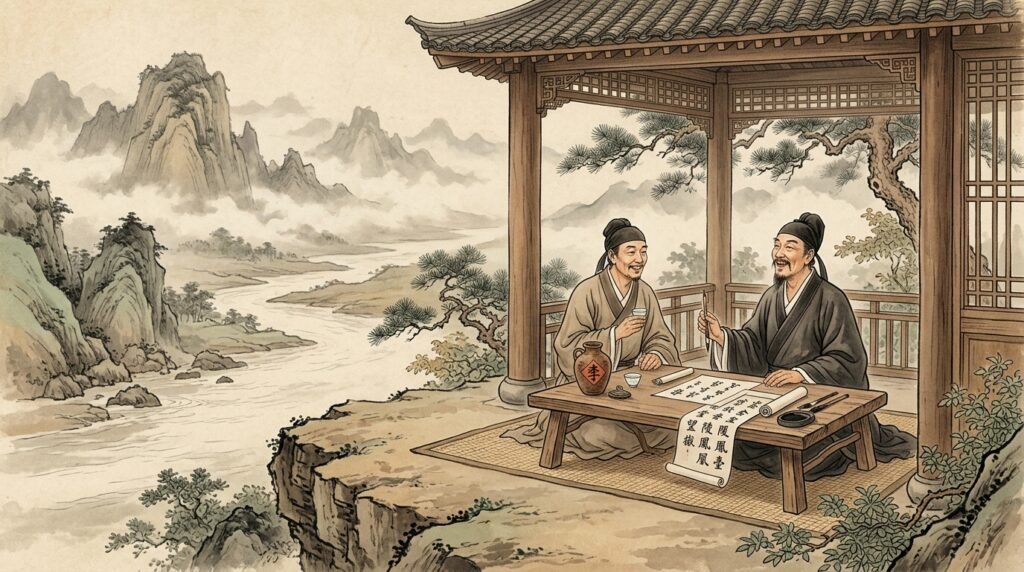
In the fourth month of the third year of Tianbao (May 744 CE), in the eastern capital of Luoyang, the two greatest poets of classical Chinese civilization met for the first time. The encounter was an event of singular literary gravity: the conjunction of two poetic titans at the meridian of the High Tang (Sheng Tang 盛唐). At the time of their meeting, their fortunes and reputations could scarcely have been more unequal. Li Bai (李白, 701–762), forty-three years old, was already an empire-wide celebrity. He had just departed the court at Chang’an, where for nearly two years he served as Emperor Xuanzong’s poet-in-attendance in the Hanlin Academy (翰林院). Celebrated as the “Banished Immortal” (Zhexian 謫仙)—an epithet famously bestowed by the elder statesman He Zhizhang (賀知章)—Li Bai had been dismissed with imperial gold (“bestowed gold and returned home,” cijin fanghuan 賜金放還) after refusing to conform to court sycophancy. He rode into Luoyang flanked by patrons, a sword at his belt and wine at his lips, surrounded by an aura of aristocratic grandeur and Daoist mystique.
Du Fu (杜甫, 712–770), thirty-two years old, was virtually unknown. Though born into a respected bureaucratic lineage—his grandfather Du Shenyan (杜審言) helped establish Early Tang metrical rules—Du Fu had failed the metropolitan examination (jinshi 進士) in 735. He spent his twenties wandering the eastern provinces, studying history and nursing unfulfilled ambitions. When he sought out Li Bai in Luoyang, Du Fu approached the older poet with reverent awe. He was captivated by Li Bai’s wild magnetism, yet his moral eye noted the restlessness beneath the older poet’s posturing. In an early verse presented to Li Bai, Du Fu captured this paradox with searching candor:
秋來相顧尚飄蓬,未就丹砂愧葛洪。
痛飲狂歌空度日,飛揚跋扈為誰雄?Qiū lái xiāng gù shàng piāo péng, wèi jiù dān shā kuì Gě Hóng.
Tòng yǐn kuáng gē kōng dù rì, fēi yáng bá hù wèi shuí xióng?“Autumn arrives, and we still gaze at each other like drifting tumbleweeds,
Du Fu, “To Li Bai” (贈李白), 744
Having not yet refined the cinnabar elixir, ashamed before Ge Hong.
Drinking deeply, singing madly, spending our days in vain—
Flying high and acting imperious: for whom are you playing the hero?”
Li Bai was charmed by his younger companion, though he regarded Du Fu’s agonizing artistic discipline with breezy amusement. In a well-known teasing quatrain, “Playfully Presented to Du Fu” (Xi zeng Du Fu 戲贈杜甫), Li Bai poked gentle fun at Du Fu’s pale, earnest countenance:
飯顆山頭逢杜甫,頂戴笠子日卓午。
借問別來何為客,總為從前作詩苦。Fàn kē shān tóu féng Dù Fǔ, dǐng dài lì zi rì zhuó wǔ.
Jiè wèn bié lái hé wéi kè, zǒng wèi cóng qián zuò shī kǔ.“At the summit of Rice-Grain Mountain I ran into Du Fu,
Li Bai, “Playfully Presented to Du Fu” (戲贈杜甫)
Wearing a bamboo hat on his head beneath the noon sun.
May I ask why you have grown so haggard since we parted?
It must be from the bitter torment of laboring over poetry!”
This humorous exchange exposed a fundamental aesthetic divide. For Li Bai, poetry was a spontaneous, celestial outflow, as effortless as clouds across the sky. For Du Fu, verse was a moral calling and an existential craft, requiring painstaking labor, technical precision, and ethical accountability. In Luoyang, in 744, these two complementary philosophies of art met face to face.
2. Two Temperaments, One Epoch: Li Bai’s Daoist Transcendence vs. Du Fu’s Moral Realism and Compassion
The contrast between Li Bai and Du Fu embodies the two great spiritual poles of classical Chinese thought: Daoist transcendence and Confucian moral engagement. Both poets were shaped by the High Tang, a civilization radiating supreme economic vitality and cultural confidence. Yet their internal compasses oriented them toward entirely different dimensions of experience.
Li Bai’s imagination was vertical, mythological, and cosmic. Raised in Sichuan near the western fringes of the empire, his literary sensibility was nourished by the southern shamanism of the Chuci (楚辭) and the radical liberation of Zhuangzi. Li Bai was an ordained Daoist adept who identified himself with the mythical Great Roc (Dapeng 大鵬), which ascends ninety thousand li into the azure heavens on a whirlwind. When he engaged with politics, he did so through the archetypes of the knight-errant (youxia 遊俠) and the sage-hermit who descends from misty peaks to rescue the state with effortless brilliance, then retreats into the clouds. He had no patience for bureaucratic routine. In his lyrics, he converses with the moon, crosses chasms on rainbow bridges, and proclaims his refusal to bend his knees to princes: “How can I lower my brow and bend my waist to serve the powerful and noble, / When it prevents my heart and face from opening in gladness?” (An neng cui mei zhe yao shi quan gui, shi wo bu de kai xin yan? 安能摧眉折腰事權貴,使我不得開心顏?).
Du Fu’s imagination, conversely, was horizontal, historical, and deeply grounded in human society. Steeped in the Confucian Classics from his boyhood, Du Fu was governed by the cardinal virtue of ren (仁)—benevolence and active compassion. Unlike Li Bai, who sought to escape the mundane world, Du Fu felt a sacred obligation to repair it. His lifelong ideal was to serve as a loyal minister and help his emperor inaugurate a moral golden age:
致君堯舜上,再使風俗淳。
此意豈不高,翻為同舍哂。Zhì jūn Yáo Shùn shàng, zài shǐ fēng sú chún.
Cǐ yì qǐ bù gāo, fān wéi tóng shè shěn.“To place my sovereign above Yao and Shun,
Du Fu, “Written from the Capital to Fengxian”
And bring the customs of the realm back to purity.
Could such an aspiration fail to be exalted?
Yet it only earned the mockery of my lodging-mates.”
Where Li Bai looked at a river and saw the Milky Way descending from the stars, Du Fu looked at a river and saw grain boats navigating rapids, carrying rations taxed from impoverished farmers to supply the imperial court. Li Bai expressed the unfettered ecstasy of the individual soul; Du Fu bore the collective anguish of a suffering people. Neither could have existed without the High Tang, and neither alone can represent it. Together, they formed the dual soul of classical Chinese literature.
3. The Wandering in Liang and Song: Travel with Gao Shi, Hunting, Wine, and Poetic Rivalry
In the autumn of 744 and the following spring of 745, Li Bai and Du Fu embarked on an excursion across the historic plains of Liang and Song (modern eastern Henan and western Shandong). Along the way, they were joined by a third poet of major stature: Gao Shi (高適, c. 704–765). Gao Shi was a seasoned, impoverished gentleman who had spent years in northern border garrisons, composing frontier verse (biansai shi 邊塞詩) that stripped warfare of courtly romance to depict frostbitten armor, whistling arrows, and lonely graves. The union of these three men created an unforgettable literary fellowship: Li Bai the celestial lyricist, Gao Shi the frontier realist, and Du Fu the observant young master absorbing both traditions.
The three travelers galloped across ancient plains, visiting legendary sites associated with the Warring States. They mounted the ancient Platform of King Xiao of Liang (梁孝王平台) at Suiyang, where princes had once patronized grand rhapsodists. By day they hunted deer and wild birds with falcons and mounted archery; by night they drank heavily in rustic inns, reciting verse and debating statecraft. Years later, amid wartime exile, Du Fu looked back upon this excursion as the golden summer of his youth, writing in “Recalling Past Travels” (Xi you 昔遊):
昔者與高李,晚登單父臺。
寒蕪際野色,遠樹涵天開。
痛飲狂歌飛玉佩,窮途落拓寄幽懷。Xī zhě yǔ Gāo Lǐ, wǎn dēng Shànfù Tái.
Hán wú jì yě sè, yuǎn shù hán tiān kāi.
Tòng yǐn kuáng gē fēi yù pèi, qióng tú luò tuò jì yōu huái.“In the past, together with Gao and Li,
Du Fu, “Recalling Past Travels” (昔遊)
In the evening we climbed the Shanfu Platform.
Withered weeds stretched out to touch the wild horizon;
Distant trees held the skies as they opened wide.
Drinking deeply, singing madly, shaking our jade pendants,
At our wit’s end, living wildly, we poured out our hidden hearts.”
In 745, their journey led them to Shandong. In Jinan, at the Ziji Palace, Li Bai received formal Daoist ordination and sacred registers (daolu 道籙). Du Fu accompanied him as far as Mount Tai and Mount Meng, gazing up at the sacred summit and penning his triumphant line: “One day I shall climb to the very summit, / And behold all other mountains small beneath my feet” (Hui dang ling jue ding, yi lan zhong shan xiao 會當淩絕頂,一覽眾山小).
In the late autumn of 745, at Stone Gate (Shimen) east of Lu County, their paths finally divided. Du Fu was bound for Chang’an to seek official rank, while Li Bai set out for Jiangnan. Outside the city walls, over final goblets of wine, Du Fu wrote: “Like drifting tumbleweeds we each journey far away— / Let us drain to the bottom the cups in our hands!” (Fei peng ge zi yuan, qie jin shou zhong bei! 飛蓬各自遠,且盡手中杯!). They parted into the gathering mist, unaware that they would never see each other in person again.
4. The Golden Splendor of the Kaiyuan and Tianbao Eras: Chang’an at Its Imperial Peak
To grasp the magnitude of the catastrophe that would soon engulf both poets, one must first behold the world that was lost. The reign of Emperor Xuanzong (r. 712–756) encompassed two distinct phases: the prosperous Kaiyuan era (開元, 713–741) and the lavish Tianbao era (天寶, 742–756). Together, they brought Chang’an to its zenith as the cosmopolitan capital of the medieval world. Covering thirty square miles and laid out in 108 walled wards (fang 坊), Chang’an housed over a million residents. Along its avenues walked Persian merchants, Sogdian wine-sellers, Japanese monks, and camel caravans bearing Silk Road treasures. Granaries were full, music echoed from the Pear Garden (梨園), and peace seemed guaranteed by imperial border armies.
Yet political decay was setting in. Tiring of statecraft, Xuanzong yielded control to Chief Minister Li Linfu (李林甫), whose sinister charm earned him the moniker “honey-mouthed and sword-bellied” (kou mi fu jian 口蜜腹劍). To preserve his power, Li Linfu appointed non-Han military governors (jiedushi 節度使) to border commands, preventing civil rivals from gaining military prestige. Simultaneously, Xuanzong became infatuated with Yang Yuhuan (楊玉環), elevated to Guifei (Honored Consort). The court sank into luxury at the Huaqing Palace, while Consort Yang’s cousin, Yang Guozhong (楊國忠), climbed the bureaucratic ladder.
Both poets witnessed Chang’an at its height, but from opposite ends of society. Li Bai arrived in 742, summoned by imperial decree. Installed in the Hanlin Academy, he immortalized Consort Yang beside blooming peonies at the Agarwood Pavilion in his “Clear and Peaceful Tunes” (Qingping diao 清平調):
雲想衣裳花想容,春風拂檻露華濃。
若非群玉山頭見,會向瑤臺月下逢。Yún xiǎng yīshang huā xiǎng róng, chūnfēng fú kǎn lù huá nóng.
Ruò fēi Qún Yù shān tóu jiàn, huì xiàng Yáo Tái yuè xià féng.“Clouds bring to mind her robes, flowers her countenance;
Li Bai, “Clear and Peaceful Tunes” (清平調)
The spring wind caresses the balustrade, rich with glowing dew.
If not encountered on the peaks of Jade Mountain,
She can only be met beneath the moon on the Jasper Terrace.”
Yet Li Bai soon tired of serving as an ornamental court entertainer. Drinking in taverns with the eccentric circle known as the “Eight Immortals of the Wine Cup” (Yinzhong baxian 飲中八仙), he alienated courtiers until his departure in 744.
Du Fu’s experience of Chang’an was marked by ten years of grinding poverty from 746 to 755. In 747, when Xuanzong held a special examination for talented scholars, Li Linfu rigged the results so no candidate passed, reporting that “no talent is left in the wilderness” (ye wu yi xian 野無遺賢). Du Fu knocked on doors of grandees while his family went hungry. Yet this suffering honed his moral voice. In “Ballad of the Army Carts” (Bingche xing 兵車行), he exposed the human cost of imperial expansionism:
君不見,青海頭,白骨向來無人收。
新鬼煩冤舊鬼哭,天陰雨濕聲啾啾!Jūn bù jiàn, Qīnghǎi tóu, báigǔ xiànglái wú rén shōu.
Xīn guǐ fán yuān jiù guǐ kū, tiān yīn yǔ shī shēng jiūjiū!“Have you not seen, by the shores of the Blue Sea,
Du Fu, “Ballad of the Army Carts” (兵車行)
Bleached bones of old that no one ever gathers?
New ghosts resent their wrongs, old ghosts weep aloud,
Under dark skies and soaking rain, their voices wail and chirp!”
In November 755, visiting his family in Fengxian, Du Fu arrived only to discover his infant son had starved to death. In that terrible hour, he wrote the immortal lines: “Behind vermilion gates meat and wine go sour; / Along the roads freeze the bones of the dead” (Zhu men jiu rou chou, lu you dong si gu 朱門酒肉臭,路有凍死骨). Days later, the empire collapsed into civil war.
5. The Cataclysm of 755: The An Lushan Rebellion, the Fall of the Two Capitals, and the Flight of Xuanzong
In December 755, the accumulated strains of the High Tang exploded into total catastrophe. An Lushan (安祿山), the Sogdian-Turkic military governor commanding 150,000 veteran troops across three northern circuits, rebelled at Fanyang (modern Beijing). His cavalry swept south across the Yellow River with devastating speed. Because the Tang interior had long been demilitarized, provincial garrisons collapsed in weeks, and the Eastern Capital of Luoyang fell before the year ended.
In the summer of 756, panic destroyed the empire’s last defense. At the strategic Tongguan Pass, veteran generals Gao Xianzhi and Feng Changqing were executed on false charges whispered by court eunuchs. Their successor, Geshu Han, was coerced by Yang Guozhong into abandoning fortified positions; his army was ambushed and slaughtered in a narrow defile. The road to Chang’an lay undefended.
On July 14, 756, Emperor Xuanzong fled his capital at dawn with a small retinue, heading for the mountains of Sichuan. Thirty miles west of Chang’an, at Mawei Courier Station (馬嵬驛), the starving imperial guard mutinied. Blaming the Yang clan for the realm’s ruin, they slaughtered Yang Guozhong and demanded the death of Yang Guifei. Powerless before his troops, Xuanzong wept as his chief eunuch, Gao Lishi, strangled the consort with a white silk cord outside a Buddhist shrine. The dynasty split: Xuanzong continued to Chengdu, while Crown Prince Li Heng rode north to Lingwu, proclaiming himself Emperor Suzong (肅宗) without his father’s consent.
Chang’an was occupied and looted by rebel forces. Du Fu, attempting to move his family to safety in northern Fuzhou, was captured by rebel cavalry and brought back under guard to Chang’an. Held under surveillance for eight months, he walked the ruined avenues in the spring of 757, composing “Spring Prospect” (Chun wang 春望):
國破山河在,城春草木深。
感時花濺淚,恨別鳥驚心。
烽火連三月,家書抵萬金。
白頭搔更短,渾欲不勝簪。Guó pò shān hé zài, chéng chūn cǎomù shēn.
Gǎn shí huā jiàn lèi, hèn bié niǎo jīng xīn.
Fēnghuǒ lián sān yuè, jiāshū dǐ wàn jīn.
Báitóu sāo gèng duǎn, hún yù bù shèng zān.“The realm is shattered, but mountains and rivers remain;
Du Fu, “Spring Prospect” (春望), 757
Spring in the city, grass and trees grow thick and deep.
Grieved by the times, flowers draw forth splattering tears;
Hating separation, birds startle the fearful heart.
Signal beacon fires have burned for three consecutive months;
A letter from home is worth ten thousand pieces of gold.
White hairs, scratched in sorrow, have grown so sparse and short,
They can no longer hold even a single hairpin!”
In “Spring Prospect,” Du Fu established an enduring archetypal contrast: dynasties perish in fire and blood, but nature endures indifferent. The spring foliage represents not renewal, but the terrifying triumph of wild weeds over civilization. Through these eight lines, an individual’s anguish became the collective trauma of an entire epoch.
6. Divided Destinies in War: Li Bai and the Prince of Lin Treason Scandal; Du Fu as Refugee and Censor (Zuo Shiyi)
As the civil war engulfed the Central Plains, the lives of Li Bai and Du Fu took radically divergent and equally dangerous paths. Li Bai had sought sanctuary in the secluded valleys of Mount Lu (廬山) in Jiangxi. In late 756, Li Lin, the Prince of Lin (永王李璘)—Xuanzong’s sixteenth son, assigned to command the Yangtze basin—sailed downriver with a powerful fleet. Harboring ambitions to establish an independent southern regime, Prince Lin invited Li Bai to join his staff. Seduced by ancient fantasies of himself as an unworldly counselor delivering the state, Li Bai accepted. He wrote eleven celebratory stanzas titled “Songs of the Prince of Lin’s Eastern Tour” (Yongwang dongxun ge 永王東巡歌), boasting:
三江逆旅何時到,萬里中原何日平。
但用東山謝安石,為君談笑靜胡沙。Sān jiāng nì lǚ hé shí dào, wàn lǐ zhōng yuán hé rì píng.
Dàn yòng Dōngshān Xiè Ānshí, wèi jūn tán xiào jìng hú shā.“When shall our travels through the three rivers reach their goal?
Li Bai, “Songs of the Prince of Lin’s Eastern Tour”
On what day will the ten thousand li of the Central Plains be pacified?
Only employ Xie An of Eastern Mountain,
And for you he will quell the barbarian sands in pleasant laughter!”
The venture proved a political catastrophe. Emperor Suzong viewed his brother’s mobilization as treason. Loyalist armies—commanded, with bitter irony, by Gao Shi, Li Bai’s companion from Liang and Song—crushed Prince Lin’s fleet in early 757. The prince was executed, and Li Bai was imprisoned at Xunyang under sentence of death. Saved only through the intervention of General Guo Ziyi and his wife’s aristocratic relatives, Li Bai had his sentence commuted to perpetual banishment to Yelang (夜郎), an inhospitable borderland in modern Guizhou.
While Li Bai languished in prison, Du Fu risked his life for the dynasty. In the spring of 757, Du Fu escaped occupied Chang’an, slipping through rebel checkpoints in hemp sandals to reach Suzong’s wartime court at Fengxiang. Moved by his loyalty, Suzong appointed him Reminder of the Left (Zuo Shiyi 左拾遺), an imperial censor charged with admonishing the throne.
Yet Du Fu’s unyielding integrity quickly ended his political career. When Chancellor Fang Guan (房琯) was dismissed following a battlefield defeat, Du Fu submitted an outspoken memorial defending Fang’s honor. Suzong was enraged at this perceived insolence. Du Fu was arrested, interrogated, and narrowly spared execution. Demoted to an educational post in Huazhou, Du Fu witnessed the ongoing agony of the populace. In 759, traveling through the war zone, he composed his famous realist cycles: the “Three Officials” and “Three Separations,” including “The Officer at Shihao” (Shihao li 石壕吏), capturing the merciless conscription of peasants for the front lines.
7. Poems of Friendship and Yearning: Du Fu Dreaming of Li Bai (“Thinking of Li Bai at the Sky’s End”, “Dreaming of Li Bai”)
One of the most moving chapters in classical Chinese literary history is the profound, asymmetrical devotion Du Fu harbored for Li Bai. While Li Bai’s restless temperament led him to write only a handful of casual poems to Du Fu, Du Fu composed at least fifteen major verses celebrating, worrying over, and mourning his elder friend across three decades. For Du Fu, Li Bai was not merely an admired poet; he was a celestial spirit whose unfitness for worldly intrigue filled Du Fu with protective sorrow.
During their Chang’an days, Du Fu had immortalized Li Bai’s charismatic defiance in “The Eight Immortals of the Wine Cup” (Yinzhong baxian ge 飲中八仙歌): “Li Bai drinks a gallon of wine and writes a hundred poems; / In the marketplace of Chang’an he sleeps in a tavern. / When the Son of Heaven summons him, he refuses to board the imperial boat, / Declaring: ‘Your subject is an immortal of wine!'” (李白斗酒詩百篇,長安市上酒家眠。天子呼來不上船,自稱臣是酒中仙。). But when word reached Du Fu in 758 and 759 that Li Bai had been banished to Yelang, affectionate humor gave way to dread.
Stranded in Huazhou and Qinzhou, haunted by rumors that Li Bai had perished on the road, Du Fu suffered recurring nightmares. He poured his grief into his moving sequence, “Dreaming of Li Bai” (Meng Li Bai 夢李白二首):
死別已吞聲,生別常惻惻。
江南瘴癘地,逐客無消息。
故人入我夢,明我長相憶。
…
千秋萬歲名,寂寞身後事。Sǐ bié yǐ tūn shēng, shēng bié cháng cècè.
Jiāngnán zhànglì dì, zhú kè wú xiāoxi.
Gùrén rù wǒ mèng, míng wǒ cháng xiāngyì.
…
Qiān qiū wàn suì míng, jìmò shēn hòu shì.“Death’s parting swallows back our sobs and tears,
Du Fu, “Dreaming of Li Bai” (夢李白二首)
But separation in life brings constant, aching grief.
From the pestilential swamps of Jiangnan,
The banished traveler sends no word or sign.
Yet an old friend enters my dreams tonight,
Showing how deeply you dwell in my constant thoughts.
…
Fame for a thousand autumns, ten thousand years,
Is but a lonely affair after this mortal life has passed!”
Watching the autumn winds strip the trees along the western frontier, Du Fu composed “Thinking of Li Bai at the Sky’s End” (Tianmo huai Li Bai 天末懷李白), capturing the tragic fate of towering literary genius:
涼風起天末,君子意如何。
鴻雁幾時到,江湖秋水多。
文章憎命達,魑魅喜人過。
應共冤魂語,投詩贈汨羅。Liáng fēng qǐ tiān mò, jūnzǐ yì rú hé.
Hóng yàn jǐ shí dào, jiāng hú qiū shuǐ duō.
Wénzhāng zēng mìng dá, chīmèi xǐ rén guò.
Yīng gòng yuān hún yǔ, tóu shī zèng Mìluó.“A chilly wind rises at the edge of the sky;
Du Fu, “Thinking of Li Bai at the Sky’s End”
What are the gentleman’s thoughts today?
When will the wild geese bring word of you?
Across the rivers and lakes, autumn waters swell wide.
Literary genius is ever despised by worldly fortune;
Mountain goblins and river demons rejoice when travelers fall.
Surely you should converse with the wronged soul of Qu Yuan,
And cast your poems as offerings into the Miluo River!”
Du Fu’s aphorism—”Literary genius is ever despised by worldly fortune” (wenzhang zeng ming da 文章憎命達)—remains classical China’s most poignant reflection on artistic destiny. By linking Li Bai’s fate to Qu Yuan (屈原), Du Fu framed his friend’s disaster within the sacred tradition of moral martyrdom.
8. The Poetic Craft: Li Bai’s Gushi and Yuefu Freedom vs. Du Fu’s Masterly Regulated Verse (Lüshi) and Metrical Discipline
The divergent temperaments of Li Bai and Du Fu found their formal counterparts in two contrasting approaches to prosody. The High Tang witnessed a technical revolution: the codification of Recent Style Verse (jintishi 近體詩), which demanded strict tonal balance and parallel couplets, alongside the ancient traditions of Ancient Style Verse (gutishi 古體詩) and Music Bureau ballads (yuefu 樂府).
Li Bai was the champion of formal freedom. Finding the rigid rules of regulated verse constricting, he favored ancient ballads and Music Bureau songs, which allowed him to break free from five- and seven-syllable uniformities. He leaped between three-, five-, seven-, and nine-character lines, generating rhythmic surges that mirrored his emotional state. In “The Hard Road to Shu” (Shudao nan 蜀道難), his lines break into jagged bursts: “Perilous and towering high! / The road to Shu is harder than climbing to the blue heavens!” (Wei hu gao zai! Shu dao zhi nan, nan yu shang qing tian! 危乎高哉!蜀道之難,難於上青天!). In “Bringing in the Wine” (Qiang jin jiu 將進酒), he employs cosmic hyperbole: “Have you not seen the waters of the Yellow River coming down from the heavens, / Rushing toward the ocean, never to return?” (Jun bu jian Huang He zhi shui tian shang lai, ben liu dao hai bu fu hui! 君不見黃河之水天上來,奔流到海不復回!). For Li Bai, poetry was an act of natural spontaneity (ziran 自然)—an effortless celestial wind.
Du Fu was the supreme architect of metrical discipline. He took Seven-Character Regulated Verse (qiyan lüshi 七言律詩)—a demanding form requiring fifty-six syllables governed by strict tonal antithesis (pingze 平仄), uniform rhyme, and rigid couplet parallelism (duizhang 對仗)—and transformed it into the most powerful expressive medium in classical literature. Where others found regulated verse confining, Du Fu used its tension to contain the weight of human grief and historical chaos. As he famously noted of his dedication to craft:
為人性僻耽佳句,語不驚人死不休。
老去詩篇渾漫與,春來花鳥莫深愁。Wéi rén xìng pì dān jiājù, yǔ bù jīng rén sǐ bù xiū.
Lǎo qù shīpiān hún màn yǔ, chūn lái huā niǎo mò shēn chóu.“By nature eccentric, I am hopelessly addicted to fine phrasing;
Du Fu, “River Float: Playful Inscription”
If my words do not astonish men, I will not rest even in death!
Growing old, my verses flow in casual abandon;
When spring arrives, flowers and birds need not grieve so deeply.”
Du Fu revolutionized classical syntax through grammatical inversions (daozhuang 倒裝), enjambment, and dense semantic compression. Furthermore, he established the ideal of the “Poet-Historian” (shishi 詩史): poetry was not merely aesthetic ornament, but an empirical chronicle of an empire’s collapse and an ethical tribunal holding power accountable.
9. Exile, Solitude, and Death: Li Bai on the Yangtze, Du Fu in the Chengdu Thatched Cottage and Kuizhou Gorges
The closing acts of both poets’ lives were marked by displacement, poverty, and physical decline, yet each produced enduring masterworks in their final years. In 759, while tramping up the Yangtze Gorges toward exile in Yelang, Li Bai received word at Baidi City (白帝城) that Emperor Suzong had declared a comprehensive empire-wide amnesty. At fifty-eight, the banished poet was a free man. Overjoyed, Li Bai turned his boat downriver through the rapids, writing the jubilant lyric, “Departing from Baidi City Early in the Morning” (Zao fa Baidi Cheng 早發白帝城):
朝辭白帝彩雲間,千里江陵一日還。
兩岸猿聲啼不住,輕舟已過萬重山。Zhāo cí Bái Dì cǎi yún jiān, qiān lǐ Jiānglíng yī rì huán.
Liǎng àn yuán shēng tí bù zhù, qīng zhōu yǐ guò wàn chóng shān.“At dawn I took leave of Baidi amidst rainbow-tinted clouds;
Li Bai, “Departing from Baidi City Early in the Morning”
A thousand li to Jiangling returned in a single day!
While gibbons on both riverbanks chattered without cease,
My light skiff had already skimmed past ten thousand layers of mountains.”
Yet his freedom brought no security. Lacking resources or an official post, Li Bai spent his final three years wandering the lower Yangtze, relying on distant kin and local magistrates. In the winter of 762, suffering from chronic illness, Li Bai took refuge in Dangtu (modern Anhui) with his relative, the calligrapher Li Yangbing (李陽冰). There, at sixty-one, the Banished Immortal died in poverty. Li Yangbing preserved his scattered manuscripts for posterity. While popular legend romanticized his death as drowning while leaning from a boat to embrace the moon’s reflection, historical reality was grimmer: he succumbed to illness, cold, and neglect.
Du Fu’s final decade was an epic of endurance. In late 759, despairing of officialdom, he resigned his post in Huazhou and led his family over the Qinling mountains into Sichuan. In the spring of 760, with the assistance of his friend Yan Wu (嚴武), the governor of Chengdu, Du Fu built a modest thatched cottage (Caotang 草堂) on the Huanhua Stream outside Chengdu. Here he found five years of relative peace. Yet his conscience remained vigilant. When an autumn storm tore the roof from his hut in 761, he responded with a prayer for universal humanity in “My Thatched Roof Ruined by Autumn Winds” (Maowu wei qiufeng suo po ge 茅屋為秋風所破歌):
安得廣廈千萬間,大庇天下寒士俱歡顏!
風雨不動安如山。
嗚呼!何時眼前突兀見此屋,吾廬獨破受凍死亦足!Ān dé guǎng shà qiān wàn jiān, dà bì tiānxià hánshì jù huānyán!
Fēngyǔ bù dòng ān rú shān.
Wūhū! Héshí yǎnqián tūwù jiàn cǐ wū, wú lú dú pò shòu dòng sǐ yì zú!“How can I obtain a grand mansion of ten million rooms,
Du Fu, “My Thatched Roof Ruined by Autumn Winds”
Sheltering all the impoverished scholars of the world, making them beam with joy!
Unshaken by wind and rain, solid and calm as a mountain!
Alas! When shall I see such a palace rise towering before my eyes?
Even if my cottage alone were smashed and I froze to death, I would be content!”
Following Yan Wu’s death in 765, Du Fu left Chengdu. Stranded by illness for two years (766–768) at Kuizhou (夔州) in the Wu Gorges, Du Fu entered his supreme artistic phase, composing over 400 poems. In 767, he climbed a scenic terrace and wrote “Ascending the Heights” (Deng gao 登高), celebrated as the pinnacle of regulated verse:
風急天高猿嘯哀,渚清沙白鳥飛迴。
無邊落木蕭蕭下,不盡長江滾滾來。
萬里悲秋常作客,百年多病獨登臺。
艱難苦恨繁霜鬢,潦倒新停濁酒杯。Fēng jí tiān gāo yuán xiào āi, zhǔ qīng shā bái niǎo fēi huí.
Wúbiān luòmù xiāoxiāo xià, bùjìn Chángjiāng gǔngǔn lái.
Wàn lǐ bēi qiū cháng zuò kè, bǎi nián duō bìng dú dēng tái.
Jiānnán kǔ hèn fán shuāng bìn, liǎodǎo xīn tíng zhuó jiǔ bēi.“The wind is swift, the sky is high, the monkeys mournfully wail;
Du Fu, “Ascending the Heights” (登高), 767
The islet is clear, the sand is white, the birds wheel in flight.
Boundless falling leaves rustle down, down, down;
The endless Yangtze rolls on, on, on, surging past.
Ten thousand li away, grieving autumn, always a wanderer;
In my lifetime of many illnesses, I mount the terrace alone.
Hardships and bitter regrets have frosted my temples with grey;
Cast down and defeated, I have recently had to give up my cup of cloudy wine.”
In “Ascending the Heights,” every couplet observes strict parallelism, contrasting cosmic scale with human fragility. In late 768, Du Fu left Kuizhou, drifting into Hunan along the Xiang River. In the winter of 770, sick, penniless, and trapped by floods, he died aboard a small wooden boat near Yueyang at fifty-eight.
10. The Twin Summits: How Du Fu and Li Bai Formed the Dual Soul of Classical Chinese Literature
In the centuries following their deaths, the reputations of Li Bai and Du Fu converged, transforming two distinct contemporaries into the indivisible twin summits of classical Chinese literature. During their lifetimes, their standing had been vastly unequal: Li Bai was an imperial celebrity celebrated across the empire, whereas Du Fu remained obscure, excluded even from contemporary High Tang anthologies. Yet by the early ninth century, Mid-Tang masters led by Han Yu (韓愈), Bai Juyi (白居易), and Yuan Zhen (元稹) re-evaluated both poets, forging the compound term Li-Du (李杜) to denote the supreme meridian of verse.
When detractors attempted to elevate one above the other, Han Yu responded with fierce indignation in his poem “Teasing Zhang Ji” (Diao Zhang Ji 調張籍), creating an image that has defined their legacy ever since:
李杜文章在,光焰萬丈長。
不知群兒愚,那用故謗傷!
蚍蜉撼大樹,可笑不自量!Lǐ Dù wénzhāng zài, guāngyàn wàn zhàng cháng.
Bù zhī qún ér yú, nǎ yòng gù bàng shāng!
Pífú hàn dà shù, kěxiào bù zì liàng!“The writings of Li and Du endure,
Han Yu, “Teasing Zhang Ji” (調張籍)
Their radiance flames ten thousand fathoms tall!
Little do foolish children know,
How vain are their petty slanders!
Like ants trying to shake a giant tree,
How laughable their ignorance of their own limits!”
During the Song Dynasty (960–1279), critical appreciation reached its ultimate synthesis. Under Neo-Confucian influence, literati like Su Shi (蘇軾) and Huang Tingjian (黃庭堅) elevated Du Fu to the status of Shisheng (詩聖, “Poet-Sage”), celebrating his verse as the incarnation of moral rectitude, civic duty, and technical mastery. Simultaneously, Li Bai was canonized as Shixian (詩仙, “Poet-Immortal”), the archetype of Daoist liberation and unbridled lyrical genius. In his thirteenth-century treatise Canglang’s Poetic Remarks (Canglang shihua 滄浪詩話), Yan Yu (嚴羽) codified the High Tang as the golden age of poetry, with Li Bai and Du Fu standing as two mountain peaks facing each other across the sky (liang feng xiang zhi 兩峰相對).
Like the complementary forces of Yin and Yang, Li Bai and Du Fu constitute the dual soul of classical Chinese literature. Li Bai represents the transcendent flight of the human spirit: wine, moonlight, and the freedom of the imagination. Du Fu represents the steadfast anchoring of the human heart in earthly reality: the weight of conscience, historical grief, and moral solidarity with human suffering. Chinese poetry could never be complete without either: one gave the culture its wings to soar into the heavens; the other gave it the roots to endure the storms of history.
11. Scholarly Bibliography, Editions, and Translations
- Qiu, Zhao’ao (仇兆鰲), ed. (1703). Du Shaoling ji xiangzhu (杜少陵集詳注) [Detailed Commentary on the Collected Works of Du Fu]. Beijing: Zhonghua Shuju, 1979 reprint. The definitive Qing dynasty critical edition and historical commentary on Du Fu’s complete corpus.
- Wang, Qi (王琦), ed. (1758). Li Taibai quanji zhu (李太白全集注) [Annotated Complete Works of Li Taibai]. Beijing: Zhonghua Shuju, 1977 reprint. The foundational Qing edition collecting, authenticating, and annotating Li Bai’s poetry and prose.
- Peng, Dingqiu (彭定求), et al., eds. (1705). Quan Tangshi (全唐詩) [Complete Tang Poems]. Beijing: Zhonghua Shuju, 1960. The monumental Qing imperial compilation containing the definitive texts of both poets.
- Hung, William (洪業) (1952). Tu Fu: China’s Greatest Poet. Cambridge, MA: Harvard University Press. The classic English-language critical biography integrating historical narrative with meticulously translated verse.
- Owen, Stephen (1981). The Great Age of Chinese Poetry: The High T’ang. New Haven: Yale University Press. A seminal scholarly analysis of the aesthetic and historical dynamics of the High Tang poetic meridian.
- Owen, Stephen, ed. and trans. (2016). The Poetry of Du Fu. 6 vols. Boston: De Gruyter. The complete scholarly translation of Du Fu’s entire surviving corpus with critical apparatus.
- Waley, Arthur (1950). The Poetry and Career of Li Po, 701–762 A.D.. London: George Allen & Unwin. The pioneering biographical and literary study exploring Li Bai’s Daoist background and court career.
- Watson, Burton, trans. (1971). Chinese Lyricism: Shih Poetry from the Second to the Twelfth Century. New York: Columbia University Press. A foundational study contrasting the prosodic methodologies of Tang poets.
- Watson, Burton, trans. (2002). The Selected Poems of Du Fu. New York: Columbia University Press. Masterful translations capturing Du Fu’s metrical discipline and emotional gravity.
- Hawkes, David (1967). A Little Primer of Tu Fu. Oxford: Clarendon Press. An essential work of close textual scholarship analyzing thirty-five of Du Fu’s finest poems character-by-character.
- Kroll, Paul W. (1986). “Li Po’s Transcendent Path.” In Studies in Chinese Poetry and Poetics, Vol. 1, edited by Ronald C. Miao, 99–141. San Francisco: Chinese Materials Center. An academic examination of Li Bai’s Daoist ordination.
- Ha, Jin (2019). The Banished Immortal: A Life of Li Bai. New York: Pantheon Books. A vivid modern literary biography exploring the cultural and political realities of Li Bai’s era.
- Varsano, Paula M. (2003). Tracking the Banished Immortal: The Poetry of Li Bo. Honolulu: University of Hawaiʻi Press. A monograph exploring the construction of Li Bai’s poetic persona and lyric subjectivity.
- Pulleyblank, Edwin G. (1955). The Background of the Rebellion of An Lu-shan. Oxford: Oxford University Press. The definitive historical investigation into the political and military tensions that precipitated the 755 crisis.
- Lewis, Mark Edward (2009). China’s Cosmopolitan Empire: The Tang Dynasty. Cambridge, MA: Harvard University Press. A comprehensive historical survey of urban culture and governance in the Tang.
- Seth, Vikram, trans. (1992). Three Chinese Poets: Wang Wei, Li Bai, and Du Fu. London: HarperCollins. Elegant English translations reflecting the contrasting temperaments of the High Tang masters.
- Young, David, trans. (2008). Du Fu: A New Translation. New York: Alfred A. Knopf. Sensitive translations highlighting Du Fu’s colloquial directness and psychological depth.