Autumn 1899 in Beijing: Wang Yirong, Malaria, and Dragon Bones from the Apothecary
In the autumn of 1899—the twenty-fifth year of the Guangxu reign—Beijing was gripped by political paralysis and mounting imperial anxiety. Only twelve months had passed since Empress Dowager Cixi crushed the Hundred Days’ Reform, confining the youthful Guangxu Emperor to the island of Yingtai in the imperial lakes. Across the rural plains of Shandong and Zhili, the anti-foreign mystical militia of the Righteous and Harmonious Fists—the Boxers—were steadily mobilizing, while Western legations in Beijing fortified their compounds. Yet within this atmosphere of imperial crisis, an event of epochal cultural significance unfolded in the Donghuamen quarter of the capital: the initial recognition of China’s earliest written records.
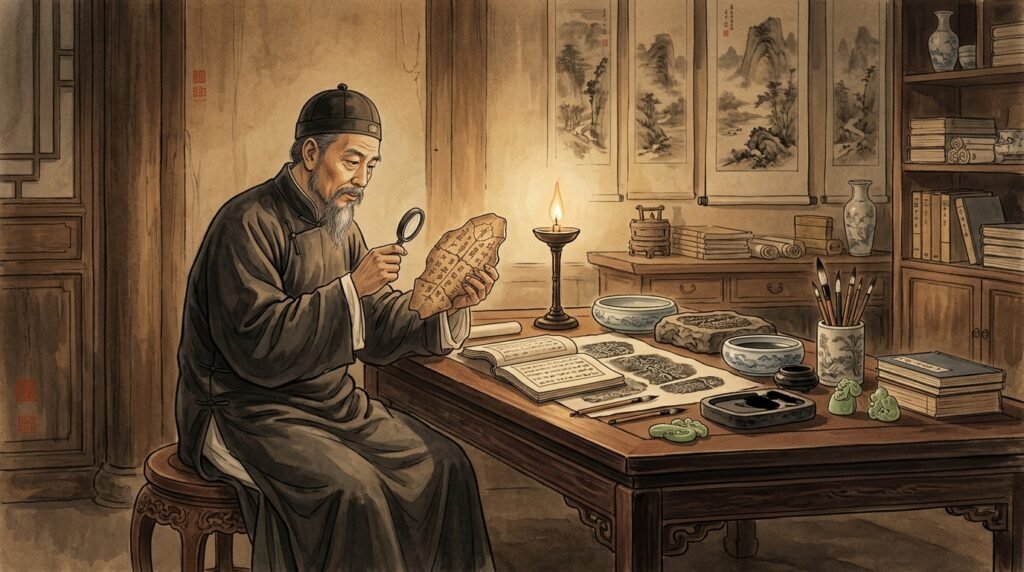
The central figure in this discovery was Wang Yirong (王懿榮, 1845–1900), courtesy name Lianqing (濂生), a native of Fushan in Shandong Province. A jinshi (進士) scholar of 1880, Wang had thrice been appointed Chancellor of the Imperial Academy (Guozijian jijiu 國子監祭酒), the preeminent educational office of the Qing state. Beyond his bureaucratic standing, Wang was the foremost epigrapher of his era, an acknowledged master of jinshixue (金石學, “the study of bronze and stone”). For decades, scholars of the Evidential Research school (kaojuxue 考據學) had studied ancient bronze vessels and stone stelae to verify and emend transmitted classical texts. Wang possessed an extraordinary visual memory and paleographic acuity, capable of recognizing minute stylistic evolutions in Chinese script across millennia of casting and chiseling.
In the autumn of 1899, Wang fell ill with a severe, recurrent bout of malaria (nüji 瘧疾). In late nineteenth-century Beijing, traditional Chinese pharmacology treated intermittent fevers, chills, and palpitations with longgu (龍骨, “dragon bones”)—fossilized Pleistocene mammal bones documented since the Han dynasty Shennong Bencao Jing (神農本草經) and prized for their sedative, spirit-calming properties (anshen 安神). Apothecaries customarily ground these brittle fossils into an anonymous white powder. On this occasion, however, unpulverized fragments were delivered to Wang’s residence—procured from an apothecary such as Da Rentang (達仁堂), or brought by his visiting friend, the novelist, engineer, and polymath Liu E (劉鶚, courtesy name Tiyun 鐵雲). Sifting through the fragments, Wang noticed flat pieces of bovine scapulae and turtle plastrons covered in fine, deliberate incisions. Where others saw insect trails (“dragon scales” 龍鱗) or natural desiccation fissures, Wang recognized the sharp, rectilinear strokes of an archaic script, carved with a burin into bone.
The incisions displayed rigorous graphic balance, stroke order, and recognizable ancestral forms of Chinese pictographs. They were clearly older and more angular than both the cast characters on Western Zhou bronzes and the Small Seal script (xiaozhuan 小篆) standardized by Qin Shi Huang in the third century BCE. Recognizing these fragments as primary historical documents of deep antiquity, Wang immediately began purchasing every inscribed piece available, offering generous silver bounties to antique dealers like Fan Weiqing (范維卿) of Weixian, Shandong. Though subsequent scholarship showed that antique runners had already begun gathering bones from Henan farmers, Wang Yirong was the first scholar in three millennia to recognize their true nature: they were the long-lost divination archives of the Shang dynasty.
The Decipherment Begins: Liu E, The Rubbings of Iron Clouds (Tieyun Canggui), and the Loss of Wang Yirong in 1900
The promise of Wang Yirong’s discovery was almost immediately engulfed by the geopolitical tempest of the Gengzi (庚子) year of 1900. By late spring, the Boxer insurgency entered Beijing with the sanction of conservative Manchu princes, besieging foreign legations and tearing up railway lines. When the Qing court took the fatal gamble of declaring war against eight foreign powers, Beijing descended into siege and street combat. The court appointed Wang Yirong as Commissioner of the Beijing Local Militia (Jingshi tuantian dachen 京師團練大臣), tasking him with maintaining civilian order and organizing urban defense.
It was an impossible assignment. On August 14–15, 1900, the Eight-Nation Alliance stormed Beijing. The imperial court fled westward to Xi’an in disguise. Wang Yirong, refusing to outlive the humiliation of his sovereign or witness the defilement of the dynastic altars (sheji 社稷), returned to his family compound at Donghuamen. Inscribing a final testament on his courtyard wall—”The Lord of the state has suffered humiliation; his minister must die”—he swallowed poison. When it proved too slow, he cast himself down the stone courtyard well; his wife, Madame Xie, and his eldest daughter-in-law followed him into the depths. Wang died at fifty-five, a Confucian martyr whose life was cut short just months after opening the doorway to Chinese prehistory.
Wang’s martyrdom plunged his household into financial ruin. His son, Wang Hanshang (王漢章), faced crushing funeral debts in an occupied capital. In this hour of crisis, the inscribed bones were saved through the intervention of Liu E (劉鶚, 1857–1909; literary name Liu Tiyun 劉鐵雲). A brilliant hydraulic engineer who had mastered Yellow River flood control, an entrepreneur, and author of the celebrated novel The Travels of Lao Can (老殘遊記), Liu had examined the bones in Wang’s study from the outset. To relieve the destitute family, Liu purchased over one thousand fragments from Wang Hanshang in 1901. Combining these with purchases from the dealer Zhao Zhizhai (趙執齋), Liu expanded his personal collection to more than five thousand pieces.
In the autumn of 1903, Liu E published Tieyun Canggui (鐵雲藏龜, The Hidden Turtles of Iron Cloud)—the world’s first published catalogue of oracle bone inscriptions. Printed in six lithographic fascicles, it contained high-fidelity ink rubbings (tuoben 拓本) of 1,058 carefully selected specimens. In his preface, Liu made three revolutionary deductions: he identified the script as “the writing of the Yin [Shang] dynasty” (殷人文字); he recognized recurring cyclical pairs as the Ten Heavenly Stems (Tiangan 天干) and Twelve Earthly Branches (Dizhi 地支) of the sexagenary cycle (jiazi 甲子); and he recognized that several glyphs matched royal temple titles (miaohao 廟號) recorded in ancient histories, such as Father Yi (Fu Yi 父乙), Ancestor Ding (Zu Ding 祖丁), and King Wu Ding (Wu Ding 武丁).
In the winter of 1904, Sun Yirang (孫誄讓, 1848–1908), the titan of Qing philology living in Rui’an, Zhejiang, received a copy of Tieyun Canggui. Working in seclusion with remarkable speed, Sun completed within two months Qiwen Juli (契文舉例, Examples of Inscribed Texts)—the first systematic academic monograph on oracle bone decipherment. Sun classified the inscriptions into functional categories—astronomical phenomena, sacrifices, military expeditions, agriculture, and royal health—and deciphered dozens of characters, demonstrating that jiaguwen was a grammatically structured language obeying regular linguistic laws.
The Secret of Xiaotun Village: Tracing the Diggers of Anyang and the Sima Qian Connection
Despite rapid intellectual strides between 1900 and 1908, the physical origin of the inscribed bones remained shrouded in commercial secrecy. Antiquities dealers from Weixian, Shandong carefully concealed the findspot to protect their lucrative monopoly. They circulated conflicting falsehoods, claiming the relics came from Tangyin (湯陰), the site of Youli (羑里) where King Wen of Zhou was purportedly imprisoned, or from Baoding (保定) in Zhili. This deception allowed dealers to buy bones from impoverished peasants for copper cash and resell them in Beijing for substantial sums in silver, while shielding the source from government intervention.
The scholar who shattered this conspiracy was Luo Zhenyu (羅振玉, 1866–1940), courtesy name Shuyun (叔蘊), literary name Xuetang (雪堂). A native of Shangyu, Zhejiang, Luo was one of the foremost antiquarians and epigraphers of modern China. Having examined the collections of Wang Yirong and Liu E, Luo doubted the dealers’ claims. He observed that the yellowish-red loess clay adhering to the cavities on the reverse of the bones was classic Henan loess, distinctly different from the gravelly alluvial soils of Tangyin.
In 1908, Luo resolved to bypass the dealers entirely. He tracked shipping along the Beijing-Hankou Railway and dispatched his younger brother, Luo Zhenchang (羅振常), on an undercover mission into northern Henan. Interviewing rural gatherers, Zhenchang traced the peddlers directly to their source. In late autumn 1908, he confirmed the truth: the inscribed bones were being unearthed by local peasants in Xiaotun (小屯), a village two kilometers northwest of Anyang (安陽) in Zhangde Prefecture (彰德府), nestled in a sweeping bend of the Huan River (洹水).
When Luo Zhenyu received his brother’s report confirming Xiaotun and the Huan River, a direct connection resonated with classical historical texts. In Chapter 7 of Sima Qian’s Shiji (史記, Records of the Grand Historian), the “Hereditary House of Xiang Yu” (項羽本紀), Sima Qian recounted the military campaigns of 207 BCE:
項羽引兵南渡洹水,軍於殷墟之上。與秦將章邯期盟於洹南殷虛上。
“Xiang Yu led his troops south across the Huan River and encamped upon the Ruins of Yin [Yinxu]. He pledged an alliance with the Qin general Zhang Han south of the Huan, atop the Ruins of Yin.”
The textual correlation was definitive. Transmitted histories, including the Shiji: Yin Benji and the “Pan Geng” chapters of the Shangshu (尚書), recorded that the nineteenth Shang monarch, King Pan Geng (盤庚), relocated his royal capital to Yin (殷) around 1300 BCE. There the Shang dynasty ruled for twelve kings and 273 years until the conquest by King Wu of Zhou at the Battle of Muye (c. 1046 BCE). Following the conquest, the royal precinct fell into ruin, remembered as Yinxu (殷墟)—the “Ruins of Yin.” The fields of Xiaotun were the physical core of Pan Geng’s capital, and the “dragon bones” were the royal archives of the late Shang court. Luo Zhenyu dispatched agents directly to Xiaotun, amassing over thirty thousand fragments and publishing milestone compendia such as Yinxu Shuqi (殷墟書契, 1913), permanently anchoring the oracle bones to their geographic cradle at Anyang.
The Shang Dynasty Reclaimed: From Mythological Doubts (Gu Shi Bian) to Solid Epigraphic Evidence
The discovery and localization of the oracle bones coincided with an acute intellectual crisis in modern China. Following the 1911 Revolution, the New Culture Movement challenged traditional Confucian authority, embracing Western scientific rationalism and historical criticism. In the field of history, this skeptical spirit crystallized in the “Doubting Antiquity School” (Gushibian pai 疑古派), spearheaded by Gu Jiegang (顧頡剛, 1893–1980) and Hu Shi (胡適, 1891–1962), alongside philologists like Qian Xuantong (錢玄同).
In his landmark 1923 manifesto in Gushi Bian (古史辨, Critique of Ancient History), Gu Jiegang formulated his theory of “ancient Chinese history fabricated layer upon layer” (cenglei de zaocheng de Zhongguo gushi 層累地造成的中國古史). Gu demonstrated that legendary culture heroes—such as Fuxi, Shennong, the Yellow Emperor, Yao, Shun, and Yu the Great—did not appear in the oldest extant texts like the Shijing, but emerged progressively in later texts from the Warring States and Han periods. Gu argued that successive generations continually projected idealized moral paragons deeper into the past to legitimize contemporary philosophies.
Under this critique, the historicity of China’s earliest dynasties was questioned. The Xia dynasty was viewed by modernists as a retrospective fiction invented by the Zhou. Skepticism soon enveloped the Shang dynasty itself; scholars questioned whether early kings like Tang the Victorious, Wu Ding, and Di Xin were merely moral archetypes illustrating the Mandate of Heaven (tianming 天命). For a brief period in the early 1920s, the second millennium BCE of Chinese history seemed on the verge of being relegated to mythology.
The decisive counterweight came from Wang Guowei (王國維, 1877–1927; courtesy name Jing’an 靜安, literary name Guantang 觀堂), one of the towering minds of modern Chinese scholarship. Working with Luo Zhenyu in Shanghai, Wang immersed himself in thousands of oracle bone rubbings. In 1917, Wang published a landmark study: Yin buci zhong suojian xiangong xianwang kao (殷卜辭中所見先公先王考, An Examination of the Ancestral Dukes and Kings Appearing in the Yin Divination Inscriptions), followed by a supplementary study (Xu kao 續考).
Wang conducted a rigorous epigraphic collation against Chapter 3 of the Shiji, the “Annals of Yin” (Yin Benji 史記·殷本紀). Modern skeptics had long dismissed Sima Qian’s genealogy of thirty-one Shang monarchs as an unverified Han romance. Wang systematically examined the ancestral sacrificial schedules (zhouji 周祭) on the oracle bones, in which late Shang kings offered cyclical sacrifices to royal ancestors identified by their temple names (miaohao 廟號). Wang proved that the predynastic dukes (Wang Hai, Shang Jia, Bao Yi) and dynastic kings (Da Yi, Pan Geng, Wu Ding, Zu Jia) matched Sima Qian’s genealogy in exact order, correcting only two minor generational misunderstandings concerning collateral brothers. In 1925, Wang codified this approach as the “Dual-Evidence Method” (Erchong zhengfaji 二重證據法): using excavated subterranean materials to verify and interpret transmitted classical texts. The oracle bones rescued the Shang from myth, anchoring China’s Bronze Age upon solid epigraphic ground.
The Anatomy of Divination: Bovine Scapulae, Turtle Plastrons, Pyro-osteomancy, and the Crack (Bu)
To understand the oracle bones is to understand the supreme ritual technology of the Shang state. The inscriptions were not secular administrative memos, but the physical residue of a centralized system of pyro-osteomancy (fire-divination on bone) and pyro-plastromancy (fire-divination on turtle shell). Through this ritual mechanism, late Shang monarchs consulted royal ancestors, nature spirits, and the supreme cosmic power, Di (帝) or Shangdi (上帝), seeking supernatural guidance for all major undertakings of the realm.
The materials of divination were strictly regulated:
- Bovine Scapulae (牛肩胛骨): The shoulder blades of cattle formed the primary mammalian medium, derived from domestic cattle (Bos taurus) and indigenous water buffalo (Bubalus mephistopheles).
- Turtle Plastrons (龜腹甲): The flat ventral shells were prized over curved dorsal carapaces. While local pond turtles (Chinemys reevesii) were harvested, massive plastrons over thirty centimeters long were imported as tribute from southern river valleys, as recorded in marginal shell inscriptions: “The southern marquis presented one thousand turtles” (南史侯來入龜千).
Pyromantic preparation took place on the reverse (uninscribed) side of the bone. To produce controlled cracks on the obverse face, diviners chiseled paired hollows: an elongated vertical gouge (zao 鑿) and an adjacent conical drill-pit (zuan 鑽). This drilling thinned the bone at the cavity base to a translucent membrane less than one millimeter thick, creating a precision stress point designed to fracture under thermal shock.
During the ceremony, a glowing heat source—a smoldering bronze rod or hardwood brand—was thrust into the conical pit. As intense heat induced rapid expansion in the thin membrane, structural tension sheared through to the obverse face. With a sudden acoustic pop, a fissure erupted. The fracture took the form of a vertical rupture intersected by a transverse spur, identical to the archaic character bu (卜). In Old Chinese phonology, 卜 was pronounced *pʰˤok or *puk—an onomatopoeic transcription of the bursting sound of the bone under heat.
The diviner (zhenren 貞人) and the King inspected the crack morphology (zhaowen 兆紋). Upward-slanting spurs were interpreted as auspicious (ji 吉); downward cracks indicated misfortune (xiong 凶). Scribes incised small ordinal numerals beside each crack to record the burning sequence. Following the divination, scribes carved the record onto the bone, adhering to a canonical four-part formula:
- 1. Preface (Xuci 敘辭): Cyclical date and diviner: `癸丑卜,爭貞` (“On day guichou, cracking: Zheng divined.”).
- 2. Charge (Mingci 命辭): The proposition submitted, often paired in positive and negative inquiries (duizhen 對貞): `王其往伐巴方,帝受又` (“The King shall attack the Bafang; Di will confer aid.”).
- 3. Prognostication (Zhanci 占辭): The King’s personal reading: `王占曰:吉` (“The King, reading the crack, said: Auspicious.”).
- 4. Verification (Yanci 驗辭): The retrospective outcome: `甲申王追伐,允獲` (“On day jiashen, the King pursued; truly, he captured them.”).
Deciphering the Jiaguwen: The Structure of Archaic Script and Linguistic Continuity
Over the past century and a quarter, more than 150,000 inscribed oracle bone fragments have been catalogued in collections worldwide. From this corpus, paleographers have isolated approximately 4,500 distinct individual characters (danzi 單字). Between 1,500 and 2,000 have been deciphered with scholarly consensus, covering core grammatical particles, royal titles, calendrical cycles, ritual verbs, and common nouns. The remaining unread characters consist largely of specialized personal names, clan insignia, obscure foreign polities (fang 方), and archaic ceremonial terms.
Far from a primitive pictographic cipher, jiaguwen was a fully articulated, structurally mature writing system. When the Eastern Han lexicographer Xu Shen (許慎) compiled the Shuowen Jiezi (說文解字) around 100 CE, he classified Chinese characters according to the “Six Principles” (Liushu 六書). Epigraphic analysis confirms that all six principles were already fully functional during King Wu Ding’s reign in the thirteenth century BCE:
- 1. Xiangxing (象形, Pictographic): Direct pictorial representations of physical phenomena—the sun (日), moon (月), rain (雨), ox (牛), deer (鹿), eye (目), and human (人).
- 2. Zhishi (指事, Indicative): Abstract relational and spatial markers—above (上), below (下), and middle (中).
- 3. Huiyi (會意, Associative Compounds): Combining semantic elements—bright (明, sun and moon), to follow (從, two figures in single file), and captive (囚, a person in an enclosure 囗).
- 4. Xingsheng (形聲, Phono-semantic Compounds): Combining a semantic radical with a phonetic component. Over 20% to 30% of oracle bone characters are already phono-semantic compounds, proving that Chinese writing had centuries of prior development before Wu Ding.
- 5. Jiajie (假借, Phonetic Loan): Borrowing an existing graph for an abstract homophone—such as lai (來), originally a wheat plant, borrowed for the spoken verb “to come.”
- 6. Zhuanzhu (轉注, Derivative Extensions): Mutually defining characters sharing morphological roots.
The material execution of the script provides further insights into Shang literacy. Although incised with bronze or jade blades, inscriptions were rarely carved freehand. Traces of red cinnabar (zhusha 朱砂) and black carbon ink (moshu 墨書) remain embedded within carved grooves, and uncarved bones preserve characters painted with an animal-hair brush (maobi 毛筆), showing modulated strokes with swelling entries and fine terminations.
This evidence indicates that brush writing was the everyday medium of Shang administration. In oracle bone script itself, the graph for “document”—ce (冊)—depicts vertical bamboo slips bound by cords, while dian (典, “statute”) depicts hands holding up a bundle of slips. The surviving oracle bones represent only a specialized ritual fraction of Shang writing; broader administrative records were kept on perishable bamboo tablets (jiandu 簡牘) that decayed in the northern soil.
In the history of world writing, jiaguwen exhibits an unmatched civilizational phenomenon. While cuneiform and Egyptian hieroglyphs perished, Oracle Bone Script is the direct ancestor of modern Chinese writing. Evolving through Western Zhou bronze script (jinwen), Warring States variants, Qin Small Seal (xiaozhuan), Han Clerical script (lishu), and Regular script (kaishu), its underlying structural morphology and syntax have remained constant. A literate reader today can instantly recognize characters like 日, 月, 雨, 山, 水, 木, 王, and 人 on a 3,200-year-old scapula, demonstrating an unbroken graphic continuity across three millennia.
The Academia Sinica Excavations (1928–1937): Li Ji, Dong Zuobin, and the Birth of Modern Chinese Archaeology
For nearly three decades following Wang Yirong’s discovery in 1899, Xiaotun was treated as an open-air commercial quarry. Peasant farmers dug uncontrolled pits across their fields, while dealers broke large plastrons into fragments to multiply sales, obliterating the stratigraphic and spatial context of the archives. Thousands of bones were smuggled abroad to collectors in Europe, America, and Japan. Scientific archaeology did not exist at Anyang until the political stabilization of 1928.
In 1928, the newly established Nationalist government founded the Academia Sinica (中央研究院). Under its auspices, the visionary historian Fu Sinian (傅斯年, 1896–1950) established the Institute of History and Philology (IHP, 歷史語言研究所). Rejecting traditional armchair antiquarianism, Fu issued a celebrated manifesto that became the philosophical motto of modern Chinese field archaeology:
我們不是讀書的人,我們是上窮碧落下黃泉,動手動腳找東西!
“We are not mere book-readers; we shall search high and low, down to the Yellow Springs, using our hands and feet to dig up things!”
In October 1928, the IHP dispatched Dong Zuobin (董作賓, 1895–1963), an epigrapher native to Henan, to Xiaotun to evaluate whether the subterranean deposits were exhausted. Dong’s test trenches revealed undisturbed cultural strata containing architectural foundations and caches of inscribed bones, prompting Fu Sinian to commit the Institute to a multi-year excavation program.
To direct field operations, Fu Sinian appointed Li Ji (李濟, 1896–1979). Having earned his doctorate in anthropology from Harvard University in 1923, Li brought Western scientific methodology to China: natural stratigraphy, 3D coordinate recording within a standardized grid, trench profile drawing, and the seriation of utilitarian gray pottery (huitao 灰陶) as the chronological backbone of the site. Li Ji’s methodological discipline earned him enduring recognition as the “Father of Modern Chinese Archaeology.”
Between 1928 and the outbreak of the Second Sino-Japanese War in July 1937, the IHP team conducted fifteen extensive excavation campaigns at Yinxu:
- Palace-Temple Precinct at Xiaotun: Over fifty monumental rammed-earth (hangtu 夯土) platforms, postholes with cast bronze plinths, drainage pipes, and workshops for bronze casting, bone carving, and jade lapidary production.
- Royal Cemetery at Xibeigang (西北岡): North of the Huan River, excavators uncovered eleven colossal cruciform tombs (yadaxing damu 亞字型大墓) with four access ramps, corresponding to the late Shang monarchs who ruled at Yin, containing chariot burials and hundreds of sacrificed human victims (xunren 殉人 and renji 人祭).
The crowning pre-war triumph occurred in the spring of 1936. At Xiaotun, the team discovered Pit YH127, an underground storage cellar packed with inscribed turtle plastrons. Realizing that field extraction would destroy fragile shells, Li Ji encased the entire three-ton block of earth in a timber frame, hoisted it onto a railcar, and transported it to Nanjing. There, Dong Zuobin and his staff spent months micro-excavating the deposit with dental tools, recovering 17,096 pieces of inscribed plastrons—the greatest royal divination archive ever found.
Drawing upon stratigraphic evidence, Dong Zuobin published in 1933 his epochal treatise, Jiaguwen duandai yanjiu li (甲骨文斷代研究例, Examples of Periodization in Oracle Bone Studies). Dong established ten diagnostic criteria (royal genealogies, diviner groups zhenren zu, calligraphic styles, and ritual cycles), classifying late Shang inscriptions into five chronological periods: Period I (King Wu Ding), Period II (Kings Zu Geng and Zu Jia), Period III (Kings Lin Xin and Kang Ding), Period IV (Kings Wu Yi and Wen Ding), and Period V (Kings Di Yi and Di Xin). Dong’s typology transformed oracle bone studies into a precision chronological discipline.
Fu Hao’s Tomb: The Unlooted Royal Crypt and the Scribe-Queen of Wu Ding
For nearly five decades, a persistent regret shadowed the Anyang excavations: every royal tomb discovered at Xibeigang had been thoroughly looted in antiquity. That historical absence was dramatically reversed in the winter of 1975–1976 through one of the most celebrated discoveries in world archaeology.
During the late Cultural Revolution, an archaeological team from the Chinese Academy of Social Sciences (CASS) was surveying land northwest of Xiaotun village under the leadership of Zheng Zhenxiang (鄭振香, 1929–2024), one of China’s first prominent female field archaeologists. Zheng noticed traces of rammed earth (hangtu) on an agricultural knoll scheduled for leveling. Resisting local political pressure to abandon the site, she conducted systematic core drilling with Luoyang spade augers. At a depth of several meters, the augers extracted traces of red cinnabar, decayed lacquer, and oxidized bronze. Zheng immediately identified an undisturbed subterranean burial shaft beneath the building foundation.
Excavations in the spring and summer of 1976 revealed Tomb No. 5 (M5), a rectangular pit tomb measuring 5.6 by 4.0 meters and 7.5 meters deep. Beneath an above-ground ancestral shrine, the excavators penetrated through sacrificial animal layers to the subterranean water table. Pumping water continuously, they uncovered an intact, unlooted royal Shang burial chamber that had remained sealed for 3,200 years.
The tomb yielded 1,928 catalogued artifacts:
- 468 Bronze Objects: Over 1.6 metric tons of bronze, including massive rectangular cauldrons (fangding 方鼎) weighing over 100 kilograms, owl-shaped wine vessels (xiaozun 鴞尊), bells, mirrors, and ceremonial battle axes.
- 755 Exquisite Jades: Dragons, phoenixes, tigers, human figurines in patterned robes, and ritual bi discs and cong tubes.
- 564 Bone and Ivory Carvings: Including turquoise-inlaid ivory beakers and delicate hairpins.
- 6,880 Cowrie Shells: The precious maritime currency of Bronze Age China.
On 109 of the finest bronze vessels and weapons, casting artisans had cast an identical two-character inscription: “Fu Hao” (婦好, Lady Hao). Several vessels bore the ancestral temple name “Queen Mother Xin” (Hou Mu Xin 后母辛). The discovery was an extraordinary convergence of archaeology and epigraphy: Fu Hao was already well known from over 250 Period I oracle bone inscriptions from the reign of King Wu Ding (c. 1250–1192 BCE). Tomb M5 materialized her physical reality in bronze and jade.
The combined textual and material evidence presents a woman who defied later Confucian gender conventions:
- Military Commander: Fu Hao was the supreme general of the late Shang state. Inscriptions record Wu Ding divining repeatedly: `登婦好伐羌` (“Order Fu Hao to summon troops and attack the Qiang”). In a campaign against the Yifang, she commanded 13,000 soldiers—the largest military mobilization recorded in Shang epigraphy. Her tomb contained four massive ceremonial bronze battle axes (yue 鉞), emblems of martial command.
- Priestess and Diviner: Fu Hao presided over state ancestral sacrifices (jisi 祭祀) and conducted pyro-osteomantic divinations herself.
- Estate Administrator: She held an independent territorial estate outside the capital, collecting grain taxes and presenting tribute.
Alongside her public roles, the oracle bones document Wu Ding’s personal devotion. The King divined repeatedly concerning her health, dental pain, and childbirth: “Divined: Fu Hao’s childbearing: will it be good? The King read the crack: If it is on a ding day, it will be good… Three weeks later, on jiayin, she gave birth: it was not good, it was a girl.” When Fu Hao died in her thirties, Wu Ding interred her beside his palace at Xiaotun, erecting an ancestral shrine (bici 妣祠) above her tomb and petitioning his royal ancestors in divination to take Fu Hao as their spiritual bride, ensuring her eternal protection.
Epigraphic Legacy: The Sima Qian King List Validated and the Evolution to Bronze Script (Jinwen)
The discovery of the oracle bones and the excavation of Yinxu constitute the foundational watershed of modern Chinese historical science. Its greatest historiographical achievement was the comprehensive vindication of the Records of the Grand Historian (Shiji 史記). Sima Qian composed his history around 100 BCE, more than eleven centuries after King Wu Ding ruled at Anyang. Throughout the nineteenth and early twentieth centuries, modern historical criticism assumed that no society lacking paper could accurately preserve genealogical records across a millennium; the “Annals of Yin” was widely regarded as an unverified pastiche of folklore and Han moralizing.
The oracle bones overturned this skepticism. When the royal genealogy reconstructed by Wang Guowei, Dong Zuobin, and Chen Mengjia from the sacrificial cycles was collated against Chapter 3 of the Shiji, the correspondence was extraordinary:
- Out of thirty-one Shang monarchs listed by Sima Qian, twenty-eight were verified by name on the original thirteenth-to-eleventh-century BCE divination bones!
- The sequence of generational succession was confirmed with near-total accuracy, correcting only two minor generational misunderstandings concerning collateral brothers.
- Predynastic Shang ancestors—figures such as Wang Hai, Shang Jia, and Bao Yi—whom skeptics had treated as myth, emerged as authentic historical figures receiving regular sacrifices.
The discovery also illuminated the organic evolution of Chinese writing from Bone to Bronze:
- Jiaguwen (甲骨文) vs. Jinwen (金文): Oracle bone script and bronze script were contemporary functional registers of the same linguistic system. Jiaguwen was incised rapidly into hard bone with sharp blades for transient divinations, favoring angular corners and rectilinear economy. Jinwen, cast into bronze ritual vessels via ceramic piece-molds, was sculpted in soft clay, favoring plastic curves and modulated strokes for eternal commemoration: “May sons and grandsons forever treasure and use this vessel” (子子孫孫永寶用).
- The Script Continuum: From late Shang bones and bronzes, the script evolved into Western Zhou liturgical bronzes (such as the Mao Gong Ding 毛公鼎), Eastern Zhou regional variants, Qin Small Seal (xiaozhuan 小篆), Han Clerical script (lishu 隸書), and finally Regular script (kaishu 楷書), which remains in active use today.
The foundation of oracle bone studies was built by the “Four Eminent Hall Scholars” (Jiagu Sisui 甲骨四堂):
- Luo Zhenyu (羅振玉, Xuetang 雪堂, 1866–1940): Identified the Xiaotun provenance, collected over 30,000 fragments, and published Yinxu Shuqi.
- Wang Guowei (王國維, Guantang 觀堂, 1877–1927): Validated the royal genealogy and established the Dual-Evidence Method.
- Dong Zuobin (董作賓, Yantang 彥堂, 1895–1963): Directed the Yinxu excavations, excavated Pit YH127, and established the Five-Period chronology.
- Guo Moruo (郭沫若, Dingtang 鼎堂, 1892–1978): Applied paleographic analysis in Jiagu wenzi yanjiu and directed the thirteen-volume Jiaguwen Heji.
The discovery of the oracle bones proved that over three thousand years ago, along the Huan River, there flourished a literate civilization of monumental architecture, metallurgical virtuosity, and a writing system of profound expressive vitality. Today, every modern Chinese character maintains a direct genealogical link to the glyphs incised upon bone in the autumn sunlight of Anyang thirty-two centuries ago.
Key Scholarly Bibliography and Excavation Reports
- Institute of Archaeology, Chinese Academy of Social Sciences (CASS) (1980). Yinxu Fu Hao Mu (殷墟婦好墓, The Tomb of Lady Hao at Yinxu). Beijing: Cultural Relics Publishing House. Primary archaeological excavation report on Tomb No. 5, detailing stratigraphy, 1,928 grave goods, bronze typologies, and epigraphic identifications.
- Guo, Moruo, and Hu, Houxuan, eds. (1978–1982). Jiaguwen Heji (甲骨文合集, Comprehensive Collection of Oracle Bone Inscriptions), 13 vols. Beijing: Zhonghua Book Company. Standard corpus containing rubbings and transcriptions of 41,956 selected inscriptions from global collections.
- Keightley, David N. (1978). Sources of Shang History: The Oracle-Bone Inscriptions of Bronze Age China. Berkeley: University of California Press. Foundational English-language monograph on osteomantic cracking, scribal conventions, and chronological methodology in Shang epigraphy.
- Li, Ji (1977). Anyang. Seattle: University of Washington Press. Authoritative retrospective by the “Father of Modern Chinese Archaeology,” recounting the fifteen pre-war excavation campaigns at Xiaotun and Xibeigang (1928–1937).
- Wang, Guowei (1917). “Yin buci zhong suojian xiangong xianwang kao” (殷卜辭中所見先公先王考, “Examination of Ancestral Dukes and Kings in Yin Divination Inscriptions”). Reprinted in Guantang Jilin (觀堂集林), 1927. Seminal paper matching the Shang king list with Sima Qian’s Shiji.
- Liu, E (1903). Tieyun Canggui (鐵雲藏龜, The Hidden Turtles of Iron Cloud). Lithographed in 6 fascicles. The first published book of oracle bone rubbings in world history, containing 1,058 rubbings from the collections of Wang Yirong and Liu E.
- Luo, Zhenyu (1913). Yinxu Shuqi (殷墟書契, Inscriptions from the Ruins of Yin). Kyoto and Shanghai. Milestone compendium publishing pristine rubbings of thousands of bones and definitively establishing Xiaotun as their findspot.
- Dong, Zuobin (1933). “Jiaguwen duandai yanjiu li” (甲骨文斷代研究例, “Examples of Periodization in Oracle Bone Studies”). Celebration Volume of the National Institute of History and Philology, Academia Sinica, 323–424. Established the Five-Period chronological sequence.
- Chen, Mengjia (1956). Yinxu Buci Zongshu (殷墟卜辭綜述, A Comprehensive Survey of Oracle Bone Inscriptions from Yinxu). Beijing: Science Press. Masterwork synthesizing Shang archaeology, religion, geography, and grammar.
- Chang, Kwang-chih (1980). Shang Civilization. New Haven: Yale University Press. Standard interdisciplinary synthesis combining archaeological stratigraphy, bronze metallurgy, and oracle bone epigraphy to reconstruct Shang social and political structure.
- Bagley, Robert (1999). “Shang Archaeology.” In The Cambridge History of Ancient China, edited by Michael Loewe and Edward L. Shaughnessy, 124–231. Cambridge: Cambridge University Press. Academic survey of Bronze Age material culture and the Anyang royal cemetery.
- Sun, Yirang (1904). Qiwen Juli (契文舉例, Examples of Inscribed Texts). Published posthumously in 1917. First scholarly monograph dedicated to deciphering the grammar, morphology, and ritual classification of oracle bone characters.
- Allan, Sarah (1991). The Shape of the Turtle: Myth, Art, and Cosmos in Early China. Albany: State University of New York Press. Major study exploring the cosmological significance of turtle plastromancy, the cosmos, and Shang ancestral sacrifice.
- Zheng, Zhenxiang, and Chen, Zhida (1981). “The Discovery and Significance of Tomb No. 5 at Yinxu.” Kaogu 1981(6): 511–518. Essential paper by the excavators analyzing Fu Hao’s status as royal consort, priestess, and military commander.
- Shaughnessy, Edward L. (1991). Sources of Western Zhou History: Inscribed Bronze Vessels. Berkeley: University of California Press. Traces the epigraphic evolution from late Shang oracle bone inscriptions to Western Zhou liturgical bronze texts.