1. The 1986 Discovery in Guanghan: Two Sacrificial Pits on the Bank of the Yazi River
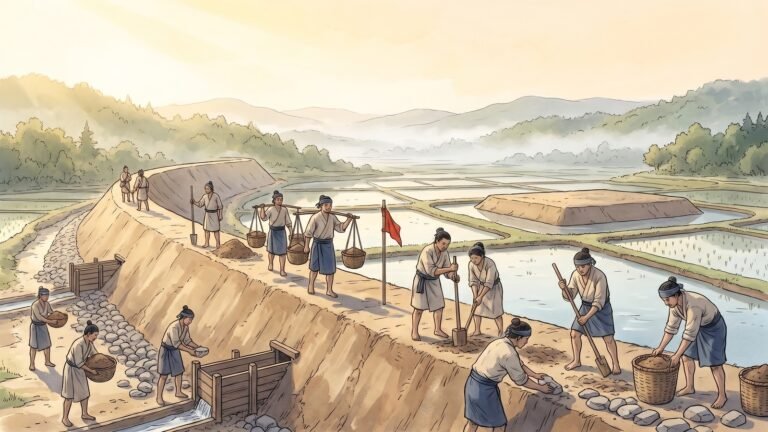
In the sweltering midsummer of 1986, thirty-eight kilometers north of Chengdu, the quiet agricultural landscape of Guanghan County (广汉) was transformed by the stroke of a laborer’s spade. Here, in Nanxing Township (南兴镇), the tranquil waters of the Yazi River (鸭子河, “Duck River”) meander across the fertile alluvial plain of western Sichuan, bounded to the west by the towering escarpment of the Longmen Mountains (龙门山). For generations, local peasants had farmed among three elongated earthen mounds rising from the river terrace. Arranged in an undulating line like three stars resting upon the earth, these mounds were known to local folklore as Sanxingdui (三星堆)—the “Three Stars Mound.” Paired with a crescent-shaped earthen ridge across the stream known as Moon Bay (月亮湾, Yueliangwan), the topography inspired the poetic idiom: “Three Stars Accompanying the Moon” (三星伴月, Sanxing Banyue). Yet beneath this pastoral setting lay buried the monumental ruins of an ancient civilization whose revelation would permanently alter East Asian archaeology.
The archaeological prologue had unfolded in the spring of 1929, when local farmer Yan Daocheng (燕道诚) and his son Yan Qingyuan were clearing an irrigation ditch behind their homestead. Yan’s hoe struck a stone slab covering a subterranean cistern packed with over four hundred polished jade and stone implements—radiant ritual discs (bi 璧), broad ceremonial blades (zhang 璋), and adzes. In 1934, David Crockett Graham, curator of the Museum of West China Union University (华西协合大学博物馆), conducted a pioneering excavation at Moon Bay with Chinese scholar Lin Mingjun (林名均), confirming an advanced prehistoric culture. Two decades later, in 1953, the eminent Sichuan archaeologist Feng Hanji (冯汉济) surveyed the dense scattering of ancient debris across the Yazi River basin, recording a prophetic assessment: the concentration of cultural remains was so immense that Guanghan was almost certainly the lost capital of the ancient Kingdom of Shu (古蜀国之都邑).
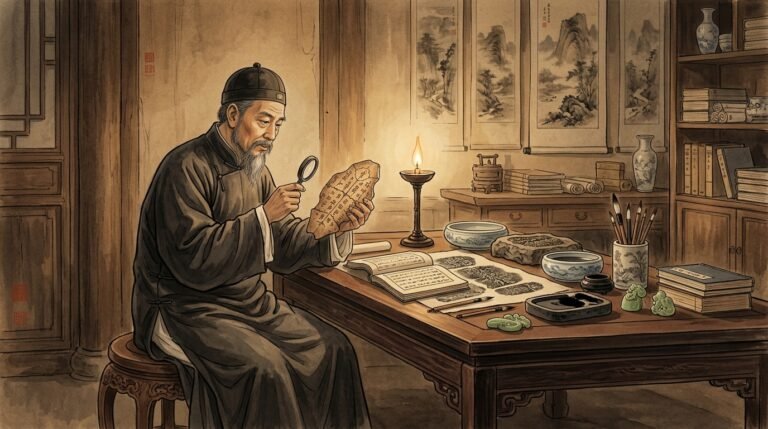
Nothing, however, prepared scholars for the summer of 1986. The Nanxing Second Brickworks (南兴第二砖厂) had established a commercial quarry at the Three Stars Mound, excavating clay for kiln bricks. On July 18, laborers struck polished nephrite and calcified bone. Archaeologists Chen De’an (陈德安) and Shen Jiande (沈仲常) rushed from Chengdu to excavate Pit 1 (K1). Measuring 4.5 by 3.4 meters, the trench yielded thirteen expressive bronze human heads, a 1.42-meter gold-sheathed scepter, jade ceremonial halberds (ge 戈) and blades (zhang 璋), cowrie shells, and three cubic meters of charred animal bones.
Just as Pit 1 was being cleared, thirty meters to the southeast, a second brickmaker’s spade struck bronze on August 14. This was Pit 2 (K2), a rectangular trench measuring 5.3 by 2.3 meters. Beneath a dense layer of over sixty intact Asian elephant tusks lay hundreds of bronze masterpieces: towering life-sized human statues, bronze trees with perching celestial birds, and colossal bronze masks with protruding cylindrical eyes. The discoveries of 1986 dismantled the orthodoxy that ancient Sichuan was an isolated barbarian hinterland, demonstrating that while the late Shang dynasty (商朝) cast ancestral cauldrons at Anyang (Yinxu 殷墟), a co-equal, technologically sophisticated, and religiously unique civilization flourished along the upper Yangtze River.
2. The Visual Shock: Protruding Eyes, Cylindrical Pupils, and Gigantic Ears
The eyes of Cancong were vertical and protruding, and he first proclaimed himself king of the Shu.
Chang Qu (常璩), Annals of the Kingdom of Huayang (华阳国志), c. 355 CE
To encounter the bronze masks of Sanxingdui is to experience an acute aesthetic and intellectual dislocation. For over a century, the visual lexicon of Bronze Age China had been defined by the sober, zoomorphic repertoire of the Central Plains (Zhongyuan 中原). In the ancestral temples of the Shang kings at Erlitou, Zhengzhou, and Anyang, bronze metallurgy was deployed almost exclusively in the service of sacrificial feasting: massive three-legged cauldrons (ding 鼎) and wine vessels (zun 尊, jue 爵) adorned with composite animal masks (taotie 饕餮) and coiled dragons. In this northern visual universe, the human form was exceedingly rare and heavily subordinated to abstract ritual ornamentation. If human faces appeared at all—such as faces bracketed by tiger jaws on Yinxu battle-axes—they were two-dimensional, stylized emblems of captive sacrifice or ritual communion with predatory beasts.
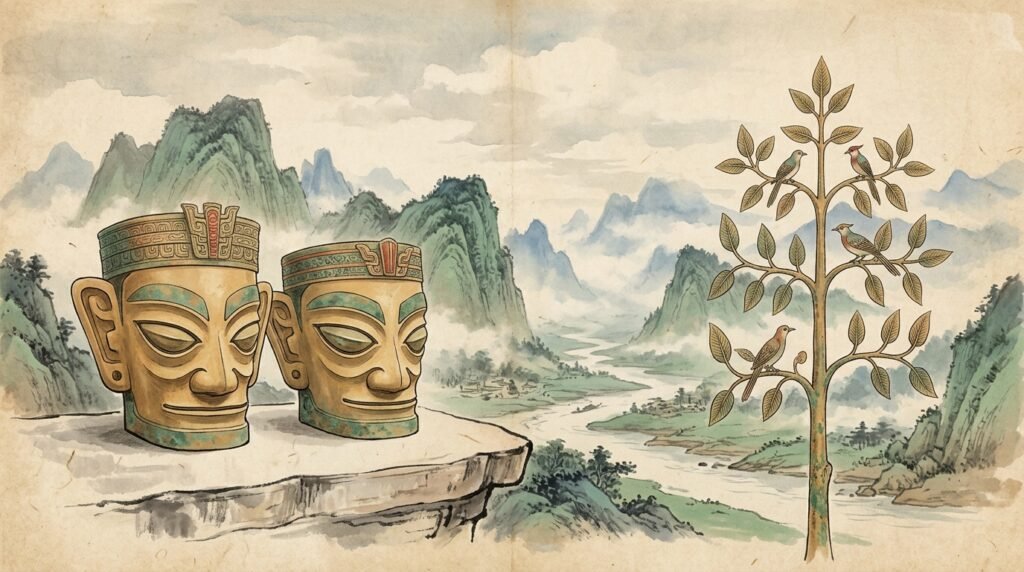
Sanxingdui, by contrast, introduced into East Asian art a monumental obsession with the human countenance. Foremost among these works are the colossal bronze masks unearthed from Pit 2. The largest and most iconic is the Great Bronze Mask with Protruding Eyes (青铜纵目面具, qingtong zongmu mianju, K2:148). Cast in a single pour of molten bronze, this sculpture measures 138 centimeters in width, 66 centimeters in height, and weighs over 80 kilograms. Its features defy terrestrial human anatomy: the eyeballs project outward from their sockets as hollow cylindrical shafts extending an astonishing sixteen centimeters. The ears stretch outward and upward like the soaring wings of a raptor, extending nearly seventy centimeters from base to tip. The mouth is a wide horizontal slit curling upward into an enigmatic, transcendent smile. A companion mask (K2:144) preserves its original vertical forehead ornament: an intricate 68-centimeter-tall bronze plume shaped like an ascending dragon or cosmic flame.
In archaic thought, sensory amplification symbolizes supernatural perception. Eyes that thrust outward along cylindrical stalks are the visual embodiment of divine clairvoyance—the capacity to pierce physical occlusions and witness the celestial spheres (“thousand-league eyes”, 千里眼, qianli yan). Similarly, the colossal flaring ears represent cosmic clairaudience (“wind-accompanying ears”, 顺风耳, shunfeng er), granting the bearer the power to capture the whispers of deities and ancestors carried upon the winds. This iconography produced an immediate shockwave across classical historiography, vindicating an ancient passage in the Huayang Guo Zhi (华阳国志) by Chang Qu (常璩): “The first king of Shu was called Cancong; his eyes protruded vertically” (蜀侯蚕丛,其目纵). Long dismissed as myth, Cancong’s vertical eyes were revealed as an authentic historical memory cast into bronze.
In addition to these colossal masks, Pits 1 and 2 yielded more than fifty life-sized bronze heads displaying social stratification through coiffure: braided hair (bianfa 辫发) trailing down the nape versus pinned hair (guanji 笄发) clasped beneath ceremonial caps, denoting cooperating sacerdotal and administrative castes. Most breathtaking are four heads overlaid with sheets of hammered pure gold leaf. Adhered with organic lacquer, these gold-sheathed faces glowed with unearthly radiance, demarcating rulers who walked among men as living manifestations of solar deities.
3. Metallurgy and Craftsmanship: The Sacred Bronze Trees, Birds, and Gold-Sheathed Scepters
In the vast wilderness stands the Jianmu tree, by which the gods ascend and descend between Heaven and Earth.
Classic of Mountains and Seas (山海经: 海内经)
If the bronze masks revealed the psychological and religious face of Sanxingdui, its monumental bronze trees demonstrated a mastery of metallurgical engineering unmatched in the ancient world. Chief among these is Bronze Tree No. 1 (一号青铜神树, K2:396), unearthed in thousands of crushed fragments from Pit 2. Reconstructed over a decade by conservators at the Sichuan Provincial Institute, the tree stands at an astonishing 3.96 meters in height. Even with its uppermost finial missing, it remains the tallest, most complex single bronze sculpture surviving from antiquity, dwarfing in sculptural ambition anything produced in the contemporary Near East or the Yellow River valley.
The tree rises from a three-legged circular base representing mountain peaks with subterranean roots. From this pedestal rises a vertical trunk divided into three tiers. At each tier, three branches arch downward before sweeping upward at their tips into lush foliage laden with pendulous fruits—nine branches in total. Perched atop each branch is a celestial bird with long crest and plumage. Winding downward along the trunk is a monumental, serpentine dragon cast in high relief: its horned head and clawed forelegs rest upon the lower pedestal, while its undulating scaly body twists upward, connecting terrestrial roots to celestial heights.
This sculpture embodies the cosmic arboreal mythology preserved in the Shan Hai Jing (山海经) and Huainanzi (淮南子). In ancient cosmology, the universe was anchored by sacred trees: the Fusang (扶桑) in the eastern dawn, the Ruomu (若木) in the western dusk, and the Jianmu (建木) at the center of the world in Shu. In the myth of the Ten Suns, ten solar birds inhabited the world tree; each morning, one bird carried the sun across heaven while nine rested within the branches. Bronze Tree No. 1 captures this cosmic moment: nine sun-birds resting in balance, while the tenth traversed the sky above the open-air sanctuary. As the Jianmu, the tree served as an axis mundi—a cosmic ladder along which shamans (wu 巫) ascended to commune with deities.
Equally radical is the Great Gold Scepter (金杖, K1:1) from Pit 1. Measuring 142 centimeters in length and weighing 463 grams of hammered gold leaf over a wooden core, its surface is incised with crowned human heads, paired birds (fu 凫), and paired fish (yu 鱼) pierced by arrows. In the Central Plains, sovereign authority was symbolized by bronze cauldrons (ding) and jade blades (gui). The royal scepter connects Sanxingdui to the royal staff traditions of Central Asia and the Eurasian steppe. Moreover, the paired fish and bird motifs constitute a visual rebus for the third king of Shu: King Yufu (鱼凫, “Fish-Cormorant”). Geochemical lead isotope analyses by Jin Zhengyao (金正耀) have shown that Sanxingdui bronzes possess “highly radiogenic lead” identical to early Shang bronzes at Zhengzhou and Anyang, proving that both civilizations tapped shared polymetallic ore sources in southwest China via extensive continental trade routes.
4. The Ancient Kingdom of Shu: Myth, Chronology, and the Annals of Huayang (Huayang Guo Zhi)
Cancong and Yufu! How vast and dim their beginnings! Forty-eight thousand years have passed, yet no smoke of human passage crossed the Qin borders.
Li Bai (李白), The Road to Shu is Hard (蜀道难), 8th century CE
For two millennia, the Sichuan Basin was cast in classical northern historiography as a remote, primeval wilderness shrouded in mountain mist. In foundational northern texts—from the Shangshu (尚书) to Sima Qian’s Shiji (史记)—civilizations south of the Qinling Mountains were largely dismissed as barbarian enclaves (the Nanman 南蛮). When the Tang dynasty poet Li Bai (李白) composed Shu Dao Nan (《蜀道难》), he captured this historical estrangement, lamenting that between the dawn of Shu and the Qin conquest, “forty-eight thousand years had passed, yet no smoke of human passage crossed the Qin borders.” The ancient rulers were remembered as ghostly phantoms rather than monarchs of bronze and stone.
The sole comprehensive ancient textual record of this lost realm is the Huayang Guo Zhi (华阳国志, Annals of the Kingdom of Huayang), compiled around 355 CE by the Eastern Jin scholar Chang Qu (常璩). Drawing upon regional oral lore, Chang Qu recorded a dynastic sequence of five sovereign lineages that ruled the Sichuan Basin before its conquest by Qin in 316 BCE:
- Cancong (蚕丛): The foundational divine ancestor dwelling in the caves of the Minshan mountains (岷山), celebrated for his vertical protruding eyes (zongmu 纵目) and revered for introducing sericulture and silk clothing.
- Baihuo (柏濩 / 柏灌, Baiguan): The enigmatic second dynastic lineage, associated with sacred ancient cypress groves and riverine water-birds, ruling across centuries of peaceful continuity.
- Yufu (鱼凫): The “Fish-Cormorant” king who led the Shu people from mountain valleys down onto the fertile Chengdu Plain, establishing sedentary wet-rice agriculture and river fishing as the foundations of state power.
- Duyu (杜宇, Wangdi 望帝): The civilizing sovereign who systematized agricultural calendarization and terracing, later abdicating after massive deluges and transforming into the mournful cuckoo bird (duyu / zigui 子规).
- Kaiming (开明): The hydraulic dynasty founded by Bieling (鳖灵) of Chu, who cut channels through Mount Wu to drain the plain, reigning through twelve generations until the Qin conquest in 316 BCE.
Systematic excavations across Sanxingdui have established a four-phase archaeological sequence that mirrors this mythological chronology with remarkable precision: Phase I (c. 2800–2000 BCE) corresponds to the terminal Neolithic Baodun Culture (宝墩文化), marked by walled settlements—the material echo of Cancong. Phase II (c. 1600–1400 BCE) witnessed proto-urban ramparts and early bronzes contemporary with Erlitou, corresponding to Baihuo. Phase III (c. 1400–1050 BCE) marks the glorious apex of the 3.6-square-kilometer walled city, palatial platforms, and sacrificial pits, contemporary with late Shang Yinxu—the epoch of Yufu. Finally, Phase IV (c. 1050–800 BCE) marks urban decline and the southward relocation of the royal center to Jinsha, coinciding with Duyu and the Kaiming dynasty.
5. Challenging the Monocentric Myth: Pluralistic Origins of Chinese Civilization Beyond the Yellow River
Chinese civilization did not originate from a single cradle like a solitary trunk, but emerged like a night sky ablaze with full stars.
Su Bingqi (苏秉琦), A New Exploration of the Origins of Chinese Civilization (1997)
The discovery of Sanxingdui dismantled one of the most deeply entrenched dogmas of modern historiography: the “Central Plains Monocentric Model” (中原中心论). Rooted in traditional Confucian texts and early twentieth-century archaeology following the discovery of Anyang oracle bones, this model asserted that Chinese civilization emerged uniquely in the Yellow River basin (Henan, southern Shanxi, and western Shandong). According to this diffusionist paradigm, the Yellow River was the solitary cradle where agriculture, bronze metallurgy, writing, and statecraft were forged, radiating outward to civilize the passive, barbarian periphery.
The material reality unearthed at Guanghan rendered this monocentric model untenable. Here, in the upper Yangtze River basin behind formidable mountain barriers, was a society contemporary with late Shang Yinxu possessing an urban footprint exceeding Anyang, bronze casting of staggering virtuosity, unprecedented gold artistry, and a complex state apparatus capable of mobilizing immense resources. Sanxingdui was not a provincial backwater imitating northern forms; it was an independent, fully autonomous civilizational pole with its own distinct cosmological ideology and ritual architecture.
This revelation catalyzed a theoretical revolution spearheaded by Su Bingqi (苏秉琦) and Kwang-chih Chang (K.C. Chang, 张光直). In A New Exploration of the Origins of Chinese Civilization, Su formulated the theory of “Regional Systems and Cultural Types” (区系类型理论), famously employing the metaphor of “Full Stars in the Sky” (满天星斗, Mantian Xingdou). Su argued that early Chinese civilization was a polycentric constellation of autonomous regional cultures—the Hongshan of the northeast, the Liangzhu of the lower Yangtze, the Longshan of the east coast, the Erlitou of the Central Plains, and the Sanxingdui of the upper Yangtze. Expanding upon this, K.C. Chang proposed the “Chinese Interaction Sphere” (中国相互作用圈), framing the emergence of Huaxia (华夏) as the outcome of multi-directional dialogue, trade, and ideological exchange among these regional spheres.
Sanxingdui was an active participant in this interaction sphere, practicing sophisticated cultural syncretism. It imported and cast classic Central Plains ritual bronze vessels, specifically flaring zun (尊) and high-shouldered lei (罍) adorned with taotie masks and ram-head flanges. Yet its religious ontology diverged completely from the north. Shang religion was bureaucratic, aniconic, and ancestral, communicating via oracle bone divination (jiaguwen 甲骨文) and offering food to invisible spirits through tripod cauldrons. Sanxingdui religion was iconic, ecstatic, and shamanic, staging public ritual theater with life-sized statues, monumental masks of solar deities, and cosmic trees bridging the cosmos. As Lothar von Falkenhausen observed, Sanxingdui reveals an entirely distinct spiritual worldview operating within the broader East Asian Bronze Age.
6. The Sacrificial Ritual: Intentional Burning, Smashing, and Orderly Burial
The sacred vessels were consumed by the flame, and the pure smoke ascended into the high heavens to reach the gods.
Book of Rites (礼记: 祭法)
To examine the contents of the Sanxingdui pits is to confront a scene of ancient ritual catastrophe. The thousands of precious artifacts deposited within these rectangular trenches were not laid down in the peaceful repose of a royal cemetery or the organized storage of a treasury. Instead, the material record bears the marks of deliberate, violent destruction. Before their final internment, the sacred treasures of Sanxingdui were methodically smashed, dismembered, burned in fierce conflagrations, and trampled underfoot.
The physical trauma was comprehensive. Monumental bronze trees were severed at their joints, their branches twisted and snapped into hundreds of segments. Bronze human statues were decapitated, their limbs sheared from their torsos. The gold-sheathed scepter was crumpled and bent; gold foil was torn from bronze faces; and ceremonial jade blades were fractured with heavy hammer blows. Layers of charcoal and timber were stacked atop the broken bronzes and ignited in roaring pyres, reaching temperatures that oxidized the metal, produced black and reddish thermal patinas, cracked heavy castings, and fused melted gold leaf onto bronze and ceramic substrates. Mingled within this incinerated stratum were cubic meters of charred animal bones—cattle, sheep, pigs, and deer—testifying to massive animal offerings accompanying the blaze.
Yet what deepens the mystery of Sanxingdui into an enduring paradox is that this furious violence was followed immediately by an astonishingly disciplined, reverent ritual deposition. The stratigraphy reveals an unwavering sequence of burial: at the very bottom lay the charred animal bones, wood ash, and shattered coarse pottery. Above this sacrificial bed, officiants carefully arranged the broken bronze statuary, monumental protruding-eye masks, gold scepters, and thousands of ceremonial jade blades (zhang, ge, bi) in horizontal layers. Then, in an act of breathtaking theatricality, the officiants blanketed the entire deposit beneath a continuous canopy of hundreds of intact Asian elephant tusks, stacked like timber logs. Finally, the pits were backfilled with sterile yellow clay, tamped level with the terrace, leaving no mound or monument to betray their location.
- The “Burnt Offering” (Liaoji 燎祭) Hypothesis: Advanced by Chen De’an and Sun Hua, proposing that smashing and burning constituted “ritual killing” to release the spiritual essence of sacred objects into ascending smoke to reach celestial deities.
- The Temple Decommissioning / Ritual Renewal (Yanzhi 瘗埋) Hypothesis: Formulated by Lothar von Falkenhausen and Robert Bagley, suggesting that sacred temple regalia were periodically retired, desacralized, and reverently interred when replaced.
- The Dynastic Rupture / Iconoclastic Upheaval Hypothesis: Proposed by Li Boqian, interpreting the deposits as the violent aftermath of a political coup or civil war between indigenous mask-worshipping theocrats and rising vessel-using secular elites.
- The Emergency Concealment Hypothesis: Postulating that priests ritually purified and buried their holiest treasures in haste to prevent desecration by an impending foreign military invasion before fleeing southward.
7. The 2019-2022 New Excavations: Pits 3 through 8, Silk Traces, and Ivory Tushes
The discovery of silk proteins in the sacrificial pits provides scientific confirmation for the first time of the ancient Shu kingdom’s sericultural tradition recorded in the legend of Cancong.
Official Excavation Bulletin, National Cultural Heritage Administration (2021)
For more than three decades following the 1986 discovery, Pits 1 and 2 stood as isolated enigmas. That changed in late 2019, when the Sichuan Provincial Institute of Cultural Relics and Archaeology, alongside Peking University, Sichuan University, the CASS Institute of Archaeology, and thirty-four national scientific research institutions, initiated a massive re-investigation of the sacrificial area. Between October 2020 and late 2022, systematic prospecting uncovered six new rectangular sacrificial pits—designated Pits 3, 4, 5, 6, 7, and 8—situated directly adjacent to Pits 1 and 2, forming a tightly planned ritual plaza oriented on a northeast-to-southwest axis.
This campaign inaugurated the “Second Golden Age of Sanxingdui Archaeology,” distinguished by state-of-the-art archaeological science. The excavation zone was enclosed within climate-controlled glass cabins maintaining a constant 20°C and 80% relative humidity, with HEPA filtration to protect ancient organics. Archaeologists wore hermetic clean-room suits and operated from motorized overhead gantry cranes, floating above the cultural layers without treading on fragile artifacts. On-site laboratories equipped with portable X-ray fluorescence (pXRF), hyper-spectral imaging, 3D scanning microscopes, and nitrogen-purged preservation chambers enabled immediate chemical and structural analysis as artifacts emerged.
The six new pits yielded more than 13,000 artifacts, including over 3,100 intact masterpieces. Pit 3 revealed a monumental bronze mask measuring 135 centimeters in width and a sculpture of a kneeling figure balancing a Shang-style zun vessel upon its head (dingzun qingtong renxiang 顶尊青铜人像), illustrating how Central Plains ritual bronze vessels were subordinated into indigenous shamanic ceremonies. In Pit 4, dense layers of burned bamboo and timber charcoal enabled Peking University’s radiocarbon laboratory to conduct seventy-three AMS carbon-14 tests. Bayesian calibration models established a tightly constrained dating window of 3148 to 2966 cal BP (c. 1198–1016 BCE), proving that all eight pits were deposited synchronously during the late Shang dynasty (contemporary with kings Wu Ding 武丁 through Di Xin 帝辛).
Pits 7 and 8 yielded peerless sculptural compositions: Pit 7’s “Turtle-Shell Shaped Bronze Vessel with Jade Inside” (龟背形网格状器)—an openwork bronze chelonian carapace holding a rectangular slab of nephrite jade—and Pit 8’s monumental “Bronze Altar” (青铜神坛) depicting a multi-tiered cosmic tableau, alongside a colossal “Bronze Mythical Beast” (青铜神兽) carrying a human rider. Crucially, micro-Raman spectroscopy and ELISA immunological testing identified silk fibroin proteins coating bronze masks and ivories across Pits 3, 4, 7, and 8. The bronze masks were wrapped in fine, patterned silk textiles prior to burial, providing the first physical evidence confirming the legend of Cancong and proving Bronze Age Sichuan was an advanced center of sericulture. Furthermore, over 400 elephant tusks (Elephas maximus) were recovered from Pit 8 alone, demonstrating a warm, subtropical Bronze Age climate or long-distance trade routes extending southward into Yunnan and Southeast Asia.
8. Jinsha and the Legacy: How Sanxingdui Transformed into the Chengdu Culture
The four golden sun-birds circle endlessly around the flaming solar core, binding the spirit of Sanxingdui to the soil of Jinsha.
Archaeological Monograph on the Jinsha Site (2006)
For fifteen years following the 1986 discovery, archaeologists wondered what became of Sanxingdui after its great walls were abandoned and its bronzes buried. The answer arrived on February 8, 2001, in the western suburbs of modern Chengdu, thirty-eight kilometers southwest of Sanxingdui. During construction of the “Shu Feng Hua Yuan” residential development in Jinsha village (金沙村, Qingyang District), backhoes uncovered a subterranean stratum packed with ivory tusks, jade blades, and gold. Emergency excavations across five square kilometers revealed the direct successor to Sanxingdui: the royal and ritual center of the Twelve Bridges Culture (十二桥文化), which flourished from roughly 1200 to 600 BCE, spanning the Late Shang through the Western Zhou.
The stylistic, religious, and technological continuity between Sanxingdui and Jinsha demonstrates an unbroken lineage spanning half a millennium. This kinship is epitomized by Jinsha’s most celebrated masterpiece: the “Golden Sun Bird” (太阳神鸟金箔, Taiyang Shenniao). Unearthed from the sacrificial area, this wafer-thin disc of hammered 94.4% pure gold foil measures 12.5 centimeters in diameter and 0.02 millimeters in thickness, weighing twenty grams. Its inner circle features twelve radiating solar rays rotating clockwise in an eternal vortex of cosmic light, while the outer register depicts four crested celestial birds flying counter-clockwise around the sun. The Golden Sun Bird is the direct descendant of the solar birds on Sanxingdui’s bronze trees, encapsulating the solar cult of ancient Shu. In 2005, it was officially adopted as the permanent emblem of Chinese Cultural Heritage (中国文化遗产标志).
Equally compelling is the Jinsha Gold Mask (金沙金面具), a forty-four-gram pure gold mask whose angular jaw, slanted eyes, triangular nose, and perforated ears match the miniature gold-sheathed bronze heads of Sanxingdui with twin-like fidelity. Jinsha also yielded a bronze statuette (19.6 centimeters high) whose long robe, braided hair (bianfa), and hollow grasping hands reproduce in miniature the iconic posture of Sanxingdui’s 2.6-meter bronze standing colossus. Shared notched jade zhang blades, bi discs, and massive unburned elephant tusk caches demonstrate that the core liturgical ceremonies of Shu remained vibrant at Jinsha.
Yet Jinsha represents a profound evolution in political economy and artistic philosophy. At Jinsha, archaeologists found no colossal bronze statues, no four-meter bronze trees, and no eighty-kilogram masks. The monumental casting infrastructure of Sanxingdui was abandoned in favor of smaller, refined, portable prestige objects in gold, jade, and ivory. This reflects a transition from a centralized temple-theocracy dominated by colossal public idols toward a more secular, agile aristocratic regime—one that laid the urban and administrative foundations for historic Chengdu, which has endured upon the same site for over 2,300 years.
9. The Mystery of Abandonment: Earthquakes, River Shifts, or Religious Upheaval?
The ancient walls fell silent, the altars were covered with silt, and the gods slept beneath the yellow earth until the spade awoke their bronze gaze.
Lin Xiang (林向), Studies in the Archaeology of Ancient Shu (2004)
One of the greatest unsolved enigmas in world archaeology remains the sudden abandonment of Sanxingdui around 1050 BCE. For nearly half a millennium, this fortified city of rammed-earth ramparts, palatial compounds, bronze foundries, and ritual sanctuaries had stood as the undisputed metropolis of southwestern East Asia. Then, within a single generation, the monumental precinct was systematically decommissioned: temples burned, bronze idols buried beneath ivory in subterranean pits, and palaces left to silt. Why did the rulers of Sanxingdui abandon their capital?
Three primary models have emerged to explain this civilizational rupture: The first is the Geological and Hydrological Cataclysm Theory. The Chengdu Plain sits directly beneath the violently active Longmen Mountain Fault Zone (龙门山断裂带), epicenter of the 2008 Wenchuan earthquake (magnitude 7.9). Geoarchaeological coring surveys led by Professor Fan Nianxue (范念学) have revealed evidence of a massive seismic disaster that struck the upper Min and Tuo river drainages around three thousand years ago—matching the terminal date of Sanxingdui Phase III. Immense earthquakes triggered landslides in mountain gorges, damming the river upstream. When these dams breached under monsoon rains, flash floods swamped the plain, causing river avulsion. The Yazi River, which flowed along Sanxingdui’s northern wall as municipal moat, drinking source, and transport artery, was diverted away or choked with debris. Deprived of water and riverine transport, the court organized an orderly evacuation southward to the Jin River (锦江) at Jinsha.
The second explanation posits an Internal Religious Revolution and Sacerdotal Schism. As demonstrated by the divergent coiffures between “braided-hair” (bianfa) and “pinned-hair” (guanji) lineages, Sanxingdui society rested upon a compromise between a shamanic, mask-wearing priestly elite and an emerging secular, military aristocracy. By the end of the second millennium BCE, this social contract may have fractured into civil war. The military aristocracy, having forged trade ties with the Central Plains and adopted bronze vessel-feasting, may have overthrown the old theocracy. The burning, smashing, and subterranean interment of the bronze pantheon represented ritualized iconoclasm—a purge of the old gods followed by a reformed dynastic order at Jinsha.
The third explanation connects Sanxingdui’s fall to the Western Zhou Conquest of the Shang in 1046 BCE. In the Shangshu (尚书: 牧誓), King Wu of Zhou (周武王) rallied allied states before the Battle of Muye (牧野之战), explicitly naming Shu: “Men of Yong, Shu, Qiang, Mao, Wei, Lu, Peng, and Pu…” (庸、蜀、羌、髳、微、卢、彭、濮人). Shu’s active participation in toppling the Shang brought northern prestige, captive wealth, and diplomatic re-alignment, catalyzing domestic state reorganization and relocation to Jinsha. Ultimately, natural disaster, religious transformation, and geopolitical integration were interlocking catalysts. Yet even as the city fell silent, the bronze masks preserved through three millennia the unblinking gaze of an ancient people who dared to cast their cosmic wonder into immortal bronze.
10. Major Scholarly References and Archaeological Excavation Reports
The archaeological study of Sanxingdui and the Bronze Age civilization of ancient Shu is established upon four decades of excavation monographs, peer-reviewed archaeometric studies, and critical historical texts. Below are the foundational works that constitute the cornerstone of modern Sanxingdui scholarship:
- Sichuan Provincial Institute of Cultural Relics and Archaeology (四川省文物考古研究所). Sanxingdui Jisikeng (三星堆祭祀坑) [The Sacrificial Pits of Sanxingdui]. Beijing: Cultural Relics Publishing House (文物出版社), 1999. The definitive two-volume archaeological monograph documenting primary stratigraphic data, artifact catalogues, metallurgical assays, and radiocarbon dates from the 1986 excavation of Pits 1 and 2.
- Sichuan Provincial Institute of Cultural Relics and Archaeology et al. “Excavation of Pits 3, 4, 7, and 8 of the Sanxingdui Site in Guanghan, Sichuan (四川广汉三星堆遗址三、四、七、八号祭祀坑发掘简报).” Wenwu (Cultural Relics) and Kaogu (Archaeology), 2021–2023 series. Preliminary excavation reports detailing clean-cabin micro-excavation, hyper-spectral scanning, and the recovery of over 13,000 artifacts from the six new pits.
- Bagley, Robert (ed.). Ancient Sichuan: Treasures from a Lost Civilization. Seattle: Seattle Art Museum and Princeton University Press, 2001. The premier English-language scholarly volume on Sanxingdui, featuring technical analyses of piece-mold bronze casting and the relationship between Shu metallurgy and the Shang dynasty.
- Chang, Kwang-chih (K.C. Chang, 张光直). Art, Myth, and Ritual: The Path to Political Authority in Ancient China. Cambridge, MA: Harvard University Press, 1983. Foundational anthropological text articulating the theoretical framework of shamanic world trees, animal intermediaries, and the ‘Chinese Interaction Sphere.’
- Su, Bingqi (苏秉琦). A New Exploration of the Origins of Chinese Civilization (中国文明起源新探). Beijing: SDX Joint Publishing Company, 1997. The seminal theoretical treatise introducing the ‘Regional Systems and Cultural Types’ (区系类型) model and the ‘Full Stars in the Sky’ (满天星斗) paradigm.
- Falkenhausen, Lothar von. “The Bronzes of Sanxingdui: A Non-Nuclear Perspective on the Chinese Bronze Age.” In Ancient Sichuan, edited by Robert Bagley, 187–200. Seattle: Seattle Art Museum, 2001. A critical study examining the ritual functionality, societal duality (braided vs. pinned hair), and alternative ontological worldview represented by Sanxingdui bronzes.
- Jin, Zhengyao (金正耀), et al. “Lead Isotope Signatures of Sanxingdui Bronzes and Their Metallurgical Significance (三星堆遗址青铜器铅同位素比值研究).” Acta Anthropologica Sinica 14, no. 2 (1995): 145–152. Pioneering archaeometric study identifying ‘highly radiogenic lead’ in Sanxingdui bronzes, demonstrating geochemical links to early Shang ore sources in Yunnan/Guizhou.
- Chang, Qu (常璩). Huayang Guo Zhi (华阳国志) [Annals of the Kingdom of Huayang]. Annotated by Ren Naiqiang (任乃强). Shanghai: Shanghai Classics Publishing House, 1987. The primary fourth-century CE historical chronicle recording the legendary dynasties of Shu—Cancong, Baihuo, Yufu, Duyu, and Kaiming—and the founding myth of the ‘vertical eyes’ (zongmu).
- Chengdu Institute of Cultural Relics and Archaeology. Jinsha: A 21st-Century Archaeological Discovery in Chengdu (金沙: 21世纪成都重大考古发现). Beijing: Cultural Relics Publishing House, 2006. Comprehensive monograph detailing the excavation of Jinsha, tracing the material and ideological continuity between the Twelve Bridges Culture and Sanxingdui.
- Sun, Hua (孙华). Sanxingdui and the Ba-Shu Culture (三星堆与巴蜀文化). Beijing: Bashu Publishing House, 2000. Authoritative Chinese-language historical synthesis examining the urban layout of the Guanghan walled city and the structure of Shu theocracy.
- Rawson, Jessica. Mysteries of Ancient China: New Discoveries from the Early Dynasties. London: British Museum Press, 1996. Comparative analysis of trans-Eurasian connections, gold regalia, and distinct ritual visual cultures of ancient Sichuan alongside contemporary Chinese bronze traditions.
- Li, Boqian (李伯谦). “The Nature of the Sanxingdui Sacrificial Pits and the Structure of Ancient Shu Civilization (三星堆祭祀坑的性质与古蜀国文明结构).” Wenwu, no. 5 (2003): 58–64. Landmark essay presenting the political rupture / iconoclasm hypothesis, analyzing internal conflicts between sacerdotal and secular factions within ancient Shu.
- Fan, Nianxue (范念学), et al. “Geoarchaeological Evidence for the Relocation of the Ancient Shu Capital: Earthquakes, River Shifts, and the Abandonment of Sanxingdui.” Journal of Archaeological Science: Reports 32 (2020): 102431. Paleo-hydrological and seismic study demonstrating how earthquake-induced avulsion of the Yazi River forced the capital’s relocation to Jinsha.