The Liangzhu culture was a Neolithic culture of the lower Yangtze region in eastern China, which flourished from about 3300 to 2300 BCE in the area around Lake Tai, in what are now the provinces of Zhejiang and Jiangsu and the municipality of Shanghai. It is known for its finely worked jade objects, its large earthen platforms and cemeteries for an elite class, and above all for the remains of a walled settlement near Hangzhou with an extensive system of dams and embankments built to manage water in the surrounding hills and plains. The water management system, constructed about five thousand years ago, is among the earliest large-scale hydraulic works known anywhere in the world. In 2019 the Archaeological Ruins of Liangzhu City were inscribed on the World Heritage List as evidence of an early state-level society based on rice cultivation. This article describes the environment and origins of the culture, the discovery and investigation of the site, the walled city and its platforms, the dams and their purpose, the jade objects and their meaning, the economy and society of the culture, its decline and its place in the history of early China. The broader picture of Neolithic China is presented in Origins of China, and the later development of metal-using states in The Chinese Bronze Age.
The Environment
The region of Lake Tai lies in the delta of the Yangtze River, the longest river in China. It is a low-lying plain crossed by rivers, canals and lakes, bordered to the south and west by hills. The climate is warm and humid, with abundant rainfall concentrated in the summer monsoon, and the land is well suited to the cultivation of rice. The region also experiences frequent flooding, both from heavy rains and from the rivers that descend from the surrounding hills, and in earlier periods the coastline and the levels of the lakes and rivers varied considerably. The geography of the lake is outlined in the Grokipedia article on Lake Tai.
The site of the Liangzhu city lies in a basin at the foot of the Tianmu mountains, north-west of the modern city of Hangzhou, in the district of Yuhang. The basin is enclosed by hills to the north, west and south and opens to the east toward the plain. Streams flowing from the hills could bring sudden floods to the basin in the rainy season, while the low ground was marshy and subject to waterlogging. The management of water was therefore a basic condition of settlement in this landscape. The modern city nearby is described in Hangzhou Between West Lake and AI Labs.
Origins
The Liangzhu culture developed from earlier Neolithic cultures of the lower Yangtze region. The Hemudu culture, which flourished south of Hangzhou Bay from about 5000 BCE, is known for its waterlogged village sites with wooden pile dwellings and for some of the earliest evidence of rice cultivation in the region; it is described in the Grokipedia article on the Hemudu culture. North of the bay, the Majiabang culture and the Songze culture preceded Liangzhu in the Lake Tai area, and many features of Liangzhu, including its jade working and its burial practices, can be traced to these earlier cultures.
Liangzhu was one of a number of regional cultures that flourished in different parts of China in the late Neolithic period. Others included the Yangshao and Longshan cultures of the Yellow River valley, the Dawenkou culture of Shandong, and cultures of the middle Yangtze such as Qujialing and Shijiahe. These cultures were in contact with one another through exchange, and objects and ideas moved between regions. The emergence of complex societies in several regions at roughly the same time has led scholars to describe the late Neolithic of China as a period of multiple centres of development, rather than of a single origin of civilisation.
Discovery and Investigation
The site of Liangzhu was first identified in 1936 by Shi Xingeng, a young researcher at the West Lake Museum in Hangzhou, who found black pottery and stone tools in the area of the town of Liangzhu and published his report in 1938. The name Liangzhu culture was adopted in 1959 to describe the culture represented by these and similar finds in the Lake Tai region.
For several decades the culture was known mainly from scattered finds of jade, pottery and stone tools. Major advances came in the 1980s with the excavation of elite cemeteries. In 1986 archaeologists excavated the cemetery at Fanshan, an artificial mound containing burials furnished with large numbers of jade objects. In 1987 they excavated Yaoshan, a hilltop site with a square altar-like structure and rich burials. In the same period they identified Mojiaoshan, a vast artificial platform in the middle of the basin.
The walls of the city were discovered in 2007, revealing that the platform and cemeteries lay within a large walled settlement. Over the following years further survey and excavation identified the system of dams in the hills north and west of the city, and radiocarbon dating published in the 2010s showed that these dams belonged to the Liangzhu period. The results of this work led to the inscription of the site on the World Heritage List in 2019. The general history of the culture is set out in the Grokipedia article on the Liangzhu culture, and the details of the inscription on the UNESCO World Heritage page for the Archaeological Ruins of Liangzhu City.
The Walled City
The walls of the Liangzhu city enclose an area of about three hundred hectares, roughly rectangular in shape with rounded corners. They were built on a foundation of stones laid on the marshy ground, over which earth was piled to form a broad rampart, many tens of metres wide at the base. Openings in the walls included gates for water, suggesting that boats could pass into and out of the city along a network of waterways. Inside the walls, the settlement was organised around rivers and canals, many of them artificial, and the houses of the inhabitants were built on raised ground along the waterways.
Outside the walls there was an outer area, enclosed by a further series of embankments and settlements, bringing the total extent of the city to several hundred more hectares. The scale of the city was exceptional for its time in China and indicates a large population and a high degree of organisation. Estimates of the population have varied, but the labour required to construct the walls, platforms and dams implies the ability to mobilise many people over long periods.
The Mojiaoshan Platform
At the centre of the city was the Mojiaoshan platform, an artificial terrace covering about thirty hectares and raised several metres above the surrounding ground. It was built partly on a natural hill and partly of earth brought from elsewhere, laid in layers. On top of the main platform were three smaller platforms, on which the remains of large buildings have been found. The platform is interpreted as the site of the palaces or principal buildings of the ruling group, and its construction represents an investment of labour comparable to that of the city walls.
Near the platform, archaeologists have found large deposits of carbonised rice, interpreted as the remains of granaries that were destroyed by fire. These finds indicate that the rulers of Liangzhu controlled substantial stores of grain, which may have been collected from the surrounding countryside as tribute or tax and used to support the elite and the labourers who worked on the great construction projects.
The Elite Cemeteries
The cemeteries at Fanshan and Yaoshan, together with others in the region, reveal the existence of a social elite who were buried with great wealth. Fanshan lies just north-west of the Mojiaoshan platform and is itself an artificial mound. Its burials contained hundreds of jade objects, including the largest known jade cong of the culture, along with axes, discs, ornaments and other items. Yaoshan, a few kilometres to the north-east of the city, consists of a hill on which a square structure of earth of different colours was built, surrounded by a ditch, with burials placed in its southern part. The structure has been interpreted as an altar, perhaps used for astronomical observation or ritual, which was later used as a cemetery.
The burials at these sites show differences between men and women in the types of jade objects they received. Men were often buried with jade axes and cong, while women were buried with other types of ornaments and implements. The distribution of these objects suggests that the elite combined political, military and religious roles, and that the possession of jade was a mark of status and authority.
The Dams
The most remarkable feature of the Liangzhu site is its system of dams. Investigations carried out mainly between 2009 and 2015 identified eleven embankments in the hills and plain to the north and west of the city, which the excavators classify in three groups. Six high dams, at Ganggongling, Laohuling, Zhoujiafan, Qiuwu, Shiwu and Mifenglong, close the mouths of valleys in two groups of three, with crests about thirty to forty metres above sea level, and created reservoirs behind them. Four low dams, at Wutongnong, Guanshan, Liyushan and Shizishan, were built about five kilometres further south on the plain, joining isolated low hills with crests at about ten metres above sea level and creating a reservoir of several square kilometres between the two groups. The eleventh structure is the Tangshan levee, an embankment at least five kilometres long running along the foot of the mountains, which was the largest single element of the system and may have protected the basin from floods descending from the mountains. The description and names follow the reports of the Zhejiang Provincial Institute of Cultural Relics and Archaeology and the Liangzhu site management’s account of the water system.
The low dams were recognised through a combination of field survey and old aerial imagery. Declassified American CORONA satellite photographs taken in the 1960s, before modern development changed the landscape, show the alignments of several of the embankments as linear features crossing the plain, and they helped archaeologists to locate and confirm the low dams in the years after 2010. CORONA was a United States reconnaissance satellite programme, and its film images were declassified in 1995, which made them available to archaeologists and other researchers working on many regions. The same approach of combining historical imagery, elevation models and field checking underlies the more recent surveys of the wider area described below.
Radiocarbon dating of plant remains within the dams indicates that they belong to the early Liangzhu period. Most dates from the high dams fall between about 5,200 and 4,800 calibrated years before present, and most from the low dams and the levee between about 5,000 and 4,800, which suggests that the high dams were built first. These dates place the system before most of the construction of the walled city itself. The dating, published by a team led by the archaeologist Liu Bin of the Zhejiang Provincial Institute of Cultural Relics and Archaeology in the Proceedings of the National Academy of Sciences of the United States of America in 2017, under the title Earliest hydraulic enterprise in China, 5,100 years ago, established the dams as among the oldest known large-scale water management works in the world.
Survey has continued since the inscription of the site. A study published in npj Heritage Science in 2025, which combined remote sensing, hydrological analysis and machine learning, reported that by 2024 a further 121 possible ancient dams had been identified in and beyond the Liangzhu area, bringing the total to 132, though most of these have not yet been excavated or dated. The study is available from Nature. If these structures are confirmed as belonging to the Liangzhu period, the water management system will prove to have been considerably more extensive than the eleven embankments described above.
How the Dams Were Built
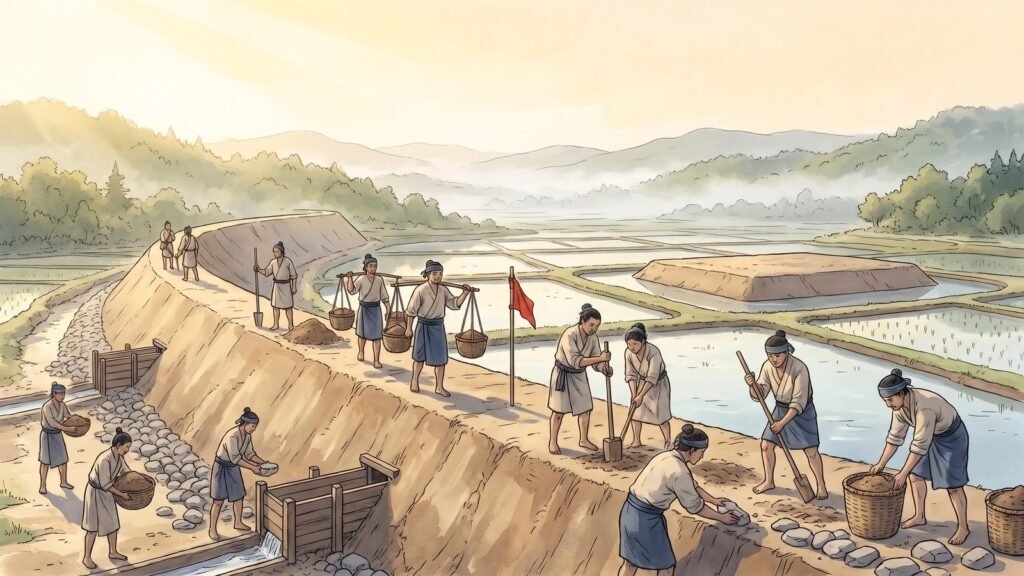
The dams were built of earth, with a distinctive technique involving bundles of grass or straw wrapped around mud or clay. Archaeologists have found that the cores of some dams were made of these bundles, laid in a crosswise pattern, which provided strength and stability. The bundles were made by wrapping clay in reeds or grasses, and their remains have been preserved in the waterlogged conditions of the dams. The outer parts of the dams were made of earth of different kinds, including yellow earth, laid in layers.
This technique allowed the builders to construct substantial dams on soft ground and to resist the erosion of water. The transport of the materials and the construction of the dams required the coordination of large numbers of workers, and the scale of the works implies that they were planned and directed by a central authority. The volume of earth moved for the dams, together with that used for the city walls and the Mojiaoshan platform, has been estimated in the millions of cubic metres.
The Purpose of the Dams
The dams are thought to have served several purposes. The first was flood control. By holding back water in reservoirs in the hills, the dams protected the city and its fields from the sudden floods that could descend from the mountains in the rainy season. The second was transport. The reservoirs and the waterways connected to them may have allowed boats to carry timber, stone and other materials from the hills to the city, and the network of canals within and around the city suggests that water transport was important to its economy. The third possible purpose was irrigation, providing water for the cultivation of rice in the fields of the basin during dry periods, though the relative importance of this function is debated.
The construction of such a system shows a sophisticated understanding of the local hydrology and an ability to plan works on a regional scale. It also indicates that the rulers of Liangzhu could command the resources to build and maintain public works for the benefit of the community as a whole. In this respect the Liangzhu dams anticipate the later tradition of hydraulic engineering in China, which reached a high point in the Warring States and imperial periods. The irrigation works of the third century BCE in Sichuan, for example, are described in Li Bing and the River That Would Not Flood and The Dujiangyan Irrigation System Shaped Sichuan. Separated from Liangzhu by more than two and a half thousand years, these later works shared its basic concern with the control of water for the security and prosperity of an agricultural society.
Sites Beyond the Capital
The city near Hangzhou was the largest centre of the Liangzhu culture, but hundreds of other Liangzhu sites have been identified across the Lake Tai region. Some were substantial settlements with their own elite cemeteries built on artificial mounds. At Fuquanshan, in the western suburbs of Shanghai, an artificial mound contained rich burials with jade objects, and the site has been studied since the 1980s. At Sidun, near Changzhou in Jiangsu, a burial of a young man contained a large number of jade cong and bi, arranged around the body. Other important sites are found near Haining, Jiaxing and Huzhou in northern Zhejiang and in southern Jiangsu.
The relationship between these regional centres and the city near Hangzhou is not fully understood. The similarity of their jade objects and motifs suggests close connections and a shared culture, and some scholars have proposed that the regional centres were subordinate to the capital, forming a hierarchy of settlements under a central authority. Others have suggested that the regional centres were more independent, linked by alliances, exchange and a common religion rather than by direct political control. The evidence from future excavations may help to resolve this question.
Jade
The Liangzhu culture is renowned for its jade objects, which are among the most sophisticated products of the Chinese Neolithic. The jade used was nephrite, a hard stone that was difficult to work. Without metal tools, the craftsmen of Liangzhu shaped the stone by sawing with strings and abrasives, drilling with tubular drills and grinding and polishing with sand and water, processes that required great skill and patience. The general history of jade working in China is described in the Grokipedia article on Chinese jade.
The two most characteristic forms are the cong and the bi. The cong is a tube, square in outer section and circular in inner section, often divided into tiers and decorated at the corners with faces. The bi is a flat disc with a central hole. In later Chinese tradition, preserved in texts of the Zhou and Han periods, the bi was associated with heaven and the cong with earth, and both were used in ritual, but whether the people of Liangzhu understood them in the same way is not known. Other jade objects include axes, which were symbols of authority rather than practical tools, and many kinds of ornaments, including plaques, pendants, beads and objects attached to clothing or headdresses.
The most important decorative motif on Liangzhu jades is a figure often described as a divine human and beast. In its most complete form it shows a human figure with a feathered headdress, whose arms reach down to grasp the eyes of a beast-like creature below, which has large eyes, a wide mouth and claws. Simplified versions of the motif, reduced to eyes and mouths, appear on the corners of cong and on other objects. The consistency of this motif across the Liangzhu region suggests a shared system of religious belief, and some scholars have interpreted the figure as a deity or the ancestor of the ruling group. Later Chinese art, including the taotie masks on Shang bronzes, has been compared to the Liangzhu motif, though the relationship between them remains a matter of discussion.
The Sources of Jade
The source of the jade used by the craftsmen of Liangzhu has been studied by geologists and archaeologists. Nephrite occurs in a number of places in China, and the most famous source in later periods was Khotan in the far west, in what is now Xinjiang. For Liangzhu, however, it is generally thought that the jade came from sources closer to the Lake Tai region, since the transport of large quantities of stone over long distances would have been difficult. Deposits of nephrite have been found in the hills of southern Jiangsu, near Liyang, and these have been suggested as one possible source, though the question of the precise origins of Liangzhu jade remains under investigation.
The control of jade sources and of the skilled craftsmen who worked the stone would have been a source of power for the elite. The production of a single large cong or a set of ornaments required many hours of labour, and the distribution of finished objects among the elite of different sites may have been one means by which the rulers of the capital maintained their authority. Workshops for jade production have been identified at some sites, providing evidence for the techniques used and the organisation of the work.
Economy and Daily Life
The economy of Liangzhu was based on the cultivation of rice. Excavations at sites in the region, such as Maoshan near the Liangzhu city, have revealed rice paddies of the period, divided by raised paths and irrigation channels, showing a well-developed system of wet-rice agriculture. The people of Liangzhu also raised pigs and other animals, fished, gathered wild plants and hunted. Stone tools, including ploughshares of a distinctive triangular form, suggest that they had developed methods for preparing fields on a large scale.
Craft production was highly developed. Besides jade, the people of Liangzhu made fine black pottery, lacquered wooden objects, textiles and objects of ivory. Some pottery and jade objects bear incised symbols, which some scholars have interpreted as an early form of writing or proto-writing, though there is no consensus on this question and the symbols have not been deciphered. The organisation of craft production, particularly of jade, appears to have been controlled by the elite.
Society and the Question of the State
The scale and organisation of the Liangzhu city have led many scholars to describe Liangzhu as an early state. The construction of the walls, platforms and dams implies the ability to mobilise labour on a large scale over long periods. The differences in burials indicate a stratified society with a powerful elite. The uniformity of jade forms and motifs across the region suggests a shared ideology, possibly controlled from the centre at Liangzhu. The World Heritage inscription describes the site as representing an early regional state with a centralised power and a unified belief system, based on rice cultivation.
Other scholars have been more cautious, noting that the definition of a state is a matter of debate and that the evidence for administrative institutions, such as writing or a system of government, is limited. Whatever the precise term used, it is clear that Liangzhu represented a level of social and political complexity that was exceptional for its time and that anticipated the later states of the Bronze Age in China.
Liangzhu and Early Water Management Elsewhere
The Liangzhu dams are among the earliest known large-scale water management systems in the world, and they can be compared with works of a similar period in other regions. In Mesopotamia, the cultivation of the dry plains between the Tigris and Euphrates depended on irrigation canals, and the city-states of the region invested heavily in the construction and maintenance of waterworks from the fourth millennium BCE onward. In Egypt, the agriculture of the Nile valley depended on the annual flood, and the management of floodwaters was a central concern of the state. In the Near East, a number of early dams have been identified, including works associated with the settlement of Jawa in the desert of north-eastern Jordan, dating from around the fourth millennium BCE.
The Liangzhu system differs from many of these examples in its environment and purpose. Whereas the early waterworks of Mesopotamia and the Near East were often designed to bring water to dry land, those of Liangzhu were built in a wet landscape, where the main problem was the control of excess water. The combination of high and low dams, reservoirs and embankments shows that the builders of Liangzhu developed solutions suited to the particular conditions of the Yangtze delta. The comparison underlines the fact that different societies in different parts of the world developed the capacity to undertake large-scale hydraulic works at roughly the same period, in response to the needs of growing agricultural populations.
Decline
The Liangzhu culture declined around 2300 BCE. The city was abandoned, and the jade-working tradition and elite burials of the culture ceased. The causes of the decline have long been debated. Suggested factors include social and political crisis, conflict, changes in sea level and environmental changes. A study published in Science Advances in 2021 by a team led by the geologist Zhang Haiwei, based on the analysis of stalagmites from caves in the region, found evidence of a period of intensified monsoon rainfall at around the time of the decline, and proposed that extreme flooding made the low-lying landscape uninhabitable. Archaeologists have also found a layer of silt covering parts of the site, consistent with flooding. If this interpretation is correct, the water that the people of Liangzhu had worked so hard to control may finally have overwhelmed them.
After the decline of Liangzhu, the Lake Tai region was occupied by cultures of a different character, such as the Guangfulin and Maqiao cultures, which did not maintain the jade-working traditions or the monumental construction of their predecessors. Elements of Liangzhu culture, particularly the cong and the bi and the motif of the divine human and beast, appear to have spread to other regions and influenced later cultures, including those of the Yellow River valley.
Shi Xingeng and the History of Research
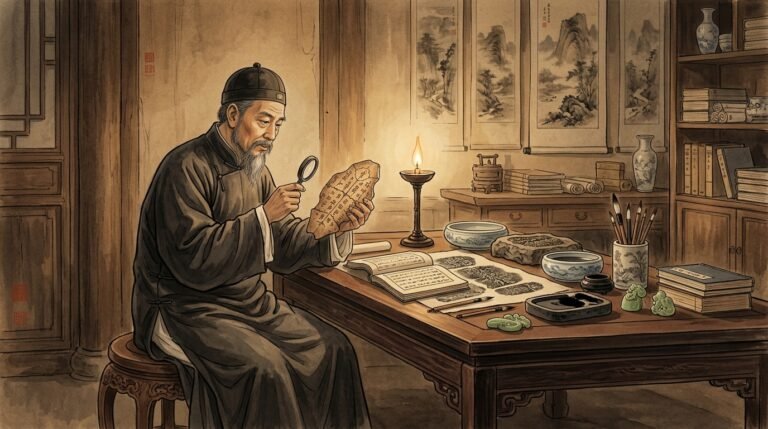
The discoverer of Liangzhu, Shi Xingeng, was born in 1912 in Liangzhu, then in Hang county and now in the Yuhang district of Hangzhou. After training at a provincial technical school, he worked in the geology and minerals section of the West Lake Museum in Hangzhou. In May 1936 he took part in a one-day trial excavation at Gudang near Hangzhou, where he recognised stone tools of a type common around his home town. He then made several surveys at Liangzhu, and on 3 November 1936 he found sherds of glossy black pottery in a dried-up pond at a place called Qipanfen. Comparing them with the published report on the excavations at Chengziya in Shandong, he concluded that they belonged to the same black-pottery tradition. With the support of the museum’s director, Dong Yumao, he carried out three small trial excavations at Liangzhu and nearby sites in December 1936 and March 1937, recovering stone tools and several hundred pottery sherds. He completed a report in the spring of 1937, and it was printed in the autumn of 1938 under the title Liangzhu, a preliminary report on the black pottery culture sites of the second district of Hang county. The war with Japan, which began in 1937, interrupted further work. Shi Xingeng moved to Rui’an in southern Zhejiang, where he served as a secretary to a local defence force, and he died there on 29 May 1939 of scarlet fever, at the age of twenty-seven by Western reckoning. These details are given in a study of his letters held by the Institute of History and Philology of the Academia Sinica.
In the decades after his death, research on the Liangzhu culture proceeded slowly. The black pottery he had found was at first associated with the Longshan culture of Shandong, which was also known for its black pottery, and only later was Liangzhu recognised as a distinct culture with its own characteristics. The jade objects that are now regarded as its most distinctive products had long been known from collections, but they had been attributed to the Zhou or Han periods, and it was only with the excavation of Liangzhu burials in the 1970s and 1980s that their Neolithic date was established. The history of research on Liangzhu thus illustrates how the understanding of early China has been transformed by archaeology in the twentieth and twenty-first centuries.
Liangzhu in the History of Early China
The discovery of Liangzhu has contributed to a revision of the traditional account of the origins of Chinese civilisation. Traditional Chinese historiography placed the origins of civilisation in the Yellow River valley, with the legendary rulers and the Xia, Shang and Zhou dynasties. Liangzhu, together with other discoveries such as Sanxingdui in Sichuan and Shijiahe in Hubei, has shown that complex societies developed in several regions of China, including the Yangtze valley, and that the formation of Chinese civilisation involved the interaction of many regional traditions.
The legend of Yu the Great, who tamed the floods and founded the Xia dynasty according to traditional accounts, has sometimes been discussed in relation to Liangzhu, as both concern the control of water in the early history of China. There is no direct evidence connecting the two, and the legend is associated with the Yellow River rather than the Yangtze, but the existence of large-scale water management at Liangzhu shows that the control of floods was a concern of early Chinese societies long before the period to which the legend refers.
The Site Today
The Archaeological Ruins of Liangzhu City are now protected as an archaeological park, with the Liangzhu Museum nearby displaying jade objects and other finds. The World Heritage property includes the Yaoshan site, the high dam area, the low dam area and the city area, including the Mojiaoshan platform and the Fanshan cemetery. Research continues at the site, with ongoing excavations and studies of the city, the dams and the surrounding landscape, and new discoveries continue to add to the understanding of this early society.
Conclusion
The Liangzhu culture was one of the most advanced societies of the Neolithic world. Its walled city near Hangzhou, with its great platform, elite cemeteries and network of waterways, and its system of dams in the surrounding hills reveal a society capable of planning and executing public works on a regional scale, based on the cultivation of rice and governed by an elite whose authority was expressed through finely worked jade. The dams, built about five thousand years ago, are among the earliest large-scale hydraulic works known anywhere, and they show that the management of water, which was to be a central concern of Chinese states throughout history, was already a foundation of social organisation in the late Neolithic. The decline of the culture, possibly as a result of flooding, is a reminder of the power of the environment that these works sought to control.
Sources and Further Reading
- Grokipedia, Liangzhu culture
- Grokipedia, Lake Tai
- Grokipedia, Chinese jade
- UNESCO World Heritage Centre, Archaeological Ruins of Liangzhu City
- Liu Bin et al., Earliest hydraulic enterprise in China, 5,100 years ago, Proceedings of the National Academy of Sciences of the United States of America, 2017
- Zhang Haiwei et al., Collapse of the Liangzhu and other Neolithic cultures in the lower Yangtze region in response to climate change, Science Advances, 2021
- Li Liu and Xingcan Chen, The Archaeology of China. From the Late Paleolithic to the Early Bronze Age, Cambridge University Press, 2012