Charles George Gordon (1833–1885) was a Royal Engineers officer who became Chinese Gordon for crushing the Taiping Rebellion, Gordon Pasha for governing the Sudan, and Gordon of Khartoum for the siege of 1884–85. This essay traces all three phases, with a particular focus on the Mahdist revolt, the last stand, and the relief expedition that arrived two days late.
Family and formation
Charles George Gordon was born at number one Kemp Terrace, Woolwich Common, on the morning of 28 January 1833. His father, Lieutenant General Henry William Gordon of the Royal Artillery, was then about forty-seven years old and had been at war for most of his adult life. His mother, Elizabeth Enderby, came from a London merchant family with money of its own, which mattered in a household where salaries were modest and postings were frequent. Charles was the fourth son and the ninth of eleven children, five girls and six boys, and the men of his family had been army officers for four generations. The expectation that he would also wear uniform was not so much spoken of as assumed. As one contemporary biographer later put it, the possibility that Gordon would pursue anything other than a military career seems never to have been considered by his parents.
The family moved. Henry Gordon’s postings in the 1830s and 1840s took the household from Woolwich to Ireland, then to postings in Scotland, then to Corfu in the Ionian Islands, which were then under British protection. Charles spent parts of his childhood in each of these places, picked up Irish and Greek the way an officer’s son does, learned to draw maps before he learned to write cursive, and acquired a permanent restlessness. He was sent to school at Taunton in the West Country in 1843, at the age of ten. The choice of school was a personal one; the headmaster, a Mr Rogers, was a brother of a governess the Gordons had employed. It was the year his favourite sister, Emily, died of tuberculosis. He later wrote that her death changed his life, that it was never the same afterwards. After Emily, his closest sibling became his older sister Augusta, who nudged him steadily towards an Evangelical Christianity that would frame the rest of his life. All of his brothers became army officers. The family was closely knit and military to its marrow.
In 1848, at fifteen, he entered the Royal Military Academy at Woolwich, the same institution his father had attended before him. He had intended to follow his father into the Royal Artillery but a streak of indiscipline, and an absence of patronage, kept him out of the more prestigious branch. He graduated in 1852 as a second lieutenant in the Corps of Royal Engineers and was posted for the usual Chatham course before a short station at Pembroke Dock in Wales. He was commissioned on 23 June 1852. By then he had already shown two of the traits that would define him in later life: a near-obsessive interest in maps, and a willingness to be deeply unpopular with his own side in pursuit of what he thought was right.
Crimea and a soldier’s reputation
The Crimean war broke out in October 1853 when the Ottoman Empire, Britain, and France declared war on Russia. The British expedition was badly managed and Gordon, in common with many of his generation, was desperate to be sent to the front. He badgered the War Office until they relented, and reached Balaklava in 1855 as a subaltern in the Royal Engineers. He served in the trenches outside Sevastopol through the long winter of 1854 to 1855, was present at the assault on the Redan, and was mentioned in dispatches. None of the British trenches in front of Sevastopol were places an officer could expect to survive in comfort; Gordon’s survival was partly luck and partly a stubborn refusal to take unnecessary risks with his men. He came home in 1856 with the reputation of a competent, slightly odd junior officer who read his Bible more than was fashionable.
His family connections served him well after the war. In 1856 he was appointed to the international commission then surveying the new Russo-Turkish frontier along the lower Danube, and in 1857 was transferred to the parallel commission working in Armenia. The work was technical: marking boundaries, settling disputes between villages, producing the kind of large-scale maps the British had become very good at producing. For his part in the Armenian survey Gordon was elected a Fellow of the Royal Geographical Society in 1858, a small honour that he later resigned in 1866 for reasons he never quite explained. He was promoted to captain in 1859 and, restless again, applied to be sent wherever the army was busiest. China, where the Second Opium War had broken out in 1856, was the answer he wanted.
China and the Second Opium War
Gordon landed in China in 1860 as part of the Anglo-French expedition that marched on Beijing to enforce the Treaty of Tientsin. He commanded a company of Royal Engineers and saw action at the Taku Forts, at the capture of the Chinese capital, and, like most of the British expedition, at the burning of the Summer Palace at Yuanmingyuan in October 1860. The decision to burn the palace was made by Lord Elgin in retaliation for the torture and killing of European prisoners. Gordon took no recorded pleasure in it; nor, given the political culture of the expedition, did he have the standing to refuse to be present.
When the fighting was over and the new treaties were signed, Gordon stayed on in China. He spent the next eighteen months on garrison duty in Tientsin and on survey work along the Great Wall, the latter being a piece of professional curiosity as much as anything else. In 1862 the political ground shifted. South China was being torn apart by the Taiping Rebellion, the largest civil war in human history up to that point, and the Taiping armies, having failed to capture Shanghai in 1860 and 1861, were threatening to try again. Sir Charles Staveley, the British commander in China, was instructed to keep a thirty-mile radius around Shanghai clear of Taiping forces, and the Royal Engineers, including Gordon’s detachment, were sent down to assist.
The Taiping context and Great Britain
The Taiping Rebellion had begun in Guangxi in 1850 under Hong Xiuquan, a failed civil-service examination candidate who had converted to Christianity and declared himself the second son of God and the younger brother of Jesus Christ. By the time Gordon reached Shanghai the rebels had been at war for twelve years, had captured the old Ming capital of Nanjing and made it their Heavenly Kingdom, and had pushed north twice, almost reaching Beijing in 1853 and again in 1855. The Qing state, weakened by a century of corruption and by the Second Opium War, had been unable to suppress them. The scale of the death toll was already in the tens of millions and rising.
Gordon’s first reaction to the Taipings was not hostile. He had read about Hong Xiuquan in England and was at first inclined to view the movement as a slightly eccentric Christian revival. That changed when he saw what the Taiping forces did to the villages they passed through. In letters home he described Taiping bands as a cruel army with a desolating presence that killed without mercy. The Qing state was also brutal, but the Taiping killing was indiscriminate in a way that the Qing brutality usually was not. By the time he took command of the Ever Victorious Army in March 1863 Gordon had decided that the Taiping cause was, as he put it, of so barbarous a nature that its suppression had become necessary in the interests of civilisation.
The Ever Victorious Army
The Ever Victorious Army had been founded in 1860 by Frederick Townsend Ward, an American adventurer from Salem, Massachusetts. Ward had arrived in Shanghai with no military rank and no commission and had offered his services to the Chinese authorities in the aftermath of the 1860 attempt on the city. The Qing did not trust him, but the Shanghai taotai, the local customs superintendent, did, and Ward was given permission to raise a force of Chinese soldiers officered by Western mercenaries. Ward funded the force partly from his own pocket and partly from the Shanghai merchant community, who wanted the Taipings kept away from their factories. By 1862 the army had grown to several thousand men and had acquired its grandiloquent name from a decree of the Xianfeng Emperor. Ward was killed in September 1862 by a bullet in the back during the siege of Tseki.
His successor was Henry Burgevine, also American, who had Ward’s talent for raising troops but not his judgement. Burgevine was dismissed in late 1862 for looting captured towns and for quarrelling with his Chinese paymasters. A brief British substitute, Captain Holland of the Royal Marines, took command and was beaten badly at Taitsang in February 1863. The Ever Victorious Army retreated to Songjiang in disarray. Its officers feared the appointment of a regular British officer, because such an officer would be obliged to bring them to book. Li Hongzhang, the governor of the Jiangsu province and the effective patron of the force, asked Staveley for a British commander. Staveley chose Gordon.
Gordon took command on 24 March 1863 as a mandarin of the first class and a lieutenant colonel in the Chinese service. He was thirty years old, a captain in his own army, and the only European in a force of roughly three thousand Chinese soldiers officered by about 150 Western mercenaries of almost every nationality and of what Gordon politely called doubtful character. He had not asked for the job. He had been completing a survey of the Great Wall and had agreed to take the command only because he had been told that no one else would.
The campaign of 1863
Gordon did not wait to reorganise his troops. Within a week of taking command he led the Ever Victorious Army to the relief of Changsu, a town about forty miles northwest of Shanghai that had been besieged by the Taipings. The relief was successful, and the success bought him the respect of men who had been ready to mutiny. The Ever Victorious Army of the spring of 1863 was the Ever Victorious Army of Ward and Burgevine, prone to looting, prone to drinking, prone to desertion when their pay was late. Gordon imposed three simple rules on it. First, no looting. Second, no executions of prisoners who had surrendered. Third, no going home without orders. The first rule produced an immediate mutiny in the autumn of 1863, which Gordon broke by shooting the ringleader and threatening to repeat the treatment every hour until order was restored. The mutiny was over inside an hour.
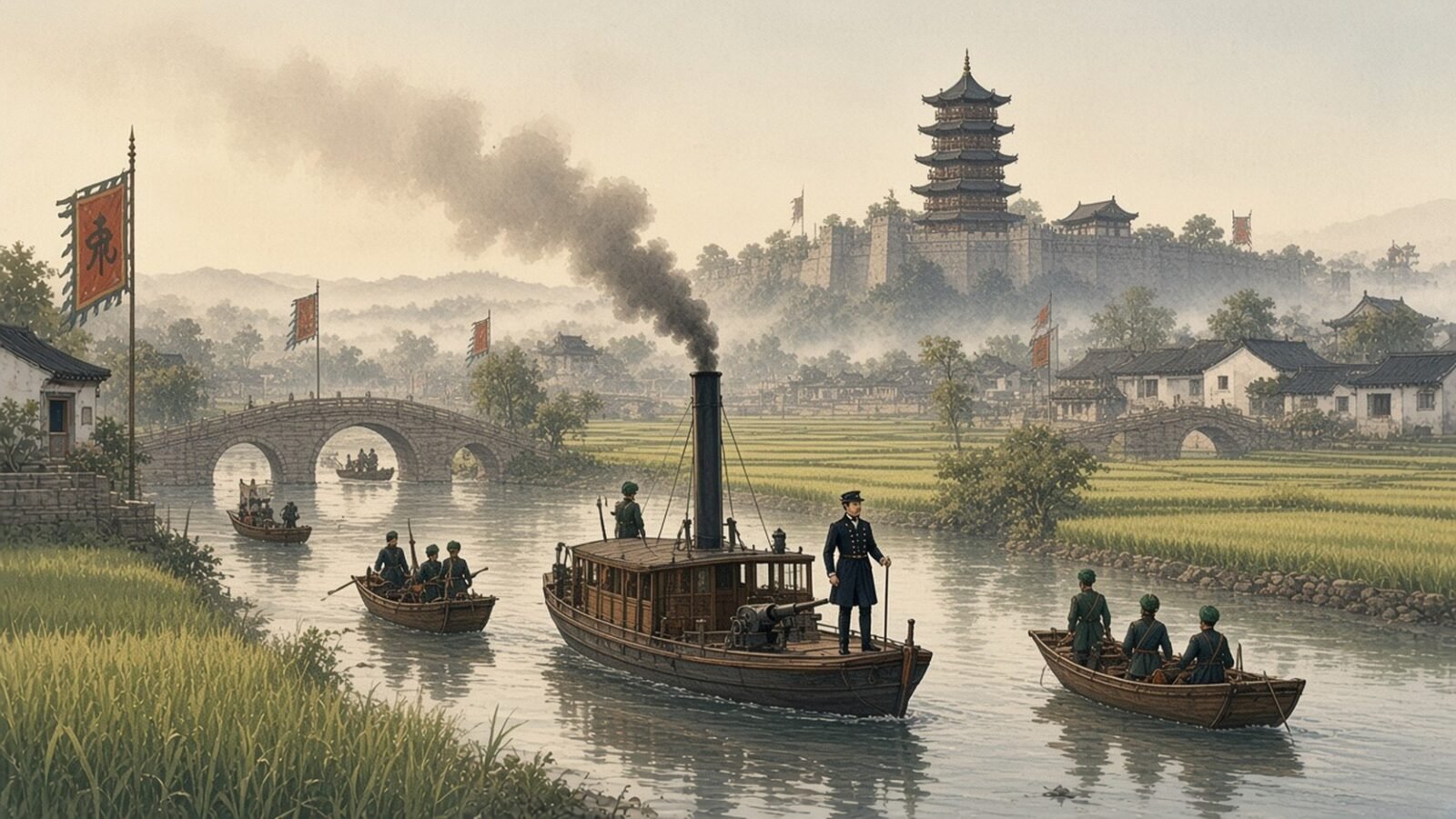
Gordon’s tactical innovation, the one that made the Ever Victorious Army into something more than an unusually disciplined mercenary band, was his use of the canal network. The lower Yangtze was threaded with canals, and Ward and Burgevine had treated them as obstacles. Gordon treated them as arteries. He equipped the army with a small flotilla of shallow-draught gunboats, mostly captured Taiping vessels with Western guns bolted to their decks, and used them to move men and supplies faster than the Taipings could march along the roads. By the end of May 1863 he had retaken Taitsang and was in front of Kunshan. By the end of the summer he had taken Quinsan and pushed into the network of fortified towns west of Suzhou. The campaign drew closer to the prize that everyone in Shanghai was watching: the walled city of Soochow, the principal Taiping military base in the region.
Soochow and the Wangs
Soochow was held by about forty thousand Taiping troops under a group of commanders known collectively as the Wangs, or kings, the senior being the Loyal King, Mu. Gordon’s army, reinforced by a body of Qing troops under Li Hongzhang‘s subordinate, laid close siege through the autumn of 1863. The fighting was heavy. On 27 November 1863 Gordon was personally defeated in a Taiping sortie outside the walls, and for a few days it looked as though the campaign would fail as Taitsang had failed the year before.
The city fell not because Gordon stormed it but because the Taiping leaders fell out among themselves. On 5 December 1863 a group of Wangs came out under a flag of truce and offered to surrender the city in return for their lives. Gordon gave them his word, on his honour as a British officer, that they would be spared. He handed them over to Li Hongzhang‘s people. Li, by Chinese custom and by long Qing practice, executed them. Eight of the Wangs were beheaded in a small courtyard that night. When Gordon heard about it he withdrew his whole force to Kunshan and refused to have anything more to do with the campaign. He tendered his resignation.
The Soochow affair has been the most debated episode of Gordon’s career. The Taiping cause was, by Gordon’s own admission, barbarous; the Wangs in particular had a record of atrocities. By Chinese standards, the executions were not unusual. By Gordon’s standards, they were an outrage. He had given his word, and Li had broken it. For three months he sulked at Kunshan and refused to take the field, while the Taiping cause ground on.
The reconciliation and the close of the rebellion
In February 1864 Li Hongzhang, with the backing of the British minister in Beijing, asked Gordon to come back. Li wrote that the Taiping question was more important than their personal quarrel, and that he would accept Gordon’s terms of further cooperation. The British government made clear that his reputation in England depended on his returning. He returned. By May 1864 he had captured Changzhou Fu, the last major Taiping stronghold in the Jiangsu region, and the campaign was done. He then disbanded the Ever Victorious Army, which by then numbered close to five thousand men.
In June 1864 Hong Xiuquan, the Heavenly King, died, possibly of illness and possibly by his own hand. The Qing forces entered Nanjing in July 1864 and sacked it. The Taiping Rebellion was effectively over. The death toll, by the most reliable mid-21st century estimates, was somewhere between twenty and thirty million people, which makes it the deadliest civil war in history up to that point and the second deadliest of any kind, after the Second World War.
Gordon’s rewards
Gordon received honours from both governments. From the Chinese Emperor he was made Ti-Tu, the highest rank in the Qing military establishment, equivalent to a field marshal. He was given the Imperial yellow jacket and the Peacock Feather, the standard marks of the very highest Chinese distinction. He was offered one hundred thousand taels, a sum then worth perhaps forty thousand pounds, and refused it. The refusal was widely reported and cemented his reputation for incorruptibility, which is what made him attractive to the British government in later years. From the British Army he received the brevet rank of lieutenant colonel and was made a Companion of the Bath. The Times called him Chinese Gordon, and the nickname stuck. He returned to England in January 1865 to a level of public attention that he found extremely uncomfortable.
The quiet years
Between 1865 and 1873 Gordon held a series of posts that did not add much to his reputation but kept him in uniform. From October 1865 he was commandant of engineers at Gravesend, in charge of renovating the Lower Thames forts. The work was unglamorous and he did it thoroughly. He was promoted brevet colonel in 1871 and appointed British commissioner on the international Danube Commission, then based in Galati. The Danube work was technical and well paid. He was in Constantinople in 1872 when he met Nubar Pasha, the Egyptian foreign minister, and through Nubar was offered the post of governor of Equatoria, the southernmost province of the Egyptian-administered Sudan.
The Egyptian Sudan in the early 1870s was a curious administrative patchwork. The Khedive of Egypt, then Ismail Pasha, claimed sovereignty over a vast stretch of territory south of Egypt proper, from the Mediterranean coast down through Nubia and into the great swamp and lake country of the upper Nile. The claim was nominal in most of the territory and rested on a few Ottoman-era grants. Egyptian authority was exercised through a handful of garrisons along the Nile and through the cooperation of local chiefs. The two big problems of the southern Sudan were the slave trade and the absence of any reliable mapping. Sir Samuel Baker, the explorer, had been the first European governor of Equatoria, between 1869 and 1873, and had managed little beyond establishing a few posts. Baker returned to Egypt and Ismail asked Gordon to succeed him.
Equatoria and the upper Nile
Gordon took up the appointment in April 1873 and reached Gondokoro on 16 April 1874. Gondokoro was a cluster of mud huts on the west bank of the White Nile, near the modern South Sudan capital of Juba. From there he spent the next two and a half years doing two things, both of them on foot and by boat. First, he mapped the upper Nile. He established a line of stations running south from Gondokoro along the river, reached the territory of the Bari people, the Nuer, the Dinka, and the Shilluk, and pushed as far south as the borders of what is now Uganda. The mapping was largely new. The cartography of the upper Nile had been guesswork, and Gordon’s stations provided the first reliable framework for any future administration. Second, he set about suppressing the slave trade.
The slave trade in the southern Sudan was not new. For centuries Arab traders from the north had bought captives from the Nuer and Dinka, had marched them in coffles north to the markets of Khartoum and Omdurman, and had shipped them down to Egypt and the Ottoman Empire. The trade had intensified in the 1840s and 1850s with the rise of new markets in the Hejaz and with the spread of firearms among the traders. The Khedive had signed a convention with Britain in 1877 agreeing to suppress the trade, but the Egyptian bureaucracy in Khartoum had no interest in doing so, because the slave trade was the basis of much of its private income. Gordon’s superior as governor-general of the whole Sudan was Ismail Aiyub Pasha, who was himself deeply involved in the trade and who did everything he could to sabotage Gordon’s anti-slavery work.
Gordon’s method was to take the field himself, intercept slave caravans, free the captives, and arrest the traders. He was personally fearless about this. He would walk into a slave camp with a small escort, read the khedive’s proclamation against the trade, and break the chains. The traders hated him. The freed captives, who had been marched hundreds of miles from home, often had to be fed and housed for months before they could be returned, and the cost of maintaining them ate into Gordon’s already thin budget. Worse, the corrupt Egyptian officials, having been ordered to free them, usually sold them back into slavery at the next opportunity.
Gordon built a close working relationship with the African peoples of the upper Nile, particularly the Nuer and the Dinka, who had long been victims of the Arab slave trade and who were willing collaborators in any effort to break it. He established a line of stations along the river as far south as the modern border with Uganda, gave the local chiefs a stake in the suppression of the trade, and provided a modicum of security for the people who lived along the riverbanks. He did not abolish the slave trade in Equatoria, but he reduced it sharply and gave the survivors of the trade a chance.
Gordon-General of the whole Sudan
In February 1877 Gordon was asked to take the position of governor-general of the entire Sudan, which then included not only Equatoria but also Darfur and the vast eastern territories along the Red Sea. He accepted, with the stipulation that he would have a free hand. He arrived in Khartoum in May 1877 and over the next two years did three large things.
First, he continued and intensified the anti-slavery campaign. The biggest obstacle in his path was not the traders themselves but Rahama Zobeir, known as the King of the Slavers, who had inherited his position from his father, Zobeir Pasha, and who controlled a private army and the loyalty of several thousand armed men. Gordon disarmed Zobeir in 1877 by summoning him to Khartoum and then exiling him to Cyprus, where he died. The campaign against the slave trade in Darfur, where Zobeir’s influence had been strongest, continued through 1878 and 1879, with Gordon personally leading columns into the field and crushing the remaining armed resistance. He abolished the public flogging of offenders with the kourbash, a whip of buffalo hide, which had been a routine punishment in the Egyptian-administered Sudan. He attempted to root out corruption in the tax system, which was used by provincial governors to extract bribes from merchants and from anyone who had dealings with the courts.
Second, he reorganised the administration. Gordon was not a natural bureaucrat and his attempts to impose systematic reform were uneven, but he did succeed in reducing the worst abuses of the Egyptian administration and in introducing a degree of justice in the courts that had not existed before. He relied heavily on a small number of European and Egyptian officials, partly because the local Arab bureaucracy was too corrupt to be trusted and partly because the available manpower of any integrity was thin.
Third, he tried to manage relations with the Ethiopian Empire to the east, the Mahdist revolt in the west, and the Egyptian government in Cairo simultaneously. The Egyptian Khedive Ismail was deposed in June 1879 and replaced by his son Tewfik. Gordon resigned in protest, arguing that the new khedive was a puppet of the British and French who had arranged the deposition and that he could not in conscience serve him. He handed over the governorship to a successor and left Khartoum in July 1879, in poor health.
The wandering years
Between 1879 and 1884 Gordon held a succession of posts in different parts of the British Empire, none of them entirely suitable and none of them long. He served briefly as the private secretary of the Viceroy of India. He visited China again in 1880 and 1881 and was received with honours by the Qing court, which still remembered him from the Ever Victorious Army. He was given command of the Royal Engineers in Mauritius in 1881 and promoted major general in 1881. He went to the Cape Colony in 1882 as adviser to the government in Basutoland, where the local populations were in revolt against disarmament, and within two months disagreed so completely with the high commissioner, Sir Hercules Robinson, that he resigned and went home. He spent the winter of 1882 to 1883 in England, in poor health and uncertain what to do next, and was considering the offer of a command in the Congo Free State from King Leopold II of Belgium when the news from the Sudan intervened.
The Mahdist revolt
The Mahdist revolt began in 1881 under Muhammad Ahmad, a Sufi religious leader from Dongola who in June of that year declared himself the Mahdi, the divinely guided redeemer of Islam. The Mahdist doctrine was apocalyptic. The Mahdi was expected to usher in a final period of justice before the Day of Judgment, and his followers, called the Ansar, were expected to wage a holy war against the Egyptian state and against the British, who were widely believed to be the Christian rulers of Egypt. The revolt took the Egyptian authorities by surprise and exploited their administrative weakness.
By the end of 1882 the Ansar had overrun the provinces of Kordofan and Darfur and had destroyed the Egyptian garrisons at El Obeid and elsewhere. By the end of 1883 they had effectively isolated Khartoum from Egypt proper, although the city itself was still held. The British government, having taken effective control of Egypt in 1882 after the bombardment of Alexandria, was in the awkward position of being responsible for the defence of the Sudan without having any appetite for another imperial war. The cabinet of William Gladstone decided in 1883 that the Egyptian position in the Sudan was untenable and that the garrisons should be evacuated. The question was how.
Gordon, by this point, was the obvious choice to lead the evacuation. He had governed the Sudan, he had experience of the territory, and the British public knew and trusted him. The problem was that Gordon was also deeply uncertain about what the right policy was. He had written in the autumn of 1883 that he was against the abandonment of the Sudan, on the grounds that the Egyptian garrisons and their dependents would be massacred and the slave trade would resume, but he also thought the evacuation might be unavoidable. He was asked to draw up his own orders. The orders he gave himself, after a brief consultation in Cairo with Sir Evelyn Baring, were a strange compromise. He was to evacuate the Egyptian garrisons, including both soldiers and civilians, and to leave behind some form of indigenous but not Mahdist government. He had no deadline. He had no clear idea of how he would accomplish either task.
Khartoum
Gordon reached Khartoum on 18 February 1884 and was received, as one British officer put it, with a perfect ovation. The city had a garrison of about seven thousand Egyptian troops and a population of roughly twenty-seven thousand, most of them civilians. The Mahdist forces had been closing in for months and the city was nearly surrounded. The three smaller Egyptian garrisons in the Sudan, at Sennar, Tokar, and Sinkat, were already under close siege.
Gordon immediately changed his instructions. He announced that, on grounds of honour, he would not evacuate Khartoum and would instead hold the city against the Mahdi. He set about organising the city’s defences. He strengthened the walls, which were old and partly broken, repaired the river defences, and arranged the garrison into a coherent fighting force. He also began to evacuate the women, the children, the sick, and the wounded down the Nile to Egypt. About 2,500 civilians were removed before the river was closed.
Gordon corresponded with the Mahdi during this period. He offered Muhammad Ahmad the sultanate of Kordofan in return for breaking off the jihad. The Mahdi replied by inviting Gordon to convert to Islam, which Gordon refused. He also asked the British government to send Zobeir Pasha, the late slaver king, to take over from him, on the grounds that the people of the Sudan would accept a Muslim ruler more readily than a Christian one. The British refused, on the perfectly correct grounds that Zobeir was a war criminal. As the weeks went on, Gordon’s telegrams became increasingly exasperated. The British government was unwilling either to send a relief expedition or to allow him to negotiate his own way out. He began to feel that he had been sent to Khartoum to fail.
The siege begins
The formal siege of Khartoum began on 13 March 1884, when Mahdist forces occupied the high ground south of the city and cut the road to Berber. The city was not at first tightly sealed. The Nile remained partly open, and Gordon was able to run small steamers up and down the river for several months. The Mahdist forces, which numbered perhaps thirty thousand at the start of the siege, were not equipped for a close blockade; they had few artillery pieces and their supply lines were thin. The Mahdi himself took up residence south of the city and waited.
By the middle of 1884 the situation had changed. Gordon had spent his ammunition on several unsuccessful sorties, and his supply of steam coal was running low. He refused to break out while there was still hope of relief. The British government, having refused for months to send help, was slowly forced into changing its position by public opinion. The Daily News, The Times, and the Manchester Guardian ran campaigns demanding that Gordon be rescued. The Queen herself sent a sharp note to Gladstone asking why nothing was being done. In July 1884 the cabinet voted, against the prime minister’s own vote, to send a relief expedition. The budget was £300,000 and the commander was Sir Garnet Wolseley.
The relief expedition
Wolseley had served with Gordon in China and was his friend. He set about organising the expedition with care. The main body would travel up the Nile by boat; the desert crossing would require expert boatmen, and Wolseley recruited Canadian voyageurs, French Canadian and Indigenous, who had navigated the rapids of the Ottawa and the St Lawrence and were accustomed to handling small boats in fast water. They sailed for Egypt in the autumn of 1884 and the column did not leave Wadi Halfa for the Sudan until January 1885. The first serious engagement of the expedition was the battle of Abu Klea on 17 January 1885, in which the British square held against a Mahdist charge but suffered heavy casualties. The column pushed on towards Khartoum through the desert, short of water and almost out of food.
Back in Khartoum the situation had become catastrophic. The Nile had fallen to its lowest level and the muddy beaches at the foot of the walls were exposed, leaving gaps in the defences that the defenders could not effectively fill. The garrison was starving. Theodores, the Egyptian regulars, were eating the city donkeys, the cats, the rats, and finally the leather from their own equipment. Cholera broke out in the overcrowded city. Gordon’s letters to the British government in the last weeks of the siege, when any got through at all, were a mixture of defiance and despair. He wrote that he would hold the city to the last and that he would not surrender. He wrote that the relief expedition was his only hope. He wrote, in one famous dispatch, that he could hold out for six months if he was properly supplied and that he was not properly supplied.
The fall
In the last days of January 1885 the relief column was less than two days from Khartoum. The Mahdi, who was by then dying of typhoid, ordered a final assault on the city before the British could arrive. On the night of 25 to 26 January, an estimated fifty thousand Mahdist fighters attacked the walls just before midnight. The garrison, weakened by ten months of siege and three months of starvation, fought back but could not hold the breaches. Within hours the Ansar were inside the city. The garrison was killed almost to a man. The Mahdi’s officers tried to stop the slaughter of civilians; the killing was halted within a day or two, but by then an estimated ten thousand civilians had been killed and many more enslaved.
Gordon died fighting. The most reliable accounts, drawn from Mahdist prisoners taken later and from the surviving Egyptian officers, place his death on the steps of the governor’s palace. He was carrying a revolver and a sword. He killed two attackers before being overwhelmed. Some accounts say he was speared, some say he was shot. His body was never found, and for a long time the British public believed, or wanted to believe, that he had been taken prisoner and might still be alive. The last telegrams sent from Khartoum before the fall were dated 14 January 1885; everything after that is reconstruction.
On 28 January 1885, two days after the city had fallen, the first of the relief gunboats arrived at the outskirts of Khartoum. The British officers on board could see that the government buildings had been demolished, that no British flag was flying, and that the Mahdist flag had been raised over the palace. They withdrew. Gordon had been killed two days short of his fifty-second birthday.
The aftermath
The fall of Khartoum produced an enormous reaction in Britain. Gladstone’s government was widely blamed for having sent Gordon to the Sudan without giving him the means to defend himself and for having delayed the relief expedition until it was too late. The phrase too late was used in headlines for months. The government fell in June 1885, in part because of the political consequences of the Sudan, and Lord Salisbury became prime minister. The Conservative Party used the slogan Remember Khartoum in the 1885 general campaign. The fall of Khartoum entered the political vocabulary of late Victorian Britain as the canonical example of imperial overreach combined with metropolitan indecision.
The Mahdi himself died in June 1885, possibly of typhoid, and was succeeded by the Khalifa Abdullah. The Mahdist state, which restored the slave trade and imposed a strict Islamic law on the population, lasted until 1898, when it was destroyed by the Anglo-Egyptian conquest under Lord Kitchener at the battle of Omdurman. Kitchener then had the Mahdi’s body exhumed and the skull sent to a museum in London, where it remained for decades. The skull was finally returned to Sudan in 2008. The Gordon Memorial College in Khartoum, founded partly from the public funds raised in Gordon’s name after his death, became the University of Khartoum.
Memory and legacy
Gordon’s reputation has gone through several phases. In the years immediately after his death he was treated as a martyr. Statues were raised to him across Britain. A memorial fountain was built in Gravesend, where he had commanded the Thames forts. The Gordon Monument on the Victoria Embankment in London was completed in 1888 at a cost of £15,000, raised by public subscription. Westminster Abbey received a memorial tablet, erected by the Corps of Royal Engineers. His journals sold in their millions; editions were reprinted for thirty years.
In the twentieth century the reputation soured. The Sudan adventure looked less like a heroic last stand and more like an imperial miscalculation that cost thousands of Egyptian and Sudanese lives. The suppression of the Taiping Rebellion, in which Gordon had played a central role, was re-evaluated by Chinese historians who saw it as the foreign suppression of a popular movement, however brutal the movement itself had been. The anti-slavery record in the Sudan remained Gordon’s strongest claim on the historical record, and it is the part of his career on which most modern assessments focus. He was, by Victorian standards, an unusually principled officer: he refused the Chinese emperor’s reward, he broke with Li Hongzhang over the Wangs, he resigned over the deposition of Ismail, and he died trying to defend a city that the British government had told him to abandon.
In Sudan itself Gordon is a more complicated figure. He is remembered as the Christian general who tried to suppress the slave trade and who then died in the Mahdist struggle, but he is also remembered as the foreign governor who had tried to break the power of the Arab slave-trading elite and who had done so without understanding the depth of the social disruption he was causing. The Mahdist state that he died defending Khartoum against is widely remembered in Sudan as the first independent Sudanese state, even by Sudanese historians who deplore the slave trade that the Mahdist state restored.
The three names
Gordon had three public names. Chinese Gordon, given him by the British press in 1864, marked the China campaign. Gordon Pasha, given him by the Egyptian administration in 1877, marked the Sudan governorship. Gordon of Khartoum, the name under which he is buried in Westminster Abbey and remembered in the British folk memory, marked the last stand. Each name points to a different phase of his life. Each name was, in its own way, accurate. He was, in succession, a Chinese servant, an Egyptian governor, and a British imperial martyr, and the three phases were not compatible with one another. The first phase made him famous. The second made him useful. The third made him immortal, and the immortality was bought with the lives of the seven thousand Egyptian soldiers and the unknown thousands of Sudanese civilians who died in the siege of Khartoum.
He was, by all accounts, a strange man. He was short, slight, sandy-haired, and quick-tempered. He read the Bible every day. He refused a hundred thousand taels. He broke a mutiny by killing a mutineer. He gave his word to the Wangs and was horrified when it was broken. He offered a Mahdi the sultanate of Kordofan and was surprised to receive an invitation to convert. He resigned the Sudan over a khedive’s deposition and accepted the Congo job the same week. He died at fifty-one on the steps of his own palace with a revolver in his hand. None of it fits a simple moral pattern, which is perhaps why it has remained so compelling. The Victorians built him a statue. The twentieth century took it down. The twenty-first century is still trying to decide what to put up in its place.
Closing note on method
Most of the dates and figures in this essay are verifiable against the Britannica entry on Charles George Gordon, against the Dictionary of National Biography article of 1885 to 1900, against the BBC’s historic-figures page, and against reference articles on the Ever Victorious Army, the Taiping Rebellion, the Mahdist War, and the siege of Khartoum. The death toll of the Taiping Rebellion is given in the range used by the War History Foundation and other mid-twenty-first-century reassessments. The death toll at Khartoum (roughly ten thousand civilians killed after the fall) is given as in the standard histories. The contemporary newspaper reactions to the fall are drawn from The Times and the Daily News of January to February 1885 as quoted in later accounts of the siege. The figure for the relief expedition’s budget, £300,000, is the figure given in the British parliamentary vote of August 1884.
The gaps in the record are worth noting. Gordon’s death was not witnessed by anyone who survived to give a calm account. The Mahdist accounts were collected under conditions that did not encourage accuracy. The British accounts were, for the most part, written either by officers who had not been in the city during the siege or by journalists working from telegrams that were often garbled. The body was never found. The story of his death is reconstructed from the testimony of people who had reasons to remember it in particular ways, and it should be read as a reconstruction rather than as a record.
Sources
References
Britannica — Charles George Gordon biography. Standard reference summary covering birth, military service, China, Sudan, Khartoum.
Charles George Gordon — Grokipedia, accessed 15 October 2026.
BBC History — General Charles Gordon. Concise summary of Gordon's three careers, useful for dates of major postings.
Victorian Web — Charles George Gordon (1833–1885): A Brief Biography. Family, schooling, and conversion narrative; identifies Gordon's evangelical faith.
Dictionary of National Biography, 1885–1900 — Gordon, Charles George. Contemporary biographical entry by an author with access to Gordon's papers.
Westminster Abbey — Charles George Gordon memorial. Confirms burial in the Abbey's north-west tower chapel, erected by the Corps of Royal Engineers.
Siege of Khartoum — Grokipedia, accessed 15 October 2026.
Mahdist War — Grokipedia, accessed 15 October 2026.
Al-Ahram Weekly — General Gordon's Last Stand. Contemporary Arabic-language press coverage from Cairo during and after the siege.
War History Foundation — The Taiping Rebellion 1851–1864. Death-toll estimates for the Taiping civil war; overview of Gordon's role.
GlobalSecurity — Ever Victorious Army. Chronology of the EVA's campaigns and Gordon's honours from the Qing emperor.
Warfare History Network — Governor-General Charles Gordon's Death in Khartoum. Eyewitness reconstruction of the last stand, drawn from Mahdist prisoner testimony.
Historic UK — General Charles Gordon: Chinese Gordon, Gordon of Khartoum. Biographical sketch emphasising the three sobriquets and the public mourning.