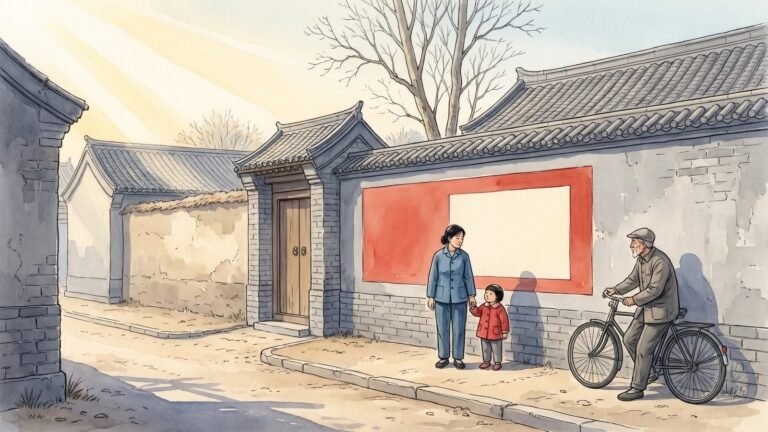
The Hunan farmhouse, 1811
Zeng Guofan was born on the twenty-sixth of November, 1811, in a farming village on the southern flank of the Xiang River valley in Hunan, into a family that was, by the standards of the late Qing, neither rich nor poor. The site of his birth, in Xiangxiang county, is today administered as part of Shuangfeng; the village sits in the low hills south of Changsha, a country of rice terraces, plum orchards, and the kind of close-grazed clay paths that join one clan settlement to the next. The family name was Zeng (曾), and the family claimed, in the way that almost every scholarly family in north Hunan claimed, descent from Zengzi, the disciple of Confucius to whom the transmission of the Dao had been entrusted. The pedigree did not make them gentlemen, but it gave them an idea of what a gentleman ought to look like. That mattered more than money.
His birth name was Zeng Zicheng; his courtesy name, Bohan; his style, the literary name by which scholars of the period were commonly addressed, was Disheng, which means roughly “washed clean” or “purified in life,” a name his grandfather gave him. His posthumous name, the honorific granted by the court after his death, was Wenzheng (文正) — “literary and correct” — the highest civil honor the empire could bestow, and one given to so few officials that the bestowal was itself a kind of judgement on the dynasty. He was the grandson of Zeng Yuping, a farmer of ambition and, by his neighbors’ accounts, considerable stubbornness, who had scraped together enough land to be called a small landowner and had then spent decades trying, without success, to push one of his sons through the imperial examinations. He died without seeing a Zeng jinshi. His son would succeed. So, eventually, would his grandson.
Zeng Guofan’s father was Zeng Linshu, a man who became the family joke and the family legend in roughly equal measure. Linshu sat the provincial examination — the juren, the degree that turned a provincial student into a man who might, eventually, be employed by the state — seventeen times before he passed, in 1832. Seventeen is not an exaggeration. The examiners’ judgement, year after year, was that Linshu could not write an essay acceptable to the board. The seventeenth time, he did. He was forty-one. His son, who had been studying alongside him for years, passed the prefectural examination, the lower rung of the system, a year later in 1833, and the provincial examination the year after that. By the time Guofan sat the metropolitan examination in Beijing, in 1838, he was already a more able scholar than his father had ever been. He passed first time. The examiners ranked him in the jinshi class — the doctorate-equivalent degree of the imperial system, the terminal academic credential of imperial China — and appointed him to the Hanlin Academy, the small body of perhaps a hundred and fifty men who served the throne as archivists, drafters of edicts, compilers of histories, and the literary eyes of the imperial household.
At the Hanlin he changed his name. The original name, Zicheng, was the kind of name given to many boys; the new name, Guofan, sounded, in his own words, “more prestigious,” and it is the name by which he has been known ever since. He served in Beijing for more than thirteen years. He rose through the ranks of the Ministry of Rites, the Ministry of War, the Ministry of Works, the Ministry of Justice, and the Ministry of Finance. He was made acting vice president of the Board of Ceremonies. He sat on the committee that examined provincial candidates. He became, by the standards of the day, a serious official. And throughout those thirteen years, in offices and in study, he kept a diary, in which he recorded, with uncomfortable precision, his own moral failings. He had been doing so since 1839. He would keep doing it, every day, for thirty-three years.
The diary, the letters, and the method
It is impossible to understand Zeng Guofan — the general, the statesman, the moderniser, the Confucian, the man the Chinese Communist Party would later denounce and the Chinese reading public would later rehabilitate as a kind of self-help sage — without taking the diary seriously. It runs, with some gaps, from his first year as a Hanlin compiler in 1839 to his deathbed in 1872. It does two things at once, and it does both of them every single day. It records the public business — troop movements, supply convoys, memorials to the throne, the endless negotiation between the Xiang Army and the Manchu court — and it records the private business. He had set himself rules — rise early; sit in stillness for a fixed period; read so many pages of the Classics; keep the diary without omission; do not lie; do not look at women in the wrong way — and he audited himself against those rules, daily, in writing. He records losing his temper. He records sleeping late. He records catching himself staring at a woman at a banquet, and being ashamed. On the day that a city falls, the diary may record the casualty figures and then, in the next entry, reproach him for laziness.
The point is not that the diary is a confession. For Zeng the two activities — governing a war and governing the self — were not separate. A man who could not govern himself could not, on his theory, govern others. The diary was the instrument by which the governing of the self was done, recorded, and checked. It is the reason that so much of his life is recoverable in his own words; the surviving entries are an unrivalled window onto the late Qing official class at work and at war, and onto a particular Chinese mind trying, in the language of the Cheng-Zhu Neo-Confucian tradition, to keep itself honest.
The letters to his family — the collection known in Chinese as the Zeng Guofan Jiashu (曾國藩家書) — are of the same kind, though differently addressed. The collection runs to nearly fifteen hundred letters to his brothers, his wife, his sons, his nephews, and his nieces. They cover study, conduct, family finances, marriage arrangements, the management of estates, the conduct of war, and the choice of careers for his sons. They were never intended for publication; they became, after his death, a Chinese self-help classic, and they remain the main source for what the man thought he was doing when he was doing it.
The mourning year, 1852
In the early spring of 1852 Zeng Guofan was appointed to examine the provincial examinations in Jiangxi. He set out from Beijing with his papers and his seal and, almost immediately, the news reached him that his mother had died at the family home in Xiangxiang. He returned to Hunan at once. Confucian mourning custom required him to retire from office for the conventional twenty-seven months, and retire he did. He went home. He settled into the family compound. He read. He wrote. He wept, by his own account, more than he had wept since childhood. And while he was weeping, the Taiping Heavenly Kingdom — the most destructive civil rebellion in Chinese history, and one of the most destructive civil wars in human history — was reaching the Yangtze.
The Taiping Rebellion had begun in January 1851 in the hill country of Guangxi, under the leadership of Hong Xiuquan, a failed examination candidate who had, after his fourth failure at the jinshi, suffered a series of fevers and read a series of Protestant tracts and concluded, after some time in a kind of ecstatic trance, that he was the younger brother of Jesus Christ. He was not. He had, however, the charismatic authority of a true believer, the organisational talent of a serious man, and the gift of a leader in a moment when the southern provinces had been hollowed out by opium, by debt, by the collapse of the Green Standard armies, and by the steady decay of an imperial system that had been visibly losing its grip since the first Opium War. By the spring of 1852 his followers, who called themselves the God Worshipping Society and who had armed themselves with the weapons they had captured from Green Standard arsenals, were moving north, up the Xiang River, into Hunan. By the autumn of that year they had seized the Yangtze port of Wuhan. By March 1853 they had taken Nanjing, renamed it Tianjing — the Heavenly Capital — and declared the founding of the Taiping Heavenly Kingdom.
The Qing response, in the first eighteen months of the rebellion, was incompetent in a way that is hard to overstate. The Green Standard army, the conventional Manchu garrison force, was understrength, underpaid, and demoralised. The Manchu bannermen, the hereditary military caste, were a generation past the end of their fighting usefulness. The provincial militias that the court tried to raise, in the first year, were local defence forces that refused to leave their home districts. The court turned, in despair, to the small minority of Han Chinese officials who had the standing to organise something larger. In January 1853, by a special decree of the Xianfeng Emperor, Zeng Guofan was ordered to assist the governor of Hunan in raising a volunteer force. He was then in mourning. He was a thirty-nine-year-old former Hanlin scholar who had held no command and had never fought. He was appointed anyway. He accepted.
He did not, however, accept on the court’s terms. He tried first the conventional militia — the local defence forces — and found them, in his own phrase, “unreliable.” What he wanted was something else: a regional army, paid and equipped by local funds and donations, officered by scholars, ideologically committed to the defence of the Confucian order, and bound to him personally by ties of family, clan, and hometown. He set out, in the late winter of 1853, to build it.
Building the Xiang Army
The army that Zeng Guofan built has gone into history under three names. The Xiang Army (湘軍) is the standard name, from the abbreviation of Hunan (Xiang, 湘) and the word for army (jun, 軍). The Hunan Army is the English rendering of the same. The Chu Army, the Chu Braves, and the Hunan Braves are older names, taken from the ancient Chu, the kingdom that had once held this part of the Yangtze valley. None of the three is quite right; all three have stuck.
What Zeng wanted, and what he largely got, was an army that did not look like any army the Qing had fielded in the previous century. The Green Standard army was a conscript force, recruited by banner and quota from across the empire, paid by the central treasury, and commanded by officers whose appointments were, in the late period, governed more by purchase and patronage than by ability. The Xiang Army was recruited from a single province. It was paid partly by the court and partly by local subscription; the local subscription was, in practice, the larger part. It was commanded by men whom Zeng knew personally — his relatives, his neighbors, his students, his fellow provincials from Hunan. They were, for the most part, not professional soldiers. They were scholars, gentry, small landowners, the kind of men who could read a memorial and write a report and keep accounts. The fighting was done by rank-and-file soldiers drawn from the rural poor of Hunan. The phrase used to describe the arrangement, and used by the army itself, was “scholars leading mountain farmers” (士為先導). It was, in effect, a gentry militia scaled up to a regional army.
Zeng also made an early decision that would matter enormously later. He built a fleet. The Taiping controlled the Yangtze; the Green Standard navy had been swept aside in the first months of the rebellion; control of the river was, he understood, control of the war. He set up shipyards at Yueyang and at Changsha, recruited shipwrights from the salt-trading families of the Xiang and Gan rivers, and built a fleet of some five hundred and forty war junks — fast, shallow-draught boats armed with cannon fore and aft — to contest the Yangtze with the Taiping river fleet. It was the first river-going fleet that the Qing had fielded in more than a generation. It would matter again and again, in the campaigns that followed.
By February 1854 Zeng had, on paper, an army of seventeen thousand men and a fleet of five hundred and forty junks. By April he had crossed the Xiang River at the head of this force and marched against the Taiping positions in the lake country south of the Yangtze. The first battle, at Jinggang, was a disaster. The second, at Xiangtan, was a disaster. His subordinates, in his absence, did better; one of them, Luo Zenan, recovered the provincial capital Changsha from the rebels, and another, a wing tank, used the new fleet to destroy the Taiping navy on Dongting Lake. But Zeng himself, in the field, was losing.
The first disasters, 1854 to 1856
The Taiping, in the first half of 1855, were not the rebels that historians sometimes describe. They were a serious military force. They had arms, including some acquired from foreign traders on the south coast. They had experienced officers. They had a coherent political programme that combined, in a manner that could be either electrifying or alarming to the Confucian gentry of central China, a mixture of idiosyncratic Protestant Christianity, a redistributed land programme, and a strict moral code. They had captured cities. They had the Yangtze. And, in the winter of 1854 to 1855, they threw Zeng Guofan out of Jiangxi almost entirely.
In January and February 1855 the Xiang Army suffered a sequence of defeats at Jiujiang, on the Yangtze, that effectively destroyed its hold on the province. Zeng retreated to Nanchang. He was besieged there for several months; the city was relieved, narrowly, by a column from Hunan. He withdrew to Hunan. He wrote to a friend, in the language of a man who had reached the end of his rope, that he could see no way forward. According to several of his contemporaries, and to the standard biography, he attempted suicide. Whether he actually did so, or only drafted the suicide note and then set it aside, has been disputed; what is not disputed is that he came close. He retreated to the family compound at Xiangxiang. He spent several months there. He read. He studied, in particular, the military writings of the sixteenth-century Ming general Qi Jiguang, who had been the first Chinese commander in two centuries to take seriously the problem of fighting an insurgency.
What Qi Jiguang taught, in essence, was that a smaller, better-disciplined, locally recruited force that knew the ground and could be kept supplied could defeat a larger force that did not. The lesson was not, on its face, novel. It was, however, exactly what Zeng had been trying to do and exactly what the early Xiang Army had failed, in the field, to be. In 1856 Zeng returned to the front. The Taiping, by then, were in the middle of an internal catastrophe. Yang Xiuqing, the East King, one of the early leaders of the rebellion and a man of formidable political and military talent, had attempted a coup against Hong Xiuquan. The coup had failed; Yang and thousands of his followers had been murdered by Hong’s inner circle in the autumn of 1856. The Taiping state, which had been built on a strange compound of millenarian Christianity and a tightly centralised military hierarchy, never fully recovered. Zeng was quick to take advantage of the disarray. By the end of 1856 he had recovered most of the ground he had lost in Jiangxi and had begun to push west again, toward the Yangtze.
Sanhe and the death of a brother, 1858
The Xiang Army’s recovery in 1856 and 1857 masked a vulnerability that the early victories had disguised. The army was held together by personal ties — Zeng’s ties to his officers, the officers’ ties to their men — and when those ties were broken, by death or by capture, the army suffered. In November 1858 the Taiping general Chen Yucheng, who was, by any honest reckoning, the best field commander on either side of the war, ambushed and annihilated a Xiang column at Sanhe, in Anhui province. The column was commanded by Li Xubin, one of Zeng’s best officers. Li was killed in the action; some accounts say he was killed in the fighting, others that he hanged himself when the rout became certain. Zeng Guofan’s younger brother Zeng Guohua, who had been serving with the column, was also killed; his body was never recovered.
The Sanhe disaster was the worst defeat the Xiang Army suffered in the entire war. About six thousand men, including most of its best field officers, were killed or captured. Zeng Guofan learned of it at his camp in Jiangxi. He wept. He considered, again, the option of giving up. He did not. He spent the next two years rebuilding the army, restoring the confidence of his officers, and, critically, changing the strategic shape of the war.
The strategic turn: siege of Anqing, 1860 to 1861
The lesson that Zeng had begun to draw in 1856, and that the disasters of 1858 forced him to draw more clearly, was that the war could not be won by seeking open battle with the Taiping field army. The Taiping had the numbers. They had the morale. They had the rivers. They could afford to lose a battle and lose another and lose a third; the Xiang Army could not. What the Xiang Army could do, and what Zeng now resolved to do, was to take the Taiping’s fortified cities, one at a time, by siege. He would isolate a city. He would cut its supply lines. He would starve it out. When the garrison was weak enough, he would assault. The strategy was slow. It was expensive. It worked.
The first test of the new strategy was Anqing, the provincial capital of Anhui, a Yangtze fortress that the Taiping had held since 1853 and that controlled the river crossing between Jiangxi and the lower Yangtze. The siege of Anqing began in late 1860 and lasted, with interruptions, for more than a year. The Xiang force around the city was commanded by Zeng Guoquan, Zeng Guofan’s ninth brother, a younger man of considerable personal courage, considerable obstinacy, and a talent for siege warfare that earned him the nickname “Zeng the Iron Container” (曾鐵桶) and, later, the less flattering nickname “Zeng the Butcher” (曾屠戶). The Taiping made repeated efforts to relieve the city; the most serious, in the spring of 1861, was led by Chen Yucheng himself and nearly broke through. It was beaten back. Anqing fell in September 1861. The Taiping garrison, which had held out until its food was exhausted, was killed almost to the last man. The city, when the Xiang Army entered, was in a state that contemporary accounts describe in terms that one hesitates to repeat.
The fall of Anqing was the strategic turning point of the war. It broke the Taiping’s western defensive perimeter. It opened the Yangtze to Xiang Army shipping. It allowed Zeng Guofan, in the late summer of 1861, to be appointed Imperial Commissioner with overall command of the suppression campaign, and Viceroy of Liangjiang — the great viceroyalty that covered Jiangsu, Jiangxi, and Anhui. He was now, in practice, the senior Han Chinese military commander in the empire. The court had made him so out of necessity, and the court would remember, in the years that followed, that it had done so.
The siege of Tianjing, 1862 to 1864
The siege of Tianjing — the Heavenly Capital, the Taiping capital at Nanjing — was the climactic operation of the war. Zeng Guofan laid out his approach in the spring of 1862, when the Xiang Army, now reinforced by Li Hongzhang’s newly raised Huai Army (淮軍) and by the Ever-Victorious Army, the mixed Chinese-and-foreign force that had been commanded by the British officer Frederick Townsend Ward and, after Ward’s death in 1862, by Charles Gordon, began the encirclement of the city. The strategy was the same as at Anqing, but on a much larger scale. The Xiang Army would cut Tianjing off from its supply lines. It would take the surrounding cities one by one. It would wait for the garrison to weaken. It would then assault.
The encirclement took two and a half years. The relief attempts, led by the Taiping Loyal King Chen Yucheng and the Loyal King Li Xiucheng, the two best field commanders the Taiping still had, were numerous and occasionally successful at the local level; none of them broke the siege. The city held out through 1863 and into 1864. Its food ran out. Its garrison was reduced, by desertion, by hunger, and by the failure of the relief columns, from hundreds of thousands to perhaps a hundred thousand. The Heavenly King Hong Xiuquan, who had not left the palace grounds for years and who had been eating, by his courtiers’ account, a regimen of strange herbs and divine promises, fell ill in the late spring of 1864. He died on the first of June, 1864. The cause of his death has been disputed ever since; the standard account is that he took poison, the Taiping court account is that he died of illness, and the compassionate account is that he starved.
Hong’s son Hong Tianguifu, who was fifteen, was proclaimed the new Heavenly King. On the nineteenth of July, 1864, after more than two years of siege, the Xiang Army breached the walls of Tianjing. The assault, led by Zeng Guoquan and the bomb-unit that had been tunnelling beneath the walls for months, was the moment the war ended. What followed was one of the great sackings of the nineteenth century. The Xiang Army, unpaid for months and promised, in the conventions of the time, the right to loot the city it had taken at such cost, killed almost everyone it found. Contemporary accounts — including the letter Zeng Guoquan wrote to his brother that evening, and the diary entry Zeng Guofan wrote that night — describe the streets filled with corpses and the palace complex burned to the ground. Most accounts put the number of dead at more than one hundred thousand. Some estimates put the total dead, including civilians, at two hundred thousand or more.
Li Xiucheng escaped the city with a small bodyguard and was captured, a few days later, at a place called Fangshan. He was brought before Zeng Guofan, who ordered him to write a confession. Li dictated, over several days, a detailed account of the Taiping war from the inside; it is one of the most remarkable military memoirs of the nineteenth century and remains a primary source for the war. He was then executed. The young Heavenly King was caught in Jiangxi, in October 1864, and was executed there. Hong Xiuquan’s body was exhumed from the palace grounds and, on Zeng Guofan’s order, cut into pieces and burned; the ashes were mixed with gunpowder and fired from cannon. The Taiping Heavenly Kingdom had lasted fourteen years. Its capital had been, in its last hours, indistinguishable from a city that had been sacked.
A general disbands his army
In the months that followed the fall of Tianjing, Zeng Guofan found himself at the apex of a power that no Han Chinese official had held in the Qing empire for at least a century. He was Viceroy of Liangjiang, Imperial Commissioner, Grand Tutor to the Crown Prince, and First Class Marquis of Yiyong (一等毅勇侯), with the right to wear the double-eyed peacock’s feather that the court reserved for the most meritorious subjects. The Xiang Army numbered perhaps three hundred thousand men. His protégés and former subordinates — Li Hongzhang, Zuo Zongtang, and a dozen lesser figures — held governorships and commands in the south and the east. A popular saying circulated at the time, in the form of a complaint, that “half of the empire’s governors and viceroys come from Zeng’s circle,” and the saying was, by most reckonings, not far wrong.
The man who held this power made a decision that surprised his colleagues and, in the long run, may have been what saved his life. Within two months of the fall of Tianjing, he submitted a memorial to the court requesting the large-scale disbandment of the Xiang Army. The argument he made was technical: the rebellion was over, the army was no longer needed, the men should go home to their farms. The argument that his contemporaries understood, and that historians have generally accepted, was political. The Qing dynasty had a long memory for generals who held armies they could not be ordered to disband. Zeng Guofan, by his own lights, was a Confucian official serving a Manchu throne. He had no intention of becoming a warlord. He disbanded the army. He did not disband all of it — Li Hongzhang’s Huai Army remained in being, and several thousand Xiang veterans were absorbed into other formations — but he disbanded enough of it that the Xiang Army, as an independent force, ceased to exist.
The decision almost certainly saved his life. He was the only “Restoration minister” of the late Qing to die a natural death. Zuo Zongtang died of natural causes but spent his last years frequently at odds with the court; Li Hongzhang spent his last years in a kind of gilded disgrace, politically protected by his usefulness to the dynasty and personally isolated by his reputation as the man who had signed every concession the foreigners demanded. Zeng Guofan retired, in the language of the day, into a long period of administration.
The Self-Strengthener
If the diary and the family letters are the private Zeng Guofan, and the Xiang Army is the military Zeng Guofan, then the Self-Strengthening Movement is the statesman Zeng Guofan. He was, along with Li Hongzhang, Zuo Zongtang, and a handful of other officials who had come up through the suppression of the Taiping, one of the principal architects of the late-Qing attempt to import Western technology without importing Western political forms.
The slogan of the movement, when it was given one, was “Chinese learning as substance, Western learning for application” (中體西用). The Self-Strengtheners wanted to preserve the Confucian core of the imperial system — the examination system, the family structure, the moral cosmology — while adopting, from the West, the practical apparatus of the modern state: modern weapons, modern shipyards, modern arsenals, modern telegraph lines, modern schools of foreign languages, and a small programme of sending young Chinese students abroad to study at Western universities.
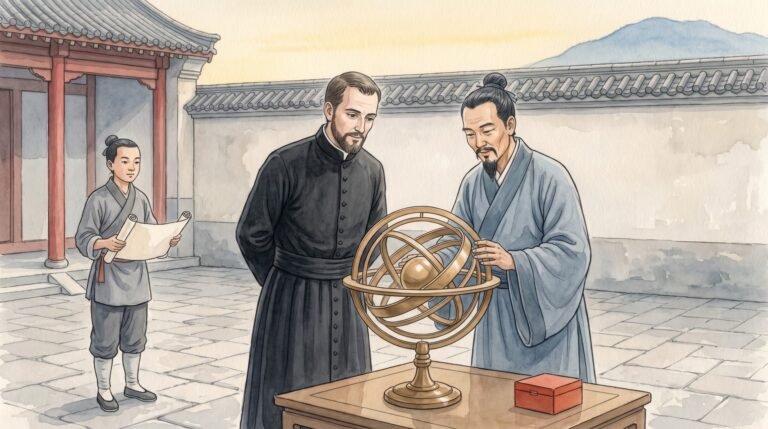
Zeng’s contribution was concrete. In 1865 he established, with Li Hongzhang, the Jiangnan Arsenal (江南製造局) in Shanghai, which became the largest single industrial enterprise in Qing China and the centre of the late-Qing attempt to build modern weapons, modern steamships, and a modern technical education. He set up a translation bureau at the Arsenal that produced, between the late 1860s and the 1890s, the largest single body of Chinese translations of Western technical and scientific texts in the nineteenth century. He supported, on the recommendation of Li Hongzhang, the young Yung Wing (Rong Hong 容閎), a Yale-educated Chinese from Guangdong, in his campaign to send groups of Chinese boys to the United States to study at American universities; the first group of about thirty boys left in 1872 and included the young men who would become the engineers and diplomats of late-Qing and early-Republican China.
He also did the more ordinary administrative work. In 1864 and 1865, in Nanjing and four other cities, he re-established the official government printing offices that had been disrupted by the Taiping occupation, and he restarted the provincial examination system that had been suspended for the duration of the war. He served twice more as Viceroy of Liangjiang. He served once, briefly, as Governor of Zhili (present-day Hebei), the province that surrounded Beijing. In each post he was, by the standards of the time, an effective administrator: stern, methodical, attentive to detail, and committed to the Confucian principle that the official who held power was personally responsible for the conduct of his office.
The Self-Strengthening Movement did not, in the event, save the Qing dynasty. By the standards of later Chinese reformers — the men who would, in the 1890s, demand the abolition of the examination system, the building of railways, the convening of parliaments — the Self-Strengtheners had been too cautious, too Confucian, too willing to compromise with the conservatives at court. By the standards of modern historians, the Self-Strengthening Movement was the first serious modernising programme in Chinese history and the model, both positive and negative, for every such programme that followed. It built the first modern arsenals, the first modern navy, and the first overseas student programme. It failed, ultimately, because it tried to do these things without changing the political system that was failing. That, however, is a judgement that requires hindsight. In the 1860s and 1870s, the Self-Strengtheners were the most forward-looking officials in the empire.
Tianjin, 1870
In the spring of 1870 Zeng Guofan was appointed Governor of Zhili, the post that came with responsibility for the security of the capital and for relations with the foreign legations in Tianjin. He had been there forty days when, on the twenty-first of June, 1870, a riot broke out in the French concession. The proximate cause was a rumour that the French Catholic orphanage was kidnapping Chinese children and harvesting their organs for use in Western medicine. The rumour was untrue. It was, however, embedded in a longer history of resentment against the foreign missionaries, who were widely believed to enjoy extraterritorial protection that the Chinese authorities could not touch.
The riot that followed was one of the most serious anti-foreign incidents of the nineteenth century. The French consul, Henri Fontanier, fired his pistol at a Chinese magistrate who was trying to calm the crowd and killed the magistrate’s servant. The crowd killed the consul, ten nuns from the orphanage (by most accounts, after stripping them and torturing them in the street), two French priests, two French consular staff, three Russian nationals, and somewhere between thirty and forty Chinese Catholic converts. They burned the cathedral, the orphanage, the French consulate, and four Protestant churches run by British and American missionaries. Within forty-eight hours, warships from France, Britain, the United States, Germany, and Russia had gathered off the harbour at Dagu. The diplomatic crisis was immediate.
The court, in Beijing, looked for an official who could handle the crisis without losing either the foreigners or the Chinese public. The Empress Dowager Cixi, who was then at the height of her power, decided on Zeng Guofan. He was the most senior Han Chinese official in the empire. He was, in his own reputation, incorruptible. He had, more importantly, no reputation for the kind of anti-foreign zealotry that the restive gentry were beginning to express. He accepted the appointment, although he was unwell and although he understood that the position was, in political terms, almost certainly fatal. He wrote his will before he left Beijing.
He went to Tianjin. He investigated. He found no evidence of kidnapping or organ-harvesting at the orphanage, and he said so in his report to the court. He negotiated with the French envoy, who demanded the death of a substantial number of Chinese officials and the execution of perhaps twenty ringleaders of the riot. He negotiated the figure down. The settlement that he eventually concluded provided for the execution of sixteen of the rioters (a number that his successor Li Hongzhang, who took over the case in late 1870, would reduce by two), the exile of twenty-five more, the dismissal and exile of the Tianjin prefect and county magistrate, compensation of approximately four hundred and ninety thousand taels of silver to the foreign powers, and a formal apology to France, delivered by the senior official Chonghou. The settlement held. The foreign warships sailed away. The diplomatic crisis was over.
The political consequences, for Zeng Guofan, were severe. The Chinese public, the gentry press, and a substantial fraction of the official class denounced him as a traitor who had sold out to the foreigners. His old enemies, who had never forgiven him for the sack of Nanjing, took the opportunity to add their voices. He was replaced, in the autumn of 1870, by Li Hongzhang, who took the Zhili governor-generalship and the responsibility for the foreign affairs portfolio that Zeng had held. He returned to Nanjing as Viceroy of Liangjiang. He lived there for the last eighteen months of his life.
The last year, 1872
The last phase of Zeng Guofan’s life was, by his own account, the most difficult. He was in his early sixties. He was tired. His eyesight, which had been poor for years, was failing. He had been ill since the Tianjin affair; the strain of the negotiation, the public criticism, and the slow recovery of his reputation had, by the diaries of his last months, left him worn out. He continued to work. He continued to write, every day, in the diary. He continued to write to his sons, advising them on their careers. He had three sons by his wife Ouyang, a woman from a Hunan gentry family whom he had married when he was in his late teens, and five daughters; two of his eldest children had died young. His eldest surviving son, Zeng Jize, was in 1872 still a young man of thirty-three who had not yet begun the diplomatic career that would make him one of the most distinguished Chinese diplomats of the nineteenth century.
On the morning of the twelfth of March, 1872, Zeng Guofan suffered a cerebral haemorrhage. He died that day in his official residence in Nanjing. He was sixty years old. He was given a posthumous name — Wenzheng, “literary and correct” — that was the highest civil honour the dynasty could bestow. He was buried, in accordance with his instructions, in the family cemetery at Xiangxiang. He was mourned, in the official press, as one of the great men of the dynasty. He was mourned, in the popular press, with considerably less respect: the sobriquet “Zeng Guozéi” (曾國賊, “Zeng the National Thief”) was in widespread circulation by the time of his death, and has not entirely disappeared.
Zeng Jize and the inheritance
Zeng Guofan’s eldest surviving son, Zeng Jize (曾紀澤, 1839 to 1890), inherited his father’s title of First Class Marquis Yiyong and, after a long preparation that included teaching himself English, became one of the most distinguished Chinese diplomats of the nineteenth century. He served as minister to Britain, France, and Russia between 1878 and 1885; lived in Europe for seven years; pioneered the use of telegrams for diplomatic communication between Qing legations and the Zongli Yamen in Beijing; and negotiated, in 1880 and 1881, the Treaty of Saint Petersburg that reversed most of the Russian gains of the Treaty of Livadia of 1879 in Ili (East Turkestan) and recovered a substantial portion of the territory that Russia had seized in the late 1870s. He argued, in a series of dispatches from Paris in 1883 and 1884, against the French seizure of Tonkin (northern Vietnam), and his denunciations of French policy were sharp enough that the French government demanded his recall in the spring of 1884. His successor, Xu Jingcheng, was a more emollient diplomat; the Sino-French War broke out within months.
Zeng Jize’s career is, in a sense, the proof that the diary-keeping father had raised a son who could read the world. The elder Zeng had spent his life learning to govern the Chinese empire; the younger Zeng spent his life learning to negotiate with the foreign empires that were closing around it. Neither of them, in the end, could save the dynasty. But Zeng Jize’s diplomatic recovery of Ili in 1881 is one of the few genuine Qing diplomatic victories of the late nineteenth century, and it is a vindication, of a kind, of the elder Zeng’s insistence on the unity of moral cultivation and practical statecraft.
Legacy: Confucian, general, bureaucrat, moderniser
It is difficult to summarise a man whose posthumous career in the Chinese memory has been as long and as contested as his actual career. There are, broadly, four Zeng Guofans in circulation.
The first is the Confucian Zeng Guofan — the man of the diary, the family letters, the self-cultivation tradition, the Cheng-Zhu school of Neo-Confucianism that he inherited and adapted. This Zeng Guofan has been, since the 1990s, the most popular Zeng Guofan in the Chinese reading public. The diaries and the family letters have been republished, sometimes in expurgated editions, as self-improvement literature and as management philosophy. They have been translated into English in part, most accessibly in William Jenner’s translation of the family letters. They have been read, in this century, by airport-bookshop readers, by mid-level officials, and by chief executive officers — by the kind of reader who is willing to take seriously the proposition that the governing of the self is the precondition of the governing of the state.
The second is the general Zeng Guofan — the man who built the Xiang Army, who fought the Taiping for fourteen years, who starved Nanjing into submission, and who then disbanded his army before the court could ask him to. He was not, on any honest reckoning, a brilliant battlefield commander. His subordinates did most of the actual fighting, and his subordinates were very good. His strength was the strategic patience of the siege, the organisational talent that built the army in the first place, and the political skill that kept the Xiang Army supplied, paid, and bound to him for more than a decade. In the long history of Chinese military biography he stands, with Zhuge Liang and with Wang Yangming, as one of the figures in whom the tradition of the scholar-general is most fully realised.
The third is the bureaucrat Zeng Guofan — the man who, twice, ran the Liangjiang viceroyalty; who, once, ran the Zhili governor-generalship; who rebuilt the examination system after the Taiping; who set up the printing offices; who negotiated, in the Tianjin affair, the most difficult diplomatic crisis of his generation. He was an effective administrator, a careful reader of memorials, and (unusually for the late Qing) not personally corrupt. He was, in the Confucian sense, a junzi — a gentleman — in office as well as out of it.
The fourth is the moderniser Zeng Guofan — the man who, with Li Hongzhang and Zuo Zongtang, founded the Self-Strengthening Movement; who set up the Jiangnan Arsenal; who supported the translation bureau; who sent the boys to America. He is praised by some historians as the first serious moderniser in Chinese history and criticised by others as the man who delayed the deeper reforms that might have saved the dynasty. The judgement of the historical record, so far as one can make one, is that Zeng Guofan did what was possible in the conditions of the 1860s and the 1870s, and that the conditions themselves were the obstacle. The dynasty was not, in the end, reformable from the top.
What the four Zeng Guofans have in common is the proposition, central to the Confucian tradition he inherited and adapted, that the self and the state are not separate projects. A man who cannot govern himself cannot govern others. A state whose officials cannot govern themselves cannot be governed. The diary, in this reading, is not a private document. It is a public document — the record of the man who, in his own person, was trying to keep the Confucian order honest. That order failed, in the years after his death. The record of his attempt is one of the great documents of nineteenth-century China.
References
- Spence, Jonathan D. (1996). God’s Chinese Son: The Taiping Heavenly Kingdom of Hong Xiuquan. W. W. Norton. The standard English-language account of the Taiping rebellion, including the military narrative and Hong Xiuquan’s biography.
- Platt, Stephen R. (2012). Autumn in the Heavenly Kingdom: China, the West, and the Epic Story of the Taiping Civil War. Alfred A. Knopf. The narrative account of the Taiping war from 1851 to 1864, with detailed treatment of the Xiang Army campaigns and the siege of Nanjing.
- Jenner, William, trans. (1986). Selections from the Family Letters of Zeng Guofan. Chinese University Press. The most accessible English translation of the family letters.
- Liu, Yongli, and Liu, Yiping (2021). “Self-Cultivation as the Basis of Person Making: A Confucian Perspective Illustrated by a Case Study of Zeng Guofan.” Journal of Human Values 27(1). The scholarly account of Zeng’s practices of self-cultivation as recorded in the diaries, family letters, and reading records.
- Kuhn, Philip A. (1978). “The Taiping Rebellion.” In The Cambridge History of China, Vol. 10, edited by John K. Fairbank, 264-317. Cambridge University Press. The standard scholarly synthesis of the rebellion, with attention to the military and administrative roles of Zeng Guofan and the Xiang Army.
- Teng, Ssu-yü, and Fairbank, John K., eds. (1954). China’s Response to the West: A Documentary Survey, 1839-1923. Harvard University Press. The documentary collection that includes the principal memorials of Zeng Guofan and the Jiangnan Arsenal documents.
- Wang, Jianlang, and Zhou, Wu, eds. (2011). The Diaries of Zeng Guofan (曾國藩日記). Yuelu Press. The standard modern critical edition of the diaries in Chinese.
- Zhao, Dongyan (2018). Zeng Guofan and the Xiang Army (曾國藩與湘軍). Beijing University Press. The principal Chinese-language scholarly account of the founding and campaigns of the Xiang Army.
- Smith, Richard J. (2012). “The Tianjin Massacre and the Diplomatic Crisis of 1870.” In The Battle for China: Essays on the Military History of the Late Qing, edited by Bruce A. Elleman, 219-244. Routledge. The standard scholarly account of Zeng Guofan’s handling of the Tianjin affair and its political consequences.
- Yung, Wing (1909). My Life in China and America. Henry Holt. The memoir of the Yale-educated Chinese reformer who worked with Zeng Guofan and Li Hongzhang on the educational mission to the United States.