There is a peculiar contradiction at the heart of modern China. Many of the country’s greatest sources of energy are found far from the places that consume the most electricity. The deserts and plateaus of Xinjiang, Gansu and Inner Mongolia offer extraordinary conditions for solar and wind generation. Sichuan, Yunnan and Tibet contain enormous hydropower resources. Coal remains concentrated heavily in the north and northwest. Yet the densest concentrations of factories, office towers, data centres, apartment blocks and electric vehicles lie thousands of kilometres away, around the Yangtze River Delta, the Pearl River Delta, Beijing, Tianjin and the great urban belt of eastern China. China therefore faces an energy problem that is also a problem of geography: how does a continental country move electricity from where nature has placed its resources to where industrial society demands them?
China’s answer has been to build something almost invisible compared with its high-speed trains, skyscrapers and bridges, but in some respects even more ambitious. Across the country now stretches an extraordinary system of ultra-high-voltage transmission lines, giant converter stations, regional grids, substations and increasingly sophisticated control systems capable of moving immense quantities of electricity across distances that would span entire European countries. By the end of 2025, China was operating dozens of ultra-high-voltage transmission projects, while cross-provincial transmission capacity had climbed into the hundreds of gigawatts. These are not simply larger versions of ordinary power lines. They form part of a national attempt to reorganise the geography of electricity itself, allowing solar power generated near the Gobi Desert to illuminate apartment towers far to the east and hydropower produced among western mountains to run factories on the coast.
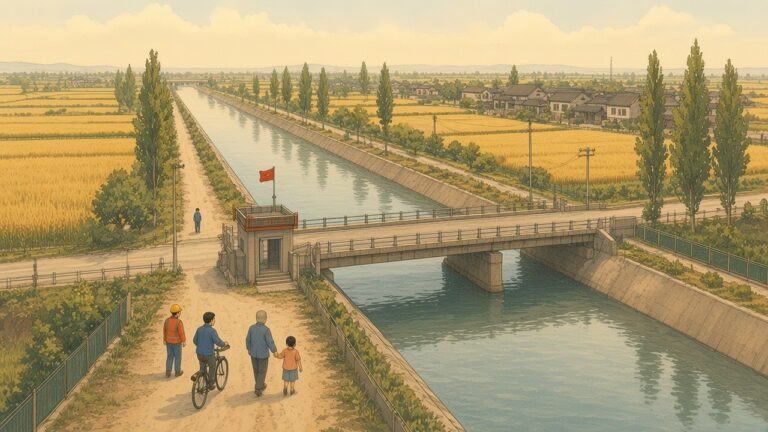
The significance of this network goes far beyond engineering. China is attempting to make distance matter less. That ambition has deep historical echoes. Chinese states have repeatedly confronted the problem of how to connect a vast territory whose resources, populations and centres of production rarely occupy the same places. The Grand Canal transported grain from the fertile south towards the political centres of the north. Imperial courier roads carried officials and information across enormous distances. Modern railways moved coal and industrial goods between inland resource regions and coastal cities. The contemporary electricity grid belongs to this same family of infrastructure. It is another attempt to make a huge and geographically uneven country function as a single economic system.
The Geography Problem
The easiest way to understand China’s electricity system is to look at a map. The country’s population and industrial production are heavily concentrated in the east and southeast. Provinces such as Guangdong, Jiangsu, Zhejiang and Shandong contain vast manufacturing clusters and large urban populations. Shanghai sits at the centre of one of the most electricity-intensive economic regions in the world, while the Pearl River Delta combines heavy industry, electronics manufacturing, logistics, finance and tens of millions of urban consumers. Yet some of China’s best sites for generating renewable electricity lie far inland, where land is abundant, sunlight is intense, winds are strong and population density is comparatively low.
This imbalance became increasingly important as China industrialised. Coal could be loaded onto trains and ships, but electricity itself had traditionally been much more difficult to move over very long distances without significant losses or enormous infrastructure costs. Conventional transmission networks tended to connect relatively nearby generators with consumers. A country could build regional grids, but attempting to send huge quantities of electricity across two or three thousand kilometres presented a much harder technical problem. China’s expansion of renewable energy has made the geographical mismatch even sharper because so much new wind and solar capacity has been built precisely in the regions where local demand is least able to absorb it.
By the end of 2025, China had built renewable generating capacity on a scale unmatched anywhere else in the world. Wind and solar alone had reached levels that would have seemed implausible only a decade earlier. The country was adding hundreds of gigawatts of new capacity each year, creating enormous renewable energy bases in the north and west as well as rapidly expanding rooftop and distributed solar in the east. Yet installing solar panels and wind turbines is only the beginning. Electricity must be delivered at the moment it is required. A solar farm producing enormous amounts of electricity at midday is of limited use if transmission lines cannot carry that electricity towards consumers. Wind output fluctuates, demand rises and falls according to weather and industrial activity, and electricity systems must balance generation and consumption continuously.
This is where China’s transmission programme becomes central to the country’s energy transformation. Without the grid, the spectacular growth of renewable energy would remain geographically fragmented. With it, solar farms in Xinjiang, wind installations in Inner Mongolia and hydropower stations in Sichuan can increasingly become components of a continental electricity network.
What Makes Ultra-High Voltage Different?
Electricity loses energy as it travels through transmission lines. One way to reduce those losses is to increase the voltage. The principle is relatively straightforward even if the engineering is not. For the same amount of transmitted power, raising voltage allows electricity to travel with lower current, which reduces resistive losses in the line. The higher the voltage, the more economically very large quantities of electricity can generally be transmitted across long distances.
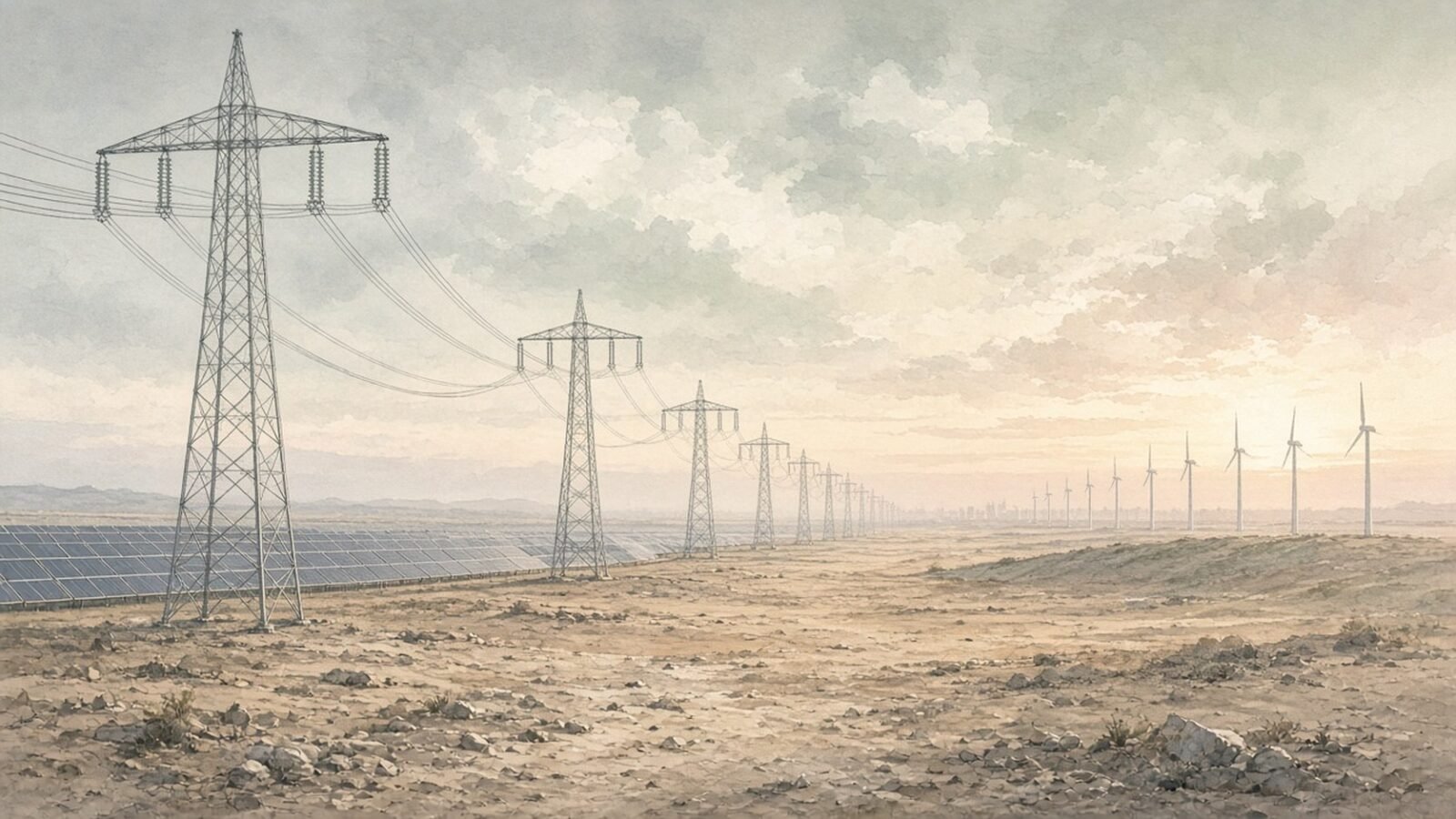
China has pushed this principle to an extraordinary scale through ultra-high-voltage technology. Its network includes both alternating-current and direct-current systems. UHV alternating-current lines help connect and strengthen large regional grids, while ultra-high-voltage direct-current systems are particularly well suited to carrying huge blocks of electricity over immense distances. The towers themselves can be enormous, the cables stretch across mountains, rivers, farmland and desert, and at either end sit gigantic converter stations filled with transformers, switchgear, control equipment and power electronics. These facilities convert electricity between alternating and direct current and regulate the flow of power into receiving grids.
The result resembles an electrical version of a long-distance freight railway. Instead of moving coal from western mines towards eastern cities, China can increasingly generate electricity close to the energy source and move the electricity itself. That distinction matters because the movement of electrons is potentially far more efficient than the physical transport of fuel. It also allows wind, solar and hydropower resources in remote regions to become economically useful to distant cities without requiring local population centres to consume the output.
One recent project illustrates the concept particularly clearly. In June 2025, the ±800-kilovolt ultra-high-voltage direct-current line connecting Hami in Xinjiang with Chongqing entered operation. Stretching more than 2,000 kilometres across China, the project is designed to carry enormous quantities of electricity from one of the country’s most resource-rich energy regions towards one of its largest inland metropolitan areas. Much of the associated generation comes from wind, photovoltaic solar and solar-thermal power. Hami, historically associated with the Silk Road, is now being transformed into a major node in China’s twenty-first-century energy network.
Consider what that means geographically. Hami lies deep in northwestern China amid landscapes of desert and mountains. Chongqing is a vast metropolis in the upper Yangtze region, filled with factories, residential districts, logistics hubs and transport networks. The distance between them is comparable to crossing much of Europe. Yet electrically they are becoming neighbours. This is precisely what China’s grid strategy is designed to accomplish.
From Moving Coal to Moving Electrons
For much of modern Chinese industrial history, energy geography was dominated by the movement of physical fuel. Coal mined in Shanxi, Inner Mongolia and other northern regions travelled by rail towards industrial centres and ports. Entire railway corridors became dedicated to carrying the fuel that powered factories and electricity stations elsewhere. Ports, freight lines and coal terminals formed a vast logistical system whose purpose was to move concentrated energy from resource regions towards consuming regions.
That system remains enormously important. China still relies heavily on coal, and energy security continues to influence electricity policy. But long-distance transmission introduces another model. Instead of moving millions of tonnes of fuel across the country before burning it near consumers, electricity can be generated closer to the resource and transmitted through wires. Hydropower provided an early demonstration of this principle. Southwestern China contains some of the greatest hydrological resources on Earth, and major dams in Sichuan and Yunnan produce electricity on a scale far exceeding local demand. Transmission networks allow part of that power to travel towards eastern and southern provinces.
The renewable boom now extends the same logic to the deserts and grasslands of northern and western China. Huge wind and solar complexes are being developed in regions that could never consume their output locally. Their economic rationale depends partly on the ability of the national grid to transport electricity elsewhere. China is therefore turning geographical remoteness from a disadvantage into an energy asset. Land that is distant from the coastal economy can host enormous generation complexes precisely because transmission technology makes that distance increasingly manageable.
This helps explain why discussions of China’s renewable expansion that focus exclusively on the number of solar panels or wind turbines miss much of the story. The electricity grid is the machine that allows those individual assets to operate as a national system. Without transmission, storage and market reform, a terawatt of renewable capacity scattered across distant regions would be less useful than the headline numbers suggest. The challenge is not merely to generate electricity but to move, balance and distribute it efficiently.
The Grid Meets the Renewable Explosion
China’s success in manufacturing solar panels, wind turbines, batteries and electrical equipment has produced a new problem: generation capacity can now be built faster than grids can always absorb it. The country has added astonishing quantities of renewable power over the past several years, reaching its earlier wind and solar targets far ahead of schedule and continuing to accelerate construction. Entire desert areas that once appeared economically marginal are now filled with solar arrays and wind installations, while eastern provinces have seen explosive growth in rooftop solar.
Yet generating capacity is not the same thing as usable electricity. Solar farms can sometimes produce more electricity than the local network can absorb. Wind farms may be forced to reduce output when transmission capacity is insufficient. Renewable power can therefore be curtailed, meaning technically available generation is not used. This is not unique to China. Every electricity system with a rapidly increasing share of intermittent renewable generation eventually faces similar questions. But China encounters them on a scale unmatched elsewhere.
Renewable construction has proceeded so rapidly that transmission infrastructure, storage systems and electricity-market reforms must race to catch up. China has consequently been pouring investment into transmission and distribution networks, while also expanding battery storage, pumped hydro and grid-control technologies. The country’s energy transformation is entering a different phase. The first challenge was building vast quantities of renewable generation. The next challenge is making all those generators behave like components of a coherent national electricity system.
That shift is important because it changes the nature of China’s energy problem. A decade ago the question was whether the country could deploy renewable energy at extraordinary speed. It clearly could. Today the harder question is whether electricity generated across millions of separate panels, turbines and power stations can be integrated into a system reliable enough to support an industrial economy of more than a billion people.
A National Electricity Market
Infrastructure alone cannot solve the problem. Electricity also has to cross administrative boundaries. China’s provinces have historically operated significant parts of their electricity systems with strong local considerations. Provincial governments naturally care about local generators, employment, electricity prices, tax revenues and supply security. Yet renewable energy frequently makes economic sense only when electricity can move freely between regions.
Imagine one province experiencing strong winds and weak electricity demand while another region experiences heavy industrial demand. From an engineering perspective, transferring electricity between them seems obvious. In practice, electricity markets, grid rules, pricing arrangements and local interests can complicate that exchange. China has consequently been building what officials describe as a unified national electricity market, intended to allow power to move more efficiently across provincial and regional boundaries while using market mechanisms to coordinate generation and consumption.
The physical grid and the market system therefore form two sides of the same project. UHV lines provide the ability to move electricity. Market reform determines when, where and at what price that electricity moves. Without both, the value of the network would be limited. A transmission corridor that technically connects two provinces cannot reach its full potential if administrative rules discourage electricity from crossing the boundary.
The scale of interregional exchange is already enormous. Electricity transmitted across provincial and regional boundaries has risen sharply over recent years, and the direction of travel is clear. China’s electricity system is becoming less a collection of provincial grids and more a continental network. This may ultimately prove as important as the physical construction of the transmission lines themselves because a national grid works best when electricity can move according to system needs rather than administrative geography.
The Return of the Periphery
Infrastructure can alter the economic meaning of geography. For much of the reform era, China’s most dramatic growth occurred along the coast. Guangdong became the workshop of export manufacturing. Shanghai and the Yangtze River Delta developed into one of the world’s largest industrial and commercial regions. Shenzhen rose from a border town into a global technology centre. Inland provinces often struggled to match the coastal combination of ports, foreign investment, dense supply chains and large consumer markets.
Energy creates a different map. Xinjiang cannot compete with Shanghai as a maritime financial centre, nor can Inner Mongolia reproduce Shenzhen’s electronics ecosystem, but these regions possess something increasingly valuable: space, sunlight, wind and energy resources. A vast solar installation requires land. Large wind farms require favourable geography. Long-distance transmission requires corridors that can connect generation zones to consumption centres. Western and northern China possess these conditions in abundance.
The energy transition therefore gives some inland regions new strategic economic functions. They become electricity-exporting regions whose natural geography is connected to distant cities by transmission infrastructure. There is an historical symmetry here. China’s political centres were once dependent on grain shipped northwards through canals. Industrial cities later depended upon coal transported from mining regions by rail. The twenty-first-century metropolis may increasingly depend upon electrons transmitted from deserts, mountains and plateaus.
The commodity has changed, but the underlying question has not. How does a vast country move essential resources between regions that produce them and regions that consume them? China’s ultra-high-voltage network is one of the most ambitious answers ever attempted.
The Other Grid Revolution
The spectacular UHV lines receive much of the attention, but another transformation is happening at the opposite end of the system. China is also experiencing enormous growth in distributed energy resources: rooftop solar panels, commercial batteries, electric vehicles, charging infrastructure and small-scale generation connected directly to local distribution grids.
This creates almost the reverse engineering problem. Traditional electricity systems were designed largely around large power stations sending electricity in one direction towards consumers. But when millions of buildings, factories, batteries and vehicles can generate, store or release electricity, local networks become far more complicated. Electricity can flow in multiple directions. A factory roof may generate power at midday. An electric car connected to a charger could eventually help stabilise the grid. A neighbourhood battery might store electricity during periods of abundant supply and release it later.
China’s planners have already recognised the challenge. Distribution networks increasingly have to evolve from relatively passive systems into active, interactive networks capable of accommodating distributed generation, storage and electric vehicles. The future Chinese grid may therefore operate simultaneously at two extremes. At one end, gigantic transmission lines will carry electricity thousands of kilometres across the continent. At the other, millions of small devices will continuously exchange power inside local networks.
Connecting those two worlds is one of the great engineering tasks of the coming decades. The national grid has to become both larger and more granular at the same time. It must coordinate enormous cross-country flows while also responding to millions of local decisions made by factories, homes, batteries and vehicles.
Storage Changes the Equation
Electricity networks have always confronted one fundamental problem: supply and demand must remain balanced. Solar and wind make that balancing act more difficult because their output depends partly on weather. Solar production falls rapidly after sunset just as household electricity demand may remain strong. Wind generation can rise or collapse over relatively short periods.
China is responding by building storage at extraordinary speed. Traditional pumped-storage hydropower remains important. Electricity is used to pump water uphill when supply is abundant, then released through turbines when demand rises. But the newer revolution is electrochemical and other forms of so-called new energy storage. Battery systems are being constructed alongside renewable projects, industrial zones and urban electricity networks.
This changes how the grid can operate. A transmission line does not have to perfectly match generation and demand at every moment if electricity can be stored temporarily. Batteries near solar farms can smooth output. Storage close to cities can reduce pressure during demand peaks. Electric vehicles may eventually become part of the balancing system themselves. The grid is gradually becoming less like a simple network of wires and more like an enormous coordinated machine containing generation, storage, transmission and consumption.
Storage also changes the economics of renewable power. A solar farm whose output peaks at midday can store part of that energy and sell it later in the evening. Wind generation that arrives during a period of weak demand can be preserved rather than wasted. The more storage China builds, the more effectively it can use the enormous renewable capacity already installed.
The Risks of Building the World’s Largest Electrical Machine
Scale brings vulnerability as well as strength. A highly interconnected grid can move electricity efficiently across regions, but it also requires sophisticated control systems to prevent disturbances from spreading. Renewable intermittency creates new balancing challenges. Extreme heat can simultaneously raise electricity demand and strain infrastructure. Droughts can weaken hydropower generation. Heavy storms, floods and other weather events can damage transmission equipment.
China’s electricity planners therefore face a difficult balancing act. They must decarbonise the power system while maintaining reliability for an economy whose industrial sectors consume enormous quantities of electricity. Energy security remains central to that calculation. Coal-fired power stations have not disappeared simply because renewable capacity has expanded. They continue to provide dispatchable generation that can operate when required, particularly during periods of high demand or weak renewable output.
China’s transition is therefore not a simple replacement story in which solar panels and wind turbines immediately displace every older technology. It is the construction of a more complicated system in which renewable generation, nuclear energy, hydroelectricity, coal, storage, transmission and demand management interact. The sheer speed of renewable construction makes those interactions increasingly important.
The challenge is converting installed renewable capacity into dependable, continuously usable electricity. That is fundamentally a grid problem. It is also why the less glamorous parts of the energy system, from substations to transmission markets and battery storage, may prove just as important as the solar farms and wind turbines that attract more public attention.
China’s Quiet Infrastructure Revolution
Visitors to China tend to notice the visible symbols of infrastructure first. High-speed trains slide into enormous stations. Bridges cross estuaries and mountain valleys. Metro systems spread beneath cities. Airports appear on a scale that seems almost excessive until passenger numbers catch up with them. The electricity grid is harder to see. Transmission towers pass anonymously beside highways, converter stations sit behind security fences far from city centres, and control rooms rarely become tourist attractions.
Yet without this infrastructure much of contemporary China would simply stop functioning. Factories depend on it. High-speed railways depend on it. Electric vehicles depend on it. Smartphone networks, semiconductor plants, automated warehouses, apartment elevators, hospitals, ports and data centres all depend on the uninterrupted movement of electricity.
This makes the grid arguably one of the most consequential infrastructure projects China has ever attempted. Its development also says something about the way the country has approached modernisation. China repeatedly builds systems whose value emerges not from an individual component but from the network created when thousands of components are connected together. One high-speed railway is useful, but a national high-speed railway network changes the geography of travel. One port is useful, but a system of ports, expressways and manufacturing zones changes the geography of trade.
Electricity follows the same logic. One solar farm in the desert is a power station. Thousands of renewable installations connected to storage, regional markets and long-distance transmission lines become something else entirely: an energy system operating on a continental scale.
The Old Chinese Problem in a New Form
Seen from a sufficiently long historical perspective, China’s ultra-high-voltage grid does not look entirely unprecedented. The technology is new, but the problem is ancient. Chinese governments have always governed a territory where geography creates enormous differences between regions. Grain grows more easily in some places than others. Rivers connect certain regions while mountains divide them. Mineral resources are unevenly distributed. Populations cluster around particular plains, valleys and coasts.
Successive Chinese states therefore became builders of networks. Canals moved grain. Roads moved officials. Postal stations moved information. Railways moved coal. Expressways moved manufactured goods. High-speed trains moved people. Now transmission lines move energy. The UHV tower rising over a remote stretch of northern China may look like the purest expression of modern engineering, but conceptually it belongs to a much older Chinese tradition: the attempt to overcome geography by constructing infrastructure at extraordinary scale.
The difference is that electricity moves almost instantly. A grain barge travelling along the Grand Canal could take weeks to reach its destination. A freight train carrying coal requires hours or days. Electricity generated in western China can enter an eastern power system almost immediately. For the first time, the resource being moved across China travels at essentially the speed of light.
That may ultimately be the most remarkable feature of the country’s electricity revolution. China is not merely building more power stations. It is constructing the connective tissue that allows deserts, mountains, factories and megacities separated by thousands of kilometres to operate as parts of the same machine. The towers crossing the landscape are therefore more than transmission infrastructure. They are the latest answer to one of the oldest questions in Chinese history: how can a civilisation occupying a continent-sized space make distance disappear?