For centuries, Jingdezhen did something more consequential than make beautiful porcelain. It assembled raw materials, specialised labour, kilns, merchants, waterways and foreign demand into a manufacturing system of extraordinary scale, one whose logic still shapes the city as it enters another technological age.
In July 2026, UNESCO added the Jingdezhen Handicraft Porcelain Industry Sites to the World Heritage List. The recognition was ostensibly about ceramics, but the most interesting thing preserved in Jingdezhen is not any particular vase, bowl or imperial kiln. It is the remains of a system: a landscape in which mines, workshops, firing sites, transport routes, merchants, forests and urban neighbourhoods once combined to produce porcelain for emperors, merchants and households across much of the known world.
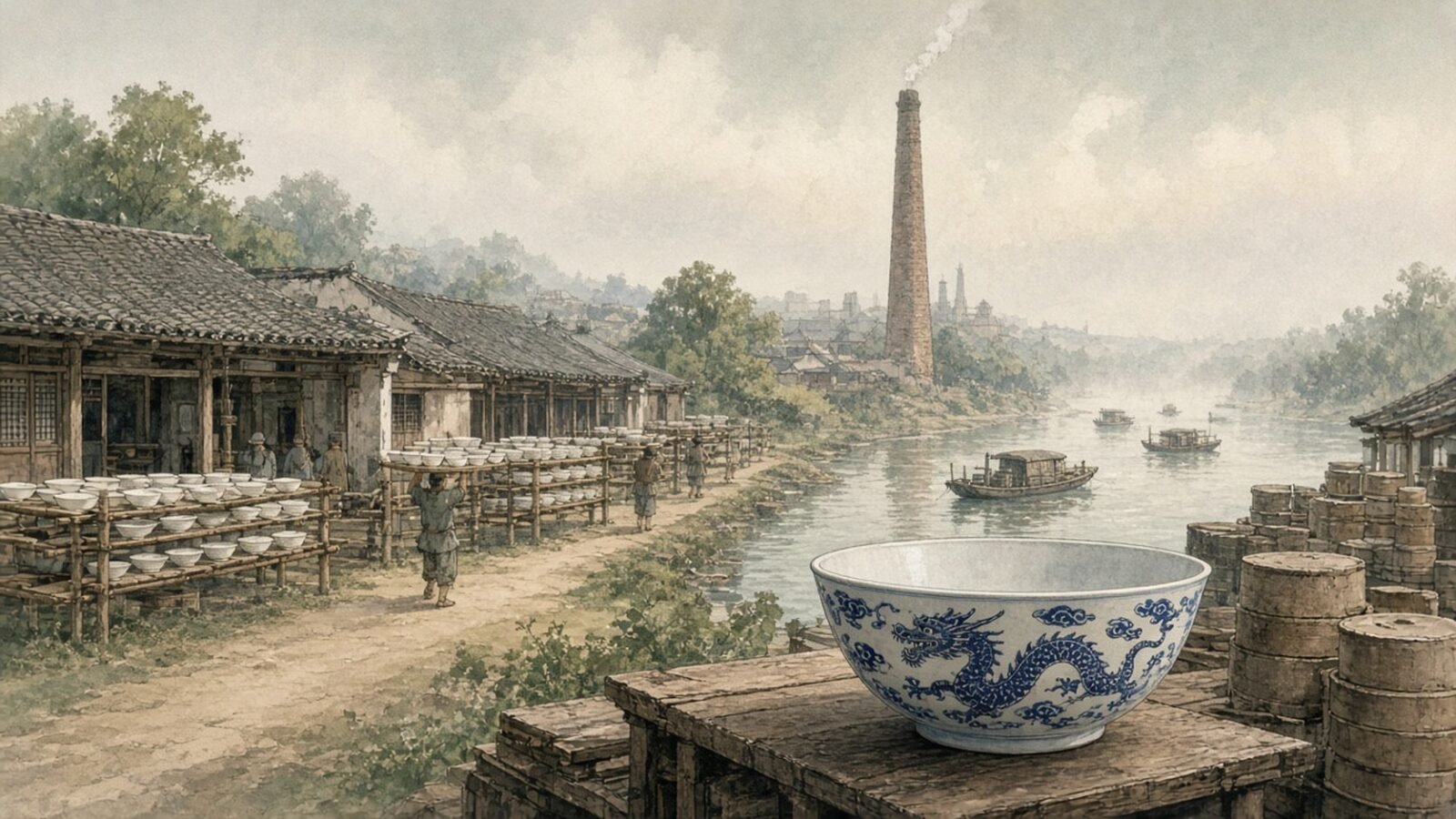
Imagine the city before electricity, railways or powered machinery. Hills close around a river valley in north-eastern Jiangxi. Barges move along the Changjiang River carrying stone, clay, firewood and finished porcelain. Smoke hangs above tiled roofs. Inside workshops, one person crushes minerals, another levigates clay, another throws a vessel on a wheel, another trims it and another paints cobalt onto its pale surface. Elsewhere, workers manufacture the clay boxes in which porcelain will survive the kiln, while kiln crews load thousands of pieces into enormous firing chambers where a mistake in temperature or airflow can ruin weeks of work. No single craftsman necessarily makes the finished object. Instead, the object moves through the city.
That distinction matters. Jingdezhen is routinely described as China’s “porcelain capital”, which is true but inadequate. Its greater achievement was organisational. Long before the modern factory concentrated workers beneath one roof and powered their tools with steam, Jingdezhen had already divided manufacturing into specialised tasks, standardised processes, linked urban workshops to distant resource zones and produced vast quantities for customers who might live thousands of miles away. A porcelain bowl therefore offers an unusual way of looking at Chinese history. Turn it upside down and, beneath the glaze, one begins to see an industrial system.
A World Heritage Site Made of Connections
UNESCO’s new listing makes this unusually explicit. The designated property is not simply an imperial kiln or a museum filled with masterpieces. It consists of five component areas representing a larger productive landscape: the urban porcelain-production centre, the Hutian kiln site, the Gaoling porcelain-clay mining area, the Changling porcelain-stone mining area and the Jiaotan fuel-production area. Mines, kilns, workshops, transport routes, commercial institutions and landscapes supplying firewood all belong to the same story.
The geography explains much of why Jingdezhen became so important. It sat near supplies of the materials required for high-fired porcelain, including porcelain stone and kaolin. Water connected those resources with the workshops and linked the city outward towards Poyang Lake and eventually the Yangtze. Forested hills supplied the tremendous quantities of fuel consumed by kilns. A manufacturing centre could therefore draw its ingredients inward and send finished objects outward using a relatively cheap transport network. Yet this was not merely convenient geography. People spent centuries learning how to exploit the landscape with increasing precision.
Porcelain is an unforgiving material. Ordinary pottery can be fired at substantially lower temperatures, but the hard, vitrified body associated with Chinese porcelain requires carefully prepared ingredients and high-temperature firing. One crucial Jingdezhen development was the systematic combination of porcelain stone with kaolin, creating a body capable of tolerating firing above roughly 1,300 degrees Celsius without collapsing. UNESCO describes this “binary formula” as one of the technological innovations that helped establish the city’s importance from the Yuan period onwards.
The name kaolin itself travelled globally from Gaoling, the hill country near Jingdezhen associated with the clay. A local resource became an international geological term because European observers trying to reproduce Chinese porcelain eventually needed to understand what the Chinese were putting into it. Material knowledge was therefore moving around the world before industrial chemistry had acquired its modern vocabulary, and Jingdezhen became not merely a place where objects were made but a source of technical problems that other societies wanted to solve.
The Seventy-Two Hands Behind a Bowl
The most revealing feature of old Jingdezhen was its division of labour. Historical studies of the city’s trades describe major occupational lines concerned with throwing and moulding bodies, firing kilns, making saggars, the protective clay containers in which porcelain was fired, painting decoration, packing and transportation, tool making and numerous supporting activities. These were further subdivided into specialised occupations. A traditional saying held that a piece of Jingdezhen porcelain passed through “seventy-two hands” before completion. The number was proverbial rather than a literal count applicable to every object, but it captured a real economic structure: highly fragmented specialisation.
This is what makes Jingdezhen much more interesting than the romantic image of a solitary master potter. Modern consumers often understand craftsmanship through authorship. We imagine one gifted individual beginning with raw clay and finishing with a signed work. Jingdezhen frequently operated according to another principle, in which skill resided in a process distributed across many people. One workshop might prepare blanks. A painter specialising in borders might never paint figures. Someone else could paint flowers, another inscriptions, while kiln masters possessed expertise in stacking and firing rather than forming vessels.
Production was dispersed physically but integrated economically. The city therefore resembles what a later industrial economist might call a cluster. Specialists were concentrated close enough to exchange labour, knowledge, materials and orders. A merchant did not need to create every capability inside one enterprise because the city itself contained the capabilities. That arrangement reduced the cost of production while increasing flexibility. It also made Jingdezhen unusually responsive to different classes of demand.
Imperial commissioners could require extraordinarily refined wares, exact in colour, proportion and decorative programme. Domestic merchants could order more ordinary ceramics in quantity. Foreign buyers could request forms or decorations intended for markets whose dining habits, heraldry or religious imagery differed greatly from those of China. Jingdezhen did not manufacture a single product so much as it manufactured the capacity to manufacture, and that distinction helps explain why the city’s ceramic economy proved so durable.
Cobalt Arrived From Somewhere Else
Nothing illustrates Jingdezhen’s openness better than blue-and-white porcelain, the style that eventually became so closely associated with China that it can appear almost timeless. Yet it was neither timeless nor purely local. Blue-and-white decoration uses cobalt pigment beneath a transparent glaze. Earlier Chinese ceramics had experimented with cobalt, but Jingdezhen’s mature blue-and-white tradition emerged particularly strongly during the Yuan dynasty. Research and museum scholarship indicate that imported cobalt from western Asia played an important role in early production, while Chinese cobalt sources became increasingly important later. The exact provenance of pigments in particular periods remains a subject of archaeological and chemical research.
That matters because one of the most recognisable “Chinese” objects in world history was partly a product of international exchange. The Mongol empire had connected China more intensively with Central and western Asia. Merchants moved along maritime and overland routes, and large dishes and vessels suited Middle Eastern dining traditions appeared among Jingdezhen exports. Imported pigment met Chinese kilns, Chinese clay preparation and Chinese painting, creating a style that would eventually circulate across Eurasia on an enormous scale.
The result was not simply foreign influence imposed on Chinese craft. Jingdezhen absorbed an external material into its own technical system and transformed it into something that customers from Istanbul to Amsterdam would eventually regard as quintessentially Chinese. In doing so, the city repeatedly demonstrated a capacity that would recur throughout its history: the ability to take materials, tastes and commercial demands from elsewhere, process them through a dense local manufacturing ecology and send back objects that were both adapted to foreign markets and unmistakably shaped by Jingdezhen.
A sixteenth-century Jingdezhen jug now in the Metropolitan Museum makes the process wonderfully visible. It carries Portuguese royal arms, but its shape draws on an Islamic metalwork form. Chinese artisans produced it in porcelain for the Portuguese market. The coat of arms was misunderstood and painted upside down. The object is therefore Chinese, European and Middle Eastern at the same time, a small artefact of globalisation made several centuries before the word existed. Its imperfections are almost more revealing than a perfect export object would have been, because they expose the distance between makers and customers while also showing how closely connected their economic worlds had become.
The Imperial Kiln Was Only Part of the Machine
Imperial patronage gave Jingdezhen prestige, but it can also distort our view of the city. The Yuan administration established the Fuliang Porcelain Bureau in the late thirteenth century, and successive Ming and Qing courts maintained systems for commissioning ceramics from Jingdezhen. Imperial demand pushed artisans towards exceptional levels of technical control. Court workshops required exact colours, forms and decorative programmes, while failed objects could be destroyed rather than released. Excavations around the imperial kiln area have revealed layer upon layer of production debris alongside evidence of neighbouring civilian manufacture.
Yet Jingdezhen was never simply a royal factory. Civilian kilns surrounded the official operation, commercial producers served domestic consumers and international merchants, and skills flowed between sectors. The imperial system could push quality upwards, while commercial demand pushed output outwards. That combination created something unusual: luxury and mass production occupying the same industrial ecology.
A technically demanding court commission and a shipment of export dishes did not necessarily emerge from identical workshops, but both drew on the same deep pool of kiln knowledge, raw-material suppliers, painters, clay processors, merchants and transport networks. The emperor was therefore one customer within a much larger production system, albeit an exceptionally influential one. This helps explain why Jingdezhen could survive political disruption. Courts changed, dynasties ended, foreign demand fluctuated and kilns closed and reopened, yet the knowledge was not contained inside a single palace bureaucracy. It was distributed through a city.
Industrial resilience often works this way. A company can disappear quickly because its knowledge, machinery and workforce are concentrated in a single organisation. An ecosystem is harder to erase because skills are held by families, neighbourhoods, workshops, suppliers and merchants. Jingdezhen’s strength lay not merely in institutional continuity but in a much broader social continuity of making, trading and adapting.
When Europe Tried to Reverse-Engineer China
By the seventeenth century, Chinese porcelain had become a major international commodity. Portuguese traders were followed by the Dutch and other European maritime powers, while shipwreck cargoes recovered from Asian waters contain Jingdezhen ceramics in astonishing quantities. A group associated with the seventeenth-century Hatcher wreck, now documented by the British Museum, includes late Ming Jingdezhen export ware thought to have been travelling towards the commercial networks centred on Batavia. An East India Company armorial dish from the wreck of the Diana, made at Jingdezhen around 1816, demonstrates how long this customised export system endured.
Europe did not simply buy Chinese porcelain. It tried desperately to reproduce it. For centuries, European potters could imitate the appearance of Asian porcelain without fully reproducing its material properties. Delftware and other tin-glazed ceramics adopted blue-and-white aesthetics, royal collections filled with Chinese vessels and chinoiserie spread through painting, furniture, architecture and interior decoration. Chinese porcelain was admired not only because it was beautiful, but because its manufacture seemed technically elusive.
The ultimate prestige object was therefore not only a Chinese vase. It was knowledge of how the Chinese vase had been made. When European manufacturers finally developed hard-paste porcelain successfully in the early eighteenth century, most famously at Meissen in Saxony, the balance began to change. China no longer possessed an unanswerable material secret, and European and later Japanese producers could compete in forms that had once required importation.
Yet even this technological transfer reveals Jingdezhen’s importance. Europe had spent generations trying to solve a manufacturing problem that a Chinese city had already embedded in everyday economic life. UNESCO’s assessment emphasises precisely this global effect: Jingdezhen’s recipes, kiln technologies, production organisation and decorative traditions influenced ceramic industries far beyond China. Porcelain was not simply exported as merchandise. It exported a technological challenge, forcing competitors to ask how the material was composed, how firing was controlled and how such large volumes could be made with such consistency.
The City Was the Factory
Calling Jingdezhen “industrial” requires some care. It was not Manchester. Its kilns were not powered by steam engines, it did not organise production through nineteenth-century mechanised factories and its labour relations did not correspond neatly to those of modern industrial capitalism. Yet industrialisation is not only about engines. It is also about specialisation, throughput, standardisation, logistics, skilled labour, capital, quality control, supply chains and the ability to reproduce complex objects in quantity.
By those measures, premodern Jingdezhen appears strikingly modern. The crucial difference is architectural. A later factory pulled many stages of production beneath one roof, whereas Jingdezhen spread them through neighbourhoods and across the surrounding countryside. Instead of a single building containing the manufacturing system, the settlement itself became the manufacturing system.
Mines in the hills were effectively upstream departments. River wharves were logistics infrastructure. Kilns were high-temperature processing plants. Painters’ workshops were finishing departments. Merchants converted distant demand into specifications and orders. Fuel suppliers kept the thermal machinery alive, while occupational networks regulated labour and protected specialist knowledge. The system was decentralised in space but tightly integrated through trade and expertise.
This explains one of the paradoxes of Jingdezhen porcelain. The finished object can look delicate, quiet and individual, while the system behind it was crowded, noisy, dangerous and enormous. A blue brushstroke on a white bowl conceals mining, forestry, hydrology, chemistry, fire management, transport and finance. The object is serene because the turbulence of its production has been hidden beneath a flawless glaze.
What Survived the Kiln Age
Modern Jingdezhen could easily have become a city preserved mainly through museums, its fame resting on imperial masterpieces and archaeological remains. Instead, ceramics still organise much of its economy. The transformation is visible at Taoxichuan, where former state-owned ceramic factory buildings and chimneys have been converted into studios, galleries, shops, cafés and markets. The architecture belongs to twentieth-century industrialisation, while the activity inside increasingly belongs to a creative economy of independent makers, students, designers and visitors.
Jingdezhen attracts potters from elsewhere in China and abroad because its old advantage remains powerful: almost anything connected with ceramics can be sourced there. Clay bodies, glazes, mould makers, kiln services, decorators, firing specialists, packaging suppliers and highly particular forms of skilled labour remain unusually concentrated. A ceramic artist can arrive with an idea and find within the city the people and materials required to test it.
The technology has changed, but the cluster logic has not. Recent numbers make the point more forcefully. Jingdezhen’s municipal government says the city’s ceramic industry surpassed 102.7 billion yuan in output in 2025, with advanced ceramics accounting for about 34 per cent. In 2024, the city reported 26.03 billion yuan of output specifically from advanced ceramics, including products associated with electronic components and materials such as alumina, zirconia and silicon nitride.
Those materials inhabit a very different world from an imperial blue-and-white vase. Advanced ceramics can be engineered for electrical insulation, thermal stability, wear resistance and extreme operating environments. They appear in electronics, communications equipment, industrial machinery and aerospace systems. A city historically built around controlling mineral composition and extreme heat therefore finds itself unusually well placed to participate in a modern industry that also depends on controlling mineral composition and extreme heat.
The continuity should not be exaggerated. A semiconductor ceramic substrate is not simply a high-tech version of a Ming bowl. The chemistry, equipment, tolerances and corporate structures are different. But there is a deeper continuity of economic habit. Jingdezhen still understands ceramics not as one product but as a field of possibilities, and that habit may be more important than any single technical inheritance.
Heritage Can Freeze a City, or Give It Another Market
The 2026 UNESCO inscription therefore arrives at an interesting moment. World Heritage status can preserve places, attract visitors and focus investment on conservation. It can also turn functioning landscapes into stages. Workshops become demonstrations, historic districts become polished visitor routes and a living economy risks being interpreted principally through what outsiders consider picturesque.
Jingdezhen faces that tension directly. The city’s government says Taoxichuan attracted nearly three million visits in 2025 and hosted dozens of weekend and night markets. UNESCO’s own management recommendations highlight congestion, tourism planning and the need to interpret the five component sites as parts of one interconnected industrial system rather than isolated attractions. That last point is especially important because the city’s significance can easily be misunderstood if its history is reduced to decorated porcelain and celebrity artisans.
If Jingdezhen is presented merely as a place where exquisitely dressed craftsmen once painted elegant vases, its most important historical achievement disappears. The genius was not just the hand but the network connecting hands. That network also explains why Jingdezhen remains culturally alive in a way many old manufacturing centres do not. Contemporary artists can arrive precisely because the supply chain still exists. Students can experiment because firing services, materials and expertise are available nearby. Small makers can enter the market without owning every stage of production themselves.
The old division of labour, stripped of some of its former guild structures and transformed by electricity, trucks, digital marketplaces and tourism, continues to reduce the cost of trying something new. The city that once made customised porcelain for Persian, Portuguese, Dutch and imperial Chinese customers now sells through studios, galleries, exhibitions and online platforms to another global market. The route has changed, but the principle has not.
The Bowl Was Never Just a Bowl
Return to the workshop. A painter lowers a cobalt-loaded brush onto pale ceramic. The line looks almost black before firing. Around it are unfinished bowls, powdered pigments, clay, brushes, timber shelves and the accumulated knowledge of generations. Somewhere else, a kiln is being loaded. Somewhere upstream, minerals have been quarried. Somewhere downstream, a merchant is thinking about a customer. What appears to be an object is actually a meeting point for dozens of processes that stretch across landscape, labour and trade.
That is what Jingdezhen changes about the familiar story of Chinese porcelain. We tend to admire the finished surface: the translucency, the blue, the precise curve of a bowl, the improbably thin wall of a cup. Jingdezhen asks us to look behind it. There we find an urban system capable of absorbing foreign materials, satisfying imperial taste, responding to global commerce and breaking difficult production into specialised tasks. We find miners linked to painters, forests linked to kilns and inland waterways linked to dining rooms on other continents.
Europe eventually learnt the chemistry of hard-paste porcelain. Other regions learnt the forms. Competitors copied the blue and white, while factories mechanised processes that Jingdezhen’s artisans had once performed by hand. Yet Jingdezhen survived because its real product was never only porcelain. Its deeper product was an ecosystem of making, one capable of transmitting technical knowledge across generations while adapting to changing markets and technologies.
That ecosystem is why a city whose international fame was built in the age of sail can now produce both handmade tea bowls and engineered ceramic materials. It is why UNESCO has had to protect not one monument but an entire landscape of mines, workshops, transport routes and kilns. And it is why the old phrase about seventy-two hands still matters. The most revealing thing about a Jingdezhen bowl is not simply that so many hands touched it. It is that a city learnt how to make all those hands work together.