In the early summer of 1357, in the Marinid city of Fez, an old man who had spent more than half of his life on the road dictated his memoirs to a young court secretary named Ibn Juzayy al-Kalbi. The old man was Abu Abdallah Muhammad ibn Abdallah ibn Muhammad ibn Ibrahim al-Lawati al-Tanji — known to history, and known to himself in the book’s introduction, as Ibn Battuta. He was born in Tangier in 1304, of a family of Berber jurists from the small Berber confederation of the Lawata. He was educated in the Maliki school of Sunni law, the dominant school of the Maghreb, and he left Tangier in 1325 at the age of twenty-one with the deliberate intention of making the pilgrimage to Mecca. He did not return to the Maghreb for twenty-four years, and when he did, the book he dictated described a journey that had taken him, by his own account, through some 120,000 kilometres of road and sea — through North Africa, Egypt, Syria, the Hejaz, Iraq, Persia, Anatolia, the Crimea, the steppe, India, the Maldives, Sri Lanka, Bengal, Sumatra, the South China Sea, the southern Chinese ports, the route to Khanbaliq, the Indian Ocean return, the East African ports, the Sahara, the Niger, the Saharan oases, and the Maghreb again. The book is called the Rihla, the Journey, and it is the longest first-person travel account in any pre-modern language. It is also one of the most carefully examined, and one of the most heavily questioned, accounts of the world that any medieval traveller produced.
The Rihla is principally known in the West for the China section, which occupies the last third of the book. Ibn Battuta is the only medieval Muslim traveller to have left a detailed account of Yuan China, of the Mongol-ruled dynasty that would be overthrown in 1368, just eleven years after the Rihla was dictated. The account is uneven, in places thin, and at several specific points contradicted by the surviving Chinese sources. The account is also, in the eyes of the modern reader, almost unbelievably ambitious. Ibn Battuta was, by the time he reached the Chinese port of Quanzhou in about 1346, a man in his early forties who had been travelling for more than twenty years, who had held a number of judicial and administrative positions in the Delhi Sultanate, who had been shipwrecked in the Maldive Islands, who had survived the great Delhi famine, and who had been appointed, in the year before his arrival in China, as a qadi, an Islamic judge, of the Muslim community of the Chinese port of Quanzhou. He was, by any standard, the most widely travelled person in the world of his time, and his account of China is the first extended Muslim account of the country to be written in the Arabic language.
How much of the account is first-hand is the question that has divided the scholars of the Rihla for the last two hundred years. The questions are sharper for the China section than for any other part of the book, because the China section is the only part of the book for which there is a substantial body of independent Chinese documentary evidence against which Ibn Battuta’s account can be checked. The Chinese sources are, in some respects, the only sources that can resolve the questions. The questions are not new. The questions were raised in the eighteenth century by the editors of the Leiden edition of the Rihla, who observed that several of Ibn Battuta’s specific claims about Yuan China — the date of the Mongol conquest of southern China, the status of the Muslim communities of the southern ports, the route of the sea-road from Sumatra to Quanzhou, the name of the city that he called Khansar — were inconsistent with what the Chinese sources of the period record. The questions were sharpened in the nineteenth century by the Russian orientalist Henryk Kowalewsky, who compared the book systematically with the Yuan Shih, the official history of the Yuan dynasty, and concluded that Ibn Battuta had been in China for a much shorter time than he claimed, and that he had never been further north than the port of Quanzhou. The questions were reopened in the twentieth century by the work of the French Arabist Henri Cordier and the British Arabist H. A. R. Gibb, both of whom concluded that the China section of the Rihla is largely second-hand, and that the first-hand material is confined to the account of the city of Quanzhou and the account of the sea-road from Sumatra to the South China Sea.
From Tangier to Mecca, 1325 to 1326
Ibn Battuta left Tangier on 14 June 1325, with a small sum of money and the blessing of his parents. The Rihla records the date, the place, the names of the companions with whom he set out, and the precise religious intention of the journey. The journey from Tangier to Alexandria, by land along the North African coast, took him about six months. He went by way of Tlemcen, Béjaïa, Tunis, Sousse, Sfax, and Tripoli. The Rihla records the names of the saints and scholars whose tombs he visited, the names of the legal scholars with whom he studied, the names of the markets, the names of the rulers who gave him gifts, and the names of the men who travelled with him. The style of the book, from the first page, is the style of an Islamic religious traveller. It is a record of visits to the tombs of the saints, of attendance at the lectures of the scholars, of the observance of the prescribed rituals, and of the contacts made with the local Muslim communities.
From Alexandria he went down the Nile to Cairo, and from Cairo to the great mosque of Al-Azhar, where he studied for several months. He visited the pyramids, the sphinx, the schools of the city, the great cemetery of al-Qarafa, the city of Damascus, the city of Jerusalem, the city of Hebron, the city of Bethlehem, the city of Tyre, the city of Sidon, the city of Beirut, the city of Tripoli, the city of Aleppo, the city of Hama, the city of Homs, the city of Antioch, the city of Aintab, the city of Malatya, and the city of Sivas. He joined the caravan of the Egyptian Hajj, and arrived in Mecca in the autumn of 1326. He performed the Hajj, and remained in Mecca for several months. He was now, by the standards of the day, a fully qualified hajji, an alumnus of the great mosque, and a member of the international Muslim community of the Hejaz.
From Mecca he went to the port of Jeddah, and from Jeddah down the Red Sea coast to the Yemen. He visited the cities of Zabid, of Aden, of Shihr, of Zafar, and of Taiz. He joined a trading voyage across the Arabian Sea to the south-west Indian coast, and visited the cities of Calicut, of Quilon, of Mangalore, of Goa, of the Konkan coast, of the Malabar Coast, of Hormuz on the Persian Gulf, of the southern Iraqi cities of Basra and of Wasit, of the cities of Tabriz, of Hamadan, of Isfahan, of Shiraz, of Baghdad, of Mosul, of the Jazira, and of the cities of central Arabia. He returned to Mecca for a second Hajj in 1327. He was, by the end of his first journey, a thoroughly seasoned traveller, a hajji twice, a member of the scholarly community of the Hejaz, and a person with the contacts, the languages, the experience, and the financial resources to undertake a much longer journey.
The Second Journey, 1327 to 1332
The Rihla records that Ibn Battuta set out on his second journey in 1327, with the intention of travelling overland through the heart of Asia, to the cities of the Volga, to the Mongol steppe, to the cities of Central Asia, and to the cities of the Indian subcontinent. The route he took is one of the most thoroughly debated in the history of medieval travel. The book gives a series of place-names, several of which are difficult to identify with any certainty, and several of which appear to be inconsistent with the geography of the regions he claimed to have passed through. The consensus of the modern scholarship is that he went from Mecca to the Persian Gulf, from the Persian Gulf to the port of Hormuz, from Hormuz across Persia to the city of Tabriz, from Tabriz to the city of Baghdad, from Baghdad to the city of Mosul, from Mosul to the city of Diyarbakr, from Diyarbakr to the cities of upper Mesopotamia, from upper Mesopotamia to the cities of Anatolia, from Anatolia to the ports of the Black Sea, from the Black Sea across the Crimea, from the Crimea to the steppe, from the steppe to the lower Volga, and from the lower Volga to the capital of the Golden Horde, the city of Sarai Berke.
He remained at Sarai Berke, the capital of the Golden Horde and the seat of the Muslim khan Özbeg, for several months. He joined the khan’s court, was received by Özbeg, attended the khan’s court ceremonial, and was presented to the khan’s principal wife. From Sarai Berke he went to the city of Astrakhan, and from Astrakhan across the Caspian to the city of Baku, and from Baku across the Caucasus to the cities of Shirvan, of Tiflis, of the Cilician Armenian kingdom, and of the southern Anatolian ports. He returned to the Crimea, to the city of Kaffa, the principal Genoese trading port of the Black Sea, and from Kaffa he went by sea to the city of Constantinople. He visited Constantinople for about a month, and was received by the Byzantine emperor Andronikos III Palaeologos. He was the second Muslim traveller known to history to have visited the imperial city; the first was the Spanish Muslim Ibn Jubayr, who had been there in 1184.
From Constantinople he went by the Aegean ports to the cities of Asia Minor, and from Asia Minor to the cities of the Syrian coast, of Damascus, of the cities of the Euphrates, of the cities of central Persia, of the cities of Transoxiana, of the cities of Khorasan, of the cities of Afghanistan, of the cities of Sind, of the cities of the Punjab, of the cities of the Delhi Sultanate, of the cities of central India, of the cities of the south Indian coast, and of the Maldives. He arrived in Delhi in 1334, in the early years of the reign of Muhammad bin Tughluq, and he was received at the court of the Sultan and appointed to a number of official positions in the Islamic judicial and administrative establishment of the Sultanate. He remained in the service of the Sultan for about seven years, and during that time he was sent on diplomatic missions to the southern Indian kingdoms, was appointed a qadi in a number of cities, and was employed in the administration of the Delhi Sultanate’s financial and judicial system.
The Delhi Sultanate and the Famine of 1335
The Delhi Sultanate in the 1330s was, by the standards of the day, an enormous political entity. It had been founded by the Mamluk slave-soldiers of Qutb ud-Din Aibak in 1206, and it had been consolidated by the Khalji dynasty at the end of the thirteenth century. By the 1330s it extended, in theory, from the Indus to the Brahmaputra, from the foothills of the Himalayas to the southern tip of the Indian peninsula, although the practical control of the Sultanate was limited to the Indo-Gangetic plain, to the cities of central India, and to a number of vassal kingdoms in the south. The Sultan of Delhi, Muhammad bin Tughluq, was one of the most ambitious, and one of the most disastrous, rulers in the history of Indian Islam. He was a patron of learning, a writer of Persian and Arabic verse, a builder of mosques, and a serious student of Islamic law. He was also, by the end of his reign, a man who had brought the Sultanate close to financial ruin and administrative collapse.
Ibn Battuta’s account of the Delhi Sultanate is the longest continuous first-hand account of the Sultanate that survives in any language, and it is one of the most important sources for the history of Indian Islam in the 1330s. The account includes the description of the court ceremonial, the description of the administration of justice, the description of the system of espionage, the description of the Sultan’s hunting expeditions, the description of the Sultan’s diwan, the description of the financial collapse of the Sultanate in the late 1330s, the description of the rebellion in the province of Bengal, the description of the famine in the southern Indian provinces in 1335, and the description of the great exodus of the population of Delhi in the late 1330s. The account is detailed, specific, and largely consistent with the surviving Persian and Arabic sources of the period, although the accounts of the financial collapse of the Sultanate are corroborated by the Indian sources only in part, and the account of the famine is not corroborated by any Indian source.
The famine of 1335, which the Rihla describes in some detail, was a regional famine that affected the southern Indian provinces of the Sultanate. The Rihla records that the famine was caused by a combination of the failure of the south-west monsoon, of a series of military campaigns undertaken by the Sultan in the south, and of the breakdown of the public distribution system. The Rihla records that the famine caused the death of a substantial proportion of the population of the cities of the southern Indian provinces, and that the Sultan responded by relocating the survivors to the northern provinces. The Rihla records that Ibn Battuta himself was among the survivors, and that he was sent by the Sultan to the city of Daulatabad in the Deccan, where he served as a qadi in the years 1337 to 1342. The Rihla records that he was also sent on a diplomatic mission to the kingdom of the Hoysalas in the south, and to the city of Calicut on the Malabar Coast.
To China by Sea
In 1342, after seven years in the service of the Sultan, Ibn Battuta left the Delhi Sultanate. The Rihla records that he was sent by the Sultan as a diplomatic envoy to the court of the Yuan emperor, and that the Sultan’s intention was that the embassy should travel by sea, from the port of Calicut on the Malabar Coast, to the ports of southern China, to the port of Quanzhou, and to the Yuan capital of Khanbaliq. The Rihla records that the embassy was accompanied by a number of presents, by a number of Yemeni and Indian merchants, by a number of Chinese Muslim merchants resident in India, and by a substantial body of documents. The Rihla records that the embassy sailed from Calicut in 1342, and that it reached the port of Quanzhou in 1346, after a long series of delays, of shipwrecks, of storms, of changes of vessel, and of long periods of residence in a number of intermediate ports.
The route is one of the most detailed in the Rihla, and one of the most debated. The Rihla records that the embassy sailed from Calicut down the Malabar Coast to the port of Quilon, from Quilon to the port of Quanzhou, and from Quanzhou to the port of Hangzhou. The Rihla records that the embassy was unable to proceed to the Yuan capital of Khanbaliq for several years, that it remained in the southern Chinese ports for an extended period, and that Ibn Battuta was eventually able to make the journey to Khanbaliq. The Rihla records that the embassy returned to Quanzhou in 1347, that it sailed from Quanzhou to Sumatra, from Sumatra to the Maldives, from the Maldives to Calicut, and from Calicut to the Persian Gulf. The Rihla records that the embassy was unable to return to Delhi, that the Sultan was no longer in a position to receive an embassy, and that the embassy was dissolved.
The dates and the routes are inconsistent in several places with the Chinese and other Asian sources of the period, and the inconsistencies have been the subject of substantial scholarly work. The consensus of the modern scholarship is that Ibn Battuta reached Quanzhou in 1346, that he spent about a year in the southern Chinese ports, that he did not travel to Khanbaliq, and that his account of the journey to the capital is largely second-hand. The basis for the conclusion is partly the silence of the Chinese sources, partly the silence of the Persian sources, and partly the geographical inconsistencies of the Rihla’s account of the route from the southern Chinese ports to the Yuan capital. The Chinese sources record the names of several Muslim officials of the Yuan court, but they do not record the name of an Ibn Battuta, and they do not record the existence of a Delhi embassy to the Yuan court in the 1340s. The Persian sources, similarly, do not record the existence of a Delhi embassy to the Yuan court in the 1340s.
In Quanzhou
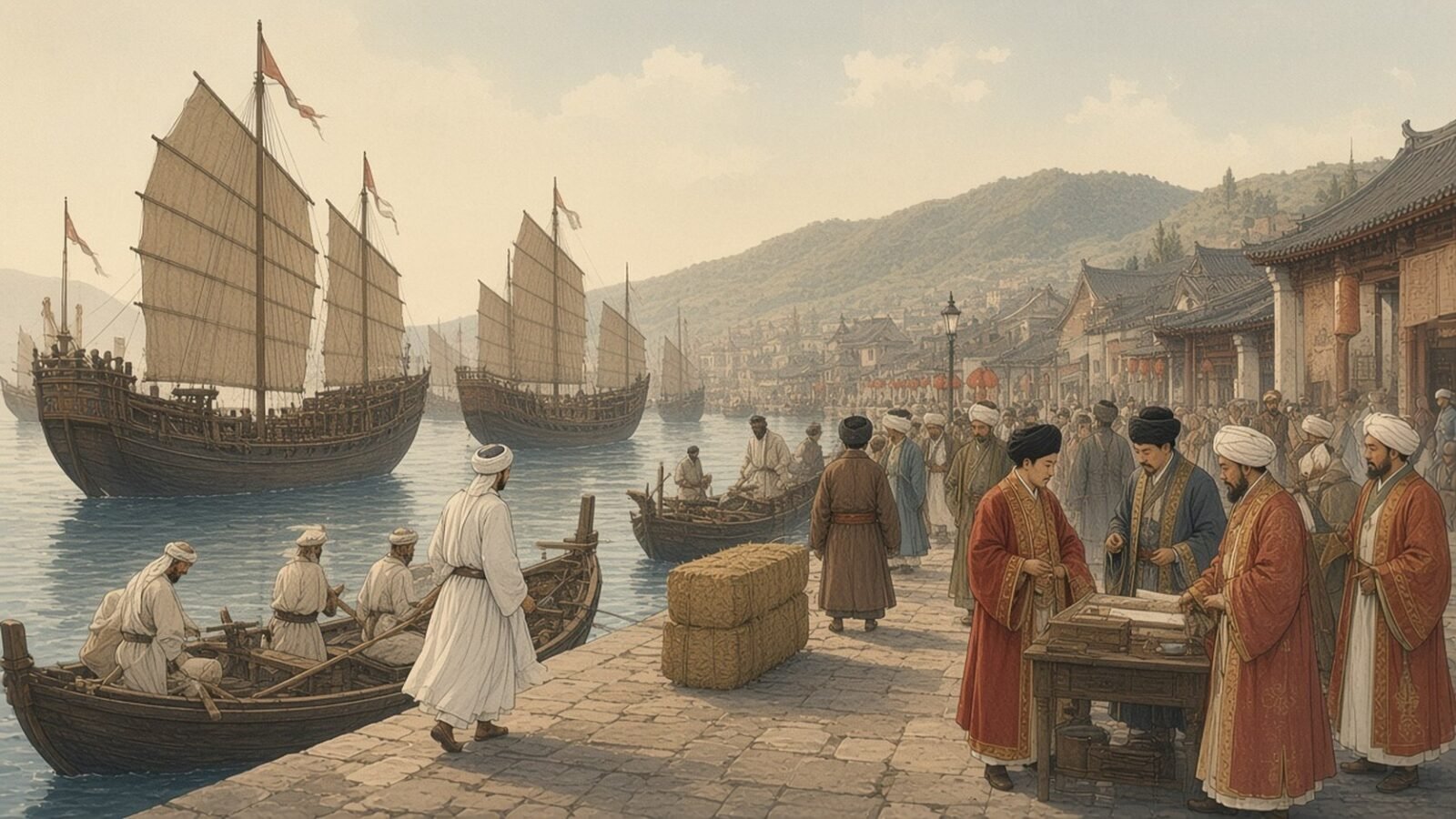
The Rihla’s account of Quanzhou, the principal Chinese port of the South China Sea in the 1340s, is the most detailed first-hand Muslim account of the city that has survived. The account is detailed, specific, and largely consistent with the surviving Chinese, Arab, and Persian sources of the period. The account records the name of the city, which the Rihla calls “Zaytun” (a name derived from the Chinese name for the city, “Citong,” and which the Arab geographers of the period had long used for the principal port of southern China). The account records the geography of the city, the port, the mosques, the markets, the foreign merchant communities, the Chinese Muslim community, the Indian Muslim community, the Arab Muslim community, the Persian Muslim community, the system of justice administered by the Muslim qadi, the system of the imperial post-stations, the system of the imperial granaries, the system of the Chinese maritime trade, and the customs of the Chinese city.
The account of the city is, in many respects, the most original in the Rihla. The account includes the description of the city’s great mosque, the description of the city’s Muslim cemetery, the description of the city’s Muslim hospital, the description of the city’s Muslim schools, the description of the city’s Muslim bath-houses, the description of the city’s Muslim merchants, the description of the city’s Muslim judges, the description of the city’s Muslim soldiers, the description of the city’s Muslim astronomers, and the description of the customs of the Chinese Muslim community. The account is detailed enough that a number of the specific sites mentioned in the Rihla can be identified with surviving sites in the modern city of Quanzhou, including the cemetery of the Muslim saints on the hill to the south of the city, the Ashab Mosque in the city centre, and the Qingjing Mosque, the principal mosque of the city in the Yuan period.
The Rihla also records the existence of a substantial Chinese Muslim community in Quanzhou, a community that was descended in part from the Muslim merchants of the Song period, in part from the Muslim soldiers of the Mongol armies that had conquered southern China in the 1270s, in part from the Muslim merchants of the Indian Ocean trade of the late Yuan period, and in part from the Muslim merchants of the maritime Silk Road. The Chinese Muslim community of Quanzhou in the 1340s was, by the standards of any contemporary European or Islamic city, very large. The Chinese sources of the period record a Muslim community of some tens of thousands in Quanzhou alone, and a Muslim community of several hundred thousand in the southern Chinese ports as a whole. The Chinese Muslim community was administered by a qadi, an Islamic judge, who was appointed by the Yuan court and whose office was one of the established positions of the Yuan administration. The Rihla records that Ibn Battuta was appointed to this office, and that he served as qadi of the Muslim community of Quanzhou for about a year before the embassy returned to the Indian Ocean.
The Fanjiang
The most distinctive feature of Yuan administration for the Muslim communities of the southern Chinese ports was the Fanjiang, the system of Muslim officials appointed by the Yuan court to administer the Muslim communities of the empire. The Fanjiang was, in essence, a parallel administration to the regular Chinese provincial administration, with jurisdiction over the Muslim communities of the empire, and with the authority to appoint Muslim officials, to maintain Muslim institutions, to administer Muslim justice, to collect Muslim taxes, and to represent the Muslim communities to the Yuan court. The Fanjiang was a substantial bureaucracy, and it was one of the principal instruments of the Yuan court’s policy of managing the religious diversity of the empire.
The Chinese Muslim communities of the southern Chinese ports were, in the 1340s, at the peak of their prosperity. The communities had been established by the trade of the late Song and the early Yuan, and they had been reinforced by the migration of Muslim soldiers and merchants from Central Asia, from Persia, and from the Indian Ocean ports. The communities maintained a network of mosques, of schools, of hospitals, of cemeteries, of judges, of notaries, of doctors, and of astronomers that was substantially the same as the institutions of the Muslim communities of the major cities of the Islamic world. The communities also maintained a network of trade that extended from the southern Chinese ports to the ports of the Indian Ocean, to the ports of the Persian Gulf, to the ports of the Red Sea, to the ports of the East African coast, and to the ports of the Mediterranean. The Chinese Muslim merchants of Quanzhou were, in the 1340s, among the principal actors in the Indian Ocean trade of the late Yuan period.
The Rihla’s account of the Fanjiang is one of the principal sources for the system, and one of the principal sources for the Chinese Muslim communities of the southern Chinese ports in the 1340s. The account records the structure of the Fanjiang administration, the names of the principal officials, the names of the principal Muslim institutions, the names of the principal Muslim scholars, the names of the principal Muslim merchants, and the names of the principal Muslim sites in the southern Chinese ports. The account is detailed enough that several of the specific officials and institutions mentioned in the Rihla can be identified with surviving Chinese sources of the period. The account is also, in places, inconsistent with the surviving Chinese sources, and the inconsistencies are the basis for the modern scholarly view that the China section of the Rihla is, in part, second-hand.
Return via the Maldives and the Maghreb
The Rihla records that the embassy returned to Quanzhou in 1347, that it sailed from Quanzhou to Sumatra, from Sumatra to the Maldives, from the Maldives to Calicut, and from Calicut to the Persian Gulf. The Rihla records that the embassy was unable to return to Delhi, that the Sultan was no longer in a position to receive an embassy, and that the embassy was dissolved. The Rihla records that Ibn Battuta was unable to return to the Maghreb by the overland route through Central Asia, that the routes through Central Asia were blocked by the breakdown of the Mongol khanates, and that he resolved to return to the Maghreb by sea. The Rihla records that he sailed from the Persian Gulf to the East African ports of Mogadishu, of Malindi, of Mombasa, of Kilwa, of the Comoros, and of the south-east African coast, and that he then sailed to the southern Arabian ports and to the Red Sea, and that he returned to the Maghreb by way of the Egyptian port of Alexandria.
The Rihla records that he arrived back in Tangier in November 1354, after an absence of twenty-nine years. The Rihla records that he found that his father had died, that his mother had died, and that the greater part of his family and his property had been dispersed. The Rihla records that he was received with honour by the Marinid sultan of Fez, Abu Inan Faris, that the sultan offered him the position of qadi of Fez, and that he accepted the position. The Rihla records that he did not hold the position for long, that the sultan withdrew the offer, and that he was forced to seek the patronage of a number of other rulers of the Maghreb. The Rihla records that in 1357, while he was at the court of the Marinid sultan, the sultan proposed to him that he should dictate an account of his travels for the benefit of the Moroccan scholars, and that the Rihla was the result.
The account was dictated to Ibn Juzayy al-Kalbi, a young secretary of the Marinid court, who was a competent writer of Arabic and who was familiar with the literary conventions of the Rihla, the genre of travel-writing in classical Arabic. Ibn Juzayy wrote the book in the course of a few months, working from Ibn Battuta’s dictation and from a number of written sources, including a copy of the Rihla of the Egyptian jurist and traveller Ibn al-Mujahid, the geographical work of the Spanish Muslim al-Idrisi, the geographical work of the Persian Muslim al-Qazwini, the geographical work of the Syrian Muslim Yaqut, and the geographical work of the Persian Muslim Hamdallah Mustawfi. The book was completed in the early months of 1357. The book was read aloud to the sultan and to the scholars of the Marinid court. The book was, by the standards of the day, an immediate success. It was copied and circulated throughout the Muslim world, and it has been continuously in print, in Arabic, in the major Muslim intellectual centres of the world, for the six hundred and seventy years since it was dictated.
The Question of the China Section
The most carefully examined part of the Rihla is the China section, and the most carefully examined question about the China section is the question of how much of the account is first-hand. The question is sharpened by the fact that the China section is the only part of the Rihla for which there is a substantial body of independent Chinese documentary evidence. The Chinese sources of the period do not record the name of an Ibn Battuta, do not record the existence of a Delhi embassy to the Yuan court in the 1340s, do not record the existence of a Muslim qadi in Quanzhou by the name of Ibn Battuta, and do not record the existence of a journey to Khanbaliq by a Muslim traveller from the Maghreb. The silence of the Chinese sources is not, in itself, conclusive. The Chinese sources of the period are partial, and they do not record the names of all the foreign visitors to the Yuan court, and they do not record the names of all the Muslim officials of the Fanjiang administration. The silence of the Chinese sources is, however, the principal evidence for the modern view that the China section of the Rihla is largely second-hand, and that the first-hand material is confined to the account of the city of Quanzhou and the account of the sea-road from Sumatra to the South China Sea.
The modern consensus, which has been developed over the last two hundred years by a long series of orientalists and sinologists, is that Ibn Battuta reached Quanzhou in 1346, that he spent about a year in the southern Chinese ports, that he did not travel to Khanbaliq, and that his account of the journey to the capital is largely second-hand. The consensus is based on three principal lines of evidence. The first is the silence of the Chinese sources. The second is the geographical inconsistencies of the Rihla’s account of the route from the southern Chinese ports to Khanbaliq, which are not consistent with the geography of the routes that the Yuan administration had established. The third is the internal evidence of the Rihla itself, which contains a number of specific claims that are not consistent with the Chinese sources of the period, including the date of the Mongol conquest of southern China, the status of the Muslim communities of the southern ports, the route of the sea-road from Sumatra to Quanzhou, and the name of the city that Ibn Battuta called Khansar.
The consensus is not unanimous. A small number of scholars, including the British Arabist H. A. R. Gibb and the French Arabist Henri Cordier, have argued that the first-hand material of the China section is more substantial than the consensus view allows, and that the geographical inconsistencies of the Rihla can be explained by a number of factors, including the use of second-hand sources, the abbreviation of the original text, and the loss of part of the original text. The consensus is, however, the majority view, and it is the basis for the standard modern editions of the Rihla, including the Gibb translation of 1958 and the Defrémery and Sanguinetti edition of 1858. The question is, in the end, a question of how much weight to give to the silence of the Chinese sources, and the consensus view is that the weight is substantial.
The Rihla in the World
The Rihla is, in the long view, the most important travel account in the pre-modern Arabic language, and one of the most important travel accounts in the pre-modern world. The book is the principal source for the geography of the fourteenth century world, for the political arrangements of the Mongol khanates, for the Indian Ocean trade of the late Yuan period, for the Chinese Muslim communities of the southern ports, for the Sultanate of Delhi in the 1330s, for the kingdom of the Maldives, for the kingdom of the Hoysalas, for the trade of the Indian Ocean ports, for the trade of the East African ports, and for the customs of the Muslim communities of the late medieval world. The book was used, from the fourteenth century onwards, as a source of geographical and ethnographical information by a long series of Muslim geographers, including the Egyptian al-Maqrizi, the Syrian al-Umari, the Tunisian Ibn Khaldun, and the Moroccan al-Idrisi. The book was also used, from the eighteenth century onwards, as a source of evidence about the history of the Indian Ocean trade, of the Mongol Empire, of the Yuan dynasty, of the Delhi Sultanate, of the Maldives, of the Hoysalas, and of the Chinese Muslim communities.
The book’s account of the Chinese Muslim communities of the southern ports is, in particular, one of the principal sources for the history of the Muslim communities of late Yuan China, and it is the principal source for the Fanjiang administration of the Muslim communities. The account is detailed enough that several of the specific sites mentioned in the Rihla can be identified with surviving sites in the modern city of Quanzhou, and it is detailed enough that several of the specific officials mentioned in the Rihla can be identified with surviving Chinese sources of the period. The account is, in this respect, a substantial contribution to the history of the Chinese Muslim communities, and it has been used as a source by a long series of Chinese and Western sinologists and historians of the Chinese Muslim communities, including the modern scholars Joseph Fletcher, Donald Daniel Leslie, and the late Dru Gladney.
What the book gives, in the end, is not a complete picture of Yuan China, but a partial, foreign, and highly selective picture of the southern Chinese ports of the late Yuan period, drawn partly from Ibn Battuta’s own observation and partly from the reports of merchants, missionaries, and other travellers that Ibn Battuta had met during his long residence in the Indian Ocean ports. The book is the account of a Muslim jurist who lived in Quanzhou for about a year, who was a competent enough speaker of Arabic and of Persian to be useful to the Muslim community of the city, and who had a particular interest in the religious, commercial, and administrative arrangements of the Muslim communities of the southern Chinese ports. The book is not the account of a Chinese-speaker, a Confucian scholar, a Buddhist monk, a Taoist priest, or a Chinese official. It is the account of a Muslim jurist who served, for a year, as qadi of the Muslim community of the principal Chinese port of the South China Sea, and who wrote, in dictation, the first extended Muslim account of late Yuan China. That it was written in a single sitting in the early months of 1357, in the Marinid city of Fez, in the form of a Rihla for the instruction of the Moroccan scholars, is part of what makes it remarkable.
Ibn Battuta died in 1368 or 1369, in Fez or in the Maghreb, and was buried in the city. The Rihla survived, in manuscript, in the libraries of Fez, of Cairo, of Damascus, of Istanbul, of the principal Muslim intellectual centres of the world, until the first printed edition of 1803, in Paris. The book is, in the long view, the principal record of the world of the fourteenth century that any Muslim traveller produced, and one of the principal records of the China of the late Yuan period that any Arabic writer produced. That it was written by an old man who had spent more than half of his life on the road, in a single sitting in the early months of 1357, in a Moroccan court that had never been to the places he described, is part of why it remains one of the most important books of the medieval world.