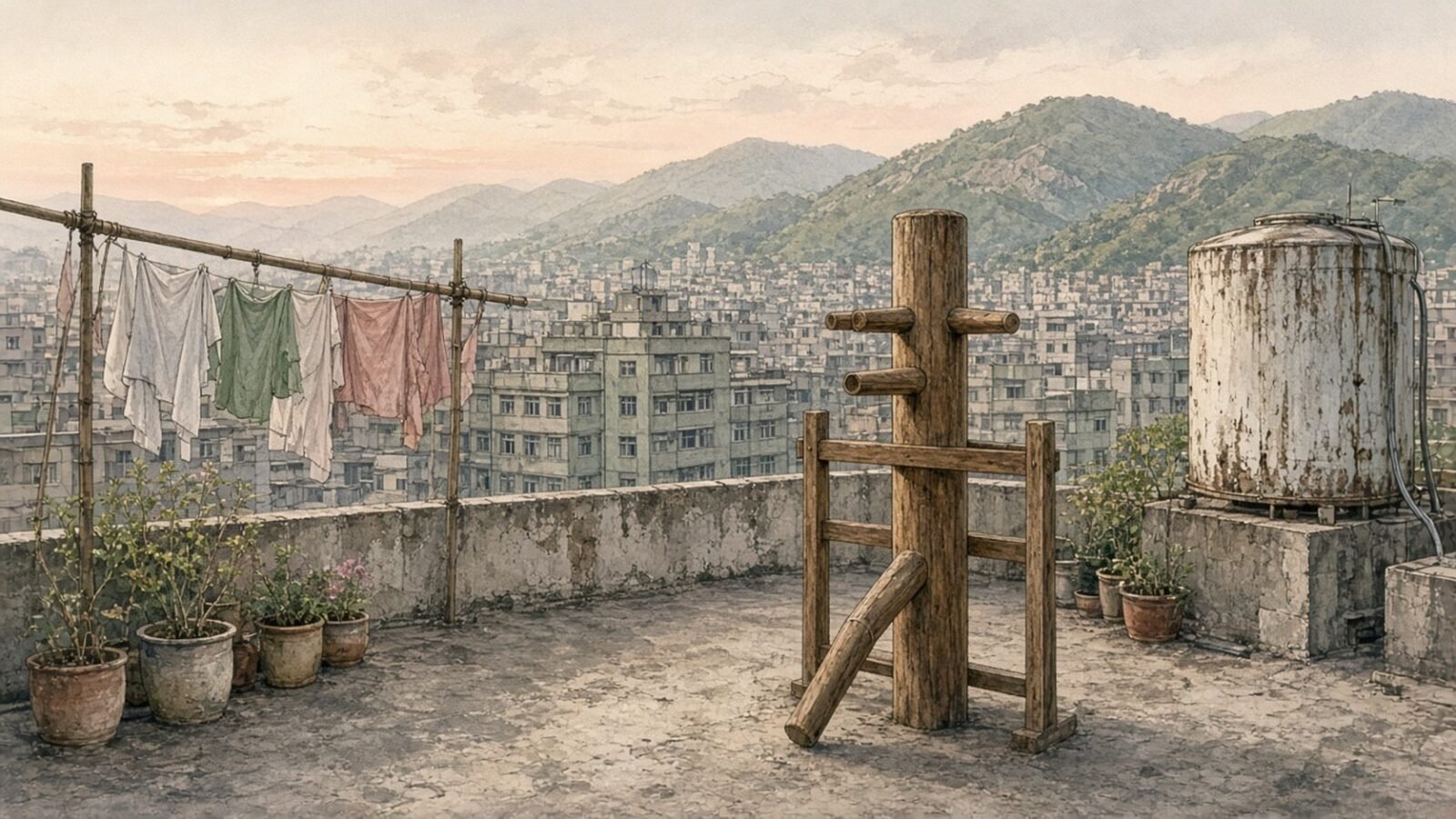
In the autumn of 1972, a few weeks before he died, an elderly man in a Kowloon flat was filmed performing the forms of the martial art he had spent his life teaching. The footage is short, grainy and undramatic: a thin figure in a vest and trousers moving through the first Wing Chun form and working a wooden dummy. It has since been watched millions of times online, and it is one of the few direct records of the real Ip Man, the teacher of Bruce Lee.
Today, most people who know the name know it from the cinema. Since 2008, Ip Man has been played by Donnie Yen, Tony Leung, Anthony Wong, Dennis To and others, and has become one of the best-known figures in Chinese popular culture. The films turned a wealthy Foshan gentleman, Nationalist policeman and refugee who began teaching Wing Chun to restaurant workers in 1950s Kowloon into a national hero who defeats Japanese generals and British boxers. This article looks at what is known about the man, what is disputed, and how and why the screen version departs from the record.
A gentleman’s son in Foshan
Ip Man, born Ip Kai-man (葉繼問), is generally recorded as born on 1 October 1893 in Foshan, then a busy manufacturing town near Guangzhou in Guangdong province. Some lineage chronicles give 14 October, a difference that probably reflects conversion from the lunar calendar. His family was wealthy and he received a traditional classical education. Accounts compiled by his students and descendants agree that he was the second son, and that the family owned property on Foshan’s main street, Song Yuen.
Foshan was a centre of southern Chinese martial arts, and Wing Chun had a local lineage there through the herbalist Leung Jan and his students. One of them, Chan Wah-shun, a money-changer by trade and known as “Money Changer Wah”, taught in a hall rented from the Ip family. Ip began studying with him as a boy. Sources differ on his age: a Hong Kong Commercial Daily feature and several biographies say seven, others say about thirteen. Chan was elderly, and Ip is said to have learned much from Chan’s senior student Ng Chung-sok, who continued his training after Chan’s death, usually dated to around 1905.
Hong Kong, St Stephen’s and the Leung Bik story
Around 1908, with the help of a relative by marriage, Ip was sent to Hong Kong to attend St Stephen’s College, a school for wealthy Chinese families and foreigners. The best-known story of his youth comes from this period. According to the account passed down in his lineage, a classmate arranged for him to spar with an older man staying with the classmate’s family; the teenage Ip was easily beaten, and discovered that the stranger was Leung Bik, the son of Leung Jan and therefore a senior figure in his own lineage. Ip then trained with Leung Bik for several years, and returned to Foshan with a refined version of the art.
The story matters because it is used to explain why Ip Man’s Wing Chun differed from that of other Foshan practitioners, and it has been questioned for that reason. Some researchers suggested that Leung Bik was a convenient invention, since the main evidence came from Ip Man’s own circle. The historian Benjamin Judkins, co-author with Jon Nielson of The Creation of Wing Chun (2015), a social history of the art, has since pointed to a 1926 Foshan publication that refers to Leung Bik as an active martial artist with students of his own. That makes the man’s existence more secure, though the details of his relationship with Ip rest largely on later recollection. Another popular tale, repeated by Ip’s son, has the young Ip disarming a foreign policeman who was beating a woman in Hong Kong; the Telegraph notes that Ip himself did not mention it in interviews, so it should be treated as family lore.
Police work and the war years
Ip returned to Foshan in his early twenties. He married Cheung Wing-sing, and they had four children, including two sons, Ip Chun, born in 1924, and Ip Ching, born in 1936. For the next three decades he lived as a man of means, practising with friends rather than running a public school. He is described in Chinese sources as holding posts in the military and police, but the details are thin before 1945.
The Japanese occupation of Foshan from 1938 is the period the films exploit most, and the one where legend and record diverge furthest. What is documented is that the family lost most of its wealth; Ip Ching later described how occupiers dug up gardens looking for buried valuables. Lineage chronicles say Ip refused to serve the puppet administration and was often hungry. A friend, Chow Ching-chung, helped him, and in return Ip taught Chow’s son and a small group of others at a cotton mill between about 1941 and 1943; several of those students later taught Wing Chun in Guangdong. A widely repeated story says he refused to teach Japanese soldiers. There is no reliable evidence that he fought Japanese martial artists or a Japanese general, and his son Ip Chun has said the films’ fights were not historical.
After the war, according to research summarised by Judkins and by Chinese biographies, Ip took a post in Foshan’s reconstituted Nationalist police force, leading a plain-clothes detective unit, and he is also recorded as holding a colonel’s rank in a Nationalist security unit. Those links to the Kuomintang made him vulnerable when the Communists took Guangdong in 1949.
A refugee teacher in Kowloon
Ip left for Hong Kong at the end of 1949, via Macau, according to his nephew Lo Man-kam, who described the journey to the South China Morning Post. His wife and children stayed behind at first. He was in his mid-fifties and, for the first time in his life, needed to earn a living.
A friend from Foshan, Lee Man, secretary of the Hong Kong and Kowloon Restaurant Workers’ Union, found him lodging at the union’s premises in Sham Shui Po. The union’s chairman, Leung Sheung, who already practised other styles, tested Ip’s skill, was impressed, and became his first student in Hong Kong. In 1950 Ip began teaching a class at the union; only members could attend, and the first class, as Lo Man-kam recalled, had just five or six students. The school then moved repeatedly, to Hoi Tan Street in 1954, Lei Tat Street in Yau Ma Tei in 1956 and later Li Cheng Uk estate and elsewhere, according to the history published by the Ving Tsun Athletic Association. Many of the students were bus company workers and young men interested in fighting, and challenge matches with other schools were common.
His private life was difficult. His wife returned to Foshan and, when the border closed, was unable to rejoin him; she died there of cancer in 1960. His sons Ip Chun and Ip Ching came to Hong Kong in 1962. Several accounts, including Judkins and Nielson’s history, say that Ip used opium during his Hong Kong years; this rests on the testimony of students and is not something his family has emphasised. In the late 1960s his senior students organised the Ving Tsun Athletic Association to put the art on a more formal footing.
Bruce Lee and the students
Ip’s most famous student joined in 1956. Bruce Lee, already a child film actor, was brought to the Lei Tat Street school at about 15 or 16 by his friend William Cheung, who was then living with Ip. Lo Man-kam told the South China Morning Post that Lee “was fighting in the street a lot” and that Ip scolded him: “You are learning kung fu. You are not learning how to fight.” Cheung later said that senior students objected to teaching Lee because of his partly European ancestry, and that he trained Lee alongside Wong Shun-leung, a formidable fighter who had joined in 1954 and taught much of the day-to-day class. Accounts of this episode come from the people involved and differ in detail.
Lee left for the United States in 1959 and went on to develop his own approach, later called Jeet Kune Do, with Wing Chun as its foundation. His fame, in turn, drew attention back to his teacher. Other students, including Wong Shun-leung, Leung Ting, Moy Yat, Lo Man-kam, Chu Shong-tin and Ip’s own sons, founded schools that spread the art to Europe, North America and Australia. The split between these lineages, each with its own emphasis, is one reason Wing Chun today has many rival branches.
Ip Man died of throat cancer at his home at 149 Tung Choi Street, Mong Kok, on 2 December 1972 (some sources give 1 December). He was 79 and was buried at Fanling. The film of his forms had been shot shortly before, reportedly at his own wish, to preserve a record. Bruce Lee died seven months later, in July 1973. Ip Ching died in January 2020. Ip Chun, born in 1924, went on teaching into his nineties.
The art he taught
Wing Chun’s own origin story is a legend. The version most often told says it was devised by a Buddhist nun, Ng Mui, who escaped the destruction of the Shaolin temple and taught it to a young woman named Yim Wing-chun, after whom the style was named. Historians of the martial arts, including Judkins and Nielson, treat this as a founding myth: no contemporary records support it, and the earliest lineage that can be traced with some confidence runs through nineteenth-century Guangdong, including Cantonese opera performers and Leung Jan in Foshan.
What Ip Man taught in Hong Kong is better known. The system consists of three empty-hand forms, Siu Nim Tao (“little idea”), Chum Kiu (“seeking the bridge”) and Biu Jee (“darting fingers”), a set of movements on the wooden dummy, and two weapons, the long pole and a pair of butterfly knives. Its best-known training method is chi sau, “sticking hands”, in which two partners keep their forearms in contact and try to sense and exploit each other’s openings. The style emphasises economy of movement, a centreline theory of attack and defence, and simultaneous blocking and striking at close range.
Ip’s contribution, as Judkins and Nielson argue, was partly pedagogical. Teaching large numbers of paying students in a modern city required a clear curriculum, and he presented Wing Chun in rational, almost scientific terms that suited Hong Kong’s young, urban and often educated recruits, rather than as a secret family inheritance. That modern framing helped the style travel abroad, where its compact techniques and lack of acrobatics made it easy to adapt.
Donnie Yen and the making of a hero
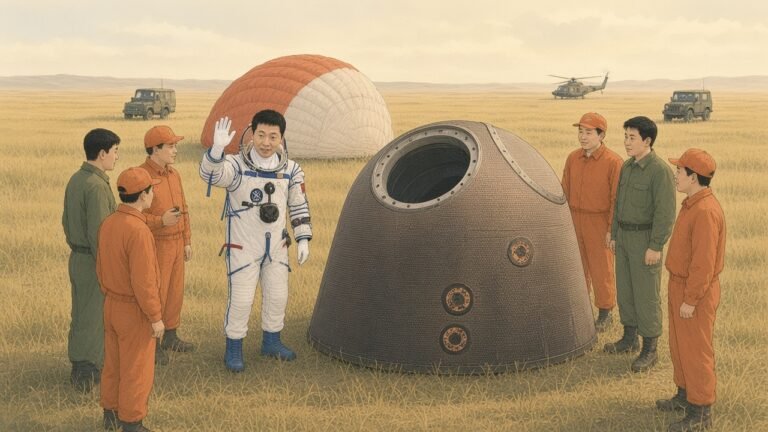
For decades after his death, Ip Man was known mainly to martial artists. That changed with Ip Man (2008), directed by Wilson Yip and starring Donnie Yen, who trained in Wing Chun for the role. The film shows Ip as a wealthy, gentle master in 1930s Foshan who loses everything under the Japanese occupation, is forced to fight for rice in a Japanese arena, and finally defeats a karate-practising general, Miura, in front of a crowd. It grossed about $22 million worldwide and was a hit across Chinese-speaking markets.
Three sequels followed, all directed by Wilson Yip with Yen. Ip Man 2 (2010) moves him to Hong Kong, where he confronts a rival master, Hung Chun-nam, played by Sammo Hung, and then an arrogant British boxer called Twister, played by Darren Shahlavi, who kills Hung in the ring. Ip Man 3 (2015) brings in Mike Tyson as a property developer and a Wing Chun rival, Cheung Tin-chi, and shows Ip nursing his dying wife in Hong Kong. Ip Man 4: The Finale (2019) sends him to San Francisco, where he confronts racism against Chinese immigrants and a US Marine sergeant. According to Box Office Mojo and The Numbers, the later films earned about $157 million and $176 million worldwide respectively. The Ip Man 3 figures were clouded by scandal: its mainland distributor admitted buying tickets and fabricating thousands of screenings to inflate its opening, and the authorities penalised the company, as the BBC reported in 2016.
What the films invented
The Donnie Yen films draw on the real outline of Ip’s life, a wealthy Foshan background, poverty under occupation, refugee life in Hong Kong and a famous student, but their central conflicts are invented. There is no evidence for General Miura or the rice-for-fights arena; Ip Chun has said his father did not fight the Japanese in this way. Twister and Hung Chun-nam have no documented real counterparts, and the boxing match did not happen. Cheung Tin-chi is fictional, and the film’s own credits describe its incidents as fictional. The real Cheung Wing-sing died in Foshan, separated from her husband by the border, not in his arms in Hong Kong. The fourth film’s American trip is also invented; there is no record of Ip Man travelling to the United States.
The films also reshape his character. The real Ip was a Nationalist police officer from a privileged background whose teaching was, by several accounts, a way to make a living in hard times, and whose private life included an opium habit. The screen Ip is an idealised Confucian gentleman, humble, patriotic and devoted to his wife, whose fights are almost always defensive responses to insult or oppression. That is a choice of genre as much as of ideology: the films follow a long Hong Kong tradition, running from the Wong Fei-hung films of the 1950s to Bruce Lee’s Fist of Fury (1972), in which a martial artist defends Chinese dignity against foreign bullies.
Other Ip Mans
Donnie Yen’s was not the only version. The Legend Is Born: Ip Man (2010), directed by Herman Yau, starred Dennis To as the young Ip and dramatised his training, including the Leung Bik story; in a neat piece of casting, the elderly Leung Bik was played by Ip Chun himself. Yau also directed Ip Man: The Final Fight (2013), with Anthony Wong as the older Ip in Hong Kong. That film is generally regarded as closer to the documented story, showing his poverty, his students and the rough world of 1950s Kowloon, though it too adds drama. A 50-episode mainland television series, Ip Man (2013), directed by Fan Xiaotian, starred Kevin Cheng.
The most ambitious version was Wong Kar-wai’s The Grandmaster (2013), with Tony Leung as Ip. It opened the Berlin International Film Festival and received Academy Award nominations for cinematography and costume design. Wong had been inspired partly by the 1972 footage. His film is less a biography than a meditation on the lost world of Chinese martial arts in the Republican era, and much of it follows an invented character, Gong Er, played by Zhang Ziyi, the daughter of a northern grandmaster. Wong’s Ip is quiet, melancholy and shaped by loss, closer in spirit to the refugee of the historical record than Yen’s avenger, but the film’s central relationship is fiction.
Nationalism, Hong Kong and the Wing Chun boom
The Yen films have often been read as nationalist. Their villains are Japanese soldiers, a British boxer and corrupt colonial police, an American marine and racist immigration officials, and Ip wins each confrontation as a representative of Chinese dignity. Critics in the West and in Hong Kong have described the films as patriotic crowd-pleasers, and their success in mainland China coincided with rising nationalist sentiment, a trend the site has examined in its piece on Wu Jing and the Wolf Warrior films. Others point out that the films’ anti-colonial themes are rooted in older Hong Kong cinema, and that the Ip of the films is also a Hong Kong figure: a refugee who builds a new life in the colony. The real Ip’s Kuomintang past, which fits neither reading neatly, is left out.
Whatever their politics, the films had a measurable effect on martial arts. The South China Morning Post and others have reported surges of interest in Wing Chun after the Yen films, with new schools opening in Hong Kong, mainland China and abroad, and Foshan now promotes itself as the home of Ip Man and Wing Chun, with a museum and memorial hall. Ip Chun became a sought-after teacher and was awarded an honorary doctorate by Lingnan University in 2020. For many practitioners around the world, the path to Wing Chun now runs through the films as much as through Bruce Lee. Readers interested in how Hong Kong’s own institutions tell the city’s story may also find the site’s history of the South China Morning Post of interest.
Conclusion
The real Ip Man was a more ordinary and more interesting man than the screen hero: a wealthy son of Foshan who learned a regional martial art as a hobby, served as a Nationalist policeman, lost his fortune and his country, and at the age of 56 began teaching kung fu to restaurant workers and street fighters in a crowded refugee city. His achievement was to take a little-known family style and turn it into a teachable system that his students carried around the world.
The films built a legend on that foundation. Some of what they show is loosely true, much is invented, and the inventions tell us about the audiences of the 2000s and 2010s as much as about the 1930s and 1950s. The grainy footage from 1972, of an old man calmly working through his forms, remains the best reminder of the difference.