In the late 1970s the most admired athlete in Chinese wushu was a slight teenager from Beijing who had grown up without a father and had been winning national titles since the age of eleven or twelve. A few years later hundreds of millions of people had watched him shave his head and train as a monk in Shaolin Temple. Two decades after that he was trading kicks with Mel Gibson in Hollywood, then standing at the centre of Zhang Yimou’s Hero, the first Chinese-language film to top the American box office. Jet Li’s life traces, more closely than almost any other, the path by which a sport rebuilt by the People’s Republic became a global screen style. This article follows that path, from the Beijing sports school and the Beijing Wushu Team through Wong Fei-hung, Fist of Legend and Fearless, to his illness, his charity work with the One Foundation, his Singapore citizenship, his quieter recent years and how China sees him today, noting where accounts differ.

A Beijing childhood
Li Lianjie was born in Beijing on 26 April 1963, the youngest of four children. His family’s ancestral home was Shenyang in Liaoning. His father died when he was two, and the household was poor. Sport would offer him a way out.
The opening came by chance. At about eight he joined a summer course at the Beijing sports school at Shichahai, near the old lakes north of the Forbidden City, and his coaches noticed an unusual combination of speed, flexibility and concentration. The most important of them was Wu Bin, who would become one of the best-known wushu coaches in China. Biographical accounts describe Wu going beyond ordinary coaching, even buying food for the family so that the boy had enough protein to train.
After 1949 the state reorganised China’s varied family and temple martial arts into a standardised competitive sport, judged on set routines of forms and weapons, much as gymnastics is judged, with talented children training full time in sports schools. Li was a product of this system, and his early career belongs to sports history as much as to martial arts lore.
Champion of a revived sport
In 1974 Li was among a group of young Chinese wushu performers who toured the United States, performing in cities including San Francisco, New York and Washington at a time when sporting exchanges were part of the thaw between the two countries. In November that year the Beijing Wushu Team was formed and he became a member.
His competitive record is the foundation of his reputation. He won the national all-around title repeatedly in the second half of the 1970s. Sources differ on the exact count: some say four titles between 1975 and 1979, others five consecutive championships. What is not in dispute is that he was astonishingly young. Li later recalled that at his first national victory he was about twelve, and that on the podium he was still shorter than the adults who had come second and third.
He was strongest in changquan, the long-range “long fist” family of northern styles that forms the core of modern competition wushu, and he trained widely in other styles and weapons. He left competition at the end of the decade, with accounts citing a knee injury, and spent some time as an assistant coach before film took over his life.
Among those who later followed the same route through Shichahai and the Beijing Wushu Team was Wu Jing, whose own career as the star of the Wolf Warrior films is covered elsewhere on this site. The Beijing team became a nursery for mainland action stars, and Li was its most famous graduate.
Shaolin Temple and the making of a star
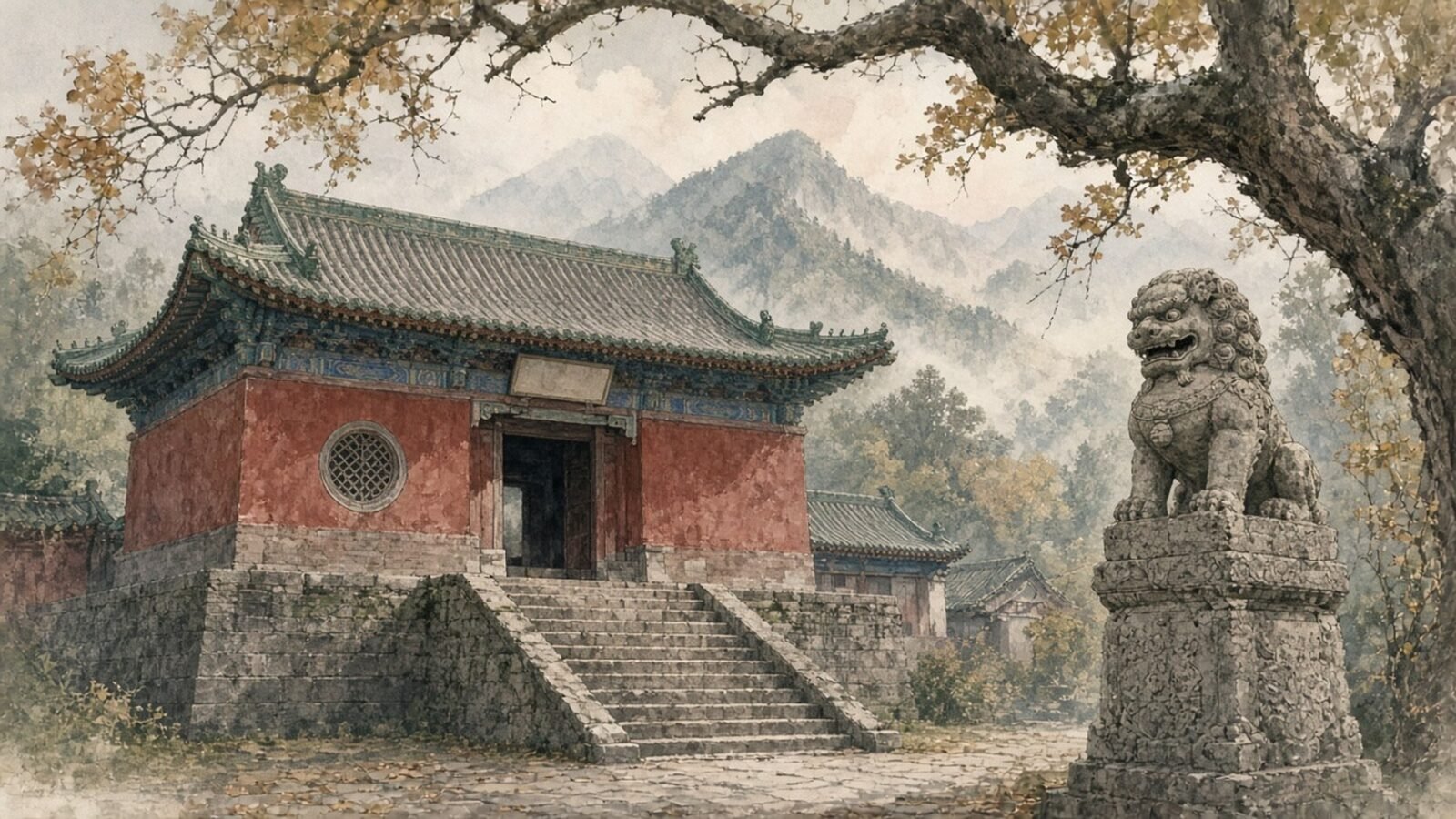
In 1982 Li made his screen debut in Shaolin Temple, directed by Chang Hsin-yen for a Hong Kong company but shot in mainland China with a largely mainland cast of wushu athletes. It was one of the first major co-productions between Hong Kong and the mainland after the start of reform and opening, and the first film shot at the Shaolin Monastery itself, in Henan. Set at the end of the Sui dynasty, it has a young fugitive learn the monastery’s martial arts and help the future Tang emperor Li Shimin.
The film was a phenomenon. Ticket prices at the time were very low, and box office records from the period are incomplete, so figures should be treated as estimates, but it is commonly said to have sold several hundred million tickets in China, with around 500 million the figure most often quoted. On that basis it is often described as the most-watched Chinese film ever when adjusted for inflation. Li was reportedly paid a tiny daily allowance for the long shoot, a detail that has become part of the legend.
According to the usual account, it was around this time that he acquired the name “Jet Li“, after a publicity company handling the film in the Philippines looked for something easier to pronounce and more dynamic than his Chinese name. Two sequels followed, in 1984 and 1986, and in 1988 he directed his first film, Born to Defence.
The films had consequences far beyond cinema. The Shaolin Monastery, which had suffered badly during the Cultural Revolution, became a magnet for visitors, and a wave of martial arts schools grew up around Dengfeng. The films are widely credited with helping to turn Shaolin into the major tourist and commercial brand it is today, a development critics say has made the monastery as much a business as a religious site.
Hong Kong and the Wong Fei-hung years
By the end of the 1980s Li had moved his career to Hong Kong, then the centre of Chinese-language popular cinema. His breakthrough there came in 1991, when the director Tsui Hark cast him as Wong Fei-hung in Once Upon a Time in China. Wong was a real martial artist and physician from Foshan in Guangdong in the late Qing period, who had become a folk hero through a long series of Cantonese films starring Kwan Tak-hing from 1949 onwards.
Tsui’s version recast Wong as a calm, principled patriot trying to hold his community together as foreign powers, gangsters and corrupt officials pressed in on late Qing China. The film won four Hong Kong Film Awards, including Best Director and Best Action Choreography. It borrowed the old Wong Fei-hung theme, the folk tune “Under the General’s Orders”, in a stirring new arrangement that became inseparable from the character. The same tune had accompanied Jackie Chan’s very different, comic young Wong Fei-hung in Drunken Master (1978).
Li played Wong in Once Upon a Time in China II (1992), in which his principal opponent was played by Donnie Yen, and Once Upon a Time in China III (1993), then returned for Once Upon a Time in China and America (1997). Between these films he made a run of successes that defined early-1990s Hong Kong martial arts cinema, including the wuxia fantasy Swordsman II (1992), the comic folk-hero adventure Fong Sai-yuk (1993) and Tai Chi Master (1993).
The later Ip Man films, which are discussed in a separate article on this site, would draw on a similar blend of historical southern Chinese master, community leadership and resistance to foreign humiliation that Tsui’s Wong Fei-hung had made so popular.
Fist of Legend and the Huo Yuanjia story
Many critics consider Fist of Legend (1994) his finest martial arts film. Directed by Gordon Chan, with fight choreography by Yuen Woo-ping, it remade Bruce Lee’s Fist of Fury (1972). Li played Chen Zhen, a student who returns from Japan to Shanghai in 1914 to find that his master, Huo Yuanjia, has died after a fight with a Japanese opponent, and discovers that Huo was poisoned.
The film is notable for being more nuanced than its model. Bruce Lee’s version is a raw cry against Japanese contempt; Chan and Li’s version includes a Japanese girlfriend for Chen, a sympathetic Japanese karate master, and a Japanese diplomat who helps Chen escape, while keeping the anger at imperial aggression. Its grounded, fast fights, with relatively restrained wirework, have been widely praised. Yuen Woo-ping later choreographed The Matrix (1999) and Crouching Tiger, Hidden Dragon (2000), carrying this style of Hong Kong action into Western cinema.
Hollywood and its limits
Li’s first Hollywood role was also his first as a villain: the Triad enforcer in Lethal Weapon 4 (1998). He is said to have accepted the part on the understanding that the producer Joel Silver would give him a lead in his next project, which became Romeo Must Die (2000), co-starring the singer Aaliyah. He followed it with Kiss of the Dragon (2001), produced by Luc Besson, The One (2001), Cradle 2 the Grave (2003) and Unleashed (2005, also known as Danny the Dog), in which he played a man raised like an animal opposite Morgan Freeman and Bob Hoskins.
Commercially the American films were mixed. Lethal Weapon 4 and later The Expendables (2010) were his biggest hits in the United States, but both were ensemble films in which he was not the lead, and several of his starring vehicles were only modest successes.
Commentators on Asian representation in Hollywood have often used Li’s American career as an example of the limits imposed on Asian male leads: he was cast mostly as a fighter rather than a romantic or rounded character, and Romeo Must Die, marketed as a love story, gave its leads no screen kiss. That debate fits into a longer history of how Western popular culture has pictured Chinese men, from the Fu Manchu stories onwards. Later roles included the villain of The Mummy: Tomb of the Dragon Emperor (2008), the first three Expendables films and the Emperor in Disney’s live-action Mulan (2020). In The Forbidden Kingdom (2008) he appeared on screen with Jackie Chan for the first time.
Hero, Fearless and a farewell to wushu epics
Li’s most celebrated film of the 2000s was made in China. In Hero (2002), directed by Zhang Yimou, he played Nameless, an assassin who comes before the King of Qin, the future First Emperor, claiming to have killed three would-be killers. Told in colour-coded flashbacks and co-starring Tony Leung Chiu-wai, Maggie Cheung, Zhang Ziyi and Donnie Yen, it became the highest-grossing film at the Chinese box office to that date. It was nominated for the Academy Award for Best Foreign Language Film. After a long delay by its American distributor Miramax, it opened in North America in August 2004, debuted at number one, and grossed about US$177 million worldwide.
Hero was also controversial. Its climax, in which Nameless spares the king for the sake of “all under heaven”, was read by some critics as an endorsement of unity imposed by force. J. Hoberman of the Village Voice compared its ideology unfavourably with propaganda cinema, and Stephen Hunter of the Washington Post wrote that it ended up agreeing with “the tyrant’s creed”. The director Jia Zhangke also expressed discomfort. Others defended it as a meditation on the costs of peace. Li has summarised its message as the idea that one person’s suffering cannot outweigh the suffering of a nation.
Fearless (2006), directed by Ronny Yu, brought him back to Huo Yuanjia, this time playing the master himself rather than his avenging student. Huo was the real founder of the Jingwu (Chin Woo) Athletic Association in Shanghai, remembered for challenges to foreign fighters at a time when China was seen as weak. Li described it as his last wushu epic and “a conclusion to my life as a martial arts star”, saying that he intended to keep acting but to move away from the genre.
He kept that promise only partly. In The Warlords (2007), a drama about sworn brothers during the Taiping era with Andy Lau and Takeshi Kaneshiro, action took second place to character, and it won him the Best Actor award at the 27th Hong Kong Film Awards. In Ocean Heaven (2010) he played, without any fighting at all, a terminally ill father caring for an autistic son.
Illness, rumours and a quieter life
After Ocean Heaven, where he lost weight to play a man with liver cancer, rumours spread online that Li himself was seriously ill. In December 2013, while recording a CCTV talent show, he explained that he had been diagnosed with hyperthyroidism, an overactive thyroid, in 2010, that his weight had fluctuated sharply and that his medication, which controls the heart rate, prevented him from exercising. “I’m not Wong Fei-hung, I’m not Huo Yuanjia, I’m not a hero. I’m just like you,” he told reporters, adding that he was in pain but not suffering.
Rumours did not stop. Unflattering photographs periodically went viral, and false reports of his death circulated repeatedly on Chinese social media. When he appeared at a book event in Taiwan in November 2023 to promote a biography about his spiritual life, his opening words were reported as “I’m not dead yet”. He said that he had been in poor health about a decade earlier but that his condition was controlled with medication. He later also denied claims that he used a wheelchair. The only diagnosis he has publicly confirmed is hyperthyroidism.
His screen appearances have become occasional. In 2026 he took a supporting role in Yuen Woo-ping’s Blades of the Guardians, a Chinese New Year wuxia release led by Wu Jing, which Box Office Mojo records as grossing more than US$210 million in mainland China.
One Foundation and a turn to charity
Li has said that his commitment to charity began with the Indian Ocean tsunami of December 2004, which he survived while on holiday in the Maldives. In April 2007 he launched the One Foundation, initially operating under the umbrella of the Red Cross Society of China, since independent charities in China then had very limited ways to raise money from the public.
The foundation became active in disaster relief, notably after the 2008 Sichuan earthquake and the 2013 Lushan earthquake, and later in child welfare and mental health. Its most significant moment came when, under pilot rules in the Shenzhen Special Economic Zone, the Shenzhen One Foundation was approved as an independent public fundraising foundation on 3 December 2010, and publicly unveiled in January 2011. It was widely described as the first privately initiated public fundraising foundation in China, backed by founding institutions including the foundations of Tencent and Vanke, and commentators treated it as a breakthrough for Chinese civil society.
The foundation has not been free of controversy. After the Chinese Red Cross was damaged by a scandal in 2011, One Foundation was criticised in 2013 when internet users found an outdated English webpage still describing donations as passing through a Red Cross account. The foundation said the page reflected arrangements before its independent registration and removed it. Li has argued that grassroots organisations can help the government in its “blind spots”.
In 2010 the International Federation of Red Cross and Red Crescent Societies named him a goodwill ambassador, and Time magazine included him among its 100 most influential people. In 2011 he co-founded Taiji Zen, a venture promoting tai chi and meditation, with Jack Ma, the founder of Alibaba.
Citizenship, faith and identity
Li’s personal choices have occasionally attracted attention in China. He took up American citizenship in the 1990s, lived for a time in California, and later renounced it. In 2009 Singaporean media reported that he and his wife, the former actress Nina Li Chi, had bought a house in Singapore and that he had become a Singaporean citizen; The Straits Times has since stated that he became a citizen that year. Reports linked the move to their daughters’ education; Singapore’s immigration authority declined to confirm individual cases.
Reaction in China was not as hostile as one might expect: a state-run outlet reported that internet users were largely calm about the news, though the question of stars holding foreign passports remains a sensitive one and recurs whenever patriotic feeling runs high. Li is a practising Tibetan Buddhist, having taken refuge in the late 1990s, and his public statements often frame martial arts, illness and fame in Buddhist terms.
The screen persona
Li’s screen persona differs sharply from those of the other great Chinese action stars. Bruce Lee projected fury and charisma; Jackie Chan, whose career is discussed in a companion piece, built a comic everyman who survives by improvisation. Li’s characters are usually composed, restrained and morally certain, figures of discipline more than of rage or humour. His Wong Fei-hung is a doctor and community elder as much as a fighter; his Huo Yuanjia learns humility; his Nameless chooses not to strike.
That restraint rests on technique. Li’s movement is recognisably that of a forms champion: extended, balanced, very fast and clean, the product of routines practised thousands of times. Critics sometimes found his early acting limited, but later dramatic roles, from Unleashed to Ocean Heaven, suggest range the genre rarely used.
He has also been consistently cautious about the fantasy that films sell. He has said that a gun “outdoes years of martial arts training in a split second”, that he has never used his skills in a real fight, and that anyone who learns martial arts to bully others is not a true martial artist.
Influence on cinema and martial arts
Li’s influence runs in several directions. In China, Shaolin Temple launched the mainland martial arts film after decades in which kung fu cinema had been largely a Hong Kong and Taiwanese product, and it inspired a generation of children to take up wushu. In Hong Kong, the Once Upon a Time in China series drove the early-1990s revival of period martial arts films. In the West, Hero joined Crouching Tiger, Hidden Dragon in showing that subtitled Chinese martial arts epics could succeed commercially in the United States.
He was also the first mainland Chinese star to build a career across Hong Kong and Hollywood, a path that later actors followed. In sport, the Chinese Wushu Association named him an image ambassador for wushu at the 2007 World Wushu Championships in Beijing, and in 2023 he was inducted into the Martial Arts History Museum Hall of Fame in the United States.
How he is seen in China today
In mainland China Li occupies an unusual position. For older viewers he is permanently linked with Shaolin Temple and with Wong Fei-hung, and his early career is remembered with considerable nostalgia. His charity work has generally earned respect, and his calm public manner, together with his frankness about illness, has won sympathy.
There are also more critical currents. His foreign citizenship periodically resurfaces in online debates about stars’ loyalties. Compared with some other stars, he has also kept a relatively low political profile, avoiding the kind of statements that have made Jackie Chan a divisive figure in Hong Kong and Taiwan.
Perhaps the most accurate summary is that Li has become something of an elder statesman of Chinese action cinema: less a working star than a reference point. The athlete from Shichahai who won national titles as a child helped carry a state-organised sport onto cinema screens across Asia and then the world, and in later life turned his fame towards charity and a quieter spiritual path.
A note on sources
This article draws on reporting by the Associated Press on Li’s hyperthyroidism (December 2013), The Straits Times on his citizenship and his 2023 public appearance, One Foundation’s own published history, contemporary critical reviews of Hero, Box Office Mojo for box office figures, and published filmographies and biographical reference works. Box office and ticket figures for 1980s Chinese films are estimates, and accounts of his early competition record differ; where that is the case, it is noted in the text.