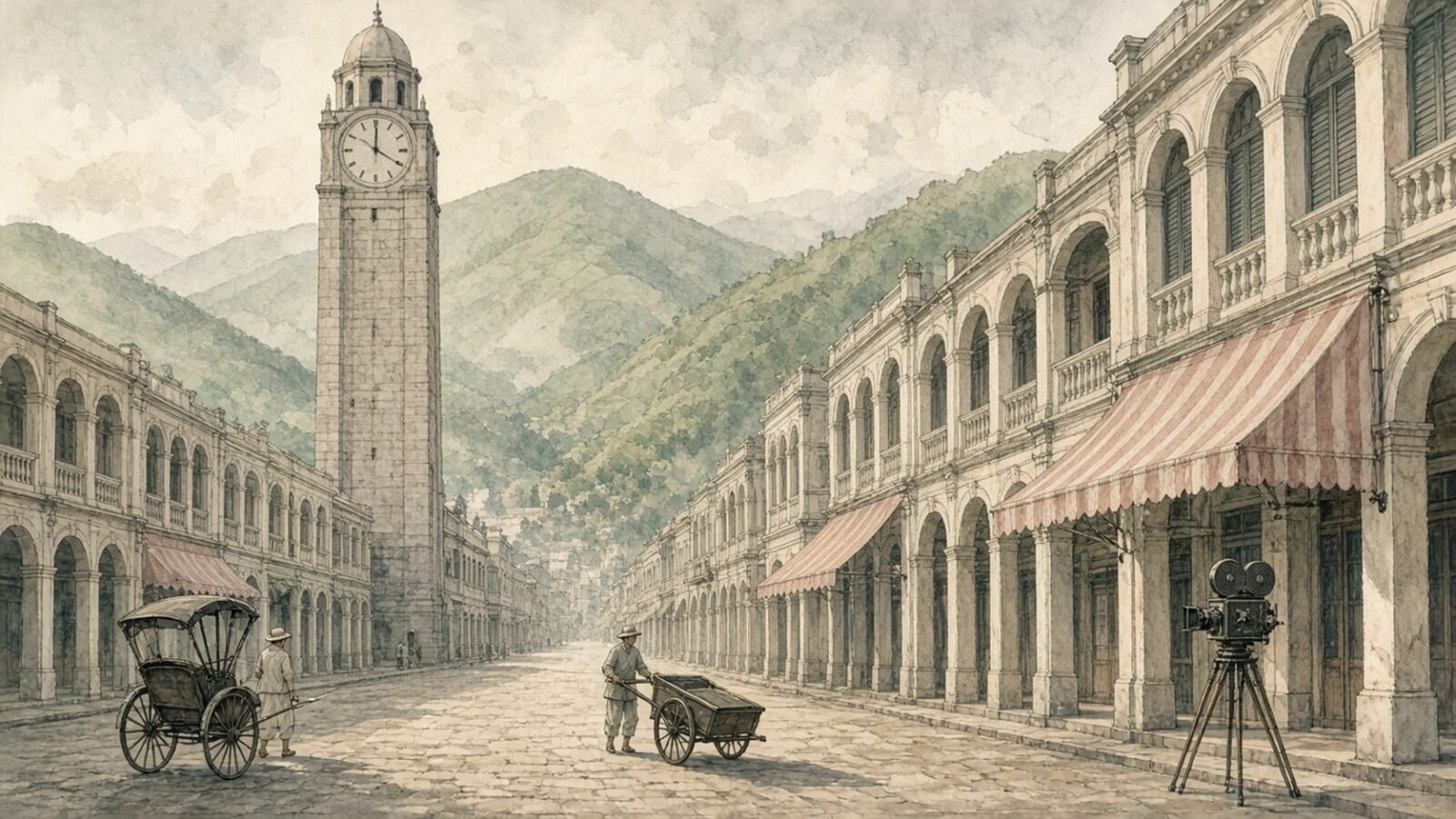
In the final minutes of Project A (1983), a man in a sailor’s uniform hangs from the hand of a clock tower, lets go and falls about eighteen metres, tearing through two cloth awnings before hitting the ground. The actor did it himself, and did it three times because he was not satisfied with the first two takes. Jackie Chan built one of the most extraordinary careers in cinema on moments like that: a Peking opera schoolboy who worked as a stuntman in Bruce Lee’s films, reinvented kung fu as comedy, won an honorary Oscar and became, by some measures, the most recognised film star in the world. He has also become one of the most politically divisive figures in Chinese entertainment. This article looks at both sides of the story, from Drunken Master, Project A and Police Story to Hollywood with Rush Hour, his stunt team and his injuries, and on to his politics, his son’s drug case and his standing in China today, noting where accounts are contested.
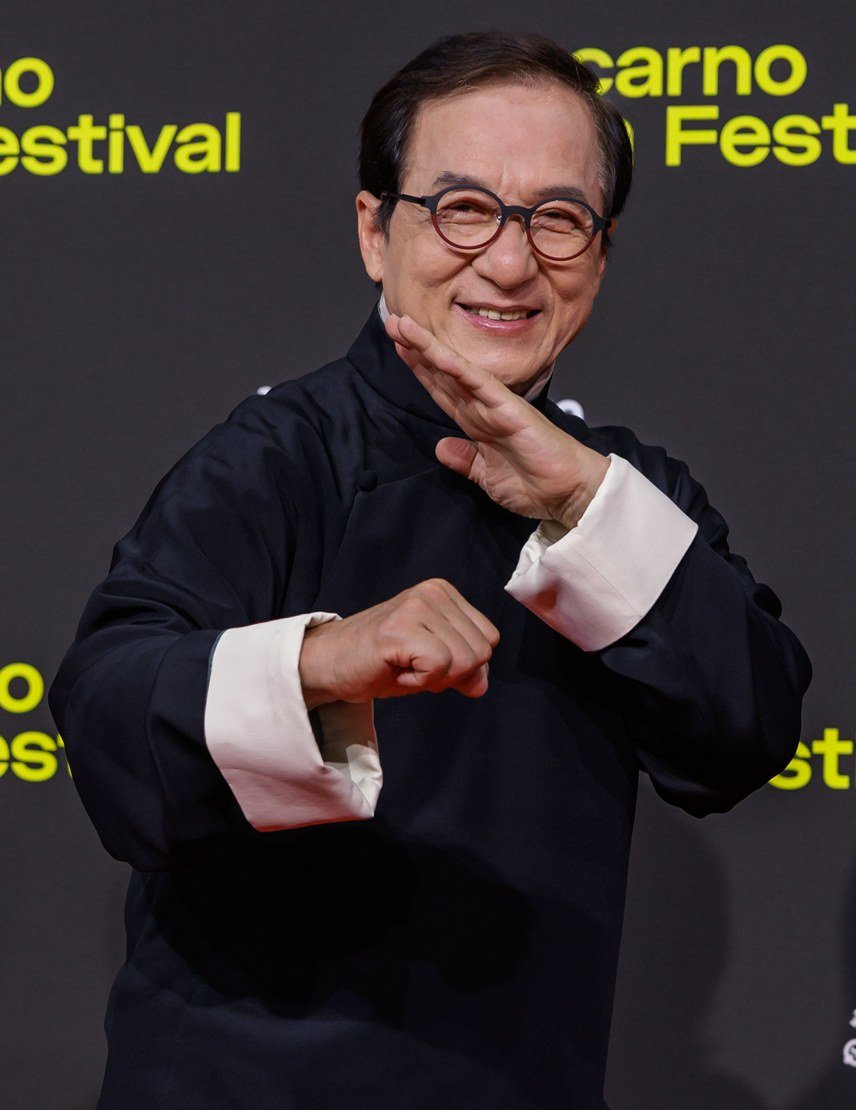
A Peking opera childhood
Chan Kong-sang was born in British Hong Kong on 7 April 1954. His parents, Charles and Lee-lee Chan, had fled the mainland during the civil war. His father worked as a cook at the French consul’s residence on Victoria Peak, and the family lived on the grounds. Much later Chan learned that his father had been born with the surname Fang and had worked for the Nationalist intelligence services before escaping to Hong Kong; in later life Chan adopted the Chinese name Fang Shilong in recognition of that ancestry, whose roots lie in Wuhu, Anhui.
Chan did badly at primary school. When his father took a job as head cook at the American embassy in Canberra in the early 1960s, the boy, then about six or seven, was enrolled at the China Drama Academy, a Peking opera school in Kowloon run by Master Yu Jim-yuen. Pupils typically signed on for about ten years and trained for very long days in acrobatics, martial arts, singing and acting, under a regime of physical punishment that Chan later described in his memoirs as arduous and frightening. His classmate Sammo Hung has offered a gentler memory, pointing out that Hong Kong was poor at the time and that the master took no fees.
The best pupils performed as the Seven Little Fortunes, and Chan, under the stage name Yuen Lo, was among them. Two fellow students, Sammo Hung and Yuen Biao, would become his lifelong collaborators; the trio were later known in Hong Kong as the “Three Dragons”. By the time the three were teenagers, however, Peking opera was in decline as a popular entertainment, and the school’s graduates increasingly found work in the film industry, which needed people who could fall, tumble and fight on camera.
In 1971 Chan briefly joined his parents in Canberra, where he worked on building sites. A fellow worker called Jack took him under his wing, and the young man became “Little Jack”, later “Jacky” and, from the 1980s, “Jackie”.
Stuntman in the age of Bruce Lee
Chan had played child roles since the early 1960s, and in the early 1970s he found steady work as an extra and stuntman. He appears in Bruce Lee’s Fist of Fury (1972), where he doubled for a Japanese villain in the final fight, and in Enter the Dragon (1973), as a henchman. Lee’s death in 1973 left the Hong Kong industry scrambling for a successor.
The producer and director Lo Wei tried to turn Chan into that successor. He cast him in New Fist of Fury (1976), a sequel to Lee’s film, and gave him the screen name Sing Lung, meaning “becoming the dragon”, in obvious reference to Lee’s Chinese name. The film failed, as did several others in the same mould. Chan was not suited to Lee’s intensity, and he knew it.
Kung fu becomes comedy
The breakthrough came when Chan was loaned to Seasonal Film Corporation for two films directed by Yuen Woo-ping in 1978. The first, Snake in the Eagle’s Shadow, gave Chan freedom to design his own action and mixed kung fu with slapstick. The second, Drunken Master, made him a star.
In Drunken Master Chan played a young, lazy and mischievous Wong Fei-hung, the late Qing martial artist and physician from Foshan who was already a Cantonese folk hero, sent by his father to train under the fearsome Beggar So, a master of the “drunken” style. It was an irreverent take on a figure usually shown as a dignified elder; the Wong Fei-hung that Jet Li would play for Tsui Hark in the 1990s was a far more serious patriot, as a companion article on this site describes. Drunken Master earned about two and a half times as much as Snake in the Eagle’s Shadow and ranked among the most popular films of the year in Hong Kong. Its influence stretched far beyond cinema: Akira Toriyama drew on it for the manga Dragon Ball. Chan returned to the role in Drunken Master II (1994), directed by Lau Kar-leung, which Time magazine later included in its list of the 100 best films of all time.
After directing his first film, The Fearless Hyena (1979), Chan left Lo Wei’s company for Golden Harvest, then the leading studio in Hong Kong. The contract dispute was bitter; accounts of it say Lo used triad connections to pressure Chan before the matter was settled with the help of the actor Jimmy Wang Yu. At Golden Harvest, The Young Master (1980) broke box office records previously set by Bruce Lee’s films and established Chan as Hong Kong’s top star.
Project A, Police Story and the stunt revolution
Through the 1980s Chan developed the style for which he is best known: long, intricate fight sequences combined with dangerous stunts and physical comedy, often using everyday objects such as ladders, chairs and bicycles as props and weapons. He shot scenes repeatedly until they were right. In Dragon Lord (1982) one scene is reported to have needed some 2,900 takes.
Project A, set among pirates and rival police forces in late Qing Hong Kong and co-starring Sammo Hung and Yuen Biao, brought the style into focus. Its clock tower fall recalled Harold Lloyd’s Safety Last!, and critics compared Chan to Buster Keaton, although Chan said he had not watched Keaton’s films until later. The film won Best Action Design at the Hong Kong Film Awards.
Police Story (1985) moved the action to modern Hong Kong. It opens with a car chase through a hillside shanty town and ends in a shopping mall where so much sugar glass was broken that the crew nicknamed the film “Glass Story”. In the climax Chan slides several storeys down a pole strung with lights; the bulbs had heated the pole, and he suffered burns to his hands as well as back and pelvic injuries. The film won Best Film at the Hong Kong Film Awards, and its sequels and the Armour of God films (1986 and 1991) pushed the stunts further. The end-credit outtakes that became a signature of his films, showing failed stunts and injuries, were inspired by the closing credits of the American comedy The Cannonball Run (1981), in which he had a small role.
The Jackie Chan Stunt Team
Chan could not do this alone. From the late 1970s he began working regularly with a group of stuntmen and martial artists, several of them also Peking opera school graduates, and by the time of Project A they had become a formal organisation, known in Cantonese as Sing Ga Ban, “the Chan family troupe”. Sources give different founding dates: the team is often said to have been formed in 1976, while Project A in 1983 is usually treated as its official start. Chan himself, accepting his Oscar in 2016, described that year as the team’s fortieth anniversary.
Being a member brought a monthly salary and, at first, insurance, although Hong Kong insurers eventually refused to cover the team’s work. Members performed many of the stunts credited to other characters, with their faces hidden, and Chan’s intimate knowledge of each member’s abilities made it possible to choreograph complex sequences quickly. The salaried team was reorganised around 1990, after which members were hired film by film. Later, it also recruited foreigners; the Australian Brad Allan became its first non-Asian member and later worked as a fight choreographer in Hollywood.
Guinness World Records has recognised Chan for “most stunts by a living actor”, noting that insurers would not underwrite productions in which he performed all his own stunts.
A body of broken bones
The price was paid in injuries. The worst came during the shooting of Armour of God in 1986, when Chan fell from a tree and fractured his skull, an accident he has described as the closest he came to death. Over the years he has also reported breaking his nose, cheekbones, fingers, ribs and ankle, and dislocating his pelvis, among many other injuries. Publicity for Rumble in the Bronx made a selling point of this, with one poster diagramming the parts of his body he had broken.
From the 2000s Chan acknowledged that age was catching up with him. At Cannes in 2012 he said he would stop making big action films, later clarifying that he meant he would do fewer dangerous stunts and look after his body more. He has continued to perform action into his seventies, with far more help from doubles and effects than in his youth.
Hollywood at last
Chan’s first attempts to break into America, The Big Brawl (1980) and The Protector (1985), failed, and for a decade he focused on Asia, where by the mid-1990s he was the most popular action star across much of the continent and had large audiences in Europe. His American breakthrough came with Rumble in the Bronx, released in Hong Kong in 1995 and widely in North America in early 1996, where it opened at number one.
Rush Hour (1998), a buddy cop comedy with Chris Tucker, made him a Hollywood star, grossing more than US$140 million in North America. Rush Hour 2 (2001) did even better, earning about US$347 million worldwide, and Shanghai Noon (2000) paired him with Owen Wilson. Later came The Karate Kid (2010), in which he played a mentor, and voice roles in the Kung Fu Panda films.
Chan has been open about his mixed feelings. He has said that he did not much like the Rush Hour films, finding their action inferior to his Hong Kong work and their humour hard to understand, and that Hollywood gave him little control and a narrow range of roles. Critics noted that his American fight scenes were toned down. His roles also inherited some of the stereotypes Hollywood had long attached to Chinese characters, a history explored in this site’s piece on the “Yellow Peril”, although his comic heroism also did a good deal to change how Asian men were seen on American screens. In 2003 he set up his own production company, and increasingly worked in mainland Chinese co-productions.
The screen persona
Chan designed his screen character as the opposite of Bruce Lee. Lee’s heroes were fierce and morally upright; Chan plays well-meaning, slightly foolish ordinary men who get into trouble, take a beating and win through by improvisation and endurance. He has said he deliberately moved differently too: where Lee held his arms wide and flowed, Chan kept his arms close and moved in tight, choppy bursts. He winces in pain, which Lee’s heroes rarely did.
He has generally refused to play villains, saying he wants to be a role model for children, and has kept strong language out of his films; he is said to have persuaded the makers of Rush Hour to cut a swear word from his dialogue. Quentin Tarantino called him “one of the greatest physical comedians since sound came into film”. In middle age Chan pushed against his image, playing a grieving, alcoholic policeman in New Police Story (2004), a gangster in Shinjuku Incident (2009) and a vengeful father in the British-Chinese thriller The Foreigner (2017).
The honorary Oscar
On 12 November 2016, at the Academy’s Governors Awards in Hollywood, Chan received an honorary Oscar, presented with the help of Tom Hanks, Michelle Yeoh and Chris Tucker. The citation described “an international film star who has captivated millions with his wit, boundless energy and unparalleled athletic artistry”. In his speech Chan recalled watching the Oscars with his father, who asked why he had not won one, and said that after 56 years in the industry, more than 200 films and many broken bones, “finally, this is mine”. He thanked Hong Kong, “my hometown”, and China, “my country”, saying he was proud to be Chinese.
Among his other honours are an MBE (1989), the Hong Kong Silver Bauhinia Star (1999), a star on the Hollywood Walk of Fame and the Jackie Chan Action Movie Awards, held at the Shanghai International Film Festival since 2015.
Politics and controversy
Chan’s political journey has been striking. In May 1989 he performed at the Concert for Democracy in China at Happy Valley racecourse in Hong Kong, a fundraiser for the student protesters in Tiananmen Square. In later decades he became one of the most prominent pro-Beijing voices in Chinese entertainment.
Some of his statements have provoked strong reactions. In 2004 he called that year’s Taiwanese presidential election “the biggest joke in the world”, prompting calls in Taiwan to ban his films. At the Boao Forum for Asia in April 2009 he said he was “not sure if it’s good to have freedom or not”, and that “we Chinese need to be controlled”; the remarks drew anger in Hong Kong and Taiwan, and his spokesman later said he had been referring to the entertainment industry rather than society as a whole. In 2012 he described Hong Kong as a “city of protest” and suggested limits on demonstrations.
From 2013 to 2023 he served two terms on the National Committee of the Chinese People’s Political Consultative Conference, the country’s top political advisory body. During the 2019 Hong Kong protests he told the state broadcaster CCTV that the unrest was sad and that he supported a social media campaign in defence of the national flag, which led to calls for boycotts from protest supporters. In July 2021, at a China Film Association symposium following Xi Jinping’s speech on the Party’s centenary, he said he was “jealous” of Party members and wanted to join, according to footage reported by Variety.
How to read this is itself contested. Supporters in mainland China see a patriot who has stayed loyal to his country and used his fame to promote it, and Chan has described his goal as being a cultural bridge between China and the West. Critics, especially in Hong Kong and Taiwan, see a star who aligned himself with the Communist Party and its policies, including on Hong Kong, in a way that serves his access to the world’s largest cinema market. Both views have been argued in serious commentary.
Jaycee Chan’s drug case
In 2009 Chinese authorities named Jackie Chan a national anti-drug ambassador. Five years later his only son, the actor and singer Jaycee Chan, was detained in Beijing in August 2014 along with the Taiwanese actor Kai Ko. Police said both tested positive for cannabis and that more than 100 grams were found at Jaycee Chan’s home. Ko was released after administrative detention; Chan was charged with the more serious offence of providing a shelter for others to use drugs.
The arrest came during a nationwide crackdown on drug use in which several celebrities were detained, and many observers saw the case as a message that fame offered no protection. On 9 January 2015 a Beijing court sentenced Jaycee Chan to six months in prison and a fine of 2,000 yuan, taking into account the time he had already spent in custody, and he was released in February. Jackie Chan publicly said he was ashamed and heartbroken, apologised on his son’s behalf, and said he would not use his influence to secure a lighter sentence. Jaycee Chan made a public apology after his release; his career in China has never recovered.
Philanthropy
Chan founded the Jackie Chan Charitable Foundation in 1988, and in 2005 the Dragon’s Heart Foundation, which builds schools and supports children and elderly people in remote parts of China. He is a UNICEF Goodwill Ambassador, has campaigned on conservation, and in 2006 pledged to leave half his assets to charity. His regret at never receiving a proper education has led him to fund educational projects, including a science centre at the Australian National University in Canberra, the city where he once worked on building sites.
Influence on world cinema
Chan’s influence on action cinema is hard to overstate. His combination of intricate choreography, comic timing and inventive use of everyday surroundings has been cited by film-makers from Edgar Wright to Tom Holland and traced in films as different as the John Wick series, Kingsman and Marvel’s Shang-Chi. Wright has said that however many people copy Chan’s films, they cannot copy Chan himself. His former collaborators, and the Hong Kong stunt tradition more broadly, went on to shape Hollywood fight design.
In popular culture his reach is equally broad, from Dragon Ball to video games such as the 1984 arcade game Spartan X, based on his film Wheels on Meals, to characters in the Tekken series. He is also a successful singer in Cantonese and Mandarin, performing at the closing ceremony of the 2008 Beijing Olympics, and his films have collectively grossed billions of dollars worldwide.
How he is seen in China today
In mainland China Chan is widely known as “Da Ge”, or Big Brother, and remains a household name across generations. He is also an internet personality: in 2015 “duang”, a made-up word Chan used in an old hair-product advertisement, became a viral meme. His films continue to draw audiences. Ride On (2023), in which he plays an ageing stuntman, was read by many as a reflection on his own career, and The Shadow’s Edge (2025), directed by Larry Yang, held the top spot at the Chinese box office for four consecutive weekends. In 2024 he carried the torch for the Paris Paralympic Games.
Official media generally treat him as a model patriotic artist, and his political statements fit comfortably within a mainstream that has also produced Wu Jing’s Wolf Warrior films. Among younger mainland viewers the tone is more mixed, combining affection for the films of their childhood with a fondness for teasing him online. In Hong Kong, where he was born and which he still calls his hometown, and in Taiwan, his political stances have cost him much of his former goodwill.
Taken as a whole, Chan’s story connects the harsh world of the Peking opera schools with the global film industry, and the pre-handover Hong Kong that produced him with the China he now champions. His films remain a benchmark for what a human body can do on camera without digital help, and that achievement stands, whatever one thinks of his politics.
A note on sources
This article draws on Chan’s autobiographies, I Am Jackie Chan (1998, with Jeff Yang) and Never Grow Up (2018, with Zhu Mo); the Academy of Motion Picture Arts and Sciences’ record of the 2016 Governors Awards; reporting by the BBC, the New York Times and CBC on Jaycee Chan’s case; The Guardian, Time and the New York Times on the 2009 Boao remarks; Variety on his 2021 comments and The Shadow’s Edge; and published filmographies and box office databases. Some details of his early life and of stunt records come mainly from his own accounts and are presented as such.