
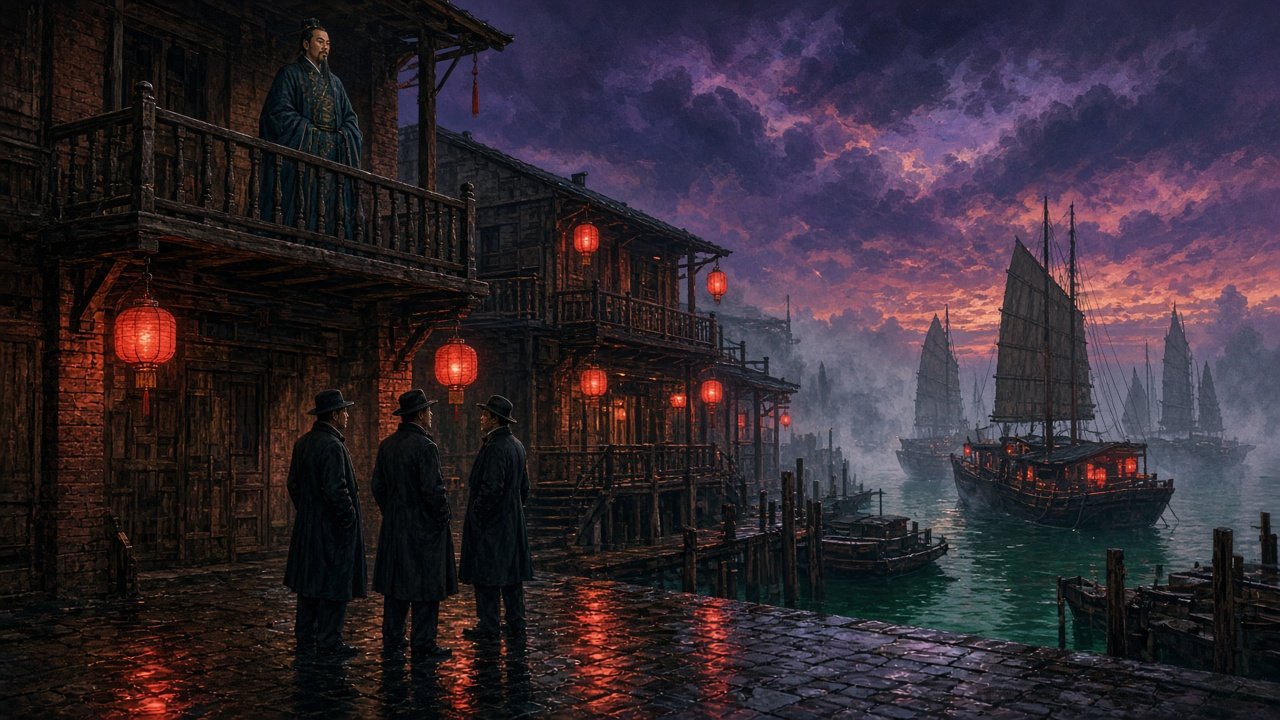
Sax Rohmer did not invent Western fear of China. He packaged it. From 1912 onward, his Fu Manchu stories turned a set of late imperial anxieties into a durable pulp product: a Chinese mastermind who was brilliant, cruel, scientifically modern, and organised for the overthrow of white civilisation. The books sold in the millions in Britain and America. Films, comics, and radio carried the face further than many readers ever travelled. For large Western audiences who were not China specialists, and often not particularly interested in China at all, Fu Manchu became one of the easiest available pictures of Chinese power: not the coolie, not the mandarin alone, but the Asiatic genius as conspiracy.
Arthur Henry Sarsfield Ward, who wrote as Sax Rohmer, was an English popular author rather than a Sinologist. He worked the magazine and thriller market. The first Fu Manchu tale, The Zayat Kiss, appeared in 1912. Related stories were gathered as The Mystery of Dr. Fu-Manchu in 1913, published in the United States as The Insidious Dr. Fu-Manchu. Further early volumes followed during the First World War years, then a long pause, then a return in the 1930s that continued until Rohmer’s death in 1959. Estimates of lifetime sales for the series run around twenty million copies. That figure matters more for reception history than any single plot summary. Fu Manchu was not a marginal curiosity. He was a commercial standard.
The formula is simple and strong. Sir Denis Nayland Smith, an imperial policeman type, and his companion Dr Petrie pursue Fu Manchu through London’s East End, country houses, and later a widening geography of intrigue. The doctor commands exotic methods: insects, fungi, dacoits, stranglers, drugs, and laboratories. He belongs, in the early books’ own language, neither simply to old China nor to Westernising reformers, but to a third force bent on racial and political reversal. Narration repeatedly tells the reader that Westerners underestimate Chinese patience and cruelty. The thrill depends on that claim. If Fu Manchu were merely a local Limehouse crook, the series would collapse into ordinary crime fiction. He has to stand for a civilisational threat.
Yellow Peril was already a public vocabulary before Rohmer. Late nineteenth and early twentieth century Europe and America had watched Chinese migration, labour competition on the Pacific Rim, the Boxer rising, the scramble for concessions, and Japan’s military rise after 1895 and 1905. Cheap fiction, newspapers, and political cartoons mixed these facts with fantasy. Chinese people had often been shown earlier as victims or comic servants. The Fu Manchu phase emphasised the Chinese as organisers of danger to the white world as a whole. Scholars of popular culture are right that Rohmer’s villain became a concentrated personification of that shift. They are also right that the novels inverted imperial hierarchy for entertainment: the empire that ruled others is imagined under siege from a superior Eastern intellect.
Rohmer himself claimed reportorial roots in London’s Limehouse and stories of Chinese criminals. Whether those claims were embellished is less important than what readers bought. They bought atmosphere: fog, docks, opium suggestions, secret societies, and the sense that the imperial capital contained an unreadable Asiatic underground. Actual Chinese communities in Britain were small. The literary Chinatown was large. That gap between demography and imagination is central to how indifferent Western audiences received the material. Most buyers were not studying Chinese politics. They were buying a night’s excitement in which China functioned as a stage set for menace and marvel.
Indifference is easy to miss if one reads only later criticism. A large part of the Western public did not hold a worked out racial philosophy about China. They held habits of attention. Fu Manchu fitted those habits. He was exotic enough to feel new, English enough in narrative frame to feel safe, and serial enough to feel familiar. Magazine readers who followed Nayland Smith were doing what they did with Sherlock Holmes rivals and other master criminals. The Yellow Peril content travelled inside that entertainment circuit. It did not require every reader to join a league against Asian immigration. It required only that Chinese genius as threat felt plausible enough for suspense.
That does not make the content harmless or empty. Popular fiction teaches by repetition. When the most famous Chinese character in English language pulp is a torturing world conspirator, casual readers absorb a default association even if they never vote on a China bill. American and British reprint markets kept the association warm for decades. Hollywood and British film adaptations, including the Warner Oland pictures of the early 1930s, fixed a visual type: moustache, skullcap suggestions, long nails, hypnotic manner. Chinese diplomats and community voices protested some of these portrayals as insults. Those protests are part of the factual record. So is the industry’s continued profit from the type.
A full account also has to notice what the books admire. Fu Manchu is not only degraded. He is called a genius of evil, a mind centuries ahead, a will that repeatedly outthinks his British hunters. Pulp villainy often works by grudging respect. The yellow peril fantasy flatters Western readers by casting them as the prize worth conquering, and flatters the Chinese figure by granting him competence denied to comic coolie stereotypes. This double movement helps explain longevity. Pure contempt grows dull. A worthy enemy sells sequels. Rohmer’s China is unreal, but it is unreal in the direction of power, not only of dirt and passivity.
Chinese and overseas Chinese responses varied with time and politics. Early twentieth century reformers and later nationalists already disliked Western cartoons of Chinese villainy because they damaged dignity abroad and morale at home. After 1949, mainland discourse folded Fu Manchu type imagery into a broader indictment of imperialist culture. In Western universities from the later twentieth century, Orientalism and race studies made Rohmer a standard exhibit of popular racism. Those critiques recover real patterns of stereotype and exclusion. They can also flatten the texts into a single moral offence and forget the pulp mechanics, the sales figures, and the mixed motives of audiences who wanted thrills first.
Seen from British imperial history, the early Fu Manchu boom sits beside wartime and postwar nerves about decline. The first novel lands just before the Great War. Later volumes run through Depression and Cold War shadows. A Chinese master of science and conspiracy was a convenient screen for fears that Western primacy was not guaranteed. Japan’s actual victories complicated the racial story, since the rising Asian power that beat Russians and shocked Europeans was not China. Popular culture often kept China as the sinister reservoir anyway, because Chinatown and Boxer memories were already stocked in the warehouse of images. Consistency with geopolitics was never required for bestsellers.
Seen from Chinese history, the insult lands differently. A civilisation with its own high traditions of statecraft, examination culture, and technical achievement found itself, in foreign mass media, represented by a Limehouse demon doctor. That mismatch between self image and export image is one reason Fu Manchu still irritates. It is also why some later Chinese and diasporic artists have reworked the figure through parody or reclamation. Reclamation does not erase the original market. It proves the brand’s grip. The West’s indifferent reader and the Chinese offended reader were looking at the same product from opposite sides of the mirror.
One should separate three layers that later arguments often smash together. First, Yellow Peril as a political slogan tied to immigration restriction, labour conflict, and naval rivalry. Second, Yellow Peril as a fiction brand that sold magazines. Third, ordinary Western ignorance of China, which made any vivid Chinese character disproportionately influential. Fu Manchu operated mainly in the second and third layers while borrowing heat from the first. An indifferent clerk in Birmingham or Ohio could enjoy The Devil Doctor without reading a Foreign Office paper. The story still left him with a Chinese face attached to words like insidious, cruel, and world plot.
Rohmer’s defenders, when they appear, usually say he wrote entertainment, that villains of every nationality fill thrillers, and that judging 1913 by 2020 campus speech norms is bad history. There is a limited truth there. Crime fiction needs enemies. Comparing Fu Manchu to Moriarty is fair as a genre point. It becomes evasive if it denies the racial frame the books themselves announce. Nayland Smith’s war is not against a private criminal syndicate alone. It is staged as defence of the white race against Eastern organisation. The text is explicit. A factual essay should quote that explicitness without turning the whole discussion into a sermon.
For Western audiences who were interested in China rather than indifferent, Fu Manchu was sometimes an annoyance precisely because it crowded out harder knowledge. Missionaries, traders, diplomats, and scholars produced other images: convert, customer, ally, rival, reformer, peasant revolutionary. Those images fought for space with the devil doctor. In practice the pulp figure often won among people who read little else about Asia. That is the mechanism worth stressing. Indifferent audiences do not hold detailed false theories. They hold a few sticky pictures. Rohmer supplied one of the stickiest.
Film and later media matter because they reached people who never opened the novels. Once Fu Manchu was a face and a voice, the character could detach from Rohmer’s sentences and live as a costume. Mid century comedy and spoof treatments assumed the audience already knew the type well enough to laugh. Satire confirms penetration. You cannot parody what has not saturated. By the time critics called the figure racist shorthand, millions had already learned the shorthand as adventure.
The publishing timeline helps keep claims honest. After the first burst of novels in the 1910s, Rohmer tried to leave the character, much as Conan Doyle tired of Holmes. Market demand and film interest pulled Fu Manchu back in the early 1930s. Collier’s and other outlets wanted serials. Paramount and other studios wanted a known Asiatic villain. Newspaper strips extended the reach again. Continuity across media is how a pulp figure becomes social furniture. By mid century, people who had never read The Si-Fan Mysteries could still recognise the type.
Compare Fu Manchu with other popular Asian images of the same era and the specificity sharpens. The detective Charlie Chan offered a different stereotype: polite, clever in a servile key, safe for white audiences who wanted an Oriental helper rather than an Oriental conqueror. Dragon Lady figures in comics emphasised sexualised danger. Fu Manchu emphasised scientific and organisational danger. Western audiences could hold several cartoons at once. The indifferent reader did not reconcile them into a theory. He switched channels. Rohmer’s channel was the one that made Chinese intellect look like a weapon aimed at London and New York.
Class and geography inside the West also shaped reception. Limehouse fiction played differently for Londoners who lived near docks than for Midwestern Americans who knew China only through missions, tea chests, and headlines. Yet the export worked in both places because the narrative frame was portable: white protagonists, English prose, chase structure, and a villain whose foreignness was the point. Local knowledge was optional. That optionality is another word for indifference. The story did not punish you for knowing little about Beijing politics. It rewarded you for recognising menace.
There is also the matter of what the novels omit. They omit ordinary Chinese family life, commerce, scholarship, and the internal conflicts of a collapsing Qing and a contested republic. They omit the fact that Chinese reformers were themselves arguing about science, race, and national strength in languages Rohmer’s readers never heard. An indifferent audience cannot miss what it never sought. Fu Manchu filled the silence with plot. Silence plus plot is a powerful teacher.
None of this requires the historian to deny craft. Rohmer could pace a pursuit, plant a clue, and end a chapter on a hook. Editors paid him because pages turned. Moral audits that ignore craft misunderstand markets. Markets that ignore moral content misunderstand culture. The factual middle is that skilled entertainment carried a racial scenario to people who mainly wanted skilled entertainment. Intentional indoctrination and unintentional image training can travel in the same train carriage.
What, then, should a careful reader conclude? Sax Rohmer built a bestselling Chinese villain out of Yellow Peril materials that predated him and out of thriller crafts that were larger than race politics alone. Western mass audiences often received Fu Manchu less as a policy brief than as pleasure reading, which is exactly how such images travel furthest. Chinese observers had reason to see a damaging stereotype. Literary historians have reason to see imperial anxiety turned into plot. Genre readers have reason to see a memorable antagonist. All of those perspectives can be true at once. The Fu Manchu problem is not that one angle is secret. It is that the entertainment machine made one angle outrun the others among people who were not trying to understand China at all.
That last point returns to huaxia.click’s usual beat. China in Western popular culture has repeatedly been consumed as mood furniture: menace, mystery, cheap labour, red tide, market miracle. Fu Manchu is an early twentieth century piece of that furniture, polished for the thriller shelf. Studying him factually means measuring sales, filming, protests, and narrative design without recruiting him only as a villain in today’s culture war. The indifferent Western reader of 1913 wanted a shiver. Rohmer sold it. The shiver carried a picture of China. Pictures have consequences even when their buyers insist they were only having fun.