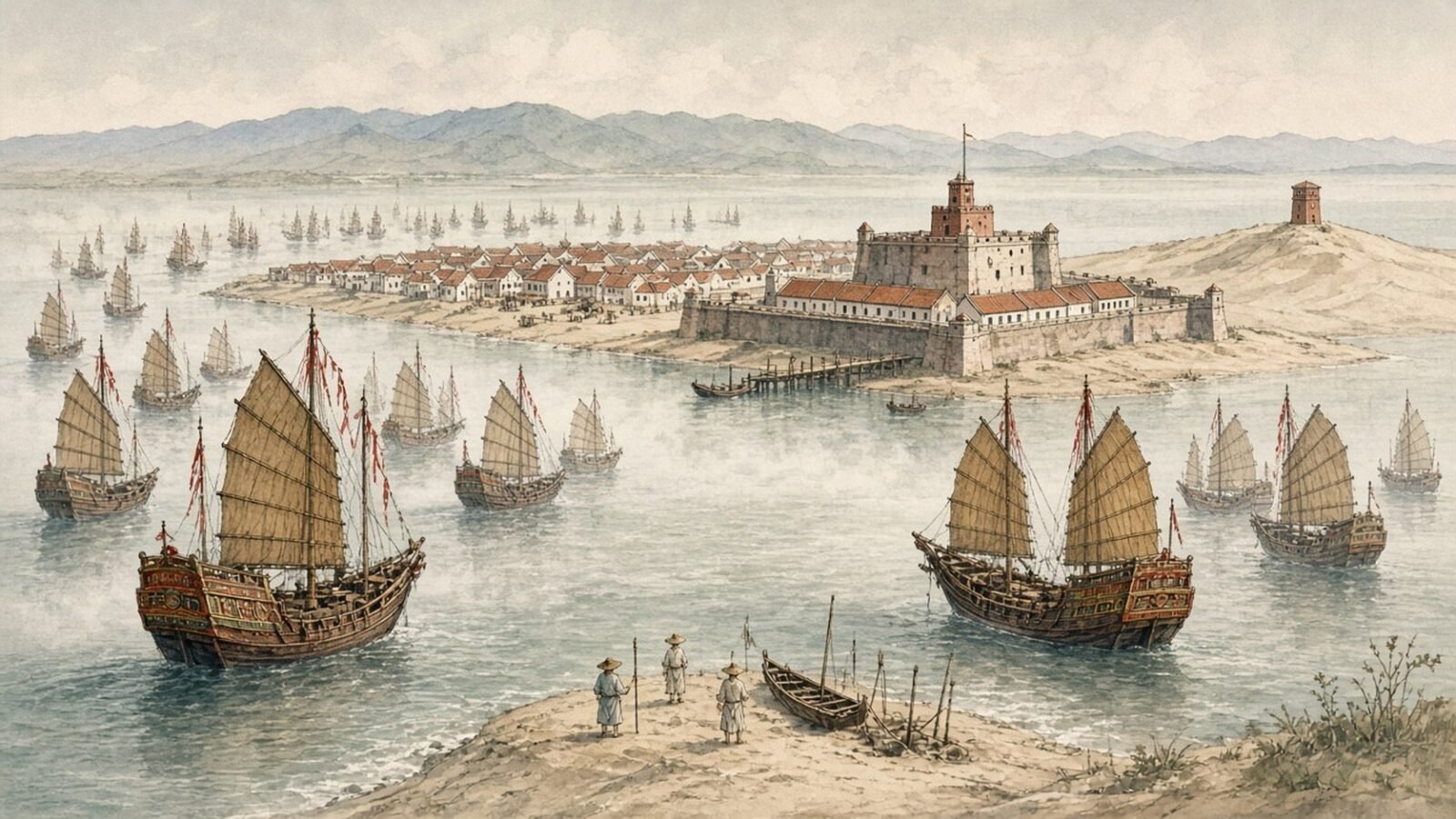
On the morning of 30 April 1661 a thick mist lay over the sandbar of Tayouan, off the south-west coast of Taiwan, where the Dutch East India Company kept its fortress and its trading town. When the mist lifted, the people in Fort Zeelandia saw a fleet of Chinese junks off the harbour mouth. A Swiss soldier in Company service, Albrecht Herport, wrote that there were so many masts it looked like a dry forest, and that nobody, not even the governor, knew at first whether they were friend or foe. The fleet belonged to Zheng Chenggong, known to Europeans as Koxinga, the most powerful commander still fighting for the fallen Ming dynasty, and it carried an army that within nine months would end thirty-eight years of Dutch rule on the island. This piece explains who Koxinga was, why he went to Taiwan, how a fortress of the latest European design was taken, and how the state he founded led, twenty-one years later, to Taiwan’s entry into the Qing empire.
A Fortress on a Sandbar
The Company wanted direct trade with China. When an attack on Portuguese Macao failed in 1622 it occupied the Penghu islands in the Taiwan Strait instead, and when Ming forces made it leave in 1624 it moved east to Tayouan, a long sandbar sheltering a lagoon near present-day Tainan. The name of that small bay later spread to the whole island.
The fort on the sandbar, first of earth and timber, took its lasting name, Zeelandia, in 1627. Over the next decade it was rebuilt in brick as a square “upper castle” with a pointed bastion at each corner, joined by a larger, lower walled enclosure on the town side that held the governor’s residence and warehouses. Beside it grew a town of tiled brick houses, mostly lived in by Chinese traders. On a high dune to the south stood a small redoubt, named Utrecht, built in the late 1630s to stop an enemy using that dune to fire down into the fort. Across the lagoon, on the Taiwan mainland at Sakam, a second and smaller strongpoint, Fort Provintia, was added in 1653.
The colony began as a place to buy Chinese silk for Japan and grew into something larger. Indigenous hunters supplied deerskins for the Japanese market. From the 1630s the Company encouraged farmers from Fujian to cross the strait and grow rice and sugar, and by the 1650s the Han Chinese population of the plains numbered in the tens of thousands. The Company taxed them heavily. In 1652 a settler named Guo Huaiyi led a rising of several thousand farmers; Company musketeers and indigenous allies crushed it within days. That episode left many Dutch officers with a firm and, as it turned out, dangerous belief that Chinese troops would run at the first volley.
The Pirate’s Son With the Emperor’s Surname
Koxinga was born Zheng Sen in 1624 at Hirado in Japan. His father, Zheng Zhilong, was a Fujianese merchant, smuggler and sea lord who had once interpreted for the Dutch; in 1628 the Ming court bought him off with an official post guarding the coast against the pirates he had recently led. His mother, Tagawa Matsu, was Japanese. At about seven the boy was brought to his father’s seat at Anhai in Fujian, given a classical education, and sent on to the Imperial Academy in Nanjing.
The Ming lost Beijing in 1644, first to the rebel Li Zicheng and then to the Manchus, who proclaimed their Qing dynasty there. Ming princes set up rival courts in the south. One of them, the Longwu Emperor at Fuzhou, depended on the Zheng fleet, and in 1645 he favoured the young man by granting him the imperial surname Zhu and a new personal name, Chenggong (“success”). From then on he was addressed as Guoxingye, “Lord of the Imperial Surname”. In the Hokkien speech of the coast this sounded something like Kok-sèng-iâ, which Dutch and other European writers turned into “Coxinga” and “Koxinga”.
In 1646 the Qing entered Fujian. Zheng Zhilong judged the Ming cause lost and went over to them; they took him to Beijing and kept him as a hostage. His son refused to follow. When Qing troops sacked Anhai, Tagawa Matsu, lately arrived from Japan, died there, by the usual account by her own hand. His biographers say Koxinga then burned his scholar’s robes at a Confucian temple and declared himself a soldier. From then on he fought the Qing at sea and along the coast for the rest of his life.
A Sea Kingdom Without a Country
Through the 1650s Koxinga ran what was in effect a maritime state from the islands of Xiamen and Jinmen. He controlled his father’s old trading network, sent junks to Japan and South-East Asia, and recruited fishermen, peasants, deserters and former pirates into a large, well-drilled army, including heavily armoured infantry known as the “Iron Men”. He served the last Ming claimant, the Yongli Emperor in the far south-west, who made him Prince of Yanping, but in practice he acted on his own.
Discipline was severe; commanders who failed could expect execution. In about 1651 a talented naval officer, Shi Lang, quarrelled with him and escaped; Koxinga had Shi’s father and brother killed, and Shi Lang went over to the Qing. That decision would matter a great deal three decades later.
In 1659 Koxinga staked everything on an offensive up the Yangzi. His army reached the walls of Nanjing, the old Ming southern capital, and then waited for the city to surrender. Qing reinforcements arrived, sallied out in early September and broke his army. He fell back to Xiamen with heavy losses. The Qing squeezed his trade, and in 1661 they ordered the evacuation of the coast itself. Under the policy later called the Great Clearance, coastal people in Fujian and neighbouring provinces were moved some tens of li inland (a li is about half a kilometre), so that the Zheng fleets would find no villages to buy food from, recruit in or trade with. Koxinga needed somewhere else to stand.
The Interpreter and the Map
Koxinga’s dealings with the Dutch mixed trade, suspicion and occasional embargo; he regarded Taiwan’s Chinese settlers as his people. Invasion rumours in 1660 brought a Company fleet from Batavia, the Company’s Asian headquarters on Java, but when no attack came its commander took most of the ships away in early 1661.
The decisive push came from a man the Dutch had trusted. He Bin, called Pincqua by the Dutch, was a wealthy interpreter and tax farmer at Tayouan who often carried messages between Koxinga and the Company. In 1659 he was caught collecting tolls on Chinese shipping for Koxinga and fled to Xiamen, leaving large debts and taking a map of the Tayouan waters. According to the Chinese record, Koxinga told his officers in 1661 that Taiwan was a vast fertile land yielding several hundred thousand taels a year, that it was held by “red-haired barbarians” who had fewer than a thousand men in their fortress, and that it could be taken almost without effort. “Red-haired” was the ordinary Chinese name for the Dutch, just as “pirate” was the Company’s ordinary word for Koxinga.
A Forest of Masts
The fleet left Liaoluo Bay on Jinmen in late April 1661, sheltered from bad weather in the Penghu islands, and arrived off Tayouan on 30 April. The expedition as a whole numbered about 25,000 soldiers in several hundred junks. Against them the Company had a garrison of little more than a thousand at Tayouan.
Koxinga avoided the harbour mouth under the fort’s guns. His ships went instead through the Lakjemuyse channel, now Luermen, a shallow passage to the north usable only at high tide, which gave him the lagoon and the mainland shore. Chinese settlers came out in small boats to help the troops land. Other units landed on Baxemboy, the sandbar just north of Tayouan across a narrow channel, which put the Dutch fort and town between Chinese forces on both sides.
The Dutch struck back on 1 May. Three ships attacked the junks guarding the channel. The largest, the heavily gunned Hector, did serious damage until five or six junks closed around it; in the smoke there was a huge explosion, and the Hector and the junks beside it were gone. The other two escaped to sea, and a fourth ship, the Maria, slipped away against the monsoon and reached Batavia with the news some fifty days later.
On land Captain Thomas Pedel took about 240 musketeers across to Baxemboy, where some 4,000 Chinese troops had landed. He expected them to break. They did not. The Chinese general Chen Ze held the front with steady ranks and sent a second force around the Dutch flank. Pedel was killed with roughly half his men, and the survivors fled to their boats, some of which sank. A separate column sent to reach Fort Provintia turned back almost at once. Provintia, short of water and cut off, surrendered on 4 May. That day the Dutch council at Zeelandia hoisted the red “blood flag”, the sign that they would not surrender, and abandoned the town to the Chinese, who found rice and sugar still in its warehouses.
Nine Months Behind Brick
Koxinga’s experience was of Chinese city walls: huge, but straight, with few flanking towers, and often taken by storm. In late May his troops built a battery near the fort, bombarded it and attacked in force. Zeelandia, however, was built on the Italian “bastion” system, which had grown up in Renaissance Europe in answer to the cannon. Its angled bastions let defenders sweep every stretch of wall with crossfire, so that there was no blind spot where attackers could gather. The Dutch held their fire until the attackers were close and then fired into the packed ranks. By Dutch reckoning about a thousand Chinese soldiers were killed before the assault was called off. Koxinga did not try a direct storm again. He settled down to blockade, while his army spread over the plains to farm, which led to clashes with indigenous villages and hunger in his own camp.
The siege produced the episode Europeans remembered longest. Among the prisoners taken in the countryside was the minister Antonius Hambroek. Koxinga sent him into the fort with a demand for surrender, holding his family as hostages. Dutch accounts say Hambroek urged the garrison to hold out instead and then, rather than stay in safety, went back to the Chinese camp as he had promised. He was beheaded with other prisoners. Executions of captives in sight of the walls, and reports of Dutch women taken as concubines, were meant to break the garrison’s will. To Dutch readers they confirmed the image of Koxinga as a tyrant, and in 1775 the playwright Joannes Nomsz made Hambroek the hero of a patriotic tragedy.
Batavia had meanwhile decided to recall Governor Frederick Coyett, a Swedish-born Company officer, after complaints that his warnings were alarmist. His replacement arrived at the end of July, saw the situation and sailed on to Japan without landing. A relief fleet of ten ships with about 700 soldiers under Jacob Caeuw arrived in August, but a storm drove it out to sea for weeks, because the silted harbour gave large ships no safe anchorage. When the Dutch did attack, in the autumn, with ships and troops together, the wind failed them. Two of the larger ships ran aground and were destroyed, and the land force was driven back with more than a hundred dead.
When the Qing authorities in Fujian proposed an alliance, the council agreed to send ships to the mainland. Caeuw volunteered to lead them, sailed in early December, and went instead to Siam and then Batavia, taking three good ships out of the defence. Soldiers in the fort began to desert.
The Sergeant Who Walked Out
One of the deserters was a German sergeant, Hans Jurgen Radis, who told the guards he was going hunting and walked over to the Chinese lines in December 1661. He pointed Koxinga’s attention to the Utrecht redoubt on the dune. If it fell, guns placed there could fire straight down into the fort. Coyett had been warning Batavia about this weakness for years. Historians disagree about how much Radis added. Koxinga’s officers may already have seen the importance of the hill, and Coyett had good reason to blame a turncoat. But Radis did help design and site batteries in the European manner, and these did the most damage.
On 25 January 1662 the Chinese batteries pounded Utrecht all day until the redoubt was rubble. That night the defenders withdrew to the fort and left a charge in the ruins, which exploded and killed many of the Chinese who came in the next morning. But the dune was now in Koxinga’s hands. On 27 January the Zeelandia council voted to negotiate.
The capitulation was signed on 1 February 1662. In eighteen articles, the fort, its guns and the Company’s goods passed to Koxinga; hostilities were forgiven on both sides; the garrison could march out with full military honours and sail for Batavia with provisions; officials and civilians kept set sums of money and their belongings; prisoners were to be released. Within weeks the survivors sailed. The Company briefly reoccupied Keelung in the far north between 1664 and 1668, but Dutch Taiwan was over.
Coyett’s reward was arrest. In Batavia he was tried for losing the colony, sentenced to death, and had the sentence commuted to exile on the island of Ai in the Banda group. He was released in 1674 after appeals that reached William III of Orange, and in 1675 he published a defence under the initials C.E.S., ’t Verwaerloosde Formosa (“Neglected Formosa”). Its argument is in its title: the colony was lost because Batavia would not listen. Caeuw and the governor who sailed past were never punished.
Why the Fort Fell, and Why It Held So Long
To the Dutch the defeat was a disgrace that needed a culprit: Coyett, Batavia, the deserters. The historian Tonio Andrade of Emory University, in Lost Colony (2011), uses the war to test a larger question: how far did Europeans of the seventeenth century really have a military edge over China?
His answer is that they had two real advantages. One was the broadside sailing ship, bigger, more heavily gunned and better at sailing into the wind than a junk. The other, more important, was the bastion fortress, which let a few hundred men hold off an army for nine months. Muskets and field drill gave no edge; Pedel’s men were beaten by troops just as disciplined. And the ships’ advantage was largely cancelled by the shallows, storms and monsoons of the strait, which Koxinga’s captains knew far better.
What decided the war, Andrade argues, was leadership. After his first assault failed, Koxinga switched to blockade, artillery and siege works, learning in months a method European engineers had taken generations to develop. The Company’s commanders quarrelled, underrated their enemy and in two cases simply left. Other historians put more weight on the colony’s isolation and on Batavia’s neglect, which no commander on the spot could have fixed. Nobody disputes the central fact: in the first full war between a European power and a Chinese state, the Chinese side won.
The Eastern Capital
Koxinga named the island Dongdu, the “Eastern Capital”, made the former Fort Provintia the seat of a prefecture called Chengtian, renamed the Tayouan settlement Anping after his family’s home in Fujian, and set his soldiers to farm in military colonies. In spring 1662 he sent a Dominican friar to Manila to demand the Spanish governor’s submission, which set off panic and a massacre of Chinese residents there.
Then everything went wrong. His father had been executed in Beijing in late 1661. The Yongli Emperor was handed over from Burma and put to death in Kunming in 1662. News came that his eldest son, Zheng Jing, in charge at Xiamen, had fathered a child with a wet nurse, a grave offence by the household’s standards; Koxinga ordered his son’s execution, and the commanders at Xiamen refused. He fell ill, probably with malaria, and died on 23 June 1662, aged thirty-seven.
Zheng Jing won a short succession struggle with an uncle and ruled for almost twenty years. In 1663 the Qing, helped by a Dutch squadron seeking revenge, took his last mainland bases at Xiamen and Jinmen. From 1664 he called the realm Dongning, “Eastern Pacification”, usually rendered in English as the Kingdom of Tungning. His chief minister, Chen Yonghua, built a Confucian temple and school at the capital, held examinations, and promoted rice and sugar and trade with Japan and, later, the English East India Company. In talks with the Qing, Zheng Jing repeatedly asked to be treated like Korea, as a tributary state outside the empire, which Beijing would not accept.
In 1673 three generals holding vast fiefs in southern China, the “Three Feudatories”, rose against the young Kangxi Emperor. Zheng Jing crossed to Fujian in alliance with one of them and held coastal towns for a few years, but in 1680 he withdrew to Taiwan for good. He died in 1681, and after a palace coup his young son Zheng Keshuang became ruler, with real power in the hands of ministers and generals.
Shi Lang Comes Back
The Kangxi Emperor’s choice to finish the Zheng state was Shi Lang, whose father and brother Koxinga had killed thirty years earlier, and who knew the Zheng navy from the inside. After years of argument at court, he sailed from Fujian in July 1683 with about 300 warships and some 20,000 men. Off the Penghu islands he met the main Zheng fleet under Liu Guoxuan and destroyed it in a battle lasting several days. Liu escaped to Taiwan with a few ships, but without its fleet the island could not be defended. The Dongning court surrendered, and in October 1683 Shi Lang landed to accept the submission of Zheng Keshuang, who was taken to Beijing and given a noble title.
Many Qing officials wanted to bring the settlers home and leave Taiwan empty, as remote, malarial and a magnet for rebels. The Kangxi Emperor is often quoted as calling it a mere “ball of mud” beyond the sea, whose possession added nothing to the empire. Shi Lang argued in a memorial of early 1684 that if China abandoned Taiwan, pirates or the Dutch would take it and threaten the coast. He won. In 1684 Taiwan became a prefecture of Fujian province, with three counties, and it remained under the Qing until it was ceded to Japan in 1895. Koxinga’s war thus had a result he never intended. By taking the island from the Dutch and filling it with Han settlers and soldiers, he made it a place the Qing had to conquer, and so brought it into the empire he had fought.
Afterlives
Each society involved has made its own Koxinga. In Japan, Chikamatsu Monzaemon’s puppet play The Battles of Coxinga (Kokusen’ya Kassen), first staged in Osaka in 1715, ran for about seventeen months and made the half-Japanese warrior a household name, stressing his Japanese mother and his warrior spirit more than his Ming loyalty.
On Taiwan he was worshipped as a local god, the “King Who Opened Taiwan”. In 1875 the Qing official Shen Baozhen won permission to make his shrine in Tainan an official temple honouring him as a loyal subject; loyalty to a fallen dynasty was easier to honour once that dynasty was safely in the past. Under Japanese rule the shrine became a Shinto one. For the Republic of China after 1945 he was a national hero who had expelled a colonial power and, like the Nationalists after 1949, held Taiwan against the mainland. In the People’s Republic he is celebrated as a patriot who recovered Chinese territory from Western colonists, and a giant granite statue of him looks out from Gulangyu island off Xiamen. Some Taiwanese historians, and many indigenous Taiwanese, see him instead as the leader of a new wave of settlers who pushed the island’s original peoples further into the hills.
At Anping today only a stretch of Fort Zeelandia’s red-brick outer wall still stands, wrapped in banyan roots; the white tower and house on the old platform are much later. The lagoon has long since silted up, and the sandbar on which the Dutch built is now part of the mainland.
Related reading on this site: Taiwan and the People It Produced follows the island’s later history, From Jurchen Tribes to Manchu Emperors explains who the Qing were, Zheng He’s Voyages covers the Ming’s earlier and very different use of sea power, and Chiang Kai-shek From the Mainland to Taiwan tells of the next loyalist government to make Taiwan its refuge.
Sources
- Koxinga, Grokipedia.
- Siege of Fort Zeelandia, Grokipedia.
- Dutch Formosa, Grokipedia.
- Zheng Zhilong, Grokipedia.
- Frederick Coyett, Grokipedia.
- Antonius Hambroek, Grokipedia.
- Great Clearance, Grokipedia.
- Kingdom of Tungning, Grokipedia.
- Shi Lang, Grokipedia.
- Battle of Penghu, Grokipedia.
- Tonio Andrade, Lost Colony: The Untold Story of China’s First Great Victory over the West (Princeton University Press, 2011), publisher’s page. The main modern study of the war, drawing on Dutch and Chinese archives.
- Tonio Andrade, How Taiwan Became Chinese: Dutch, Spanish, and Han Colonization in the Seventeenth Century (Columbia University Press, 2008), especially chapters 10 and 11 on He Bin, Radis and the fall of the colony.
- Miles Bryan, “How the Dutch Lost Taiwan”, Reed Magazine, December 2012. A summary of Andrade’s argument, including Pedel’s defeat and the role of bastion forts and broadside ships.
- “The shameful fall of fort Zeelandia”, VOC Warfare (a thesis chapter on Company warfare in the 1660s, drawing on C. R. Boxer’s 1926 study of the siege and Albrecht Herport’s eyewitness account). Source for the Hector, Pedel’s sortie, the relief fleet, Caeuw and the fall of the Utrecht redoubt.
- Han Cheung, “Taiwan in Time: Koxinga’s final assault”, Taipei Times, 24 January 2021. On He Bin, Radis and the bombardment of 25 January 1662.
- Atlas of Mutual Heritage (Netherlands), “Zeelandia, fort (Formosa)” and “Utrecht, redoute (Formosa)”. On the fort’s building history and the redoubt on the dune.