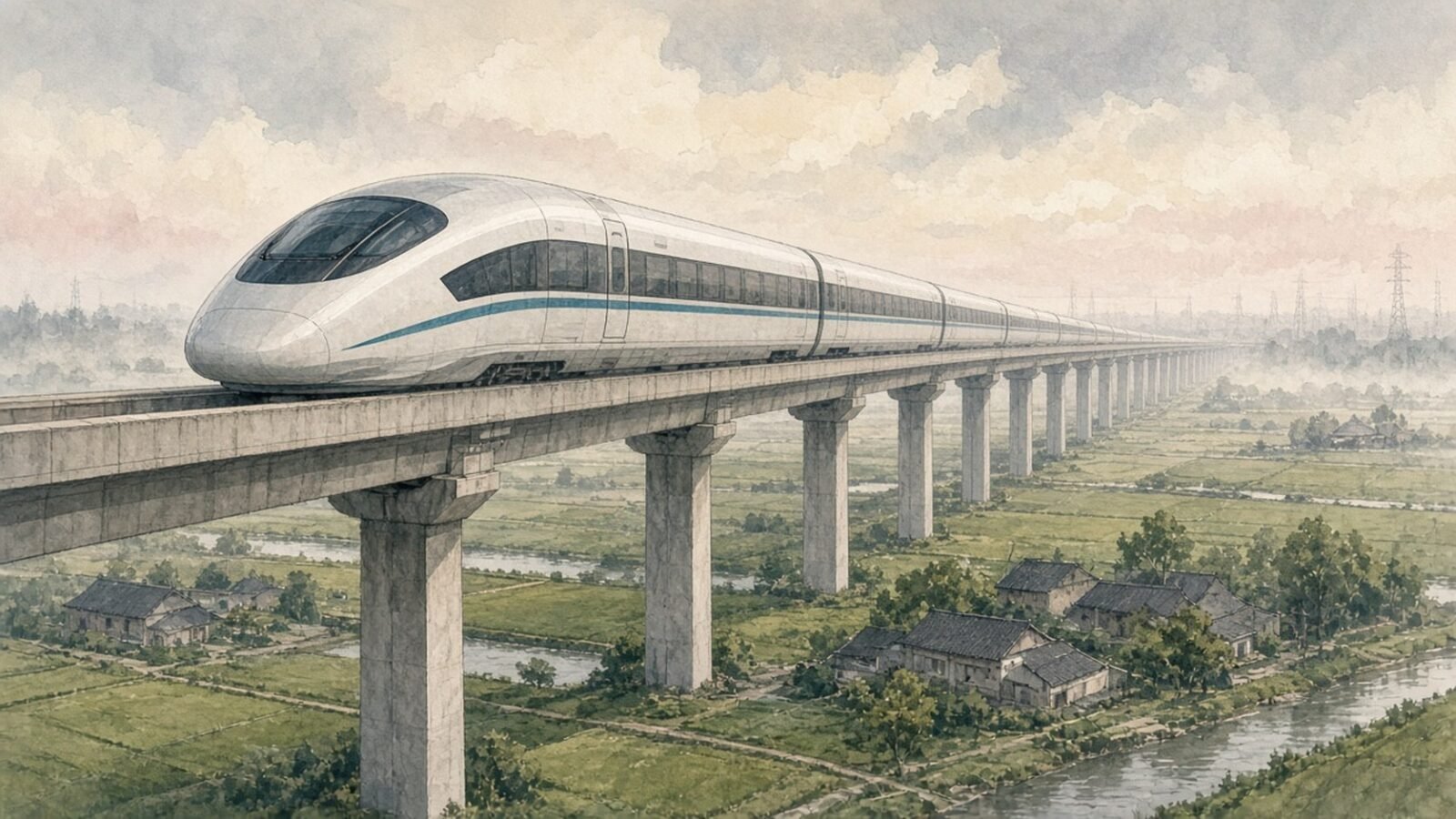
Step off Line 2 of the Shanghai Metro at Longyang Road and you reach the platform of one of the strangest railways in the world. The train waiting there has no wheels touching a rail and no engine on board. It wraps around a concrete beam, lifts itself about a centimetre into the air and is pushed forward by a travelling magnetic field built into the track. Around eight minutes later it glides into Pudong International Airport, some 30 kilometres away.
The Shanghai Maglev opened at the very end of 2002 as the world’s first high-speed magnetic levitation line built for commercial service, and for years it was the fastest passenger train in regular operation, running at 431 km/h. It was meant to be the start of something much larger, for China and for the German industry that built it. Neither future arrived. This is the story of how German Transrapid technology found its only commercial home in Pudong, why the line never grew beyond 30 kilometres, and how China went on to pursue maglev in its own way.
Our earlier piece on China’s bullet train empire tells the story of the wheel-on-rail network that now covers the country. This article looks at the road not taken.
A German Invention in Search of a Customer
The technology inside the Shanghai train is called Transrapid. Its roots go back to the German engineer Hermann Kemper, who patented the idea of magnetic levitation in the 1930s, but serious development began only from the late 1960s, backed by West German industry and government. The effort eventually centred on Siemens and ThyssenKrupp, working through a joint company, Transrapid International. In 1985 a test track opened in Emsland in north-west Germany, near the town of Lathen.
The difficulty was that Germany kept failing to build a line. The most ambitious plan, a Berlin–Hamburg Transrapid, was abandoned in February 2000 as cost estimates rose and passenger forecasts fell. The industry needed a reference project somewhere in the world. China, then planning a Beijing–Shanghai high-speed railway and still undecided about its technology, looked like the ideal customer.
In the late 1990s Chinese engineers and officials were locked in a long argument over whether that line should use conventional wheel-on-rail technology or maglev; Chinese press reports at the time blamed the dispute for delaying the project. Maglev’s supporters wanted China to leapfrog to the most advanced system available. Critics pointed to the cost, the lack of any commercial track record and maglev’s incompatibility with the existing network.
Zhu Rongji Makes the Call
The decisive figure was the premier, Zhu Rongji, a former mayor of Shanghai with a reputation for impatience and a strong interest in technology. On 30 June 2000 China and Germany signed an agreement to study the feasibility of a maglev line in Shanghai. Two days later, on 2 July, during an official visit to Germany, Zhu travelled to the Emsland test facility and rode the Transrapid himself, according to contemporary reports in Guangming Daily. He came away enthusiastic.
The project moved with remarkable speed. In August 2000 the proposal for a Shanghai demonstration line was approved, and a group of Shanghai state-owned enterprises formed the Shanghai Maglev Transportation Development Company to build and operate it. On 23 January 2001 the Chinese side signed the main supply contract with the consortium of Siemens, ThyssenKrupp and Transrapid International, reportedly worth about 1.29 billion Deutschmarks. ThyssenKrupp supplied the vehicles and Siemens the propulsion, power and control systems; the guideway and civil works were largely Chinese.
The route was telling. Rather than a genuine intercity trip, the line would run from Longyang Road, on the edge of central Pudong, to the new Pudong International Airport, opened in 1999. It was explicitly a demonstration line, to be extended if the technology proved itself, and a statement about Pudong, the former farmland being turned into a financial centre (a story told in our article on Pudong’s transformation).
Built in Twenty-Two Months
The State Council gave final approval at the end of February 2001, and construction began on 1 March 2001, when Huang Ju, then Shanghai’s Communist Party secretary, pressed the button at the ground-breaking ceremony.
The guideway runs mostly on elevated concrete beams. Pudong’s soft, waterlogged soil was a real challenge, because the gap between the train’s magnets and the track is only about a centimetre, so the beams cannot be allowed to settle unevenly. Deep foundations and precision-made beams were needed. The double-track main line came out just under 30 kilometres long, with only two stations and a depot.
On 31 December 2002, twenty-two months after work began, the line held its opening ceremony. Zhu Rongji, a few months from retirement as premier, and the German chancellor, Gerhard Schröder, cut the ribbon at Longyang Road and rode the train together to the airport. Schröder described the line as a symbol of close Sino-German economic cooperation. Zhu, in remarks widely reported by Chinese media, said that he had ridden with his whole family, including his grandchildren, without buying any insurance, and that he was therefore completely confident that maglev had a broad future in China.
That ceremony is often described as the start of commercial service, but the reality was gradual. Public trial operation began at the end of December 2003, initially in limited hours, with all-day trial service from late January 2004. According to the Chinese operator’s history, the line passed national completion acceptance in April 2006 and then entered formal commercial operation, whereas Transrapid’s publicity spoke of revenue service from early 2004. Both dates appear in reputable accounts; the difference is largely one of definition.
How a Train Floats
There is more than one way to make a train float. The Transrapid uses electromagnetic suspension, or EMS, which works by attraction rather than repulsion.
The underside of each car wraps around the T-shaped guideway like a clamp, with arms that curl inwards beneath the edges of the track. On those arms, facing upwards, are electromagnets. Fixed to the underside of the guideway are steel stator packs. When the magnets are energised they are attracted upwards towards the steel, lifting the vehicle. A second set of magnets on the sides pushes against the guideway’s side rails to keep the train centred.
Left to itself, such a system is unstable: the closer the magnet gets to the steel, the stronger the pull. The trick is constant electronic control. Sensors measure the gap thousands of times a second and adjust the current so that the train hovers at roughly 10 millimetres. Because the magnets work whether or not the train is moving, a Transrapid levitates even when standing in a station.
Propulsion comes from a long-stator linear synchronous motor. Imagine taking the stationary part of an ordinary electric motor and unrolling it flat along the track: the motor windings sit in the guideway itself. Alternating current fed into them creates a magnetic field that travels along the track, pulling the train’s magnets with it. The frequency sets the speed, and reversing the effect brakes the train. The vehicle carries no propulsion motor and no pantograph; on-board systems draw power from linear generators while moving, with batteries as backup.
With no wheels there is no rolling friction and far less wear, and the wrap-around design makes derailment in the ordinary sense almost impossible. But because the motor is in the track, every kilometre of guideway is part of a giant electric machine, which makes construction expensive. And a maglev cannot share track with any other train, so it cannot use existing stations or corridors.
Japan chose a rival approach. Its SCMaglev, being built for the Chuo Shinkansen between Tokyo and Nagoya, uses superconducting magnets and repulsion, rising about 10 centimetres above a U-shaped guideway once moving. In April 2015 a Japanese test train reached 603 km/h, still the record for a manned train.
Very Fast, Very Short
For passengers, the defining feature was speed. On a normal run the train accelerated to 431 km/h, held it for less than a minute and then slowed for the airport, completing the trip in between seven and eight minutes. Speedometer displays let passengers watch the numbers climb, and many rode simply for the experience. In an unloaded test in November 2003 a train reached 501 km/h on the line.
That brief burst exposes the central problem. At around 30 kilometres the route is too short for very high speed to matter much, and it does not reach central Shanghai: most passengers bound for the Bund or the western districts must change at Longyang Road, eroding the time saved.
The trains have also slowed. From 2009, 431 km/h was offered only in certain time windows, with other services at 300 km/h. From 1 May 2020, amid the collapse in air travel during the Covid-19 pandemic, all services were capped at 300 km/h. (The cut is sometimes dated to 2021, but the operator’s announcements and Chinese reporting place it in May 2020.) Some reports say a few runs have since returned to higher speeds, while recent travel guides describe all services as running at 300 km/h, so visitors should not count on seeing 431 on the display. A single ticket has long cost 50 yuan, discounted for passengers with a same-day air ticket.
Fire, Losses and a White Elephant
The line’s safety record has been good, with one well-publicised incident. On 11 August 2006 a fire broke out in an electrical compartment beneath a car shortly after a train left Longyang Road. Passengers were evacuated and nobody was hurt, though pictures of thick smoke were widely broadcast. According to China Daily, investigators ruled out arson and traced the fire to an electrical fault.
More damaging were the economics. The construction cost is usually put at about 10 billion yuan (roughly US$1.2 billion), though contemporary Chinese reports gave a figure nearer 8.9 billion yuan; the exact number depends on what is included. For a 30-kilometre airport link with two stations, it was an enormous sum.
Passenger numbers never justified it. The line carried its millionth passenger in the summer of 2004 and close to four million in 2006, when Transrapid’s promoters claimed that covered operating costs, though not construction. Traffic peaked around the 2010 Shanghai World Expo, then fell back, partly because Metro Line 2 reached Pudong Airport that year, offering a cheaper, slower ride straight into the city. By the early 2010s the maglev carried roughly three million passengers a year, well under a tenth of landside airport traffic.
Figures for losses are contested. Chinese media reports cited in English-language accounts estimated annual losses of 500 to 700 million yuan in the early years, and more than a billion yuan in total between 2004 and 2006, but the operator does not publish accounts that allow these estimates to be checked. What is clear is that the line has never paid for itself. In 2012 the South China Morning Post described it as “increasingly becoming a white elephant”, noting that state leaders had once hoped it would begin a national maglev network.
The Extensions That Never Came
That network was supposed to begin with extensions: west across Shanghai to Hongqiao, the city’s older airport and a future rail hub, and on to Hangzhou, about 170 kilometres to the south-west, a route long enough finally to show off maglev’s speed.
The first obstacle came from below. When the planned route through the western suburbs became known in 2007, residents of housing estates along it wrote letters, hung banners and filed complaints. In May 2007 Xinhua reported that the project had been suspended. When a revised route was published at the end of the year, the objections resumed.
In January 2008 residents staged what they called “strolls” through central Shanghai, a careful way of protesting without formally demonstrating. The largest gatherings, around People’s Square in mid-January, were estimated at several hundred by Reuters and around 2,000 by the South China Morning Post, with some online claims far higher; the true figure is unknown. Residents feared noise, falling property values and, above all, electromagnetic radiation. One told the Associated Press: “We feel like we’d be living beside a big microwave oven.” Officials insisted the line would be safe, but they set up a hotline and ordered further environmental assessment rather than pushing the project through.
The extension was never built, but the protests were not the only reason. Costs were daunting, and China’s railway authorities had by then firmly chosen wheel-on-rail for the national network. The Shanghai–Hangzhou high-speed railway opened in October 2010, and Hongqiao became a vast hub served by conventional trains and metro lines. Once that existed, a separate maglev covering the same ground made little sense.
Transrapid Dies at Home
In Germany, meanwhile, the Transrapid was collapsing. On 22 September 2006 a test train on the Emsland track near Lathen ran into a maintenance vehicle left on the guideway at around 160 to 170 km/h, according to different reports. Twenty-three people were killed and several more seriously injured, the first fatal accident in the programme’s history.
Investigators blamed human error, not the maglev technology: controllers cleared the train without registering that the maintenance vehicle was still on the track, and the facility lacked an automatic electronic safeguard. Two operating managers were later fined, and in 2011 two controllers received suspended sentences. But the damage to the system’s image was severe.
The last realistic German hope, a link between Munich’s central station and its airport, was abandoned in March 2008 after estimated costs rose from about 1.85 billion euros to more than 3 billion. The Emsland test track closed when its licence expired at the end of 2011. Decades of German development had produced one commercial line, in Shanghai.
China Chooses Its Own Maglev Path
The Shanghai line did not persuade China to buy more Transrapid systems, but it helped persuade Chinese engineers that maglev was worth mastering themselves, in two quite different directions.
Slow maglev for cities
The first was medium-to-low-speed maglev, developed with major input from the National University of Defense Technology in Changsha. These systems run at around 100 km/h on urban and suburban routes, and their appeal lies in quietness, steep gradients, tight curves and low maintenance rather than speed.
On 6 May 2016 the Changsha Maglev Express opened, linking the city’s south high-speed station with Huanghua International Airport over about 18.5 kilometres; the Hunan government calls it China’s first medium-to-low-speed maglev line with fully independent intellectual property. On 30 December 2017 Beijing followed with Line S1, a roughly 10-kilometre line in the western suburbs operating at up to 80 km/h. Both are simply part of their cities’ urban rail systems (see our overview of China’s metro systems).
Fast maglev for the future
The second direction is high-speed maglev. On 20 July 2021 CRRC unveiled a high-speed maglev train designed for 600 km/h in Qingdao, describing it as China’s first such domestically developed system. Like the Transrapid it uses electromagnetic suspension. It had not reached its design speed on track when unveiled, and there is still no commercial line for it (CRRC’s rise is covered in our article on China’s train builder).
Others pursue superconducting designs. In January 2021 Southwest Jiaotong University in Chengdu unveiled what it called the world’s first engineering prototype of a high-temperature superconducting high-speed maglev, designed for 620 km/h, on a test section just 165 metres long. The China Aerospace Science and Industry Corporation has tested a maglev vehicle in a low-vacuum tube in Datong, Shanxi, reporting 623 km/h on a two-kilometre line in 2024. And in June 2025 Hubei’s Donghu Laboratory said a test vehicle of about 1.1 tonnes had reached 650 km/h on a one-kilometre experimental line in Wuhan.
These results need careful reading. Short tracks, light vehicles and tube experiments demonstrate particular technologies; they are not passenger trains running for hours on full-length lines, and none has yet produced a commercial route. The question that doomed the Shanghai extensions still applies: a new maglev must justify a completely separate network in a country that already has the world’s largest conventional high-speed rail system.
A Symbol More Than a Railway
Judged purely as transport, the Shanghai Maglev is hard to defend: expensive, short, underused and not reaching where most passengers want to go. A metro line does much of its job at a fraction of the cost.
But it was never judged purely as transport. In 2002 China had only just joined the World Trade Organization and was eager to show it could adopt, and soon master, the most advanced technology in the world. Pudong was the stage on which Shanghai presented itself as a global city, and a train that floated faster than anything else in service was the perfect symbol. For many foreign visitors the ride from the airport was their first impression of modern China, and the speedometer ticking past 400 was precisely the point.
It was also a symbol of Sino-German partnership. German industry hoped it would lead to exports across China. Instead China’s railway strategy became one of importing wheel-on-rail technology, absorbing it and building its own trains at vast scale. The maglev showed the limits of buying a finished foreign system: without a domestic industrial base and a place in the national network, even the most advanced train remains an island.
The 2008 strolls add one more layer: they showed that urban residents could influence a major infrastructure project, at least when their concerns aligned with doubts inside the system.
Conclusion
More than two decades after Zhu Rongji and Gerhard Schröder rode it to the airport, the Shanghai Maglev still runs, still the only high-speed Transrapid line in commercial service, and still an experience travellers seek out for its own sake. It is both a triumph of engineering and a cautionary tale about building for prestige rather than usefulness.
It did not start a national maglev network and could not save the Transrapid in Germany. But it gave China hands-on experience of high-speed maglev in daily operation, and the country’s own programmes, from the urban lines in Changsha and Beijing to the prototypes in Qingdao and the test tracks in Chengdu, Datong and Wuhan, owe something to the curiosity it created. Whether any will yield a long-distance line that makes economic sense remains open. Until one does, the short, floating trip from Longyang Road to Pudong Airport is China’s clearest picture of what maglev can do, and of what it has so far failed to do.