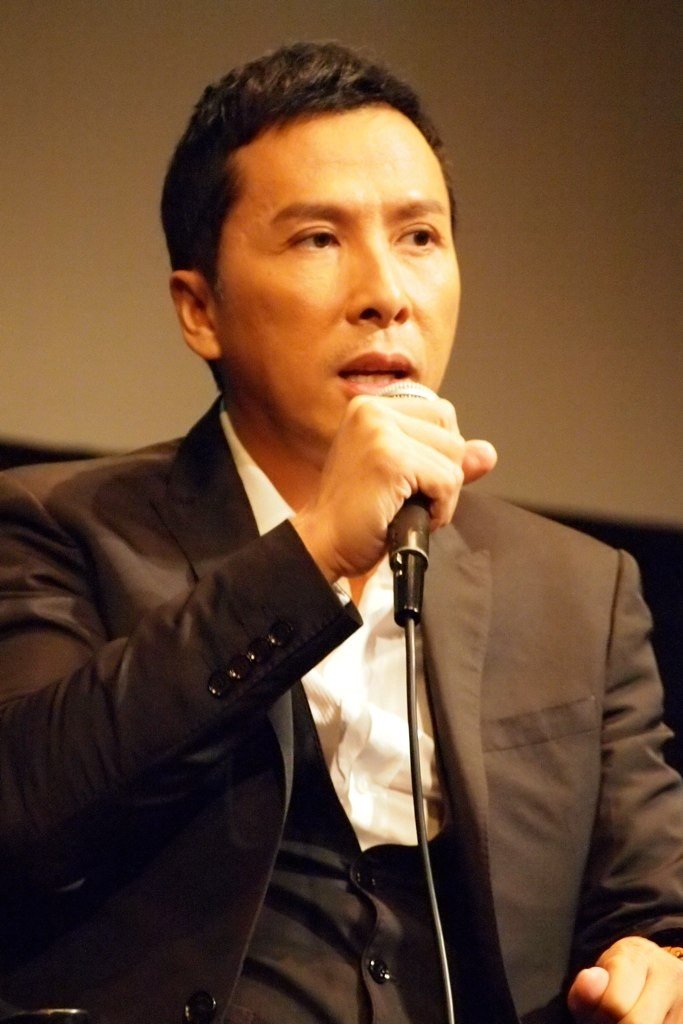
Donnie Yen spent more than two decades as a respected but not quite top-tier name in Hong Kong action cinema before a single role, Ip Man, made him one of the most recognisable faces in the Chinese-speaking world. His career runs from a Boston martial arts school to a Beijing training hall, through the hard-knocks studio system of 1980s Hong Kong and the loan-shark years of the late 1990s, to Star Wars (Rogue One), John Wick and a seat on China’s top political advisory body. It is a career that says as much about how Chinese-language cinema has changed as it does about the man himself. Over four decades he reshaped screen fighting, and this article looks at his films, from his early work with Yuen Woo-ping onwards, his MMA-influenced choreography, his directing, and the politics that divide opinion in Hong Kong.
A Guangzhou birth and a Boston childhood
Yen was born in Guangzhou on 27 July 1963. The city’s long history as a meeting point between China and the outside world is covered in our piece on Canton and the making of a global Chinese city. His father was a newspaper editor. His mother, Bow-sim Mark (麥寶嬋), became one of the first people to teach Chinese wushu in the West. As a girl in Guangzhou she trained under the tai chi master Fu Wing Fay, mastering his system, including the Wudang sword, over roughly a decade, according to a 2011 Boston Globe profile.
Accounts of how the family got out differ in the details. Yen told GQ in 2023 that he moved to Hong Kong with his father at the age of two, and that because of restrictions under the Mao-era government his mother could not go with them. “My mom and I were separated for eight years,” he said. The Boston Globe profile of Mark gives a different timeline: the couple left China with their son in 1973 and moved on to the United States in 1975. Both accounts agree on the broad path, from Guangzhou through Hong Kong to Boston, and on the family settling there in the mid-1970s, when Yen was about ten or eleven.
Mark opened the Chinese Wushu Research Institute in Boston in 1976, starting with ten students. It became the base for her teaching career. Black Belt magazine later named her its kung fu artist of the year for 1995. Yen trained under her and, by his own account, pushed back against it. “She was very forceful, old school, like what you see in the movies,” he told GQ. He also described early years in the United States when the family lived on food stamps and the city was not always welcoming. He found refuge in Bruce Lee double bills and in other gyms around Boston, including karate schools and boxing clubs. That habit of looking beyond one tradition would shape his later work.
Beijing training and a meeting with Yuen Woo-ping
At 16, Yen’s parents sent him to train with the Beijing Wushu Team, the programme that produced national champions and, among Yen’s contemporaries, Jet Li. Yen has described feeling like an outsider there as one of the few Cantonese speakers. “We were all Chinese, but I was outside,” he told GQ. Accounts differ on exactly how long he stayed and on his formal status with the team, so it is safest to say that he trained with the Beijing programme in his late teens rather than to claim any particular title from it.
The break into film came through his mother. Bow-sim Mark had taught the sister of Yuen Woo-ping, the Hong Kong action director who had already helped launch Jackie Chan with Snake in the Eagle’s Shadow and Drunken Master. On a trip from Beijing back to Boston, Yen stopped in Hong Kong to audition. According to Yen, Yuen “was trying to make another Jackie Chan”, and he signed the 18-year-old to a three-year, multi-film contract.
The apprenticeship was tough. Yen has described the Yuen clan’s working method as “old-school military”, with no storyboards, whole days spent designing moves, and a director who would reject a day’s work as “not cool enough”. It was also where he learned to think like a camera. He has said that the discipline of those years taught him to know exactly where the frame was at every moment, a skill that later made him an unusually hands-on action director.
Drunken Tai Chi, Tiger Cage and the 1980s
Yen’s first leading role came in Yuen Woo-ping’s Drunken Tai Chi (1984), a comic kung fu film. It set traditional forms alongside touches of American pop culture, including skateboarding and a moment in which Yen moonwalks. It never reached the popularity of Drunken Master, but it introduced a performer whose speed and flexibility stood out even by Hong Kong standards.
The rest of the decade was a working apprenticeship in a punishing industry. Yen has said he still cannot raise his right arm fully overhead because of an injury from being slammed into a brick wall on Mismatched Couples (1985). Tiger Cage (1988), another Yuen Woo-ping film, moved him into the gritty contemporary police thrillers then popular in Hong Kong. His screen time was limited, but reviewers have singled out his fight with the American martial artist Michael Woods as a highlight. That mix of modern settings and harder-hitting action would come back two decades later.
Once Upon a Time in China II and Iron Monkey
The role that made his reputation among fans came in Tsui Hark’s Once Upon a Time in China II (1992), with Yuen Woo-ping as action choreographer. Yen played General Nap-lan, a Qing official, against Jet Li’s folk hero Wong Fei-hung. Their duel with cloth and bamboo poles is still regarded as one of the finest fights of the era. It was filmed without digital effects, and Yen later told GQ that a stunt double’s missed strike during the sequence split open his brow near his eye and needed six stitches. He was back on set the next day. The film was a rare Hong Kong sequel that outgrossed the original.
A year later came Iron Monkey (1993), directed by Yuen Woo-ping and produced by Tsui Hark. Yen played Wong Kei-ying, the father of the young Wong Fei-hung, in a fictionalised tale of a Robin Hood-like vigilante. The film did modest business at home. Its second life came in 2001, when Miramax released a re-edited version in the United States, presented by Quentin Tarantino, riding the Western interest in Hong Kong choreography that followed The Matrix and Crouching Tiger, Hidden Dragon. The New York Times reviewed it warmly. The American cut changed the score and subtitles and trimmed scenes, which frustrated some Hong Kong film fans.
Through the mid-1990s Yen also worked in television, most notably as Chen Zhen in ATV’s Fist of Fury (1995), a series based on the Bruce Lee film. He would return to the character on the big screen in Legend of the Fist: The Return of Chen Zhen (2010).
Bullet Films and the lean years
In 1997 Yen set up his own production company, Bullet Films, and began directing. Legend of the Wolf (1997) and Ballistic Kiss (1998), both co-written, produced, directed by and starring Yen, failed at the box office. He has been frank about what followed. He told GQ that he hung around film sets to eat for free and eventually borrowed from loan sharks with Triad connections, through an introduction from one of his producers. He later repaid the debt. It is his own account and cannot be independently checked, but he has told it consistently, and it fits a wider picture of a Hong Kong industry in decline in the late 1990s.
Hollywood choreographer, Hong Kong star
Around the turn of the millennium Yen went back to the United States to work as an action choreographer. He choreographed and appeared in Highlander: Endgame (2000). Guillermo del Toro then hired him to design the fights for Blade II (2002), in which he also played a small role alongside Wesley Snipes. Yen has called Blade II “one of the worst times in my career”. He praised del Toro but said the production gave him hours for fight scenes that would have had two weeks in Hong Kong. He also played the villain Wu Chow opposite Jackie Chan and Owen Wilson in Shanghai Knights (2003).
Back in Chinese cinema, he reunited with Jet Li in Zhang Yimou’s Hero (2002), playing the spearman Sky. Their courtyard duel became one of the film’s best-known scenes. Then came the partnership that shaped his mature career. With director Wilson Yip he made SPL: Sha Po Lang (2005), a violent police thriller in which Yen played an inspector and fought a young Wu Jing, later the star of the Wolf Warrior films, in a knife-against-baton alley fight. He also fought Sammo Hung in the finale. Dragon Tiger Gate (2006), a comic-book adaptation, followed. Yen also worked as action choreographer on the British spy film Stormbreaker (2006).
Flash Point and a new kind of fight
Flash Point (2007), again with Wilson Yip, is where Yen’s thinking about screen fighting came most clearly into focus. He starred, produced and choreographed. For the major fights he drew on mixed martial arts, combining grappling, takedowns and striking from Brazilian jiu-jitsu, judo, boxing, kickboxing and wrestling with his own wushu and taekwondo background, and he brought in fighters from several countries. The long closing fight with Collin Chou is often compared by reviewers to an unregulated cage bout. The choreography won Best Action Choreography at both the 27th Hong Kong Film Awards and the Golden Horse Awards.
Yen has explained what he was reacting against. “Everything is so staged it’s fake,” he told GQ of older fight choreography, in which every blow landed in perfect rhythm. His fights began to include misses, clinches and scrappy ground work. He describes himself as a mixed martial artist, and his interest in MMA grew during his years in the United States in the early 2000s. It shaped SPL, Flash Point and later films such as Special ID (2013). In that sense Yen is a bridge between the elegant wire-assisted style of 1990s Hong Kong and the grounded, bruising action of later international thrillers.
Ip Man and fame across the Chinese-speaking world
Everything changed with Ip Man (2008), directed by Wilson Yip, produced by Raymond Wong and choreographed by Sammo Hung. Yen played the Wing Chun master who later taught Bruce Lee, recast as a dignified Foshan gentleman who stands up to the Japanese occupation. The history behind the character, and how far the films depart from it, is covered in our separate piece on the real Ip Man behind the legend. So this section looks only at what the role did for Yen.
To prepare, Yen trained in Wing Chun and drew on Ip Man’s sons for insight into their father, aiming for a restrained, scholarly figure far from his usual explosive screen persona. Reviewing the film for Variety, Derek Elley wrote that Yen, “taking on real star charisma in middle age”, brought “a simple dignity” to the role. The film won Best Film and Best Action Choreography at the Hong Kong Film Awards. It grossed about US$22 million, a big hit by the standards of the time, even without a North American release.
Ip Man 2 (2010), Ip Man 3 (2015), in which Mike Tyson played a property developer and street fighter, and Ip Man 4: The Finale (2019) followed. The Hollywood Reporter put the first three films’ combined worldwide gross at more than US$228 million. Screen International reported that the fourth took more than US$176 million, although totals differ between trackers. The same Hollywood Reporter article noted that the franchise made Yen a star and opened the way to his later Hollywood roles.
The films also coincided with a renewed interest in Wing Chun itself. Teachers interviewed by the South China Morning Post‘s Young Post credited the Ip Man films, together with Bruce Lee’s legacy and social media, with a revival of the art. That evidence is anecdotal rather than statistical, but the link between the films and the art’s profile is widely accepted. The success also set off a wave of unofficial Ip Man films by other studios. Yen at one point said he would not return to the role because of the oversaturation, before coming back for two more instalments. In 2019 he said the fourth film would be his final kung fu film. In 2023, however, Mandarin Motion Pictures announced an Ip Man 5 at the Cannes market, and at the time of writing it had no confirmed release date.
The Ip Man years also brought a run of box-office work in mainland China and Hong Kong: Bodyguards and Assassins (2009), Legend of the Fist (2010), the comedy All’s Well, Ends Well 2011, The Monkey King (2014), Kung Fu Jungle (2014), and a rare turn as a corrupt police officer, with little fighting, opposite Andy Lau in Wong Jing’s Chasing the Dragon (2017). Raging Fire (2021), the last film by the director Benny Chan, returned him to the contemporary police thriller.
Rogue One, xXx, Mulan and John Wick
In 2016 Yen joined the Star Wars universe in Rogue One as Chirrut Îmwe, a blind warrior devoted to the Force. By Yen’s own account, the early script offered a generic martial arts master. “Typical master. Doesn’t smile,” he told GQ. He says he suggested making the character blind and gave him a sense of humour. That is Yen’s version and has not been independently confirmed, but the character became one of the film’s most popular. A year later he played Xiang in xXx: Return of Xander Cage (2017), and Paramount promoted him prominently in its Chinese marketing. In Disney’s live-action Mulan (2020) he played Commander Tung, a mentor figure for the heroine.
His biggest Western role came in John Wick: Chapter 4 (2023) as Caine, a blind assassin forced into service against an old friend. Yen told GQ that the character was originally called “Shang or Chang” and dressed in mandarin collars, and that he persuaded director Chad Stahelski to change both. He said he enjoyed the production. He has presented such changes as part of a career-long pushback against Hollywood’s generic image of Chinese characters, a history explored in our pieces on the ‘Yellow Peril’ and Fu Manchu. Deadline reports that Chapter 4 is the highest-grossing film in the franchise, at more than US$447 million. Lionsgate then gave Yen his own spin-off, Caine, which he directs and stars in, from a script by Mattson Tomlin. Production began in 2026, with shooting reported in Budapest and Hong Kong, and it is expected in 2027.
Behind the camera again with Sakra
Yen’s return to directing came with Sakra (2023), an adaptation of part of Jin Yong’s wuxia novel Demi-Gods and Semi-Devils. He directed, co-produced with Wong Jing, and starred as the hero Qiao Feng, a warrior exiled when he is revealed to be of Khitan birth. It was his first directing credit in about two decades. Some Western listings also credit Kam Ka-wai as co-director. In mainland China the film went straight to streaming over the 2023 Lunar New Year and was reported to be a leading title on the major platforms. It was released in cinemas in Hong Kong, Malaysia, Singapore and elsewhere. In The Guardian, Phil Hoad called the showpiece fights “absolutely top-notch” and noted a thread about outsiders and prejudice, while finding the whole overstuffed. Other critics agreed that the action was stronger than the storytelling. Yen then directed and starred in the legal action drama The Prosecutor (2024).
Politics, controversy and public criticism
Yen’s public identification with Beijing has made him a divisive figure, especially in Hong Kong. The Hollywood Reporter recorded that he shared a stage and sang at a 2017 gala marking the 20th anniversary of Hong Kong’s handover, which Xi Jinping attended. In early 2019, after fans in mainland China objected to his attendance at an event held by a Western fashion brand accused of an earlier slight to China, he issued a statement reaffirming his loyalty to the motherland. It was an example of the pressure Chinese celebrities face from online nationalism.
During the 2019 Hong Kong protests, users of the pro-democracy forum LIHKG organised a boycott of Ip Man 4, citing the pro-Beijing positions of Yen, co-star Danny Chan and producer Raymond Wong, and posting spoilers to discourage viewers. The Hollywood Reporter noted that the film took about US$660,000 in its first days in Hong Kong while breaking records elsewhere in Asia.
The sharpest controversy came in March 2023, around the 95th Academy Awards. In a GQ interview published that February, Yen said of 2019: “It wasn’t a protest, okay, it was a riot.” He added that he was “speaking from my own experience” and expected criticism. He also said Western outlets such as the BBC and CNN ignored China’s progress. When the Academy announced him as a presenter, a Change.org petition started by the Hong Kong activist Henry Tong called for the invitation to be withdrawn. It described him as a supporter of the Chinese government who had backed the National Security Law, a characterisation made by the petitioners. The exiled 1989 student leader Wang Dan joined the criticism. According to Radio Free Asia the petition passed 100,000 signatures, and protesters gathered outside the ceremony. The Academy kept him on, and Yen introduced the performance of “This Is a Life” from Everything Everywhere All at Once.
How one describes 2019 is itself contested. Protesters and many observers regard the movement as a pro-democracy protest in which a minority used violence and the police were accused of heavy-handed tactics. The Hong Kong and central governments have described much of it as rioting. Yen’s words place him clearly on one side of that argument. His supporters see a patriot speaking honestly. His critics see a star lending celebrity to official narratives. Both views are held sincerely, and the reader should weigh the quotations rather than any label.
Standing in China
In mainland China Yen’s standing is secure. In 2023 he became a member of the 14th National Committee of the Chinese People’s Political Consultative Conference, the country’s top political advisory body, and attended the annual “Two Sessions” in Beijing. The CPPCC’s own English-language site quoted his praise for China’s modernisation. He has described himself as a Chinese patriot and has said he wants his Hollywood roles to portray Chinese people with respect.
His commercial reach is broad. Chinese streaming platforms were willing to premiere Sakra, Hollywood studios cast him as their Chinese star, and his name alone supports franchises. GQ described him as “the last in a dynasty of martial arts stars that runs from Bruce Lee to Jackie Chan to Jet Li”. Yet in Hong Kong, the city where he learned his craft, his politics have cost him goodwill with part of the audience, as the Ip Man 4 boycott showed.
A career built on reinvention
Several threads run through Yen’s four decades on screen. One is the lineage he absorbed: his mother’s internal arts, the Beijing wushu programme, Yuen Woo-ping’s studio discipline and Bruce Lee’s example. Another is a restlessness that took him from classical forms to MMA, and from period epics to police thrillers and Hollywood franchises. A third is persistence through failure. The man who borrowed from loan sharks in his mid-thirties became, in his mid-forties, the face of one of Chinese cinema’s most lucrative series.
His politics will continue to divide opinion, and it is fair to report them plainly. So is his craft. Few performers have done as much to shape how fights look on screen, in Hong Kong, in mainland China and, increasingly, in Hollywood. Whether Caine and a possible Ip Man 5 add to that legacy, Yen is already among the most influential action filmmakers of his generation.