
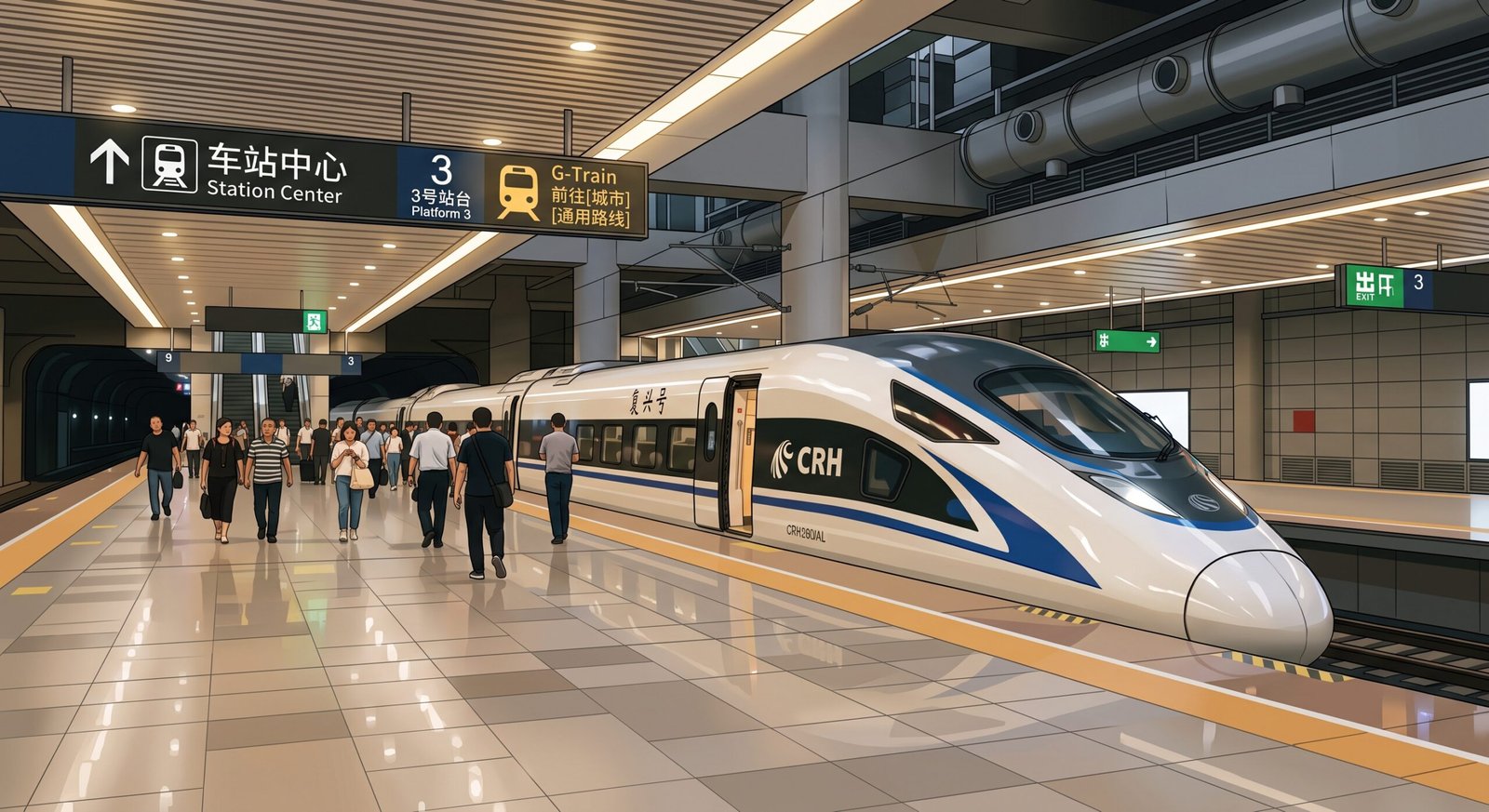
It does look rather odd when you stand inside Futian Railway Station: an enormous, expensive underground complex in the middle of Shenzhen’s CBD, yet compared with Shenzhen North, relatively few long-distance trains seem to use it. There is a good reason. Futian was built for a role that turned out somewhat differently from what planners envisaged.
The basic idea was to put high-speed rail directly into Shenzhen’s central business district. When the Guangzhou–Shenzhen–Hong Kong high-speed line was planned, Shenzhen North was deliberately placed farther north at Longhua, where there was enough land for a genuinely huge national railway hub. But that left Futian, the financial and governmental heart of Shenzhen, some distance away. The Ministry of Railways therefore pushed for a second HSR station directly underneath Futian. Shenzhen initially resisted because of the cost, lack of land and traffic difficulties; the solution was to put virtually the entire station underground. The plan was approved in 2006.
So Futian and Shenzhen North were never supposed to perform exactly the same job.
Shenzhen North was designed as the big national interchange: 11 platforms and 20 tracks, with trains radiating towards Guangzhou, Beijing, Wuhan, Xiamen, Shanghai and elsewhere. Futian has only four platforms and eight tracks. Its main purpose was much more specific: high-frequency Guangzhou–Shenzhen–Hong Kong traffic and rapid access to central Shenzhen. Shenzhen’s own transport authority still describes it as mainly serving the Guangzhou–Shenzhen–Hong Kong corridor.
That explains one of the apparent contradictions: Futian is physically enormous but is not actually an enormous railway station in terms of tracks. Its roughly 150,000 m² includes a vast underground interchange, circulation areas, waiting halls, access passages, ventilation and evacuation infrastructure and connections to Metro Lines 2, 3 and 11. It is more like an underground transport complex than simply eight railway tracks with a waiting room. The National Railway Administration describes it as a three-level, 1,023-metre-long underground structure with 21 entrances.
There was another important element, though, which makes the station’s scale more understandable.
During the development of the Hong Kong high-speed link, border-control facilities at Futian were seriously considered. Shenzhen’s own Port Office says that in 2014 it was studying arrangements for temporary boundary-control facilities at both Shenzhen North and Futian for the Guangzhou–Shenzhen–Hong Kong railway. Earlier planning work also envisaged substantial customs/immigration functions associated with the station.
That eventually changed. Hong Kong and Mainland immigration and customs for high-speed trains were instead concentrated at Hong Kong West Kowloon, using co-located clearance. Today passengers arriving at Futian from Hong Kong have already completed both sets of immigration procedures at West Kowloon.
That decision effectively removed one of the reasons for Futian needing to function as such a major cross-border gateway.
There is also a railway-operating reason why so many trains pass Futian without stopping. Every additional Futian stop costs several minutes and consumes capacity on a very busy two-track high-speed corridor. For a Beijing–Hong Kong, Wuhan–Hong Kong or Shanghai–Hong Kong passenger, stopping at both Shenzhen North and Futian only about 8–10 minutes apart by train is often unnecessary. Shenzhen North has vastly better facilities for originating, terminating, cleaning and turning trains, so China Railway naturally concentrates most long-distance services there. This situation could be viewed similarly to the relationship between St Pancras and Stratford International stations in London.
Futian therefore works best as something closer to a high-speed city-centre station, while Shenzhen North functions as the main regional/national terminal.
And Futian isn’t actually quite as unused as it feels. Current published timetables show roughly 60 departures a day towards Hong Kong, around 19 towards Guangzhou South, plus numerous short-distance and through services. But because the place is so huge, those passengers get spread through an extraordinary amount of space. A station built for future growth, interchange traffic and potentially much heavier cross-border business can consequently feel almost deserted between trains.
So I think the simplest answer is:
Futian wasn’t built because Shenzhen needed another Shenzhen North. It was built because planners wanted the Guangzhou–Hong Kong high-speed railway to penetrate directly into Shenzhen’s CBD, with Futian becoming a major cross-border business gateway. Shenzhen North subsequently became overwhelmingly dominant as the national HSR hub, border clearance ended up at West Kowloon, and railway operators discovered that stopping long-distance trains at both Shenzhen North and Futian often wasn’t worthwhile.
In that sense, Futian is perhaps a little overbuilt for its present role, but it is also a classic example of Chinese infrastructure being constructed and expected to exist for decades rather than just in the present.