On 26 September 1959, a rig in the Songliao Basin of Heilongjiang Province pushed a column of oil out of the Songji No. 3 well at a rate of 13.02 tonnes a day, and the sound it made reached the Politburo in Beijing. China had oil. Not the modest seeps of the Sichuan salt wells, not the imported barrels that emptied the national treasury at the rate of a hundred million dollars a year, but a field, on a scale the geological textbooks said continental China did not have. Within four years that field would supply two-thirds of every barrel the country pumped. What was built on the Songliao plain, over the following three years and at a cost measured in human endurance rather than money, became the central industrial fact of the Mao era and one of the most durable slogans the Communist Party has ever put into circulation. It also produced a man, a driller from the Yumen oilfield in Gansu, whose name would become 铁人, the Iron Man, and who would die of stomach cancer in 1970, aged forty-seven.
Too Much Oil, and Not Enough of It
The discovery of Daqing solved a problem that had been tightening for a decade and a half, and it solved it in the middle of a catastrophe. Chinese geologists had spent years working under a discouraging consensus. The received wisdom of the period, embedded in the geological literature and repeated by officials at every level, was that China was poor in oil. The country was said to have abundant coal in the north, iron in the north-west, and copper in the south-west, but its oil reserves were a disappointment, and Chinese geologists who went looking for petroleum were working against that expectation. The story that circulates about the Songliao survey is that when the prospecting teams found indications of oil, their reports were disbelieved. The field itself does not conform to the classical picture of an oilfield at all. As the report prepared for the International Council on Monuments and Sites notes, Daqing is one of the few large-scale continental sandstone oilfields in the world, and its discovery and exploitation proved that continental strata could produce oil and form large oilfields. That was a geological revolution as much as an industrial one.
The basin itself is large enough to have become a category of its own. The Songliao Basin spans some 260,000 square kilometres across Heilongjiang, Jilin and Liaoning, ringed by the Greater and Lesser Khingan ranges, the Changbai mountains and the Kangping hills, and crossed by the Songhuajiang and Liaohe rivers. Its black soil, rich in humus and well-aerated, made the plain one of China’s better farming regions before a barrel of oil was drawn from it, and it grows soy, maize, wheat, flax, sugar beet and broomcorn. Nearly a hundred minerals have been proved in the basin, and the basin today accounts for more than half of China’s already-proven oil reserves. That last figure is the measure of what the Songliao survey found: not a local deposit but a national resource, in a country whose proved reserves before 1959 were measured in tens of millions of tonnes.
The strategic background made the timing extraordinary. The Sino-Soviet alliance that had carried the First Five-Year Plan had collapsed. Soviet advisers were withdrawn, contracts torn up, and the technological assistance that had underpinned the earlier build-out of Chinese heavy industry went with them. Western powers were applying an embargo, and the phrase used in the Chinese account of the campaign was that they were holding the country by the throat on oil. As Zeng Yukuo, then head of the Daqing Oilfield Administration, put it in a report delivered in Beijing in 2005, the shortage was visible in absurd detail: because of the lack of oil, the public buses in Beijing had to run on gas bags slung over their backs. The effect on defence was starker still, and Zhu De is quoted in the same document as saying that without oil a tank and a cannon are no better than a stick for beating dogs.
And then the Great Leap Forward, which began in 1958 and had by 1959 turned into a famine of a magnitude that no one inside China could see clearly and that outsiders could measure with growing precision in the demographic record. Estimates published in the academic literature have converged on figures of roughly 4.08 million excess deaths in 1959, 10.12 million in 1960 and 2.12 million in 1961, measured against the average death rate of the years 1955 to 1957 and derived by a research team that modelled the distortion of information as it travelled upward through a hierarchical organisation during the crisis years. Whatever the precise number, the shape of the event is not in doubt: a catastrophic mortality peak in 1960, and a population that had been told to eat its own grain reserves and to expect nothing from the state. It is worth being precise about the sequence, because the Daqing campaign is often told as though it were a response to the famine. It was not. The well spouted oil in September 1959; the famine was already under way, and the great mobilisation at Daqing happened alongside the worst years of it, not after.
The Campaign
In February 1960 the Minister of Petroleum, Yu Qiuli, reported the discovery to Mao Zedong, and the Central Committee approved a campaign to concentrate every available force. In the spring of that year, more than 40,000 demobilised servicemen, oil workers and scientists travelled north to a region with a few hundred families, and the 石油大会战, the great petroleum battle, began. The city of Daqing itself was named for the moment: the town of Datong, where the well stood, was renamed in the knowledge that the field had arrived just days before the tenth anniversary of the People’s Republic, and 大庆 means a great celebration. The town of Daqing was born on 1 October 1959. It would become one of the great company towns of the twentieth century and a standard example, in the heritage literature, of the industrial landscape that the oil industry left behind.
The field that resulted was not one well but a complex. The oilfield administration, with the passage of half a century, came to comprise some 52 separate oil and gas fields — Saertu, Xingshugang, Lamadian and Chaoyanggou among them — spread across about 6,000 square kilometres in the middle-western part of Heilongjiang and the northern part of the Songhuajiang-Nenjiang plain. The heritage study for ICOMOS names the sequence in which those fields were brought in: Saertu first, then Xingshugang, then Lamadian, each adding to the output at an average rate of three million tonnes a year as the explorers prepared the ground for the fields that came after. A second well, Fu-27, produced industrial oil in the same year as Songji No. 3, and the two together commenced the development of the basin. The city that grew on top of them now holds close to 2.9 million people across an area of 22,161 square kilometres, and describes itself, with the particular confidence of a company town, as the Petroleum Capital of China: the largest onshore oilfield, an important petrochemical base, and the leading centre of economics, culture, education and research in western Heilongjiang. It has also become, by its own description, a city of a hundred lakes on a wetland embraced by the Songhuajiang and Nenjiang rivers.
The conditions were extraordinary even by the standards of the campaign. Daqing lies in the northern reaches of the Heilongjiang plain, and in October it could already be snowing heavily; the lowest winter temperatures were said to reach below minus forty degrees. In summer the ground was grassland and swamp. Tens of thousands of people arrived over three months and there were not enough houses, beds, tools or food. Some lived in cowsheds and stables, others in pits they dug for themselves. The monthly ration was 15 kilograms of grain per person, then cut again, at its lowest to five liang a day, a quantity of roughly 175 grams of raw grain that had to sustain a person doing heavy physical labour in forty-degree cold. In 2001 the Xinhua chronicler of the campaign, in a piece marking the sixtieth anniversary of Daqing’s discovery, put the physical detail of the logistics plainly: the workers used shovels as cooking pots.
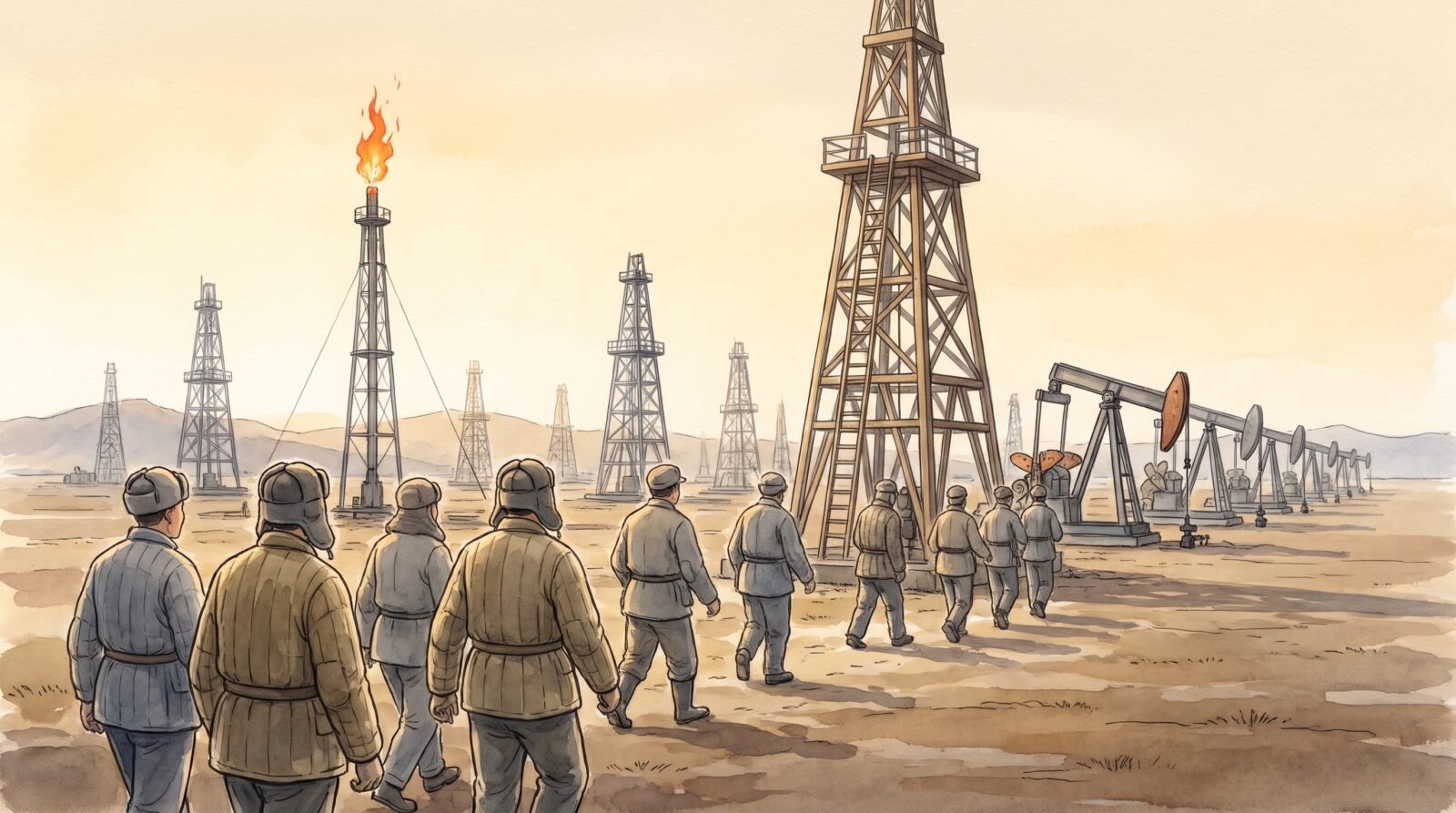
This is the setting in which the drilling teams worked, and it is where the man who became the Iron Man comes in. Wang Jinxi came to Daqing in March 1960 at the head of the 1205 drilling team, brought north from Yumen in Gansu. According to the Xinhua account, he did not ask where he would sleep or what he would eat when the train arrived. He asked whether the drilling rig had come, and where the well site was. The rig had arrived and there was no crane to lift it. So the workers used rollers and crowbars and put their shoulders into it, and for three days and three nights in the bitter wind they raised a derrick 38 metres high and 22 tonnes heavy on the open plain. When the pipe was connected they found there was no water at the well. Wang led the men to break ice from the ponds nearby and carried fifty tonnes of water to the site in basins and buckets, by hand.
Then the well began to blow. There was no barite powder to kill the flow, so he decided to use cement, and there was no mixer, and the bags of cement would not blend in the mud pit. The account that has become the standard, in the Xinhua version and in the party-school version taught across China, is that Wang Jinxi jumped into a mud pit that came up to his waist and mixed the cement with his own body. It reads like a fable, and it is presented as a fable; the point of the fable is not that a man could stir cement by standing in it, but that he would stand in it. The lines attributed to him have become the most quoted in the modern Chinese canon of industrial self-sacrifice: 石油工人一声吼,地球也要抖三抖, a roar from the oil workers will make the earth shake three times; 有条件要上,没有条件创造条件也要上, if the conditions exist, go ahead; if they do not, create the conditions and go ahead anyway; and 宁可少活20年,拼命也要拿下大油田, rather than live twenty years less, I will fight to take the big oilfield. These slogans are now the standard currency of motivational speeches in Chinese state enterprises, which is a measure of how completely they have left the specific circumstances that produced them.
Three Olds and Four Strictnesses
What the campaign produced was not only an oilfield but a vocabulary, and the vocabulary is the more durable achievement. The terms that came out of the Songliao campaign are 三老四严, the Three Olds and Four Strictnesses, and 四个一样, the Four Samenesses. The Three Olds are stated in the official formulation as: in relation to one’s work, be an honest person, speak honest words, do honest deeds. The Four Strictnesses are: strict demands, strict organisation, a strict attitude, and strict discipline. Zeng Yukuo’s 2005 report, delivered at the Great Hall of the People to the staff of the Standing Committee of the National People’s Congress, gives the canonical wording, and the National People’s Congress site carries a second version under the title of the Daqing Petroleum corporate-culture statement, dated March 2022. The parallel formula 四个一样, the Four Samenesses, requires that the leader, the cadre, the worker and the ordinary member live in the same conditions, eat the same food, wear the same clothing and share the same hardship; its function was to forbid the formation of a privileged stratum in a society that had declared itself against privilege. It is a formula of the period and it carries the period’s assumptions, including the assumption that proximity between levels of a hierarchy is itself a moral achievement. Read coldly in the twenty-first century, the Four Samenesses are a form of self-policing. Read generously in the terms the people who used them intended, they are a refusal to let a command economy become a patronage economy, and the fact that they had to be invented at all says a great deal about how Chinese institutions understood power.
The style of work that the campaign developed was codified in the same way. The workers produced 十懂十会, ten things to understand and ten skills to master; pump operators devised the Five-Character Operating Method; refinery workers invented blindfolded practice, in which a worker performed a maintenance task from memory with the plant’s lights off. Each well site was to be drilled to a standard such that the output of the well was guaranteed from the first day. These were not innovations in technique. They were innovations in discipline, and they were what allowed an industry staffed largely by workers with elementary education to run a drilling programme at a scale that the world’s oil companies had achieved with expensive, imported equipment and a professional engineering corps.
The Numbers
From 1960 to 1963 Daqing produced 11.662 million tonnes of oil. In 1963 the national crude output reached 6.478 million tonnes, of which Daqing accounted for 4.393 million, or 67.8 per cent of the total. On 2 December 1963, Zhou Enlai told the Second Session of the Fourth National People’s Congress that the oil China needed, which had for the most part been imported, could now be essentially self-supplied. In November of that year Yu Qiuli delivered a report to the Congress in which he declared that the oil sector was the only sector that had met and exceeded its targets during the Great Leap Forward. The Daqing field had been a secret project, and this was, according to the account in the widely-read survey of the subject, the first time much of the leadership had heard of it.
The reaction was decisive. Mao called for industry to learn from Daqing on 25 January 1964, and on 5 February the Central Committee issued a notice noting that the field had placed politics in command and had joined political thinking, revolutionary drive and scientific management into a single method. On the afternoon of 25 January, Mao summoned Yu Qiuli to the Chrysanthemum Study at Fengze Garden in Zhongnanhai, where Zhou Enlai, Chen Yun, Deng Xiaoping, Li Fuchun and Li Xiannian were waiting. The reconstructed conversation, circulated in the petroleum industry’s own history, has Mao opening with an unprompted question about the campaign and ending with the observation that the practical test of the way of doing things was to make things work. The meeting ran for what Yu realised, glancing at his watch, was two and a half hours.
In April 1964 Xinhua published “大庆精神大庆人”, the long-form report that carried the story of the campaign to the whole country for the first time. The figures it circulated were: more than 50 million tonnes of oil a year for twenty-seven consecutive years, cumulative production above 2.5 billion tonnes, and 36 per cent of the national onshore total. The Daqing administration’s own 2005 accounting gives the same run as twenty-seven consecutive years above 50 million tonnes, cumulative production of 1.821 billion tonnes by the end of 2004, more than 40 per cent of national onshore output over the same period, and more than one trillion yuan in payments to the state and in absorbed oil price differentials. The two cumulative figures differ because they are measured at different dates, in 2004 and in 2023, and the share figures differ for the same reason. The heritage study prepared for ICOMOS adds a third set of firsts: first in crude output, 2.39 billion tonnes by the first half of 2019; first in profit and taxation; and first in oil recovery rate, with the main field’s recovery rate exceeding 60 per cent, which it describes as at the international leading level.
The reserve figure that followed from the Songliao discovery was what made it a national event rather than a provincial one. China’s proved oil reserves rose from something in the region of a few hundred million barrels to a figure that put it among the world’s significant producers, and China was briefly a net exporter of oil in the 1970s and 1980s. The geological theory that had been built on the assumption of a barren continental interior had to be rewritten. And the political theory followed the geological one. As Gu Mu, the economic official who would later be central to China’s opening to foreign investment, put it in his memoirs, the success of Daqing did not merely increase China’s oil supply after the rupture with the Soviet Union; it ended a longstanding geological myth about Chinese oil reserves, opened a new door for the industry in theory as well as in practice, and demonstrated that the Chinese nation could survive and develop on its own rather than living on alms.
The Man, and What Was Made of Him
Wang Jinxi was born in 1923 in Yumen, Gansu, and started his career as a drilling worker at the Yumen oilfield in 1949. He died on 15 November 1970 of stomach cancer, the disease that accounts for a large share of the occupational mortality in the drilling crews of that generation. He left behind a reputation organised around his body: the hands that mixed cement, the shoulders that raised the derrick, the boots that walked through forty-degree cold to bring water to a well. In 1966 he signed books for children at the Beijing Children’s Science and Technology Museum. The state built him a tomb and then built a national narrative around him, and the narrative has been maintained with great care ever since. The spirit of the Iron Man, 铁人精神, was defined in the Xinhua account as the personalisation of the Daqing spirit itself, and the Daqing spirit was given its canonical four-part form by Jiang Zemin on a visit to the field in 1990: patriotism that strives to bring glory to the country and the nation, hard work in independence and self-reliance, a commitment to science that includes the Three Olds and Four Strictnesses, and a dedication to the larger whole that accepts the national interest over any local one. The shorthand is 爱国、创业、求实、奉献, patriotism, enterprise, truth-seeking, dedication. The Daqing spirit was among the first campaigns to be inscribed in the Chinese Communist Party’s official catalogue of national spiritual traditions, and the succession was institutionalised in a way that few other campaigns were: a second Iron Man, the geologist Wang Qimin, and a third, the driller Li Xinmin, who took the drilling teams to Sudan and set thirty-two local records over eight years in the process. The drilling crew itself survives as an institution: 1205, the crew Wang brought north in 1960, has by the accounts of its own members drilled more than 3.2 million metres of hole over seventy-one years, employs a mean age of thirty-six, and moves its homes with its derrick, so that wherever the rig stands, the families of the crew stand with it.
There was an economic argument running underneath all of this, and it was made at the time. The economist and historian Andrew Batson, reviewing Hou Li’s 2018 book on Daqing and the formation of the Chinese socialist state, has pointed out that Daqing was the single greatest industrial accomplishment of the Mao era, and that its oil helped restore Mao’s confidence in a form of economic development based on mass mobilisation rather than orthodox planning, on political enthusiasm rather than material incentives, and on heavy industry over agriculture. The timing matters. When large-scale production at Daqing began in 1963, China was in the middle of a severe famine, the Great Leap had discredited aggressive industrialisation, and economic policy had returned to more cautious managers. The oil did not single-handedly redirect the country. But it gave the leadership a working example of the mobilisation model at exactly the moment when the Gulf of Tonkin incident in August 1964 made the possibility of war seem imminent and an economy facing war might plausibly need to be reoriented towards heavy industry in defensible inland locations. The Third Front campaign, the long-secret effort to build such a base out of the interior, had a working precedent, and the precedent had a name.
Batson also notes the darker reading available. Natural resource wealth has a well-documented tendency to corrupt the institutions of the countries that find it, and there is evidence of resource-curse-like effects in China on a regional basis today, in places where heavy endowment of natural resources correlates with state-dominated and less successful economies. The Daqing city that grew up on the plain in the 1960s was itself an odd thing: a dispersed settlement of packed-earth houses whose inhabitants largely grew their own food, the model that Mao preferred for a socialist industry, ascetic, egalitarian and scattered rather than urban and hierarchical. It worked as an image and it worked as a discipline. The oil under it was real, and for a while the field delivered.
The Second Thirty Years
What happened at Daqing in the 1990s and after is the part of the story the official account handles with a good deal of euphemism, and it belongs in the history because the gap between the two accounts is itself instructive. The early production from the field came from a reservoir that was relatively easy to work, and by the late 1980s the easy oil had largely been produced. Output from Daqing peaked in the 1980s and then declined through the 1990s, and the decline exposed a set of problems that the celebrated discipline had made difficult to acknowledge: an ageing workforce, an ageing and increasingly difficult reservoir, and a cost structure that had been built for a different kind of problem. In the end the field needed the water injection and the enhanced recovery techniques that its engineers had themselves developed against the predictions of foreign specialists in the 1960s, and it needed them applied at a scale and with an intensity that the old methods could not deliver. The Chinese petroleum industry’s own later account of the field, published in its English-language basin survey, gives the shape of the recovery in its own terms. By the end of 2009 the field had produced two billion tonnes of crude, and the recovery rate of its major oilfields had passed 50 per cent, which the industry’s own survey describes as ten to fifteen percentage points higher than that of any comparable oilfield at home or abroad. The field produced more than 50 million tonnes in each of the twenty-seven years after 1976, and more than 40 million tonnes in each of the eight years that followed, which the survey calls a miracle in the development history of comparable oilfields anywhere in the world. The heritage report for ICOMOS puts the later figure higher still, at a recovery rate exceeding 60 per cent and at the international leading level. The two are measuring slightly different things and are not in serious conflict; both are saying that the second half of the field’s life was engineered rather than inherited, and that a recovery rate which reads as a geological inevitability was in fact the work of a second technical campaign built on top of the first.
The administrative answer to the decline was the restructuring of the petroleum industry itself. Daqing became part of the China National Petroleum Corporation, and the administration that had run the field became a subsidiary operating under it, with the oilfield name preserved but the corporate identity changed. The old Daqing Oilfield Administration, with its system of work camps, its model workers and its political education, no longer existed as an independent institution in the form it had held between 1960 and the 1990s. The 2005 report to the National People’s Congress is explicit that the transition from a planned to a market economy exposed the workforce to exactly the pressures the Three Olds and Four Strictnesses were supposed to prevent: workers asked, in the report’s summary of the doubts expressed at the time, whether a set of standards formed in a planned economy had any value in a market one, whether it could still be applied in the age of modern enterprise management, and whether it mattered at all in an organisation whose only criterion was whether there was work and whether the work paid. The report names two specific construction scandals of the late 1990s as the test cases: the Zhongshiliu joint station and the Donghu residential development, which it calls the 中十六联现象 and the 东湖现象. It is a rare thing to find a Chinese state enterprise documenting, in its own words and through its own authorised channel, the concrete failures that accompanied its own privatisation. It also shows the durability of the vocabulary. The report’s answer is that the Three Olds and Four Strictnesses survive the transition and are more necessary in it, not less, because the market is where the temptation to special treatment lives.
What the campaign left behind, then, is a field that still produces, a city that is larger than the one Mao imagined, a drill crew with a name that means something to everyone who has worked in the sector, and a set of sentences that are now older than anyone alive who used them. The old wellhead is still there in the village of Yongyue, and the field that grew out of it has passed two and a half billion tonnes of oil. Whether the Iron Man was a man or a method is the question the sources leave open. The drilling records suggest that he was a driller who arrived before his crane and found the job anyway, and that the method was to keep finding the job. That is a smaller thing than a legend and a more durable one. The slogans were written by men who had been hungry and cold and were not certain they would live to see the oil, and they were written down by other men who wanted the country to believe that such men existed. The oil came out of the ground either way, and the country did believe it, and for thirty years it produced at a rate that no one outside it could have sustained without the belief. That is a harder thing to explain than geology, and it is the part of the story that the field itself cannot.
There is also a question about what the campaign cost, and it should be asked plainly rather than left to the slogan writers. The labour was conscripted, the food was rationed, the winter was not survivable for everyone who went north, and the production figures of the first four years were produced by a workforce that included men and women who were simultaneously losing children to the famine that was running in parallel with the drilling. The field and the famine are usually taught separately in China: the Great Leap and its famine in one chapter, the petroleum battle in another, with an interval marked 1960 to 1963 during which the two are quietly held apart. They cannot be held apart entirely. The same state, the same apparatus of reporting, the same grain procurement system that delivered the famine also delivered the drilling crews their five liang a day, and the same enthusiasm that the campaign was able to mobilise was an enthusiasm that the preceding years had burned through. The American analysts watching from outside read the campaign correctly, if they read its meaning wrong: in 1966 a Central Intelligence Agency assessment of China’s power machinery industry recorded that the Ta-ching oil field had been exploited since 1960 and that an epoch-making economic change had occurred, self-supply of oil having become possible. The epoch, the analysts understood, was industrial. What the field was also doing was making the political consequences of the famine survivable in a way that nothing else could, by putting a measurable, visible, extractable achievement underneath the state’s feet at the precise moment when the state needed one. The drilling crews went north because they were told to, and they stayed because the oil was real, and the oil was real because the people in it were there. That is the whole of it. It is not a mystery. It is only a very large thing that happened to a very great many people at once.
One further piece of the record deserves setting down, because it is easy to lose in the rhetoric and because it is the part of the story that has been most carefully institutionalised. In 1990, on a visit to the field, Jiang Zemin gave the Daqing spirit its four-part canonical form, and the four parts are not a list of virtues in the abstract. They are a sequence of obligations, and each of them names an audience. Patriotism is directed outward, towards the country and the nation. Enterprise is directed inward, towards the party’s own doctrine of self-reliance. Truth-seeking is directed at method, and it is defined in the official formulation by the Three Olds and Four Strictnesses rather than by any general principle of intellectual honesty. Dedication is directed at the collective, and it is specified as the subordination of a local interest to the national one. Read as a job description for the cadre, it is a system for producing a certain kind of person: honest, disciplined, self-sufficient, and answerable to something larger than the immediate site. Read as a description of what actually happened at Songliao, it is accurate. The drilling crews were honest about their difficulties, in the peculiar sense that they were required to report them upward and the reporting worked. They were disciplined, in the sense that a shift began on time and the standard did not move with the weather. They were self-sufficient, because there was nothing to be self-sufficient with except each other. And they were answerable to something larger than the site, because the site was a hole in the ground in Heilongjiang and what justified the hole was a claim about the future of a country that most of the men digging it would not live to see in the form they had been promised. That last fact is not a contradiction of the spirit. It is the condition under which the spirit operated, and it is why the spirit has proved so durable: it gave the men who worked there an account of themselves that was larger than the wage, and it gave the state a class of workers who would accept terrible conditions without a second thought, and it did both by describing the work in terms of the nation rather than in terms of the workers.
References
- Oil Industry Heritage: Thematic Study for ICOMOS – Liu Boying and Liu Xiaohui, TICCIH, 2020
- 苦干实干 三老四严——中国石油天然气集团有限公司主题宣讲词 – 共产党员网, 22 March 2022
- “三老四严”的优良传统和作风永远推动我们前进 – 曾玉康, 国务院国有资产监督管理委员会, 15 September 2005
- 时光相册丨大庆精神:一甲子的回望 – 新华社, 20 April 2024
- 【史鉴】毛主席为何号召学大庆 – 郝季年, 中国石油石化网, 29 February 2016
- Daqing: The Oil City Named for a Birthday and Held Up to a Nation – The Nan Jing-er, 2024
- Daqing and the Resource Curse under Socialism – Andrew Batson, 4 June 2020
- Nightmare in China – Peter Lewis, The 1960s Project
- Information Distortion in Hierarchical Organizations: A Study of China’s Great Famine – Ziying Fan, Wei Xiong and Li-An Zhou, Princeton University, 2016
- Accomplishments of China’s Power Machinery Industry – Central Intelligence Agency, 15 January 1966
- China Oil Production Prospects – Central Intelligence Agency, 1964
- Great Leap Forward – Encyclopaedia Britannica
- 大庆精神 – 思想网, 中国社会科学院
- Songliao Basin – China National Petroleum Corporation, Petroleum Industry Publication
- New era dawns on old – South China Morning Post, 1 July 1997
- Songliao Basin – China National Petroleum Corporation, Petroleum Industry Publication
- New era dawns on old – South China Morning Post, 1 July 1997