Wu Zhao, later Empress Wu Zetian, was the only woman in Chinese history to rule as emperor in her own right. She entered the back palace of the Tang dynasty as a low-ranking concubine of Emperor Taizong in the 620s, became a junior consort of his son Gaozong after Taizong’s death, and over the next half-century accumulated more power than any woman before or since in the imperial system. In 690, she declared a new dynasty, the Zhou, interrupting the Tang and ruling as emperor until she was forced to abdicate in favour of her son Zhongzong in 705.
This essay traces the arc of Wu’s career and the institutions of the Zhou restoration. It is built on the standard sources of the period: the Jiu Tang shu (Old Book of Tang), the Xin Tang shu (New Book of Tang), the Zizhi tongjian (Comprehensive Mirror for Aid in Government), and the surviving edicts, stele inscriptions, and Buddhist texts of Wu’s reign. The picture that emerges is not the demonised villain of Confucian historiography nor the feminist icon of modern popular history. It is the picture of a serious political actor who used the imperial institutions of the Tang, the ideological resources of Buddhism, and the politics of the Tang court to build a regime that lasted fifteen years and shaped the next century.
At a glance
Wu Zhao was born in 624, possibly in Wenshui in modern Shanxi, into a mid-ranking Tang family. She entered the palace of Emperor Taizong around 626 as a caigen (attendant), a low rank among the imperial consorts. After Taizong’s death in 649 she was sent to a Buddhist convent, from which she was recalled by the new Emperor Gaozong around 652. She became a junior consort, was made empress in 655, and from the late 660s exercised effective power alongside Gaozong. After Gaozong’s death in 683 she ruled through her sons Zhongzong and Ruizong. In 690 she took the throne herself, founding the Zhou dynasty with herself as emperor. She ruled until 705, when a palace coup forced her to abdicate. She died later that year.
The concubine from the back palace
The Tang imperial harem was a structured institution. Below the empress were four ranks of imperial consorts, with titles drawn from the Rites of Zhou: guifei, shufei, defei, and xianfei. Below them were the nine pin system, including the rank of caigen, the lowest official rank in the harem. A caigen performed routine service in the imperial quarters and was not normally a candidate for elevation. Wu Zhao entered the harem as a caigen, but the Jiu Tang shu records that Taizong noted her presence and that, on his deathbed, she was among the junior consorts who had caught his eye.
The customary fate of a junior consort of a dead emperor was confinement to a Buddhist convent, where the imperial ladies served until they died. Wu Zhao was sent to the Ganye Temple outside Chang’an in 649. Her recall by Gaozong, the new emperor, was itself unusual. According to the Jiu Tang shu, the empress Wang wished to bring her former rival into the palace as a counterweight to her husband’s favourite consort, Consort Xiao. Wu Zhao was recalled, given the title of zhaoyi (a mid-level consort), and entered the palace around 652.
The next years saw the consolidation of her position. Gaozong’s wife, Empress Wang, had no sons. Consort Xiao had one son. Wu Zhao bore four sons in the following years, the eldest of whom, Li Hong, became heir apparent. The childbearing gave her a claim on the succession that no previous consort of the Tang had achieved. It also brought her into direct conflict with Empress Wang and Consort Xiao. By the early 660s Wu had displaced both of them. In 655, Gaozong deposed Empress Wang and made Wu his empress.
The transition was violent. Consort Xiao and Empress Wang were killed, reportedly under Wu’s orders. The sons of Consort Xiao, including the elder Li Zhong, were demoted and later exiled. The Jiu Tang shu, which draws on court chronicles of the period, treats the episode as a warning of Wu’s ruthlessness. The Xin Tang shu, written under Song Confucian influence in 1060, treats it as confirmation of her unfitness for power. Modern historians have noted that the politics of the harem under the Tang were never polite and that the deaths were in line with the conventions of the time.
The path to the throne
Gaozong suffered from increasing ill health in the 660s and 670s. By the late 660s, according to the Zizhi tongjian, Wu Zhao was exercising substantial authority over the imperial administration. She received officials in the inner palace, drafted edicts in Gaozong’s name, and chaired audiences with the chancellors. In 670, when the chancellor Li Yixian proposed to remove her from power, Gaozong is reported to have asked whether the proposal came from Wu or from himself. The story may be a later amplification, but the underlying reality is plain: by 670, Wu was effectively co-ruling.
The imperial institution of the Tang provided several routes to formal power. A consort could become empress, but empresses did not rule in their own right. A regent could rule on behalf of an underage emperor, but regency implied temporary status. A co-ruler could be designated, but Tang precedent had no such designation. Wu’s innovation was to combine the institutional roles available to a consort with the personal authority of a long-standing co-ruler. The Jiu Tang shu records the phrase tian hou (heavenly empress) used of her from the early 680s. The Zizhi tongjian notes that she was addressed as tian huang (heavenly emperor) in informal audiences before she took the throne.
Gaozong died in 683. His son Li Zhe, Wu’s third son, became Emperor Zhongzong. Zhongzong attempted to assert authority by promoting his father-in-law, Wei Xuanzhen, and by making other independent appointments. Within two months, Wu had him deposed and replaced by his younger brother Li Dan, who became Emperor Ruizong. Ruizong was a figurehead. Real power was in Wu’s hands as empress dowager and regent.
The regency years from 684 to 690 were the period in which the imperial cult of the Zhou was constructed. The most striking innovation was the use of Buddhist institutions to support the regency. The Maitreya cult, the belief in a future Buddha who would restore the world, had been popular in China since the fourth century. Wu’s court sponsored Buddhist monasteries in Chang’an, hosted Buddhist councils, and produced a Buddhist inscription, the Dayun jing, that predicted a female incarnation of the future Buddha as the ruler of a renewed China. The inscription was almost certainly a fabrication of the court, but it served as a religious legitimation of the regency.
The Zhou restoration of 690
In 690, Wu took the throne as emperor of the new Zhou dynasty. The change was formally prepared. Petitioners from the imperial guard, the officials, and the Buddhist clergy requested that Wu accept the Mandate of Heaven. The petitions followed the conventional pattern of imperial succession, but with two innovations. First, the petitions came from the imperial guard, which had not been the source of similar petitions before. Second, the petitions cited Buddhist scripture, drawing on the Maitreya texts that had been produced in the preceding years.
Wu accepted. She took the title Zetian, meaning “following heaven” or “illuminated by heaven,” a name with both Confucian and Buddhist resonance. She adopted a new era name, Tianzhoushuang (Heavenly Beginning), and ordered a general amnesty. The Tang princes, including the sons and grandsons of Gaozong’s brothers, were demoted and exiled. Some were killed. The Tang imperial cult at the ancestral temple was replaced by the Zhou imperial cult. The dynastic shift was meant to be complete.
The Zhou was not, however, a structural revolution. The state apparatus continued to be the Tang state apparatus. The chancellors, the ministries, the censors, the provincial governors, the military command system all remained in place. The tax registers were not reorganised. The equal-field system continued. The examination system continued, with quotas adjusted but not abolished. The major change was at the top of the imperial institution. The emperor was a woman, and the dynastic name was Zhou instead of Tang.
The choice of Zhou as the dynastic name was itself significant. The Zhou was the dynasty of the kings of antiquity, the period of the Duke of Zhou and of the Rites of Zhou. By naming her dynasty Zhou, Wu placed herself in the lines of the most prestigious classical past. It also allowed her to argue that the Tang had been a deviation from the natural order of dynastic succession, since the Tang ruling house was of mixed Han and Xianbei descent, while Wu claimed descent from the Zhou-era aristocracy. The political theology of the Zhou restoration was conservative in form, radical in substance.
The reign, year by year
The reign of Wu as emperor lasted from 690 to 705. The Zizhi tongjian divides the period into several phases. The first phase, 690 to 692, was the consolidation of the Zhou. The loyalist opposition was suppressed. The Tang princes were either killed or exiled. The chancellors of the early reign were Wu’s close associates: Li Zhi, the chief of the secretariat, and the censor Lai Junchen, who directed a system of secret accusations. The censorship and the system of secret police were the most repressive instruments of the early Zhou.
The second phase, 692 to 700, was a period of relative stability. Lai Junchen was dismissed in 694 and later killed. The chancellors of the period included Zhou Xing, the architect of the secret police, and Di Renjie, who would later become famous as the model of Tang judicial wisdom. The bureaucracy continued to function. The examination system continued to recruit officials. The provincial governors continued to govern. The state maintained the fubing militia system and the provincial commands.
The third phase, 700 to 705, saw the succession question come to a head. Wu’s sons, the former Tang princes, had been demoted but not all killed. Her nephews, the sons of her brother Wu Chengsi and Wu Yuanshuang, became powerful figures in the court. The choice between a son and a nephew as heir was not merely personal. A son would restore the Tang. A nephew would continue the Zhou. Wu alternated between promoting her sons and her nephews, without committing to either, for most of the period.
In 705, Wu fell ill. A palace coup, led by the chancellor Zhang Jianzhi and the imperial guard general Cui Xuanwei, with the cooperation of Li Dan’s brother Li Xian (the son of Wu’s deposed husband Li Xian, not the same person), entered the palace. Wu was forced to abdicate in favour of Li Xian, who became Emperor Zhongzong for the second time. The Zhou was abolished. The Tang was restored. Wu was given the title of empress regent in retirement. She died later that year.
Religion, ritual and the new orthodoxy
The most distinctive feature of Wu’s reign was the use of Buddhist institutions as political theology. The Buddhist infrastructure of the Tang was already substantial. The great monasteries of Chang’an and Luoyang were wealthy landowners and centres of learning. The translation of Buddhist scripture into Chinese had been ongoing since the second century. The Tang imperial house had supported Buddhism since its founding, with Taizong and Gaozong both issuing edicts in support of the religion.
Wu’s innovation was to bring Buddhist doctrine into the centre of imperial legitimation. The Dayun jing, a Buddhist text that predicted a female incarnation of the future Buddha, was produced during the regency. The inscription at the Longxing Temple in Longmen, near Luoyang, commissioned in 690, declared that the Maitreya had already come, in the form of a female emperor. The inscription is preserved in part and is the most concrete documentary evidence of the Buddhist ideology of the Zhou.
The Confucian response to the Buddhist ideology of the Zhou was muted during the reign but grew stronger afterwards. The Confucian scholars of the mid-Tang, including the later chancellor Li Linfu, treated the Buddhist legitimation of the Zhou as heterodox. The Xin Tang shu, written in the eleventh century, treats Wu’s Buddhism as a deviation from the Confucian orthodoxy of the Tang. The picture is complicated by the fact that the Tang dynasty itself, including Taizong and Gaozong, had supported Buddhism generously. The difference was in the use of Buddhism as political theology, which Wu pushed further than any previous emperor.
The use of Buddhism as political theology was not, however, the only ideology of the Zhou. The Zhou also drew on the classical tradition. The Rites of Zhou, the Book of Changes, and the Spring and Autumn Annals were cited in edicts. The court revived the ancestral cult of the Zhou kings and performed sacrifices at Mount Tai. The political theology of the Zhou was, in this sense, plural: Buddhist in its Maitreyan claims, Confucian in its appeal to antiquity, and Tang in its administrative practice.
The court and the literati
The court of Wu as emperor was a substantial institution. The chancellors included some of the most able officials of the Tang: Li Zhi, Yao Yuanzhi, Di Renjie, and Zhang Jianzhi. The censors and the provincial governors continued to be drawn from the established families of the Tang aristocracy. The examination system continued to produce officials. The literati of the period – the poets, the essayists, the historians – were subject to the same political pressures as in other reigns, but the use of literary talent as a test of political loyalty was more pronounced.
The most striking case of literary loyalty was the poet Song Zhiwen, who served Wu loyally and was rewarded with high office. The most striking case of literary resistance was the poet Chen Zi’ang, who was exiled for his criticisms of the Zhou. The most famous case of ambiguous loyalty was the poet Luo Binwang, who was involved in a plot against Wu and was exiled but later pardoned. The literary culture of the Zhou was a culture of accommodation, resistance, and survival.
The historiography of Wu is dominated by the two Tang histories. The Jiu Tang shu, compiled under Later Jin in 945, includes Wu’s reign as a section of the Gaozong biography, treating it as a regency rather than as an independent reign. The Xin Tang shu, compiled under Song in 1060, separates Wu’s reign into a distinct basic annal, treating it as a legitimate reign but with strong moral critique. The difference in treatment is significant. The Tang historians treated Wu’s reign as an interruption of the Tang. The Song historians treated it as a historical episode.
The Zizhi tongjian, compiled by Sima Guang in 1084, treats Wu’s reign as a continuous part of the Tang history but with extensive commentary on the political mechanics of her rule. Sima’s commentary is critical but contains crucial detail. The Zizhi tongjian remains the most comprehensive narrative source for the period.
The succession and the Zhongzong Restoration
The succession question that haunted the Zhou was the question of Wu’s heir. Her sons Zhongzong and Ruizong were both alive. Her nephews Wu Chengsi and Wu Yuanshuang were both powerful. The choice between them was not made until 705, when the palace coup forced the issue. The choice between a son and a nephew was the choice between restoring the Tang and continuing the Zhou.
The succession was further complicated by the fact that Wu’s sons had been raised in the Tang imperial tradition and were accustomed to the political style of the Tang. The nephews had been raised in the imperial tradition of the Zhou and were accustomed to the political style of Wu’s court. The two political styles were not identical. The Tang style emphasised the bureaucratic administration of the empire through the chancellors and the ministries. The Zhou style emphasised the personal authority of the emperor and the use of the secret police.
The palace coup of 705 was led by figures of the Tang restoration. Zhang Jianzhi, Cui Xuanwei, and Huan Yanfeng were all associated with the Tang imperial house. Their cooperation with Li Xian (the future Zhongzong) was a restoration project. The coup succeeded because Wu was old and ill. The coup did not succeed in restoring the Tang in any radical sense. The chancellors, the ministries, the censors, the provincial governors all remained in place. The dynasty was restored. The state was not reformed.
The Zhongzong Restoration lasted from 705 to 710. Zhongzong’s wife, Empress Wei, attempted to repeat Wu’s pattern by exercising power through her husband. The attempt failed when Zhongzong died in 710 and his son Li Chongmao briefly succeeded, only to be displaced by Li Longji (the future Emperor Xuanzong), who killed Empress Wei and her daughter. The restoration of Tang did not, in the end, restore the Tang of Gaozong. The Tang of Xuanzong was a new Tang.
The political economy of the Zhou
The Zhou restoration was, in economic terms, a continuation of the Tang political economy rather than a rupture. The equal-field system, which allocated land to households on the basis of the labour force, continued to function in most regions. The tax registers, which recorded households and their obligations to the state, were not reorganised. The salt and iron monopolies, which had been a feature of the Tang fiscal system since the seventh century, continued under Wu. The silk tribute system, which brought silk from the provinces to the capital, continued. The granary system, which stored grain against famine and military emergencies, continued.
The principal fiscal innovation of Wu’s reign was the tightening of provincial tax collection. The provincial governors, who had accumulated substantial power under Gaozong, were brought back under central control through a series of transfers and demotions in the 690s. The censors were given enhanced powers to investigate provincial administration. The provincial officials were rotated more frequently than under Gaozong. The result was a more centralised fiscal system, but not a structurally different one.
The military establishment of the Zhou was the same as the Tang military establishment. The fubing militia system, which registered soldiers as household members and rotated them between garrison duty and farming, continued to function. The jimi prefectures, which governed the border regions under the dual authority of the Tang administration and the local tribal leaders, continued to exist. The military commands of the frontier, particularly the Anxi and Anbei commands in the Tarim Basin and the Mongolian steppe, continued to operate. The Tang military system had been built under Taizong and Gaozong, and Wu did not alter it.
The most distinctive military development of Wu’s reign was the use of the imperial guard as a political instrument. The imperial guard, which had been a hereditary force under the Tang, was reorganised under Wu to include larger numbers of palace attendants and recruited soldiers loyal to the court. The result was a more reliable palace force but also a more expensive one. The cost of the expanded imperial guard was a significant fiscal burden in the later years of the Zhou.
The trade policy of the Zhou was, in many respects, a continuation of Tang trade policy. The Silk Road trade with Central Asia continued. The maritime trade with Southeast Asia and the Indian Ocean continued. The tributary system, which managed China’s relations with neighbouring states, continued to function. The principal new development was the increased use of Buddhist institutions as channels of foreign relations, particularly with Korea, Japan, and Tibet. The Buddhist missions of the Zhou period were larger than the missions of the Tang period, and they played a more visible role in foreign policy.
The economic effects of Wu’s reign were, in the aggregate, modest. The Tang economy was already large and complex. The political changes of the Zhou did not substantially alter the underlying structure. The fiscal burden of the expanded imperial guard, the increased reliance on Buddhist institutions, and the larger ceremonial apparatus of the Zhou did create fiscal pressure. The pressure was relieved in part by increased tax collection in the provinces and in part by drawing on the reserves of the imperial household. The economic strains of the Zhou were, however, contained within the existing fiscal system.
The earlier Tang polity and the path to power
The Tang polity in which Wu rose was a system of substantial central power, structured around the emperor, the chancellors, the ministries, and the provincial administrations. The emperor’s authority was, in principle, absolute. The chancellors, who were typically several and divided into the heads of the three main departments, managed the routine administration. The ministries, six of them in the Tang system, executed the policies of the chancellors. The provincial administrations governed the territory outside the capital regions of Chang’an and Luoyang.
The political culture of the early Tang was a culture of the aristocratic families. The seven great families of the early Tang – the Li, the Cui, the Lu, the Li of Zhao, the Wang, the Yuwen, and the Yu – dominated the chancellery and the provincial administrations. The imperial family of the Tang, the Li, was itself one of these families. The political culture was a culture of marriage alliances, of patronage networks, and of competition within the elite. Wu Zhao, who came from a mid-ranking family, was an outsider to this culture.
The path to power that Wu followed was therefore not the conventional path. The conventional path for a Tang emperor was to inherit the throne as the eldest son of the previous emperor, to be educated in the imperial household, and to be introduced to the chancellors and the ministers at the appropriate age. The conventional path for a consort was to marry into the imperial family, to bear children, and to exercise informal influence over the imperial household. Wu followed a different path, beginning as a low-ranking consort of Taizong, becoming the consort of Gaozong, displacing the empress, and gradually accumulating power.
The accumulation of power was incremental. Wu did not seize power in a single decisive act. She accumulated it over decades, through the bearing of children, the cultivation of alliances with the chancellors and the palace attendants, the displacement of rivals, and the management of Gaozong’s illness. The result was that by the time Gaozong died, Wu had already accumulated the authority that she exercised as empress dowager and regent. The declaration of the Zhou was the formal recognition of a reality that had existed for years.
The political style of Wu’s reign was also distinctive. The Tang political style, as practiced by Taizong and Gaozong, emphasised collective decision-making, regular audiences with the chancellors, and a careful balance of the imperial household and the aristocratic families. Wu’s political style emphasised personal authority, direct control over the chancellors, and a careful balance of the imperial household and the new institutions of the Zhou. The shift was not absolute, but it was visible. The Zhou was a more personal regime than the Tang.
The literary politics of the Zhou
The literary politics of Wu’s reign were inseparable from the political politics. The poets and essayists of the period were required to navigate the political expectations of the Zhou, and the literary production of the period reflects the accommodations and resistances that the regime produced. The official histories of the period, the Jiu Tang shu and the Xin Tang shu, include biographical sections on the literary figures of the Tang and Zhou that document the patterns of accommodation and resistance.
The most prominent literary figure of the Zhou period was the poet Song Zhiwen, who served Wu loyally and was rewarded with the position of yushi dafu (grand master of remonstrance). Song Zhiwen had been a friend of Chen Zi’ang in the early reign of Gaozong and had been involved in the literary circles of the Tang court. His accommodation of the Zhou was politically effective but personally costly. He died in exile in 690 or shortly thereafter, having fallen from favour late in the Zhou.
The most prominent literary critic of the Zhou was the poet Chen Zi’ang, who was exiled to the south for his criticisms. Chen Zi’ang’s poetry was a poetry of political engagement, drawing on the classical tradition of the shi jing and the chu ci. His exile and his death in 702 were the most prominent literary martyrdom of the Zhou period. The treatment of Chen Zi’ang was a warning to other literary figures of the cost of resistance.
The literary production of the Zhou period was substantial. The poets of the period produced collections that have survived and that are studied as a distinct literary phase of the Tang. The major literary genres – the shi, the fu, the pianwen – continued to be practiced. The themes of the poetry were, however, modified by the political expectations of the Zhou. The Buddhist themes that Wu promoted were taken up by some poets. The Confucian themes that the conservative literati preferred were taken up by others. The literary culture of the Zhou was a culture of accommodation, resistance, and survival.
The legacy of the Zhou restoration
The Zhou restoration left a complex legacy. The institutional legacy was substantial. The examination system, which Wu had expanded, continued to function and became the principal channel of recruitment for the imperial administration. The imperial apparatus of the Zhou continued to function under the restored Tang and was the basis of the high Tang of the eighth century. The fiscal and military systems of the Zhou continued to function. The provincial administration continued to function.
The political legacy was more mixed. The Zhou demonstrated that the imperial institution could be exercised by a woman in her own right. The demonstration was not lost on the political theorists of the Tang and Song. The Confucian theorists of the Song, including Sima Guang and the compilers of the Xin Tang shu, treated the Zhou as a deviation from the natural order. But the institutional precedent was set. The possibility of female rule was established. The image of Wu as emperor was preserved in the historical record.
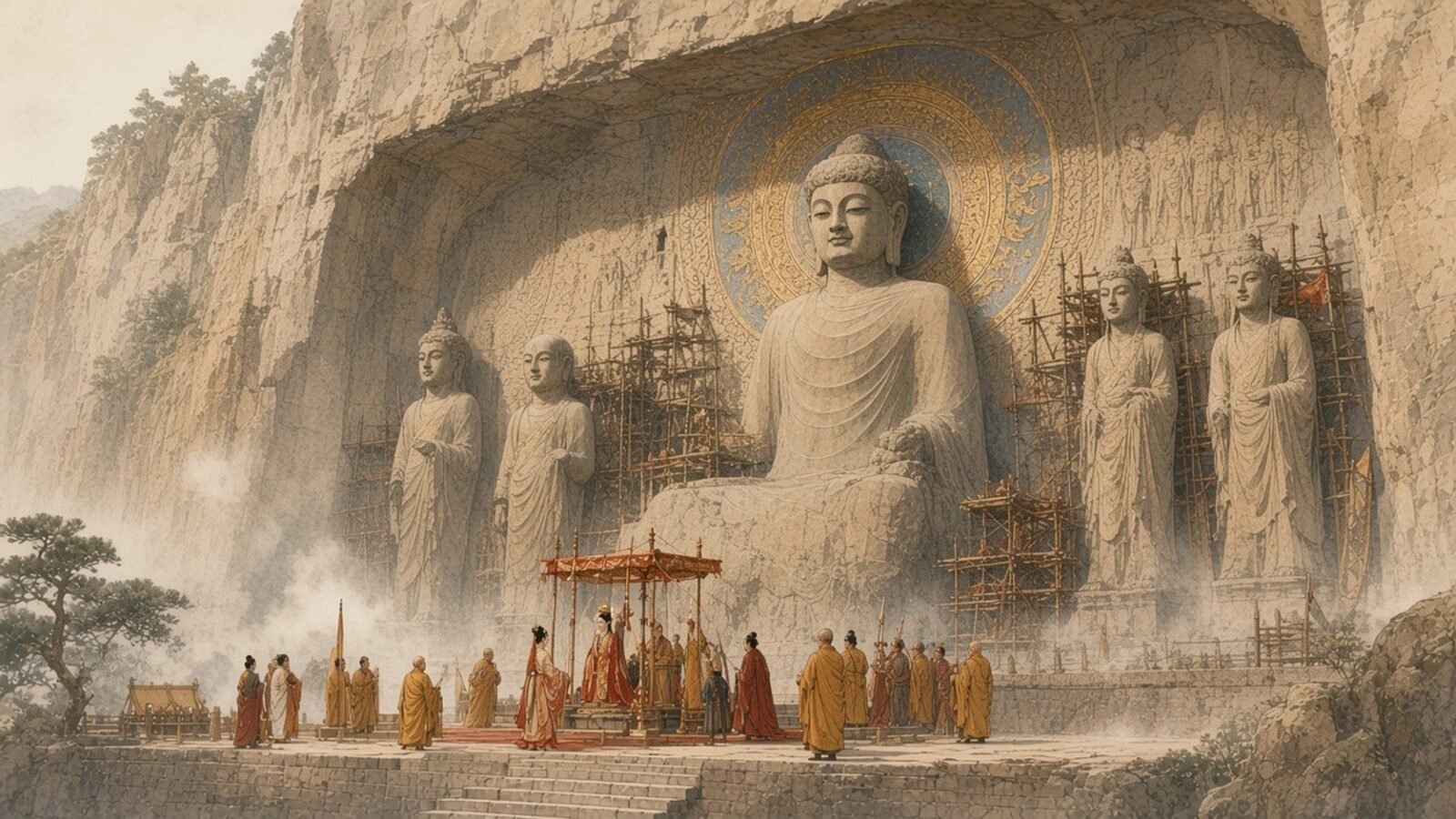
The religious legacy was substantial. The Buddhist institutions that Wu patronised continued to function under the restored Tang and under the Song. The Buddhist translation bureau of Wu’s reign produced a substantial portion of the later Buddhist canon. The Buddhist art of the Tang, including the Vairocana at Longmen and the other monuments of the period, was the product of imperial patronage that Wu had established. The Buddhist infrastructure of the Tang and Song was, in part, the infrastructure of the Zhou.
The historiographical legacy was even more substantial. The two Tang histories, the Jiu Tang shu and the Xin Tang shu, were written in part to evaluate Wu’s reign. The Zizhi tongjian was written in part to provide a comprehensive narrative of the period. The historiography of Wu became the test case for evaluating the role of women in Chinese political history. The image of Wu as villain, as victim, as feminist icon, as political realist, has been constructed and reconstructed over the centuries, and the historiographical legacy of the Zhou is one of the most discussed topics in Chinese historical writing.
The personal legacy of Wu was, in a sense, the most enduring. The image of Wu as the only woman to rule China as emperor in her own right has been a constant reference point in Chinese political discourse. The image is contested. The historiographical tradition of the Tang and Song treated Wu as a deviation from the natural order. The historiographical tradition of the twentieth century, including the modern histories of Tang China, has treated Wu as a serious political actor who used the imperial institutions of the Tang to build a regime that lasted fifteen years. The image of Wu is a measure of how Chinese political culture evaluates the role of women in the imperial institution.
What survives of Wu
The most striking physical survivals of Wu’s reign are the inscriptions. The Longxing Temple inscription at Longmen, the stele at the Dayun Temple, the giant statue of the Buddha Vairocana at Longmen carved during her reign, the inscriptions at the Qianling Tomb where she is buried with Gaozong – all of these survive. The most impressive is the Vairocana at Longmen, a seventeen-metre statue commissioned in 672 and completed in 675, which was rededicated under Wu’s reign and bears an inscription naming her as the patron.
The most striking documentary survivals are the Buddhist texts. The Dayun jing and the prophecies of the female Maitreya were preserved in the Buddhist canon. The catalogues of Buddhist translations compiled during the reign list the texts produced by the Tang translation bureau. The translation bureau of Wu’s reign was the largest of the Tang, and its work became part of the later Buddhist canon.
The most striking architectural survival is the imperial palace at Luoyang. Wu made Luoyang the effective capital during her reign. The palace complex at Luoyang was built in the Zhou style and was the principal residence of the emperor. The palace is gone, but the site is marked, and the foundations have been excavated. The excavation has produced ceramics, architectural elements, and inscriptions that document the imperial architecture of the Zhou.
The most striking institutional survival is the examination system. Wu expanded the examination quotas, added palace examinations in which she herself participated, and recruited officials from a wider range of backgrounds than previous Tang emperors. The pattern of recruitment established under her was continued by her successors and became the model for the high Tang of Xuanzong. The bureaucratic culture of the Tang of the eighth century was, in part, a bureaucratic culture that Wu had shaped.
The most striking personal survival is the historiography. The image of Wu as villain, as victim, as feminist icon, as political realist, has been constructed and reconstructed over the centuries. The image in the Xin Tang shu, the image in the Zizhi tongjian, the image in the modern historiography of Tang China – all are different. The historical Wu is a figure who can be approached but not retrieved. The sources are dense, the historians are divided, and the political theology of the Zhou is irreducible to a single moral verdict.
References
- Jiu Tang shu (Old Book of Tang) – Liu Xu (compiler), Later Jin court, 945; multiple modern editions including the Zhonghua shuju punctuated edition, 1975
- Xin Tang shu (New Book of Tang) – Ouyang Xiu, Song Xian, 1060; Zhonghua shuju punctuated edition, 1975
- Zizhi tongjian (Comprehensive Mirror for Aid in Government) – Sima Guang, 1084; Zhonghua shuju punctuated edition, 1956
- Wu Zetian: The Only Female Emperor in Chinese History – Geling Shang (novelistic treatment); for scholarly treatments see the works cited in N.J. Giradot’s standard bibliography
- The Fragile Scholar: Power and Masculinity in Chinese History – Keith McMahon, University of Hawai’i Press, 2004
- The Woman Ruler and the Dynastic Threshold – Mischa Mueller (1996), and the article by Antonino Ferro in the Journal of Chinese History, 2019
- Buddhism in the Tang – T.H. Barrett in “The Buddhist Revival in the Tang”, an essay volume; for the Longxing inscription see the Longmen grottes de Longmen Cun, vol. 2
- The Tang Dynasty: A Historical Overview – John W. Chaffee, in “The Cambridge History of China, Volume 3: Sui and Tang China”, 1979
- Longmen Grottoes (UNESCO World Heritage listing) – UNESCO, listing includes the Vairocana Buddha and other monuments of the Tang and Zhou periods
- Luoyang: The Imperial Capital of the Tang and Song – See the Luoyang Museum site report for the imperial palace foundation excavations (multiple volumes, 1998-2008)