At a glance: a war of nine months, fought principally on land in Korea and along the Liaodong peninsula and at sea in the Yellow Sea, between a Qing China that had not fought a major external war for two generations and a Meiji Japan that had spent two decades building a conscript army on the French model and a navy on the British model. The war ended with the Treaty of Shimonoseki in April 1895, by which China recognised the independence of Korea, ceded Taiwan and the Liaodong peninsula, paid an indemnity of two hundred million taels of silver, and opened four new treaty ports. The war did not, however, end with the treaty. The humiliation of the defeat, the cession of Taiwan, and the burden of the indemnity became the proximate cause of a generation of Chinese reform and revolution. The Boxer Rebellion, the Hundred Days’ Reform of 1898, the late Qing constitutional movement, the Wuchang Uprising of 1911, and ultimately the fall of the imperial system all trace, in different ways, to the consequences of 1894-95.
Background: Korea between Qing and Meiji
To understand the war, one must begin with Korea. In the early 1890s the Korean peninsula sat uneasily between two competing spheres of influence. The Qing dynasty, the traditional suzerain of the Joseon kingdom through the centuries-old tribute relationship, claimed a residual right to be consulted in matters of Korean foreign policy. The Meiji government in Tokyo, having declared itself a regional power after the Meiji Restoration of 1868, regarded Korea as the first step in a broader campaign of national aggrandisement and immigration. The two claims had been in tension since the conclusion of the Treaty of Ganghwa in 1876, by which Korea opened to Japanese trade; the tension had been aggravated by the Tianjin Convention of 1885, by which China and Japan had agreed to withdraw their forces from Korea simultaneously and to give prior notice of any future troop movements.
The internal politics of the Korean kingdom complicated the picture. The Joseon court in Seoul was divided between a conservative faction, which favoured the traditional tributary relationship with China, and a reformist faction, which favoured modernisation on the Japanese model. The Donghak Peasant Revolution of 1893-94, which began as a tax revolt in the southern provinces and grew into a national movement, gave the two factions a context in which to invite foreign troops to suppress the rebellion. The conservative faction, which controlled the court, requested Chinese troops; the reformist faction, which had ties to Japan, responded by inviting Japanese troops to balance the Chinese presence. The result was the deployment, in June 1894, of substantial Chinese and Japanese forces on Korean soil, ostensibly to suppress the Donghak rebellion but in fact to assert competing claims to influence over the Korean government.
Outbreak: the collapse of the Beijing-Tokyo channel
From June to July 1894 the Chinese and Japanese governments attempted, through their respective ministers in Seoul and through their foreign ministries in Beijing and Tokyo, to negotiate a simultaneous withdrawal. The negotiations failed for reasons that combined mutual suspicion, domestic political pressure on both sides, and the absence of a recognised mediator. The Japanese government, having decided that the moment was ripe for a decisive assertion of its claims, presented the Chinese government with a set of demands that amounted, in substance, to a Japanese protectorate over Korea. The Chinese government, unable to accept the demands without abandoning its traditional role and unable to reject them without provoking a war, equivocated. On 23 July 1894 Japanese forces seized the Korean palace in Seoul, installed a puppet government, and demanded that the Chinese forces withdraw. The Chinese commander in Korea, General Yuan Shikai, withdrew his forces to the northern provinces; the Japanese forces pursued.
The first significant engagement was at Pungdo, a small island in the Korean Strait, on 25 July 1894. A Japanese naval squadron attacked two Chinese cruisers, the Kangji and the Yangwei, that were escorting a troop convoy to Korea. One of the cruisers was sunk; the other escaped. The engagement was minor in its immediate consequences but major in its symbolic weight. It established that Japan was willing to use force against Chinese naval vessels outside the immediate theatre of the land war. It also established that the Japanese navy, equipped with modern British-built cruisers and trained by British instructors, was at least the equal of the Chinese fleet, which was equipped with a mixture of British, German, and Chinese-built vessels and which had not engaged in a major fleet action for two decades.
The land war in Korea and Manchuria
The land war that followed was conducted on two principal fronts: in Korea, where the Chinese forces concentrated around Pyongyang in the north of the peninsula, and in Manchuria, where Japanese forces landed in Liaodong and pushed north toward the Yalu River. The first major land engagement was the Battle of Pyongyang, on 15 September 1894. Japanese forces under Marshal Yamagata Aritomo assaulted the Chinese positions around the city; after a short engagement the Chinese garrison, commanded by General Song Qing, withdrew in disorder across the Yalu River into Manchuria. The Japanese forces entered Pyongyang the following day. The battle was a serious tactical defeat for the Chinese, who lost some two thousand men killed or wounded and a substantial quantity of matériel, and it opened the road to the Chinese border.
The second major land engagement was the Battle of the Yalu River, also known in Japanese historiography as the Battle of Jiulianchengby, on 17 September to 1 November 1894. Japanese forces under Marshal Yamagata pursued the Chinese forces across the river and engaged them in a series of actions along the Chinese bank. The Chinese forces, commanded by General Liu Buchan and by the Viceroy of Zhili Li Hongzhang, defended prepared positions along the river and around the town of Jiuliancheng. The Japanese forces broke through the Chinese positions after several days of fighting and pursued the retreating Chinese forces south toward the Liaodong peninsula. The campaign that followed, in October and November 1894, established Japanese control of the Liaodong peninsula and of the major Chinese naval base at Lushunkou (Port Arthur).
The sea war in the Yellow Sea
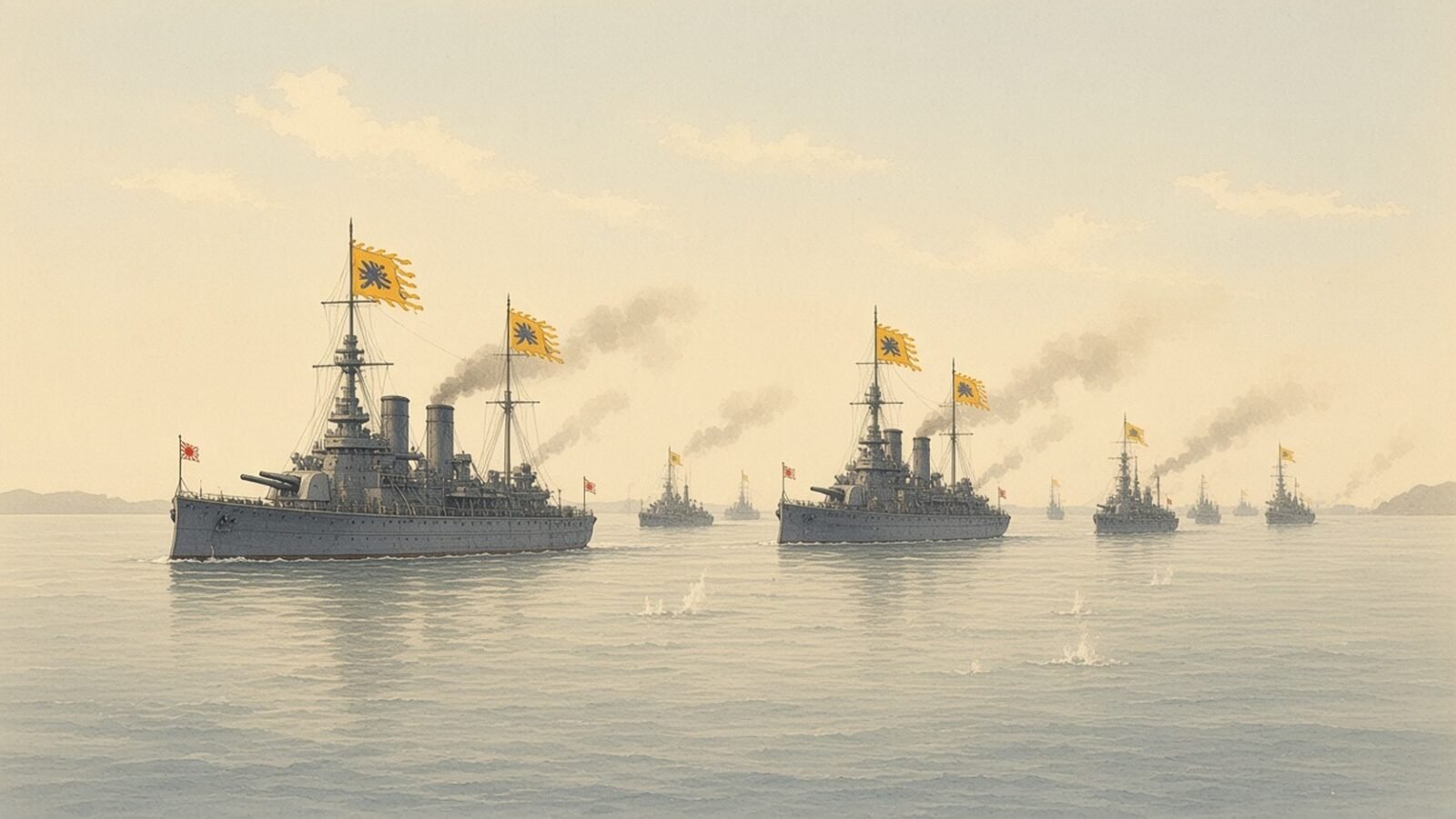
The decisive engagement of the war was the Battle of the Yellow Sea, also known as the Battle of the Yalu River at sea, on 17 September 1894. The Chinese Beiyang Fleet, commanded by Admiral Ding Ruchang, sortied from its base at Weihaiwei to challenge the Japanese Combined Fleet under Admiral Itō Sukeyuki. The two fleets met in the Yellow Sea off the mouth of the Yalu River. The engagement lasted some five hours; the Japanese fleet, employing more modern shells and faster gunnery, sank or disabled five Chinese ships, including two of the four remaining ironclads. The Chinese fleet withdrew, damaged, to Weihaiwei.
The Battle of the Yellow Sea was decisive because it destroyed the operational effectiveness of the Beiyang Fleet. The Beiyang Fleet had been built up over twenty-five years, principally under Li Hongzhang, with German and British assistance; it had been regarded, in the 1880s, as one of the four or five most powerful fleets in Asia. By 1894, however, the fleet had fallen behind the Japanese fleet in personnel, in maintenance, in gunnery, in ammunition supply, and in tactical doctrine. The Battle of the Yellow Sea exposed the gap. The Beiyang Fleet never again sortied from Weihaiwei in force; in the closing weeks of the war the Japanese fleet reduced the Weihaiwei base itself, sinking or capturing the remaining Chinese ships at their moorings.
The Japanese fleet then turned its attention to the Chinese coast south of the Bohai. In February and March 1895 a Japanese expeditionary force landed on the Shandong peninsula and at Yingkou, threatening Beijing. The Chinese court, recognising that the war could no longer be sustained, instructed Li Hongzhang to negotiate.
The Treaty of Shimonoseki
The negotiations that followed were conducted at Shimonoseki, on the Japanese side of the strait between Honshu and Korea, between Li Hongzhang, representing the Qing court, and Itō Hirobumi, the former Prime Minister and then the chief Japanese negotiator, supported by Mutsu Munemitsu, the Japanese Foreign Minister. The negotiations opened on 20 March 1895 and concluded, after a hiatus during which Li was wounded by a Japanese extremist, on 17 April 1895. The treaty imposed the following principal terms on China: the recognition of the independence of Korea; the cession of Taiwan, the Pescadores, and the Liaodong peninsula; an indemnity of two hundred million taels of silver, payable over seven years; the opening of four new treaty ports to Japanese commerce; and the grant to Japanese subjects of the right to open factories and to manufacture in the treaty ports, an extension of the most-favoured-nation clause.
The indemnity was, in proportion to the Chinese economy, enormous. Two hundred million taels of silver represented, on contemporary estimates, roughly three to four years of total Qing central government revenue; the burden of the indemnity and its interest absorbed a substantial fraction of Chinese tax receipts for the next decade. The cession of Taiwan removed from the Qing realm the island that had been incorporated in 1683 and that had been the principal source of rice supply for the eastern coast of Fujian; the cession of the Liaodong peninsula gave Japan a strategic foothold on the Chinese mainland opposite Korea. The grant of the right to manufacture was the first time that any treaty had imposed on China an open-ended economic concession of this kind; the concession became the model for subsequent demands from the Western powers.
The Triple Intervention
The cession of the Liaodong peninsula provoked an immediate response from three European powers. Within days of the conclusion of the Treaty of Shimonoseki, Russia, France, and Germany, acting in concert but without a formal alliance, advised the Japanese government that the cession of the Liaodong peninsula would be inconsistent with the peace of East Asia and that they would be obliged to take action if Japan did not return the peninsula to China. The Japanese government, recognising that it could not fight a war on three fronts, agreed to return the Liaodong peninsula in exchange for an additional indemnity of thirty million taels. The intervention, known in the literature as the Triple Intervention, had three principal consequences. It demonstrated that Japan could be contained by the concert of European powers. It established Russia as the principal external power in Manchuria, a position Russia would hold until its defeat in the Russo-Japanese War of 1904-05. It humiliated Japan, which resolved to build up its military forces sufficiently to prevail against a European combination in the next war.
The intervention also had consequences for China. The Russian presence in Manchuria that followed the return of the Liaodong peninsula was, in the longer term, a major cause of the Sino-Japanese rivalry in the region; the rivalry was in turn a major cause of the Russo-Japanese War, the Boxer Rebellion, and the rise of Japanese militarism in the twentieth century. The Qing court was, however, unable to exploit the intervention for its own purposes. The court returned to the status quo ante in the Liaodong peninsula but had no diplomatic leverage to recover Taiwan or to revise the indemnity. The intervention gave China a temporary breathing space, not a strategic reversal.
Consequences for Qing China
The consequences of the war for Qing China were immediate and severe. The indemnity, the cession of Taiwan, and the opening of the new treaty ports imposed direct economic burdens. The destruction of the Beiyang Fleet and the loss of the navy yards at Lushunkou and Weihaiwei imposed strategic burdens. The humiliation of the defeat imposed political burdens. The conservative faction at court, which had been associated with the conduct of the war, lost credibility. The reformist faction, which had long argued for a thorough modernisation of Chinese institutions on the Japanese model, gained credibility.
The reformist faction won its first significant victory in 1898 with the Hundred Days’ Reform, in which the Guangxu Emperor, acting on the advice of reformists led by Kang Youwei and Liang Qichao, issued a series of edicts that would have reorganised the educational system, the civil service examinations, the military, and the imperial government itself. The reform was abruptly terminated in September 1898 by a coup d’état organised by the conservative faction under Empress Dowager Cixi, who had effectively retired from the conduct of the imperial government since the Sino-French War of 1884-85 and who now returned to power. The Guangxu Emperor was placed under house arrest in the Summer Palace; Kang Youwei and Liang Qichao fled into exile.
The conservative reaction that followed the Hundred Days’ Reform was, in its turn, a major cause of the Boxer Rebellion. The Boxers, a movement of religious and martial societies in the northern provinces, had been growing in strength since the early 1890s; their anti-foreign and anti-Christian ideology, and the implicit support that the movement received from the conservative faction at court, made the movement an instrument of the conservative reaction. In 1899-1900 the Boxers besieged the foreign legations in the capital; in June 1900 the Boxers, supported by elements of the Qing military, declared war on the foreign powers. The war was suppressed by an Eight-Nation Alliance that occupied Beijing in August 1900 and that imposed on China the Boxer Protocol of September 1901, by which China paid an additional indemnity of four hundred and fifty million taels of silver, stationed foreign troops in Beijing, and executed or punished a number of officials associated with the movement.
Consequences for Japan
The consequences of the war for Meiji Japan were, in the short term, almost entirely favourable. The indemnity of two hundred million taels, even after the return of the Liaodong peninsula and the payment of the additional thirty million taels, provided the Japanese government with the foreign exchange to adopt the gold standard in 1897, to expand the navy, and to finance the expansion of the Japanese military and industrial base. The cession of Taiwan gave Japan its first substantial overseas territory in the modern period; the cession of the Pescadores gave Japan a strategic foothold in the South China Sea. The recognition of Japanese dominance in Korea cleared the way for the formal annexation of Korea in 1910.
The Triple Intervention was, however, a severe shock. The Japanese government, recognising that the European powers had been able to dictate terms to Japan without engaging in a war, resolved to build up the Japanese military and industrial base sufficiently to prevail in the next conflict. The Japanese navy embarked on a major expansion programme that produced, by 1904, a fleet substantially more powerful than the Russian fleet in East Asia. The Japanese army embarked on a programme of modernisation that produced, by 1904, a conscript force capable of fighting a continental war. The result was the Russo-Japanese War of 1904-05, in which Japan defeated Russia in a conflict that was widely interpreted, at the time and since, as the first victory of an Asian power over a European power in the modern period.
Consequences for Korea
The consequences of the war for Korea were, in the longer term, disastrous. The recognition of Korean independence by China released Korea from the tributary relationship but left Korea in a position of formal sovereignty without the diplomatic, military, or economic means to defend that sovereignty. The Korean court, which had been divided between pro-Chinese and pro-Japanese factions, was now effectively under Japanese influence. The assassination of Empress Myeongseong in 1895, in which Japanese agents attacked the Korean consul in Beijing, signalled the depth of Japanese involvement in Korean politics. The assassination of Kim Gu in 1896 and the rise of the Russian faction at the Korean court precipitated the Russo-Japanese rivalry in the peninsula. The assassination of Itō Hirobumi in 1909, by a Korean nationalist in Harbin, gave the Japanese government the pretext for the formal annexation of Korea in 1910. The Korean peninsula remained under Japanese rule until 1945.
The long shadow
The First Sino-Japanese War has, in the literature of Chinese history, a different standing than the war has in the literature of Japanese history. In Japanese historiography the war is the first war of the new Japan, the war that established Japan as a regional power, the war that laid the foundation for the next three decades of Japanese expansion. In Chinese historiography the war is the war that exposed the bankruptcy of the Qing system, the war that began the long collapse of the imperial order, the war that inaugurated the half-century of national humiliation that would end only with the establishment of the People’s Republic in 1949.
Both interpretations are defensible, but neither captures the full significance of the war. The First Sino-Japanese War was the first war between two modern states in East Asia; it was the first war in which a modern Asian army defeated a modern Asian army; it was the first war in which a European-style conscript force defeated a Chinese-style force that had been built up over thirty years of attempted modernisation; it was the first war in which the balance of military and naval power in East Asia was determined by a modern industrial base. The war established, in effect, that the future of East Asia would be decided not by the old imperial order but by the new industrial state, whether the industrial state was Japanese, Chinese, or Russian.
The war also established, in a way that took decades to become fully visible, that the Korean peninsula would be the principal theatre of competition between the major powers in East Asia. The First Sino-Japanese War, the Russo-Japanese War, the Japanese invasion of Manchuria, the Sino-Japanese War of 1937-45, the Korean War of 1950-53, and the continuing tension on the peninsula in the twenty-first century all trace, in different ways, to the consequences of 1894-95. The peninsula is the strategic pivot on which the politics of East Asia has turned for more than a century; the First Sino-Japanese War was the war that first established the peninsula as the pivot.
Why it still matters
For Chinese history, the First Sino-Japanese War is the hinge. Before 1894, the Qing dynasty was a declining but still operational imperial order, capable of reform, capable of suppression, capable of surviving. After 1894, the dynasty was a regime in terminal decline, incapable of reform without revolution, incapable of suppression without foreign intervention, incapable of surviving without a fundamental transformation of its political and economic foundations. The Hundred Days’ Reform of 1898, the Boxer Rebellion of 1900, the late Qing constitutional movement of 1905-11, and the Wuchang Uprising of 1911 all trace, in different ways, to the consequences of the war. The First Sino-Japanese War is, in this sense, the starting point of modern Chinese history.
For East Asian history, the war is also the hinge. Before 1894, East Asia was an order dominated by the Qing dynasty, with Japan as a peripheral power and the European powers as distant commercial presences. After 1894, the order was a competition between three or four industrial states, in which the traditional imperial order was no longer dominant. The First Sino-Japanese War is, in this sense, the war that ended the old East Asian order and inaugurated the new.
For the history of warfare, the war is also significant. The First Sino-Japanese War was the first war in which an Asian conscript force, built on the French model, defeated a Chinese force that had been built on a hybrid of European and indigenous models. The war established that the military technology of the industrial revolution could be transferred to non-European states and could be used, by those states, with considerable effectiveness. The war is, in this sense, a turning point in the global history of military modernisation.
The commanders on both sides
The Chinese conduct of the war was, in the main, the conduct of Li Hongzhang. Li, then Viceroy of Zhili and Superintendent of Trade for the Northern Ports, was the senior Chinese statesman with direct responsibility for Korean affairs; he had personally negotiated the Tianjin Convention of 1885; he had built up the Beiyang Fleet and the Beiyang Army over the previous two decades; and he was the principal Chinese authority on the military and diplomatic conduct of the war. Li was, however, an old man, by 1894 in his seventies, in declining health, and unable to exert the kind of command that the crisis required. He delegated the field command to a series of subordinates — Yuan Shikai in Korea, Ding Ruchang at sea, Liu Buchan in Manchuria — whose joint conduct of the war was not well coordinated. The result was a series of disconnected engagements in which the Chinese forces, although individually substantial, were defeated in detail.
The Japanese conduct of the war was, by contrast, the conduct of a unified command structure built up over two decades of reform. The political direction of the war was the responsibility of the Cabinet and of the Privy Council; the strategic direction was the responsibility of the Imperial General Headquarters, established in 1878; the tactical direction of the land war was the responsibility of Marshal Yamagata Aritomo; the tactical direction of the sea war was the responsibility of Admiral Itō Sukeyuki. The commanders had trained together in the new military academy, had served together in the Satsuma Rebellion of 1877, had studied together in Europe, and had developed a shared doctrine of combined arms. The result was a series of coordinated engagements in which the Japanese forces, although never substantially larger than the Chinese forces, were able to achieve decisive local superiority at the point of contact.
The contrast between the two command structures was, in effect, a contrast between two stages of state-building. The Chinese system was the traditional imperial system, in which authority was delegated to provincial governors who commanded their own forces in their own regions, with little coordination above the level of the provincial governor. The Japanese system was the modern national system, in which authority was concentrated in the central government and exercised through a unified chain of command. The war demonstrated, in effect, that the traditional imperial system could not fight a modern war against a modern state.
The arms and matériel
Both sides purchased equipment in Europe. The Chinese Beiyang Fleet had been built up in the 1870s and 1880s with German and British assistance; the flagship Dingyuan, a German-built ironclad launched in 1881, was at the time of her launching one of the largest warships in Asia. The Japanese Combined Fleet had been built up in the 1880s and 1890s principally with British assistance; the cruisers Yoshino and Naniwa, both British-built, were faster and better armed than their Chinese counterparts. By 1894, however, the Chinese fleet had fallen behind the Japanese fleet in maintenance, in gunnery drill, in shell supply, and in tactical doctrine. The Chinese shells, for example, were loaded with black powder rather than the more powerful cordite used by the Japanese; the difference was significant in the Battle of the Yellow Sea, in which the Chinese shells failed to detonate on impact while the Japanese shells detonated as designed.
The land forces on both sides were equipped with modern rifles — the Japanese with the Murata rifle and the Chinese with a mixture of German Mausers and indigenous copies — and with modern artillery. The Japanese forces, however, had better field communications, better logistics, and a more rigorous training regime. The Chinese forces, although individually competent, suffered from poor coordination between units and from a system of promotion that favoured seniority over merit. The result was a series of engagements in which the Japanese forces, although never substantially larger, were able to achieve decisive local superiority at the point of contact.
The human cost
The human cost of the war was, by the standards of the time, modest but not trivial. Chinese military casualties — killed, wounded, captured, and missing — are estimated at some 35,000. Japanese military casualties are estimated at some 17,000. Civilian casualties, principally in Manchuria and along the Liaodong peninsula, are estimated at several thousand. The war also produced a substantial number of refugees, particularly from the Liaodong peninsula and from Korea, whose displacement had long-term political and economic consequences.
The human cost of the war must also be measured in the cost of the indemnity. The two hundred million taels of silver paid under the Treaty of Shimonoseki represented, in proportion to the Chinese economy of the 1890s, several years of central government revenue. The indemnity was funded, in large part, by a combination of new foreign loans and additional internal taxation; the burden of the loan service absorbed a substantial fraction of Chinese tax receipts for the next decade. The additional thirty million taels paid under the post-Triple Intervention arrangement represented a further burden. Together, they imposed a substantial drain on the Chinese economy at a time when the economy was already under strain from the cost of modernisation.
The war in world context
The First Sino-Japanese War was a war of considerable significance in the broader history of the nineteenth-century world. It was the first war between two non-European states in which the outcome was determined by the military technology of the industrial revolution. It was the first war in which an Asian army, built up on the French or German model, defeated a Chinese army that had been attempting, for thirty years, to modernise on a hybrid of European and indigenous lines. It was the first war in which the industrial base of the two combatants was a significant determinant of the outcome: the Japanese economy, although smaller in absolute terms than the Chinese economy, was more industrialised, more productive, and better integrated with the global economy.
The war also demonstrated, in a way that took decades to become fully visible, that the military technology of the industrial revolution could be transferred to non-European states and could be used, by those states, with considerable effectiveness. The Russian defeats in the Russo-Japanese War of 1904-05, the Italian defeats at Adwa in 1896, and the British defeats at Isandlwana in 1879 and at Maiwand in 1880 all illustrate the broader phenomenon of which the First Sino-Japanese War is a particularly clear example. The European powers had, in the early nineteenth century, been able to project force into Asia and Africa with comparative ease; by the end of the century, the projection of force had become substantially more difficult. The First Sino-Japanese War was one of the first clear demonstrations of this shift.
The war also established, in a way that was not fully understood at the time, that the order of East Asia could no longer be assumed to be stable. The old order, in which the Qing dynasty was the dominant power and the European powers were peripheral presences, had been visibly eroding since the Opium Wars of 1839-42 and 1856-60; the First Sino-Japanese War established that the erosion was now irreversible. The new order, in which Japan, Russia, the United States, the United Kingdom, France, and Germany would compete for influence in East Asia, would dominate the first half of the twentieth century.
Why the war has been remembered
The First Sino-Japanese War has been remembered, in both China and Japan, as a foundational event of modern East Asian history. In Chinese historiography the war is the war that began the half-century of national humiliation that ended only with the establishment of the People’s Republic in 1949; the war is the war that exposed the bankruptcy of the Qing system; the war is the war that inaugurated the long collapse of the imperial order. In Japanese historiography the war is the war that established Japan as a regional power; the war is the war that laid the foundation for the next three decades of Japanese expansion; the war is the war that demonstrated the success of the Meiji reforms.
Both interpretations are defensible, but neither captures the full significance of the war. The First Sino-Japanese War was, in the longer view, the war that established the terms of East Asian politics for the next half-century. The war established Korea as the strategic pivot of East Asian politics; the war established the Liaodong peninsula as the principal object of great-power rivalry in Manchuria; the war established Taiwan as a contested territory that would pass from the Qing to the Japanese, from the Japanese to the Republic of China, and from the Republic of China to the People’s Republic. The war established, in effect, the territorial pattern that would shape East Asian politics until the end of the Second World War.
The war also established, in a way that took decades to become fully visible, that the future of East Asia would be decided by industrial states rather than by traditional empires. The Qing dynasty had been an Imperial system in which the central authority exercised a loosely defined suzerainty over a tributary system; the Meiji state was a national system in which the central authority exercised direct control over a conscript army and a modern navy. The war demonstrated, in effect, that the future belonged to the modern state. The Chinese reformers of the 1890s and 1900s understood this; their failed attempt at reform and their eventual revolution were, in large part, attempts to build, in China, the kind of modern state that Japan had built.
References
- Paine, S.C.M. The Sino-Japanese War of 1894-1895: Perception, Power, and Primacy. Cambridge University Press, 2003. – S.C.M. Paine, Cambridge University Press, 2003
- Drea, Edward J. Japan’s Imperial Army: Its Rise and Fall, 1853-1945. University Press of Kansas, 2009. – Edward J. Drea, University Press of Kansas, 2009
- Lone, Stewart. Japan’s First Modern War: Army and Navy in the Conflict with China, 1894-95. Palgrave Macmillan, 1994. – Stewart Lone, Palgrave Macmillan, 1994
- Cheng, Lin. China at the Beijing-Hankou Railway, 1894-1905. Edwin Mellen Press, 1999. – Lin Cheng, Edwin Mellen Press, 1999
- First Sino-Japanese War — Grokipedia, accessed 15 October 2026.
- Elleman, Bruce A. Korea: The Limited War. Macmillan, 2010. – Bruce A. Elleman, Macmillan, 2010
- Spector, Stanley. Li Hung-chang and the Huai Army: A Study in Nineteenth-Century Chinese Regionalism. University of Washington Press, 1964. – Stanley Spector, University of Washington Press, 1964
- Treaty of Shimonoseki (1895). Yale University, Avalon Project. – Yale Law School, Avalon Project, ongoing
- Schirokauer, Conrad, and Miranda Brown. A Brief History of Chinese Civilization. 4th ed. Wadsworth Cengage Learning, 2012. – Conrad Schirokauer and Miranda Brown, Wadsworth, 2012
- Wang, Dong. The United States and China: A History from the Eighteenth Century to the Present. Rowman & Littlefield, 2013. – Dong Wang, Rowman & Littlefield, 2013