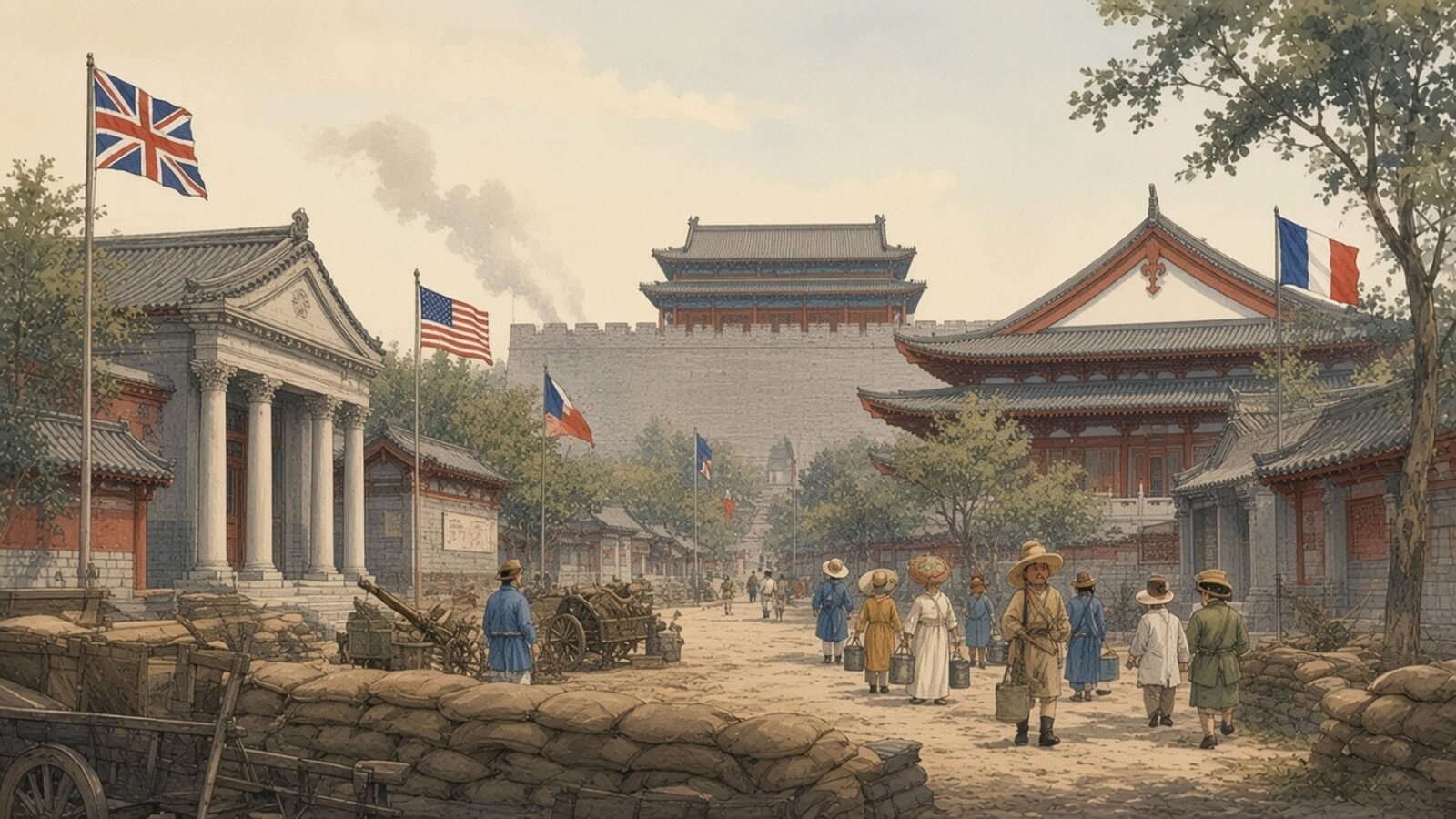
Smoke drifts across the rooftops of the imperial capital. In a single night in June 1900, the half-mile stretch of the Legation Quarter in Beijing — the long diplomatic lane that housed the embassies of the United States, Britain, France, Germany, Russia, Italy, Japan, Austria-Hungary, Belgium, and the Netherlands — became the most besieged piece of foreign soil in the world. Inside the improvised barricades, four hundred and nine foreign soldiers and roughly nine hundred civilians and Chinese Christian converts held out for fifty-five days against a besieging force that included both regular Qing imperial troops and a popular militia armed with swords, spears, and the martial-arts ritual that they believed would make them impervious to foreign bullets. The siege of the legations, the climax of the Boxer Rebellion, was a hinge event in modern Chinese history. It ended the political career of the Empress Dowager Cixi, brought the Qing dynasty to the brink of military occupation, imposed the four hundred and fifty million tael Boxer Protocol indemnity on a country that could barely afford to pay its civil service, and set the stage for the Boxer-era reforms and the 1911 revolution that finally toppled the imperial order two millennia after it began.
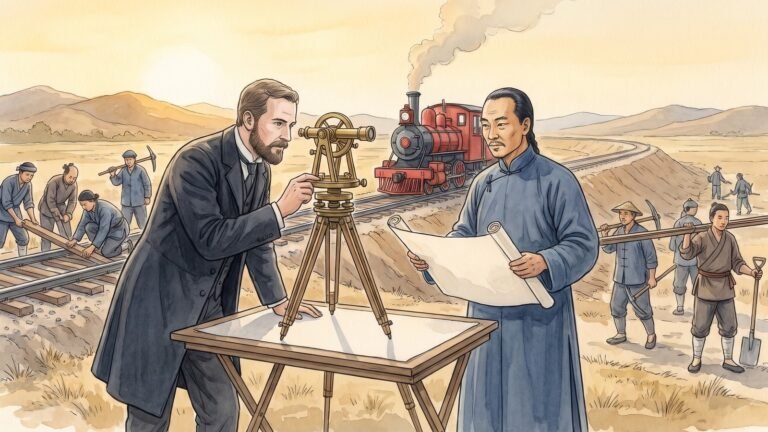
The Boxer movement that produced the siege began in the rural hinterland of Shandong province in the late 1890s as a folk-religious practice of resistance to foreign influence. The movement’s formal name was the Yihequan, the Righteous and Harmonious Fists, and the English word Boxer was a journalistic coinage of the period, derived from the boxing-style calisthenics that members performed as part of their ritual training. The Boxers believed that the practice of their martial arts and the recitation of the spells and chants associated with them would render them invulnerable to foreign bullets. They wore red sashes and head-cloths as their distinguishing mark. Their slogan was Support the Qing, exterminate the foreigners, a phrase that conflated two distinct grievances: anger at the foreign diplomats, missionaries, and railway engineers who had been a visible presence in the Chinese countryside since the Treaty of Shimonoseki in 1895; and resentment of the Christian Chinese who had converted under missionary sponsorship and were perceived as having abandoned traditional Chinese obligations.
The Boxer movement’s growth in Shandong was driven by a concatenation of events in the 1890s that pushed rural China into a state of chronic distress. The Sino-Japanese War of 1894-95 had ended in defeat for the Qing and had imposed indemnities and territorial concessions. The Treaty of Shimonoseki forced China to recognise Korean independence and to cede Taiwan and the Liaodong peninsula, and the German seizure of Qingdao in 1897 on the pretext of the murder of two German missionaries added a new European foothold in Shandong. Missionaries had been operating in the Chinese countryside since the late Ming, but their visibility increased dramatically in the late nineteenth century, and with it the resentment of rural Chinese who saw the missionaries as agents of foreign territorial encroachment. The Yellow River flood of 1898, which broke the dikes near Jinan and drowned the harvest across a broad swath of north China, was widely interpreted as a sign of cosmic disapproval of the foreign presence. The dry climate of the late 1890s added to the distress. The Boxer movement spread through the countryside on the back of these overlapping crises.
The diplomatic backdrop to the Boxer movement was the partition of China among the foreign powers that was widely feared in 1898-99. The German lease of Qingdao in March 1898 was followed within weeks by the Russian lease of Port Arthur and Dalian, the British lease of Weihaiwei and the New Territories of Hong Kong, the French lease of Kwangchowan, and the Japanese recognition of their dominance in Fujian. The Open Door policy articulated by United States Secretary of State John Hay in September 1899, which proposed that all the powers should have equal access to the Chinese market, was an attempt to forestall the partition that seemed imminent. Hay’s policy failed. The partition did not happen, but the perception that it was about to happen was one of the principal motors of the Boxer movement. The Boxers were partly responding to a foreign policy crisis that the Chinese court and its representatives were trying to manage, with varying degrees of sincerity and skill.
Empress Dowager Cixi, who had returned to power in 1898 by ousting the Guangxu Emperor in a palace coup and then suppressing the brief hundred-day reform programme of the same year, was the central figure in the court’s response to the Boxer movement. The official Qing position shifted several times in the period from late 1899 to mid 1900. Initially the court regarded the Boxers as a bandit disturbance to be suppressed. In May 1900, the Boxers’ movement spread from Shandong into Zhili and began to threaten the approaches to Beijing. Cixi, who had been persuaded by a small group of court officials including Duanfeng, Prince Duan, and Yuxu, the Director of the Board of Rites, that the Boxers’ magical practices might be effective against foreign firepower, gradually came around to supporting the movement. The court’s final position was ambiguous: it declared war on the foreign powers on 21 June 1900 but did not formally repudiate its previous diplomatic commitments, and it continued to issue protective edicts to some foreign nationals in Beijing while tolerating the Boxer attacks on others.
The first major international response to the Boxer crisis was the Seymour Expedition, a 2,100-man force drawn from the eight powers with legations in Beijing, under the command of British Vice Admiral Sir Edward Seymour. The expedition set out from the Dagu forts on 10 June 1900 by rail toward Beijing, with the intention of relieving the legations. It met heavy resistance from Qing imperial troops and from Boxer bands along the railway line, and was forced to retreat to Tianjin after a week’s march, having suffered heavy casualties. The expedition’s failure left the legations in Beijing without external relief and committed the international coalition to a much larger mobilisation. The Eight-Nation Alliance of British, American, French, German, Russian, Japanese, Italian, and Austro-Hungarian forces, with the addition of smaller Dutch and Belgian contingents, was assembled in the weeks after the Seymour Expedition’s retreat. The total force numbered roughly 55,000 men, under the overall command of British Lieutenant General Sir Alfred Gaselee.
The siege of the legations began on 20 June 1900, when the German minister Clemens von Ketteler was killed by a Qing soldier on the way to the Foreign Office for negotiations over the court’s demand that all foreigners leave Beijing. The death of Ketteler was the immediate trigger for the defensive posture that the foreign legations had been preparing for the previous two weeks. The British minister Sir Claude MacDonald was selected as the overall commander of the defence, with Herbert G. Squiers, the American secretary of legation, as his chief of staff. The defensive perimeter was drawn around the British legation, which was the largest and most easily fortified of the foreign compounds, and the civilians and Chinese Christians from the surrounding legations were evacuated into it. The total number of people inside the perimeter at the start of the siege was approximately 900 foreign nationals and 2,800 Chinese Christians, with the 409 foreign soldiers of the legation guards as the only armed defence.
The siege’s daily pattern was one of intermittent bombardment and probing attacks. The defenders were supplied with a combination of stored provisions, captured Boxer weapons, and a small amount of ammunition that was rationed carefully. The most serious crisis of the siege was the Boxer assault of 14-15 July, when a determined attack on the British legation perimeter drove the defenders to the brink of collapse. A cease-fire was brokered the next day, partly through the intervention of the Chinese Foreign Office, which was still nominally in communication with the foreign legations. The cease-fire held for the remainder of the siege, but the relief expedition’s approach to Beijing in early August brought the fighting back to the front line. The Eight-Nation Alliance reached Beijing on 14 August and relieved the legations after a brief but sharp engagement at the gates of the Tartar Wall and the city walls. The British contingent was first into the legation quarter; the American contingent climbed the city walls near the American legation’s position. The relief force suffered relatively light casualties in the relief operation; the legation defenders had suffered 55 killed and 135 wounded out of the 409 soldiers of the legation guards, a casualty rate of 46.5 per cent.
The defence of the legations was technically remarkable. The foreign soldiers and civilian volunteers improvised fortifications from furniture, brick, and sandbags; they dug trenches; they maintained a continuous fire from the settlers on the perimeter wall; they ran a system of water and food rationing that kept the population alive through the siege; they organised a daily watch rotation that maintained the perimeter without exhausting any single contingent. The technical resources of the legation defenders were modest by the standards of European armies of the period, and the Boxer attacks were unimpressive in conventional military terms. The siege’s outcome was decided less by the defenders’ military skill than by the limited ability of the Boxer and Qing forces to mount a sustained assault on a fortified position. The imperial troops and the Boxer bands were not, in the end, well equipped or well led to take a defended perimeter by storm.
The relief expedition’s advance on Beijing was a study in the awkward alliance management that characterised the Eight-Nation Alliance. The British and the Russians had been rival imperial powers in central Asia for decades; the Japanese were a rising regional power whose presence in the coalition was resented by some of the European contingents; the Germans were demanding satisfaction for the death of von Ketteler and were prepared to use the expedition as an excuse for territorial aggrandisement; the Americans were the most reluctant imperial partner in the coalition and were under instructions from President McKinley and Secretary Hay to limit their territorial ambitions in China. The coalition’s advance from Tianjin to Beijing was hampered by heat, by the destruction of the railway line by the retreating Qing forces, and by the competing ambitions of the national contingents. The advance from Tianjin to Beijing took roughly two months, with the main battle at Tianjin on 13-14 July, at Peitsang on 5 August, at Yangtsun on 6 August, and at Beijing on 14-15 August.
The Eight-Nation Alliance’s occupation of Beijing lasted for more than a year. The city was divided into districts, with each contingent administering one district. In some districts, suspected Boxers and Chinese Christians suspected of collaboration with the Boxers were subject to summary execution by the occupying forces. The foreign troops also looted the city on a substantial scale. The Russian contingent was responsible for some of the most egregious acts, including the burning of the old Summer Palace, an action that was widely reported in the international press. The American forces, under the command of Brigadier General Adna Chaffee, attempted to restrain their troops from looting, but were unable to enforce that policy across the entire occupation. The occupation of Beijing lasted from August 1900 until the signing of the Boxer Protocol in September 1901, and a residual foreign military presence continued in the Legation Quarter and along the line of communication to the coast for several years afterward.
The Boxer Protocol, signed on 7 September 1901, was the international settlement of the Boxer crisis. The Protocol’s principal provisions were the execution or exile of the principal pro-Boxer officials of the Qing court; the payment of an indemnity of 450 million taels of silver, approximately equivalent to 333 million US dollars at the exchange rates of the time, over a period of thirty-nine years; the destruction of the Dagu forts; the establishment of a permanent foreign garrison in Beijing along the line of communication between Beijing and the sea; the opening of additional Chinese cities to foreign trade; the prohibition of arms imports into China for two years; and the formal apology of the Chinese court to the German government for the murder of von Ketteler. The Boxer Protocol was the most onerous international settlement imposed on China in the late Qing period, and it contributed directly to the political crisis that produced the Boxer-era reforms and the 1911 revolution. The indemnity, in particular, was a financial burden that China was unable to discharge without substantial foreign borrowing, and the borrowing itself contributed to the financial crisis of the late Qing.
The Boxer Rebellion’s place in Chinese political history is more complex than the immediate military and diplomatic history suggests. The rebellion exposed the Qing dynasty’s structural weaknesses: the inability of the imperial military to defeat a Western expeditionary force; the limited popular legitimacy of the dynasty in the rural north; the dependence of the imperial government on the cooperation of regional officials who were increasingly autonomous from the centre. The Boxer-era reforms, promulgated in the years 1901-11, attempted to address these weaknesses by introducing a wide-ranging programme of military modernisation, educational reform, and constitutional government. The reform programme was too late and too limited to save the dynasty. The 1911 revolution, which began with a military mutiny in Wuchang and spread rapidly across the country, brought down the imperial order in less than six months. The Boxer Rebellion, in retrospect, marked the point at which the Qing dynasty’s hold on legitimacy became unrecoverable.
The Boxer Rebellion’s international consequences were equally significant. The Eight-Nation Alliance’s occupation of Beijing demonstrated the extent to which China had been reduced to a semi-colonial status in the late Qing period. The Boxer Protocol’s financial provisions entrenched the foreign powers’ economic influence in China for the next two decades, and the indemnity debt became a permanent feature of the Chinese government’s financial obligations until it was finally repudiated in 1939. The Boxer-era financial crisis contributed directly to the Republican government’s financial difficulties in the 1910s and 1920s, and the financial dependence on the foreign powers contributed to the political instability that produced the warlord era. The Boxer Rebellion’s legacy is, in short, the legacy of a country that had been forced into the international system on terms that it could neither accept nor escape, and of a political order that was no longer capable of managing the crisis.
The Foreign Military Forces and the Daily Life of the Siege
The siege of the legations was fought by foreign soldiers from nine different national contingents. The largest single contingent was the British, with approximately 75 marines and sailors drawn from the China Station of the Royal Navy. The American contingent was the second largest, with 56 marines and sailors drawn from the Asiatic Squadron and the Marine Barracks at the American legation. The French, German, Russian, Japanese, Italian, and Austro-Hungarian contingents each contributed between 20 and 75 men, and the Dutch and Belgian legations contributed smaller detachments. The legation guard’s total of 409 men was a modest force by the standards of European armies of the period, and the casualties were proportionately severe. Of the 409 men, 55 were killed and 135 wounded, a casualty rate of 46.5 per cent. The British contingent suffered 7 killed and 19 wounded; the American contingent suffered 7 killed and 14 wounded; the other contingents suffered proportionately. The civilians who participated in the perimeter defence, mostly male volunteers from the legation staff and from the missionary community, suffered additional casualties.
The daily life of the siege was dominated by the search for water and food. The wells within the legation perimeter were the principal source of water for the entire population; the food supplies were a combination of stored provisions from the legation kitchens and what could be salvaged from the surrounding buildings as the siege progressed. The food ration was established at roughly 1.5 pounds of rice per adult per day, with smaller rations for the children and the elderly. The water ration was established at roughly one gallon per person per day. The food and water rations were sufficient to maintain the population through the fifty-five days of the siege, but the diet was monotonous and the residents suffered from malnutrition, dysentery, and the general physical strain of living in a confined space under continuous threat of attack. The medical staff of the legations, including the missionary doctors and the military surgeons, treated the wounded and the sick under conditions of severe material constraint, with limited supplies of anaesthetics, antibiotics, and dressings. The death toll from disease was substantial, though not as severe as the death toll from the fighting.
The legation civilians contributed to the defence in a variety of ways beyond their participation in the perimeter watch. The women of the legation community took responsibility for the food preparation, the medical care, and the care of the children. The civilian men with military experience organised the engineering work on the barricades and the trenches. The missionaries, who had lived in China for years and were often fluent in Mandarin Chinese, served as interpreters and as intermediaries with the Chinese Christian community inside the perimeter. The Chinese Christian community, which numbered roughly 2,800 at the start of the siege, provided a substantial proportion of the labour force for the defence and contributed to the intelligence-gathering that kept the defenders informed of the Boxers’ movements. The Chinese Christian community’s role in the siege was one of the more remarkable features of the event; their presence inside the perimeter exposed them to substantial risk in the event of a Boxer victory, and their commitment to the defence was a measure of the gravity of the threat that the Boxer movement represented to the Chinese Christian community as a whole.
The legation guards’ defensive posture was largely improvised. The legation buildings were not constructed as fortifications; they were a mixture of Chinese and European-style buildings, with high walls around their compounds but no provision for sustained military defence. The defenders improvised sandbag barricades across the streets and alleyways leading into the perimeter; they mined the most exposed sections of the perimeter wall to allow controlled demolitions in the event of a determined Boxer assault; they maintained a continuous fire from the perimeter wall against any target that appeared in the surrounding streets. The Boxers’ principal tactical doctrine was the swarm attack, in which several hundred Boxers would rush a single section of the perimeter with swords, spears, and a few captured modern rifles. The tactic was ineffective against a defended perimeter, and the Boxers suffered substantial casualties in their repeated assaults. The Qing imperial troops, who occasionally joined the Boxer attacks, were better armed and better led but were also unable to mount a sustained assault on the perimeter.
The ceasefire of mid-July 1900 was brokered partly through the intervention of the Chinese Foreign Office, which had not yet been fully absorbed into the Boxer-allied faction at court. The ceasefire was a respite rather than a settlement; the Boxer attacks resumed at lower intensity for the remainder of the siege, and the defenders maintained their perimeter throughout. The ceasefire was an important moment because it suggested that the Qing court was not yet fully committed to the Boxer cause and that there was a possibility of a negotiated settlement. The negotiations did not, in the end, produce a settlement; the relief expedition’s approach to Beijing in early August made further negotiation moot. The ceasefire’s principal effect was to allow the defenders to rest and to re-supply, and to allow the relief expedition to consolidate its forces for the final assault on the city.
The relief expedition’s assault on Beijing on 14-15 August 1900 was the climax of the Boxer campaign. The expedition reached the outer walls of Beijing on the evening of 13 August, and the assault began in the early hours of the 14th. The American contingent, under the command of Captain John T. Myers of the Marines, climbed the city wall near the American legation’s position and established a beachhead on the wall. The British contingent, under the command of Major John Jellicoe of the Royal Navy, found an unguarded gate on the eastern side of the city and made its way through the city to the legation quarter. The British contingent was first to reach the legation perimeter; the American contingent was first to climb the wall. The Russian and French contingents supported the assault from the south; the Japanese contingent took the northern gates; the German contingent took the south-eastern gates. The Boxers and Qing troops were unable to mount a coordinated defence, and the relief expedition’s casualties were light. The relief expedition’s arrival marked the end of the siege and the beginning of the occupation of Beijing that would last for more than a year.
The occupation of Beijing was a moment of severe humiliation for the Chinese court and the Chinese state. The Empress Dowager Cixi had fled the city in disguise on 15 August, taking the Guangxu Emperor with her, and the imperial family would not return to Beijing until 1902. The Eight-Nation Alliance’s occupation of the imperial capital was a violation of the most fundamental norms of Chinese sovereignty, and the violation was compounded by the extensive looting of the city by the occupying troops. The Russian contingent was responsible for some of the most serious acts of looting, including the burning of the old Summer Palace and the looting of the Forbidden City; the British and American contingents also looted, though on a smaller scale and in a more disciplined fashion. The international press reported the looting extensively, and the reports contributed to the diplomatic crisis that produced the Boxer Protocol. The Boxer Protocol’s provisions for the punishment of pro-Boxer officials and the payment of an indemnity were, in part, a response to the public outrage in Europe and America at the treatment of China during the occupation.
The Boxer Rebellion’s significance in world history is, finally, as a marker of the limits of European imperialism in Asia. The Boxer Protocol’s financial provisions and its military restrictions did not, in the end, prevent the Chinese revolution of 1911 or the wars of the mid-twentieth century. The Boxer Rebellion’s legacy is the legacy of a political order that could not adapt to the challenges of the modern international system, and of an imperial dynasty that had lost the legitimacy to lead the country through those challenges. The Boxer Rebellion is also a marker of the moment when the Western powers’ confidence in their own imperial project was at its peak, and of the moment when the contradictions of that project were beginning to show. The Eight-Nation Alliance’s occupation of Beijing was a high-water mark of Western imperialism in Asia, and the Boxer Protocol’s provisions were the last major act of the European imperial order in China before the upheavals of the early twentieth century. The Boxer Rebellion, in this sense, is the boundary between the nineteenth century and the twentieth century in the international politics of East Asia.
The Boxer Indemnity and the Long Consequences of 1901
The Boxer Protocol’s financial provisions cast a longer shadow than the military events themselves. The 450 million tael indemnity, payable over thirty-nine years at four per cent interest, was to be distributed among the eight powers in proportion to their contributions to the Eight-Nation Alliance. The largest single share went to Russia, with roughly 30 per cent of the total; Britain and Germany each received roughly 20 per cent; France received 15 per cent; Japan received 7.7 per cent; the United States received 7.3 per cent; Italy received 5.7 per cent; and Austria-Hungary received 0.4 per cent. The indemnity was denominated in taels of silver, and the tael was a unit of weight rather than a fixed currency, which made the indemnity’s real value sensitive to the international silver market. The Boxer indemnity became one of the major items in the late Qing government’s balance of payments, and the indemnity’s weight on the Chinese fiscal system contributed directly to the financial crisis of the late Qing.
The indemnity’s burden was not evenly distributed across China. The central government’s revenue came primarily from the customs duties and the inland transit duties, both of which were already committed to service the earlier indemnities of the Sino-Japanese War and the Sino-French War. The Boxer indemnity’s weight fell, in practice, on the provincial governments, which were responsible for raising the additional revenue. The provincial governments responded by increasing the land tax, by imposing new surcharges on the existing taxes, and by borrowing from foreign banks at interest rates well above the indemnity’s own rate. The provincial governments’ borrowing from foreign banks contributed to the late Qing financial crisis, in which several provinces defaulted on their debts and the central government had to step in to honour the obligations. The foreign banks’ role in the Boxer indemnity financing entrenched the foreign financial presence in China for the next two decades and contributed to the perception that the late Qing government was a captive of the foreign powers.
The United States’ share of the Boxer indemnity has a special place in the history of the period. In 1908, the United States Congress passed a resolution authorising the Secretary of State to negotiate the remission of the unearned balance of the United States’ share of the indemnity. The resolution was the result of a campaign led by the American missionary community and by American sinologists who argued that the United States’ share of the indemnity had been excessive and that the balance should be returned to China for educational purposes. The negotiations were conducted by Secretary of State Elihu Root and the Chinese minister to the United States, and the resulting agreement was signed in 1908 and ratified in 1911. The agreement provided for the return of the unearned balance of the United States’ share of the indemnity, which amounted to roughly 11 million dollars in 1908 prices, for the establishment of a Chinese student exchange programme and the construction of educational institutions in China. The Boxer Indemnity Scholarship Program, as it became known, sent thousands of Chinese students to American universities in the 1920s and 1930s, and the programme’s alumni include some of the most prominent Chinese scientists, engineers, and intellectuals of the twentieth century.
The Boxer Indemnity Scholarship Program is, in many ways, the most enduring legacy of the Boxer Protocol for the international relations of East Asia. The programme’s most famous alumni include the meteorologist Zhu Kezhen, the architect Liang Sicheng, the nuclear physicist Qian Sanqiang, the chemist Hou Debang, and the diplomat Wellington Koo. The programme’s alumni returned to China after their studies in the United States and played prominent roles in the Republican government’s modernisation efforts in the 1930s. The programme also established a permanent educational bridge between the United States and China that survived the political upheavals of the mid-twentieth century and was eventually extended to include the Taiwanese and Mainland Chinese academic communities in the post-war period. The Boxer Indemnity Scholarship Program has been the subject of a substantial historical literature, and the programme’s role in the development of Chinese science and engineering is widely recognised.
The Boxer Protocol’s other consequences have been more mixed. The Protocol’s provision for the destruction of the Dagu forts was carried out in 1901, and the forts were not rebuilt until the late 1950s. The Protocol’s provision for a permanent foreign garrison in Beijing was carried out in 1901, and the garrison was not withdrawn until 1949. The Protocol’s provision for the punishment of pro-Boxer officials was carried out with mixed results; some were executed, some were exiled, and some were pardoned in the subsequent years. The Protocol’s prohibition on arms imports into China was enforced for two years, after which it lapsed. The Protocol’s opening of additional Chinese cities to foreign trade contributed to the expansion of the foreign commercial presence in China for the next two decades. The Protocol’s provisions for the formal apology of the Chinese court to the German government for the murder of von Ketteler were carried out in 1901 in a public ceremony at the German legation in Beijing. The Protocol’s effect, in sum, was to entrench the foreign presence in China and to deepen the Chinese sense of national crisis that produced the Boxer-era reforms and the 1911 revolution.
The Boxer Rebellion’s place in the cultural memory of modern China is also significant. The Boxer Rebellion has been the subject of a substantial body of Chinese-language scholarship, beginning with the late Qing historians’ accounts of the rebellion and continuing through the Republican and People’s Republic periods. The Boxer Rebellion has also been the subject of a substantial body of popular Chinese-language literature, including novels, plays, and films that have shaped the popular understanding of the rebellion. The most influential of the popular accounts is the play “The White-Haired Girl” by He Jingzhi and Ding Yi, first performed in 1952, which uses the Boxer Rebellion as a setting for a story of peasant resistance to landlord oppression. The play’s themes of peasant resistance and foreign exploitation became central to the Communist Party’s narrative of the Boxer Rebellion, and the play’s narrative was widely circulated through the state-controlled cultural apparatus in the 1950s and 1960s. The Boxer Rebellion’s place in the cultural memory of modern China is, in short, a complex product of late Qing, Republican, and Communist Party narratives, and the rebellion continues to be the subject of both scholarly and popular reinterpretation.
The Boxer Rebellion’s place in the cultural memory of the foreign powers is also significant. The Boxer Rebellion has been the subject of a substantial body of Western-language scholarship, beginning with the late Victorian and Edwardian historians’ accounts of the rebellion and continuing through the modern period. The Boxer Rebellion has also been the subject of a substantial body of popular Western-language literature, including novels, plays, and films that have shaped the popular understanding of the rebellion. The most influential of the popular accounts in the West is probably the novel “55 Days” by Hans Brattstrom, first published in 1957, which tells the story of the siege of the legations through the eyes of a young British diplomat. The novel was widely read in the 1960s and 1970s and was adapted into a film of the same name in 1974. The Boxer Rebellion’s place in the cultural memory of the foreign powers is, in short, a complex product of late Victorian, Edwardian, and modern Western narratives, and the rebellion continues to be the subject of both scholarly and popular reinterpretation.
References
- The Boxer Rebellion: Bluejackets and Marines in China, 1900-1901 — US Navy History, Naval History and Heritage Command, Washington.
- The Boxer Rebellion — National Army Museum, London.
- Siege of the International Legations (1900) — Encyclopaedia Britannica.
- Siege of the International Legations — Grokipedia, accessed 15 October 2026.
- Peking Legation Quarter — Grokipedia, accessed 15 October 2026.
- Diana Preston, The Boxer Rebellion: The Dramatic Story of China’s War on Foreigners That Shook the World in the Summer of 1900 — Walker, New York, 2000. WorldCat record.
- Peter Harrington, The Peking Legations and the 1900 Boxer Rebellion — Osprey Publishing, Oxford, 2007 (Campaign Series 244).
- Robert A. Bickers and R. G. Tiedemann (eds), The Boxer Uprising in Greater China: The Local Roots of an International Crisis — Brill, Leiden, 2007. Publisher page.
- Joseph Esherick, The Origins of the Boxer Uprising — University of California Press, Berkeley, 1987. WorldCat record.
- Victor Segalen, La grande statuaire chinoise (with notes on the Boxer period and the looting of the imperial collections) — Paris, 1902 (and later editions).
- Victor Purcell, The Boxer Uprising: A Background Study — Cambridge University Press, 1963.
- Paul A. Cohen, History in Three Keys: The Boxers as Event, Experience, and Myth — Columbia University Press, New York, 1997. Publisher page.
- Foreign Office, China. No. 1 (1901): Correspondence Respecting the Disturbances in China — HMSO, London, 1901 (the British Blue Book on the Boxer crisis).
- United States Department of State, Foreign Relations of the United States, 1900: Affairs in China — US Government Printing Office, Washington, 1901.