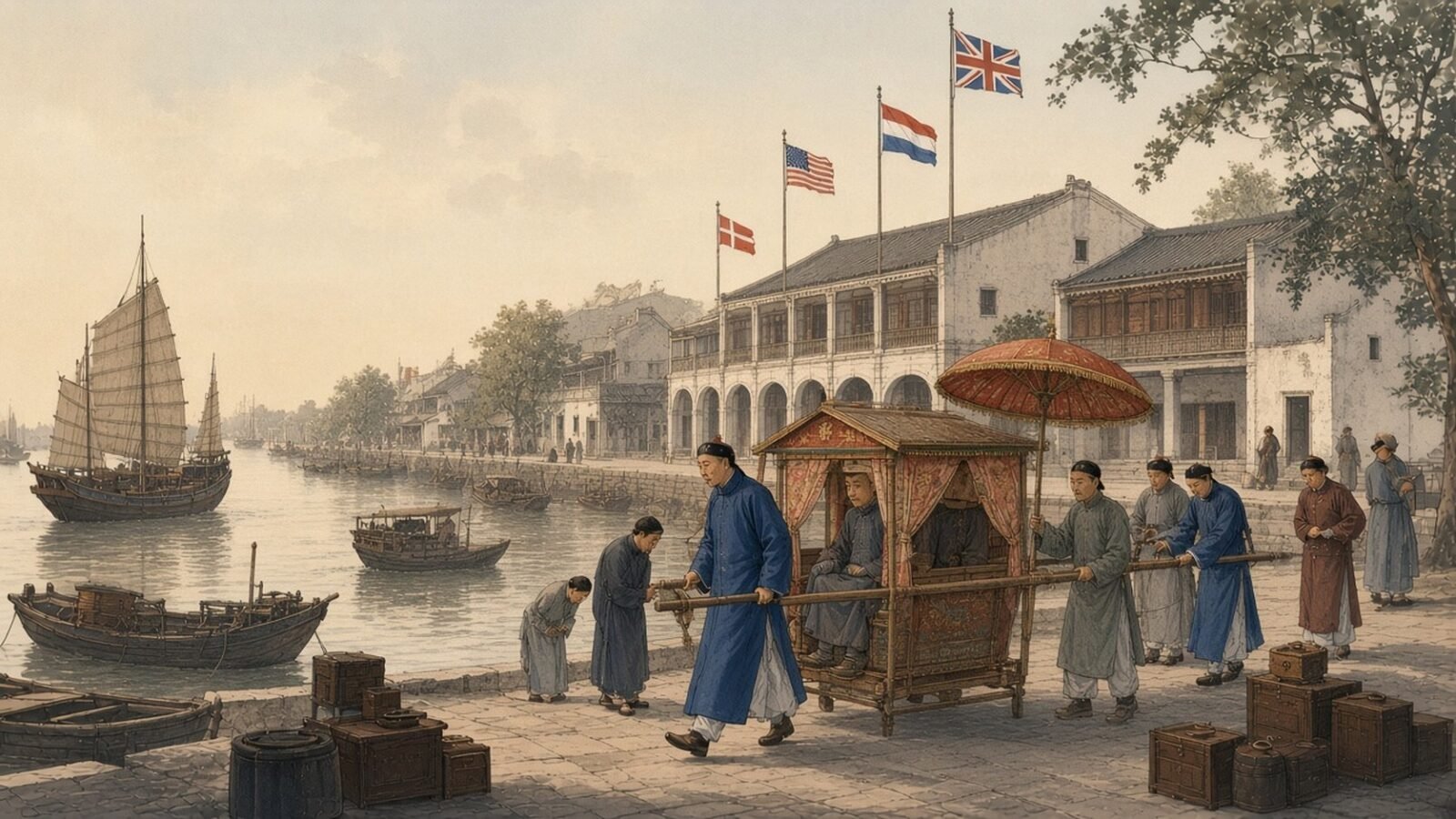
On a damp morning in late 1820, on the south bank of the Pearl River just outside the walls of Canton, a man of fifty-one in a dark blue silk robe stepped out of a long, low warehouse and onto a stone quay. His name was Wu Bingjian, his Hong name Howqua, and he was the senior partner of Ewo Hong, the largest of the Cohong trading houses licensed by the Qing court to handle all Western trade at Canton. A small English merchant in a sweat-stained linen coat was waiting for him on the quay with a list of tea orders, and the two walked together into the long, low front office of the hong, where three Chinese clerks and a Chinese-English pidgin-speaking comprador were already at work on the morning’s accounts. The first ship of the season, an East Indiaman out of Bengal, was due in the inner anchorage by the weekend, and the season’s contracts had to be set before she arrived.
The 1684 reopening and the rise of Canton
For most of the seventeenth century, the port of Canton was one of several Chinese harbours that the Ming and then the early Qing courts restricted to tribute trade under tightly policed rules. Foreign merchants were confined to Macao, a Portuguese settlement on the western side of the Pearl River estuary, and direct sea trade with the West was, in the official view, an irregularity to be tolerated only in small doses. In 1684, the Kangxi Emperor, eight years into his reign, opened the four coastal ports of Canton, Zhangzhou (in modern Fujian), Ningbo, and Shanghai to foreign trade, and a year later he established a customs office in Canton under the name Yuehaiguan, the Maritime Customs of Guangdong. The new policy brought a flood of European and American traders to the Pearl River, and by the end of the century the foreign community had grown large enough that the city administration was struggling to keep it under one roof. In 1686 the Kangxi court authorised a guild of Chinese merchants to handle the trade, the so-called Foreign Goods Hong, and the foreign traders were directed to a stretch of riverbank south-west of the old city wall, where the trade was to be conducted under Chinese supervision. That stretch of riverbank was the seed of the Thirteen Factories.
For the first half of the eighteenth century, the trade at Canton was still small and largely unstructured. British East India Company factors lived in rented Chinese warehouses, mixed freely with the local population, and complained constantly about the weather, the food, and the prices of tea. The company had been sending an annual ship to Canton since 1699, and the French, the Dutch, the Swedes, the Danes, and the Americans joined in over the next decades, each nation with its own row of hongs, or trading houses, on the Canton waterfront. By the 1740s the row had grown to thirteen buildings, and the district became known in European trade parlance as the Thirteen Factories. None of the buildings were factories in the modern sense: they were a combination of warehouse, office, residence, and club, owned by Chinese landlords and rented to the foreign factors, with a shared wharf on the river. The Thirteen Factories were not a permanent settlement; foreign traders were required to live within them during the trading season and to leave at the end of it, withdrawing to Macao or back to Europe for the summer and autumn months when the southwest monsoon made the river approach too dangerous for sailing ships.
The Chinese side of the trade was also taking shape during these decades. The term hangshang, literally “row merchant” or “trade-row merchant,” came into use to describe the small group of Chinese businessmen who held the licences that allowed them to deal with the foreign community. The hangshang financed the inland purchases of tea, silk, and porcelain, arranged the customs paperwork, took responsibility for the foreign traders’ debts and conduct, and stood surety for the payment of all duties. By 1750 the hangshang numbered between four and ten at any one time, depending on how the licences were issued by the Hoppo, the colloquial English rendering of yue haiguan bujiandou, the Superintendent of Maritime Customs in Canton. They were not yet a formal guild, and the trade was not yet a regulated system; what existed in the 1740s was a working arrangement between a small group of Chinese merchants, a small group of foreign factors, and a customs bureaucracy that had learned to live with both.
The 1757 decree and the single-port system
In 1757, a series of minor incidents along the coast convinced the Qianlong Emperor that the foreign trade had grown larger and looser than he was comfortable with. Foreign ships had been calling at the other three open ports, and at Zhangzhou in particular the local officials had lost control of the situation; the merchants in those ports were operating without the discipline of the Canton system. The Qianlong Emperor issued a single imperial edict, the so-called “single-port decree,” that confined all foreign sea trade to Canton and revoked the licences of the other three ports. The edict was unambiguous: “Henceforth, all foreign countries that wish to trade with China shall do so through the port of Canton.” The decision was not made on commercial grounds. The Qing court was interested in containing foreign presence, not expanding it, and a single port was easier to police than four.
The edict transformed the Canton trade. The foreign community at the other ports closed up or moved south, and within a decade the Thirteen Factories had become the only place in China where Western merchants could legally live and work for part of the year. The volume of trade grew accordingly. Tea exports through Canton rose from about 30,000 piculs a year in the early 1750s to more than 200,000 piculs a year by the 1780s, and silk exports rose even faster. Silver, most of it from the mines of New Spain arriving through Manila, poured in the other direction. The hoppo’s customs revenue, which was the principal source of the court’s foreign-currency income, grew with the trade. By the 1780s Canton was the most important single point of contact between Qing China and the wider commercial world, and the foreign community there had grown from a few dozen transient factors to a regularised expatriate population of several hundred.
The single-port system also required a more formal structure on the Chinese side. Until the 1750s, the hangshang had been a small and shifting group, and the Hoppo had dealt with them more or less individually. Under the new conditions the foreign community grew too large and too important to leave to ad hoc arrangements, and a series of petitions to the court from the local officials and from the foreign factors themselves produced, in 1760, a new and more formal body: the Cohong.
The Cohong is formed, 1760
The Cohong, written in Chinese as gonghang (公行, literally “officially authorised merchants”) and pidginised to “Cohong” by the English factors, was a guild of Chinese merchants given a legal monopoly on the foreign trade at Canton. Its formation is recorded in the Yuehaiguan zhi, the customs gazetteer, and in the surviving correspondence of the Hoppo, the Hoppo’s deputy, and the Governor-general of Guangdong and Guangxi. The leading figure in the formation was a hangshang named Pan Qiguan (潘启官, Hong name Poankeequa), the senior partner of the Tongwen Hong (同文行), a trading house his family had controlled for two generations. Pan Qiguan and a colleague named Chen Kuan (陈官, Hong name Swequa or possibly Conseequa, the sources vary) petitioned the Hoppo in 1759 for a more disciplined arrangement. The trade, they argued, had grown too large for individual merchants to manage; the foreigners were running up debts that Chinese merchants were being asked to honour; and the Hoppo’s office needed a single point of contact. The Hoppo agreed, and in 1760 the Cohong was formed with ten licensed hangshang, including Pan’s Tongwen Hong and Chen’s Hong, and the four most senior members designated as the guild’s chief officers.
The Cohong’s powers, as defined in the founding edict and in the Hoppo’s implementing regulations, were substantial. The guild set the terms of trade for the coming season, fixed the exchange rate between silver and copper, allocated each foreign ship to a specific Chinese merchant as security, guaranteed payment of all duties, and stood behind the quality of the goods sold. In return, the guild had the sole right to deal with the foreign community; no other Chinese merchant could legally sell to or buy from a foreigner. The Hoppo retained the right of final approval on all guild decisions, and the Governor-general of Guangdong and Guangxi retained the right to intervene in any dispute. In practice, however, the Hoppo rarely overruled the guild, and the Governor-general rarely involved himself. The Cohong became, in the well-known phrase of the trade historian Paul Van Dyke, “a privately run, government-controlled management group” rather than either a state monopoly or a free-market association.
The first decade of the Cohong was difficult. Pan Qiguan and the other senior members tried to enforce a fixed price for tea and silk, and the foreign factors, particularly the British East India Company, resisted. In 1771 the imperial court, having heard complaints from both sides, issued an order abolishing the Cohong. The guild was dissolved for the next decade. But the foreign factors, who had initially welcomed the dissolution, soon found that dealing with the Hoppo and ten competing hangshang individually was even more disorderly than dealing with the guild. In 1782, after a decade of confused dealing, the Cohong was reconstituted, this time under tighter Hoppo supervision.
The 1771 abolition and the Consoo Fund, 1781
The decade of the Cohong’s first dissolution, 1771 to 1782, was the period in which the Consoo Fund was created. The Consoo Fund, known in Chinese as the gongsuo (公所), was a self-insurance pool, a kind of merchant mutual guarantee fund, established by the hangshang in 1781 and formalised by the Hoppo in 1789. The fund was designed to address a recurring problem of the Canton trade: a foreign factor would extend credit to a Chinese merchant or to another foreign house; the merchant or house would go bankrupt; the foreign creditor would press for repayment; the Hoppo, with no obvious remedy, would order one of the hangshang to make up the shortfall; the hangshang, caught in the middle, would go bankrupt himself; and the cascade would leave the trade paralysed. The Consoo Fund was the guild’s answer to this problem. Each licensed merchant paid a percentage of his annual trade volume into the fund, and the fund was used to settle the unpaid debts of any guild member who went under. In 1789 the Hoppo added a 3 per cent levy on all foreign imports, the proceeds of which were paid into the Consoo Fund; the foreign factors were not happy about the levy, but they preferred it to the constant risk of a cascade default.
The Consoo Fund turned out to be one of the most enduring institutions of the Canton trade. It was the guild’s only truly collective enterprise; it gave the hangshang a financial reason to police their own ranks, and it gave the foreign factors a measure of confidence in the credit of the trade as a whole. The fund continued to function, with various adjustments, until the system was dismantled in 1842. It was, in the words of one modern historian, the Canton trade’s quiet structural insurance against the kind of cascade that had nearly destroyed it in the 1770s. The Chinese name gongsuo is the same as the name of the Cohong’s actual office on the Thirteen Factory Street, which is one reason the institution is sometimes confused in Western sources with the guild itself. The guild was the Cohong; the office was the Consoo; the fund was the Consoo Fund.
By the 1790s the Cohong had stabilised. The number of licensed hangshang settled at between six and ten, with most seasons having eight or nine. The trade had grown to substantial size, with tea exports running at around 200,000 piculs a year and silk exports a fifth of that. The Hoppo’s revenue was a significant part of the court’s southern income. The foreign community at the Thirteen Factories had settled into a regular pattern, with the East India Company the dominant British house and the Americans, particularly the newly independent United States, growing rapidly through the 1790s. The Cohong was the institutional form that the trade had taken, and the trade was working.
The Thirteen Factories waterfront
The Thirteen Factories occupied a stretch of the south bank of the Pearl River a short distance west of the old walled city of Canton, between the present-day Renmin Nanlu and the river. The street that ran along the front of the warehouses, the Thirteen Factory Street, was the centre of the foreign community’s life in Canton. It was also the centre of the hangshang’s life: the Cohong’s Consoo office, the Hoppo’s customs post, the foreign factors’ club and reading room, and the principal Chinese and foreign hongs all stood within a few hundred yards of one another. The street itself was about a hundred yards long, paved with granite slabs, with a stone wharf on the river side where the long, low Chinese cargo boats and the deeper-draught European and American ships tied up to offload. Behind the warehouses lay the Chinese merchants’ offices, the family compounds of the senior hangshang, and the small lanes of the southern suburbs where the goods were stored and re-sorted before the long haul up the Pearl River and across the Meiling Pass to the inland markets.
Inside the foreign hongs, the working language was a Chinese-English pidgin that survives in the correspondence of the period, a stripped-down language with most of its vocabulary from Cantonese and its grammar from English. Tea was chah, silk was shaht, an order was a chop (from the Chinese seal), and a ship’s captain was a captain. The hangshang and the foreign factors negotiated in this pidgin at daily meetings in the Consoo office, and the most senior hangshang, particularly the senior partner of Ewo Hong, were known to the English factors by Hong names that were their pidgin renderings of the Chinese xing, or surname, with the honorific qua (“lord” or “senior”): Howqua, Mingqua, Poankeequa, Swequa. The English correspondents of the East India Company referred to them in letters and ledgers as if they were the Chinese merchants’ own names, and in the European trade press of the period these Hong names became the standard way of identifying the leading hangshang.
The Thirteen Factories were also, by the standards of contemporary China, a relatively cosmopolitan place. The European factors brought their own cooks, their own furniture, and their own notions of how a merchant’s house should be run; they ate English food when they could get it, drank Madeira and claret, and complained about the Cantonese weather. They also had to learn at least the outlines of Chinese commercial law, the conventions of the Cohong, and the etiquette of dealing with the Hoppo and the Governor-general. The Americans, who arrived in significant numbers after the 1784 ship Empress of China out of New York, brought fewer of these conventions with them; they traded on credit more readily, and their presence in the early years was a small but disruptive shock to the Cohong’s price discipline. The British East India Company, with its long presence and its monopoly on the British tea trade, dominated the European side until its charter was abolished in 1834.
Howqua and the wealth of the Hong merchants
The most famous of the nineteenth-century Hong merchants was Wu Bingjian (伍秉鉴), universally known to the foreign factors as Howqua. He was born in 1769 into the family that controlled the Ewo Hong, and he took over the senior partnership in 1801. By the time the American ship Empress of China arrived in 1784, the Ewo Hong was already one of the largest of the Cohong; under Wu’s management, it became the largest by a substantial margin. Wu handled tea, silk, and porcelain on a scale that no other Chinese merchant in the late Qing period could match. He was, by the calculation of the British factor George Thomas Staunton, who knew him personally, “the richest man in the world” in the early 1820s, an estimate that has been repeated often enough to become a fixture of the trade history, even if the exact figure of his wealth is not on the record.
Howqua’s wealth was not the kind of wealth that could easily be displayed. The Cohong’s hangshang were forbidden by Qing sumptuary regulation from the open display of conspicuous luxury; they were not permitted to ride in sedan chairs within the walls of Canton, and their houses were constrained in size and ornament. Howqua kept a relatively modest residence in the southern suburbs, and his personal property, by the standards of contemporary merchant princes in Canton, was restrained. The wealth was in the business. The Ewo Hong’s working capital in the 1810s and 1820s, by the surviving inventories in the Hoppo’s records, was on the order of 8 million silver dollars; the firm’s annual tea trade alone was 60,000 to 80,000 piculs, the bulk of which it financed from its own funds and on its own credit. The Cohong’s Consoo Fund, of which Howqua was the largest single contributor, held an additional 2.5 million silver dollars by 1833, and the Hoppo’s office acknowledged that the hangshang collectively controlled the largest pool of private capital in late imperial China.
Howqua was also, by all accounts, a cautious operator. The British factors respected him as a hard but fair negotiator, and his firm’s books were audited annually by the Cohong’s own accountants. The American firm of Russell and Company, the largest American house in Canton, developed a close working relationship with Ewo Hong and made substantial loans to it; the loans were repaid on time and in full. The most famous Howqua legend involves his 1830s dispute with the British East India Company over a consignment of tea that had been damaged in a shipwreck: Howqua agreed to a reduced settlement that lost the hong several hundred thousand silver dollars, but the relationship with Russell continued. By the time of his death in 1843, Howqua was the most prominent Chinese merchant in the world, the senior partner of the largest foreign-trade firm in China, and the recognised voice of the Canton hangshang. He was, in the standard judgement of the trade historian Paul Van Dyke, “the most important Chinese merchant of the eighteenth and nineteenth centuries.”
The 1834 influx of private traders
The Canton system as it had developed by 1820 was an arrangement that worked for the parties in it. The Qing court got customs revenue and contained foreign presence to a single, easily supervised harbour. The hangshang got a regulated monopoly that gave them substantial wealth. The East India Company got reliable access to tea and silk at agreed prices. The smaller European houses and the American firms got a place in the trade under the company’s protective roof. The system broke down in 1834, when the British Parliament abolished the East India Company’s monopoly on the China trade, and the harbour at Canton was suddenly flooded with private British merchants who had none of the company’s experience, none of its discipline, and most of its appetite.
The new British private traders, the so-called “country traders” and the “free merchants,” were a different kind of Englishman from the East India Company factors. They were younger, less trained, more willing to take risks, and considerably more willing to break the Cohong’s price discipline. They bought on credit, sold on credit, and financed their operations by accepting bills of exchange drawn on the British treasury through the agency of the new British Superintendent of Trade at Canton, a post created in 1834 to replace the company’s old factory chief. The first Superintendent, Lord Napier, arrived in Canton in 1834 and immediately offended the Hoppo by trying to communicate directly with the Governor-general, bypassing the Cohong. The Hoppo responded by stopping all trade until Napier withdrew, and Napier withdrew after a few weeks, having conceded the Cohong’s right to be the channel of communication. The arrangement, however, was already under strain. The new private traders were bringing in opium as part of their cargo, in violation of the 1796 prohibition; the Cohong was being asked to stand surety for the conduct of traders it could not control; and the Hoppo’s office was increasingly unable to keep the system’s paperwork in order.
The opium trade was the central economic fact of the 1830s at Canton. The East India Company had been transporting opium from Bengal to China since the 1780s, initially through a system of licensed sales; in 1799 the Company itself took over the direct trade, and by the 1820s the opium traffic was the single largest British export to China. The trade was illegal under Qing law, but the corruption of the local customs system meant that it was conducted openly, with the connivance of the Hangzhou’s office and the protection of British naval power offshore. By 1838 the annual opium import was running at around 40,000 chests, enough to support the entire silver outflow that was beginning to drain the Chinese economy. The Hoppo’s office could not stop it; the Hangzhou could not stop it; the Cohong, whose monopoly on the legitimate trade gave them an interest in the system surviving, was in a particularly awkward position, because the opium was being brought in by the very people whose conduct they were supposed to guarantee. The Qing court’s response to the crisis, in 1839, was to appoint Lin Zexu (林则徐) as Imperial Commissioner with extraordinary powers to suppress the opium trade in Canton.
The Opium War and the 1842 collapse
Lin Zexu arrived in Canton in March 1839 and within six weeks had forced the foreign community to surrender the entire existing stock of opium, more than 20,000 chests, which was publicly destroyed at Humen (虎门) south of the city. The destruction of the opium was the trigger for the First Opium War (1839 to 1842). The British sent an expeditionary force; the Qing court tried to respond with a naval defence that the obsolete Qing fleets could not sustain; and in 1842 a defeated Qing government signed the Treaty of Nanking on board HMS Cornwallis in the Yangtze estuary. The treaty opened five treaty ports to foreign trade, abolished the Cohong’s monopoly, and ended the Canton system as it had operated since 1760.
The end of the system was a slow rather than a sudden affair. The Cohong continued to function as a merchant guild through the 1840s, but the foreign factors were now free to deal with any Chinese merchant, and the Hangzhou’s office no longer had a monopoly to enforce. Some of the hangshang, Howqua’s heirs in particular, continued as compradors to the Western firms that replaced the East India Company in the post-treaty trade. The Consoo Fund was wound up, and the Thirteen Factories were gradually taken over by the foreign firms themselves; the district survived into the 1850s as a foreign business quarter but lost its identity as a Cohong institution. The last of the original hangshang firms closed in the 1860s, and the Canton trade, as it had been conducted for nearly a century, was over.
What the Cohong had done, in its eighty years, was to give the late imperial Chinese state a way to manage its contact with the Western commercial world without the cost of building a state monopoly. The Hangzhou were the state agents, in effect, who took on the cost of intermediation and the risk of default in exchange for the monopoly profits. The arrangement worked, more or less, for both sides until the 1834 collapse of British monopoly discipline and the parallel growth of the opium trade made it untenable. The treaty that ended it in 1842, the Treaty of Nanking, was the first of the unequal treaties; the Canton system, and the Hong merchants who ran it, were the institutional arrangement that the unequal treaties replaced. The story of the Hong merchants is, in that sense, the story of the moment when the Qing court’s management of the outside world stopped working, and of the men who had to make the old system work for as long as it could be made to work.
| Period | Hangshang | Hong name | Firm | Standing |
|---|---|---|---|---|
| 1760-1771 | Pan Qiguan (潘启官) | Poankeequa | Tongwen Hong (同文行) | Co-founder of the Cohong; senior member, 1760-1771 |
| 1760-1771 | Chen Kuan (陈官) | Swequa | Chengfu Hong (诚发行) or similar | Co-founder; rival of Poankeequa by 1770 |
| 1801-1843 | Wu Bingjian (伍秉鉴) | Howqua | Ewo Hong (怡和行) | Senior partner of the largest hangshang; the most famous of the nineteenth-century Hong merchants |
| 1820s-1842 | Wu Chongyuan (伍崇源) | Mingqua | Yuanguang Hong (源广行) | Howqua’s cousin and rival; another major hangshang of the late Cohong |
| 1810s-1842 | Several others | Chunqua, Goqua, Kingqua, Puanchy, Satow | Various | Six to ten licensed hangshang in any given year; the exact roster shifted with the Hoppo’s annual licensing |
References
- Van Dyke, Paul A. (2021). The Canton Trade: Life and Enterprise on the South China Coast, 1700-1842. Hong Kong University Press. https://hkupress.hku.hk/The-Canton-Trade
- Britannica, “cohong”, “Canton system”, and “Hoppo” entries. https://www.britannica.com/money/cohong and https://www.britannica.com/event/Canton-system
- Cohong — Grokipedia, accessed 15 October 2026.
- Canton System — Grokipedia, accessed 15 October 2026.
- Hunter, William C. (1882). The “Fan Kwae” at Canton before Treaty Days, 1825-1844. Kegan Paul, Trench and Trubner. Reissued by Cambridge University Press, 2010. The contemporary account of the Cohong and the Thirteen Factories by a former Ewo Hong employee.
- Yuehaiguan zhi (粵海關志, Customs Gazetteer of Guangdong), 1839 edition, in the surviving fragments held at the Sun Yat-sen University Library, Guangzhou.
- Lin Zexu (1839). Letter to Queen Victoria, advising the British government to halt the opium trade. The English text is held in the National Archives, London, FO 17/35. FO 17/35
- Treaty of Nanking (1842). The English text is held in the National Archives, London, FO 93/201/1. FO 93/201/1
- The Chinese Repository (Canton Register), 1832 to 1851, the English-language monthly published in Canton by Elijah Coleman Bridgman and Samuel Wells Williams. Held at the Yale Divinity School Library and the Library of Congress. https://www.britishonlinearchives.com/record/89-007
- Connell, Arthur (1918). “A Brief Account of the Hong Merchants of Canton”, Journal of the Royal Asiatic Society, Hong Kong Branch, vol. 6, pp. 27-37. https://www.jstor.org/stable/23892047