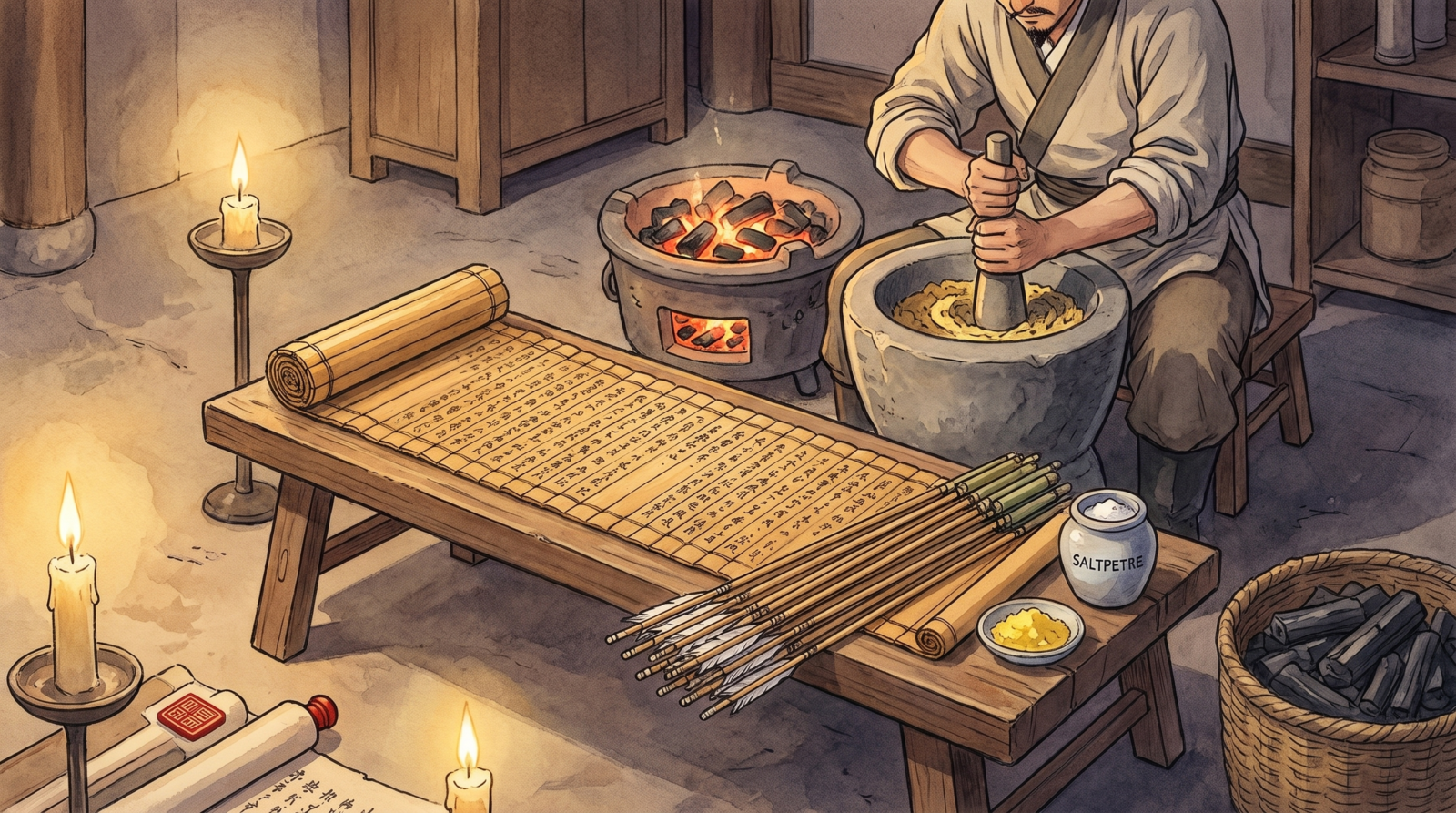
In the spring of 808 AD an obscure Taoist alchemist named Sun Simiao sat in his laboratory on Mount Taibai and wrote down the recipe for a mixture he called huo yao, which translates literally as ‘fire medicine’. The mixture was 50 parts saltpetre, 25 parts sulphur, and 25 parts willow-charcoal. He was not making an explosive. He was making a medicine that he believed would prolong life, a sulphur-and-saltpetre elixir that the Song dynasty pharmacists thought was the furnace heat used by the immortals of antiquity. The recipe, preserved in the Taoist scripture of the Great Accomplishment of the Mountain of the Primordial Sovereign, was almost identical to the gunpowder formulas of the Song military arsenal four centuries later. The transition from Taoist elixir to battlefield explosive is one of the strangest in the history of chemistry, and it tells us more about the Song dynasty than any of the dynasty’s grand military victories.
Sun Simiao’s recipe was, in chemical terms, an accident waiting to happen. Saltpetre, the potassium nitrate that we now recognise as the oxidiser in any combustion reaction, had been used in China as a soil fertiliser and as a medicine since at least the Han dynasty. Sulphur had been extracted from the volcanic deposits of Sichuan and used as a fumigant and as a treatment for skin diseases since the Eastern Han. The two had sometimes been mixed together as a long-burning incense for religious rites. What Sun Simiao’s recipe did was to mix the ingredients in close enough proportions that, when confined in a closed furnace, the mixture would burn much faster than either ingredient alone. In modern terminology, he had crossed a combustion threshold: the mixture would self-oxidise under heat, producing a sustained flame and throwing off great clouds of hot vapour. He didn’t realise that he had invented a propellant. He was looking for a medicine.
The Taoist alchemists of the 8th and 9th centuries were, like the rest of the Song-era scientific establishment, deeply interested in the cultivation of the body, the circulation of qi, and the preparation of elixirs that would extend the lifespan of a sufficiently devout practitioner. The alchemy that produced gunpowder was, ironically, the alchemy that gave up on immortality. By the 11th century the Song alchemists had given up on the dream of a single elixir of life and were working on a more modest programme: the preparation of medicines that would treat specific illnesses and lengthen life without promising eternal life. The most successful of these was, in effect, gunpowder. It treated the illness of the body better than the Taoist alchemists had ever dared to hope, in the sense that it killed the patient’s enemies at a distance. The military revolution of the Song dynasty was a side effect of the Taoist refusal of immortality.
The chemistry that produced gunpowder was also implicitly an engineering of fire. The two ingredients of Chinese fire medicine, saltpetre and sulphur, had both been used in antiquity as separate forms of ritual purification. The burning of sulphur was a Roman and Han practice for cleaning houses after funerals; the burning of saltpetre-soaked torches was a common enough Southern Song theatre effect that the play The Story of the Western Wing mentions them in passing. What the Taoist recipe did was to combine them in proportions that gave the resulting vapour a sustained and noisy flame rather than the short-lived, smoky burn of either ingredient alone. The Song military engineers who took this Taoist recipe and weaponised it understood precisely that they were improving the existing fire technology, not inventing a new one. The Taoist provenance of gunpowder is one of the great unappreciated facts about Chinese chemistry.
The Wujing Zongyao of 1044 and the First Gunpowder Formula
The earliest unambiguous military formula for gunpowder is found in the Wujing Zongyao, the ‘Collection of the Most Important Military Techniques’, compiled by the astronomer-engineer Zeng Gongliang in 1044 and presented to the Song emperor Yingzong. The Wujing Zongyao is one of the great technical manuals of pre-modern civilisation. It contains recipes for the manufacture of crossbows, gunpowder, and incendiary weapons, along with diagrams of fortress layouts, marching order, and signals for cavalry scouts. It was the field manual of the Song standing army, which by 1065 had grown to about 1,200,000 men, the largest peacetime army in the world at that time. The army was, however, mostly infantry, mostly armed with crossbows, mostly deployed in a defensive posture against the Liao, Western Xia, and then the Jurchen Jin. Gunpowder was originally a defensive weapon.
The three gunpowder formulas published in the Wujing Zongyao are an extraordinary document. The ‘standard formula’ is essentially Sun Simiao’s: 50 parts saltpetre, 25 parts sulphur, 25 parts charcoal. The ‘blasting compound’ is 60 parts saltpetre, 20 parts sulphur, 20 parts charcoal. A third formula has more sulphur and less charcoal, suggested by Zeng Gongliang for use against fire-prone siege engines. The recipes include warnings about the need to purify the saltpetre by recrystallisation before the formula would ignite reliably, the first explicit description of a refining procedure in any Chinese chemistry text. The refining of saltpetre is itself a Song technological achievement: the saltpetre from the southern provinces contained too much calcium chloride to be useful in gunpowder, and only the recrystallisation process that the Song chemists developed in the early 11th century could convert the crude saltpetre into the version used in explosives.
The military purpose of gunpowder in the Song arsenal was twofold: to set fire to enemy siege engines and to ignite lances for short-range combat against cavalry. The earlier Chinese fire-lance, attested in the Wujing Zongyao and probably in the earlier collection of the late Tang military treatise Wujing by General Fu Youzhi, was a bamboo tube filled with an incendiary mixture that was ignited and then held over the user’s shoulder like a Roman torch. The tube would burn down in a few seconds, throwing the flame forward. The evolution from the fire-lance to the gun is well attested across the 12th, 13th, and 14th centuries, but the earliest pieces of evidence are Song, and the Wujing Zongyao is the technical text that documents them.
What the Song engineers did not have, but what their weapons would later make possible, was a sustained, reliable propellant. The Song gunpowder burned, it didn’t explode. It threw sparks at the end of a bamboo tube and set fire to a piece of wood or a thatched roof. The full explosive potential of gunpowder only became apparent in the Mongol Yuan period, when the Chinese engineers under Mongol patronage learned to grind the ingredients more finely and pack them more densely. The early Yuan formula of around 1300 has a third less sulphur than the Song formula and a much more granular saltpetre. The improved formula could be detonated rather than merely set alight, producing a true explosion rather than a sustained burn. The Song gunpowder was a fire, the Yuan gunpowder was an explosion. The 200 years between them were the period when gunpowder finished its transformation from fire medicine to battlefield weapon.
The second contribution of the Wujing Zongyao is its inclusion of detailed woodblock illustrations. The Wujing Zongyao was printed in large editions by the Song government, and many copies survive in the libraries of the Song and later Chinese scholars. The text of the Wujing Zongyao on gunpowder was then cited almost verbatim by the Yuan, Ming, and Qing military compilers, and its formulas can be traced forward into the Korean, Japanese, Vietnamese, and eventually European arsenals of the early modern period. The transmission of the gunpowder formula across the Mongol empire is one of the most consequential pieces of technological diffusion in world history, and it all starts with Zeng Gongliang’s field manual of 1044.
Fire Lances, Bombs, and Rockets: The Song Military Revolution
The Song army of 1065 was a fundamentally different army from the Tang army of 750. The most visible difference was the much larger proportion of infantry to cavalry. The Tang cavalry, which had once been the most effective striking force in Asia, had been broken by the loss of the western steppe grasslands to the Uighur and Tibetan empires and by the gradual decline in horse-flesh production in north China. The Song responded by developing a defensive doctrine that emphasised crossbow infantry, fixed fortifications, and field entrenchments. This doctrine was very expensive, very slow, and very effective. It also produced the conditions in which gunpowder could become a battlefield weapon.
The Song use of gunpowder in the field was first documented at the battle of Caizhou in 1132, when the Song general Yue Fei’s second-in-command Liu Jingya used a ‘thunder crash bomb’ to clear a Jurchen cavalry charge. The ‘thunder crash bomb’ was a clay vessel filled with gunpowder and shrapnel, with a slow-burning fuse. It was thrown forward by a sling and detonated on the ground where the cavalry was massed. The same kind of bomb was used in much larger numbers at the battle of Xiangyang in 1268 to 1273, the famous five-year siege of a Song city on the Han River by the Mongol Yuan dynasty. The Mongols used large numbers of fire bombs and early rockets to keep the Song fleet trapped inside the city’s moat. The Song counter-bomb was a similar device filled with saltpetre and shrapnel, throwing a sheet of flame and metal fragments into the path of the attacking incendiaries. The siege of Xiangyang was the first documented use of true bomb-to-bomb combat in world history, and the winners, the Mongols, were the first people to systematically import Chinese gunpowder technology into the rest of Asia.
The second device that the Song used, and the one that defined the rest of the Song era’s military doctrine, was the fire lance. The fire lance was a bamboo tube filled with gunpowder and incendiary compounds, attached to a wooden spear. The user would ignite the fuse through a small hole at the back and thrust the spear forward at the enemy. The earliest versions of the fire lance were essentially short-range flamethrowers, the user holding the spear at arm’s length and trusting to the wind of the flame to drive back the charging enemy. Later versions used a paper tube rather than a bamboo one, and could be loaded with multiple propulsion charges that would fire in sequence. By the late Song the fire lance had been lengthened to about a metre and a half, and could be fired by a single operator.
The third device, the rocket, was a development of the fire lance. The Song rocket is documented in the Wujing Zongyao of 1044 as a small pyrotechnic device strapped to an arrow and fired from a crossbow. The ‘fire arrow’ was used by Song soldiers in the field and in night attacks. By the early Yuan period the rockets had become true self-propelled weapons, the first weapon that did not require a launcher to fly. The rocket technology that the Song bequeathed to the Yuan, and that the Yuan carried westward across the Mongol empire, eventually produced the early gunpowder weapons of the Middle East and Europe. The Chinese rocket is the direct ancestor of the Indian and Persian rocket, the Congreve rocket of the Napoleonic era, and the German V-2 rocket of the Second World War. The descendants of the Song fire arrow are still in use today.
The Mongol Transmission and the Gunpowder Empires
The Mongol conquests of the 13th century were the largest single act of technological diffusion in world history before the age of steam. The Mongols did not invent anything so far as gunpowder is concerned. They encountered it as a Song defensive weapon in 1221, when their first armies began to probe the Song frontier. They rapidly absorbed it. By 1232 the Mongols were using true gunpowder bombs at the siege of Kaifeng, and by the 1250s they were using rockets, fire arrows, and gunpowder arrows in campaigns that took them across Central Asia into the Middle East and into Eastern Europe.
The transmission of gunpowder westward from China is best documented in three contexts. The first is the Mongol campaign in the Middle East, where the Manshur troops known as the Hashshashin in Arabic chronicles were the first Muslim soldiers to encounter gunpowder weapons. The 1241 battle of Legnica in Poland, where the Mongols defeated a combined Polish-German force, included a Chinese-style gunpowder weapon in the Mongol army. The second is the early Ming maritime expeditions of Zheng He, which carried gunpowder weapons across the Indian Ocean to the Swahili coast in the early 1400s. The third, and most consequential, is the Chinese engineers who worked for the Mamluk and Ottoman armies in the 14th century, transferring the formula across the Silk Road into the heart of Islamic civilisation.
By 1320 the gunpowder formula was in widespread use in the Middle East, and the recipe that had originally been developed by Sun Simiao in 808 had been passed down the military treaty lines to the engineers of the Ilkhanate, the Mamluk Sultanate, and the early Ottoman army. The Mongol sack of Baghdad in 1258 had included Chinese-style gunpowder weapons. The early Muslim engineers who worked with these weapons often noted in their treatises that they were ‘Chinese’ or ‘Mongol’ in design. The Egyptian historian al-Maqrizi, writing in the early 15th century, cites a recipe for gunpowder that is much closer to the Song formula than to the later European formulas, with a relatively high proportion of saltpetre and a moderate amount of sulphur. The 15th-century Egyptian recipes for gunpowder are recognisably the children of the Wujing Zongyao.
The European discovery of gunpowder came in turn from the Middle Eastern formula, not the Chinese. Roger Bacon in England, writing in 1267, includes a description of firecrackers that he attributes to his reading of the Latin translations of the Arabic alchemical works of al-Razi and ibn Hayyan. The first European gunpowder weapon in regular military use is documented in 1326, at the battle of al-Fakhkhar in Morocco, only a decade after the same kind of weapon had been used by the Egyptian Mamluk army against the Crusaders. The German recipe for gunpowder in the early 14th century has a 60 percent saltpetre content, almost identical to the Song blasting formula. The diffusion of the formula from China to Europe took little more than two centuries and went through three intermediate stages: Song China to Mongol Central Asia, Mongol Central Asia to the Middle East, Middle East to Latin Europe. Each transmission took about fifty to seventy years.
Why China Did Not Keep the Monopoly
The strangest fact about the Chinese invention of gunpowder is that the Chinese did not keep the monopoly. By 1500 the European and Middle Eastern states were using gunpowder weapons that were more advanced than the Chinese ones. By 1700 the gap had widened. By 1800 the British Navy was using steam-powered gunpowder frigates in the first Opium War against the Qing. The same dynasty that had invented the weapon had lost control of its most important military technology to the rest of the world.
Several reasons have been proposed. The first is the centralised nature of the Ming and Qing firearms industry. The Ming and Qing governments held the gunpowder factories under direct imperial control, and the technologies that they developed were guarded by secret imperial edicts rather than by patents. The Chinese gunpowder factory was good at producing large numbers of small weapons but was unable to invest in fundamental research and development. By contrast the late medieval and early modern European state, with its smaller armaments industry and its competitive market of competing kingdom-states, had a constant incentive to invest in technology improvements.
The second reason is the loss of the Song dynasty’s institutional infrastructure. The Song military industry of the 11th and 12th centuries had been centred on the imperial court in Bianjing (modern Kaifeng), which fell to the Jurchen Jin in 1127 and to the Mongols in 1234. The Yuan dynasty preserved much of the Song’s industrial tradition but invested in only a fraction of it. The Ming dynasty in the 14th century restored the gunpowder industry but on a different economic basis, focused on guarding the northern frontier rather than on supporting the kind of sea-borne expeditions that had carried Song weapons to the Korean peninsula and the Japanese archipelago. The institutional environment that produced the Song’s weapons had been destroyed by the Jurchen and Mongol conquests.
The third reason is the rise of the cultural stereotype of the gunpowder scholar-warrior as a non-European phenomenon. The Song and Ming armies used gunpowder, but the philosophical position that any good of the world is a good only insofar as it serves the moral order meant that the Chinese military treatise of the late imperial period did not develop the kind of technical mathematics that the European armies of the 17th century relied on for their ballistic tables. The Song general Shen Kuo wrote the Dream Pool Essays, an early form of technical encyclopedia, in 1086. The later Chinese generals did not produce corresponding compendia of practical ballistics. The European armies of the 18th century produced a continuous stream of ballistic treatises. The Song tradition of using gunpowder weapons effectively was abandoned, in part, because the Qing dynasty did not value the kind of technical experimentation that the Song had relied on.
Gunpowder, then, is the great cautionary tale of Chinese invention. China invented the formula, built the first weapons, and exported the technology, but the rapid diffusion of the formula across the Mongol empire and the slow technical progress of the later Ming and Qing imperial arsenals meant that by 1700 the weapons the European armies were using in Asia were in important ways more advanced than the ones they were defeating. The story of gunpowder is not, as the 19th-century European historians liked to tell it, a story of European rationality and Chinese stasis. It is a story of how a single act of technical invention in the 9th century produced, over the next thousand years, a world in which the descendants of the original inventors no longer controlled the weapons they had given the world.
References
- Wujing Zongyao — Zeng Gongliang, 1044; partially translated in Man, Joseph, ed., The Wujing Zongyao, A Chinese Military Manual of 1044, NSC Press, 2006.
- Science and Civilisation in China, Volume 5: Chemistry and Chemical Technology, Part 7: Military Technology: The Gunpowder Epic — Needham, Joseph, Cambridge University Press, 1986.
- Chase, Kenneth Warren, Firearms: A Global History to 1700 — Cambridge University Press, 2003.
- Liang, Jieming, Chinese Gunpowder Technology and the Firearms Industry of the Song and Yuan Dynasties — Studies in the History of the Mathematical and Physical Sciences, Brill.
- The Mongols and the Making of Modern China — Weatherford, Jack, Crown, 2004.
- The Autumn of the Middle Ages — Huizinga, Johan, translated by Payton and Mammitzsch, University of Chicago Press, 1996.
- Taoist Studies: The Comparative Religious Studies of the Twentieth Century — Kohn, Livia, ed., SUNY Press, 2001.
- Bacon, Roger, De Secretis Operibus Naturae — published 1540, Latin text in Opera Quaedam Hactenus Inedita, Cambridge University Press.
- Andrade, Tonio, The Gunpowder Age: China, Military Innovation, and the Rise of the West in World History — Princeton University Press, 2016.
- Park, Jihoon, The History of Gunpowder in China — Brill, 2016.