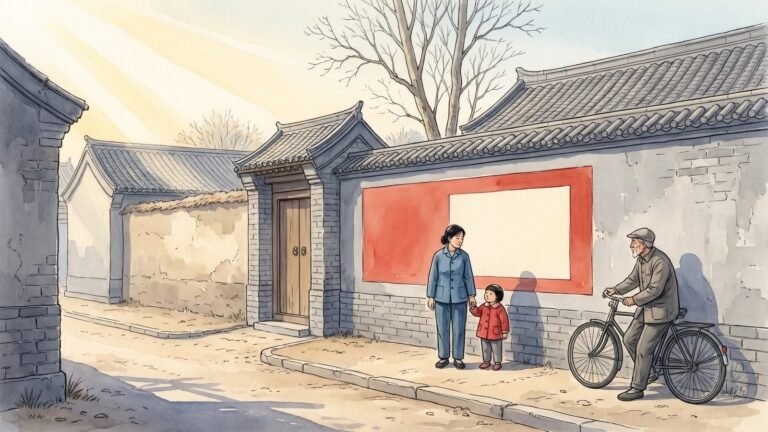
On the last day of 1898, in a house the neighbourhood still thought of as a dead princess’s, a university that was not yet a university opened its doors. The Imperial University was the one reform the coup did not cancel, and Peking University spent the next century deciding whether it was a route into office or a place for learning.
The house had belonged to Princess Hejia, the Qianlong emperor’s fourth daughter, and to her husband Fulong’an, both of them long gone. The courts at Mashenmiao, inside the Di’an Gate, had stood empty long enough for the Imperial Household to spare them. In July the grant was made. Through the autumn the rooms were counted, the old apartments turned into classrooms, and a library begun in what had been the princess’s own bedroom. By December the desks were in, and the ambition of the summer had been fitted into somebody else’s floor plan.
The charter had spoken of five hundred students. The number who actually sat down that winter was a small fraction of the promise, under a hundred in some counts, something over a hundred and fifty in others. They were not boys from a school ladder, because the country did not yet have one with a university at the top of it. They were holders of degrees, men who had already passed the examinations that led toward office, with a thinner file of younger pupils beside them. A medical class had started in November, ahead of the ceremony. The teaching that filled the other rooms was the classics, arranged as halls: Songs, Documents, Changes, Rites, and two halls for the Spring and Autumn. The North China Herald, writing in the middle of January, dated the opening to the last day of December. A dynasty that had spent the autumn killing the men who wanted it reformed had opened a school that still looked like the examinations.
A visitor who stands now by the pagoda is standing in a garden this university did not occupy for the first half-century of its life. The pagoda was built for a different college, as a water tower. The birthday the university keeps is not the day the desks were set out. On 31 December 1898 what was visible was a borrowed house, a reduced syllabus, and the odd survival of the institution itself.
A university for a dynasty that was losing
The idea was older than the house. In 1895 the Qing lost a war to Japan, and the loss suggested that an Asian neighbour, reformed in a hurry, could beat an empire that still thought of itself as the centre of the world. A surprising number of the officials who came back from that shock agreed about a school. If the capital had no university worthy of the name, the provinces would never grow one. In June 1896 Li Duanfen put that in a memorial: a capital university, and a ladder of schools under it. The memorial sat, until Sun Jianai picked it up. Sun had taken the top place in the examinations of 1859, had been the Guangxu emperor’s tutor, and was running the official book bureau. His reply was favourable, and carefully phrased. Chinese learning would be the root. Western learning would be the supplement. A university built on that sentence could be signed by men who feared universities. The plan was acceptable. It was not yet funded, housed, or begun.
The beginning came in a rush, inside the Hundred Days. On 11 June 1898 the emperor issued the edict that declared a national policy of reform, and put the university first, so that it could be the model the provinces would copy. You cannot tell a province to imitate a school you have not built. Liang Qichao drafted the charter, and the sentence Sun had used in 1896 was the sentence it carried. Wrapped inside it was a larger claim. The university was not only to teach. It was to be the highest education office in the empire, governing the provincial schools from the same courtyard. A school and a ministry, with the same minister. In the first days of July the emperor approved the charter and named Sun to take charge.
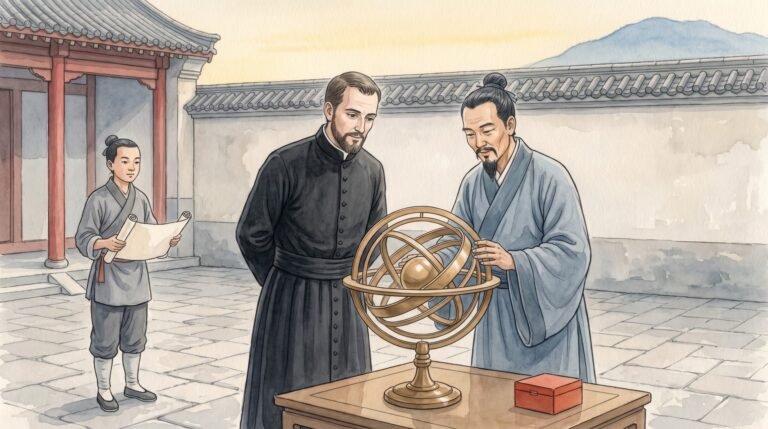
Sun was not Kang Youwei. That is why the institution survived the summer. He was a grand secretary whose whole career told the conservatives that a new school in his hands would not become a faction. In the middle of July the empty mansion was granted. On 9 August an American, W. A. P. Martin, who had spent decades at the Tongwenguan, the interpreters’ college, was named dean of Western studies and given the button of the second rank. The Italian and German ministers objected. A missionary at the head of Western learning looked to them like an American capture of a post Europe wanted. Martin stayed. On 21 September the Empress Dowager took the power back. The Hundred Days were over.
The reform they did not cancel
Kang Youwei and Liang Qichao fled. On 28 September the six gentlemen were executed. Tan Sitong, who could have left the city and did not, was one of them. The edicts of the summer were cancelled in a sheaf. Officials promoted for agreeing with the reform were dismissed. The capital spent October learning how to sound as if June had never happened. The university was not cancelled. The reason given, then and since, was that it had already sprouted, and that a place for training men was not a political club. Both halves were convenient. There was a minister, a charter, a house, a foreign dean, and a file of applications. Closing it would have meant boarding up a door the court had just paid to open. It was also useful. An empire that had just executed its radicals could point at a school and say that study, at least, was still permitted. The university remembers itself as the only great reform of that summer left standing. The memory is broadly fair. It should not be polished into a claim that what stood was the university Liang had drafted.
What stood was a remnant. The school that opened on the last day of December was a classics academy with a new name, a medical class, a famous American on the Western side, and a student body the examination system had already credentialled. Xu Jingcheng, a diplomat who had served in Europe and who was nobody’s idea of a hothead, was set over the Chinese studies, and later acted as head when Sun was ill. The coup had spared a school by shrinking it into something the coup could recognise. Desks, classics, degree-holders, a trustworthy tutor at the top. The radical document was in a drawer. The house was full.
Barracks
It had less than two years. In the summer of 1900 the Boxer rising reached the capital, and the court declared for the militants who wanted the foreigners driven out. The legations were besieged. Xu Jingcheng said this was madness anyway. Killing envoys, he told them, had no precedent he could find, in the Chinese record or the foreign one. He was the university’s second head of studies, and he had spent his career as the person European governments talked to. On 28 July he and Yuan Chang were beheaded at Caishikou for opposing the attack on the legations and the use of the Boxers. The university’s second scholar had been killed by the same court that had spared the university, for the offence of giving it advice. In the first days of August the school was ordered shut. The allied armies entered Beijing and the court fled west. German troops and Russian troops took the princess’s house for barracks. Books were spoiled. Instruments were wrecked. A school the coup had found harmless was closed because a war found its buildings convenient.
Zhang Baixi opened it again in December 1902, in rooms that had to be made usable after soldiers. The Tongwenguan was folded in, and in time became the translation school. Wu Rulun was named to direct the studies, went to Japan to see how a university was run, and died in 1903 before the looking became a system. Yan Fu and Lin Shu were brought to the translation work. In 1903 Zhang Zhidong revised the charter and pulled the supervision back toward the classics, so that a school which taught Western subjects would remain Confucian in its spine. Then, in 1905, the examination system was abolished, with Zhang among the officials who said that schools should replace it. A university standing beside the old exams was an experiment the ambitious could skip. A university standing after them was the experiment that had to work. The same year a ministry of education was created, and the university stopped being the ministry. It was, at last, only a school. It was not yet a good one.
A shortcut into office
The republic inherited it, and renamed it. In May 1912 the Imperial University became Peking University. The appointment of Yan Fu as its first president was published in the Government Gazette on 4 May. He had translated Huxley, Adam Smith, and Mill, and those books had done more to change how literate Chinese argued about the West than any curriculum yet written in the princess’s house. He had been formed by the naval school at Fuzhou and by England, and he had failed the classical examinations often enough to know what he thought of them. He wanted entrance standards that meant something, and a budget that arrived. The budget did not arrive. He was gone before the year was out. Ma Xiangbo followed him, a scholar who had already founded a college of his own, and found that this one could not be made solvent either. The office changed hands too often to accumulate a policy. What accumulated was a reputation.
The reputation was a route into office. Abolishing the examinations had not abolished the hunger for a post. It had moved the hunger into the schools, and the school in the capital was where a young man went if he wanted it fed quickly. Law was the crowded faculty, because law was the short corridor to a salary. Students asked, of a teacher, what rank he had held. Preparatory graduates chose the door that opened onto a job. Outsiders called the school corrupt. They were describing the use the students had found for an institution the empire had spared and the republic had not yet decided how to fund.
The hat, and the ninth of January
Cai Yuanpei was appointed on 26 December 1916. He had come up the old way, a jinshi and a Hanlin compiler, and then left it. He had been a revolutionary, the education minister of 1912, and a student at Leipzig. He had already spoken in this city, as minister, at the opening the republic gave the renamed school. He arrived on 4 January 1917. The story the campus kept is a small one, which is why it lasted. He stepped down from the carriage and took off his hat to the porters. A president who uncovered his head to the men at the door was announcing, before any speech, that the place was not a yamen. Rank noticed, rank deferred to, rank acquired as the point of the fees: those were the manners he had come to end.
On 9 January he gave the speech that did the real work. It was published that April in the Eastern Miscellany. He asked three things. Hold to a purpose. Temper your conduct. Honour your teachers and your fellows. The purpose was a definition, put early so that nobody could mistake the rest for courtesy. A university exists for the study of advanced learning. Not for a post, not for a salary, not for the prestige of having been in the capital. He told them that the reputation they already knew, office and money and the crowding into law, was the thing that had to stop.
The state was unsteady, and a law degree was one of the few instruments that still converted effort into a living. Cai, who already had the security of the old examinations, was asking young men without it to give the strategy up. The house had been spared in 1898 as a place for training men, and the men had been trained, in practice, for posts. From 9 January his work was to make the rooms match the sentence.
Radicals, and a man with a queue
He hired as if the sentence committed him to people who disliked one another. The formula, which the university has kept, was freedom of thought, and a tolerance wide enough to hold incompatible teachers in one courtyard. Chen Duxiu came as dean of humanities, and New Youth, the magazine he had started in Shanghai in 1915, came with him. As the house reading of a university dean, the magazine changed what the humanities were for. Hu Shi, back from America, published his proposals for a literary reform in 1917 and began to teach. Li Dazhao took the library in 1918 and made the periodical room do work the curriculum would not. Lu Xun was not a dean. He was on the staff of the Ministry of Education, and from about 1920 he came in to lecture on the history of Chinese fiction. Around them stood Qian Xuantong, Liu Bannong, Zhou Zuoren, and Shen Yinmo. A student that year could be told, by people on the payroll, that the civilisation he had come to master needed demolition.
Cai also kept the opponents. Gu Hongming wore a queue into the republican years, translated the Confucian books into an English of his own strange grandeur, and taught literature while despising almost everything Chen’s magazine loved. He had been educated in Europe. He was a learned reactionary, and he enjoyed the combat. Huang Kan taught the classics as if they were the university and the rest of the timetable a concession. Liu Shipei, whose politics had already reversed once, came to teach the old texts. A student could hear the dean in the morning and a man with a queue in the afternoon. Cai wanted the argument inside the school, where a coup could not settle it.
In the autumn of 1918 a young man from Hunan, Mao Zedong, took a post as an assistant in Li Dazhao’s library and stayed into 1919. The library did not make him. It gave him a wage, a room, and the periodicals. The wager needed a building of its own. The princess’s house was still nearby, and it was no longer the face of the place. In 1916, with borrowed money, work began on a red-brick block in the Hanzhuayuan at Shatan. It was finished in August 1918. Red brick, red tile, the humanities classrooms, the library, the offices. This was Cai’s campus. It was not the campus of 1898. By 1919 the arguments were organised in the Red Building, and the house where the classics halls had opened was already the back room of the institution’s memory.
The fourth of May
Through the spring of 1919 the news from Paris grew worse in a way students could follow week by week. The German rights in Shandong were not going to come back to China. They were going to Japan. By 1 May the students in Beijing knew. On 4 May the students of Peking University were the core of a demonstration that drew in the other schools of the city. They marched toward Tiananmen and the legation quarter. Luo Jialun, a student, drafted the declaration they carried. The march did not stay a march. The house of Cao Rulin, the official associated with the Japanese agreements, was attacked. The police made arrests. The demonstration left the campus and became a national movement, and at last the Chinese delegates at Versailles refused to sign the treaty.
Cai stood by the students who had been taken, and then he resigned. A president who could not protect them, and could not pretend he had controlled them, had in his own judgement lost the office. He left the city, was asked back, and came. In June Chen Duxiu was arrested. Cai did not want the university to become a party headquarters, and he did not want to hand his students to the police for having marched against a national humiliation. The two refusals pulled against each other for the rest of his time in the post. The movement made the school famous in a way the princess’s house never had, and it attached the name to a date. The tension between a school that studies and a school that leads a street was not resolved. It was inherited.
Nine women
There was a quieter change, and it lasted longer than the arrests. In 1919 Deng Chunlan, a woman from Gansu, wrote to Cai after he had spoken for coeducation, and asked to be admitted. The examination for the year had already passed. His own later note is plain about the procedure. The women were taken first as auditors. In February 1920 the first of them were in the classrooms: Wang Lan, Xi Zhen, Zha Xiaoyuan. By the middle of March there were nine, Deng Chunlan among them. The summer examination was opened to women, and in the autumn they entered as regular students. It was the first time a national university in China had done this. Nine is not a large number. The first term was a workaround, a president using a gap in the calendar rather than waiting for a ministry to feel ready. He let them into rooms that had been built for men, and then he regularised what he had already allowed.
South, with the other two
In July 1937 the fighting at Marco Polo Bridge made the city campus indefensible as a place of study. Peking University left Beijing. That autumn it joined Tsinghua and Nankai in Changsha, and the three moved on to Kunming. In April 1938 they became the National Southwest Associated University, and they remained one institution until May 1946. The journey south belonged to all three. What looked different from Peking University’s side was the presidency. Jiang Menglin held the office, and spent much of the war in Chongqing on the government’s education work. The man who stayed in Kunming and chaired the associated university day by day was Mei Yiqi of Tsinghua. Beida’s teachers taught in the same borrowed rooms. Its name was one of three on the papers. Its president was often a thousand miles away. A university whose fame had been the fame of one city block learnt that it could persist as a body of teachers without the block.
In 1946 it came back to Beiping. Six colleges reopened: letters, science, law, medicine, engineering, and agriculture, with a research institute for the humanities beside them, and about three thousand students. The address was still Shatan. The Red Building was still the picture a visitor was shown. The lake in the north-western suburbs, the willows, the tower that looked like a pagoda, belonged to a different university. Peking University had returned to the city it had marched in. It had not yet been sent to the garden.
Another university’s garden
In 1952 the new state reorganised the universities on a Soviet plan. Departments were lifted out of one and set down in another. Peking University was assigned the arts and the basic sciences. It gave up its engineering. It received the colleges of letters and the pure sciences leaving Tsinghua, the matching faculties of Yenching, and a smaller stream from the Catholic university of Furen. Then it was told to move.
Yenching had been an American-founded Christian university in a Qing garden in the north-western suburbs. In 1951 the state took it over. In 1952 it was dissolved, and the campus was handed to Peking University, which left the Red Building for a garden replanned in the 1920s by Henry Murphy, the same American architect who had set a domed auditorium at the head of Tsinghua’s lawn. At Yenching he had done something like the reverse. He kept the old lake, put Chinese roofs on the teaching buildings, and let the paths answer to the water. The university that arrived had not designed any of this. It inherited a missionary college’s idea of how a Chinese university ought to look, at the moment that college was abolished.
The pagoda on the south-eastern shore was finished in 1924, and it is a water tower. The city mains could not reach Haidian, so a well was sunk and the tower over it was dressed as a pagoda of thirteen storeys, so that a piece of plumbing would not insult the garden. The name it was given, Boya, says breadth and elegance. It does not say Peking University, which in 1924 was several miles away at Shatan. The lake beside it carries a name that means it has none. Weiming: unnamed. The name belonged to Yenching. The water had belonged to the Qing garden before either school. In 1952 the national university moved onto that ground, and the picture the world now means by Peking University is the picture of the college that was closed to make the picture available.
The move gathered a concentration of arts and sciences no earlier Beida had quite been, historians from Tsinghua among them. It also undid the city university Cai had made. The Red Building and the mix of subjects the republican school had grown by accretion were rearranged because a ministry had decided which subjects belonged together. The willows look as if they have always shaded the same students. They have not.
A birthday moved
For a long time the university celebrated itself on 17 December. The first celebration the records are sure of fell on that date in 1917. The doors had opened on the 31st, so the birthday was already a choice, a workable day near the end of term. After 1949 the May commemorations began to outshine it. On 7 December 1951 Tang Yongtong, the vice-president, suggested moving the anniversary to 4 May, because mid-December sat on the examinations. The calendar issued in September 1952, the year the university changed houses, carried 4 May.
A practical reason can be true without being the whole reason a date survives. The day the university accepted was the day of the movement. The story is not false. The march did leave those classrooms. It is a story that starts in 1919, and the university had been open for twenty years. A visitor who learns it on 4 May meets it first as a movement, and only later, if at all, as a school a falling dynasty tried to build in a dead princess’s house.
On 25 May 1966 a philosophy instructor, Nie Yuanzi, and a small group of colleagues put up a big-character poster attacking the university’s party leadership. Lu Ping, the president, was named, and so were Peng Peiyun and Song Shuo. The poster was praised from the top and became the spark of the Cultural Revolution on that campus. For ten years the tolerance Cai had hired for was treated as the offence. What returned after 1978 was a reopened university, not a refounding of 1917. The lake was still the picture on the cover. The Red Building became a museum of the movement whose date the birthday had adopted. Of the princess’s house, a hall survived. The bedroom that had held the first library did not.
Nobody at Mashenmiao that morning was thinking about a water tower. A thin company of degree-holders sat down to the classics in a dead princess’s courts. The man who had drafted the charter was in exile. The six gentlemen were dead. The syllabus was older than the edict that had authorised the place. And the place was open. People come to the shore now, see the willows and the thirteen storeys, and take it as obvious that the university has always stood here. It has not. It began inside the city wall, on the last day of a year in which the dynasty killed its own reform and spared this one thing, because it had already started and because a tutor the court trusted was in charge of it. The lake is a beautiful place to argue about what that spared thing was for. It is a poor place to learn where the argument began.
The other garden, and the indemnity that paid for it, are told in The Garden the Indemnity Bought.