For ninety-three days, between 1 January 1912 and 1 April 1912, China had a republican government that operated out of a converted governor’s palace on the south bank of the Yangtze at Nanjing, with a flag of five horizontal stripes in red, yellow, blue, white, and black, a provisional president who had been a doctor, a prime minister who had been a Buddhist monk, a foreign minister who had been a Christian educator, and a war minister who had been a Cantonese merchant. The government was called the Provisional Government of the Republic of China, and it was, in its brief life, the only republican government that China had ever had. The previous two thousand years of Chinese political history had been a sequence of dynasties, each of which had been overthrown by another dynasty, and the November and December of 1911 had, for the first time, raised the question of what would come next if the answer was not a dynasty. The provisional government, in its ninety-three days, attempted to answer the question. It produced a provisional constitution. It established a new national flag, a new national anthem, and a new national calendar. It was recognised by most of the major powers. It negotiated a peace with the imperial court in Beijing. It oversaw the orderly abdication of the boy emperor, the transfer of authority to Yuan Shikai, and the wind-down of the revolutionary coalition. It did not survive. Yuan Shikai, who took over the formal presidency in March 1912, dissolved the parliament, expelled the Kuomintang members, and within three years was declaring himself emperor. The provisional government’s experiment with constitutional republicanism was, in retrospect, the brief interval in which a different China might have been possible. The interval was ninety-three days long. It took place in the old Jiangning provincial capital, on the south bank of the Yangtze, downstream of the Wuchang gate where the revolution had begun.
From Wuchang to Nanjing: How a Revolution Found a Capital
The Wuchang uprising of 10 October 1911 was a local event. The revolutionary cells in the Hubei New Army, acting without the approval of Sun Yat-sen or the central committee of the Tongmenghui in Tokyo, had taken over the city of Wuchang, the south bank of the Hankou-Wuhan conurbation, and the rail line south to Changsha. They had been forced to act when the accidental bomb explosion in a Hankou kitchen revealed their membership lists to the imperial police. Within ten days, the uprising had spread to nine other provinces. Within four weeks, fourteen of the eighteen provinces of the Qing had declared independence. The provincial declarations were not coordinated. They were the work of local revolutionary cells, each acting on the news from Wuchang as a signal. The cells had spent years preparing, and the preparations were sufficient that the moment of the Wuchang uprising was the moment they had all been waiting for.
The provincial declarations created a coalition of seventeen provincial governments, each with its own military governor, each with its own declaration of independence, each with its own claim to be the legitimate government of its territory. The new coalition had no capital, no flag, no constitution, no head of state, and no agreement on the terms of a future republic. The coalition had to meet, agree on the structure of the new state, and decide on a location. The first meeting, in late October and early November 1911, was a series of ad hoc conferences in Shanghai, Wuhan, and the southern ports. The Wuchang government, which had taken the lead by virtue of having started the revolution, proposed a federal structure with a weak central government. The southern provinces, which had declared independence later and which were suspicious of the Wuchang group’s commitment to a republic, proposed a unitary structure with a strong central government. The dispute was, in part, a dispute between the old Hubei revolutionary cells, who wanted a broad-based coalition, and the Tongmenghui southerners, who wanted a centralised party state.
The decision to meet in Nanjing was made on 30 November 1911, at a conference of the seventeen provincial representatives in Shanghai. The Wuchang government had suggested Hankou or Wuchang. The southern provinces had suggested Nanjing. The compromise was Nanjing, on the argument that Nanjing was geographically central, that it had been the capital of several previous Chinese dynasties, and that it was downstream of the revolutionary centre at Wuchang. The conference also established a Provisional Senate, with three representatives from each province, and gave the Senate the authority to organise a provisional government. The Senate met first in Shanghai, on 4 December 1911, and then in Nanjing, on 12 December 1911, in the former provincial assembly building on the south bank of the Yangtze.
The Nanjing Senate’s first act was to vote on a provisional president. The candidates were Sun Yat-sen, who was still in the United States, and Li Yuanhong, the Hubei compromise figure who had been the military governor of the Wuchang government. Li was the moderate’s choice. Sun was the revolutionaries’ choice. The vote was scheduled for 29 December 1911, and on 25 December 1911, Sun Yat-sen arrived in Shanghai, having sailed from San Francisco via Yokohama and Hong Kong. The arrival was a sensation. Sun was, in the view of the revolutionary coalition, the man who had spent twenty years in exile, who had organised the first modern revolutionary society in 1894, who had brought the Tongmenghui together in 1905, who had been in Denver when the revolution succeeded, and who was, in the public imagination at least, the revolution’s leader. The vote on 29 December was unanimous. Sun Yat-sen was elected provisional president of the Republic of China.
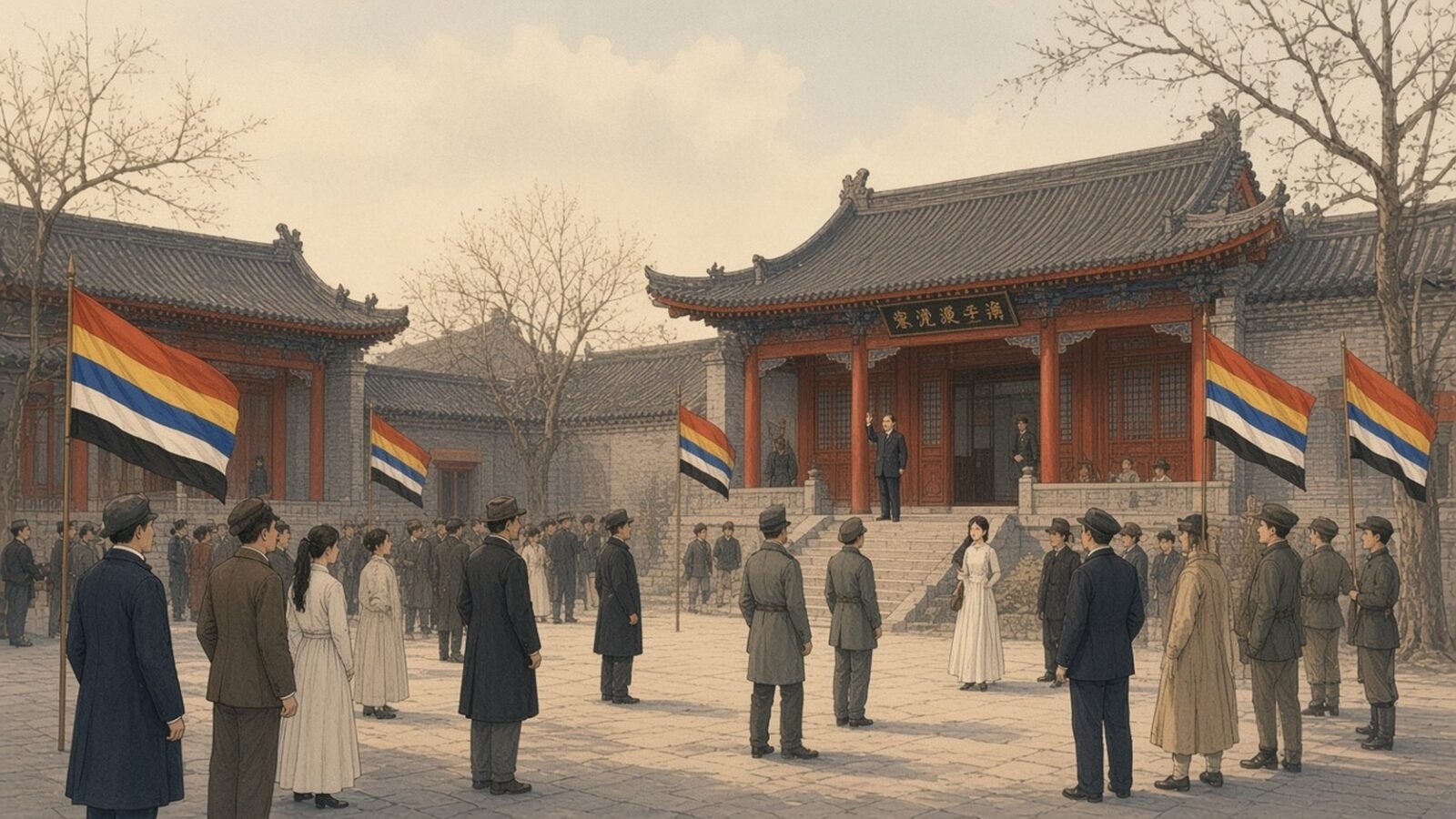
Sun took the oath of office on 1 January 1912, in the main hall of the old provincial governor’s palace in Nanjing, with the Five Races Under One Union flag hanging from the rafters and a small crowd of revolutionary leaders and foreign observers watching. The oath was short. Sun placed his hand on the constitution of the United States and swore to uphold the new republic. The provisional government was now a fact, and the first republican government in Chinese history was, in the most literal sense, born.
Sun Yat-sen’s Return and the Provisional Presidency
Sun Yat-sen was, in January 1912, forty-five years old. He had spent twenty years of his life in exile, in Hawaii, Hong Kong, London, Tokyo, the United States, Canada, and Southeast Asia. He had been a medical student at the College of Medicine for Chinese in Hong Kong, and he had been a practising Christian, a member of the Congregational church in Hong Kong, until his late twenties. He had been a professional revolutionary from 1894, the year he had founded the Revive China Society in Honolulu. He had been a wanderer, an organiser, a fund-raiser, a failed putschist, a survivor of multiple assassination attempts, and a permanent exile. The provisional presidency was, in many ways, the only formal political office he had ever held. He had been briefly the president of a short-lived Republic of Formosa in 1895, before the Japanese invasion, and he had been the nominal head of the Tongmenghui, but neither position had been a real job. The provisional presidency of 1912 was, in this sense, the first serious office of Sun’s life, and he took it with the seriousness of a man who had been waiting for the chance for a generation.
Sun appointed a cabinet on 3 January 1912, in a long list of ministerial positions that the new republic would need to govern. The cabinet was a coalition of the various revolutionary groups. The premier was Sun’s old ally Tang Shaoyi, a Cantonese Christian who had been educated in the United States and who had been a senior official in the late Qing. The foreign minister was Wang Chonghui, a Beiyang-trained lawyer who had studied at Columbia. The war minister was Huang Xing, a Hunanese revolutionary who had been the military leader of the Wuchang campaign. The finance minister was Chen Tianhua, a Hunanese radical who had died in a bomb attack on the Manchu regent in 1905, but the position was actually held by his brother, Chen Qiyuan, who had been a Shanghai merchant. The interior minister was Cheng Dequan, a Hubei revolutionary who had been the chief of staff of the Wuchang government. The cabinet was, in other words, a coalition of Cantonese, Hunanese, Hubei, and Shanghai merchant interests, with a thin top layer of Western-educated moderates, and the cabinet reflected the new republic’s social geography.
Sun’s first major act as president was to publish the provisional government’s programme, in a long statement on 5 January 1912, that laid out the principles of the new republic. The programme was a synthesis of Sun’s three Principles of the People. Nationalism meant the recovery of Chinese sovereignty from the foreign powers and the end of the Manchu dynasty’s claim to the centre of the Chinese world. Democracy meant the establishment of a republican constitutional government. People’s livelihood meant the protection of the people’s basic needs, including education, health, and a measure of economic security, against the abuses of both the late Qing and the new capitalist order. The programme was not, in itself, a political document. It was a statement of intent, and the statement was, in the view of the cabinet, a basis for the drafting of a permanent constitution.
Sun’s second major act was to issue a series of decrees, in the first two weeks of January, on the symbols and procedures of the new republic. The national flag, the Five Races Under One Union flag, was confirmed. The national calendar was set, with the year 1912 counted as the first year of the Republic and the old lunar year, in the late Qing, as the last. The official language of the republic was Mandarin, in the Beijing pronunciation, with the Manchu elements of the late Qing administration removed. The Qing court titles, the imperial surnames, the imperial forms of address, and the official use of the imperial dragon were abolished. The queue, the Manchu-imposed hairstyle, was officially permitted to be cut. The new government was, in other words, making a clean break with the imperial past, and the break was, in the first weeks of January, more thorough than it would be in any subsequent Chinese government until the communist revolution of 1949.
The provincial governments, for their part, were racing to be recognised by the new central government. The recognition was, in practice, automatic, since the provincial governments had been the source of the central government, and the central government was, in turn, the federation of the provincial governments. The problem of federalism versus centralism was, however, never fully resolved in the first three months of 1912, and the problem was, in many ways, the structural problem of the new republic. The provisional government in Nanjing had very little direct administrative control over the provinces. The provinces had their own armies, their own tax revenues, their own militaries, and their own provincial assemblies. The central government could issue decrees, but the provinces could choose whether to follow them. The provisional constitution, which was being drafted in January and February, would attempt to formalise the relationship.
The Provisional Constitution of 1912
The provisional constitution of the Republic of China was drafted by a committee appointed by the Senate in early January 1912, and the committee was chaired by Song Jiaoren, a Hunanese revolutionary who had studied politics in Tokyo and who had been a key figure in the Tongmenghui since 1905. The committee met in the former provincial assembly building in Nanjing, in the same room where the revolution had been declared, and the committee was, in its composition, a Who’s Who of the moderate revolutionary intelligentsia. The committee’s work was based on three reference documents: the constitution of the United States, the constitution of the French Third Republic, and the late Qing constitutional draft of 1908, which the Qing court had never implemented. The committee chose to model the provisional constitution on the French Third Republic, with a strong president and a strong cabinet, rather than on the American presidential system or the British parliamentary system. The choice was, in part, a reflection of Song’s training in Tokyo, where the French system was the model taught in the constitutional law courses. The choice was, in part, a reflection of the committee’s view that a strong central government was necessary in the transition.
The provisional constitution was adopted by the Senate on 8 March 1912, and it was promulgated by the provisional president on 11 March 1912. The constitution was a short document, of fifty-six articles, and it was, in its structure, an interesting hybrid of the French and American models. The president was the head of state, elected by the Senate for a three-year term, with the power to appoint the premier and the cabinet, to command the armed forces, to negotiate foreign treaties, and to dissolve the parliament. The parliament was bicameral, with a Senate elected by the provincial assemblies and a House of Representatives elected by popular vote. The cabinet was responsible to the parliament, in the French style, and the premier was, in the French style, the head of government rather than the president. The constitution included, in its articles on fundamental rights, a guarantee of the equality of all citizens before the law, a guarantee of the freedom of speech, press, assembly, and religion, a guarantee of the right to vote and to stand for election, and a guarantee of the right to private property.
The most interesting feature of the provisional constitution was its treatment of the territorial question. The constitution declared that the territory of the Republic of China consisted of the twenty-two provinces of the late Qing, plus Outer Mongolia, Tibet, and Xinjiang, which were classified as dependencies. The constitution also declared that the Manchu, Mongol, Tibetan, Muslim, and Han peoples were equal citizens of the republic, and that the flag of the republic, the Five Races Under One Union flag, was the symbol of that equality. The territorial declaration was, in effect, an attempt to translate the imperial territorial inheritance into a republican constitutional form, and the equality clause was an attempt to translate the imperial multi-ethnic doctrine into a republican form as well. The result was a constitution that claimed, in a single document, both the territorial inheritance of the Qing and the political form of a Western republic.
The provisional constitution also made a number of important decisions on the transitional question. The constitution declared that the provisional government would operate until a permanent constitution was drafted and adopted, and that the permanent constitution would be adopted by a national convention that would be elected on the basis of universal male suffrage. The constitution also declared that the first national elections would be held in late 1912 and early 1913, and that the first permanent government would take office in the spring of 1913. The transitional period, in other words, was to be short, and the permanent government was to be elected by a national vote. The provisions were, in retrospect, optimistic, but the optimism was characteristic of the moment. The provisional constitution was a document written by people who believed that the first Chinese republic would be the foundation of a stable, democratic, multi-ethnic state.
The provisional constitution was not, in the end, the constitution that the Republic of China would adopt. The provisional government collapsed in April 1912, before the national elections were held, and the permanent constitution that was eventually adopted, in 1914 and again in 1923, was drafted by governments that were not committed to the principles of the provisional constitution. The document that the provisional government had drafted, in the early months of 1912, was, however, the constitutional foundation of the Republic of China on Taiwan, which continued to use the provisional constitution as its formal document of government until 1991. The Republic of China on Taiwan, in this sense, was still operating under the constitutional framework that Sun Yat-sen and Song Jiaoren had drafted in the winter of 1911 to 1912.
Foreign Recognition and the Loan Crisis
The international recognition of the provisional government was one of the most pressing problems of the first three months of 1912. The major powers, including Great Britain, the United States, France, Germany, Russia, and Japan, had treaty relations with the late Qing, and the question of whether they would transfer recognition to the new republic was a question of considerable financial and diplomatic weight. The treaty ports, the foreign concessions, the customs service, the salt administration, the foreign-controlled railways, and the Boxer Protocol indemnities were all matters of international obligation, and the question of which government was the legitimate inheritor of the Qing’s international obligations was, for the foreign powers, the key question.
The provisional government made its case for recognition through a circular telegram sent to the foreign legations in Beijing on 5 January 1912, the day after the cabinet was appointed. The telegram argued that the provisional government was the legitimate government of China, that it would honour the Qing’s international obligations, and that it was committed to a constitutional republican form that the foreign powers would, in the long run, find easier to deal with than the imperial court. The telegram was, in effect, a continuation argument. The Republic of China was, the telegram argued, the same country as the Qing, with the same treaties, the same debts, the same concessions, and the same indemnities, and the foreign powers should recognise the new government as they had recognised the old.
The United States was the first major power to respond, on 12 January 1912, with a statement that the United States would continue to deal with whatever government was in effective control of China, and that the United States would not take a position on the legitimacy of the new government until the question was settled. The statement was, in practice, a de facto recognition of the new government, since the provisional government was, by 12 January, in effective control of most of the south. Great Britain followed, on 18 January 1912, with a similar statement. France, Germany, and Japan followed in February. Russia, which had the most to lose from a strong Chinese central government (Russia’s interests in Manchuria and Mongolia were, in part, at stake), held out until April 1912, when the provisional government was already in the process of being wound down.
The most important international question of the first three months was the question of the loans that the late Qing had taken out in 1911. The Qing had taken out four major loans in 1911, totalling about 75 million taels, to finance the suppression of the Wuchang uprising, the railway nationalisation programme, and the routine expenses of the imperial government. The loans had been arranged through the Hongkong and Shanghai Banking Corporation, the Deutsch-Asiatische Bank, and the Russo-Chinese Bank, and the loans had been guaranteed by the customs revenue, the salt revenue, and the proceeds of various railway bonds. The question of whether the new republic would honour the loans was, for the foreign creditors, the question of whether the late Qing’s debts would be transferred to the new government, and the question was, in turn, the question of the new government’s credit.
The provisional government committed itself to honour the loans, in a formal statement on 16 January 1912. The statement was necessary, in part, because the foreign creditors had, by mid-January, begun to withhold new loans, and the new government was running out of cash. The provisional government had no independent source of revenue, since the customs revenue was still going to the imperial customs service in Beijing, and the salt revenue was still going to the imperial salt administration. The new government was, in effect, dependent on the foreign powers to continue to make loans, and the foreign powers were, in effect, holding the loans hostage to the new government’s commitment to honour the old loans. The provisional government committed, and the foreign banks resumed lending.
The 1911 loan crisis was, in the end, the structural reason why the provisional government was so short-lived. The new government could not raise its own revenue, could not collect the customs, and could not operate the salt administration, all of which were in the hands of the imperial bureaucracy, which was, in turn, under the control of Yuan Shikai in Beijing. The new government was, for its ninety-three days, dependent on the imperial bureaucracy for its operating funds, and the dependence was the most practical form of the negotiation that was, at the same moment, going on with Yuan Shikai over the terms of the abdication. The provisional government, in other words, was a coalition of provincial governments in search of a national capital, dependent on an imperial bureaucracy that it was trying to replace, and the dependency was the structural problem that the abdication of the Qing was meant to solve.
Yuan Shikai and the End of the Provisional Government
The negotiation with Yuan Shikai was the most important thing that the provisional government did, and it was the negotiation that ended the provisional government. The negotiation had two parts. The first part was the negotiation of the abdication of the Qing, in which the imperial court, Yuan Shikai, and the provisional government agreed on the terms under which the boy emperor Puyi would step down. The second part was the negotiation of the transfer of the presidency, in which Sun Yat-sen, as provisional president, agreed to step aside in favour of Yuan Shikai, on the condition that the new government be based in Beijing and that the provisional constitution be respected.
The abdication of the Qing was negotiated in a series of meetings in Beijing in January and early February 1912. The imperial court was, by this time, in a state of collapse. The regent, Prince Chun, had resigned on 1 November 1911, in the face of the provincial cascade. Yuan Shikai, who had been appointed prime minister on 8 November, was the de facto head of the imperial government. The Empress Dowager Longyu, who was acting on behalf of the boy emperor, was willing to negotiate. The conditions of the abdication were: the imperial household would be supported by an annual grant from the new republican government, of four million taels per year, in perpetuity; the imperial tombs would be respected; the imperial household would be allowed to keep the Forbidden City for the duration of the boy’s minority; the imperial ancestors would remain in the ancestral temple; and the imperial personal property would be respected. The conditions were agreed in early February.
The abdication edict was issued on 12 February 1912, in the name of the boy emperor, and the edict said, in its key clause, that the imperial system, which had lasted for more than two thousand years, was being brought to a close, and that the new republican government would be the legitimate government of China. The edict was drafted by Yuan Shikai and the southern delegation, and it was signed in the name of the emperor by the Empress Dowager. The edict was, in its language, a continuation rather than a break. The Republic of China was, the edict argued, the inheritor of the Qing’s international obligations, the Qing’s treaties, the Qing’s debts, and the Qing’s concessions. The imperial order was, in effect, transferring itself to the republican order, on the republican order’s acceptance of the imperial order’s commitments.
Sun Yat-sen’s resignation, on 14 February 1912, was the second part of the deal. The provisional president, who had taken the oath of office on 1 January, resigned on the condition that Yuan Shikai succeed him, that the new government be based in Beijing, that the provisional constitution be respected, and that the provisional government be wound down in an orderly manner. Sun, in his resignation message, said that the revolution had achieved its main goals: the abdication of the Qing, the establishment of the republic, and the creation of a constitution. The remaining work could be done by a permanent government, and the permanent government would be elected, in time, by the people. Sun returned to a kind of retirement in Nanjing, and then in Shanghai, and he spent the next two years trying to organise a political party, the Kuomintang, that could compete with Yuan in the first national elections.
The transfer of the presidency happened in March 1912. Yuan Shikai was elected provisional president by the Nanjing Senate on 10 March 1912, in a vote that was, in effect, a formality. The provisional government moved to Beijing in late March 1912, and the formal transition was on 1 April 1912, when Yuan took the oath of office in Beijing. The provisional government, in its Nanjing form, came to an end on 1 April 1912, and the new permanent government, under Yuan’s leadership, took its place.
The end of the provisional government was, in retrospect, the end of the brief interval in which a different China might have been possible. Yuan, in the next three years, dissolved the parliament, expelled the Kuomintang, declared himself emperor, and died in disgrace. The 1913 election, which had been scheduled under the provisional constitution, was held under conditions that were already tilted in favour of Yuan’s coalition, and the KMT’s parliamentary majority was overturned within months. The provisional government’s experiment with constitutional republicanism was over by 1914, and the form of government that Yuan established in its place was a personal autocracy. The Republic of China, as a formal name, would continue. The republic, as a political reality, would have to wait.
The provisional government of 1912, with its Nanking governor’s palace, its Five Races flag, its Hunanese prime minister, its Cantonese president, and its ninety-three days of formal existence, was the first republican government in Chinese history. It drafted the provisional constitution. It declared the new flag. It established the new calendar. It was recognised by the major powers. It negotiated the abdication of the Qing. It handed over the presidency to Yuan Shikai. It did not survive, and the republic that it was trying to build did not survive. The interval, however, was real, and the interval was the first time in two thousand years of Chinese history in which a non-dynastic form of government had been formally established. The flag, with the five horizontal stripes in red, yellow, blue, white, and black, survived. The constitutional framework, in modified form, survived. The Republic of China, as a political entity, survived, in one form or another, for the rest of the twentieth century. The provisional government of 1912, in its ninety-three days at Nanjing, was the foundation on which all of that was built.
References
- Provisional Government of the Republic of China (1912) — Grokipedia, accessed 15 October 2026.
- Sun Yat-sen — Grokipedia, accessed 15 October 2026.
- Provisional Constitution of the Republic of China — Grokipedia, accessed 15 October 2026.
- Three Principles of the People — Grokipedia, accessed 15 October 2026.
- Five Races Under One Union — Grokipedia, accessed 15 October 2026.
- Song Jiaoren — Grokipedia, accessed 15 October 2026.
- Huang Xing — Grokipedia, accessed 15 October 2026.
- Tang Shaoyi — Grokipedia, accessed 15 October 2026.
- Nanjing — Grokipedia, accessed 15 October 2026.
- Tongmenghui — Grokipedia, accessed 15 October 2026.
- 1911 Revolution — Grokipedia, accessed 15 October 2026.
- Puyi — Grokipedia, accessed 15 October 2026.
- Empress Dowager Longyu — Grokipedia, accessed 15 October 2026.
- Kuomintang — Grokipedia, accessed 15 October 2026.
- Flag of the Republic of China — Grokipedia, accessed 15 October 2026.
- Boxer Protocol — Grokipedia, accessed 15 October 2026.
- Spence, Jonathan D. The Search for Modern China — W. W. Norton, 1990.
- Schiffrin, Harold Z. Sun Yat-sen and the Origins of the Kuomintang — Columbia University Press, 1970.
- Wells, Audrey. The Political Thought of Sun Yat-sen — Palgrave Macmillan, 2001.
By Mavis · Reading time: about 22 minutes · Filed in Modern China.