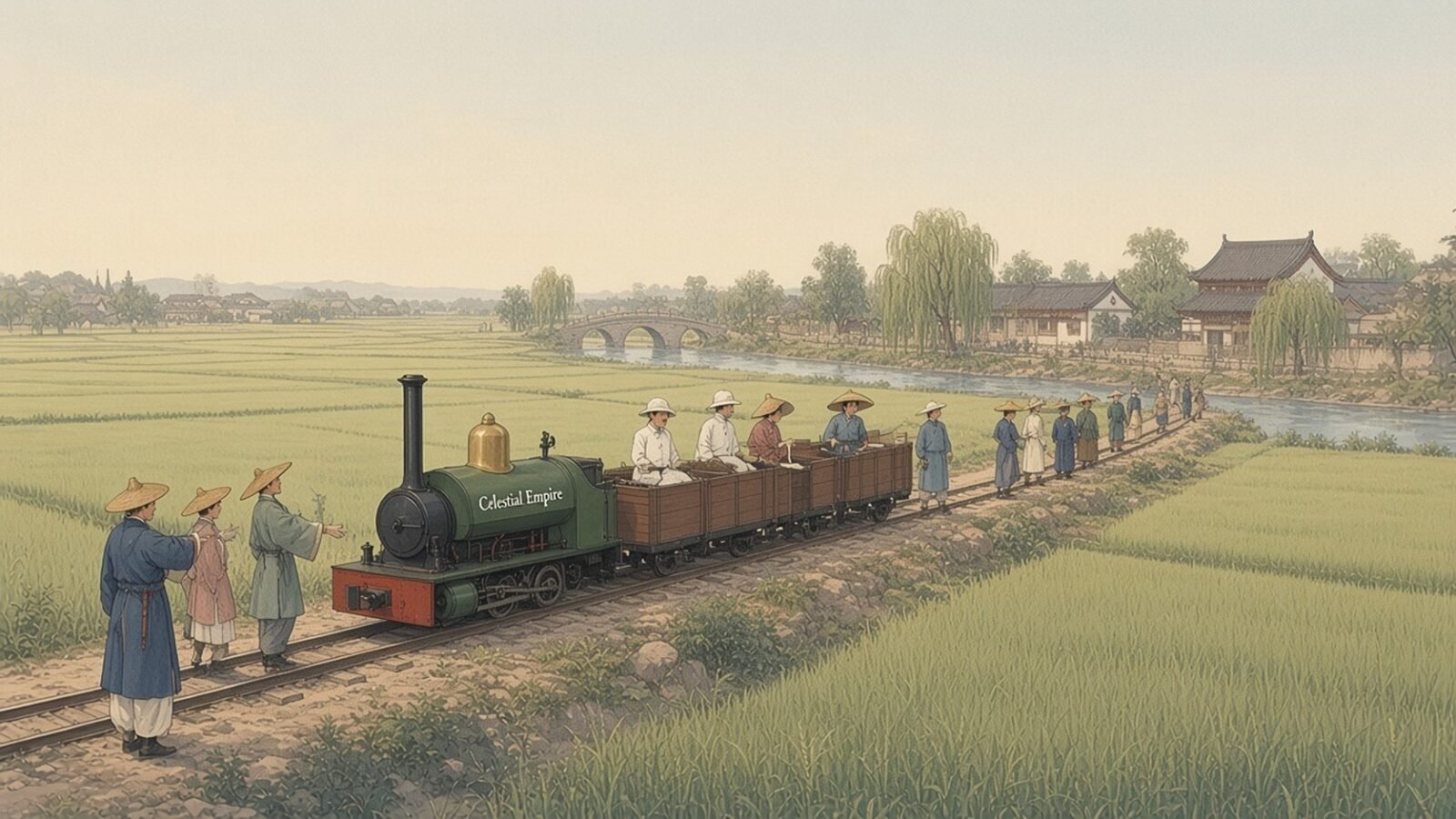
Half past five, on the evening of 30 June 1876. An English locomotive called the Celestial Empire gave a long shriek and slid out of a wooden platform down the line from where the Shanghai station was still being built. The engine drew three open carriages, with about forty people aboard, mostly foreign residents of the Shanghai settlements. The track ran four and a quarter miles across the flat, damp ground north of the foreign concessions, to a small market town called Jiangwan. Gabriel J. Morrison, the British engineer who had driven the first spike in January, sat at the throttle. The train took the best part of an hour to reach Jiangwan. A small crowd waved their hats at the Shanghai end; at the Jiangwan end, a brass band played and the foreign community drank champagne. Three cheers were given for Jardine, Matheson & Co., the British firm that had paid for everything. It was the first time a steam locomotive had carried paying passengers on Chinese soil. The line would last less than eighteen months.
A road called Wusong
The line was not announced as a railway. In the spring of 1874, the British firm of Jardine, Matheson & Co. asked the Shanghai Municipal Council for permission to build a “road” from the foreign settlements to the wharf at Wusong, on the south bank of the Yangtze, where Jardine’s agents operated a tea-receiving hulk. The “road” was registered in London in July 1875 as the Wusong Road Company, with Jardine Matheson as its proxy in China, and a British engineer named Gabriel J. Morrison as chief engineer and agent. The materials arrived in the last months of 1875 under invoices that described the steel rails, the locomotives, the carriages and the fish-plates as “ironware for building the vehicle road”. The lie survived long enough to be useful. By the time the Wusong Road Company was laying track through the rented fields of Yangjingbang, north of the foreign settlements, the neighbours along the line had been told the work was a municipal tramway for hand-pulled rickshaws, not a steam railway.
The deception worked at the local level for about a year. It collapsed when the first rails appeared. The Shanghai press, which had been covering the work as a road project, picked up the rumour in the late autumn of 1875. The North-China Herald published a brief notice on 18 December 1875 under the heading “The Woosung Road”, noting in passing that “the contractors have laid down a species of tramway consisting of flat iron bars”. The Viceroy of Liangjiang, the senior Qing official responsible for the lower Yangtze, demanded an explanation from the Shanghai daotai, the circuit intendant who handled foreign affairs. The daotai wrote back that, in his view, the work was a road. The Viceroy knew better. He had been watching the land sales around Wusong for months, and he had already noticed that public land on the route had been quietly transferred into the names of Chinese compradors associated with Jardine Matheson. The transfer was fraudulent. The Viceroy ordered an inquiry, and the inquiry quickly exposed the railway.
The Pioneer and the Tianchao
Two small locomotives worked the line. The first, a Ransomes and Rapier 0-4-0 tender engine named the Pioneer, arrived in late 1875 and ran the first trials on about a mile of finished track in mid-February 1876. The Pioneer hauled ballast trains and goods wagons. It was a sturdy little machine, only nine tons in working order, with a single pair of driving wheels on each side, and it could pull a string of small trucks at a walking pace along the level ground between Shanghai and the river. The second engine, which drew the first passenger train on 30 June 1876, was the one the American legation in Peking called, in a dispatch of 10 July 1876, “the first ‘puffing billy’ (appropriately named the Celestial Empire) in China, drawing a regular passenger-train”. Its Chinese name was Tianchao, a polite court name for the Chinese realm. It was the same size and type as the Pioneer, and it differed from its sister mainly in paint. The two engines were built to a 2-foot 6-inch narrow gauge, the same gauge used in many colonial light railways, and the track was light enough that an unloaded wagon could be lifted off it by four men.
The carriages were built to the same small scale. The first-class carriage was five feet wide and held twenty passengers on wooden benches. The second- and third-class carriages were also five feet wide, each holding twenty-four. The whole train on the opening evening consisted of the Tianchao, its tender, and the three carriages, in that order, with a small brake van behind. It was a machine built to a budget, and it looked like one. The American legation dispatch called the line “merely an experimental one, constructed with a view to something better following”. This was a kind way of saying that Jardine Matheson had spent about £20,000 on a railway that was meant to prove a point, and that the real product, the one the firm wanted to sell, was the right to build more.
Half past five, from the goods platform
The opening ride was, in the language of the dispatch, “rather spectacular”. Mr Morrison, the engineer and traffic manager, gave the word “Go” at half past five, from a goods platform down the line from where the Shanghai passenger station was still being built. The guests had taken their places, and the Tianchao “gave its premonitory shriek and whistle, and quickly began to glide out of the station amid the cheers of those assembled on the platform”. The train crossed several level crossings, where small groups of Chinese onlookers had gathered. They were not unused to the engine; the Pioneer had been running past their fields for months, hauling ballast. But the sight of the passenger carriages, with the larger engine, was, the dispatch noted, “no great novelty”. What was new was the seating. The Chinese had been excluded from the experimental runs. The 30 June ride was a foreign press junket, and the forty or so passengers were all but a handful of them British, American, French, German and Danish residents of the Shanghai International Settlement.
On 1 July 1876, the second day, free rides were offered to Chinese passengers. The newspaper Shenbao reported the next morning that people had come in crowds. “Mostly in upper and middle-class seats; by 13:00 of the day, the train had been fully packed, some passengers who bought upper and middle-class seats even had to take lower-class seats.” Three days later, on 3 July 1876, the line was formally opened to paying passenger traffic between Jiangwan and the Shanghai end. The fare structure, in Mexican silver dollars and copper cash, was published in a handbill dated 1 July 1876, “Railway Announcement”, which the Shenbao reprinted. It was the first railway timetable printed in China.
The line carried its first passenger in earnest, and the first Chinese to ride did not behave like passengers in the English sense. They sat in groups, smoked, and talked across the carriages. The conductors, who were Chinese, were unable to enforce the British convention of separate compartments for men and women. The American dispatch, with the dryness of a man writing for the State Department, said: “Several bridges and crossings were passed, at each of which there was a group of lookers-on, but these probably had been so accustomed to the daily passing to and fro of the little engine Pioneer with the ballast-wagons, that the sight of the passenger-carriages with the larger engine was no great novelty.” The Pioneer, in other words, had done the cultural work of acclimatising the neighbourhood to a steam engine on rails. The Tianchao only had to sell tickets.
Jardine’s arithmetic
The Shanghai end of the line worked, and it worked better than its builders had any right to expect. The first section, four and a quarter miles from Shanghai to Jiangwan, ran through flat, damp, well-watered ground that was ideal for a light railway. There were no cuttings, no embankments, no bridges of any size, and the gradients were imperceptible. A light engine and three carriages, run at a walking pace, could keep a respectable hourly schedule of four or five round trips in daylight. The line was profitable from the first paying week. It was so profitable, in fact, that within a few months of the July opening, Jardine Matheson was already drawing up plans for extensions: north to the walled city of Baoshan, west to the Suzhou Creek, and eventually south to the river port of Wusong, two and a half miles below the Jiangwan end.
The arithmetic was straightforward. The line had cost about £20,000 to build, including the rolling stock. In the first year of operation it carried 161,331 passengers, almost all of them paying the third-class fare of about one cash per li, which was the going rate for a sedan chair on the same route. A conservative reckoning put the gross revenue at well over £10,000. The operating costs were tiny: coal was cheap, the wages of the small Chinese workforce were tiny, and the company did not pay rent on the land, much of which it had acquired under false pretences. Within a year of opening, the Wusong Road Company had, on paper, recovered the capital cost of the railway, and the firm was sitting on a public asset it did not technically own.
The Viceroy of Liangjiang was watching these numbers. He was Shen Baozhen, a former naval reformer who had built the Fuzhou Navy Yard and who was, in private, one of the most enthusiastic advocates of Western technology in the Qing officialdom. He was also a man of procedure. The line had been built without his permission, and the land underneath it had been acquired by fraud. He was prepared to acknowledge that the railway was a good thing, on the merits, but he was not prepared to let a foreign firm keep an unauthorised railway on Chinese soil, especially one that crossed the Huangpu river basin and that could, in a war, be used to move troops against Shanghai.
Shen Baozhen and the new road
Shen Baozhen was fifty-six years old in the summer of 1876. He had come up through the provincial school system, served in the maritime customs, and risen through the ranks of the Liangjiang administration under Zeng Guofan and Li Hongzhang. He had personally supervised the construction of the Fuzhou Navy Yard, and he had written the memorial that persuaded the court, in 1866, to send boys to the United States to study shipbuilding and navigation. He was not a man afraid of machinery. He was, however, a man who believed that new things should be done in the right order, and the right order in 1876 was that a railway in the lower Yangtze should be approved by Beijing, financed by a Chinese company, and operated under Chinese control.
Shen had two problems in the summer of 1876. The first was the Wusong line. The second was the lower Yangtze itself, where the central government had all but lost control of revenue and where any new transport infrastructure that did not pass through the Imperial Maritime Customs Service would, in practice, be untaxed. He opened negotiations with the British minister in Peking, Thomas Francis Wade, in late August 1876. Wade was an old China hand, a sinologist, and the author of the Wade-Giles romanisation system that would later carry his name. He was also, in the view of his own colleagues, a difficult negotiator with a tendency to lecture.
The British position, as Wade set it out, was that the Wusong Road Company had acted in good faith, that the railway was a fait accompli, and that the proper remedy was compensation rather than confiscation. Wade opened with a figure of 200,000 taels. Shen, who had come prepared to buy, offered 300,000 taels in cash within twenty-four hours for immediate possession of the line, on the ground that any further delay risked an incident that the British could use as a pretext. Wade hesitated. The number was high; the urgency was real. By the end of October, after a month of letters, the two men had settled on 285,000 taels, payable by the Qing government in three instalments over the course of a year. Jardine Matheson, which had put up the original £20,000, agreed to sell in the larger interest of opening the Chinese market to British railway capital. At the then-current exchange rate, the buyout returned about £95,000 on the original investment. The Wusong Road Company had made a fivefold profit in fifteen months, and it had done so on an asset that it had no right to build in the first place.
The Articles of October 1876
The “Articles of Purchasing the Wusong Railway” were signed in Peking on 24 October 1876. The text was short. The Qing government bound itself to pay 285,000 taels in three instalments over the year beginning on 31 October 1876. Until the last instalment was paid, the Wusong Road Company would continue to own and operate the line, and the Qing government would have no operational say in the running of trains. The Qing government would, however, hold a lien on the line and the rolling stock, and would take formal possession on the day after the last instalment cleared. The signing of the articles did not stop the expansion of the line. The Wusong end, the new river station, was completed and opened on 1 December 1876, bringing the total length of the line to its full nine and a quarter miles, or about fourteen and a half kilometres.
The passenger numbers kept climbing. By the spring of 1877, the line was carrying an average of about 700 passengers a day, and on feast days and weekends the figure went over a thousand. The Chinese passenger had become the bulk of the traffic. Foreign riders, who had dominated in the first six months, were now a small minority. The Chinese press was beginning to take an interest, and the Dianshizhai Huabao, the Shanghai illustrated newspaper, was preparing a series of woodblock prints of the line that would be published in 1877 and again, with a long caption, in 1884. The Pioneer and the Tianchao were by now familiar to the villages along the route. A small economy of tea-stalls and noodle sellers had grown up around the Jiangwan and Wusong stations.
It was, in other words, working. The line was not a curiosity, and it was not a failure. It was a small, busy, profitable suburban railway in the lower Yangtze, and it was carrying more paying passengers per mile than the contemporary railway network of Belgium.
Twelve months more
The Articles committed the Wusong Road Company to keep the line running until 21 October 1877, the day after the last instalment cleared. The company did so, and the last year of operation was the busiest of the line’s short life. In the twelve months from December 1876 to December 1877, the company added a second pair of trains a day, lengthened the Jiangwan platform to take four-car trains, and laid a small freight siding at the Wusong end. The freight was almost entirely tea, which was brought down from the Yangtze steamers to the Wusong wharf and run up to the Shanghai godowns without breaking bulk. The freight revenue in the first nine months of 1877 was higher than the passenger revenue, and the company began to talk, in private letters to Jardine Matheson’s London office, about extending the line north to Baoshan and east to the Woosung Bar lighthouse.
None of that came to pass. The Qing government paid the third and final instalment on 20 October 1877. On 21 October 1877, formal possession of the line passed to the Chinese side. Shen Baozhen, who had been Viceroy of Liangjiang for the entire life of the railway, had been ready for this. He had his orders from Beijing, and he had his own view of the matter. The view from Beijing was that no foreign-controlled transport infrastructure should remain on Chinese soil, and that the line, having been paid for, should be erased. The view from Nanking, where Shen sat, was the same, but for a different reason. Shen believed that a foreign-built, foreign-managed railway was a bad precedent. A Chinese-built, Chinese-managed railway, on the same path, was something he could support. A line that did not exist was, in his view, a precondition for getting one that did.
The last train ran on 20 October 1877. It was a scheduled passenger service, with the usual complement of Chinese conductors, the usual first-, second- and third-class passengers, and the usual tea-stalls along the route. The engine, as far as the surviving record shows, was the Tianchao; the Pioneer, which had been the workhorse, had been taken out of regular service some weeks earlier with a cracked frame. The two engines, the three carriages, the brake van, the two goods wagons, the fish-plates, the chairs, the sleepers and the rails were, by the Articles, the property of the Chinese government from the following morning.
The slow unbolting
Shen Baozhen did not order the line destroyed in a single day. He ordered it taken up over the course of about ten weeks, beginning on 21 October 1877, with the rails to be stacked at Wusong, the sleepers to be burned, the roadbed to be levelled, and the stations to be demolished. The work was done by a workforce of about 200 Chinese labourers under the direction of a British engineer named Henry Lester, who had been hired by the Wusong Road Company and was now working for the Chinese side as a contractor. The unbolting was slow, in part because the fish-plates had been deliberately welded by the original contractors to deter casual theft, and in part because the Qing wanted the rails to come up in long, saleable lengths. By 28 December 1877, the work was done. The Shanghai daotai reported to the Viceroy that the line had been “entirely demolished, no trace of a railway remaining”. The Viceroy reported to the Zongli Yamen, the office in Beijing that handled foreign affairs, that the work was complete and the materials were being prepared for shipment.
The cost of the dismantling was about 7,000 taels. The recovered materials included about 1,800 tons of steel rail, 12,000 wooden sleepers, two locomotives, three passenger carriages, one brake van and two goods wagons. The Zongli Yamen decided, on Shen’s recommendation, that the materials should be shipped to Taiwan, where the Governor of Fujian, Ding Richang, was preparing a plan for a railway from Tainan to Taipei. The ship was a small steamer belonging to the China Merchants’ Steam Navigation Company, and the materials were loaded at Wusong in January 1878.
Rails to Formosa
Ding Richang was an old friend of Shen Baozhen. They had worked together in the Fuzhou Navy Yard. Ding was, like Shen, an enthusiastic moderniser, and he had a particular brief in Taiwan, where the court had sent him as Educational Director in 1876 to set up schools, a telegraph line, and a small programme of public works. The plan for the Tainan-Taipei railway was Ding’s, and it was, on paper, an impressive one. The line was to be about 175 miles long, to follow the western coastal plain, and to be built in three sections over the course of ten years. The first section, from Tainan north to the port of Takao (modern-day Kaohsiung), was to be about thirty miles long, and it was to use the Wusong rails, sleepers, locomotives and carriages.
The plan failed almost immediately, for two reasons. The first was the material itself. The Wusong rails had been rolled for a 2-foot 6-inch narrow gauge, which was a perfectly good gauge for a flat suburban railway in the Yangtze delta. The coastal plain of southern Taiwan was not flat; it was a series of river deltas, each separated from the next by a low range of hills. The Tainan-Taipei line, as Ding had designed it, would have to cross several of these ranges, and a 2-foot 6-inch gauge on a winding alignment with sharp curves and steep grades was, as the British engineers in China were quick to point out, impractical. The second reason was money. The court had authorised the Wusong buyout on the understanding that a Chinese-built railway would follow. It had not authorised the Tainan-Taipei line, and the necessary funds were not in the treasury.
The Wusong rails sat on the quay at Takao for the better part of two years. They were unloaded, stacked, and then left. The two locomotives and the three carriages were stored in a customs shed. In 1880, a flood lifted the stacked rails and scattered them across the harbour. By 1883, most of the recoverable ironwork had been sold for scrap to Chinese foundries, and most of the wooden sleepers had been burned for fuel. The carriages had been broken up for their teak. The Wusong Railway, which had carried 161,331 passengers in less than a year, was, in any meaningful sense, gone.
Twenty years
The first Chinese-built railway did not follow. It took twenty-one years, and it was not on the route that Shen Baozhen had in mind. The first Chinese-built railway in the China proper was the nine-kilometre line from Tangshan to Xugezhuang, built in 1881 by Li Hongzhang‘s Kaiping Mining Administration to carry coal from the Kaiping coalfield to a canal head. The line was pulled by mules for the first two years, until Li imported a small locomotive, the Rocket of China, from the United Kingdom in 1882. The second Chinese-built railway, the Keelung-Taipei-Hsinchu line in northern Taiwan, was begun in 1887 by Liu Mingchuan, the Governor of Taiwan, and ran for 107 kilometres along the northern coast. Liu’s railway was a real one, in the British sense. It was built to a 3-foot 6-inch gauge, with proper bridges, proper stations, and a fleet of proper locomotives. It was also, like the Wusong line before it, an unauthorised line, in the sense that Beijing had not specifically approved it, and it was only after Liu wrote a long memorial to the Empress Dowager that the court, in 1888, formally endorsed it.
The first railway on the Wusong route itself was the Songhu Railway, begun in 1898, twenty-one years after the Wusong line had been taken up. The Songhu was a 60-kilometre suburban railway from Shanghai to Wusong, built by a Chinese company with British finance, and it was the railway that, in due course, became the Shanghai suburban network. The Wusong Road Company’s trackbed, the careful alignment that Morrison had surveyed in 1875, was used as the centreline of the new line. The Viceroy of Liangjiang in 1898 was the same office that Shen Baozhen had held, but the Viceroy who approved the Songhu Railway was a different sort of man. The court had, by 1898, been reformed once and then reformed again, and the policy of refusing railways had, by then, been quietly dropped. The Empress Dowager had ridden on a decorated train at the Beijing-Hankou line opening in 1906. The Wusong line, had it survived, would have been, in 1898, twenty-two years old.
The story of what it cost is harder to tell. The Wusong line carried 161,331 passengers in its first ten months. In the twenty years that followed the dismantling, the Shanghai population roughly doubled, and the price of a sedan chair between Shanghai and Wusong, which had been the Wusong Railway’s main competition, roughly tripled. The line, had it been allowed to grow at the rate of comparable suburban railways elsewhere, would have been carrying, by 1897, something on the order of a million passengers a year. The marginal cost of the lost ton-miles is not, of course, the right number. The right number is the cost of the twenty years in which no Chinese official, no matter how modernising, could get a single metre of track past the censors.
A line in the ground
The opening of the Wusong line on 30 June 1876 was a small event in a small corner of a small treaty port. The 40-odd passengers on the first train were not a representative slice of the Chinese population in 1876; they were the foreign business community of Shanghai, whose commercial life was governed by the Shanghai Municipal Council and whose disputes with the Qing were managed by the British minister in Peking. The line, in the view of the Shanghai Municipal Council, was a private commercial undertaking. In the view of the Viceroy of Liangjiang, it was an act of trespass. In the view of the British minister, it was a fait accompli that ought to be paid for. The Qing bought it back. The Viceroy ordered it taken up. The rails went to Taiwan and were sold for scrap. The line was gone.
What did not go away was the question that the Wusong line had forced into the open. The question was whether the Qing state could build a modern transport system on its own territory, with its own money, on its own terms. The Wusong line, built by a foreign firm in defiance of Chinese sovereignty, was an answer that satisfied nobody. The first proper answer came in 1881, when Li Hongzhang put down nine kilometres of track in the coalfield north of Tangshan and called it a tramway. The second came in 1909, when Zhan Tianyou’s Jing-Zhang Railway opened between Beijing and Zhangjiakou, a Chinese-engineered, Chinese-financed, Chinese-built mainline that ran the 200 kilometres from the capital to the mountains in three and a half hours. The third came in 1908, when the Shanghai-Nanjing line, financed in part by Jardine Matheson, opened along the Yangtze. The story of the Wusong line is, in this larger frame, the story of the answer that was not allowed to count.
On 28 December 1877, the Shanghai daotai sent a brief report to the Viceroy of Liangjiang. The Wusong line, the report said, had been taken up. The roadbed had been levelled. The stations had been demolished. The materials were on the quay at Wusong, ready to be loaded for Taiwan. The Viceroy forwarded the report to the Zongli Yamen, with a note that the work had been done in good order and that the cost had been within the budget. The Zongli Yamen acknowledged the report and filed it. The Wusong line, the report said, was no more. The line that replaced it would not open for twenty-one years.
References
- “The Woosung Railway”, in Papers Relating to the Foreign Relations of the United States, 1876, dispatches from the United States legation in Peking, 10 July 1876: the primary eyewitness account of the 30 June 1876 opening run, with the description of the Tianchao (Celestial Empire), the timings, the route, and the engineering detail of the 2 ft 6 in gauge and the 9-ton engines.
3. Hsien-Chun Wang, “Merchants, Mandarins, and the Railway: Institutional Failure and the Wusong Railway, 1874-1877”, *International Journal of Asian Studies* 12, no. 1 (2015): the peer-reviewed account of the negotiation, the buyout at 285,000 taels, and the failure of the Taiwan project.
4. Elisabeth Koll, *Railroads and the Transformation of China*, Harvard University Press, 2019, pp. 19-52: the standard academic history of the Wusong Railway and the wider Qing policy debate on railways.
5. *175 Years of Looking to the Future*, Jardine Matheson corporate history: the firm’s own account of the Wusong line as “the first railway line in China from Shanghai to Woosung in 1876”, with the follow-on Shanghai-Nanjing line of 1904-08.
6. “Looking Back on History: Wusong Railway, Wusong Lighthouse, Wusong Datum”, Shanghai Baoshan District official site, 18 January 2021: the Baoshan district government’s account of the line, with the 161,331 passenger figure for the first ten months of operation, the 3 July 1876 opening ceremony, and the 28 December 1877 completion of the dismantling.
7. “China’s First Railroads: the Wusong and Tianjin Railways”, *Bodies and Structures* project, North Carolina State University: the academic site essay on the Wusong and Tangshan-Xugezhuang lines, with the Dianshizhai Huabao woodblock print of the Wusong line from 1884 and the contextual photograph of the Pioneer hauling ballast wagons.
8. *Remunerative Railways for New Countries*, with eight original Woodbury photographs of the Woosung Railway: a contemporary British trade volume documenting the engineering, the rolling stock and the stations of the Wusong line as built, available through the used-book trade and reproduced in part by bodiesandstructures.org.
9. Shen Bao (《申报》), reports of 1 July, 4 July and 14 August 1876, the Shanghai daily newspaper’s running account of the Wusong line’s first weeks of operation, including the reprinting of the 1 July 1876 “Railway Announcement” handbill, the first railway timetable printed in China.