
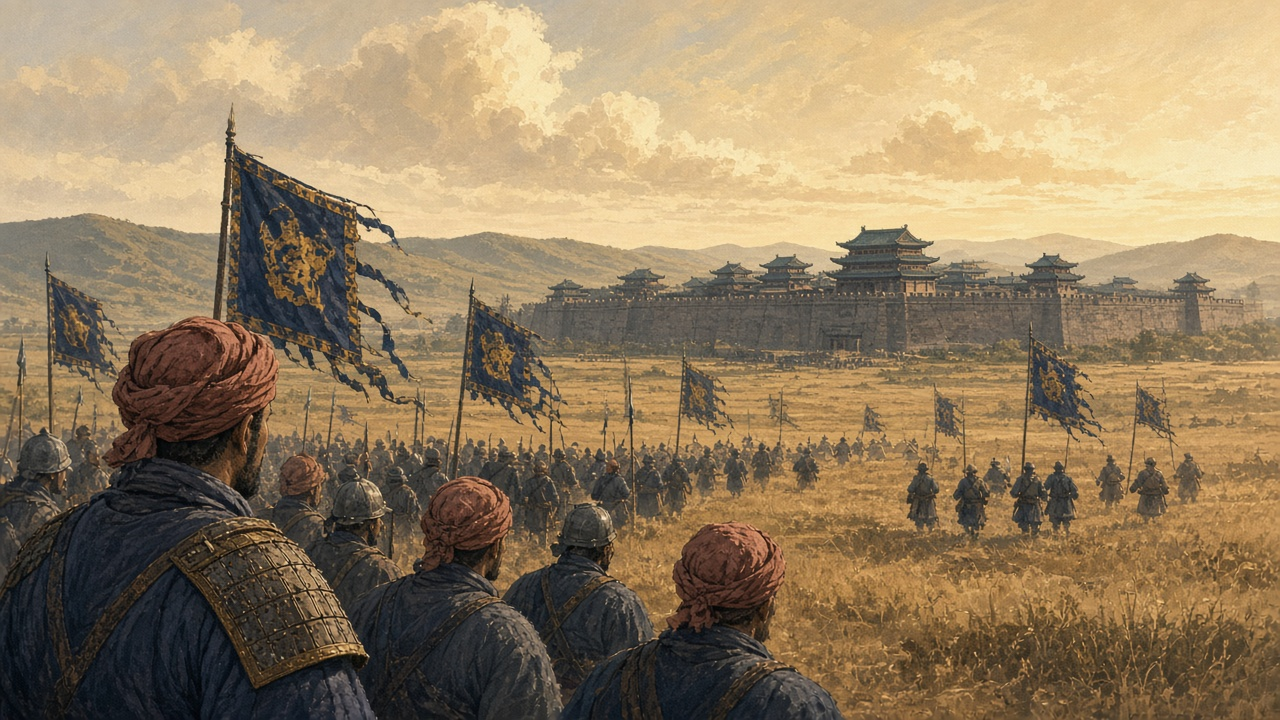
The Red Turban uprising was not one tidy army with one programme. It was a chain of rebellions across North China and the Yangtze world from the early 1350s that tore open Mongol Yuan rule, mixed millenarian religion with labour revolt, and left rival warlords fighting over the ruins. The red cloth that gave the movement its name was a badge of sect and solidarity. The politics that followed were messier: White Lotus prophecy, Song restoration claims, southern rival regimes, and finally Zhu Yuanzhang’s path from rebel subordinate to Ming founder. A Sino Despatch account should keep the sequence concrete and refuse both romantic peasant purity and simple race war slogans.
By the mid fourteenth century the Yuan state still held the map of China, but its capacity to feed and order that map was failing in key regions. Yellow River floods shifted courses, ruined fields, and broke the hydraulic link between river and Grand Canal that moved grain north. Locusts, epidemic, and tax pressure compounded the shock. Mongol emperors and their Chinese and Inner Asian officials still issued orders. What they could no longer reliably deliver was security and subsistence for the Huai and North China peasantry who would fill the first Red Turban ranks. Loss of the Mandate of Heaven was not a metaphor invented by later textbooks. It was a conclusion hungry villages drew when water and grain systems failed under a dynasty that still demanded labour.
In 1351 the court mobilised a vast corvée, often cited around one hundred and fifty thousand labourers or more, to rechannel the Yellow River and restore canal links in Shandong and neighbouring zones. Forced labour on empty stomachs is a classic recruitment ground for revolt. Han Shantong, linked to White Lotus networks that his family had long worked, and his collaborator Liu Futong found their audience among those diggers and the villages that supplied them. The conspiracy was exposed. Han Shantong was captured and executed. His wife escaped with their son Han Lin’er. Liu Futong and others chose open rebellion rather than wait for the next round of arrests. Within days they were taking Huai cities. The uprising that officials hoped to nip in the bud became a regional war.
The rebels wrapped red cloth around their heads, burned incense, and carried a religious politics that contemporary officials labelled heterodox. White Lotus teaching in this period fused Buddhist millenarian hope, especially around Maitreya, with older salvationist currents that some scholars also track toward Manichaean light and darkness imagery. The point for politics is not to settle every doctrinal footnote. The point is that the uprising offered a story larger than tax relief: the old order was ending, a luminous king or age was near, and ordinary people could act inside that drama. Red turbans and incense armies were the visible costume of that claim. Without that costume, labour anger might have stayed local riot. With it, revolt travelled as a recognisable brand.
Liu Futong established a base at Yingzhou in the Huai region and proclaimed a Red Turban government. Han Lin’er was elevated as the Young Prince of Radiance, tied in propaganda to Song imperial descent and to the luminous king expected in sectarian prophecy. The restored Song banner was useful theatre. It told Chinese elites that this was not only banditry. It told believers that heaven’s timetable had a name. It also created a figurehead whom stronger generals could honour while building their own territorial machines. Dual legitimacy, sectarian and dynastic, was the Red Turban formula at its most ambitious.
Yuan countermeasures were not instantly helpless. Chancellor Toghto organised major campaigns that temporarily checked rebel advances and showed that Mongol led armies could still win battles when properly supplied and directed. Court politics then removed him, a self inflicted wound that historians often mark as fatal to Yuan recovery. Once central direction faltered, local commanders, landlords, and rival rebel chiefs filled the vacuum. The Red Turban label spread faster than any single chain of command. Northern and southern theatres developed different leaderships and agendas even while sharing anti Yuan opportunity. A dynasty can survive battlefield defeats. It rarely survives the destruction of its best organisers by its own intrigue.
South of the Yangtze, related and parallel risings produced their own strongmen. Xu Shouhui’s Tianwan regime and later Chen Youliang’s Han state turned millenarian revolt into Yangtze warlord competition. Fang Guozhen’s coastal power showed that not every anti Yuan actor wore the same red cloth or sang the same hymn. Zhang Shicheng’s Wu regime in the rich lower Yangtze fought as a territorial state more than as a White Lotus congregation. The mid century crisis was a collapse of monopoly violence, not a single party revolution. Readers who flatten everything into one Red Turban army miss why Zhu Yuanzhang had to conquer Chinese rivals before he could expel Mongol emperors from Dadu.
Zhu Yuanzhang entered this world as a famine orphan turned Buddhist novice who joined Guo Zixing’s Red Turban affiliated force in 1352. Marriage into Guo’s household, talent for recruitment and logistics, and the capture of Nanjing in 1356 made him a regional power. He accepted titles from Han Lin’er’s Song court and used that legitimacy while running an increasingly independent Nanjing regime. Unlike some rivals, he courted Confucian advisers, disciplined troops, and framed his wars carefully. He argued that he was restoring order against rebels and that the Yuan had lost the capacity to rule, without resting the whole case on Mongol ethnicity alone. That line helped peel elite support away from both Yuan loyalism and wilder sectarian brands. The orphan who had begged rice learned that paperwork and honourable burial of enemies could win cities as surely as fire.
The Yangtze wars decided who would wear the next Chinese crown. Chen Youliang’s defeat at Lake Poyang in 1363 and the later destruction of Zhang Shicheng’s Wu power left Zhu master of the southern core. Han Lin’er’s Song court remained a nominal sun around which Zhu still orbited in public. In 1366 Han Lin’er died; later tradition and some historians suspect drowning arranged to clear Zhu’s path, though certainty is elusive and should be stated as contested. By early 1368 Zhu proclaimed the Ming at Nanjing. His generals took Dadu later that year. The Yuan court fled north. Red Turban revolt had begun as sectarian labour rebellion. It ended as dynastic founding under a man who had outgrown the movement’s original theology.
What, then, were the Red Turbans? They were a family of uprisings, not a modern political party. At the core stood White Lotus organised hope and Huai labour anger in 1351. Around that core grew Song restoration symbolism, regional armies, and opportunistic warlords who borrowed the red badge when useful. Some fighters were devout. Some were hungry. Some were career soldiers of chaos. Yuan weakness, river disaster, and corvée made the explosion possible. Rival Chinese military entrepreneurs made the outcome contingent. Mongol rule did not fall to a hymn alone. It fell when hymn, hunger, and organised violence outlasted a divided court.
Chinese nationalist memory often folds the Red Turbans into a straight story of Han recovery from alien conquest. Parts of that story are true: Yuan was a Mongol led conquest dynasty, and Ming restoration language later celebrated the expulsion of northern emperors from China proper. Parts are incomplete. Many Chinese served the Yuan as officials, clerks, and soldiers. Zhu’s own propaganda sometimes treated Yuan legitimacy as formerly real and his enemies as the true rebels. Southern warlords killed more of each other than any single morality play allows. Red Turban religion looked, to Confucian officials, like dangerous heresy as much as patriotism. The uprising was anti Yuan without being a tidy national liberation front.
Western treatments once exoticised the Red Turbans as oriental fanaticism or reduced them to peasant jacquerie without institutions. Better scholarship tracks flood, labour, sect networks, and warlord consolidation as a linked process. The millenarian language mattered because it organised trust and sacrifice when official institutions failed. The warlord phase mattered because prophecy does not administer grain transport or issue land registers. Zhu’s achievement was to ride the first current and then build a state that could survive the second. Later, as Hongwu Emperor, he would police monasteries and heterodox assemblies with a severity that revealed how carefully he remembered the world that had made him.
Women and households rarely headline Red Turban narratives, yet escape stories such as Han Shantong’s wife carrying Han Lin’er to safety remind readers that rebellion was a family logistics problem as well as a battlefield one. Marriage alliances, as in Zhu’s tie to Guo Zixing’s foster daughter Ma, converted military households into dynastic seeds. Sect networks often ran through kinship and village credit as much as through scripture. Social history of the uprising is still thinner than the chronicle of sieges, but the political history makes little sense without those quieter bonds.
For readers following Yuan collapse and Ming founding on this site, the Red Turban uprising is the hinge. Without 1351’s canal labour revolt and White Lotus organisers, the Yuan might have staggered longer under patchwork repression. Without Liu Futong and Han Lin’er’s Song theatre, Zhu would have lacked an early legitimacy umbrella. Without Zhu’s Nanjing machine and victories over Chen and Zhang, Red Turban energy might have spent itself in permanent fragmentation like other late imperial collapse eras. The red cloth named a rebellion. The Ming named the settlement.
Material details still matter for honesty. The headcloth was red; the politics were plural. Incense, Maitreya expectation, and Song genealogy were recruitment tools as well as beliefs. Yuan commanders could win battles and still lose the war when court intrigue removed their best organisers. Southern Red Turban affiliated regimes prove that the brand travelled beyond the Huai. Zhu’s later suspicion of sects and monastic wealth as emperor shows a founder policing the religious world that had once elevated him. Origins are not destiny, but they leave scars on statute books.
Compare the Red Turbans with other Chinese millenarian crises and the pattern clarifies. Belief supplies courage and solidarity. Administration and grain supply decide whether courage becomes a dynasty or a burned county. The Yellow Turbans of the late Han and later White Lotus risings under Qing show similar sparks. The mid fourteenth century was distinctive because Eurasian Mongol rule was already strained, the hydraulic state was broken in the north, and a singular organiser emerged who could translate revolt into Ming institutions. Contingency, not destiny, made Zhu the winner among many Red Turban heirs.
Geography shaped strategy as much as ideology. The Huai basin linked northern grain politics to southern riverine wealth. Whoever held Nanjing and the Yangtze corridors could feed armies and negotiate with coastal traders. Whoever remained trapped in the northern plain fought Yuan garrisons and rival Red Turban bands for the same exhausted villages. Zhu’s early decision to build a capital regime at Yingtian was therefore not only symbolic Response to Heaven branding. It was a logistics choice that turned a Huai rebellion career into a southern state.
Numbers in the sources are slippery. Claims of hundreds of thousands under this or that banner mix musters, camp followers, and propaganda. What can be said with more confidence is qualitative: the Yuan lost the ability to monopolise organised force across China proper; Red Turban and parallel movements multiplied centres of power; and one of those centres, Zhu’s, developed the administrative habits of a dynasty before it took the dynastic name. Scale mattered. So did the shift from prophetic mobilisation to tax and register government.
A fair ledger looks like this. Ecological and fiscal crisis prepared the ground. White Lotus networks struck the spark among corvée labourers in 1351. Red Turbans spread as a recognisable badge of revolt. Song restoration claims sought elite cover. Yuan recovery failed after early military successes. The rebellion pluralised into warlord competition. Zhu Yuanzhang professionalised one branch into a dynasty. Mongol emperors left Dadu; the steppe threat remained. The Red Turban uprising was therefore both a religious labour revolt and the opening act of Ming state formation. Treat it as only one of those things and the century stops making sense.