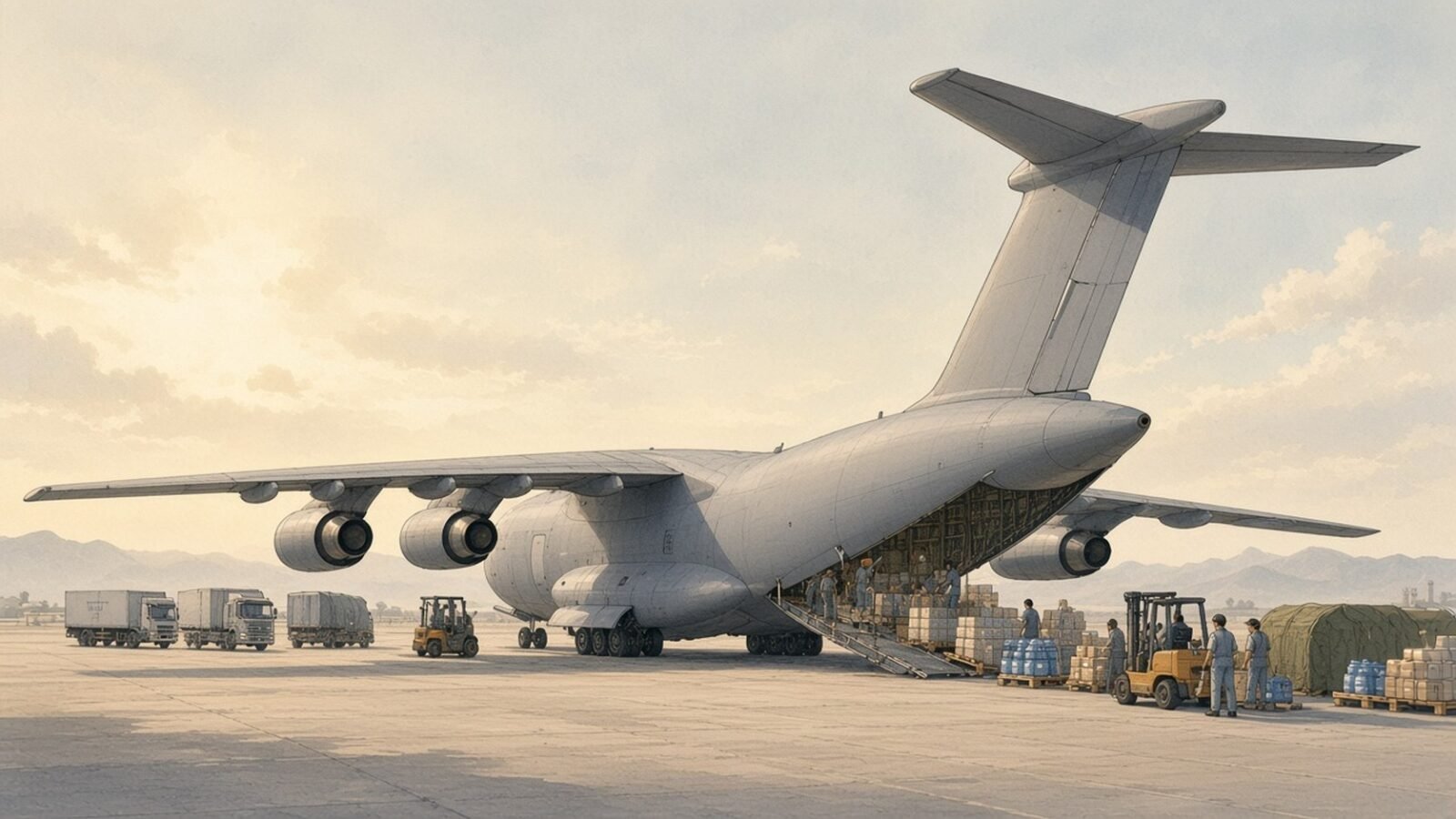
When a Y-20 took off from Tianjin on 13 March 2020, bound for Rome with nine tonnes of masks and ventilators, it was the largest Chinese-built aircraft to land in Europe since a 1960s-era Xian H-6 bomber diverted to a Soviet airfield. Over the following weeks the PLAAF‘s new heavy transport flew more than sixty sorties to fifteen countries in what became known as the COVID-19 airlift, and the Y-20 acquired a kind of soft-power dividend no Chinese weapon system had ever earned. The aircraft is the People’s Liberation Army Air Force‘s flagship strategic transport, but most of its logged hours are humanitarian, not military. That is the public register the aircraft leans on, and the reason it carries the Kunpeng (鲲鹏) nickname after the mythical fish-bird of the Zhuangzi.
Key findings
- The Y-20 entered PLAAF service in 2016 and is the largest aircraft ever designed and built in China, with a maximum payload of 66 tonnes.
- The aircraft’s civilian register — humanitarian, COVID-19, and commercial cargo flights — accounts for the bulk of its public-facing missions.
- Production of the WS-20 engine is the key constraint on fleet expansion; until WS-20 is fully qualified, every Y-20 still depends on Russian Soloviev D-30KP-2 engines.
- The Y-20 fleet is small — perhaps thirty airframes by 2023 — but the aircraft has anchored China‘s humanitarian airlift, its overseas base logistics, and its first tentative export campaign.
The aircraft and its premise
The Y-20 is a four-engine, high-wing, T-tail heavy transport with a maximum takeoff weight of around 220 tonnes and a payload of 66 tonnes. To put that in context, it sits between the Russian Ilyushin Il-76 (50-tonne payload, four engines) and the American Boeing C-17 Globemaster III (77.5-tonne payload, four engines) in capacity, and ahead of the European Airbus A400M Atlas (37-tonne payload, four engines). It is shorter than the C-17, narrower, and lighter, but its cargo box dimensions allow it to carry a Type 99 main battle tank stripped of its turret, an infantry fighting vehicle, or up to 250 fully equipped troops.
The aircraft was conceived in 2006, when the PLAAF still depended on a small fleet of Il-76s leased from Russia and a motley collection of older Soviet-era An-12s and Y-8s for strategic airlift. China‘s economic and humanitarian reach was growing — peacekeeping deployments to Sudan, the Democratic Republic of the Congo, and Lebanon were expanding; the 2008 Sichuan earthquake had shown how thin PLA airlift was; the 2011 Libya evacuation of 35,000 Chinese citizens had required the charter of foreign aircraft — but the airlift fleet had not kept pace. A Chinese heavy transport was the obvious answer.
Origins: ending the Il-76 dependency
The Russian Il-76 had been the PLAAF‘s heavy-lift workhorse since the 1990s. China bought a small fleet outright, leased more, and used them for disaster relief, peacekeeping logistics, and the occasional strategic move of armour to the Tibetan plateau. But the Il-76 was a 1970s design with limited avionics, a tail-loading ramp that didn’t suit Chinese armoured vehicles, and — most importantly — engines that needed rebuilding in Russia every few thousand hours. By 2005 the maintenance backlog was severe and the Russian production line had effectively closed.
A second motivation was industrial prestige. China had built fighters (J-10, early J-11), helicopters (Z-9, Z-10), and a wide-body passenger jet was on the drawing board (the C919). But it had never built a strategic transport, and the engineering demands — high-bypass turbofans, multi-wheel landing gear for rough fields, fatigue-rated wing boxes — were a frontier. The Y-20 would test whether the Chinese aerospace industry had crossed into the same league as Boeing, Airbus, and Ilyushin.
In 2006 the State Council and the Central Military Commission approved the programme. The prime contractor was the Xi’an Aircraft Industrial Corporation (XAIC), a subsidiary of AVIC, in Shaanxi province. The chief designer was Tang Jun (唐军), a structural engineer whose previous work included the H-6 bomber modernisation. The airframe used supercritical wing sections, a high-lift device system borrowed conceptually from the Il-76 but redesigned for Chinese manufacturing, and a digital fly-by-wire flight control system developed in cooperation with Beihang University.
Development timeline
The Y-20‘s first flight came on 26 January 2013, from Yanliang air base near Xi’an. The prototype (registered 20001) flew for an hour and made a clean landing. A second prototype (20002) flew in late 2013, and a third in 2014. The test programme covered high-altitude operations, hot-and-high takeoffs from Lhasa Gonggar airport, low-altitude drops over the Gobi desert ranges, and engine-out scenarios. By 2015 the type was judged ready for serial production.
The PLAAF formally accepted the aircraft into service in July 2016, with a small initial operational fleet based at the 4th Transport Division at Jiangbei (formerly a Soviet-built Ilyushin-equipped regiment) and the 13th Transport Division at Kaifeng. By 2023 the cumulative production was around thirty airframes, with the rate accelerating as engine supply stabilised.
The official rollout ceremony took place at the Zhuhai Airshow in November 2016, when a Y-20 performed a low pass over the crowd with two escort fighters — a confident debut that signalled the aircraft’s transition from a secretive test programme to a public-facing national asset.
Engines: the Russian problem and the WS-20 fix
Every Y-20 flying today uses the Soloviev D-30KP-2, a 1970s-era low-bypass turbofan of 12.5 tonnes of thrust, originally designed for the Il-76. The D-30KP-2 is reliable, well-understood by Chinese maintenance crews trained on Il-76s, and — crucially — still in production at the Ufa Engine Industrial Association in Russia. China buys the engines either directly or through third parties, and each one is a foreign-supplied component on what is otherwise a Chinese aircraft.
The Chinese aerospace industry has been working on an indigenous replacement since the late 2000s. The result is the WS-20 (涡扇-20), a high-bypass turbofan of around 14 tonnes of thrust developed by the Aero Engine Corporation of China (AECC) Commercial Aircraft Engine Company in Shanghai. The WS-20 first ran on a Y-20 testbed in late 2020, and a small batch of Y-20Bs with WS-20 engines entered service in 2022. The WS-20 offers roughly 10% more thrust, significantly better specific fuel consumption, and — most importantly — independence from Russian supply. But the WS-20 programme has slipped repeatedly, and as of 2024 most operational Y-20s still fly with D-30s.
The Russian engine dependency is not only a technical issue. After the 2022 invasion of Ukraine and the imposition of Western sanctions on Russian defence exports, China faced a question: would Russia keep supplying engines to a country it considered a strategic partner? The answer so far has been yes, but Beijing’s commitment to WS-20 production has visibly accelerated. The lesson of the programme is that even a successful indigenous airframe remains hostage to engine supply until the engine is also indigenous.
Operational service with the PLAAF
The Y-20‘s military missions are mostly unglamorous: airlifting personnel and equipment to the Chinese peacekeeping force in Mali, the naval base in Djibouti, and the joint base in Djibouti. The aircraft is the largest platform that can land at the short, high-altitude airstrip at Lhasa Gonggar, and it has been used to lift artillery and armour to the Tibetan plateau in exercises that simulate an India border contingency.
In November 2018 the Y-20 made its first overseas humanitarian flight, airlifting seventeen tonnes of medical supplies to Port Moresby after the Hela earthquake in Papua New Guinea. The mission was small, but the symbolism was deliberate — a Chinese heavy aircraft, painted in PLAAF livery, landing at a South Pacific capital to deliver aid.
The aircraft has also been used in non-combatant evacuation operations. In April 2019, when the situation in Libya deteriorated, the PLAAF dispatched a Y-20 to evacuate Chinese and foreign nationals from Tripoli. The mission was overshadowed by the larger 2011 Libya evacuation, but it showed that the Y-20 could reach deep into Africa on a single hop.
A quieter military role is in the joint logistics system. Since 2017 the PLA has been reorganising its logistics under the Joint Logistics Support Force, which centralises transport, supply, and maintenance under a single command. The Y-20 is the air arm of that system, capable of moving outsized loads from Beijing or Kunming to a Pacific atoll or African forward operating base without intermediate stops.
The civilian register: humanitarian airlift and COVID-19
The Y-20‘s most consequential single mission was the COVID-19 airlift of March–April 2020. From 13 March to early May, the PLAAF flew more than sixty Y-20 sorties to fifteen countries, including Italy, Serbia, Poland, the Czech Republic, Pakistan, Iran, and South Africa. Each aircraft carried between nine and eighteen tonnes of masks, ventilators, protective suits, and test kits. The largest single flight was the 12 April mission to Karachi, which carried twenty tonnes of supplies.
The COVID-19 airlift had three lasting effects. First, it established the Y-20 as the public face of Chinese humanitarian assistance — no other Chinese aircraft has been flown more often to more countries in a comparable timeframe. Second, it created operational templates for rapid-response airlift that the PLAAF now trains to. Third, it gave the aircraft a kind of brand recognition that military transports rarely achieve. Italian television stations ran aerial footage of the arrival; Serbian President Aleksandar Vucic kissed the Chinese flag at the bottom of the aircraft’s stairway; and the Kunpeng nickname entered the global press for the first time.
The Y-20 has also entered commercial service in a limited way. In 2020 Air China Cargo began operating two Y-20F-100s (the commercial export designation) on routes between Chengdu and Frankfurt, and between Zhengzhou and Liège. The Y-20F-100 is the same airframe as the military Y-20 but with civil avionics, more comfortable crew rest facilities, and a commercial livery. Air China Cargo has publicly committed to expanding its Y-20F-100 fleet, and a handful of other Chinese cargo carriers have signed letters of intent.
The commercial certification of the Y-20F-100 matters more than the route numbers suggest. Until 2020, no Chinese-built heavy aircraft held a commercial type certificate from the Civil Aviation Administration of China (CAAC). The Y-20F-100’s certification is the foundation for any future Chinese-built wide-body freighter — including the COMAC C929 freighter variant that COMAC has discussed publicly.
Future variants and strategic implications
The Y-20 family is still expanding. The most important variant is the Y-20U tanker, which would refuel Chinese fighters and transports mid-air, eliminating a key bottleneck for long-range air operations. A tanker prototype flew in late 2022. The KJ-3000 airborne early warning variant, intended to replace the older KJ-2000 based on the Il-76, is reportedly in development. A Y-20B strategic bomber variant has been rumored but not confirmed.
For China, the Y-20 is the test bench for an entire generation of large aircraft. The techniques, supply chains, and quality-control systems developed for the Y-20 will feed directly into the COMAC C929 wide-body airliner, the future military tanker and AEW fleets, and any future strategic bombers. The Y-20 is not just an aircraft; it is a proof of industrial competence that the United States, Russia, and Europe can no longer assume China lacks.
The aircraft has also become a quiet diplomatic tool. In 2023, when Egypt was negotiating a major arms deal with China, the PLAAF flew a Y-20 to Cairo loaded with humanitarian supplies. The aircraft carried no weapons, but its size and presence sent a message. Similar flights have landed in Venezuela, Ethiopia, and the Solomon Islands. The Y-20 fleet is still mostly civilian in its public-facing missions, but every one of those civilian flights is also a quiet reminder of what the platform can do in a conflict.
The export question is open. Pakistan has been discussed as a likely first buyer of a Y-20F-100 variant for the Pakistan Air Force, which currently operates a small fleet of Il-78 tankers and C-130 transports. No contract has been signed, and the per-unit cost (estimated at $80–100 million, against the C-17‘s $200 million-plus) makes the Y-20F-100 attractive. But China’s reluctance to release detailed operational data, and the absence of a mature through-life support network outside China, has kept export orders at zero.
The Y-20 in the wider strategic transport market
The Y-20 sits in a crowded strategic transport market dominated by Boeing‘s C-17 (now out of production, last delivery 2015) and the Airbus A400M Atlas. The C-17 carries 77.5 tonnes, has a 4,500-nautical-mile range, and costs about $200 million per airframe. The A400M carries 37 tonnes, has a 2,400-nautical-mile range, and costs about $180 million. The Y-20 carries 66 tonnes, has a 4,200-nautical-mile range, and is estimated at $80–100 million per airframe — about half the price of either Western competitor.
The price difference is partly a function of Chinese labour costs and partly a function of the WS-20 engine still being in development. Once the WS-20 is fully qualified and the production line is mature, the per-unit cost of the Y-20 is likely to fall further, making the aircraft one of the most cost-effective strategic transports on the market. This is the real long-term export opportunity: not Pakistan or Egypt, but the dozens of mid-sized air forces that cannot afford a C-17 but need more capacity than the A400M offers. The C-130 has been the default answer for that niche for forty years; the Y-20F-100 could plausibly replace it.
For China, the operational lesson of the Y-20 is that an indigenous strategic transport capability is not a luxury but a foundation. Without it, every overseas base, every humanitarian mission, every peacekeeping deployment depended on rented Russian aircraft and chartered foreign carriers. With it, Beijing can project force and aid on its own terms, and that capability has reshaped both Chinese diplomacy and Chinese defence planning.
Operational economics and maintenance footprint
Operating a Y-20 costs about 150,000 yuan per flight hour, including fuel, maintenance, and crew. The aircraft’s fuel burn at cruise is about 6.5 tonnes per hour, which puts the per-hour fuel cost at around 50,000 yuan at Chinese jet-A prices. The remaining 100,000 yuan covers engine overhauls (the D-30KP-2 needs a hot-section inspection every 3,000 hours and a full overhaul every 8,000–10,000 hours), routine maintenance, airframe inspections, and crew costs. By comparison, the C-17 costs about $200,000 per flight hour to operate, and the A400M costs about $180,000 per hour. The Y-20 is one of the cheapest heavy transports to operate in the world.
The aircraft’s maintenance footprint is, however, substantial. Each Y-20 requires about 25 maintenance hours per flight hour — a ratio typical of Soviet-era transports but well above the C-17‘s 12 hours per flight hour. The PLAAF has had to expand its maintenance corps significantly to support the Y-20 fleet, and the maintenance training centre at Jiangbei has graduated about 800 technicians since 2016. The maintenance footprint is one reason the PLAAF has been reluctant to lease Y-20s to commercial operators, even though the Y-20F-100 is nominally certified for commercial service.
The aircraft’s reliability has improved steadily since 2016. The PLAAF has not released detailed reliability data, but Western analysts estimate the Y-20 fleet’s mission-capable rate at about 75% in 2023, up from 60% in 2018. The improvement reflects the maturation of the maintenance corps, the gradual resolution of early teething problems with the D-30KP-2, and the introduction of Chinese-built avionics and subsystems that have replaced some of the older Russian and Israeli components. The 75% rate is now competitive with the C-17‘s 80%, and the gap is likely to narrow further as the WS-20 matures.
Looking forward
For the next decade, the Y-20 is likely to be the most visible Chinese aircraft in the world. The fleet will expand as the WS-20 matures and as the Y-20U tanker enters service. The aircraft’s civilian register — humanitarian airlift, COVID-style emergency response, commercial cargo — will continue to dominate its public image, and that public image will continue to be a tool of Chinese statecraft. The aircraft is still mostly civilian in its visible missions, but the underlying capability is military, and the fleet is sized for both tasks. The Y-20 is now the practical symbol of what the Chinese aerospace industry can deliver when it sets its mind to a frontier programme, and that symbol is likely to remain central to Chinese defence planning for at least another generation.
Likely export customers
The Y-20‘s most likely export customers in the near term are the air forces that already operate Chinese military hardware and need a heavy-lift capability that their existing fleets cannot provide. The Pakistan Air Force has been the most public discussant: Pakistan already flies the JF-17, operates Chinese air defence systems, and would benefit from a heavy transport for the Karakoram and Hindu Kush operations that its existing C-130 fleet cannot support. The Bangladesh Air Force and the Myanmar Air Force are also in discussions. All three countries would be buying not just an aircraft but a maintenance and training package that would lock them into the Chinese defence ecosystem for decades.
The longer-term export picture is more open. Iran, Egypt, Algeria, and Venezuela are all air forces that would benefit from a heavy transport but cannot afford a C-17 and are not eligible for A400M deliveries. The Y-20F-100‘s per-unit cost of $80–100 million makes it competitive with the C-17 at half the price, and the absence of a Western export-control regime on Chinese aircraft removes a major barrier. The export market is the long tail of the Y-20 programme, and the aircraft’s commercial success will ultimately depend on how well China supports the through-life maintenance of exported airframes.
The certification of the WS-20 and its domestic ripple effects
The WS-20 turbofan has had a long, often frustrating path from drawing board to operational service. The engine programme began in 2008 under the designation WS-10H, an offshoot of the earlier WS-10 that powers the J-11B, J-15, and J-16 fighters. The H variant added a fan section large enough to match the D-30KP-2 at high bypass, and the first prototype ran on a stand at the AECC test cell in Shanghai in 2013. The first flight on a Y-20 testbed, registered 20003, came in late 2020, and the engine has since accumulated perhaps 800 flight hours across five airframes.
The certification path is technically unusual. The Civil Aviation Administration of China has a parallel engine qualification process for indigenous designs, and the WS-20 is going through both the military qualification (which it has effectively completed for limited use) and a commercial qualification that will eventually support the Y-20F-100 export variant. The two tracks have different reliability and durability thresholds, and the commercial qualification is the harder one. AECC has been reluctant to disclose test data, but Western analysts believe the WS-20 is at about 80% of the D-30KP-2‘s time-on-wing before overhaul, and the gap is closing.
The success or failure of the WS-20 matters far beyond the Y-20. The engine is the test case for a generation of Chinese high-bypass turbofans, including the CJ-1000A that will eventually power the COMAC C919 narrow-body airliner, and the AEF3500 that is intended for the COMAC C929 wide-body. Both programmes depend on Chinese mastery of large turbofan manufacturing, and the WS-20 is the technology demonstrator for the family. If the WS-20 delivers, the C919 and C929 have a credible indigenous engine option; if the WS-20 fails, both aircraft are stuck with Western or Russian engines for the foreseeable future.
Aerobatic display and the public face of the Y-20
The Y-20‘s public image is partly shaped by its aerobatic displays. The aircraft has performed at every Zhuhai Airshow since 2014, and the 2022 display included a Y-20 flying a low pass in formation with two J-20 stealth fighters — a marketing image that emphasised the aircraft’s strategic value. The display is choreographed by the August 1st Aerobatic Team of the PLAAF, and the Y-20 routine is the centrepiece of every show.
The Y-20 has also been featured in Chinese aviation-themed films and television. The 2019 film The Captain (中国机长), about the 2018 Sichuan Airlines 8633 incident, featured a Y-20 cameo as part of the post-incident fleet mobilisation. The 2021 documentary Above the Clouds (云端之上) profiled the Y-20’s development over a six-year period and was broadcast on CCTV-1 in November 2021. The aircraft has become a symbol of Chinese aerospace achievement, and the public response to its appearances is consistently positive.
The Y-20 in the Chinese strategic doctrine
The Y-20 is the air arm of the Chinese strategic projection doctrine. The 2015 Chinese defence white paper, China’s Military Strategy, explicitly identified strategic airlift as a core capability gap and called for the development of a “large, multi-role transport aircraft.” The Y-20 is the practical answer to that requirement, and its deployment is tied to the broader restructuring of the PLA into a joint-service force capable of operating beyond China‘s immediate periphery.
The aircraft’s operational concepts include the airlift of brigade-sized formations to forward operating bases, the evacuation of Chinese citizens from conflict zones, the rapid deployment of PLA Navy marine units, and the support of PLA Rocket Force operations in a Taiwan scenario. The Y-20 can carry a single DF-26 missile transporter-erector-launcher (TEL) in stripped-down configuration, although the Y-20U tanker variant would be needed to extend the operational range. The aircraft has been photographed at Nanjing Dajiaochang airfield in configurations consistent with a Taiwan-strait operation, and the PLAAF reportedly maintains a small dedicated Y-20 squadron at the base for rapid-response tasks.
For China, the Y-20 is therefore not just an industrial achievement but a strategic capability. The aircraft’s thirty-or-so operational airframes are a small fleet by global standards, but each one is a flexible platform that can be moved from humanitarian to military tasking in hours. The fleet is still mostly civilian in its public-facing missions, but its military capability is now a quiet assumption in every Chinese defence planning exercise.