
Long before Shanghai’s skyline and Shenzhen’s factories, a Fujian port city quietly ran the busiest maritime marketplace on Earth — and its story still shapes how China thinks about the sea.
In the thirteenth and fourteenth centuries, if you wanted to know what the world was trading, you did not go to Venice or Genoa first. You went to Quanzhou.
Western memory still tilts toward the Mediterranean. Marco Polo, the Crusades, the Italian city-states — those stories travel easily. Quanzhou’s story travels less easily, which is a shame, because for a stretch of the Song and Yuan dynasties this Fujian harbour was one of the planet’s great junctions: ships from the Persian Gulf, Southeast Asia, India, and the Chinese coast meeting in a place Arabic writers knew as Zaitun.
That name itself is a clue. Foreign merchants did not merely visit Quanzhou; they lived there, prayed there, married there, and left stone and script behind. Mosques, Tamil inscriptions, Hindu temple fragments, and Muslim tombs still sit in and around the modern city — quiet evidence that cosmopolitanism on the China coast is not a twenty-first-century invention.
Quanzhou thrived because China under the Southern Song had turned decisively toward the sea. With the north contested and the capital shifted south, maritime trade was not a side project. It was strategy. Porcelain, silk, tea, and copper cash moved out; spices, incense, ivory, and exotic woods moved in. The state’s interest was practical as much as cultural: customs duties filled coffers, and shipbuilding became a serious craft.
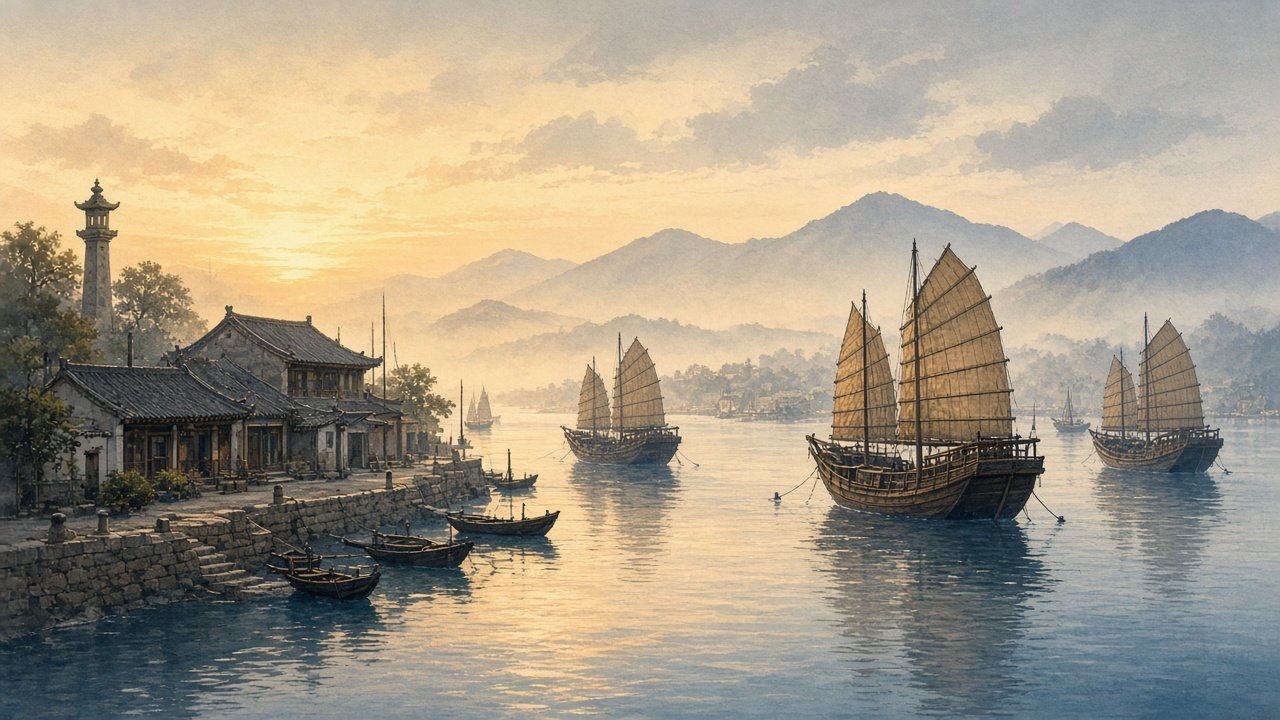
The vessels that made this possible were not romantic props. Chinese junks of the period — with their watertight bulkheads, stern-mounted rudders, and battened sails — were among the most capable ocean-going designs of their age. Quanzhou’s shipyards and merchants sat inside a wider coastal economy that treated the South China Sea less as a barrier and more as a working highway.
What matters for a reader today is not nostalgia for junks. It is the mindset. Quanzhou’s prosperity came from connection: knowing who wanted what, which monsoon window to catch, which goods kept value across long distances, and how to keep foreign partners coming back. Soft power, before the phrase existed, looked like trust, credit, and reliable harbour rules.
Quanzhou’s golden age did not last forever. Silting, political upheaval, shifts in imperial policy, and the rise of other ports rearranged the map. Later centuries of European maritime expansion rewrote the global narrative around Atlantic and colonial routes. In many textbooks, China’s ocean story jumps awkwardly from Zheng He to “opening up” after 1978, as if the centuries between were empty water.
They were not. Coastal communities kept trading, migrating, and sending remittances. The Hokkien and Teochew diasporas that spread across Southeast Asia carried commercial habits and family networks that still matter in Singapore, Malaysia, Indonesia, and beyond. Quanzhou’s decline as the hub did not erase the maritime habits it helped form.
In recent decades, China has deliberately rediscovered this history. Quanzhou appears in heritage campaigns, museum exhibitions, and the language of contemporary connectivity — the idea that China’s past relationship with the sea legitimates a present one. That use of history is never neutral. States always choose which ancestors to amplify. Still, the underlying archaeology and foreign accounts are real enough: Quanzhou was not a provincial footnote. It was a world city by the standards of its time.
Three lessons travel well.
First, China’s “opening” is older than the slogans. Periods of intense international exchange are part of the historical record, not a Western gift bestowed in the late twentieth century. Understanding that complicates lazy binaries of closed empire versus open West.
Second, infrastructure is culture. A deep harbour, customs procedures, multilingual brokers, and ships that could survive monsoon routes were as important as any single invention. Today’s ports, undersea cables, and logistics parks sit in the same family of ambition: make distance profitable and predictable.
Third, cosmopolitanism leaves residue. The stones and scripts in Quanzhou remind us that globalisation has always been uneven, local, and sticky. People convert, settle, argue, and build. Empires rise and fade; the residues remain for anyone willing to look past the postcard version of Chinese history.
None of this requires romanticising the past. Medieval trade involved hierarchy, risk, and violence like every other maritime age. Quanzhou was not a utopia. It was a working port that briefly stood near the centre of Afro-Eurasian exchange — and then, like most centres, it moved.
Walk the old streets today and you will find a modern Chinese city layered over older bones. That layering is the point. China’s story about itself is often told through dynastic capitals and continental frontiers. Quanzhou insists on another line: the coast, the monsoon, the foreigner who stayed, the merchant who calculated wind and price in the same breath.
For a blog about China — technology, culture, history, and the future — Quanzhou is a useful harbour. It shows that looking forward without looking seaward is only half a map. The ships have changed. The question has not: who connects whom, on what terms, and whose harbour becomes the place the world has to know?