In 1951, an American singer named Frankie Laine took a song to number three on the Billboard charts, a breezy love tune with an insinuating rhythm and an English lyric about a flower. The song was “Rose, Rose, I Love You”, and beneath the American lyric it was, note for note, “Meigui Meigui Wo Ai Ni”, a Shanghai dance-hall number from 1940, composed by Chen Gexin and first recorded by the singer Yao Lee for the Pathé label. It remains the only song of Chinese origin ever to become a major American pop hit, and it was not an accident or an outlier. It was a leak from an ecosystem: for twenty years, from the late 1920s to the late 1940s, Shanghai was the pop music capital of Asia, a city where Chinese melody met American jazz orchestration in the dance halls and recording studios of the concessions, and the music they made together, the style called shidaiqu, is the ancestor of every Mandarin pop song sung today. The previous essay on this site told the story of Shanghai’s golden-age cinema. This is the sound that came with it, and out of it, and beyond it: the story of when Shanghai sang.
The father of the yellow music
Chinese pop begins with one man, and he was not a gangster, an impresario or a foreigner, but a schoolteacher. Li Jinhui was a Hunanese music educator and composer, a veteran of the May Fourth world, who believed passionately that China needed a modern vernacular music as much as it needed a modern vernacular literature, and that the way to build it was to start with children. Through the 1920s his song-and-dance troupes, culminating in the famous Bright Moon Song and Dance Society, toured China and Southeast Asia with children’s operettas, charming, modern, mildly scandalous shows that trained a generation of performers in the new style. Then, in 1927, came the song that changed everything: “Drizzle”, Maomao Yu, a lilting love song in a modern idiom, recorded by Li’s own teenaged daughter Li Minghui, and generally counted as the first Chinese popular song. It was an instant, enormous hit, and it established the template: a melody rooted in Chinese folk modes, harmonized and orchestrated in the Western manner, sung in an intimate, conversational voice about recognizably modern feelings. Li Jinhui kept writing hits, his troupe kept producing stars, and by the early 1930s the formula had an industry.
It also had enemies, and the fight over Li Jinhui’s music is one of the funniest and most revealing culture wars of the Chinese twentieth century. To the serious men of the left, the new pop was “yellow music”, a term borrowed from the era’s colour coding of indecency: decadent, effeminate, a soporific for a nation that needed marching songs. The attack had a face: Nie Er, a fiery young Yunnanese composer who had himself trained in Li Jinhui’s Bright Moon troupe, turned on his mentor in print and argued that music should arm the people, not lull them. History granted both men their monument. Nie Er, who drowned in Japan in 1935 aged twenty-three, left behind the “March of the Volunteers”, written that year for a Shanghai film, which is now the national anthem of the People’s Republic of China. Li Jinhui’s love songs, condemned in the same decades by the Nationalists as demoralizing and by the Communists as decadent, outlived both condemnations and became the foundation of Mandopop. The anthem and the love song were born in the same studios, within a few years of each other, from men who had worked in the same troupe. Shanghai’s pop golden age contained, as the city itself did, all the contradictions of the century, playing simultaneously, in adjacent ballrooms.
The campaign against the yellow music was fought with real bureaucratic energy, and its details illuminate the era better than any manifesto. Nie Er’s polemics, published under pen names in the Shanghai press in the early 1930s, accused Li Jinhui by name of poisoning the nation’s youth with soft, effeminate tunes while the country faced invasion. The Nationalist government, whose New Life Movement disapproved of dancing on principle, periodically banned lists of songs, Li Jinhui’s titles featuring heavily, and police in more puritanical districts occasionally raided establishments for playing them. The bans did what bans on pop music generally do: they conferred glamour. Li Jinhui defended himself with the reasonableness of a born educator, arguing that a nation of four hundred million could not subsist on marching songs alone, and that a people without love songs would not long remain a people worth defending. He lost the argument politically, was harassed, bankrupted more than once, and died in straitened circumstances in 1967, during the Cultural Revolution, which took a predictably dim view of “Drizzle”. His vindication was total but posthumous: today he is honoured in China, officially, as the father of Chinese popular music, and the songs once banned as decadent are taught as classics. The arc of the verdict took eighty years, which in the twentieth century was about average for being right too early.
The machine that made the hits
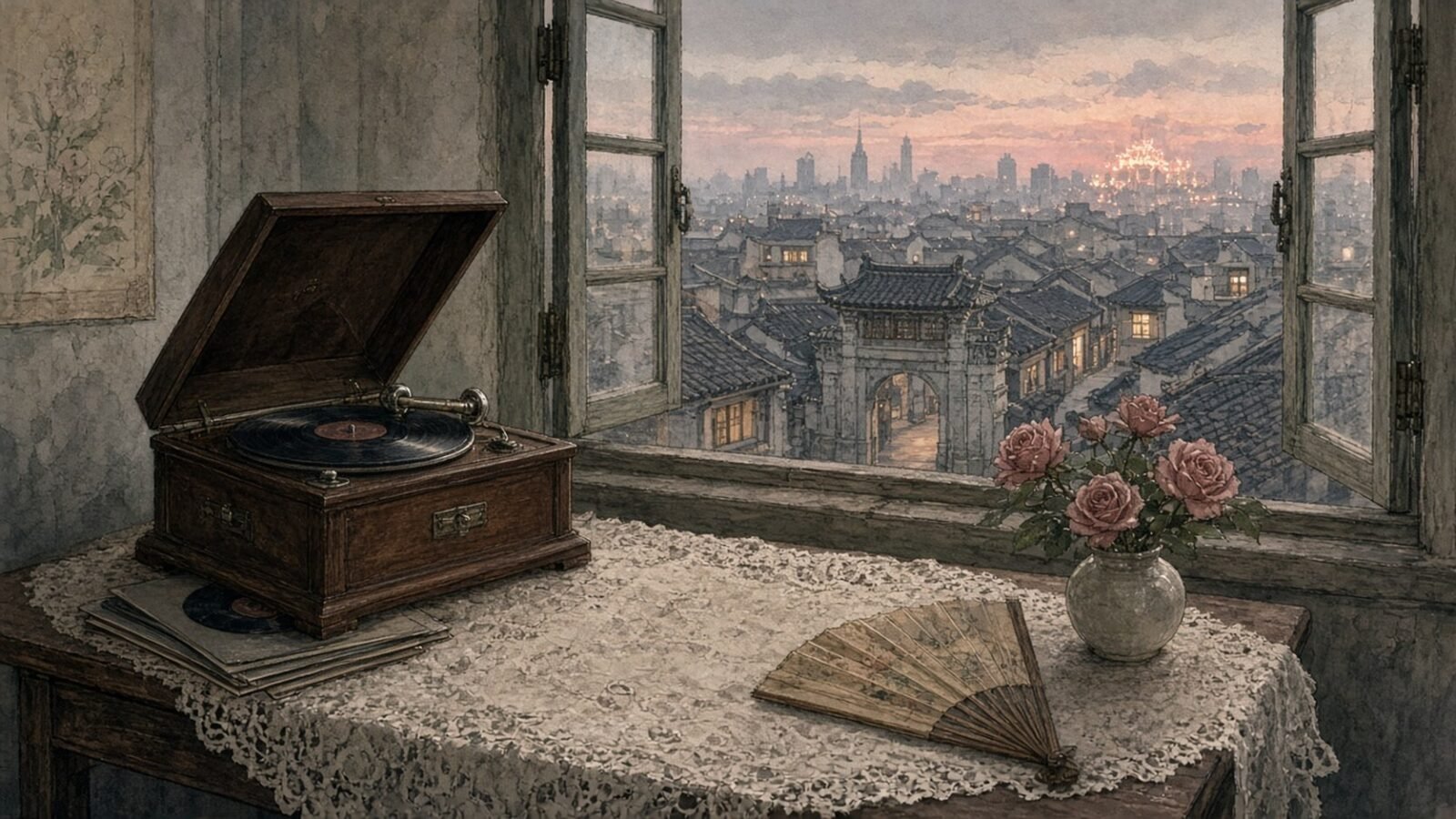
By the mid-1930s the Shanghai music industry was a fully modern hit factory, and its infrastructure deserves description, because it was the first of its kind in Asia. At its centre sat the record companies, above all Pathé, the French firm whose Shanghai operation, with its famous rooster logo, dominated the market, with EMI’s Chinese operation behind it. The Pathé studios on the premises of its Shanghai plant recorded hundreds of sides a year, and the company’s name was so dominant that “Pathé” became, in Shanghai usage, practically a synonym for a gramophone record. Radio did the marketing: the concessions hosted dozens of stations, Chinese, foreign and mixed, and the airwaves were saturated with the new songs, sponsored programmes, and live relays from the dance halls. And the dance halls were the glamorous front end of the machine: the Paramount, the art-deco palace on Bubbling Well Road that billed itself as the number-one dance hall in the Far East; Ciro’s; the Majestic; the ballroom of the Canidrome, where, as the previous essay noted, Buck Clayton’s Harlem orchestra held residency in the mid-1930s and a young trumpeter learned the trade before going home to join Count Basie.
The musicians were a microcosm of the city. The best dance bands in Shanghai were for years substantially Filipino, since the American colonial music education system in the Philippines had produced Asia’s finest jazz players, and Shanghai’s ballrooms recruited them by the boatload. White Russian refugees filled orchestras and cabarets. Chinese arrangers and composers, Li Jinhui, his equally gifted younger brother Li Jinguang, Chen Gexin, and a dozen more, learned to write for the full jazz orchestra, and the records they made fused the two traditions with increasing sophistication: pentatonic melodies carried by saxophone sections, Jiangnan silk-and-bamboo turns of phrase over a four-beat swing, muted trumpets answering erhu-like vocal slides. The result sounded like nothing else on earth, and it was instantly recognizable, then and now, as the sound of Shanghai.
To feel the machine working, spend an evening at the Paramount around 1935. The hall’s exterior tower, floodlit, could be seen down the length of Bubbling Well Road; inside, the main ballroom held a thousand dancers on a genuinely sprung wooden floor, with a glass floor below for variety acts and a rooftop garden for the summer. Entry bought you the right to watch; dancing cost extra, and it was metered. The dance halls employed hundreds of taxi dancers, young women, mostly, from the city’s teeming lower-middle class, who sold their time by the book of dance tickets, each coupon redeemable for one dance with a hostess of the customer’s choice. The system was genteel in form and industrial in fact: the hostesses were paid by commission, the famous ones were stars with followings and write-ups in the tabloids, and the marriages that occasionally resulted, a banker’s son and a dance-hall queen, fed the gossip pages for weeks. It was the frontier where the new music met the new society, and it was watched by everyone: by the moralists, by the police, and by the city’s writers, for whom the dance hall became the essential symbol of Shanghai modernity, with all its glitter and all its undertow.
The records travelled astonishingly far. Shanghai pressings were shipped down the coast and across the South China Sea to Singapore, Penang, Manila and Batavia, where the Chinese diaspora bought them by the crateful, and across the Pacific to the Chinatowns of San Francisco and Vancouver; a hit recorded on the Pathé label could be on a gramophone in a Kwangtung village teahouse within months. The diaspora market was large enough to shape the product: songs were cut in Cantonese versions, troupes toured Southeast Asia constantly, and the phrase “Shanghai tune” became, across the Nanyang, a byword for fashionable modernity. It is worth remembering, when the era is dismissed as a thin veneer over a peasant country, that the veneer had astonishing reach: the shidaiqu catalogue was, in its day, the most widely distributed popular culture ever produced in Asia, and it was made by a single city.
The golden voice
The industry’s greatest star was a woman whose life could have been plotted by its own screenwriters, and in a sense was. Zhou Xuan was born around 1920, orphaned or sold in earliest childhood, she never knew the full truth of her origins, raised in a song-and-dance troupe, and pushed on stage as a child. Her voice was small, pure and plaintive, not a belter’s instrument but an instrument of intimacy, and in the era of the microphone intimacy was the technology that mattered. She became the Golden Voice, the queen of the Pathé catalogue, and when the film Street Angels made her famous in 1937, her rendition of “The Wandering Songstress”, the lament of a country girl singing for customers in a teahouse, became the era’s signature recording. Over the following decade she made more than forty films and recorded some two hundred songs, and her off-screen life ran the doomed gamut of the star vehicle: bad marriages, crooked management, breakdown. She died in 1957, aged thirty-nine, after years in and out of psychiatric care, having become, like Ruan Lingyu before her, one of the city’s secular saints: the beautiful voice that the century used up.
Zhou Xuan stood at the head of a pantheon. The industry crowned, in the 1940s, its Seven Great Singing Stars, and the list reads like a map of the style’s possibilities: Bai Hong, Gong Qiuxia, Yao Lee, who sang “Rose, Rose, I Love You” and lived to hear it crooned back from America; Bai Guang, the deep-voiced, smoky contralto of the late 1940s; Wu Yingyin, whose “Stars and Moon” would be resurrected for a new century; and, strangest of all, Li Xianglan. Li Xianglan was, in fact, Yamaguchi Yoshiko, a Japanese actress and singer raised in Manchuria, presented to Chinese audiences as Chinese, and for four years one of the biggest stars in the occupied territories, her signature song, “Ye Lai Xiang”, “Fragrance of the Night”, composed by Li Jinguang in 1944, became the single most enduring recording of the whole era. After the war she was tried for collaboration as a traitor, proved her Japanese nationality, was acquitted, deported, and went on to a long Japanese career in film and, eventually, twenty years in the upper house of the Japanese Diet. There is no neater emblem of the era’s entanglements: the most beloved Chinese song of the 1940s, sung by a Japanese star passing as Chinese, written by the brother of the founder of Chinese pop, and later adopted, adopted still, by everyone.
The writers at the next table
The music also had a literature, and it was one of the glories of the period. The writers called the new-sensationists, Liu Na’ou, who had run a bookshop and a film magazine, and above all the prodigy Mu Shiying, invented a prose to match the sound: syncopated, neon-lit, drunk on speed and modern surfaces. Mu Shiying’s “Shanghai Foxtrot”, written in 1932 when he was twenty, is the set piece of the whole school, a story that reads like a night at the Paramount scored for typewriter, all headlights, dance tickets, jazz and urban loneliness, and its technique, the montage, the fragmented rhythm, the city as pure sensation, was as modern as anything being written in Europe at the same moment. These writers were not observers of the music scene; they were its patrons and its products, and their fiction is the best surviving evidence of what the dance halls felt like from the inside, the exhilaration and the hollowness in one rhythm.
A decade later the greatest of all Shanghai writers, Eileen Chang, would write her stories and essays in a city under occupation, with the gramophone playing and the dance halls still open, and her work is saturated with the world this essay describes: the radio leaking through the wall, the neighbour’s phonograph, the taxi dancer’s hard economics, the cheongsam silhouettes against the blackout curtains. Chang understood the era’s secret, that in a time of catastrophe the love song is not an escape from reality but one of the places reality is kept. Her wartime stories, detached, ironic and devastating, are the literary twin of the late shidaiqu: beautiful surfaces, meticulously rendered, with grief audible underneath. Between them, the new-sensationists at the height of the boom and Eileen Chang at the end of it bracketed the whole era in prose, and it is impossible now to hear “Night Shanghai” without hearing it the way they wrote it, as the sound of a city that knew the music could not last and danced anyway.
War, exile, afterlife
The industry survived the war’s beginning, at a price. During the occupation years, from 1937 in the north of the city and 1941 in the concessions themselves, the studios and ballrooms kept working under Japanese control, and the music of the occupation era has carried an ambiguous aura ever since: lovely songs, compromised circumstances. After 1945 came a brief, brilliant final flowering, the years of “Night Shanghai”, the 1946 song by Chen Gexin that serves now as the era’s own anthem, its lyric a postcard of the neon city, sung by Zhou Xuan in one of her last great roles. Then history closed the ballroom doors. The civil war’s inflation ruined the entertainment economy; in 1949 the new government took a dim view of yellow music, and shidaiqu, like so much of treaty-port Shanghai, emigrated. The studios, the stars, the arrangers and the songs moved south to Hong Kong, where Mandarin pop enjoyed a second golden age in the 1950s, and later to Taipei. On the mainland the style survived only as a half-remembered hum, until the reform era’s most surprising cultural import arrived in the late 1970s on smuggled cassettes: Teresa Teng, the Taiwanese singer whose sweet, intimate style was shidaiqu’s direct grandchild, and whose voice, illicit at first, then irresistible, taught two generations of mainlanders what a love song was. The line of descent is direct and documented: Li Jinhui’s “Drizzle” to Zhou Xuan’s “Wandering Songstress” to the Hong Kong exiles to Teresa Teng to the entire Mandopop industry of today.
What the music was
It is tempting to treat the shidaiqu story as nostalgia, and the city’s own nostalgia industry has obliged: the songs are back, the dance halls restored, the Bund’s peace hotel keeps a jazz band of elderly gentlemen playing “Night Shanghai” for tourists, and the style’s sepia glow is now a Shanghai brand. But the golden age deserves to be taken seriously on its merits, because it solved, twenty years early, the problem that the rest of Chinese culture spent the century wrestling with: how to be modern and Chinese at once, without apology in either direction. The classical tradition’s answer had been reverence; the revolution’s answer had been rupture. Shanghai pop’s answer was jazzier and more durable: take the folk melody your grandmother hummed, hand it to a brass section, put a new lyric about a taxi or a telegram on top, and let the dance floor decide. The fusion was not dilution. Listen to “Ye Lai Xiang” today and the Chinese line of the melody is unmistakable and intact, riding on a rhythm section that would have been at home in Los Angeles. Nobody who danced to it felt they were betraying anything. They were, for the length of a song, entirely at home in the modern world, and that is a larger achievement than it sounds, and a more durable one than any of the era’s manifestos managed.
There is a footnote that ties the whole story into a bow. Chen Gexin, who wrote “Rose, Rose, I Love You” and “Night Shanghai”, the era’s most cosmopolitan composer, had a son. The son, Chen Gang, trained in the classical tradition at the Shanghai Conservatory, and in 1959, with his classmate He Zhanhao, composed the work that would become the most beloved piece of Chinese orchestral music ever written: the Butterfly Lovers Violin Concerto, which takes a Shaoxing opera love melody and carries it on a full Western orchestra to tell the old story of the lovers who become butterflies. The father’s trick, folk melody, Western orchestra, no apology, had become the son’s masterpiece, in a country that had banned the father’s music. The tune survived the politics, which is what tunes are for. Shanghai’s golden age lasted twenty years and has lasted, in that sense, a century: every time a love song in Chinese finds its melody and its backbeat at once, somewhere in the arrangement you can still hear the Paramount’s sprung floor, the Pathé rooster, and the small, pure voice of the Golden Voice, singing about a wandering girl, in the city that taught China how to sing to itself.