
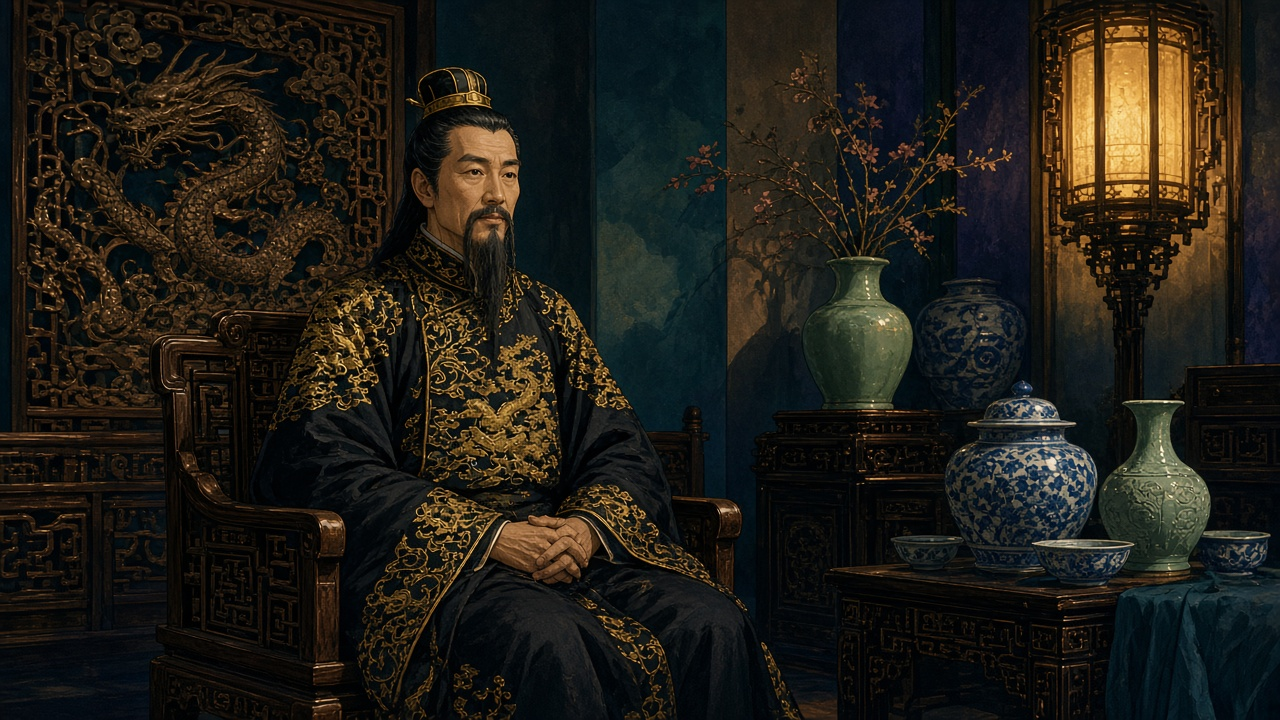
Sax Rohmer’s Fu Manchu was already half a century old when Christopher Lee put on the makeup. This site has treated Rohmer’s novels and their Western reception elsewhere; the point here is the 1960s screen revival, not a second digest of the whole literary career. Producer Harry Alan Towers, writing scripts as Peter Welbeck, relaunched the devil doctor in colour for a British West German market hungry for exotic thrillers. Five films followed in quick succession: The Face of Fu Manchu (1965), The Brides of Fu Manchu (1966), The Vengeance of Fu Manchu (1967), The Blood of Fu Manchu (1968), and The Castle of Fu Manchu (1969). Lee played the title role in all five. Tsai Chin played his daughter Lin Tang through the cycle. The result was not a prestige literary adaptation. It was a pulp franchise under cost pressure, held upright by Lee’s voice, posture, and professional seriousness.
The historical frame matters. Rohmer’s early books belong to Edwardian and wartime Yellow Peril fiction: Chinese genius as organised threat to white civilisation, chased through Limehouse fog by Nayland Smith. By the mid 1960s the geopolitical enemy lists of Western popular culture had shifted toward Soviet conspiracy, nuclear dread, and Bond style master criminals. Towers’s Fu Manchu films keep the Chinese mastermind and the Si Fan atmosphere, yet they often play like Cold War adventure with an older racial costume. Secret weapons, kidnappings of scientists, mind control, and world domination plots sit closer to contemporary spy cinema than to 1913 magazine serials. Lee’s Fu Manchu becomes a Cold War villain wearing a Qing revival mask. That combination is why the cycle feels both dated and oddly modern.
Casting Lee was the production’s sharpest decision. By 1965 he was internationally known for Hammer horror and for a gallery of imposing antagonists. He brought height, precise diction, and a refusal to wink at the audience. Even when the sets look thin, Lee plays absolute belief: a civilisational enemy who considers Western heroes provincial. Yellowface casting was standard industrial practice for this character from the Boris Karloff years onward; Lee continued that practice. Chinese and diasporic critics then and later called the type demeaning. The films themselves do not debate the point. They sell the type. A factual review can register both Lee’s craft and the racial convention without turning the paragraph into a campus tribunal or a nostalgic denial.
The Face of Fu Manchu, directed by Don Sharp and released in 1965, is the strongest of the five. Shot largely around Dublin, including locations such as Kenure House and Kilmainham Gaol, it has more visual ambition than its sequels. Reported budgets sit around £150,000 or about $700,000, with respectable returns near $1.3 million in period figures. Nigel Green plays Nayland Smith with barked authority; Howard Marion Crawford is Dr Petrie; Tsai Chin establishes Lin Tang as cool executive cruelty beside her father’s grandeur. The plot, summarised without dumping protected dialogue, turns on a fake execution, a Tibetan linked poison extract, and a race to stop Fu Manchu’s blackmail of the West. Sharp keeps geography and pursuit readable. Lee’s entrance and stillness do more than many later action beats. If one film from the cycle still entertains cleanly, it is this one.
The Brides of Fu Manchu (1966), again under Sharp, replaces Green with Douglas Wilmer as Smith. Towers used the picture partly as a showcase for young actresses cast as abducted specialists’ daughters, leverage in a scheme involving forced scientific labour and a destructive transmitter. Entertainment value holds in the first half through Lee’s calm domination and Chin’s icy loyalty. Repetition already shows. Fu Manchu plots world coercion; Smith arrives in time; the base falls; the doctor’s laugh promises return. Sharp later recalled that Towers began to think the franchise could run on story outlines alone. The remark fits the decline curve. Brides is watchable pulp. It is also the moment the series starts consuming its own formula.
The Vengeance of Fu Manchu (1967), directed by Jeremy Summers, continues Wilmer as Smith and shifts more of the action toward an Asian setting in the production’s geography of convenience. The scheme involves discrediting Smith through a double and consolidating underworld power. Lee remains the gravitational centre. Supporting texture thins. Critics and later home video essays commonly treat Vengeance as the hinge between Sharp’s relatively disciplined thrillers and the Jess Franco endgame. That judgment is fair. The film still offers period costume menace and Chin’s presence, but chase mechanics and dialogue scenes feel assembled rather than driven. Cold War paranoia about impersonation and ruined reputations sits inside the older Yellow Peril chassis without deep political thought. Pulp rarely needs deep political thought. It needs pace. Vengeance has less of it.
The Blood of Fu Manchu (1968) and The Castle of Fu Manchu (1969) handed the director’s chair to Jesús Franco and replaced Wilmer with Richard Greene as Nayland Smith. Franco’s cinema is an acquired taste: eroticised atmosphere, wandering tone, and elastic continuity. Applied to Fu Manchu under multinational co production conditions, the results are often cheap looking and narratively slack. Blood sends the doctor into a South American venom plot against world leaders; Castle piles up a freezing ocean scheme, stock footage, and fortress intrigue. Castle in particular has become a byword for franchise exhaustion, sometimes listed among notoriously poor films of its era. Lee’s professionalism still peeks through inserts and speeches, which only sharpens the gap between actor and surrounding production. Tsai Chin remains one of the cycle’s few consistent pleasures, a modern daughter figure who executes policy while Western heroes bluster.
Production cheapness is not a moral category; it is a craft fact. Towers specialised in rapid international packaging: German partners, British stars, sunny or borrowed locations, scripts written to a pattern. The early Sharp films show what that method can still achieve with a strong director and a fresh cast. The Franco films show what happens when the method is asked to replace direction. Sets recycle. Extras stand politely. Special effects announce their budget. Meanwhile Lee hits his marks as if appearing in a tragedy of empires. That mismatch is the cycle’s signature aesthetic, more memorable than any single gadget.
Racism and Yellow Peril framing are historical properties of the texts and films, not optional moods. Fu Manchu’s genius is marked as Chinese; his organisation is marked as Eastern; his defeat is framed as defence of Western order. Lin Tang’s devotion scripts Chinese femininity as glamorous cruelty in family service to the mastermind. Western science is kidnapped and turned against its makers, a fantasy of reverse engineering by a civilisation typed as both ancient and hyper modern. None of that vanishes because Lee acts well, or because 1960s audiences also feared SPECTRE and nuclear blackmail. Nor does acknowledging the frame require a lecture that pretends pulp consumers were uniquely wicked while other decades’ entertainments were pure. Yellow Peril was a real publishing and film vocabulary. These pictures used it. Chinese protests against earlier Fu Manchu screen types already existed. The Towers cycle did not pause for them.
Why call Lee’s version a Cold War villain in particular? Because the threat design matches mid century popular geopolitics more than Qing nostalgia. Secret laboratories, hostage experts, remote control weapons, and cabals that dissolve national borders after a broadcast ultimatum are the grammar of postwar thriller cinema. Fu Manchu’s Chinese identity supplies the exotic brand; the plot engines often could host a Central European or stateless mastermind with only costume changes. Bond had already taught global audiences to enjoy the theatrical villain who explains the device before noon. Lee’s Fu Manchu competes in that marketplace. He loses prestige comparison to the best Bond antagonists, yet he shares their internationalised evil. Rohmer’s Limehouse fog becomes jet age logistics on a shoestring.
Entertainment value, judged film by film without piety, is uneven. Face deserves recommendation to anyone interested in 1960s British thriller craft or in Lee’s non Hammer range. Brides is a lesser companion piece with enough style to finish. Vengeance is for completists. Blood and Castle are instructive as decline specimens and as Franco curios, not as balanced evenings. The Indicator Blu ray grouping of the cycle in later years treated the set as film history rather than as five equal gems, which is the right instinct. Endurance comes from Lee’s iconography, Chin’s presence, and the stubborn afterlife of Fu Manchu as a recognisable silhouette. It does not come from consistent screenwriting excellence.
Lee’s performance craft repays closer attention than the plots. He underplays where amateurs overplay. He treats classical villain courtesy as a form of power: the enemy who need not raise his voice. Makeup and wardrobe do crude racial signalling; Lee adds hierarchical calm, the sense that Western agents are interrupting a long campaign. In interviews across his career he discussed the first film with more respect than the sequels, a judgment that matches the screen evidence. Actors often know when the scaffolding has gone. Viewers can agree without pretending the first film was politically innocent.
Tsai Chin’s Lin Tang is the cycle’s other durable element. A Chinese actress in a major antagonistic role complicated the all whiteface gallery even while the father’s role remained yellowface. Lin Tang is not written as a liberal corrective. She is written as an efficient lieutenant and daughter. Within those limits Chin supplies modernity: fashion, irony, and administrative steel. She often seems to believe the world conquest brief more briskly than the exhausted Western policemen opposite her. That spark keeps scenes alive when Franco’s camera loses interest.
All perspectives include the commercial one. Distributors wanted a known property. Towers wanted repeatable titles. Audiences wanted colour menace between news reports of real wars in Asia. China’s actual politics in the late 1960s were not Rohmer’s Si Fan, yet popular culture rarely waits for Sinology. The films offered a China of underground forts and daughter assassins because that China already lived in Western heads. Chinese viewers who encountered the type abroad met an insult exported as adventure. Western viewers who knew nothing else about Chinese history met a sticky picture. Both receptions are part of the factual record. Neither cancels Lee’s technical merit.
Compare the Towers cycle with earlier Hollywood Fu Manchu and the difference is tone as much as politics. 1930s entries could be sadistic spectacle within studio orientalism. The 1960s films aim for travelogue thriller and serial cliffhanger energy under European co production law. They are less opulent than studio Hollywood at its richest and less disciplined than Hammer at its best. Lee is the continuous quality control. When he leaves the frame, the temperature drops. That is another way of saying the character’s literary menace was always bigger than any one production design, and that Towers rented Lee to paper the gap.
Do the films endure? As art, mostly no, except Face and patches of Brides. As cultural evidence, yes. They show how a Yellow Peril brand survived into the television age by borrowing Cold War thriller hardware. They show British horror stardom migrating into international junket cinema. They show a Chinese British actress carving presence inside a compromised template. They show a producer’s faith that the laugh at the end would sell the next contract. Home video archaeology has been kinder than theatrical memory, because decline sequences are interesting to historians even when they are tiresome to casual viewers.
Contemporary reviews were mixed in the expected way. Trade papers noticed the first film’s energy and Lee’s marquee value. Later entries drew shorter notices and harder shrugs. Asian American and overseas Chinese commentary, when it registered the cycle at all, tended to file it under the long complaint against Fu Manchu rather than under auteur debate about Franco. That split reception continues: film nerds argue Sharp versus Franco; cultural historians argue stereotype continuity.
The Cold War label should not be oversold into allegory hunting. These scripts do not encode a precise reading of Beijing politics in 1966. They encode Western thriller habits during a decade when Asia was on television as war zone and when master villain cinema was a reliable export. Fu Manchu’s Chinese costume let producers claim literary heritage from Rohmer while staging threats that felt current: toxins, broadcasts, kidnapped expertise. Allegory is optional. Market mimicry is obvious.
Legal and distribution trivia shaped later memory. Rights fragmentation made complete sets hard to see for years, which preserved Face as a semi orphan favourite and left Castle as a rumour of awfulness. Restorations and boxed cycles reversed that scarcity. Scarcity had protected reputations unevenly; abundance lets viewers rank the five with their own eyes. Ranking them honestly is kinder to Lee than pretending uniform quality.
One more comparative note: Hammer’s Dracula films gave Lee mythic continuity inside a coherent studio style. Towers’s Fu Manchu films gave him mythic continuity inside an incoherent production system. The same actor can look monumental or stranded depending on the frame rate of competence around him. That is not mystique. It is labour conditions made visible.
If the cycle has a teaching use beyond entertainment, it is as a compact exhibit of how older racial pulp adapts to new thriller technology without abandoning its brand face. Students can watch Face, then Castle, and measure decline as industrial process. They can also place Tsai Chin’s performance beside Lee’s and ask what changes when one lead is cast within ethnicity and the other is not. Those questions are analytical. They do not require a sermon, and they do not require denial.
A fair final ledger looks like this. Rohmer supplied the racist pulp premade. Towers supplied the package. Sharp supplied the only sustained direction. Franco supplied entropy. Lee supplied belief. Chin supplied edge. Green, Wilmer, and Greene supplied three grades of imperial policeman. The Yellow Peril frame remained the condition of the character’s recognisability. The Cold War thriller frame kept the plots legible to 1960s ticket buyers. Christopher Lee did not redeem Fu Manchu into a progressive text. He made him stand up straight in colour while the scaffolding cracked. That is a narrower achievement than moral transformation, and a real one.
For readers arriving from the Rohmer essay, the screen cycle is the brand’s mid century afterlife rather than its origin. For readers arriving from film history, it is a case study in how star presence and franchise logic interact under thin capital. Either path leads to the same concrete claim. Between 1965 and 1969, Fu Manchu on screen was Christopher Lee’s voice against a map of stolen scientists and secret weapons, with Tsai Chin at his side and Harry Alan Towers counting locations. Call that entertainment, call it residue of Yellow Peril, call it Cold War cosplay in mandarin dress. It was all three. The films remain easiest to defend when they are described accurately rather than laundered or anathematised.