
Chinese cinema has produced many expensive spectacles. Few have changed what audiences expect from a Chinese cartoon. The Ne Zha films did. The first, directed by Yang Yu under the pen name Jiaozi and released in the summer of 2019, turned a Ming dynasty boy god into a box office champion that Hollywood animation could not ignore inside China. The sequel, which opened on the first day of Chinese New Year in 2025, went further. It became the highest grossing film in Chinese history and, by the tallies that matter for global charts, the highest grossing animated feature ever made. This essay explains how that happened: the myth underneath the IP, the production story, the numbers that are real rather than promotional, the industry meaning, the soft power argument that followed, and the limits that remain.
The boy god audiences already knew
Nezha is not a character invented for merchandising. In Chinese folk religion and literature he is a child deity of martial protection, rebellion, and costly loyalty. The version that most modern viewers know comes from the Ming dynasty novel Investiture of the Gods, or Fengshen Yanyi, traditionally associated with Xu Zhonglin. In that telling Nezha is the third son of Li Jing, the garrison commander at Chentang Pass. He is born from a miraculous pearl, trained by the immortal Taiyi Zhenren, and soon collides with the Dragon King of the East Sea. After killing the dragon prince Ao Bing, Nezha sacrifices himself so that his parents will not be punished. He is later remade in a body of lotus flowers, then drawn into the larger war that ends the Shang dynasty and installs the Zhou.
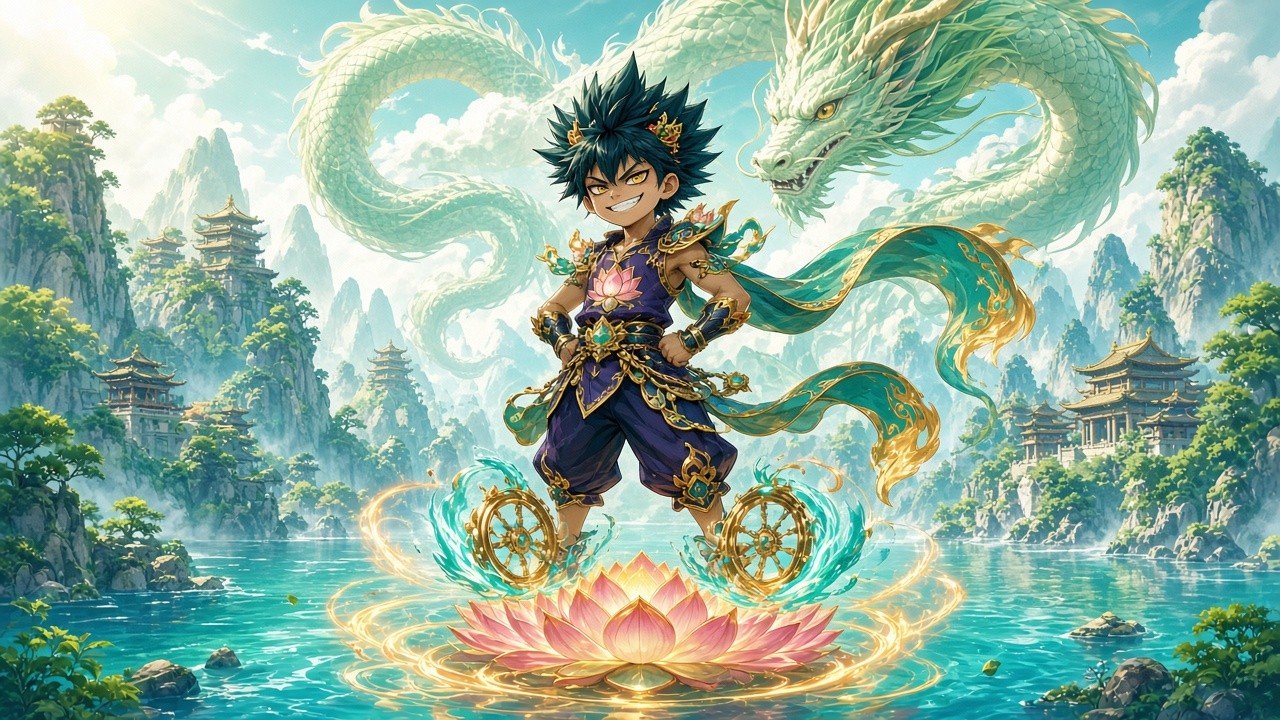
Scholars and popular explainers also stress an older layer. The name and some traits track back to Buddhist and Indian protective figures, often linked to Nalakuvara, which Chinese religion and opera then folded into a Daoist pantheon and a Confucian concern with filial duty. The Oedipal sharpness of some early motifs was softened. The self sacrifice that returns flesh and bone to the parents became a moral climax rather than a pure act of rage. Journey to the West keeps Nezha as a capable heavenly fighter. The result is a figure ordinary Chinese audiences recognise without footnotes: impulsive, armed with the Universe Ring and Wind Fire Wheels, forever half child and half weapon.
That familiarity is the first commercial fact. A studio that puts Nezha on a poster is not introducing a stranger. It is arguing about what the stranger means now. Chinese New Year and summer audiences already bring childhood temple images, television serials, and playground boasts about fire tipped spears. The films did not create recognition. They redirected it.
An earlier screen Nezha, briefly
Before computer graphics, the decisive animated landmark was Nezha Conquers the Dragon King, released by the Shanghai Animation Film Studio in 1979. Directed by Wang Shuchen, Yan Dingxian and Xu Jingda, it was the studio’s second cel animated feature and China’s first widescreen animated film. It played out of competition at Cannes in 1980 and later reached British television under a different English title. Coming after the Cultural Revolution, it helped return Chinese animation to mythological subjects and to a craft tradition often labelled national style: ink influenced design, opera colour, moral clarity.
That Nezha is an innocent hero child who fights dragons for the town. Jiaozi’s later redesign would keep the mythic furniture and change the psychology. The 1979 film remains the ancestor Chinese viewers of a certain age still recall. It is also the standard against which critics measure whether a new version is updating a classic or merely borrowing a brand. Later television adaptations and live action Fengshen films kept the name in circulation without solving the industrial problem the 2019 feature finally cracked: how to make a Chinese cartoon feel like a national event rather than a classroom treat.
How the 2019 film was made and what it earned
Ne Zha, Chinese title Nezha: Birth of the Demon Child, was Jiaozi’s first feature. He wrote and directed it for his Chengdu studio Coco Cartoon, with Beijing Enlight Pictures as the major producer and distributor. Enlight’s Coloroom animation label had been building a slate of Chinese myth and fantasy titles through the mid 2010s, after Monkey King: Hero Is Back in 2015 showed that domestic computer animation could draw adult ticket money. Jiaozi spent about two years on the script and three years in production. Public accounts of the shoot cite more than 1,318 visual effects shots, more than twenty Chinese effects houses, and more than 1,600 people. The reported budget was about twenty two million US dollars, modest by Hollywood franchise standards and large by earlier Chinese animation norms.
The story loosens Investiture of the Gods into a modern parable. A Chaos Pearl is split into a Spirit Pearl and a Demon Orb. Through sabotage, Ne Zha is born of the Demon Orb and marked for destruction by heavenly lightning after three years. Townspeople fear his appearance and temper. His parents and master try to raise him as a hero while hiding the prophecy. Ao Bing, born of the stolen Spirit Pearl as a dragon prince, becomes his only real friend. The film’s emotional engine is prejudice and fate: whether a child defined as a demon can choose otherwise. The redesign makes Ne Zha deliberately ugly and abrasive so that audiences must earn their sympathy. Catchphrase culture that followed, including lines about defying destiny, turned a mythic rebel into a youth identification figure for people who felt typed by school, family, or class before they could speak for themselves.
Release timing was careful. After a Beijing premiere on 11 July 2019, the film opened in IMAX and other large format screens on 13 July, then went nationwide on 26 July. It took roughly ninety one and a half million dollars on opening and about six hundred million yuan in its first three days. By the end of 2019 mainland receipts had crossed five billion yuan, making it China’s box office champion for the year. Worldwide tallies settled near seven hundred and forty three million dollars, almost all from China. Well Go USA released it in North America from late August, where it earned only a few million dollars. China still submitted it as its entry for Best International Feature at the ninety second Academy Awards, the first Chinese animated film so chosen. It was not nominated. Domestic critics and audiences were warmer: Douban scores hovered around eight point four, and Chinese industry awards followed, including a Golden Rooster for best animated feature and a Hundred Flowers screenplay prize for Jiaozi.
Reception abroad was thinner but not hostile. English language review aggregates were positive on small samples of professional critics, while Metacritic’s middling average reflected how few Western outlets treated the film as a major release. The pattern foreshadowed the sequel: enormous Chinese consensus, polite and partial foreign notice, and a hard ceiling set by language, marketing budgets, and the absence of a global children’s television pipeline that Disney and Japanese studios spent decades building.
What the first hit meant for Chinese animation
For years Chinese theatrical animation had lived in the shadow of imported Hollywood and Japanese work. Families bought tickets for Zootopia or Frozen as event cinema. Domestic titles were often treated as children’s filler or as patriotic craft exercises. Ne Zha changed the booking maths. It overtook Zootopia as the highest grossing animated film in China at the time and proved that a Chinese studio film, without famous voice stars, could clear summer grosses that rivalled live action national hits.
Industry structure mattered as much as one director’s talent. Enlight Media, a listed private entertainment group, used Coloroom as a portfolio of animation teams rather than a single in house factory. That model spread risk across titles such as White Snake and later Jiang Ziya, while concentrating marketing muscle when a film broke out. The wider policy climate favoured cultural products that could carry Chinese stories abroad, but the 2019 film itself was a commercial bet paid back by Chinese ticket buyers. State celebration came after the receipts, not instead of them. Officials could praise a market success more cheaply than they could manufacture one.
There was also a universe experiment. In 2020 Enlight released Jiang Ziya, sometimes called Legend of Deification, as a related Fengshen title. After a pandemic delay it opened on National Day and earned on the order of two hundred and forty million dollars worldwide, respectable yet far below Ne Zha. The lesson was blunt. Shared mythology does not automatically create a Marvel style franchise. Audiences were loyal to Ne Zha’s tone and character design more than to a corporate map of immortals. Chinese animation’s rise, in other words, was uneven: one IP could print money while neighbouring titles in the same myth cycle behaved like ordinary releases.
Ne Zha 2 and the scale of 2025
The direct sequel, Ne Zha 2, Chinese title Nezha: The Demon Child Churns the Sea, opened in China on 29 January 2025, the first day of the lunar new year holiday. Jiaozi again wrote and directed. Reported budget rose to about eighty million dollars, or roughly six hundred million yuan. Production involved nearly two thousand effects shots and more than one hundred and thirty Chinese animation and effects companies. East Asia Forum reporting noted that Jiaozi initially looked abroad for effects help and found little interest, then relied on domestic capacity such as Base FX. The film continues Ne Zha and Ao Bing’s story into a larger conflict with sea powers and immortal bureaucracy, keeping the first film’s mix of slapstick, pathos, and fight spectacle at a longer running time of about one hundred and forty four minutes.
The domestic run was historic even by China’s large market standards. When mainland theatrical play ended after one hundred and fifty three days, the ticketing platform Maoyan put China grosses at fifteen point four four billion yuan, about two point one three billion US dollars at the exchange rates used in official English reports, from three hundred and twenty four million admissions. That made it both the highest grossing and the most watched film in Chinese cinema history. Global totals at the same moment stood near fifteen point nine one billion yuan, about two point one nine billion dollars. Later aggregators such as Box Office Mojo published worldwide figures above two point two seven billion dollars as overseas play continued. Whatever the final decimal, several claims are stable across major sources: Ne Zha 2 became the highest grossing animated film of all time, the first animated film to pass two billion dollars, and the first film produced outside the Hollywood studio system to do so.
Outside China the story is smaller and more revealing. In North America an early Mandarin release with English subtitles, handled with CMC Pictures and later supported by A24 for English language versions, opened to about seven point two million dollars from roughly six hundred and sixty theatres. The domestic American and Canadian total settled near twenty three million dollars. That is a strong result for a Chinese language animation in those markets, and diaspora audiences in Australia, New Zealand and North America were important. It is still a rounding error beside the China gross. Enlight chairman Wang Changtian said at the 2025 Shanghai International Film Festival that overseas box office might exceed one hundred million dollars, which would be a landmark for Chinese film abroad if achieved in full. Even then, more than ninety eight percent of early revenue was mainland Chinese. The film travelled as cultural news and as niche event cinema. It did not become a default global family title on Disney’s terms.
Merchandising followed the Chinese hit pattern. Enlight reported related goods across more than thirty categories and more than two hundred products, from blind boxes and plushes to figures. That extends IP value beyond the ticket, though public audited merchandising totals remain thinner than the box office headlines. The Spring Festival calendar amplified everything: holiday cinema in China is a social ritual, and Ne Zha 2 became the film people assumed you had seen. Enlight also told investors that Ne Zha 3 is in development and will be held to higher standards. Jiaozi’s team publicly stepped back from interviews to work. A third film is therefore confirmed as an industrial plan, not a rumour, with a multi year timeline implied by the last sequel’s long gestation.
Soft power, pride, and what the films do not claim
Success on this scale inevitably enters politics. Chinese commentary treated Ne Zha 2 as proof that domestic animation had industrial depth and that Chinese myth could hold a mass audience without Hollywood intermediaries. Western commentary split between admiration for the craft and suspicion that any Chinese cultural hit is a soft power operation. Both reflexes need trimming.
What the films do show is a China that wants cultural industries capable of competing on technique and on emotion, not only on slogans. They show pride in telling a Chinese story with Chinese pipelines after decades in which Mulan style Hollywood retellings shaped foreign images of Chinese legend. They also show a youth market hungry for stories about stigma, parental pressure, and choosing a self against a script written by heaven or by neighbours. Those themes are contemporary even when the costumes are ancient. Prejudice against a demon child maps easily onto ordinary experiences of being misread. That is why the first film’s line about destiny travelled further than any ministry talking point.
What the films do not show is a coherent foreign policy. Ne Zha’s rebellion is personal and then reconciled in defence of a community. The politics, if any, are the politics of commercial Chinese cinema under ordinary censorship: conflict is allowed when it resolves into belonging. Wanning Sun, writing for East Asia Forum in March 2025, argued that Ne Zha 2 succeeded as a market product aimed first at Chinese speaking audiences, in contrast to costly state media efforts to go global that often read abroad as propaganda. That distinction matters. Soft power here looks more like a capable product that people choose than like a government leaflet. Beijing can boast afterward. Boasting did not write the shots.
National pride is real and commercially rational when three hundred million tickets are sold at home. It becomes misleading when overseas grosses are narrated as if the world had converted. Chinese animation still punches far below Hollywood in international distribution, brand management, and non myth genres. People’s Daily reporting in February 2025 noted that animation was about twenty seven percent of the North American box office in 2024 but only about sixteen percent of China’s, a reminder that the home market itself is not saturated and that one franchise does not equal a diversified industry. Soft power that depends on one boy god is fragile soft power.
Limits that deserve to stay in the frame
Animation quality debates did not vanish because receipts rose. Some Chinese and foreign critics find the humour broad, the moral arc familiar, and the spectacle ahead of psychological subtlety. Academic writers have praised the films as modern takes on ancient culture while also noting how heavily they borrow the look of international blockbuster CG rather than older ink national style. The 2019 film’s Metacritic average was only middling on a tiny sample of English language reviews, even as Rotten Tomatoes critics were largely positive. Jiang Ziya showed that universe branding can disappoint. Replication is hard: researchers and industry voices after Ne Zha 2 stressed that technology, storytelling, and marketing had to align, and that another accident of timing around Spring Festival cannot be ordered from a ministry.
Censorship is part of the production environment in China, but forcing a heavy political reading onto these particular films adds more heat than light unless new evidence appears. They cleared for the widest possible holiday releases. Their rebellions are framed as fights against prejudice and fatalism, not against the state. An honest essay can note the regulatory context without inventing allegory. Likewise, claims that every frame is nationalist instruction overstate what paying crowds bought: jokes, tears, and a fight between fire and water.
Data hygiene also matters. Yuan and dollar conversions move with the exchange rate and with whether a source counts pre sales or a specific cut off date. Prefer mainland figures in yuan from Maoyan when discussing China, and treat global dollar league tables as living estimates. The industrial fact survives the footnotes. On budgets of tens of millions, Chinese feature animation produced two of the most commercially successful cartoons in history, rooted in a myth every Chinese schoolchild already half knew.
What remains after the records
The Ne Zha films matter because they closed an old argument inside China: whether domestic computer animation could be event cinema rather than a side dish to imports. The 2019 film answered with five billion yuan and a demon child who refused his prophecy. The 2025 sequel answered with more than fifteen billion yuan, hundreds of millions of admissions, and a temporary rewriting of global animation charts. Abroad, the same films remain specialised successes, strong with diaspora crowds and curious critics, still far from the everyday penetration of Pixar or major Japanese brands.
That asymmetry is the real soft power lesson. Cultural confidence at home is now backed by industrial proof. Cultural persuasion abroad still depends on translation, distribution, and stories that do not require a prior education in Fengshen. Ne Zha 3 will test whether the franchise can deepen rather than merely enlarge. Until then, the series stands as the clearest recent case of Chinese feature animation matching mythic memory to factory scale craft, and of a market, not a press release, deciding the size of the phenomenon.