
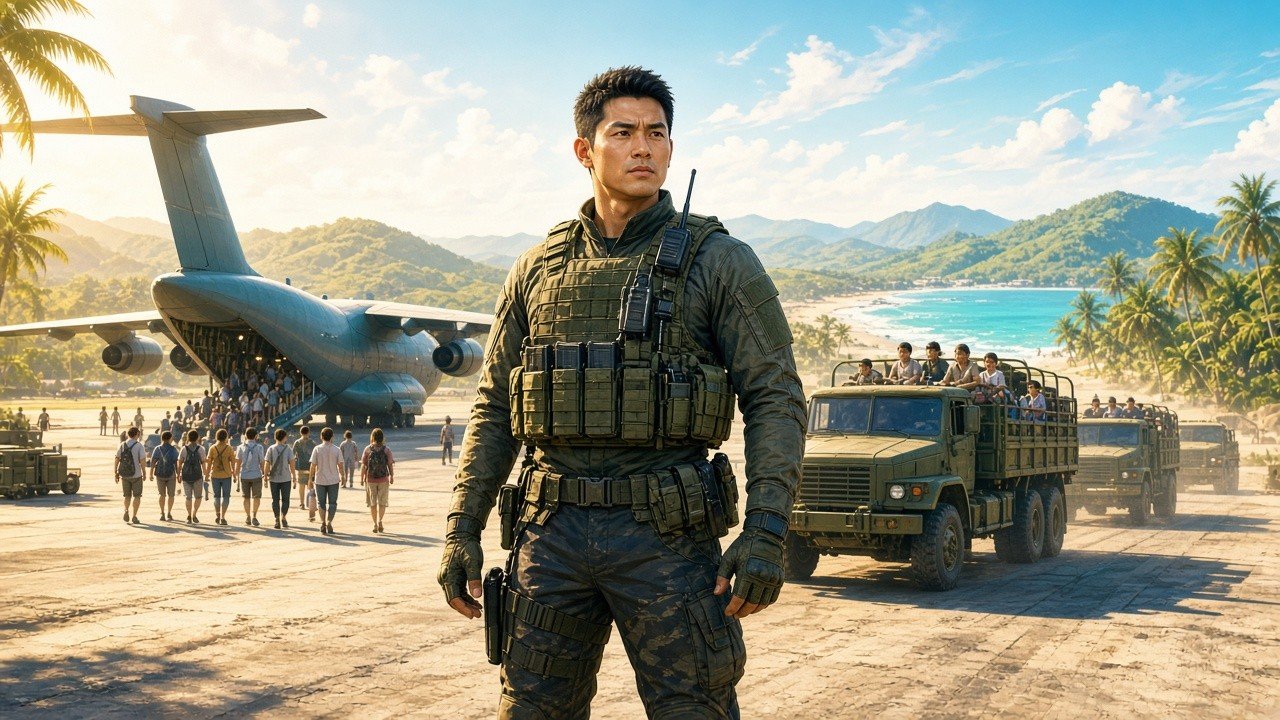
In the mid 2010s Chinese cinemas were already crowded with imported franchises and domestic comedies. What they still lacked, in commercial form, was a modern military action hero who looked and fought like a Hong Kong martial arts star and spoke the language of national protection abroad. Wu Jing filled that gap with Wolf Warrior in 2015 and, more decisively, with Wolf Warrior 2 in 2017. The sequel became China’s highest grossing film for four years, sold about 159 million tickets at home, and entered the global all time box office lists as the first Chinese title to do so. A few years later Western journalists borrowed the film title as a nickname for confrontational Chinese diplomats. The films, the star and the nickname are related, but they are not the same thing. This essay sets out how each piece worked.
Wu Jing’s path from wushu to directing
Wu Jing was born in Beijing on 3 April 1974 into a family of martial artists. At six he was sent to the Beijing Sports Institute at Shichahai. Like Jet Li a generation earlier, he joined the Beijing Wushu Team and won junior national titles. He kept competing as an adult even as height made some routines harder. In 1995 the Hong Kong choreographer Yuen Woo-ping spotted him and cast him in Tai Chi Boxer, released in 1996. That debut put him on a familiar East Asian action path: mainland wuxia television, then Hong Kong cinema.
Through the 2000s he worked with Lau Kar-leung on Drunken Monkey (2003), played a vicious assassin in Wilson Yip’s SPL: Sha Po Lang (2005), and led or co-starred in Fatal Contact, Twins Mission and Invisible Target. He appeared with Jackie Chan, Andy Lau and Nicholas Tse in Shaolin (2011). The skills were never in doubt. What was missing was a durable star persona that Chinese audiences would treat as their own contemporary action lead rather than as a supporting fighter in other people’s films. Sixth Tone later noted that Tai Chi Boxer never launched him the way Shaolin Temple had launched Jet Li. Hong Kong’s action boom was already past its commercial peak, and Wu Jing spent years as a reliable body for hire before he controlled the camera.
He began directing with Legendary Assassin in 2008, co-helming with action choreographer Nicky Li. Wolf Warrior, released in April 2015, was his first major solo director-star vehicle and, by several accounts, a long planned passion project. The People’s Liberation Army’s Nanjing Military Region gave substantial practical support: weapons, vehicles and training access that older state studio war films once monopolised but that commercial cinema had rarely used for a contemporary story. Wu Jing told Chinese media that producers had long been wary of modern war themes because they seemed less likely to draw female audiences, who had become a driving force at the Chinese box office. He was not inventing patriotism. He was packaging it as a summer action product with Hollywood pacing and his own body as the selling point.
The first Wolf Warrior film in 2015
Wolf Warrior, or Zhan Lang, follows Leng Feng, a PLA sniper who ignores an order to hold fire and kills a drug lord during a raid. He is punished, then recruited by Lieutenant Colonel Long Xiaoyun into an elite unit nicknamed the Wolf Warriors, which trains by simulating foreign tactics. The dead man’s brother hires a squad of foreign mercenaries led by Tom Cat, played by Scott Adkins, a former Navy SEAL type on the page, to kill Leng Feng. A training exercise on China’s southern border turns into a real ambush. The plot stretches into mines, traps and a scheme involving a genetic weapon aimed at Chinese people. The tone is blunt. Promotional lines promised that anyone who offended China, no matter how far away, would be made to pay.
The film opened in China on 2 April 2015. Reporting at the time put the production budget near 12 million dollars. Domestic box office reached about 545 million yuan, roughly 89 to 90 million dollars worldwide depending on conversion. That was a solid hit rather than a once in a generation event. It topped the Chinese chart in its opening stretch, then competed with Furious 7. End credits already teased a sequel.
Reception split along predictable lines. Many Chinese viewers welcomed a contemporary military film that looked more like Hollywood war action than the older August First Studio style. Early Douban scores sat in the mid sevens. Western trade reviews were cooler. Variety called the direction crude and the plot gag worthy even while noting the commercial incursion. Chinese critics who liked the weapons and fight craft still often found the script thin. Global Times coverage treated the film as a pathfinder for a commercial military genre that had been missing. The important commercial fact was simpler: enough people paid to see a PLA adjacent hero win, and Wu Jing now had proof of concept for a larger film.
Wolf Warrior 2 and the China box office record
Wolf Warrior 2 arrived on 27 July 2017, during the annual summer window when foreign studio titles are usually held out of Chinese cinemas. The budget was reported at about 200 million yuan, roughly 30 million dollars. Wu Jing again directed and starred. Celina Jade played a doctor. Frank Grillo played Big Daddy, the American head of a mercenary outfit called Dyon Corps. Much of the African material was shot in South Africa, including locations in Soweto and Alexandra. A tank battle was filmed at an ironworks in Hebei. Principal photography ran from June to November 2016.
The story picks up after Leng Feng has been discharged for killing a property developer who threatened a fallen comrade’s family. He drifts to Africa working security on a freighter, fights off Somali pirates underwater, then gets caught in a civil war. Chinese naval ships arrive to evacuate Chinese nationals. Factory workers and hospital staff remain inland. Leng Feng volunteers to go after them because Chinese forces, on foreign soil, wait for higher permission and United Nations Security Council clearance. Rebels and mercenaries hunt a vaccine related MacGuffin. The rebel leader orders that Chinese people not be harmed because China is a permanent Security Council member and he will need Beijing later. Big Daddy kills him and continues the assault anyway. Leng Feng leads a factory defence, survives infection by a fictional disease, kills Big Daddy in a long brawl, and shepherds survivors toward a United Nations camp. A closing image of a Chinese passport, and on screen text about consular protection, made the soft power message explicit for anyone who had missed it in the gunfire.
The box office was historic by Chinese standards. Xinhua and China Daily, citing the film regulator’s year end figures, put the domestic total at 5.68 billion yuan. Industry tallies put worldwide gross near 874 million dollars at then exchange rates, almost all of it earned inside China. Chinese reports counted about 159 million admissions. Within twelve days the film passed Stephen Chow’s The Mermaid, which had held the China record at about 3.39 billion yuan. It became the first Chinese film to enter Box Office Mojo’s global all time top 100, and for a time the highest grossing non English language film ever. Deadline tracked it past 600 million dollars in China alone while it was still running. It remained China’s all time champion until 24 November 2021, when The Battle at Lake Changjin, another Wu Jing starring war epic, overtook it.
Several mechanisms explain the surge. The summer blackout limited Hollywood competition. Word of mouth was strong enough that the second weekend outgrossed the first, which is rare for a tentpole. Tank, missile and hand to hand set pieces delivered spectacle that Chinese audiences had mostly associated with imported blockbusters. Patriotic framing matched a wider mood under Xi Jinping’s talk of national rejuvenation, without requiring the film to be a dry lecture. Evan Osnos later compared the swagger to Reagan era Rambo. Stanley Rosen told the New York Times that the quest felt individualist and Hollywood like, with the Party less visible than patriotism and the protection of Chinese people abroad. That mix sold tickets. It also showed distributors that a domestic action film could hold screens for weeks instead of collapsing after the opening holiday.
Overseas theatrical returns were tiny beside the China figure. Box Office Mojo lists about 2.72 million dollars in North America and about 135,570 dollars in the United Kingdom. Australia did better among Chinese language screens, around 1.35 million dollars. Early overseas weeks were reported near two million dollars across limited runs. The film was China’s submission for the 2018 Academy Awards foreign language category and was not nominated. On Rotten Tomatoes a small sample of English language reviews produced a middling fresh score; Metacritic sat near 44. Praise usually went to Wu Jing’s physical fights. Criticism usually went to nationalism, plot holes and the depiction of Africa as a violent backdrop awaiting rescue.
What the films put on screen
Both films centre on PLA adjacent competence. Special forces kit, live fire aesthetics and naval presence sell the idea of a state that can project organised force. Leng Feng is a classic maverick: punished for excessive violence, then validated when the world turns out to need that violence. Love of comrades and of Chinese civilians abroad sits beside contempt for foreign mercenaries who treat Chinese lives as cheap. The first film’s border war and the second film’s overseas rescue are two stages of the same fantasy: Chinese skill wins under pressure, and Chinese institutions eventually catch up to the lone hero.
China overseas is the sequel’s distinctive ground. Factories, medical aid and evacuation of nationals place Chinese interests inside an African crisis at a time when Chinese firms and workers were already widely present on the continent. The films do not stage a formal invasion. They stage a rescue fantasy in which Chinese ships and a lone Chinese fighter do what Hollywood films long reserved for American protagonists. Western and mercenary antagonists are drawn as sadistic professionals rather than as governments in uniform, which lets the story attack a foreign threat without naming a state as the villain on the poster. African rebels appear as chaos and as bargaining actors who understand China’s UN veto weight. That is a power fantasy, not a documentary of African politics.
Fair reading means holding two thoughts. First, Chinese audiences had been watching American military fantasies for decades and wanted a version that put them at the centre. Second, foreign critics who called the films propaganda were describing a real tone, even if the same word is unevenly applied to Top Gun or American Sniper. Lily Kuo and others argued that Leng Feng inverted the white saviour trope without escaping the saviour structure. Domestic debate was not unanimous either. Some Chinese commentators mocked empty swagger. A drama school lecturer’s harsh online review of Wolf Warrior 2 became a small cause célèbre. Douban scores softened over years as the first rush faded. Commercial patriotism creates fans and fatigue in the same market.
How a film title became a diplomacy nickname
The phrase wolf warrior diplomacy, zhanlang waijiao, takes the film brand and applies it to public behaviour by Chinese diplomats. It is a journalistic and analytic label, not an official MFA job title. The films supplied a ready metaphor: tough, nationalist, ready to snarl back. The diplomatic practice they named had older roots in a shift away from Deng Xiaoping’s advice to hide strength and bide time, and in a more open contest for international discourse power under Xi Jinping. Assertive language on maritime disputes and Western criticism was already visible before the movies. The movies made the metaphor sticky.
Chinese media began using the phrase widely in the second half of 2019 after a heated Twitter exchange on 13 July 2019 between Zhao Lijian, then posting from a posting linked to Pakistan, and former United States ambassador Susan Rice. Zhao was promoted in August 2019 inside the Foreign Ministry’s information department and became a ministry spokesperson in February 2020. Chinese outlets sometimes celebrated him as an internet celebrity and a wolf warrior diplomat. Western outlets, especially from 2020 during the early Covid period, used the same nickname for a broader style: combative press conferences, aggressive social media, and refusal to leave critical foreign talking points unanswered. Bloomberg and others noted that Chinese diplomats once joked about receiving calcium tablets from compatriots who wanted more backbone. The joke stopped being funny once the backbone was on display daily.
The metaphor meant different things to different audiences. In much foreign commentary it signalled coercion, thin skin and a break with cooperative rhetoric such as panda diplomacy or quieter checkbook influence. Inside China, nationalist voices had long joked that diplomats needed calcium for stronger bones. Assertive spokespeople such as Zhao, Hua Chunying and others gained online fans. At the same time, Chinese cyberspace also used wolf warrior as mockery when nationalism looked crude, including jokes about Wu Jing’s own interviews. Officials often rejected the Western tag while insisting China had the right to refute insults. Wang Yi said in May 2020 that China would not bully others but would push back against deliberate insult. Le Yucheng argued later that year that rhetorical tit for tat answered countries that came to China’s door to interfere and smear.
By 2021 and after, the style cooled in public. A May 2021 Politburo study session on international communication was widely read as a signal to soften external messaging. Zhao Lijian left the spokesperson role in January 2023 for a post in the Department of Boundary and Ocean Affairs. Researchers tracking ministry language found belligerent answers rising after 2019 and declining after 2022. Foreign Affairs and The Diplomat described a tactical moderation rather than a simple extinction of assertive habits. That is evolution under incentives, not a confession that the films caused foreign policy. Diplomats perform for domestic politics as well as for foreigners. The film title was a convenient shorthand when the performance turned loud.
Later career and an unfinished sequel
Wu Jing did not stay trapped inside one franchise. He played Liu Peiqiang in The Wandering Earth (2019) and returned for later chapters of that science fiction series. He starred in The Battle at Lake Changjin (2021) and its sequel, Korean War stories that carried main melody prestige and enormous receipts. Changjin’s overtaking of Wolf Warrior 2’s China record underlined how fully the industry had learned to sell large scale patriotic spectacle. Wu Jing’s brand became bigger than one series: reliable lead for state adjacent blockbusters that still needed stunt craft and star heat.
Wolf Warrior 3 was teased in the sequel’s mid credits and confirmed in interviews. In August 2017 Wu Jing said the pressure was now very great and that he did not know how to shoot the third film. Later remarks described scripts still being polished as geopolitics and expectations shifted. As of this writing there is no widely confirmed completed shoot or release date. Occasional denials that the project has been cancelled sit beside years without a start date. The brand cooled partly because the market filled with other military and historical blockbusters such as Operation Red Sea, and partly because the diplomacy nickname made the title politically noisier abroad than a simple action sequel might wish.
Huge at home, small in Western cinemas
The soft power paradox is arithmetic. A film that earned well over 800 million dollars worldwide, almost entirely in one country, did not remake Western popular taste. North American and British theatrical numbers were rounding errors beside the China take. Limited marketing, lack of a mainstream MPAA rating path into large chains, competition from Dunkirk and Spider Man in the same season, and a story whose emotional contract is Chinese national protection all reduced the chance of a crossover. Pandaily and other trade comments at the time also noted that the North American distributor was not a major studio and that Chinese viewers still formed much of the overseas audience. Diaspora screens and later streaming widened access without creating a Hollywood scale theatrical event.
Soft power is not the same as domestic box office. Hollywood has long sold American military fantasy to Americans and, selectively, to the world. Wolf Warrior 2 sold Chinese military fantasy overwhelmingly to Chinese viewers. Foreign critics who rejected the politics, and foreign audiences who already had their own action stars, had little reason to queue. That does not make the China success fake. It makes the audience local. Imitators such as Operation Red Sea showed that the genre, not only one film, had demand at home. The paradox is therefore less a mystery than a mismatch of markets: pride that fills Chinese multiplexes does not automatically translate into tickets in London or Los Angeles.
The lasting residue is therefore split. In Chinese film history, Wu Jing’s Wolf Warrior films mark the moment when a martial arts body, PLA adjacent hardware and commercial direction produced a true national blockbuster and a reusable hero template. In international political talk, wolf warrior became a portable label for a phase of assertive Chinese public diplomacy that rose with social media spokespeople and later eased when costs to reputation and trade relationships looked high. The films did not invent that diplomacy. They supplied a nickname that stuck because the image was easy to remember: a fighter who answers offence with force, far from home, under a national flag. Explaining the phenomenon means watching ticket queues in Chinese cities and press conferences in Beijing as related markets for toughness, not as a single script written by a movie studio.