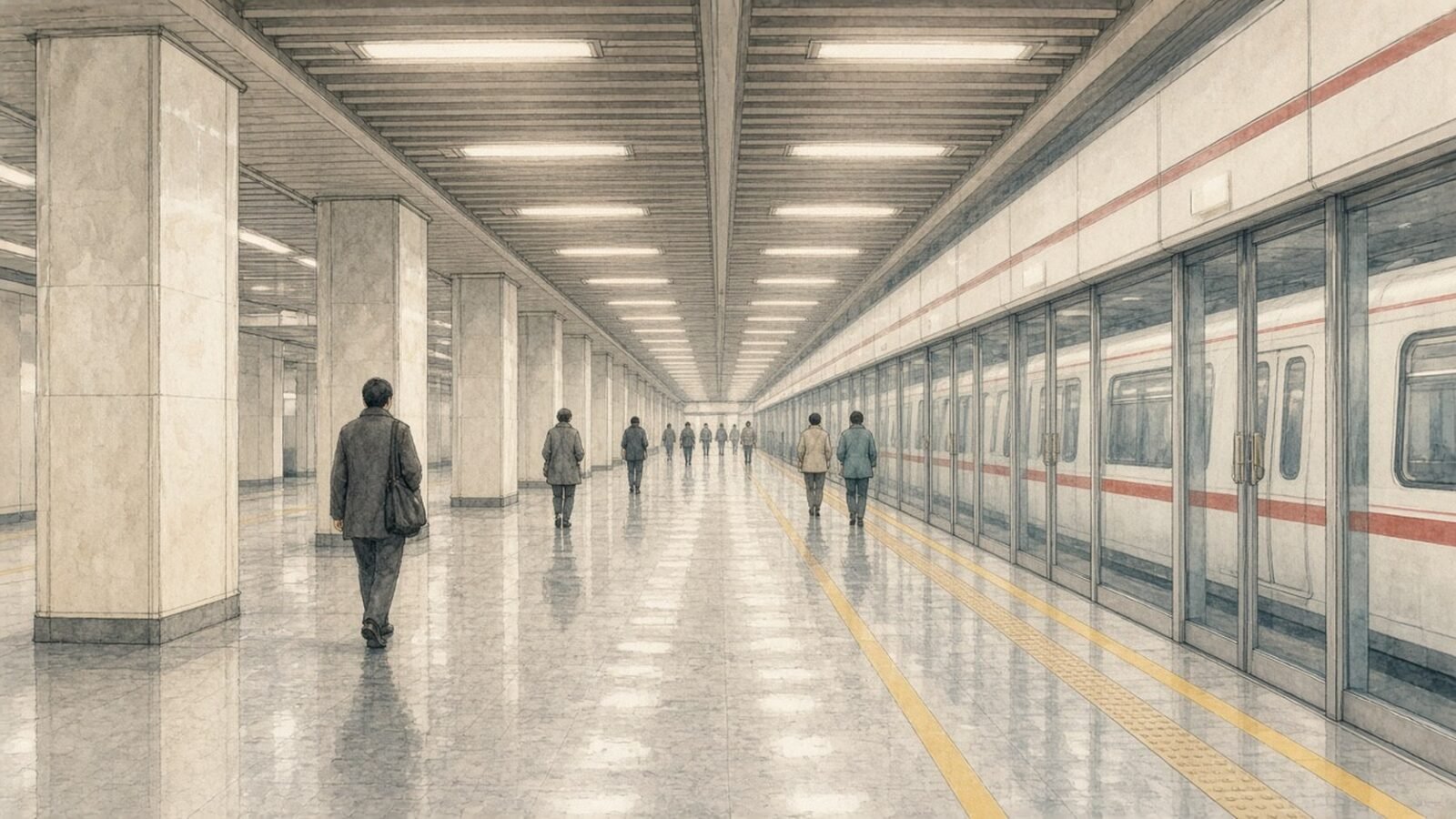
At eight o’clock on a weekday morning, the largest machine in the world is running beneath Shanghai. It has no single name and no single photograph can contain it: more than eight hundred kilometers of track, twenty lines, over five hundred stations, a fleet of seven thousand carriages, carrying more than ten million rides on an ordinary day — a volume the entire London Underground takes nearly a week to match. Commuters pour down the stairways of People’s Square and Xujiahui and Century Avenue in rivers, tap their phones at the gates, and step onto trains that arrive every two or three minutes with the indifference of weather. Almost none of them give it a thought, which is the truest measure of the achievement. Thirty years ago, Shanghai did not have a subway at all. It built the biggest one on earth in a single generation, under some of the worst geology any metro builder has ever faced, and then kept building. This is how it happened.
The Long Wait
Shanghai had wanted a subway for a very long time. The city’s planners drew their first serious schemes in the 1950s, when Soviet advisers were helping China design everything from steelworks to boulevards, and the arguments for going underground were already obvious: Shanghai was dense, its streets were narrow, and its population was enormous. The arguments against were geological and financial. The city stands on the soft alluvial silt of the Yangtze delta — waterlogged mud and sand hundreds of feet deep, with bedrock far out of reach — the single least promising soil of any major city that has ever attempted a metro. Tunnel through it and the tunnel floats, shifts, and leaks; dig a station box in it and the surrounding buildings sink. The Soviets, masters of the deep-bedrock metros of Moscow and Leningrad, took one look at the delta mud and were discouraging. Shanghai dug an experimental tunnel in the 1960s to teach itself the craft, a few hundred meters of trial and error, and then money and politics intervened: for thirty years the subway remained a folder in a planning office, while above ground the city’s buses and nine million bicycles fought for every meter of road.
By the 1980s the folder could stay closed no longer. Reform-era Shanghai was choking. The city held more than ten million people, its roads carried some of the heaviest bus loads on the planet, and the leadership understood that no amount of road-widening could move a city this size. A subway was no longer an ambition; it was a rescue plan. The question was whether anyone could actually build one in that mud — and the answer, when it came, came with German engineering attached.
Line One
Construction of Line 1 began in January 1990, funded in part by German government loans and built with German soft-ground tunneling technology — shield machines that could press through the waterlogged silt, lining the tunnel with concrete rings as they went, while grouting and ground-freezing techniques held the surrounding mud in place. The first line was a north-south spine of sixteen kilometers and thirteen stations, from Jinjiang Park in the southwest to the railway station, threading beneath the densest districts in China. Every meter was an education. Shanghai’s engineers were learning shield tunneling in the hardest classroom on earth, and the city’s builders were learning to carve station boxes out of liquid ground without cracking the hundred-year-old buildings overhead.
On May 28, 1993, the southern section opened for trial operation, and Shanghai reacted in a way that no metro planner had quite anticipated: it treated the subway as a tourist attraction. Families queued for hours, not to go anywhere, but simply to ride — to descend the escalators into the clean, bright, air-conditioned underworld and glide beneath their city in a way no Shanghainese ever had. The full line opened in April 1995, and within a few years the queues were no longer for the novelty. They were for the necessity. Line 1 was carrying hundreds of thousands of people a day, and the city had learned the central lesson of every metro: build one line and you have created demand for ten. The first trains were German-built, wide-bodied cars that rode so smoothly and quietly, after a lifetime of groaning buses, that passengers wrote letters to newspapers about them. Drivers, dispatchers, and station staff had been trained for a system that did not exist a few years before, and they ran it, from the beginning, with a discipline that set the tone for everything that followed. Shanghai’s metro was born, and born serious.
The Learning Curve
Line 2, opened in 1999, crossed the river. That sounds simple and was momentous: the east-west spine ran from central Puxi beneath the Huangpu to Lujiazui, stitching the new Pudong financial district to the old city and making the towers across the river practical to reach. A banker could now live in Puxi and work in Pudong with a commute of minutes, and the saying about preferring a bed in Puxi to a room in Pudong began its slide from folk wisdom into joke. Line 3, opened in 2000, showed a different kind of ingenuity: it ran largely on elevated viaduct along the alignment of the old Songhu railway, the nineteenth-century line that had once linked Shanghai to its northern suburbs, recycling a dead railway’s footprint into a modern transit corridor. Shanghai was assembling, piece by piece, the full toolkit of urban rail — subway, elevated line, river crossing — and the pace was beginning to quicken.
Tunneling Through Porridge
It is worth dwelling on what “soft ground” means, because it explains both why Shanghai waited so long and why its eventual achievement impressed the engineering world so deeply. Beneath the city lies delta sediment — clay, silt, and fine sand saturated with water, with the consistency, engineers say, of porridge. A tunnel bored through it is a steel-and-concrete tube floating in mud, and it behaves accordingly: it rises, sinks, and drifts, and it must be monitored and corrected for years. A station excavation is worse — a vast open pit carved into liquid soil, propped by steel struts and diaphragm walls, while the streets and century-old buildings above must not be allowed to move so much as a centimeter. Shanghai learned the techniques the hard way, on Line 1, and one lesson came as a genuine shock: in 2003, during construction of a cross-passage on Line 4 beside the Huangpu, the ground failed, the river wall was breached, and a section of riverside road and buildings subsided and collapsed. No one was killed, but the accident stopped the project for years and taught the city’s engineers a permanent humility about their mud. The rebuilt tunnel, when it finally opened in 2007, was a monument to patience as much as to technique — and Shanghai’s mastery of soft-ground construction, bought at that price, is now exported across China, where its engineers are the consultants of first resort for every city that has to tunnel through difficult earth.
The Expo Sprint
Then came the decision that turned a fast build-out into the greatest burst of metro construction in human history. When Shanghai won the right to host the 2010 World Expo, the city committed itself to a promise: the Expo would be served by a world-class subway, full stop. In the five years before the gates opened, Shanghai built metro at a pace no city had ever attempted — at the peak, dozens of shield machines were chewing through the delta mud simultaneously beneath different districts, and new lines and extensions were opening two, three, four at a time. By the spring of 2010 the network had passed four hundred kilometers and eleven lines, quadrupled in half a decade. Seventy million visitors came to the Expo, and the subway carried them. Transport historians reached for comparisons and found none: London had taken a century and a half to reach four hundred kilometers. Shanghai had done it in fifteen years.
The speed was not bravado; it was industrial method. Shanghai standardized its station designs, mass-produced its tunnel segments, ran its shield machines in fleets, and treated each completed line as the training academy for the crews of the next. The soft mud that had terrified the Soviet advisers was, by now, simply the medium Shanghai worked in — the city had become, perforce, the world capital of soft-ground metro engineering, and its engineers would go on to advise metro projects across China and beyond.
The Maglev
No account of Shanghai’s underground can skip the thing that runs above it. On the last day of 2002, the Shanghai Maglev made its first demonstration run, with the German chancellor and the Chinese premier aboard, and by 2004 it was carrying the public: thirty kilometers from Longyang Road to Pudong International Airport in as little as eight minutes, at a top speed of four hundred and thirty-one kilometers an hour — the fastest commercial ground transport on earth, floating on a magnetic cushion with no wheels touching anything. It was a German Transrapid system, the only one ever put into commercial service, and it never extended beyond its airport shuttle; conventional high-speed rail, which China was about to build on a continental scale, proved the cheaper path. But as a statement of intent it was perfect. The city that had no subway in 1990 had, by 2004, the biggest metro construction program in the world and the fastest train in the world, and visitors stepping off their flights got both in sequence: eight minutes of silent levitation, then down the escalators into the metro. It remains the most dramatic airport arrival on the planet.
The Network Today
The numbers, at this point, have gone past the reach of superlatives. The Shanghai Metro is the longest urban rail network in the world — more than eight hundred kilometers, and by official plans still growing toward a thousand — with twenty lines and more than five hundred stations. It carries, on an ordinary weekday, more than ten million rides; on record days, more than thirteen million. Line 11 runs eighty-two kilometers end to end, one of the longest metro lines anywhere, and in 2013 it crossed the city boundary into Huaqiao, in Jiangsu province — the first inter-provincial subway in Chinese history, delivering commuters from a neighboring province into the heart of Shanghai without anyone leaving the system. Lines 15 and 18 run without drivers, their passengers free to stand at the very front of the train and watch the tunnel unspool. Century Avenue station interchanges four lines; People’s Square, a small city beneath a square, moves crowds that would swamp most national capitals’ entire networks.
And the system has absorbed Shanghai’s particular genius for digital life. The turnstiles read QR codes from the Metro app, or a phone tap, or a transit card; the security check at every entrance has its own practiced choreography; the platform screens count down the next two trains in minutes and seconds. The air-conditioning, which the riders of 1993 queued to marvel at, is now simply assumed — as is the cleanliness, the two-minute headways, and the last train close to midnight. A system built from nothing in thirty years has achieved the final state of all great infrastructure: it is utterly taken for granted by the people whose lives it makes possible.
The Map on the Wall
Every metro city is mentally organized by its diagram, and Shanghai’s has become one of the defining documents of modern urban life: twenty color-coded lines laid over the delta like a circuit board, consulted a hundred million times a day. The map has quietly replaced the compass in the local mind. Shanghai people no longer navigate by the river or the old concession streets; they navigate by line number and interchange. Directions are given in stations. Property advertisements quote walking minutes to the gates. The station names themselves form a running index of the city’s memory — temples and martyrs’ parks, vanished villages and university gates, roads named for provinces and bridges named for bends in the river — so that learning the subway is, without anyone intending it, a course in Shanghai’s history. And the map keeps redrawing itself. Commuters have watched new lines appear on it the way sailors once watched coastlines emerge: Line 13 crossing the northwest, Line 14 threading the center, Line 18 opening up the northeast, each one converting some distant, inconvenient corner of the municipality into a place you could simply decide to go. The cartographers of the metro company may be the most consequential urban planners Shanghai has.
Riding the Beast
To understand what the network means, ride it at rush hour. The choreography begins at the station entrance, where the security check has evolved its own unhurried rhythm of bags on belts; then down through the corridors, following the color-coded signage, until the crowd compresses at the platform edge in neat two-row queues painted on the floor. The train arrives, the doors open, and the practiced miracle occurs: the exiting crowd flows out through the center while the entering crowd streams in from both sides, and in twenty seconds a thousand people have changed places. At People’s Square or Xujiahui at six in the evening, the trains are packed to a density that first-time visitors photograph in disbelief — and yet the whole thing moves, train after train, two minutes apart, absorbing the evening of a city of twenty-five million. Inside the carriages, Shanghai conducts itself as it does everywhere: on its phone. The metro is where the city watches its dramas, plays its games, answers its work messages, and occasionally dozes against the glass with an earphone in. Students do homework on Line 9. Couples arrange to meet by exit number. Elderly residents ride to parks in distant districts simply because the ride, for them, is free. The etiquette campaigns roll on — no eating on board, let passengers off first, keep the music in the headphones — and the city has largely obliged, turning the largest metro on earth into one of its most orderly public rooms.
The City the Subway Built
It is worth pausing on what the metro did to Shanghai, because the answer is: it remade it. Every Chinese city of scale now has a subway — dozens do — but Shanghai was the pioneer of the model that made them possible: the metro as the armature of urban expansion. Land beside new stations multiplied in value; the city used that value to fund the building; vast new suburbs — Minhang, Songjiang, Jiading — grew along the lines as deliberately as beads on a string, each with its mall above the station and its towers beyond. The metro made Pudong practical, made the Expo possible, made the far districts commutable, and quietly rewrote the social map: where Shanghai people live, work, shop, and court now follows the color-coded diagram on the station wall. The system is, in the most literal sense, the largest thing the city has ever made — larger than the Bund, larger than the skyline, a second Shanghai laid out in tunnels beneath the first.
There is a detail that the city’s older riders like to mention. In 1993, when Line 1 opened for its trial runs, people bought tickets just to experience the ride, and some of them wept — because Shanghai, the greatest city of prewar Asia, had waited so long for what other world cities took as birthright. Thirty years later, a commuter tapping through the gates at People’s Square at rush hour, swept along in a crowd of ten thousand, does not think of Moscow or London or New York at all. She is thinking about whether she will get a seat.
And the building has not stopped. The Airport Link line, opened in 2024, connects Hongqiao and Pudong airports — the city’s two great gateways, on opposite ends of the metropolis — in forty minutes, threading a direct tunnel beneath districts the older lines had to wind around. New tunnels are boring toward Chongming, the vast green island at the river’s mouth, which will gain its first rail connection to the city. Official plans carry the network past a thousand kilometers within the decade, a figure that would have been dismissed as fantasy anywhere else and is treated in Shanghai as a schedule. Somewhere beneath the city tonight, a shield machine is chewing forward through the delta mud at ten meters a day, laying rings of concrete behind it, on its way to a station that does not yet have a name, in a suburb that does not yet exist — but will, the moment the line arrives. That has been the pattern for thirty years. The subway, like the city it serves, has arrived — and the surest proof is that nobody is amazed anymore.