In March 2025, a battery company from Shenzhen that had once made the electronics in your laptop overtook Tesla to become the world’s largest seller of electric vehicles. BYD, which stands for Build Your Dreams, sold about 4.3 million cars in 2024; Tesla, its nearest rival, sold 1.8 million. China as a whole now builds more than seventy per cent of the electric cars and more than seventy per cent of the batteries that go into them; six of the world’s ten biggest EV brands in 2025 are Chinese; and at home, in the country that invented the internal-combustion age, the electric car has become the default new car. More than half of every passenger vehicle sold in China in 2025 ran on a plug. None of this was an accident, almost none of it was the work of the market alone, and almost none of the standard Western explanations for it — cheap labour, industrial espionage, theft of intellectual property — will survive a serious look at the record. The story of how China built the world’s biggest electric car industry is a story about policy, persistence, and a very unusual combination of public and private ambition. It deserves to be told in order.
The Man Who Picked the Technology
Every industry has a moment when a small decision, taken at the top of a state, locks in a national trajectory for a generation. The electric car in China has such a moment, and it can be dated with unusual precision. In 2009, the physicist Wan Gang — a former Audi engineer, a professor at Tongji University, and a returning overseas Chinese who had brought back a clutch of patents in lithium-ion battery technology — was about to leave the post of Minister of Science and Technology. He had spent his first years in office pushing a package of subsidies and demonstration projects for so-called New Energy Vehicles, the Chinese term that covers battery electrics, plug-in hybrids, and fuel cells. The subsidies were modest and the cars were clumsy, most of them adapted gasoline platforms retrofitted with lead-acid batteries, and the program had so far produced more scepticism than sales. Wan Gang walked into the office of Wen Jiabao, the Premier, with a short, blunt presentation: by 2030, he argued, internal combustion could not remain the centre of Chinese transport, and the only viable replacement at scale was electric. Wen said yes. Wan was kept on. The Ten Cities, Thousand Vehicles program was expanded into a national programme, and the road that runs through every Chinese city today, lined with charging stations, began to be laid.
The choice was not obvious. Hydrogen fuel cells, hybrid drive trains without plugs, biofuels, even compressed natural gas, all had partisans in those years, and many serious governments backed them. China chose the plug. In part this was a bet on lithium-ion batteries, which in 2009 were still expensive but improving on a learning curve of about eight per cent cost reduction per doubling of cumulative output — the kind of curve that, given enough volume, takes a product from the laboratory to the mass market inside a decade. In part it was a bet on the country’s own ability to master that curve, given that the world’s battery chemical and materials expertise was already migrating east, where the supply chain of lithium, cobalt, nickel, and rare earths converges. In part it was a bet that the car of the future would be partly a software product, with a digital nervous system running from battery management to driver assistance, and that a country already dominant in mobile electronics and increasingly competitive in artificial intelligence would have a real shot at that game. But above all it was a bet that the worst costs of a fossil-fuel transport system — urban air pollution, dependence on imported oil, the foreign-policy exposure of sea lanes through the Strait of Malacca — were costs China could no longer afford to ignore.
The Village of Suppliers
A subsidy programme alone does not an industry make. The proof of the policy’s seriousness was the ecosystem that grew up around it. Within five years of Wan Gang’s bet, the eastern coastal province of Jiangsu alone hosted more than two hundred registered New Energy Vehicle firms. Most of them were small, and most of them failed; but the ones that didn’t fail found themselves at the centre of the world’s first truly dense EV supplier cluster. Battery cells were made in Ningde by a former Huawei battery unit that became CATL, and in Shenzhen by the legacy firm BYD. Cathode materials came from Hunan and Jiangxi. Anodes from Inner Mongolia. Aluminium and copper for the motors and wiring came from Henan and Yunnan, fed by the world’s largest base-metal refineries. Aluminium battery casings were extruded in Guangdong. The car plants themselves, taking advantage of China’s existing overcapacity in vehicle assembly, clustered around Shanghai (Tesla, SAIC), Shenzhen (BYD), Guangzhou (GAC), Hangzhou (Geely), and Hefei (NIO, Volkswagen Anhui). A new entrant could pick a complete bill of materials off a screen, drive a few hours, and assemble a working prototype inside a year. The car industry has never before been so geographically concentrated, nor so vertically integrated. It was, in the literal sense of the term, a national champion built on a regional bench.
The state’s role was not to build the cars but to make the building of the cars cheap. Subsidies flowed from Beijing to consumers in the form of tax exemptions and direct rebates; they flowed to local governments in the form of mandates to electrify bus and taxi fleets; and they flowed to manufacturers in the form of tax holidays, free land, and cheap credit from state banks. The policy was hedged with quotas: from 2019, automakers had to ensure that a steadily rising share of their sales were New Energy Vehicles, with non-compliance punished by the loss of production licences for conventional models. The effect was a long-running national experiment in industrial policy, conducted over a decade and a half, with costs and dead ends visible in the wreckage of brand after failed Chinese EV startup, but also with results that are now visible everywhere.
The Blade and the Cell
The crucial technical leap happened in 2020, and it happened at BYD. For most of the previous decade, the central problem of the electric car had been the battery. Lithium-ion cells of the conventional kind, cylindrical or pouch-shaped, packed their energy into modules which then sat inside a heavy, bolted, liquid-cooled battery pack bolted into the floor of the car. It was workable, but it wasted space, raised the centre of gravity, and made the pack expensive to repair. In March 2020 BYD unveiled a different architecture it called the Blade Battery. The Blade did away with the modules entirely. Cells were made long and flat, like rulers, and stood upright in the pack like books on a shelf, packed edge-to-edge, with the pack itself acting as the structural element of the car floor. The result was a fifty per cent improvement in space utilisation, a sharp reduction in fire risk (the cells used lithium iron phosphate, which is much less prone to thermal runaway than the nickel-rich chemistries favoured by Korean rivals), and a cost that BYD claimed made electric cars price-competitive with petrol ones even before subsidies. The Blade has since been licensed to Tesla for use in some European and Asian models and is on its way to becoming a global standard.
The Blade’s deeper importance was not technical. It was that it appeared in volume at almost the same moment that Tesla, in January 2020, began deliveries from its new Gigafactory Shanghai. Tesla’s Chinese plant was a marvel of construction speed — the building was finished in under a year — and of operational maturity: it ran at full utilisation almost immediately, and within three years it was exporting Model 3s and Model Ys from Shanghai to Europe and across Asia. The presence of Tesla in China did two things at once. It validated the country as a place to build electric cars at world scale, and it goaded every Chinese competitor, BYD above all, into a step-change in cost, quality, and software. Chinese engineers who had worked at Tesla Shanghai went home to local firms with habits of rapid iteration, vertical integration, and obsessive attention to manufacturing detail that had not previously been native to the country’s car industry. The Gigafactory was the most expensive industrial espionage operation in history, conducted in the open, with both parties benefiting.
The Bus, the Cab, and the Grid
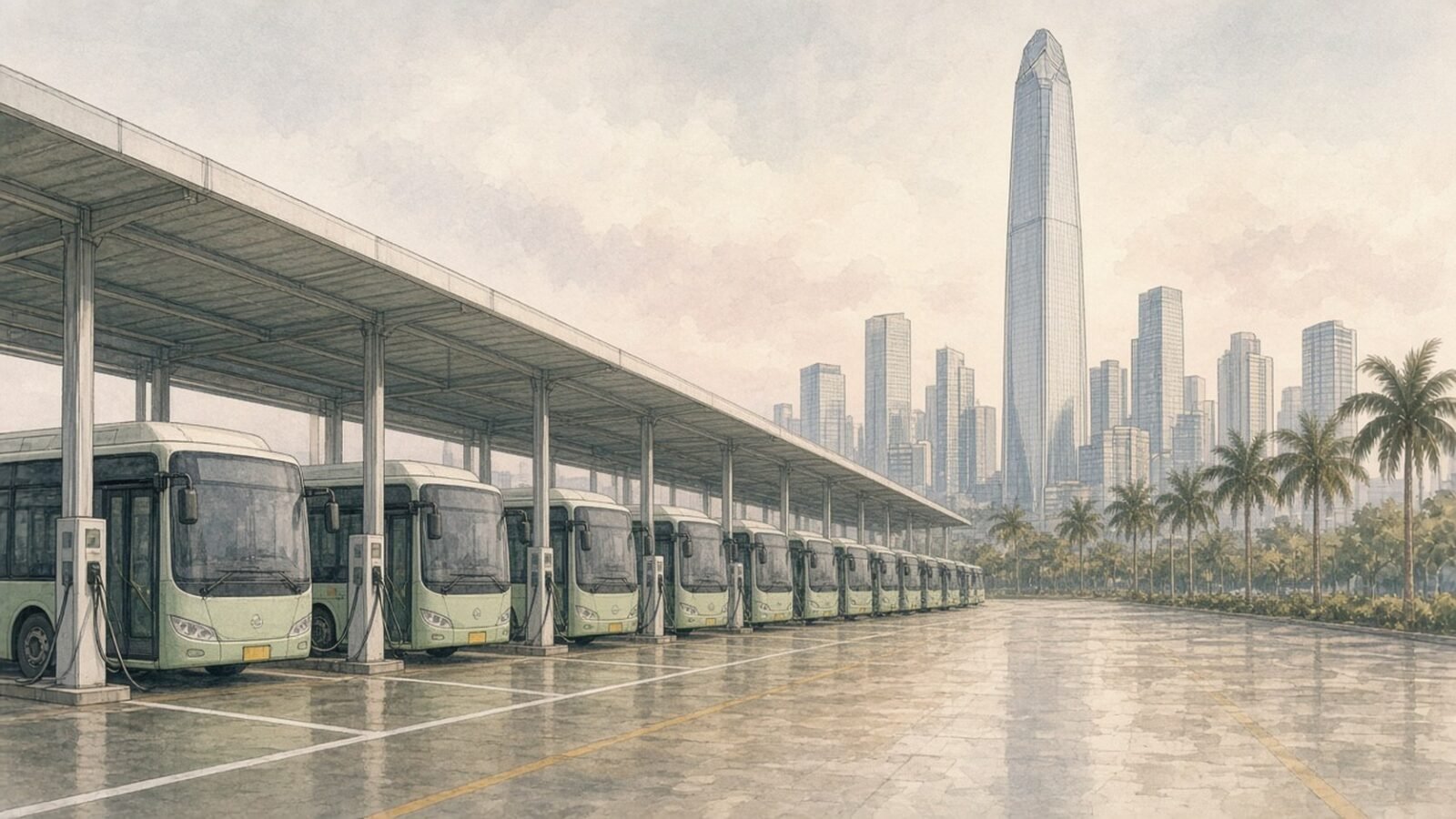
Visitors to Shenzhen today, looking at the silent electric buses gliding past and the silent electric taxis waiting at the rank, sometimes miss that this is the future the city’s planners chose, deliberately, in the late 2000s. The Shenzhen bus company, in a single decade, replaced a fleet of more than sixteen thousand diesel buses with electric ones built by BYD, the city’s own firm. By the time the last diesel bus was retired, in 2018, Shenzhen had built a network of charging stations that became the model for every other Chinese city. Today, more than ninety-eight per cent of the buses in Shenzhen and more than seventy per cent of the taxis are electric. The Chinese passenger car followed the public fleet, not the other way around. By 2024, more than half of every new car sold in the country was electrified in some form. The grid was ready, or made ready: China now runs the world’s largest high-voltage direct-current transmission network, stretching from the hydroelectric and solar stations of the west to the coastal cities, and capable, by some estimates, of recharging ten million cars at once without breaking a sweat. The grid is the unsung half of the EV miracle, and it was built in parallel with the cars, by the same state, on the same logic.
The 2022 Explosion
If the EV industry had a quiet decade and a half, it then had a loud one. In 2022, Chinese exports of electric cars tripled. In 2023 they tripled again. In 2024, the country exported more electric vehicles than Germany, Japan, or Korea, and in the first months of 2025 the pace continued. The destinations told the story. Europe, where the average new car now includes a long list of Chinese-made models from MG (owned by SAIC), BYD, Polestar (owned by Geely), Volvo (owned by Geely), Dacia (using Leapmotor platforms), and the Smart brand (using Geely platforms), absorbed the largest share. Southeast Asia, where Chinese marques are taking the place of Japanese ones, took the second largest. The Middle East, Australia, Brazil, and even Mexico, despite American political objections, took the rest.
The numbers are unsettling for incumbents. By the end of 2024, more than half of all new electric cars sold in Europe were made in China, either by Chinese brands or by European ones building in China. By April 2025, Chinese brands had doubled their share of the European car market in a single year, despite tariffs imposed by Brussels that, for some firms, run as high as thirty-five per cent. The European response has been to put up the wall higher; the American response has been to put up the wall different, with a fifty-percent tariff on Chinese EVs announced in 2024 and a near-total ban on Chinese software and components in connected vehicles taking effect in the same period. The Chinese response to both responses has been to build inside the wall. BYD is constructing plants in Hungary, Turkey, Brazil, Thailand, and Uzbekistan; Geely already runs a factory in Belarus; Chery is expanding in Spain and is the largest Chinese car exporter by volume, much of its output going to Russia. The export boom is becoming a localisation boom, and the localisation boom is reshaping the geography of the world’s oldest industry.
What It Was
It is tempting, looking at the BYD numbers or at the Tesla Shanghai production line, to call China’s electric car industry a triumph of central planning, the vindication of a particular economic doctrine. The story is messier and more interesting than that. What China did was combine three things that few other countries had the tools or the patience to combine: a state that could pick a technology a decade in advance of its commercial prime and stick with it through several administrations; a dense, urbanised consumer market big enough to absorb the early, expensive generations of cars until the learning curve bent down; and an unusually capable manufacturing base, especially in batteries, software, and electronics, that could turn the state’s commitment into products the world would actually buy. Each element was necessary. None of them, alone, would have been sufficient. Their conjunction was the achievement.
What it produced is a car industry that, in 2025, looks a great deal like the steel industry of the 1980s or the shipbuilding industry of the 2000s: a national giant, much larger than its Western rivals, capable of producing at scales and prices that other countries cannot match, and now subject to the political pressures that such a position always invites. The EU is investigating what it calls unfair subsidies; the United States has effectively shut its market; Brazil has raised tariffs; India has refused to allow Chinese manufacturers to set up shop. The geopolitics of the electric car are now as much the story as the technology, and will be for the rest of the decade. But the technological and industrial position that the geopolitics is reacting to is now set. The electric car, as a global industry, is a Chinese industry, in the same way that the smartphone, as a global industry, is a Chinese industry, in the same way that the solar panel, the lithium battery, and the high-speed train are Chinese industries. The story is not unique. It is, in fact, the same story: a state that picks a future and pays to build it, a manufacturing culture that learns faster than its rivals, and a domestic market big enough to underwrite both until the rest of the world catches on, or until it is locked out. Wan Gang’s bet, made quietly in an office in Beijing in 2009, is now the foundation of a global industry. The car that drives past you in any city on earth in 2030 is more likely than not to have begun its life as a piece of Chinese policy.