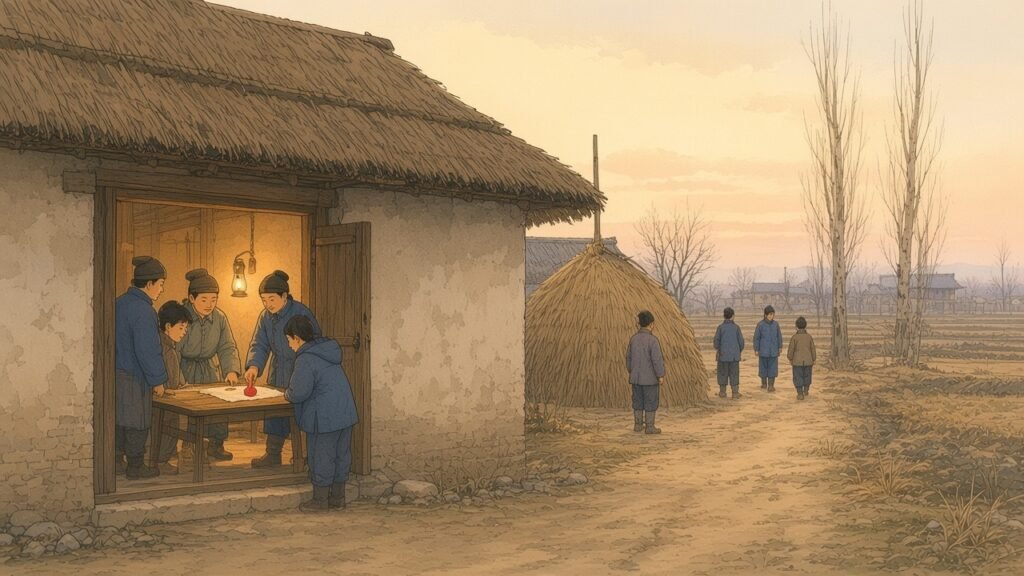
On a winter night in late November 1978, in a small village in the hills of Fengyang County in the province of Anhui, the heads of eighteen households gathered in a mud-walled house and put their names and red thumbprints to a short handwritten document. It agreed that the land of their production team would be divided among the families who worked it, that each household would deliver its share of the grain owed to the state and to the collective, and that if the leaders of the team were imprisoned for what they had done, the other villagers would raise their children until the age of eighteen. The village was Xiaogang, and the paper they signed has since been displayed in the National Museum of China in Beijing as one of the founding documents of the reform era. The arrangement it described, in which farm households contracted for land and output rather than working under the direction of the collective, spread within six years to almost the whole of rural China and became known as the household responsibility system. Its history is the history of how the people’s communes came to an end, and of the first and in some ways the most consequential of the economic changes that followed the death of Mao Zedong.
The story of Xiaogang is often told as a single dramatic act, and it was one. But it also belongs to a longer history of experiments, retreats and arguments about how China’s farmland should be organised, reaching back to the land reform of the early 1950s and the catastrophe of the Great Leap Forward. The villagers who signed the agreement knew that history well, because they had lived through it, and much of their caution in 1978 came from memory of what had happened to people who had tried similar things before.
Land and the collective after 1949
The first great change in the countryside after the founding of the People’s Republic was land reform. Between 1947 and 1952, in the areas controlled by the Communist Party and then across the whole country, the land of landlords and rich peasants was confiscated and redistributed to poor peasants and labourers. For a few years most Chinese farmland was worked by households that owned it. The arrangement was not intended to last. From 1953 the party encouraged peasants to form mutual-aid teams, in which households pooled labour and tools at busy seasons, and then elementary cooperatives, in which land was pooled and members were paid partly according to the land they had contributed. In 1955 and 1956, in a campaign that moved much faster than many planners had expected, these were merged into advanced cooperatives in which land became the property of the cooperative and income was distributed according to work alone.
In 1958 the advanced cooperatives were themselves merged into people’s communes, much larger units that often contained thousands of households and combined agricultural production with local government, militia, schooling and small industry. The communes were the institutional heart of the Great Leap Forward, the campaign launched that year to accelerate the country’s industrial and agricultural growth. In many places private plots were abolished, households were expected to eat in communal canteens, and labour was mobilised on a vast scale for irrigation works and for the backyard furnaces of the steel campaign. Grain output was reported at fantastic levels by local officials anxious to show success, and procurement by the state was set according to these reports rather than the real harvest.
The result was the great famine of 1959 to 1961, in which tens of millions of people died. Estimates of excess mortality vary widely according to the method and data used, but most scholarly reconstructions place it between fifteen and forty-five million. Anhui was among the provinces worst affected, together with Sichuan, Gansu, Henan and Guizhou, and Fengyang County was one of the hardest hit within Anhui. Later investigations recorded that the county’s population fell sharply during those years, and that in some villages a large share of the inhabitants died or fled.
The famine brought a retreat from the most radical features of the communes. In 1961 and 1962 the canteens were closed, private plots were restored, and the basic accounting unit, the level at which output was measured and income distributed, was moved down from the commune and the brigade to the production team, a group of perhaps twenty to forty households roughly corresponding to a natural village or part of one. This structure of three levels, commune, brigade and team, remained the framework of rural life until the early 1980s.
The first experiments with household contracting
During the retreat of the early 1960s some provinces went further. In Anhui, under the provincial first secretary Zeng Xisheng, a system known as “responsibility fields” was introduced in 1961, in which plots of land were assigned to individual households who were responsible for their cultivation and rewarded according to their output. By some accounts the system covered a large majority of the province’s production teams within a year. It was popular with peasants and appeared to help recovery from the famine, and similar arrangements were adopted informally in parts of other provinces. In 1962, however, Mao criticised such practices as a step back towards individual farming and capitalism, and at a conference that year the responsibility fields were condemned. Zeng Xisheng was removed from his post, and the arrangements were abolished.
The phrase most often used for the practice, baochan daohu, “contracting output to the household”, became politically dangerous. During the Cultural Revolution, which began in 1966, it was cited as evidence of the “capitalist road” for which leaders such as Liu Shaoqi and Deng Xiaoping were attacked. In the countryside the campaign to “learn from Dazhai”, a model brigade in Shanxi held up as an example of collective self-reliance, pressed teams to expand collective labour, reduce private plots and limit rural markets. Peasants who had experienced household contracting remembered it, but few were prepared to propose it openly again.
Fengyang and the village of Xiaogang
Fengyang County lies in the north of Anhui, between the Huai River and the low hills that separate the Huai basin from the Yangtze. It is best known in Chinese history as the birthplace of Zhu Yuanzhang, the founder of the Ming dynasty, who built an ambitious capital there in the 1370s before abandoning the project. The county was also known for poverty. A folk song, the Fengyang flower-drum song, sung by beggars who carried small drums as they travelled from county to county, lamented that since the emperor had come from Fengyang the place had had nine years of famine in every ten. In the 1960s and 1970s the custom of going out to beg after the harvest, when the collective’s grain had run out, was still common in the county, and local officials sometimes issued letters that allowed villagers to travel for the purpose.
Xiaogang was a production team within Liyuan commune, consisting in 1978 of about twenty households and a little over a hundred people. Most families bore the surname Yan. The team’s land was poor and its harvests were small; accounts of the village describe it as dependent on state relief grain, loans and seasonal begging for much of the period from the early 1960s onward. In the drought of 1978, which was severe across Anhui, the village’s prospects were especially bleak. The work points system, by which members of a team were credited for each day’s labour and paid out of the team’s net income at the end of the year, gave little reason for effort when the income to be divided was so small and when the work of diligent and idle members was rewarded almost equally.
The drought of 1978 also prompted a decision by the provincial leadership that would prove important. Wan Li, who had been appointed first secretary of the Anhui party committee in 1977, had toured the province’s poorest areas and been shaken by what he found. In November 1977 the provincial committee issued a set of six regulations on rural policy, which gave production teams more autonomy in deciding what to plant, allowed some work to be organised in small groups and assigned to them, and protected private plots and household sideline activities. In the autumn of 1978, when the drought threatened to prevent the sowing of winter wheat, the province allowed teams to lend uncultivated land to households to plant for themselves, a measure described as “borrowing land to survive the famine”. In parts of Anhui this was taken as an opening for something larger.
The night of the agreement
Accounts of the meeting at Xiaogang have been collected from the participants many times since the early 1980s, and they differ in details. The broad outline is consistent. The team’s leaders at the time were Yan Junchang, the team head, Yan Hongchang, his deputy, and Yan Lihua, the accountant. The team had already experimented in 1978 with dividing its members into smaller work groups, but the groups had quarrelled and the arrangement had not worked. At a meeting held at night, usually dated to 24 November 1978, in the house of one of the villagers, the heads of the households agreed to go further and divide the land among the families themselves.
The document they produced is short. Its text, written by Yan Hongchang according to most accounts, records that the land would be divided to the households, and that each household head would sign and seal the agreement. It states that each household would guarantee to complete its annual quota of grain to be delivered to the state and its contribution to the collective, and would no longer ask the state for money or for grain. If this could not be done, the signatories were willing to be jailed or even executed, and the other members of the team undertook to raise the children of the team cadres to the age of eighteen. The names of the household heads follow, with their thumbprints or seals in red ink. Most accounts speak of eighteen households and eighteen farmers; the document itself carries a slightly larger number of names, because some families were represented by more than one person or because absent members were added, and later scholars have discussed whether some of the signatures were added afterwards. The commitment to secrecy was understood as part of the bargain: the agreement was not to be spoken of outside the village.
The fear expressed in the clause about the children was not exaggerated. Household contracting had been condemned as capitalist restoration for sixteen years, and the political line at the centre had not yet changed. The Third Plenary Session of the Eleventh Central Committee, which met in Beijing in December 1978 and is now regarded as the beginning of the reform era, was still a few weeks in the future when the villagers signed, and even that meeting did not endorse dividing land to households. The documents on agriculture it discussed explicitly said that the land should not be divided for individual farming and that output should not be contracted to households. The people of Xiaogang were, in the terms of the law and policy of the day, breaking the rules.
The first harvest
The land was divided, by most accounts, according to the number of people in each household, together with the team’s draught animals and implements. The work that followed was intense. Households who knew that what they produced beyond their quotas would be theirs to keep began to work their plots with a care that the collective had not called forth. The winter wheat was sown, and in 1979 the village had what was by its standards an extraordinary year. Figures given in later official accounts state that the team harvested about 66 tonnes of grain, more than 130,000 jin, roughly equal to the team’s entire output over the five years from 1966 to 1970 together, and that oil-bearing crops and other produce also rose sharply. For the first time in more than twenty years the village delivered grain to the state rather than receiving it, repaid part of its loans, and had a surplus. Average incomes per person, which had been some twenty or thirty yuan a year, rose several times over.
The figures were later used widely in publicity and may have been rounded or improved in the telling, but there is no doubt about the general picture. Similar gains were being recorded at the same time in other places where teams had adopted household or group contracting, in Anhui and in Sichuan, where the provincial leadership under Zhao Ziyang had also given teams greater freedom. The harvests of 1979 changed the terms of the argument. A system that had been attacked as a road back to poverty and inequality was associated, at least in these places, with a sudden end to hunger.
Discovery and protection
The secret did not stay secret for long. In a county where neighbouring teams were still working under the collective, the sight of Xiaogang’s households working their own plots from before dawn was hard to hide, and the commune officials soon learned what had happened. Accounts describe a period in 1979 when the commune leadership tried to stop the arrangement, threatening to withhold seed, fertiliser and loans from the team unless it returned to collective farming. The county party secretary, Chen Tingyuan, took a more cautious line and allowed the village to continue for the time being, arguing, according to later accounts, that the experiment should be given a year to show its results.
The decisive protection came from the provincial level. Wan Li visited Fengyang and Xiaogang in 1980, and the meeting between the first secretary and the villagers became one of the best-known episodes of the story. By the accounts of those present, he asked to see the households’ grain stores, was shown granaries full for the first time in decades, and told the villagers that they could continue; when local officials objected that the practice went against the line of the centre, he is reported to have said that he would take responsibility, and that if the method helped people to eat, it should not be forbidden. Whatever the exact words, the effect was clear. With the backing of the provincial first secretary, the arrangement could not easily be reversed locally, and other teams in Fengyang and beyond began to copy it.
The question then moved to Beijing. In 1979 and early 1980 the national leadership was divided over household contracting. Some leaders and many officials in the agricultural ministries regarded it as incompatible with socialist agriculture, and articles in the national press warned against the trend. Others, including Wan Li, who moved to Beijing in 1980 as a vice premier responsible for agriculture, and Zhao Ziyang, who became premier the same year, defended the practice as a pragmatic response to rural poverty. On 31 May 1980, in a conversation with senior officials that was later published, Deng Xiaoping spoke approvingly of the results of contracting output to households in Anhui, mentioning Fengyang by name and remarking that the change had brought great improvement in a single year and that there was no need to fear it would harm the collective economy. The remark did not settle every argument, but it signalled that the most powerful figure in the leadership would not oppose the trend.
From exception to national policy
In September 1980 a central document on rural work allowed household contracting in remote, mountainous and poor areas where peasants had long depended on state relief, while maintaining that in most other places collective farming with various forms of production responsibility should continue. The document was framed as a limited concession, but the line between poor and other areas was hard to draw, and in practice the boundary was pushed outward by peasants and local officials across the country. By the end of 1980 a sizeable minority of production teams had adopted some form of household contracting, and the share rose rapidly through 1981.
The decisive endorsement came in the first of a series of annual central documents on agriculture, known as the “Number One Documents” because each was the first central document issued in its year. The document of January 1982 declared that the various forms of the responsibility system, including contracting output to households and contracting all tasks to households, were forms of the socialist collective economy rather than a retreat from it. This formula was important. Land remained collectively owned, and the household received a contract to use it rather than a title of ownership; the system could therefore be described as a reform within socialism. Subsequent Number One Documents in 1983 and 1984 extended and stabilised the system.
The form that spread most widely was not exactly the one practised at Xiaogang in its first year. In the early variants, known as contracting output to the household, the household was assigned a quota of output for the team and was paid in work points according to whether it met it, with the team still handling distribution. The variant that came to predominate, known as baogan daohu or “contracting everything to the household”, dispensed with the work points. Each household was assigned land and a set of obligations: a quota of grain or other crops to be sold to the state at the state’s price, an agricultural tax, and contributions to the collective for welfare, public works and the support of cadres. Whatever it produced beyond these obligations was its own, to consume or to sell. The arrangement at Xiaogang, with its promise to deliver the state’s share and the collective’s share and keep the rest, was essentially of this kind, and the village was later presented as its origin.
By the end of 1983, according to official statistics, more than nine-tenths of production teams had adopted household contracting, and by 1984 the proportion was close to universal. The speed of the change reflected both pressure from below and the willingness of officials, once the direction of policy at the centre was clear, to implement it quickly. In many places the land was divided in the space of a single season.
The end of the communes
Once land was farmed by households, much of the purpose of the production team and the brigade disappeared. The communes had combined economic management with local government, and the change in farming made their economic functions largely redundant. The revised constitution of December 1982 provided for the re-establishment of township governments as the basic level of state administration in the countryside, separate from economic organisations, and in 1983 the central authorities ordered the separation of government from commune management. Over the following two years the communes were dissolved across the country and replaced by townships, and the brigades and teams by administrative villages and villagers’ groups. By the end of 1984 the process was almost complete, and by 1985 the people’s communes, which had organised the lives of the rural population for more than a quarter of a century, had ceased to exist except in a handful of places that chose to retain collective farming.
The dissolution was accompanied by other changes that widened the scope of household enterprise. Restrictions on rural markets were eased, and the range of products subject to compulsory state procurement was progressively narrowed. In 1985 the state abolished the system of unified procurement of grain that had been in force since 1953 and replaced it with contracts between the state and farmers, although in practice quotas persisted in various forms for many years. State purchasing prices for grain and other farm products had already been raised substantially in 1979, by about a fifth for quota grain and by a larger proportion for above-quota sales, and this increase, coming at the same moment as the change in organisation, was an important part of the rise in rural incomes.
The harvests of the early 1980s
The years between 1978 and 1984 saw the fastest growth in Chinese agriculture of any comparable period since the founding of the People’s Republic. National grain output rose from about 305 million tonnes in 1978 to about 407 million tonnes in 1984, an increase of roughly a third in six years. The production of cotton roughly tripled over the same period, and that of oilseeds more than doubled. Rural incomes per person, according to official household surveys, more than doubled in real terms. Shortages of grain that had been a constant feature of Chinese life were replaced for a time by surpluses, and in 1984 and 1985 the state struggled to store and pay for the quantities that farmers wished to sell.
How much of this growth was due to the change in organisation, and how much to higher prices, greater use of chemical fertiliser and better seeds, has been studied closely by economists. The most widely cited estimate, by the economist Justin Yifu Lin in an article published in the American Economic Review in 1992, attributed about half of the growth in output between 1978 and 1984 to the shift from collective to household farming, with most of the remainder due to increased inputs and price changes. Other studies have reached somewhat different figures, but most agree that the change in incentives created by household contracting was the single largest cause. Lin and others also observed that the effect was largely a one-time gain: once the households had taken over the land and the slack of the collective period had been taken up, growth in grain output slowed sharply after 1984, and in 1985 output actually fell.
The economic logic was simple, and the villagers of Xiaogang had understood it before the economists. Under the work points system, a member’s income depended on the team’s total output divided among all members according to their points, so that extra effort by one member was shared among everyone, and it was difficult to monitor the quality of agricultural work done in scattered fields. Under household contracting the household kept the whole of any extra output after meeting its fixed obligations, and the problem of supervision disappeared because the people doing the work were also those who benefited from it. The change also released labour. Families who could produce their quota with less time in the fields turned to sidelines, livestock, handicrafts and trade, and in time many of their members left agriculture altogether.
Sichuan and the other early experiments
Anhui was not alone. In Sichuan, the most populous province and one that had also suffered severely during the famine, the provincial first secretary Zhao Ziyang had from 1976 encouraged measures that gave production teams more control over planting, enlarged private plots and allowed work to be assigned to small groups with output quotas. In 1978 and 1979 a number of counties went further, and the province became known together with Anhui as a pioneer of rural reform; a popular rhyme of the time ran that if you wanted grain you should look for Ziyang, and if you wanted rice you should look for Wan Li, a play on the two leaders’ names. Sichuan also experimented with the reform of the communes themselves, and in 1980 Xiangyang commune in Guanghan County became one of the first to take down its commune sign and restore a township government. In Guizhou and Gansu, poorer provinces with mountainous terrain, local officials allowed household contracting under the pressure of hardship, often before any provincial or national approval. The national policy that emerged between 1980 and 1984 thus drew on many separate experiences, and the officials who drafted the central documents studied reports from all these places.
Wider consequences in the countryside
The labour released by household farming found its way into new kinds of work. The township and village enterprises, factories and workshops owned by townships, villages or groups of households, grew rapidly from the middle of the 1980s and by the early 1990s employed more than a hundred million people. They produced building materials, textiles, simple machinery and consumer goods, and in some regions, especially in Jiangsu, Zhejiang and Guangdong, they became the main engine of local growth. Rural markets for small commodities expanded alongside them; the trading town described in the post on Yiwu and the world’s largest small-commodities market owes its origins to peddlers and farmers of exactly this period. Later, as restrictions on movement were eased, rural labour flowed in great numbers to the coastal cities and the special economic zones, including the city whose rise is told in How Shenzhen Was Built From Border Villages.
The change in farming also altered the relationship between rural households and the state in ways that touched other policies. The collective had been the main instrument through which local officials organised compulsory labour, distributed grain and enforced rules, and its disappearance weakened that capacity at the same moment as the government was trying to enforce strict limits on births. Households farming their own land placed a high value on sons as labourers and as support in old age, and the tension between the incentives created by the new farming system and the demands of the birth-planning campaign was one of the reasons that rural rules were later relaxed to allow a second child where the first was a daughter, as described in The One-Child Policy, 1980 to 2015.
Not every consequence was welcomed. With the end of the collectives, the funding of rural clinics, schools and irrigation works became more difficult. The cooperative medical scheme that had supported barefoot doctors in many villages collapsed in most places during the 1980s, and the maintenance of collectively built canals and reservoirs suffered in some regions. Plots were small and often scattered, since land had usually been divided so that each household received a share of good and poor fields, and this fragmentation limited the scope for mechanisation. Local governments, deprived of collective revenue, relied increasingly on fees and levies on farmers, which became a source of rural grievance in the 1990s and were eventually addressed by the abolition of the agricultural tax in 2006.
Securing the contracts
The contracts of the early 1980s were often short and uncertain, and farmers were reluctant to invest in land they might lose at the next redistribution. In 1984 the central authorities declared that contracts should generally run for fifteen years. In 1993, as the first contracts approached expiry, the term was extended by a further thirty years, and the principle was written into the Rural Land Contracting Law of 2002. In 2008 the party declared that contract relations should remain stable and unchanged “for a long time”, and in 2017 it announced that the second round of contracts would be extended for another thirty years on expiry. Throughout, the land remained collectively owned by the village, and the rights of households were rights of use, later divided in policy documents into the contracting right held by the household and a management right that could be leased to others. This last change, introduced in the 2010s, allowed the consolidation of small plots into larger farms operated by specialised households, cooperatives and companies, while preserving the formal connection between each household and its land.
Xiaogang after 1978
The village itself did not become rich quickly. After the early gains of the 1980s its growth slowed, and by the 1990s visitors who came expecting a model of prosperity often found a village that remained poorer than many in the more industrialised parts of the country. Some of the original signatories were frustrated by the slow pace of change; others left to work elsewhere. In the 2000s the provincial government and later the central authorities invested in the village, building a memorial hall, roads and new housing, and Xiaogang became a site of political pilgrimage and tourism. A party secretary sent from the provincial finance department, Shen Hao, who served in the village from 2004 until his death in 2009 and was later honoured nationally, encouraged the consolidation of land and the development of new enterprises. National leaders visited repeatedly, including Hu Jintao in 2008 and Xi Jinping in 2016, and each visit was accompanied by statements reaffirming the household contract system while encouraging new forms of cooperation and land transfer.
The original agreement, with its rows of red thumbprints, is kept in the National Museum of China, where it is displayed as an exhibit of the reform era, and a copy hangs in the memorial hall in the village. The house where the meeting was held has been reconstructed. The surviving signatories became minor celebrities, interviewed on anniversaries and photographed in front of the reconstructed house; by the 2010s only a minority of them were still alive.
Origins and the place of a legend
Historians have pointed out that Xiaogang was not the first or the only place in which household contracting reappeared in the late 1970s. Similar arrangements were adopted at about the same time, or slightly earlier, in other parts of Anhui and in Sichuan, Guizhou and Gansu, and in some villages household farming had persisted quietly through the collective period. The prominence of Xiaogang owes something to the drama of its agreement, something to the attention of Wan Li and the provincial leadership, and something to the needs of later publicity for a single, vivid origin. The details of the night itself, including the precise date and the number of signatures, have been examined and debated by Chinese and foreign scholars.
None of this reduces its importance. The agreement of November 1978 was a written record, made by people who could expect to be punished for it, of a decision that would soon be taken by hundreds of millions of others. It showed that the impulse for the most far-reaching change of the early reform period came in part from the villages themselves, and that the role of the reforming leadership was at first less to design the change than to allow it and then to give it a name. The rural reforms of 1978 to 1984 prepared the ground for much that followed: the growth of rural industry, the great migration to the cities, the export economy of the coast and, in time, China’s entry into the global trading system described in China’s Accession to the World Trade Organization in 2001. They began with a short document on a winter night in a poor village of northern Anhui, and with the promise of its signatories to look after one another’s children if things went wrong.