In the year 221 BCE, a man who had spent his life surrounded by violence, intrigue, and relentless warfare looked out over a landscape transformed by his own hand. For nearly two centuries, the region we now call China had been torn apart by the Warring States period—a brutal, shifting kaleidoscope of seven rival kingdoms competing for total dominance. Millions had perished in campaign after campaign. Ancient bloodlines had been extinguished, cities leveled, and philosophical schools embroiled in intense debates over how to salvage a broken civilization.
Then came Ying Zheng, the King of Qin.
Through sheer military force, administrative ruthlessness, and an uncompromising geopolitical strategy, Ying Zheng conquered the rival states of Han, Zhao, Yan, Wei, Chu, and Qi one by one. By 221 BCE, he stood alone as the undisputed master of the realm.
Believing that traditional titles like Wang (“King”) were inadequate for a sovereign of his unprecedented achievements, he created a new title: Qin Shi Huangdi—the First August Emperor of Qin.
Qin Shi Huangdi remains one of history’s most enigmatic, controversial, and polarizing figures. To his admirers—both historical and modern—he was the visionary architect of Chinese unity, the genius who transformed a fractured patchwork of feudal estates into a centralized state structure that endured for over two millennia. To his detractors, he was an unyielding tyrant whose rule was defined by brutal labor, intellectual persecution, and an obsessive pursuit of immortality that bordered on madness.
I. The Crucible of War: The Rise of the Kingdom of Qin
To understand Qin Shi Huangdi, one must first understand the state that birthed him. The Kingdom of Qin was situated on the western frontier of the Chinese heartland, in what is today Shaanxi province. For centuries, the more traditional eastern states of the central plains had viewed Qin as semi-barbaric—a rough-edged border region hardened by constant friction with nomadic tribes.
However, Qin possessed a distinct structural advantage: it was unburdened by the entrenched aristocracy that bound the internal Chinese states. In the mid-4th century BCE, a political reformer named Shang Yang arrived at the Qin court. Under the patronage of Duke Xiao of Qin, Shang Yang implemented a suite of revolutionary political, economic, and military reforms that laid the foundations for Legalism (Fajia).
The Principles of Legalist Governance
Legalism rejected the moralist framework of Confucianism, which taught that rulers should govern through virtue, ritual, and moral example. Instead, Legalism posited that human nature was selfish, fickle, and driven purely by self-interest. To maintain order and build state power, a ruler needed two things: absolute, clear laws (Fa) and an unyielding system of rewards and punishments (Shu and Shi).
Shang Yang transformed Qin into an efficient war machine:
- Meritocratic Advancement: Feudal titles were stripped of hereditary privileges. Nobility could no longer be inherited; it had to be earned on the battlefield. Soldiers were promoted based directly on the number of enemy heads they brought back from combat.
- Agricultural Mobilization: Farming and military service were designated as the only two honorable professions. Farmers who produced surplus grain were exempted from labor tax, while those engaged in commerce were heavily taxed and marginalized.
- Collective Responsibility: Communities were divided into mutual surveillance groups of five to ten households. If one person committed a crime and others failed to report it, the entire group faced execution or mutilation.
By the time Ying Zheng was born in 259 BCE in the Zhao capital of Handan, Qin was already the most formidable military power in the region.
II. From Hostage Boy to Supreme Monarch
Ying Zheng’s early life was marked by instability. Born as a royal hostage in enemy territory during a brief truce between Qin and Zhao, his lineage was almost immediately shrouded in controversy.
Grand Historian Sima Qian, writing centuries later in the Shiji (Records of the Grand Historian), recorded a famous rumor: that Ying Zheng was not actually the son of King Zichu of Qin, but the illegitimate child of Lü Buwei, a wealthy merchant who had orchestrated Zichu’s rise to power. Modern historians continue to debate whether this story was authentic or a piece of Han-dynasty propaganda designed to delegitimize the Qin dynasty.
Seizing the Reins of Power
Ying Zheng ascended the throne of Qin in 246 BCE at the age of thirteen. Because of his youth, his mother, the Queen Dowager Zhao, and Lü Buwei ruled as regents. The young king watched, learned, and waited.
By his early twenties, Ying Zheng demonstrated the cold, decisive instincts that would define his reign:
- The Lao Ai Coup (238 BCE): Lao Ai, an official who had entered a secret relationship with the Queen Dowager, plotted a rebellion to install his own son on the throne. Ying Zheng uncovered the plot, crushed the rebellion, executed Lao Ai and his extended family, and placed his mother under house arrest.
- The Dismissal of Lü Buwei (237 BCE): Implicated in the Lao Ai affair, Lü Buwei was stripped of his titles and exiled. Realizing his eventual execution was inevitable, Lü Buwei committed suicide by drinking poison.
With all rival factions neutralized, the twenty-two-year-old monarch assumed absolute command of Qin. He surrounded himself with brilliant, uncompromising advisors—most notably Li Si, a fellow student of Legalism who would become the Grand Councilor and main architect of the Qin imperial system.
III. The Unification Campaigns (230–221 BCE)
With internal control established, Ying Zheng turned his attention outward. The six remaining Warring States stood between him and total mastery of the known world.
Between 230 and 221 BCE, the Qin war engine launched a series of military campaigns that fundamentally reshaped the geography of East Asia:
- 230 BCE (Fall of Han): The weakest of the six rival states, Han, was overrun quickly. Qin armies captured the capital of Xinzheng, annexing the kingdom directly into Qin territory as a foundational strategic foothold.
- 228 BCE (Conquest of Zhao): After a series of devastating earthquakes and droughts weakened Zhao, Qin forces led by General Wang Jian exploited the crisis, captured King Qian of Zhao, and ended decades of bitter rival border warfare.
- 226 BCE (Submission of Yan): Spurred by an assassination attempt by Crown Prince Dan’s envoy, Jing Ke, Qin launched an immediate, punitive invasion, driving the Yan royal family into exile and capturing their capital.
- 225 BCE (Fall of Wei): General Wang Ben led Qin troops to surround the heavily fortified city of Daliang. Rather than risking a long siege, Qin engineers diverted the Yellow River to flood the city walls, forcing a swift surrender.
- 223 BCE (Defeat of Chu): In the largest campaign of the war, Qin deployed 600,000 soldiers under General Wang Jian. After surviving an initial setback, Qin crushed the massive southern kingdom of Chu in a war of attrition.
- 221 BCE (Annexation of Qi & Unification): Surrounded and isolated, the eastern state of Qi surrendered without major resistance. Ying Zheng completed the unification of China and assumed the title Qin Shi Huangdi.
The conquest was total. For the first time in history, the vast geographic expanse from the Ordos Loop in the north to the Yangtze River valley in the south fell under the control of a single central authority.
IV. The Grand Blueprint: Building an Empire
Conquering an empire through military force is one challenge; governing it as a single, cohesive entity is another entirely. Qin Shi Huangdi understood that if he retained the old feudal system, the empire would inevitably fracture back into warring states upon his death.
In a pivotal imperial court debate, senior advisors recommended granting royal family members fiefdoms in the outlying regions, mirroring the old Zhou Dynasty structure. Li Si vigorously opposed this, arguing that blood ties fade over generations, leading inevitably to civil war.
Qin Shi Huangdi sided with Li Si, declaring:
“The world has suffered endlessly from conflict because of kings and lords. To recreate states now would be to plant the seeds of future wars.”
Administrative Centralization
The Emperor abolished feudalism entirely. He divided the realm into 36 commanderies (jun), which were further subdivided into counties (xian). Each commandery was managed by a triad of centrally appointed officials who reported directly to the imperial court:
- Civil Governor: Managed tax collection, infrastructure, and regional administration.
- Military Commander: Oversaw troop garrisons and regional security.
- Imperial Inspector: Acted as an independent oversight agent reporting directly to the Emperor to prevent corruption or treason.
To prevent regional warlords from building local power bases, the Emperor ordered 120,000 wealthy, aristocratic families from the conquered states to forcibly relocate to the imperial capital of Xianyang. There, under the watchful eyes of the imperial court, their wealth was repurposed, and their ancestral lands were absorbed into the state.
V. Standardization: The Infrastructure of Unity
To weld distinct regional cultures into a singular civilization, Qin Shi Huangdi initiated a series of radical standardization reforms that laid the foundation for Chinese cultural continuity.
1. The Written Script (Xiaozhuan)
Before the Qin conquest, each state used its own regional variant of the Chinese written script. A character written in Zhao might be unreadable to an official in Chu.
Under the direction of Li Si, the court developed the Small Seal Script (Xiaozhuan). All regional script variants were outlawed. Henceforth, every official document across the empire had to be drafted using standard characters. This reform ensured that even as regional spoken dialects diverged over centuries, the written language remained universally intelligible across China.
2. Currency, Weights, and Measures
To facilitate trade and streamline tax collection, the regional currencies of the conquered states—such as the spade coins of Zhao and the knife coins of Yan—were collected and melted down.
The Emperor introduced a single imperial coin: the Ban Liang. Cast in bronze, it featured a round shape with a square hole in the center—a design representing the ancient cosmological concept of a round sky over a square earth. This coin design remained the standard template for Chinese currency for over two thousand years.
Simultaneously, standard bronze weights and measuring cylinders were manufactured in government workshops and distributed across the empire.
3. Transport Infrastructure
To ensure rapid military mobilization and efficient communication, the Emperor constructed an ambitious network of imperial highways. The most famous was the Straight Road (Zhidao), an elevated highway spanning over 800 kilometers that connected the capital region directly to the northern frontier.
To ensure carts moved efficiently along these dirt highways, the Emperor standardized the axle width (che tong gui) of all vehicles to six Chinese feet, ensuring wagon wheels fit into identical ruts carved into the road network.
VI. Megaprojects: The Human and Material Cost
Qin Shi Huangdi’s ambitions demanded unprecedented mobilization of human labor. Hundreds of thousands of conscripted peasants, convicted criminals, and defeated soldiers were drafted into state service to complete megaprojects that dwarfed anything built before.
The Early Great Wall
To the north, the nomadic Xiongnu tribes posed a constant threat to the empire’s frontier. Qin Shi Huangdi dispatched his top general, Meng Tian, along with a force of 300,000 troops to drive the Xiongnu northward out of the Ordos region.
To secure this frontier, Meng Tian was ordered to connect, expand, and fortify existing defensive walls built by the former northern states of Qin, Zhao, and Yan. Constructing these rammed-earth fortifications across desert terrain, jagged mountains, and barren steppes cost tens of thousands of lives. While the stone wall visible today largely dates to the Ming Dynasty (1368–1644), Qin Shi Huangdi established the structural framework of the Great Wall of China.
The Lingqu Canal
In the tropical south, the Emperor launched military campaigns to conquer the Baiyue tribes in modern-day Guangdong and Guangxi. To solve the immense logistical challenge of supplying troops through dense jungles and mountain ranges, Qin engineers constructed the Lingqu Canal in 214 BCE.
Connecting the Xiang River (which flows north into the Yangtze) with the Li River (which flows south into the Pearl River system), the Lingqu Canal linked Northern and Southern China’s inland waterways for the first time. It remains one of the world’s oldest contour transport canals still in operation today.
VII. Ideological Purges: The Burning of Books and Burying of Scholars
As the years passed, Qin Shi Huangdi grew increasingly intolerant of criticism. Traditional scholars, particularly Confucians, frequently cited ancient texts and the legendary rulers of the early Zhou dynasty to criticize the Emperor’s centralizing policies and harsh Legalist laws.
In 213 BCE, during an imperial banquet at Epang Palace, a scholar named Shunyu Yue openly advocated for returning to the old feudal system. Li Si, outraged by this challenge to imperial authority, submitted a formal petition to the Emperor:
“In the past, the world was fragmented and divided, and no one could unify it. That is why the feudal lords ruled simultaneously. Scholars use the past to disparage the present and spread confusion among the common people… I request that all historical records, except those of Qin, be burned.”
The Burning of Books (213 BCE)
Qin Shi Huangdi approved Li Si’s proposal. The imperial decree ordered the immediate confiscation and destruction of:
- All historical chronicles originating from states other than Qin.
- Classic philosophical texts, particularly the Classic of Poetry (Shijing) and the Classic of History (Shujing).
- The works of non-Legalist philosophical schools.
Exceptions were made only for practical manuals on agriculture, medicine, divination, and forestry, along with copies stored in the restricted Imperial Library. Anyone caught discussing the banned texts was sentenced to execution; those who hid books after 30 days were branded and sentenced to four years of hard labor on the Great Wall.
The Burying of Scholars (212 BCE)
The following year, a second purge occurred. According to Sima Qian, the Emperor engaged two alchemists to search for ingredients to create an elixir of life. After failing to find the secret to immortality—and pocketing large sums of imperial gold—the alchemists fled, leaving behind statements accusing the Emperor of being a paranoid, cruel tyrant.
Enraged, Qin Shi Huangdi ordered an investigation into the scholar community in Xianyang. Over 460 scholars and alchemists were found guilty of defaming the Emperor or practicing illicit magic. They were executed by being buried alive (Keng Ru) in a mass pit, serving as a warning to all intellectuals across the realm.
Historical Context Note: Modern historians continue to examine Sima Qian’s account of the “burying of scholars.” Some scholars argue the account was exaggerated by Han Dynasty historians to highlight Qin cruelty and frame Han rule as a moral alternative. However, the event remains an enduring cultural symbol of ideological tyranny.
VIII. The Quest for Immortality and the Subterranean Empire
As Qin Shi Huangdi aged, his fear of death evolved into an all-consuming obsession. The man who had conquered the known world was terrified of the unknown realm that awaited him beyond the grave.
The Search for the Elixir of Life
The Emperor gathered fangshi—alchemists, mystics, and magicians—from across the empire. He sent expeditions into the Eastern Sea in search of Mount Penglai, a mythical island said to be inhabited by immortals who held the secret to eternal life.
The most famous of these expeditions was led by an alchemist named Xu Fu. Xu Fu set sail with a fleet carrying thousands of young boys and girls, along with tools and seeds. They never returned; legend holds that Xu Fu landed on the islands of Japan and settled there, fearing the Emperor’s wrath if he returned empty-handed.
At court, alchemists brewed potions containing dangerous heavy metals, including mercury, lead, and arsenic, promising these substances would preserve the Emperor’s physical form. Ironically, the daily ingestion of mercury elixirs likely poisoned his body and mind, accelerating his physical decay and fueling his growing paranoia.
The Terracotta Army and the Mount Li Mausoleum
While searching for eternal life on Earth, Qin Shi Huangdi simultaneously constructed a subterranean empire for his journey through the afterlife.
Construction on his massive mausoleum complex at Mount Li (near modern Xi’an) began as soon as he ascended the throne of Qin in 246 BCE, eventually employing over 700,000 laborers.
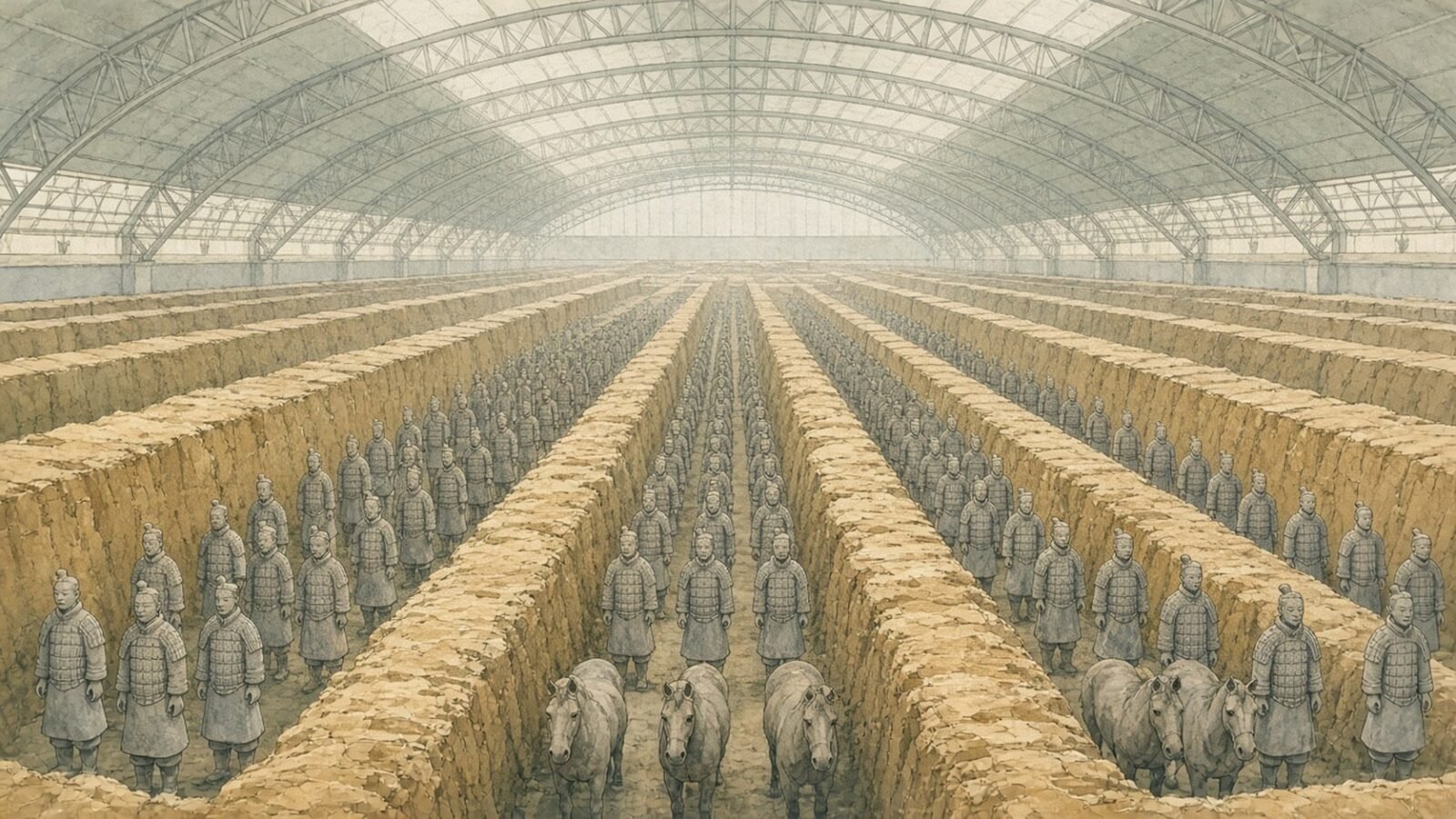
Discovered by local farmers digging a well in 1974, the Terracotta Army represents one of the greatest archaeological discoveries of the 20th century. Pits surrounding the main mound contain an estimated 8,000 life-sized clay soldiers, along with hundreds of chariots and horses:
- Individual Detail: No two terracotta soldiers are identical. Each features unique facial expressions, hairstyles, armor plates, and footwear reflecting their rank, origin, and unit type.
- Original Paint: When created, the terracotta figures were brightly painted with pigments derived from azurite, cinnabar, and malachite, preserved under a layer of natural lacquer.
- Tactical Deployment: The soldiers stand in precise battle formation, facing east toward the lands the Emperor had conquered, ready to protect his spirit against his former enemies in the afterlife.
The central tomb mound itself remains unexcavated to this day. Historical accounts describe a vaulted central chamber designed as a miniature cosmos: the ceiling decorated with copper representations of the sun, moon, and stars, while the floor featured a topographical map of China with rivers of liquid mercury mechanically pumped to flow toward a miniature ocean. Modern soil testing around the mound has revealed unusually high concentrations of mercury, lending credence to Sima Qian’s descriptions.
IX. Death in the Desert and the Collapse of Qin
In the summer of 210 BCE, while on an imperial tour of the eastern provinces, Qin Shi Huangdi fell gravely ill. He died at the palace of Sandao, hundreds of miles from the capital. He was 49 years old.
The Sandao Conspiracy
Knowing the news of the Emperor’s death could trigger immediate rebellion across the newly unified realm, Grand Councilor Li Si and the chief eunuch Zhao Gao kept his death a secret.
They placed the Emperor’s body inside his covered imperial carriage and ordered carts loaded with rotting fish to travel immediately ahead and behind it to mask the smell of decomposition as the procession made its way back to Xianyang.
Before his death, Qin Shi Huangdi had written a sealed letter to his eldest son, Prince Fusu, ordering him to hand over military command to General Meng Tian and return to the capital to direct his funeral. Fusu was widely respected and had previously opposed the burning of books, making him a popular successor choice.
Zhao Gao and Li Si intercepted the letter. Fearing that Fusu’s ascension would lead to their removal from power, they forged an imperial decree ordering Prince Fusu and General Meng Tian to commit suicide for “disloyalty,” declaring the Emperor’s younger, weak-willed son, Huhai, as the second emperor (Qin Er Shi). Prince Fusu obeyed the forged decree and took his own life.
The Rapid Collapse (209–206 BCE)
The Qin Dynasty was built on absolute authority, clear structure, and ruthless enforcement. Without a strong ruler, the administrative apparatus fractured quickly.
In 209 BCE, two military officers named Chen Sheng and Wu Guang were leading a group of 900 peasant conscripts to a northern garrison post. A torrential rainstorm washed out the roads, making it impossible for them to arrive on time. Under strict Qin law, the penalty for missing a military deadline was death—regardless of the cause.
Facing certain execution, Chen Sheng famously addressed his men:
“If we attempt to flee, we die. If we attempt an uprising, we die. Since death is the outcome for both, why not die fighting for our freedom?”
The Dazexiang Uprising ignited a wave of anti-Qin rebellions across the continent. Descendants of the former noble families rose up to reclaim their lands, joined by millions of exhausted peasants.
Inside the capital, Zhao Gao seized control of the government, forcing Li Si’s execution and eventually driving the incompetent Second Emperor to suicide. In 206 BCE, less than four years after Qin Shi Huangdi’s death, the rebel leader Liu Bang marched into Xianyang. The Qin Dynasty—intended to endure for ten thousand generations—had collapsed after just fifteen years. Out of the ashes of Qin rule, Liu Bang established the Han Dynasty (202 BCE – 220 CE).
X. Legacy: Tyrant, Genius, or Architect of Nationhood?
Few leaders in world history have left a legacy as complex or enduring as Qin Shi Huangdi.
The Han Paradox
The Han Dynasty officially denounced Qin Shi Huangdi as an unfeeling tyrant whose legalist cruelty brought about his empire’s ruin. Han scholars crafted a historical narrative that contrasted Qin brutality with Han Confucian benevolence.
Yet, behind this public condemnation, the Han state adopted virtually the entire Qin administrative framework:
- They retained the centralized commandery system.
- They preserved the standardized script, currency, and measurements.
- They inherited the unified legal code and administrative bureaucracy.
As historians have noted, the Han Dynasty presented a Confucian facade built over a solid Legalist Qin core—a governing model that defined Chinese statecraft for the next two thousand years.
Conclusion: The Shadow of the First Emperor
Qin Shi Huangdi was a sovereign of stark contradictions. He was an uncompromising tyrant whose rule broke the spirits and bodies of millions of subjects, yet he was also an administrative genius whose reforms created the structural template for China as a unified civilization.
Without his ruthless focus on integration, East Asia might have remained a patchwork of rival nation-states—much like modern Europe—divided by language barriers, distinct currencies, and endless border rivalries. By forging a unified script, a centralized state apparatus, and a shared cultural identity, he laid a durable structural foundation for imperial continuity.
The emperor who spent his final years searching for an elixir of life never found physical immortality. Yet through the enduring shape of the civilization he forged, Qin Shi Huangdi achieved a historical permanence matched by few leaders in human history.