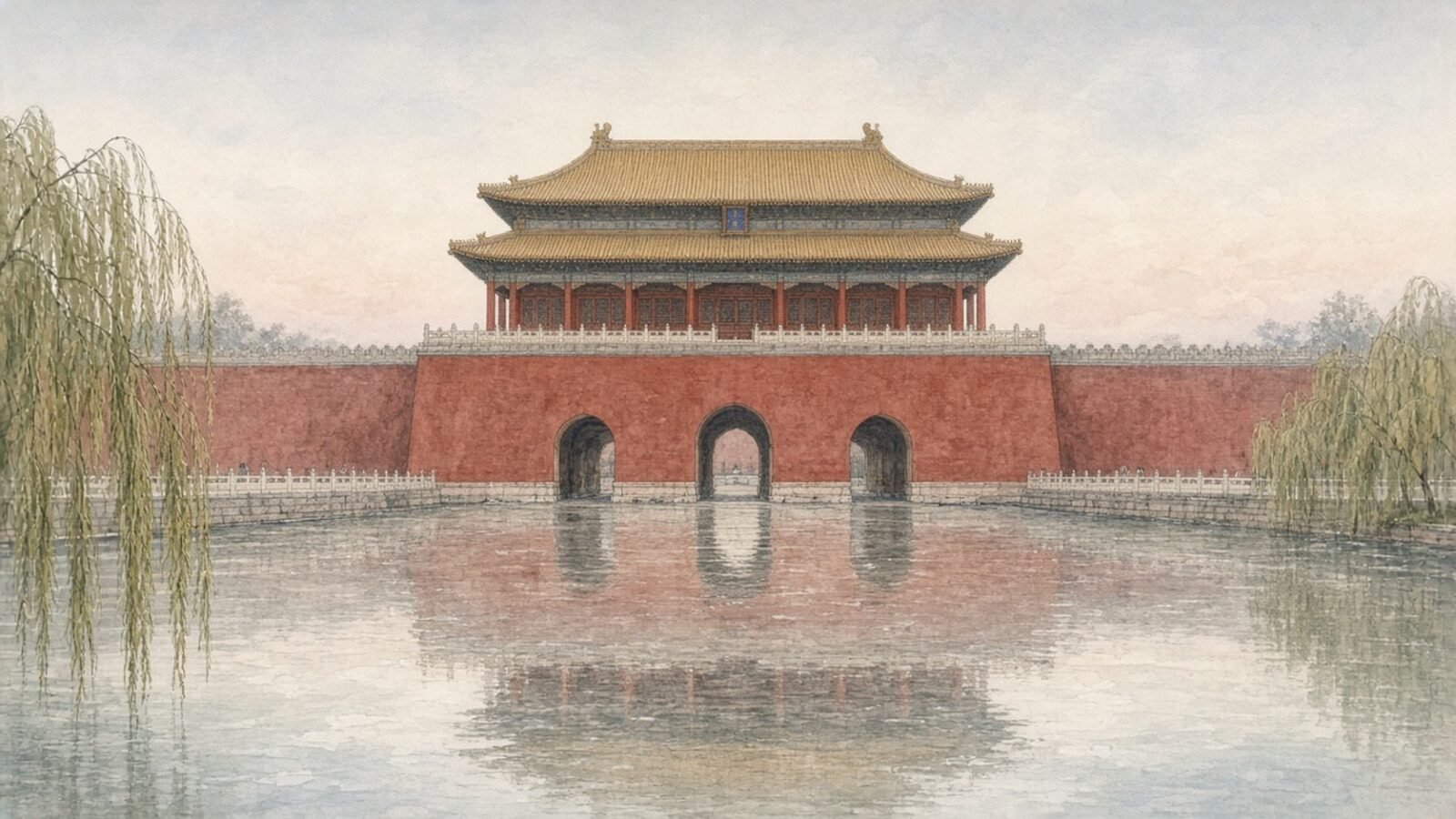
If you have ever stood on the central axis of Beijing on a pale winter morning and looked at the north gate of the Forbidden City, you know the red I mean. It is not the thin, cheerful red of a London bus or a Coke can. It is a deep, oily, almost purple vermilion that seems to absorb light and give it back warmer. It stains the eye. It makes the gray sky and the gray stone of the city recede. And you see it again and again until you realize it is not an accent color at all, it is the ground color of the civilization. It is on the pillars that hold up the roofs of temples, on the paper that is pasted to every door at New Year, on the silk a bride still wants to wear even when she also wears white, on the seal that makes a document real, on the flag that goes up in every schoolyard on Monday morning, on the little plastic cover of a book of quotations that millions of people once held over their heads like a talisman. The West likes to say China is red because China is Communist, which is true in the way that saying Rome is white because the Pope wears white is true. It mistakes the last layer of paint for the building. The Communists chose red because China was already red, had been red for two thousand years, and the real question is not why the Party liked red, but why a culture that had every color available to it kept returning to this one, through dynasties that hated each other, through peasant revolts and imperial restorations, through invasions and revolutions.
The answer begins before there was a China in the imperial sense, in the way classical Chinese thought organized the universe not as a collection of things but as a system of correspondences. In the theory of the Five Phases, wuxing, everything belongs to Wood, Fire, Earth, Metal, or Water, and each phase generates and overcomes the others in turn, and each phase has a direction, a season, a taste, an organ, a virtue, and a color. Fire corresponds to the south, to high summer, to heat and brilliance, to the heart, to propriety, and to red, chi. The south was the direction of maximum yang, the direction you faced if you were the emperor because you faced the light, while everyone who approached you faced north, toward shadow and cold. To wear red, to display red, was to align yourself with that southern, summery, life-giving power. It was auspicious by definition. It was not the only powerful color, because the system was too sophisticated for a single monopoly. Yellow, huang, belonged to the center, to Earth itself, and by the Tang it was being reserved for the emperor alone. Blue-green, qing, belonged to the east and spring. White belonged to the west and autumn and to mourning, which is why traditional Chinese mourning clothes are white, not black. Black belonged to the north and winter and to water. Red was powerful but shareable. An ordinary family could not wear imperial yellow, but they could and did use red. That shareability is crucial to its longevity. And underneath the cosmology there was a hard material fact. China is rich in cinnabar, mercury sulfide, which occurs in the mountains of Hunan and Guizhou in crystals of such bloody intensity that you understand why early alchemists thought it was congealed life. Ground up it makes zhusha, a pigment that does not fade, that stays true for a thousand years on a wall. Heated, it releases liquid mercury, which Daoist alchemists believed was the essence of immortality, and many emperors duly drank cinnabar elixirs and died of mercury poisoning, which only seemed to prove that the stuff was potent. By the Han dynasty, from 206 BCE to 220 CE, the material and the metaphysics had fused into statecraft. Imperial edicts were corrected and approved in vermilion ink, zhupi, the vermilion brush. A low clerk wrote in black, the emperor intervened in red. Life and death decisions were literally red marks. The seals that made any document authentic, the chops that every Chinese person still owns today, were cut in stone and stamped in vermilion paste made from cinnabar and oil. Authority was red because authority needed to be visible, indelible, and alive.
Because red was fire and light, it was also protection, and this is the second great root of its popularity, the popular root that runs alongside the imperial one. If ghosts and misfortune are creatures of shadow, of the yin world, you keep them away with yang color. You light a fire against them. Every Chinese New Year is still a great lighting of symbolic fires. You paste red couplets, chunlian, on either side of your door, you hang red lanterns, you dress children in red jackets and hats, you give money in red envelopes, hongbao, which are red precisely so that the evil that might steal the money or the child is burned off. The language of celebration itself is saturated with red. Honghuo means bustling, lively, literally red fire. Hongshi means a happy event. Hongyan means good luck. The bridal color for most of Chinese history was not white, which is the color of funerals, but red, because a wedding is a dangerous passage when a woman leaves her natal family and enters another, when a new household is formed and is therefore vulnerable, and the bride is wrapped in red silk and carried in a red chair to keep her safe and to declare her fertility. A girl who is lucky in love is hongren, a red person. All of this meant that for a farmer in Shaanxi or a merchant in Suzhou, red was not an abstract imperial symbol at all. It was the color you reached for whenever life was at its most intense and precarious, birth, marriage, new year, death. One strand of red said power from above, the vermilion seal. The other said life from below, the red thread tied around a baby’s wrist. They were never really separate.
That double meaning explains why red keeps becoming the color of rebellion, and why your first example, the Red Turbans, matters so much. In the 1340s and 1350s the Mongol Yuan dynasty, which had ruled China for less than a century, was disintegrating. The Yellow River changed course catastrophically, flooding vast areas and forcing hundreds of thousands into labor gangs to repair dikes and reopen the Grand Canal. Taxation was savage, the bureaucracy was seen as foreign, plague was spreading. In that world of flood and hunger, millenarian Buddhism flourished, especially the White Lotus Society, which taught a Manichaean division of light and darkness and promised the imminent descent of Maitreya, the Buddha of the future, who would usher in a new age and punish the wicked. The White Lotus needed an army, and its army needed a uniform that could be made cheaply, seen at a distance, and understood cosmologically. They wrapped their heads and turbans in red cloth dyed with safflower, and they called themselves Hongjin Jun, the Red Turban Army. The choice was practical and theological at once. Practically, safflower red was cheap and unmistakable on a battlefield. Cosmologically, Chinese theorists of the Five Phases had assigned the Yuan, who had come from the west, to the phase of Metal and the color white. In the cycle of mutual destruction, Fire overcomes Metal. So to defeat the white dynasty of the west you must wear the fire color of the south, red. Religiously, the prophecies said the old world would be cleansed by fire before Maitreya came. To wear red was to declare yourself the agent of that cleansing. So you had bands of starving peasants in red turbans chanting that the empire is in great chaos, Maitreya is about to be reborn, that the world of light is coming. They were apocalyptic, often brutal, and enormously popular, and out of their southern branch came a man who had been born into utter poverty in Anhui, had been a cowherd, had lost his entire family to famine and disease, had become a novice in a Buddhist monastery and then had to leave it to beg for food, a man named Zhu Yuanzhang. He joined a Red Turban unit, married his commander’s foster daughter, imposed ferocious discipline on his men when other rebel leaders let theirs loot, and slowly, brilliantly, outfought both the Mongols and his fellow rebels. In 1368 he proclaimed himself emperor in Nanjing and gave his new dynasty a name heavy with light, Ming, meaning Bright. The boy in the red turban was now the Hongwu Emperor, and his family name, Zhu, was itself a pun on vermilion.
It is Zhu Yuanzhang’s son, the Yongle Emperor, who gives you your second example, the Forbidden City, and who shows how that peasant red became imperial red again without ever losing its popular charge. Yongle seized the throne from his nephew, decided to move the capital from Nanjing in the south to Beijing in the north to watch the Mongols, and ordered a palace that would be the earthly counterpart of heaven. It was built between 1406 and 1420 by a million laborers and a hundred thousand artisans, and it was designed as a cosmological diagram. Its name, Zijin Cheng, tells you everything. Zi refers to Ziweiyuan, the Purple Forbidden Enclosure, the cluster of stars around the North Star where the celestial emperor dwells, because the earthly emperor’s palace must mirror the celestial one. Jin means forbidden, Cheng means city. The Forbidden City. What strikes you first is not the yellow glazed roofs, though they are spectacular. It is the walls and the pillars. They are red, and not a bright festive red but a deep, expensive, blood-ox vermilion called zhu. Part of that is a pun so obvious every commoner would get it. The dynasty is Zhu, the color is zhu, the palace is Zhu’s palace in Zhu’s color. It is branding on a scale no modern corporation has ever achieved. Part of it is material and sensory. Those enormous columns, many of them single trunks of nanmu wood floated a thousand miles from the forests of Sichuan, are lacquered again and again with cinnabar lacquer. That lacquer preserves the wood against the brutal dry cold of Beijing winters and the dusty heat of its summers, and it also creates a surface that seems to glow even on a dull day. In low northern light, a vermilion pillar looks warm to the touch. You feel enclosed and protected. That is intentional. The building is teaching you that you are in the realm of Fire, of the south, even though you are in the far north. And there is a political grammar in the colors. In Ming and Qing official architecture, the structural bones, the pillars and walls and doors, are red, and the roofs are yellow. Yellow by this time is restricted, on pain of death, to the emperor. Red is the color of the officials who support him. The building says, the yellow heaven rests on the red state. When the Manchus, who were from the northeast and whose own cosmological color was white and whose banners were white and black and blue, conquered Beijing in 1644 and founded the Qing, they had every reason to repaint the city in their own colors. They did not. They kept the vermilion walls, they kept the yellow roofs, they kept the entire Ming color code, because they understood that to rule China you had to speak Chinese, and Chinese power spoke in red and yellow. The Forbidden City remained red through 276 years of foreign rule, which is why it is still red today.
That long continuity makes the 20th century turn comprehensible instead of jarring. When Sun Yat-sen overthrew the Qing in 1912, his Republic needed a flag that was not Manchu yellow, and its designers experimented with five-color flags for the five peoples, and red was always one of them because you could not have a Chinese flag without the color that had meant celebration and legitimacy for two millennia. When the Chinese Communist Party was founded in 1921 and began to build its own army in 1927, it faced a different problem. Every socialist movement in the world since the French Revolution of 1848 and the Paris Commune of 1871 had adopted red as the color of workers’ blood and revolution. To be a Communist was to fly a red flag. That international red arrived in China and landed on soil that was already completely prepared for it. The peasants the CCP tried to mobilize did not need to be taught that red meant good luck, that red meant a just rebellion against a corrupt dynasty, that red was the color that overcame white metal. They already knew that story from operas and village tales about the Red Turbans. The CCP’s own army was called hongjun, red army, a phrase that in Chinese ears echoes hongjin jun, red turbans, almost exactly. Mao Zedong, who was a voracious reader of popular history and classical novels like Water Margin where outlaws in red sashes fight corrupt officials, cultivated that echo deliberately. Yan’an, the CCP’s base in the 1930s and 40s, was presented as a sacred red base, a new Mount Jinggang. The Long March was framed as a pilgrimage that would end with the world renewed, exactly as White Lotus prophecies had been. When the People’s Republic was proclaimed on October 1, 1949, the flag that went up over Tiananmen, designed by Zeng Liansong, was red with five yellow stars. Officially red stands for revolution and the yellow stars are the four classes gathered around the Party. But everyone could also read it the old way. Yellow on red is the old imperial pairing inverted, the people as the roof, the revolution as the pillars. It worked because it was both entirely new and entirely familiar.
Which brings us to your final example, the Red Guards, Hongweibing, where that familiar red becomes almost incandescent with intensity. In 1966 Mao, feeling that the Party and the country he had created had become bureaucratic and revisionist, called on students and young workers to attack the Four Olds, old ideas, old culture, old customs, old habits. They organized themselves into Red Guards. They wore armbands of red cotton with Hongweibing written in gold, they carried the little book of Mao’s quotations bound in red plastic, the Hong Baoshu, the Little Red Book, and they learned that to hold it aloft when challenged was to prove your loyalty. Officially they were the guards of the red revolution. Culturally they were doing something much older and much darker with the apotropaic power of red. If red is fire that wards off evil, then to purify a society you must paint it red. The Red Guards painted everything red. They renamed streets to include hong and dong, red and east, they painted doors and walls with red slogans, they beat teachers and officials they labeled heibang, black gangs, and niuguisheshen, ox demons and snake spirits. Notice the chromatic language returning. Red against black. Fire against shadow. Light against darkness. It is the same war the Red Turbans declared against the white Yuan, the same war every New Year decoration declares against the old year, now taken to its absolute extreme. For two or three years, from 1966 to 1968, photographs of China show crowds that are literally a sea of red, red flags, red banners with huge black characters, red books held up like offerings, red armbands on every arm. It is a festival and an exorcism and a military mobilization at once, which is why it was so intoxicating to participants and so terrifying to victims. When the Cultural Revolution subsided, many Chinese associated that particular, saturated, political red with fear for a decade, and contemporary artists would later use it ironically, as in the Political Pop paintings that put Mao’s face in Andy Warhol pinks and reds. And yet red did not disappear. It could not. It was too old and too useful.
It persists today for all the reasons layered on top of each other. It persists because it is chemically stable and visually dominant in a landscape of gray brick and dusty roads and green fields, so architecture learned early to use it as a beacon. It persists because the language is built out of it, hongren, honghuo, hongyun, hongli, beloved, bustling, lucky, profitable, so to wish someone well is to wish them red. It persists because every Chinese person still experiences it as the color of the moments when life is most concentrated, a birth where a red egg is given, a wedding where the double happiness character is red, a New Year where every door is red, a funeral where, tellingly, you pointedly do not use red. And it persists because history has never offered a credible alternative that could carry the same weight. White is mourning, black is stern, yellow is too imperial to be popular, blue is too cool and distant. Red alone can be both the emperor’s vermilion seal and the peasant’s turban, both the palace wall and the bridal veil, both the flag of the state and the envelope that a grandmother presses into a child’s hand. That is why China is red, from red turbans to red guards to the Forbidden City. It was never just a pigment. It was an argument about what should survive, and for more than two thousand years the answer, given by Daoist alchemists grinding cinnabar in a mortar, by Han clerks stamping a seal, by starving rebels tying cloth around their heads, by Ming architects lacquering a pillar, by students tying an armband around their arm, has been the same. Let the fire color survive.