For more than two thousand years, what we now call Vietnam lived in China’s shadow and at times inside its borders, and that long entanglement is what the old phrase Sino-Annam history is trying to capture. The phrase itself tells the story, because Annam is not what the Vietnamese called themselves at any point in their own language. It is what the Chinese court called them, An Nan, meaning the Pacified South, a name that was at once geographic description, political program, and moral claim. To understand Sino-Annam history you have to hold two ideas together that seem contradictory but coexisted for centuries. The first is domination and resistance, the famous Bac thuoc periods when Vietnam was a Chinese province and the long series of revolts that expelled Chinese armies. The second is intimacy and imitation, because Vietnamese kings built a state that copied Chinese bureaucracy, examinations, law, literature, and court ritual more faithfully than almost any other country in East Asia, and they did so not under duress but by choice, long after they were independent. It was simultaneously foreign rule and domestic model, and that duality runs through every century from the Red River bronze drums to the border war of 1979.
The deep past begins before there was a China or a Vietnam as we understand them, in the world of the Baiyue, the Hundred Yue peoples who stretched from what is now Zhejiang down through Fujian, Guangdong, Guangxi and into the Red River Delta. The ancestors of the Vietnamese, known to their own legends as the Lac Viet under the Hung kings at Van Lang, were one of those Yue peoples, living in dense wet-rice villages protected by bamboo hedges, casting great bronze drums, tattooed, and organized under chieftains called Lac lords and Au lords. In 221 BC Qin Shi Huang unified the warring states and immediately pushed south, and though his armies shattered many Yue groups they never fully consolidated control over the far south before Qin collapsed in chaos. Out of that chaos emerged Zhao Tuo, Trieu Da in Vietnamese pronunciation, a former Qin general from Hebei who seized Guangzhou in 204 BC and declared himself king of Nanyue, Nam Viet, a kingdom that included Guangdong, Guangxi, and the Red River Delta. Nanyue is the hinge on which Chinese and Vietnamese national histories diverge and will never fully agree, and it is worth lingering on because it sets the pattern. Chinese histories treat Nanyue as a Chinese regional regime founded by a Chinese man that brought Chinese civilization to the Yue. Vietnamese histories treat Trieu Da as the Trieu dynasty, the first Vietnamese dynasty to unite the north, proof that Vietnamese statehood predated Han conquest. Archaeology at Co Loa, just north of modern Hanoi, with its massive earthen ramparts and advanced crossbow triggers, shows there really was a powerful local kingdom of Au Lac under An Duong Vuong before Zhao Tuo conquered it around 179 BC, so both stories have truth. Nanyue’s court itself was hybrid, its kings wore Chinese robes and used Chinese seals but kept Yue customs, took Yue wives, and were buried with Yue artifacts, and that fusion of Yue substrate and Han superstructure would define Annam for the next two millennia.
In 111 BC the Western Han Emperor Wu, who was expanding in every direction, sent armies by land and sea to destroy Nanyue, and with its fall the Red River Delta became three commanderies of the Han empire, Jiaozhi, Jiuzhen, and Rinan, beginning what Vietnamese historiography calls the First Domination, Bac thuoc lan thu nhat, lasting from 111 BC to 39 AD. Han rule was transformative in ways that are easy to underestimate because they became invisible. The Han introduced iron plows and buffalo-drawn agriculture that massively increased rice yields, built dikes to tame the Red River, imposed a household registration and tax system, minted coins, built roads, and brought the Chinese writing system which would remain the sole written language of administration in Vietnam until the early twentieth century. They also brought large numbers of Han migrants, officials who were exiled for political crimes, merchants seeking the maritime trade route to India, and soldiers who settled. Two figures from this era dominate later memory. The first is Shi Xie, Si Nhiep, who served as governor of Jiaozhi from 187 to 226 AD as the Han dynasty collapsed into the Three Kingdoms, ruling almost as an independent king, keeping the peace while central China tore itself apart, and patronizing Confucian schools so effectively that later Vietnamese Confucians worshipped him as a king and Chinese histories praised him as a model Confucian. The second is the Trung Sisters, Hai Ba Trung, Trung Trac and Trung Nhi, daughters of a Lac lord family, who rose in 40 AD after a particularly harsh Han prefect executed Trung Trac’s husband. Their revolt was not a small village uprising, it expelled the Han administration and held sixty-five towns and fortresses for three years, with Trung Trac proclaimed queen. In 43 AD Han Guangwu Emperor sent his veteran general Ma Yuan, Ma Vien, with perhaps twenty thousand regulars, who reconquered the delta, captured and executed the sisters, who according to Vietnamese legend drowned themselves in the Hat Giang River rather than surrender, and erected bronze pillars inscribed as the southern boundary of Han. Vietnamese folklore says locals hated the pillars and knocked them down, and the sisters became the eternal archetype of patriotic resistance, invoked by every later movement, while Ma Yuan became in Chinese lore the great pacifier of the south whose name was given to the horseshoe.
What followed was the Second Domination, from 43 AD to 544, almost five hundred years under Han, Eastern Wu, Jin, and the Southern Dynasties, and it was far from peaceful or passive. Chinese records themselves list dozens of major uprisings in Jiaozhi in 100, 137, 144, 178, 248 and other years, most led by the powerful local clans who had both Viet and Han ancestry and who resented taxation and conscription. In 248 a young woman named Trieu Thi Trinh, Lady Trieu, at twenty-three years old, raised an army, rode into battle on an elephant, and is said to have declared, I want to ride the wind and waves, kill the whales of the Eastern Sea, sweep the seas clean, save the people from drowning, why should I imitate others, bow my head, be a slave. She was crushed after six months but her image endured. During these centuries Buddhism arrived from two directions at once, Indian monks coming by sea and Chinese monks coming by land, Taoist magicians and alchemists became influential, and a bilingual elite emerged who could write classical Chinese perfectly and speak local Viet at home, who served as interpreters and clerks for the Chinese administration but also preserved local genealogies. By the sixth century this elite was ready to break away. In 544 Ly Bi, a man from a prominent local family who had served as a Liang official, declared himself Emperor of Van Xuan, the Myriad Spring, with his own reign title and court, independent of Liang. He held the Red River for five years, building fortresses and a court at Long Bien before Liang sent an army that defeated him. His general Trieu Quang Phuc continued the resistance from the swamps of Da Trach, and although Van Xuan fell, it established the precedent that independence was possible. The Sui dynasty, having reunified China in 589, reconquered Jiaozhi in 602 with a large expedition, beginning the Third Domination, a shorter but more bureaucratic period under Sui and early Tang when the Chinese tried to count every household for corvee labor and to impose regular land taxes, building new roads and attempting to integrate Annam fully into the empire.
Under the Tang dynasty, which is often seen as the cosmopolitan high point of Chinese history, the name Annam itself was formally born, and the character of Chinese rule changed again. In 679 the Tang court reorganized its southern frontier and created the Annam Duhufu, the Protectorate General to Pacify the South, with its seat at Songping on the site of modern Hanoi, and from that point onward Annam became the official Chinese name for the region for more than a millennium, a name that Europeans would later borrow. Tang Annam was wealthier and more exposed than earlier Jiaozhi. The Tang built extensive dike systems on the Red River that allowed for more intensive cultivation, they developed a maritime port near modern Haiphong that linked the overland routes of Yunnan to the maritime routes of Champa and Srivijaya, and they faced constant pressure from three directions, the upland Tai and Muong chieftains who refused to pay taxes, the kingdom of Nanzhao in Yunnan which became a great military power in the ninth century and twice sacked Songping in 862 and 863 and held it for two years, and Champa to the south. To hold Annam the Tang stationed a large garrison and relied increasingly on local strongmen. Tang also left the deepest cultural imprint. Confucian schools were expanded, with sons of local clans sent to take examinations in Chang’an, Vietnamese Buddhist monks like Vo Ngon Thong became patriarchs of major schools, and the basic social unit that would survive every later war, the xa or lang, the Vietnamese village commune with its communal rice fields, its bamboo hedge, its dinh communal house, its own patron spirit and its fierce autonomy from any central government, solidified under Tang taxation as peasants clustered together to share the burden. By the late ninth century Tang was collapsing into warlordism, and in Annam local families began to rule as autonomous Jiedushi, military commissioners. The Khuc family, Khuc Thua Du in 905 and his son Khuc Hao, took power in Hanoi, calling themselves Jiedushi of Annam but refusing to send taxes to the dying Tang and later to the Later Liang. They were followed by the Duong and Ngo families. In 938 the Southern Han kingdom based in Guangzhou, which claimed to be the legitimate successor to Tang in the south, sent a large fleet under Liu Hongcao to reimpose direct control. Ngo Quyen, a general and son-in-law of the Khuc, met them on the Bach Dang River estuary. Knowing the tides intimately, he had his men plant thousands of iron-tipped stakes in the riverbed at low tide, then sent small boats to lure the Southern Han fleet in at high tide, and when the tide turned and the Southern Han ships were impaled and immobilized, he attacked. The entire fleet was destroyed, Liu Hongcao was killed, and Southern Han never again tried to take Annam. In 939 Ngo Quyen declared himself king and moved his capital to Co Loa, ending the Third Domination.
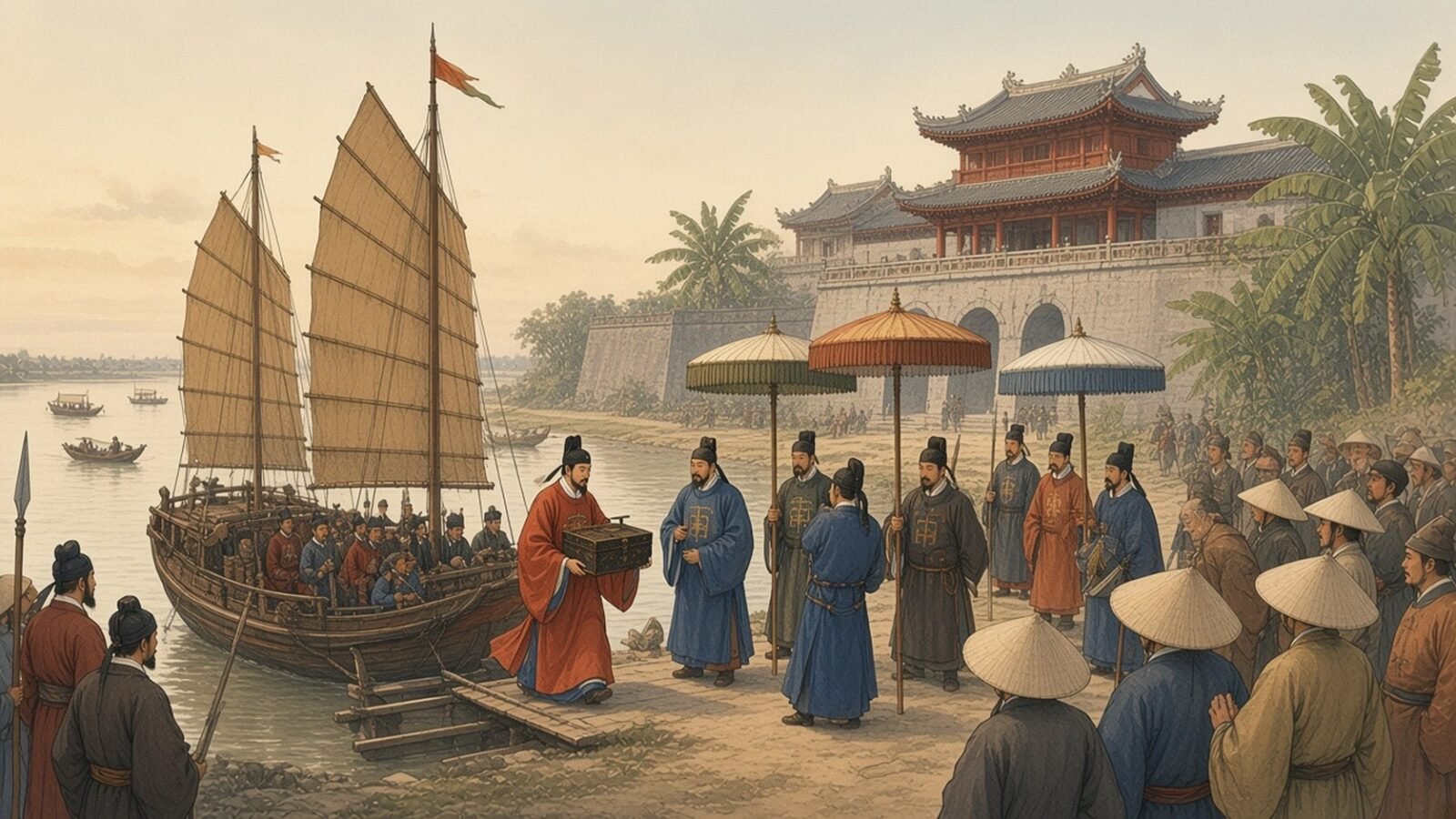
The period from 939 to 1407 is often called the era of long independence, but it is a mistake to think that meant separation from China. It was the era when Dai Viet, as the country called itself from 968 onward, learned to live with China by mastering the tributary game, a piece of political theater that was so effective it preserved independence for almost five centuries. The problem facing each new Vietnamese dynasty, Dinh, Early Le, Ly, Tran, was simple and existential. They were too strong to be easily conquered, too small to challenge China militarily, and too culturally similar to ignore China culturally. The solution was to accept investiture. Each time a new king took the throne in Hanoi, he would send a formal embassy to the Chinese capital, first to Kaifeng under Song, then to Hangzhou under Southern Song, then to Dadu and later Beijing under Yuan, Ming, and Qing, bearing tribute gifts of gold, silver, ivory, aromatic woods, kingfisher feathers, and exotic animals, and a memorial written in exquisite classical Chinese asking the Son of Heaven to recognize him as King of the State of Annam. The Chinese emperor would in return grant a golden seal, a calendar, a robe, and a title that was always carefully lower than what the Vietnamese king claimed internally, often calling him Annam Quốc Vương or even just An Nam Đô Thống Sứ, Commissioner of Annam. In return China pledged in theory not to invade and allowed border markets. Inside Vietnam, the same king called himself Hoang De, Emperor, wore yellow robes that only an emperor could wear in Chinese ritual, used his own reign name, and declared that he was Emperor of the Southern Country, equal to the Emperor of the North. Vietnamese envoys kowtowed in Beijing and then came home and wrote poems about how the South had its own mountains and rivers. This dual sovereignty was understood by both sides as a fiction that kept the peace. Under this umbrella Dai Viet built a powerful state. The Ly dynasty from 1009 to 1225 moved the capital to Thang Long, modern Hanoi, a city that would remain the capital for eight hundred years, built the Temple of Literature in 1070 dedicated to Confucius, held the first civil service examinations, and created a permanent bureaucracy. In 1075 the Song dynasty tried to invade, and the great general Ly Thuong Kiet launched a preemptive strike into Guangxi and Guangdong, then held the border on the Cau River, where legend says his soldiers recited the poem Nam Quoc Son Ha, Over mountains and rivers the South has its own Emperor, as the first Vietnamese declaration of independence. The Tran dynasty from 1225 to 1400 faced an even greater threat, the Mongols. The Yuan under Kublai Khan demanded submission and invaded three times in 1258, 1285, and 1288, sending armies of hundreds of thousands of Mongols, northern Chinese, and Yunnanese troops. The Tran twice abandoned Thang Long to the enemy, waging guerrilla war from the forests, and then counterattacked. In 1288 Tran Hung Dao, perhaps Vietnam’s greatest military hero, repeated Ngo Quyen’s tactic on the same Bach Dang River, planting stakes and destroying the Mongol fleet under Omar ibn Abi Bakr. The Mongols never returned. Throughout these centuries Chinese influence deepened rather than weakened, because the Vietnamese elite wanted it. The script Chu Nom was invented, using Chinese characters to write Vietnamese phonetically, Confucian examination graduates replaced hereditary aristocrats, and Neo-Confucianism as interpreted by Zhu Xi became state orthodoxy. To the Chinese court, Annam was the most troublesome tributary but also the most civilized, more Confucian in its court ritual than Korea or Japan in some eyes, yet constantly needing to be reminded of its place.
The fiction broke down in 1400 when Ho Quy Ly, a powerful minister, usurped the Tran throne and proclaimed a new dynasty. He also embarked on radical reforms, issuing paper money, redistributing land, and trying to limit Buddhism. The Ming dynasty under the Yongle Emperor, who had just usurped his own nephew in China, used the usurpation as pretext. Yongle, who saw himself as a universal ruler on the model of Tang Taizong, declared he was restoring the Tran and invaded in 1406 with an army that Ming sources put at 215,000 men. By 1407 the Vietnamese army was crushed, Ho Quy Ly was captured and died in exile in China, and Dai Viet was turned into the Ming province of Jiaozhi again, the Fourth Domination. This occupation was different from Tang because Ming was far more interventionist and ideological. Ming officials seized the complete archives of the Tran dynasty and shipped them to Nanjing, burned Vietnamese books deemed heterodox, banned the Nom script, forced Vietnamese men to adopt Chinese hairstyles and long gowns, imposed Chinese schools, and transferred tens of thousands of artisans to Beijing to work on the Forbidden City. The History of Ming is explicit about the goal, to transform their customs and teach them our rites. The occupation provoked the most famous resistance in Vietnamese history. Le Loi, a landowner from Lam Son in Thanh Hoa province, who had initially cooperated with Ming, raised the flag of rebellion in 1418. For ten years his forces lived in the mountains, often on the verge of annihilation, supported by a network of villages and advised by the scholar Nguyen Trai, who wrote letters in classical Chinese trying to persuade Ming officials to withdraw. Gradually Le Loi wore down the Ming garrisons, cutting their supply lines from Yunnan. In 1427 Ming sent a huge relief force of 100,000 men under Liu Sheng and Mu Sheng. Le Loi and his general Le Sat crushed them at Chi Lang Pass near Lang Son, killing Liu Sheng, and then surrounded the main Ming army in Dong Quan, modern Hanoi. Rather than annihilate them, Nguyen Trai negotiated. In exchange for safe passage back to China, Ming would recognize Le Loi as King of Annam. In 1428 Le Loi ascended the throne as Le Thai To, founder of the Later Le dynasty which would last, with interruptions, for 360 years. Nguyen Trai wrote the Binh Ngo Dai Cao, the Great Proclamation upon the Pacification of the Wu, which is considered the second declaration of independence of Vietnam after Ly Thuong Kiet’s poem. Its opening lines, deliberately modeled on Chinese classical prose, state, Our Dai Viet has long been established as a nation, with its own mountains and rivers, its customs in North and South are different, the Trieu, Dinh, Ly, Tran dynasties built our foundation, side by side with Han, Tang, Song, Yuan as equals through the ages. After 1428 no Chinese dynasty would ever again try to govern Vietnam directly as a province.
From 1428 to 1802 Vietnam remained inside the tributary system but turned increasingly southward in what historians call Nam Tien, the March to the South. Under the great Le emperor Le Thanh Tong from 1460 to 1497, Dai Viet became a smaller mirror of Ming. Le Thanh Tong promulgated the Hong Duc legal code modeled on Ming law, created six ministries and nine grades of mandarins exactly as in Beijing, organized the country into thirteen dao circuits, conducted a census, and built a powerful army that in 1471 destroyed the kingdom of Champa and seized its capital Vijaya, taking the central coast down to Nha Trang. That expansion was crucial for Sino-Annam relations because as Vietnam grew south toward the Mekong it became less vulnerable to China and acquired a new frontier, and its identity shifted from a purely Red River state to a long coastal country. When the Mac usurped the Le in 1527, Ming China was asked to intervene by Le loyalists who fled to Beijing. The Jiajing Emperor threatened invasion, but after long negotiations settled for a humiliating ritual. In 1540 the Mac ruler Mac Dang Dung had to present himself bound with rope at the border gate at Zhennan Pass, barefoot and kowtowing, to offer a map and registers and accept reduction of Annam from a kingdom to a pacification office. It shows how tributary politics was theater backed by real force. From 1627 to 1772 Vietnam itself split into two rival regimes, the Trinh lords ruling in the name of the Le emperor in the north at Thang Long, and the Nguyen lords ruling in the south from Hue, both claiming to be the legitimate Vietnam. Both sent tribute to Qing, and Qing, with great pragmatism, accepted tribute from both, treating them as two sides of Annam. The last great Chinese invasion of imperial Vietnam came at the end of this period. In 1788 the Le king Le Chieu Thong, after being driven from Thang Long by the Tay Son rebels who had overthrown both Trinh and Nguyen, fled to Beijing and begged the Qianlong Emperor for help. Qianlong, who had just completed his Ten Great Campaigns, saw a chance to reassert suzerainty and sent 200,000 troops under Sun Shiyi into northern Vietnam. They occupied Thang Long in December 1788 and set up Le Chieu Thong as a puppet. The Tay Son leader Nguyen Hue, who had proclaimed himself Emperor Quang Trung, marched north from Phu Xuan with extraordinary speed during the Tet New Year, telling his soldiers that they would celebrate Tet in Thang Long. On the fifth day of the new year 1789 he crushed the Qing at Dong Da, just outside Hanoi, in a battle where Vietnamese war elephants trampled Qing lines and Qing soldiers panicked and drowned in the Red River. Sun Shiyi fled, losing his seal. Qianlong, ever pragmatic, immediately reversed course, recognized Quang Trung as the new King of Annam, and arranged a marriage alliance, and Quang Trung sent a famous tributary mission to Chengde where he was received with great honor. The battlefield of Dong Da is still a low mound park in Hanoi where locals picnic.
The nineteenth century broke the old system beyond repair because a new empire arrived from the sea. The Nguyen dynasty unified the country in 1802 after twenty-five years of civil war, with some French military help and with investiture from the Jiaqing Emperor, who for the first time granted the name Vietnam, Viet Nam, meaning south of Viet, though the Nguyen founder Gia Long had actually asked for Nam Viet and Jiaqing reversed the words to avoid confusion with ancient Nanyue. Under Minh Mang, Gia Long’s son, Vietnam became more Confucian than ever, banning Christianity, centralizing administration on the Qing model, and expanding into Cambodia. At the same time European pressure on China after the Opium War of 1839-1842 showed that the tributary system could no longer protect anyone. From 1858 France began its conquest of Vietnam, first at Danang then at Saigon. The Hue court repeatedly appealed to Beijing as its suzerain, sending memorials that France was encroaching on a tributary state. For twenty years China tried to play its traditional role without fighting France directly, sending Black Flag irregulars under Liu Yongfu, remnants of the Taiping rebellion who had settled in the borderlands, to fight alongside Vietnamese troops in Tonkin, and building up Yunnan and Guangxi armies. This led directly to the Sino-French War of 1884 to 1885, a war that was fought largely on Vietnamese soil but also at sea. On paper China was the suzerain defending Annam, in reality the French army under General de Negrier defeated Qing armies at Bac Ninh and Lang Son, and in August 1884 the French navy under Admiral Courbet sailed into Fuzhou harbor and annihilated the entire Fujian Fleet, China’s most modern fleet, in half an hour. The resulting Treaty of Tientsin in 1885 was a watershed in Sino-Annam history. Article II stated that China recognized France’s protectorate over Annam and Tonkin and abandoned its suzerainty. For the first time since 111 BC, Vietnam’s fate was decided by a power other than China. France divided Vietnam into three parts, Tonkin in the north, Annam in the center, and Cochinchina in the south as a direct colony, keeping the old Chinese name Annam for its own central protectorate. The cultural consequences were even larger than the political ones, because the French, to weaken both Chinese and traditional elite influence, promoted quoc ngu, the romanized alphabet invented by Jesuit missionaries in the seventeenth century, and by 1910 classical Chinese was abolished from examinations, ending two thousand years of Chinese as the language of state.
Sino-Annam history did not end in 1885, it mutated into revolutionary comradeship and then into modern rivalry. The anti-colonial movements of both countries were intertwined. Sun Yat-sen organized among overseas Chinese in Hanoi and Haiphong, Phan Boi Chau, Vietnam’s leading anti-French nationalist in the early twentieth century, lived for years in Guangzhou and Hangzhou and wrote his books in classical Chinese, and Ho Chi Minh himself lived in China for much of the period from 1924 to 1945, founded the Indochinese Communist Party in Hong Kong in 1930, spent time in Chinese prisons under the Guomindang, and worked with the Chinese Communist Party’s southern bureaus. From 1950 to 1975 China was North Vietnam’s most important ally, the relationship described by Mao as being as close as lips and teeth. China sent over three hundred and twenty thousand troops who served as anti-aircraft gunners, railway engineers, and logistics corps, allowing North Vietnamese regulars to go south, and provided an estimated twenty billion dollars in aid at today’s values, including guns, rice, and fuel, and allowed transit of Soviet aid through Chinese railways. Chinese air defense troops around Hanoi shot at American planes. Yet beneath the public rhetoric, traditional suspicions never disappeared, Vietnamese leaders privately resented Chinese paternalism and the memory of past dominations, and Chinese leaders worried that Vietnam would become a Soviet client. After unification in 1975 those tensions exploded. Hanoi expelled about four hundred and fifty thousand Hoa, ethnic Chinese, many of whom had lived in Cholon for generations, aligned itself militarily with the Soviet Union in a treaty signed in 1978, and invaded Cambodia in December 1978 to overthrow Pol Pot, who was China’s closest ally in Southeast Asia and who had been massacring Vietnamese border populations. In response Deng Xiaoping, who had just been rehabilitated and had just visited Washington and Tokyo, decided to punish Vietnam. On February 17 1979 the People’s Liberation Army crossed the border in twenty-six places with about two hundred thousand troops, announcing a self-defense counterattack to teach Vietnam a lesson. The three-week border war was savage and strategically inconclusive. China captured the border cities of Lao Cai, Cao Bang, and Lang Son, declared its punitive mission accomplished, and withdrew, while Vietnam claimed it had repelled the invader by tying down Chinese divisions with militia. Both sides suffered heavy casualties, Chinese sources later acknowledged about twenty-six thousand dead and wounded, Vietnamese sources claimed far higher Chinese losses, and border skirmishes and artillery duels continued until 1990. The war was followed by a decade of hostility when China armed the Khmer Rouge remnants and Vietnam was isolated. Normalization finally came in 1991 after the Cold War ended, and since then Sino-Vietnamese relations have returned to a pattern that any Tang or Le official would recognize immediately, massive trade with China now Vietnam’s largest trading partner, deep cultural and linguistic similarity, thousands of cross-border marriages in Lang Son and Lao Cai, and intense strategic mistrust over the Paracel and Spratly Islands and over who sets the rules in Southeast Asia.
If you walk through Hanoi today you can read the whole story in stone and habit without needing a textbook. In the Temple of Literature the eighty-two stelae of doctoral laureates list names that are half Chinese in origin and half Vietnamese, carved in Chinese characters by men who thought of themselves as both. In almost every village communal house the parallel couplets over the door are still in Chinese characters even if no one can read them, and the village dinh still has a guardian spirit that was once registered by a Le ministry using Ming regulations. Vietnamese New Year, Tet, the mid-Autumn festival, ancestor worship on death anniversaries, the burning of paper money, the city god cult, Mahayana Buddhism with Quan Am, Taoist talismans to keep ghosts away, the use of chopsticks, the lunar calendar, the respect for calligraphy, all came via China over two thousand years and are now so Vietnamese that people forget their origin. Yet the language spoken at home remains Austroasiatic, not Sinitic, with a grammar that has nothing to do with Chinese. The folk religion of mother goddesses, Dao Mau, the cult of the Trung Sisters and Tran Hung Dao as spirits, the bronze drum motifs still tattooed on highlanders, the fierce autonomy of the village that survived every empire and every collectivization campaign, all remain distinctly non-Chinese and were never absorbed. That is the paradox that Sino-Annam history leaves you with, and why it matters beyond academic curiosity. For a thousand years it was not foreign relations in the modern sense at all but domestic history inside a shared civilizational world, like England and Scotland or Castile and Aragon, and for the next thousand years it was a tutorial and a rivalry between a giant and a small country that learned everything from the giant except how to obey it. Vietnamese historiography for centuries has been written as the struggle to preserve that distinction while using Chinese tools, as the fifteenth century historian Ngo Si Lien put it, our country is Dai Viet, though our customs have at times followed the North. Chinese historiography often treats Vietnam as a wayward student who learned well but forgot respect. Neither view is complete, and the truth lives on the same riverbank. The Bach Dang River appears three times in this story, in 938, 1288, and in the memory of every Vietnamese schoolchild who knows that stakes in a river can sink an empire, and it is why both sides still remember it and why the story still feels unfinished.