The idea of China as a single continuous civilisation is both deeply compelling and fundamentally misleading if taken too literally, because what we now call China is not a natural unit that existed from the beginning but rather a vast and varied landscape that over many millennia came to be unified by shared cultural practices, shared mythologies of origin, and eventually by shared forms of writing and political organization. The geographic heart of this process lies in the great river systems that drain the eastern flank of the Asian continent, above all the Huang He which is often called the Yellow River in English and the Chang Jiang which is called the Yangtze in English, two enormous waterways that create corridors of fertile alluvial soil, seasonal flooding, and transport, and that also create natural boundaries and zones of interaction between very different ecological worlds, from the cold dry loess plateau of the northwest to the humid subtropical hills and rice paddies of the south. Any account of Chinese origins must therefore begin not with a single people or a single centre but with a mosaic of local adaptations to these environments, each developing its own forms of pottery, its own domestication of plants and animals, its own burial customs and symbols, and each eventually drawn into larger networks of exchange that would create the cultural texture from which historical China emerged. For a very long time western popular imagination pictured Chinese history as beginning with a fully formed empire, perhaps with wise sage kings who invented writing, agriculture and law, but modern archaeology has replaced that picture with something far more interesting, a slow accretion of interlinked Neolithic societies that were already sophisticated, already regionally distinct, and already engaged in forms of social complexity that prefigure later Chinese institutions, and it is this deep background that makes the eventual appearance of literacy in the second millennium BCE so significant, not as a sudden invention ex nihilo but as the crystallization of a long tradition of symbol making and political record keeping. The term China itself is anachronistic for this early period, as the people who lived along the Yellow River in the third millennium BCE did not call themselves Chinese in any modern sense, nor did they inhabit a state with defined borders, yet their cultural descendants would come to imagine themselves as the heirs of a central plain, a Zhongyuan, surrounded by less civilized peripheries, and that self imagination has powerfully shaped both traditional historiography and modern national narrative, so any honest account must hold two truths at once, that there is a remarkable continuity of material culture, ritual practice and linguistic lineage in northern China, and that this continuity was always plural, contested and locally varied, not the simple expansion of a single ethnic core. The loess soils of the north, fine windblown dust accumulated over hundreds of thousands of years, provided a material that was both easy to till with simple wooden and stone tools and capable of supporting millet based agriculture that could sustain relatively dense village communities, while the wetlands and lakes of the Yangtze basin supported the early domestication of rice, a crop that demands more labor and more communal water management but that yields far more calories per unit of land, and these two agricultural regimes, millet in the north and rice in the south, formed the economic foundation for two great traditions of Neolithic culture that interacted constantly along the Huai River valley and other ecotones, exchanging pottery styles, jade working techniques, and ideas about ritual and cosmology, so that by the late Neolithic the area that would become China was already a world of interregional contact, not isolated villages, and the origins of Chinese civilisation must be sought in this interaction as much as in any single site or culture.
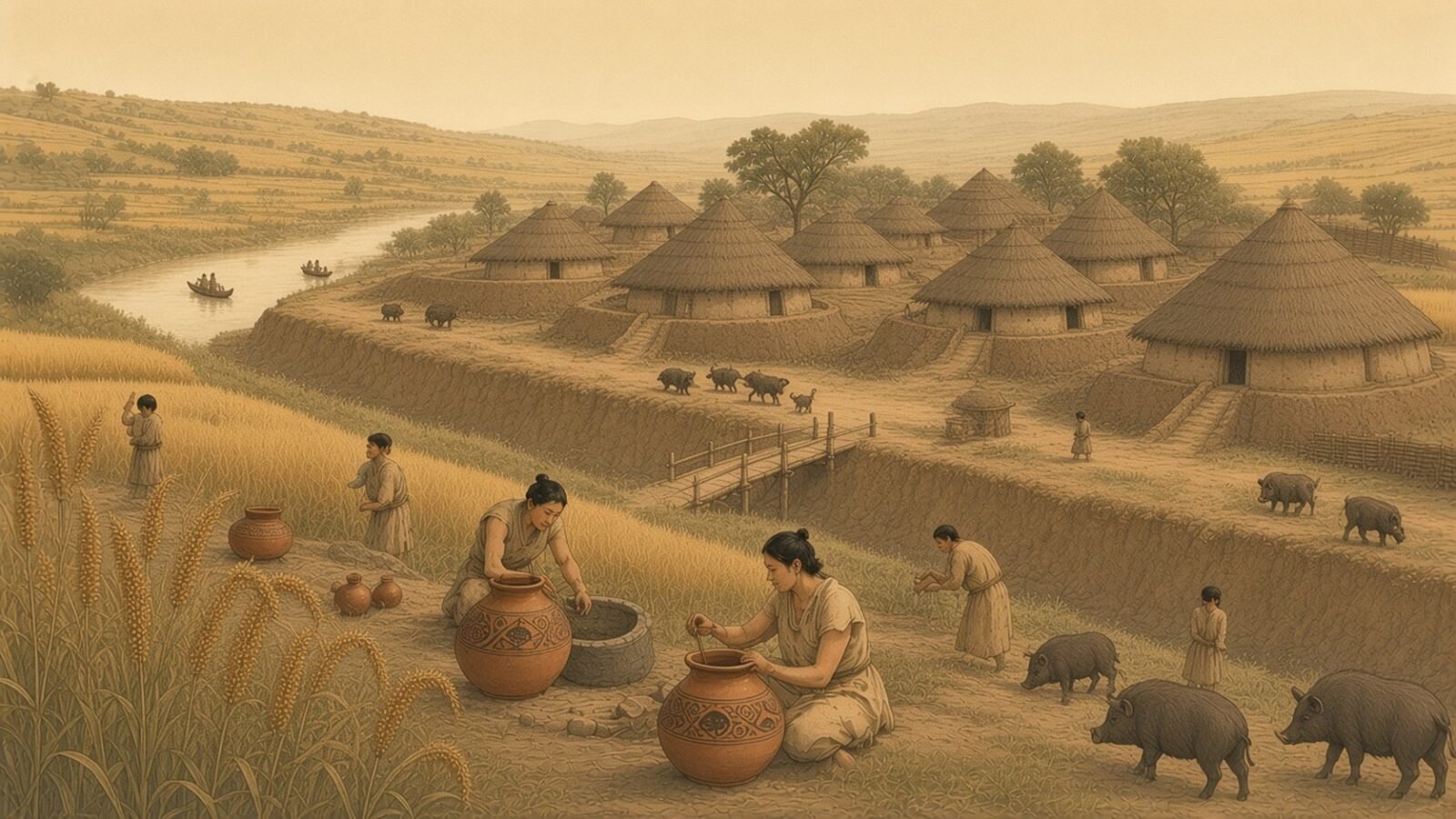
When we move from geology to human occupation, the record begins with scattered Paleolithic foragers who left simple chipped stone tools across northern China, but the decisive transformation occurs in the early Holocene, after the end of the last Ice Age, when climatic warming and stabilization allowed for more permanent settlement, for the collection and eventual domestication of wild millets like Setaria italica and Panicum miliaceum in the north, and for the gradual management of wild rice Oryza rufipogon in the southern wetlands, a process that is visible archaeologically in sites such as Cishan in Hebei, Peiligang in Henan, and Shangshan and Kuahuqiao in Zhejiang, all dating to roughly eight thousand to nine thousand years ago, where we find grinding stones, storage pits, early pottery that was low fired and often cord marked, and the remains of domesticated pigs and dogs, evidence that people were no longer moving constantly but were tethered to places where they could store grain and raise animals, a shift that created new forms of social life, new concepts of property and ancestry, and new symbolic worlds expressed in pottery decoration, in burials, and in the working of jade and other hard stones that required immense labor and therefore indicated emerging distinctions of status and ritual authority. These early Neolithic cultures were not primitive precursors waiting to become Chinese, they were fully realized societies with their own aesthetics and logics, and their significance for later Chinese civilisation lies not in a direct line of political descent but in the toolkit of practices they developed, above all the idea that community identity could be expressed through highly standardized ceramic vessels, through nucleated villages surrounded by ditches or rammed earth walls, and through cemeteries where the dead were arranged according to principles that suggest lineage and seniority, principles that would later be elaborated into the ancestor focused kinship systems that characterize historic Chinese society, and it is striking how early we see craft specialization, such as the beautifully burnished red pottery of Peiligang with its incised symbols that some scholars have controversially tried to link to later writing, even though such claims overreach the evidence, because what matters more than any putative early script is the habit of marking objects, of making symbols that communicate ownership, ritual dedication, or clan affiliation, a habit that prepares the ground for true writing centuries later. By the fifth millennium BCE this mosaic of regional Neolithic traditions had intensified dramatically, leading to what archaeologists often call the middle Neolithic fluorescence, a period when distinct cultural spheres become archaeologically visible across the area of modern China, each with its own diagnostic pottery, settlement pattern and ritual repertoire, yet each increasingly in contact with its neighbors, and it is in this period that we first encounter sites of a scale and complexity that suggest more than simple egalitarian villages, for example the Hongshan culture in the Liao River valley in the northeast, famous for its finely worked jade in the form of pig dragons and cloud shaped plaques, its elaborate burial platforms at sites like Niuheliang where female figures with inlaid jade eyes suggest shamanic or ritual specialists, and its ritual architecture that indicates communal labor mobilized for purposes that were not strictly practical, or the Daxi culture in the middle Yangtze with its early paddy fields, its finely painted pottery and its own jade traditions, and crucially the Yangshao culture that spread across the middle Yellow River basin, known for its painted pottery with sweeping black designs of fish, spirals and stylized human faces, its large villages such as Jiangzhai with more than a hundred houses arranged around a central plaza, and its evidence for social differentiation in burial, where some graves contain many more goods than others, indicating that status was no longer achieved purely through personal prowess but was inherited or at least accumulated within certain lineages.
In the fourth and third millennia BCE this regional diversification reached a new level of sophistication, and two broad horizons dominate any narrative of Chinese origins, the Yangshao to Longshan sequence in the north and the sequence of cultures culminating in Liangzhu in the south, both of which reveal a world moving toward greater social stratification, greater craft specialization, and greater investment in public works and ritual, and it is within these horizons that many of the cultural traits that later generations would recognize as characteristically Chinese first appear in recognizable form, not as imports from elsewhere but as indigenous developments. The late Yangshao, around three thousand five hundred to three thousand BCE, shows a marked increase in the size and density of settlements, the construction of rammed earth walls that imply both defense and the ability to command collective labor, the production of highly standardized pottery using fast wheels, and the emergence of large cemeteries where burials are organized in rows and clusters that suggest lineage groups, while its successor Longshan, around three thousand to two thousand BCE, is often seen as the immediate prelude to Bronze Age civilization because it displays nearly all of the social and material preconditions for state level organization without yet having a true state, including walled towns that can be several tens of hectares in area, such as Taosi in Shanxi which covers more than two hundred and eighty hectares and includes a rammed earth enclosure, elite residences, storage facilities, and an observatory like structure of rammed earth pillars that may have been used to track solstices, indicating a concern with calendrical ritual and cosmology that would become central to Chinese kingship. Longshan pottery is famously thin walled and black, polished to a lustrous sheen that requires very high firing temperatures and great skill, a clear sign of full time craft specialists, and Longshan burials show stark differences in wealth, with some individuals interred with dozens of jade cong tubes and bi discs and fine eggshell thin goblets while others have nothing, suggesting a society in which lineage and ritual power were becoming hereditary, and similar trends appear in the Shandong Longshan with its own distinctive black pottery and its own walled centers. To the south the Liangzhu culture in the lower Yangtze delta around three thousand four hundred to two thousand two hundred BCE presents an even more striking case of early complexity, centered on the large site of Mojiaoshan and the recently recognized walled city at Liangzhu itself, which controlled an elaborate hydraulic system of dams, reservoirs and canals that is among the oldest large scale water engineering in the world, a system that required coordinated planning and labor far beyond a single village and that suggests a political authority capable of organizing thousands of workers, while Liangzhu jade working reached extraordinary levels of technical accomplishment, producing cong tubes decorated with the taotie like mask motif of a human like face with large eyes that would later become a central motif in Bronze Age art, and the sheer volume of jade in elite Liangzhu burials, sometimes hundreds of objects in a single grave, indicates that access to ritual materials was tightly controlled, perhaps by a priestly elite whose authority was rooted in the ability to mediate between human community and spirit world, a pattern that resonates strongly with later Chinese notions of kingship as ritual mediation. The coexistence of these powerful regional centers in the late Neolithic, each with its own ritual system, its own elite symbols, and its own economic base, raises a fundamental question about origins, whether China should be understood as originating from one of these cultures that then expanded and assimilated the others, or whether it should be understood as a synthesis of many that were gradually drawn into a common cultural sphere through trade, warfare, intermarriage and shared ritual language, and modern scholarship strongly favors the latter view, often called the interaction sphere model or the model of multiple centers with a central plain that served as a zone of intense contact, because no single Neolithic culture contains all of the elements that become Chinese, but the collective network does, and it is from this network that the first attempts at supra regional political integration emerge, first in the late Longshan period with the spread of similar forms of scapulimancy or divination using heated animal bones, of similar forms of elite pottery and jade, and of similar walled town layouts that suggest shared concepts of urban planning and defense, and it is against this background that traditional Chinese historiography places the era of the sage kings, Yao Shun and Yu, figures who may preserve in mythologized form the memory of leaders who managed flood control, organized labor, and established new forms of political legitimacy at a time of increasing environmental stress and social competition.
The classic texts compiled centuries later, above all the Shujing or Book of Documents and the Shiji or Records of the Grand Historian by Sima Qian in the late second century BCE, present a neat genealogy from the Yellow Emperor Huang Di through a succession of sage kings to the founders of the first three dynasties Xia Shang and Zhou, and for a long time this textual genealogy was taken as literal history, but archaeology has shown that the reality was far messier and far more interesting than a simple dynastic succession, even as it has also shown that these myths are not pure invention but encode important truths about how early elites in the Central Plain legitimized themselves by claiming descent from culture heroes who tamed floods and ordered the world. The great flood myth associated with Yu the Great, who is said to have spent thirteen years dredging channels to control the Yellow River floodwaters and thereby earned the right to establish the Xia dynasty, corresponds archaeologically to a period of increased flooding and climatic instability around two thousand two hundred to two thousand BCE, evidenced by thick alluvial deposits at many sites in the Yellow River basin, and the idea of a leader whose legitimacy rested on hydraulic management fits well with what we know about late Longshan and early Bronze Age societies where control of water and labor was paramount, so while we cannot identify a historical Yu, we can understand the kind of social role that such a figure represents, the emergence of a form of leadership that is no longer just ritual or lineage based but managerial and territorial, able to mobilize resources across many communities for projects that benefit or at least claim to benefit a wider population. This shift is visible at the great site of Taosi mentioned earlier, which some scholars have proposed as a late Neolithic capital with astronomical observation and possible evidence of violence and political upheaval at its end, including a rammed earth enclosure that was destroyed and rebuilt, mass burials suggesting conflict, and the abrupt disappearance of elite symbols, hinting at a cycle of centralization and collapse that would become characteristic of early Chinese state formation, where centers grew rapidly through the concentration of craft production, storage and ritual, then fell apart due to internal tension, environmental stress or warfare, only for new centers to arise elsewhere that borrowed and transformed their predecessor’s symbols. The question of the Xia dynasty sits precisely at this junction between myth and archaeology, because Sima Qian and other early historians describe Xia as the first hereditary dynasty founded by Yu, ruling the Central Plain before being overthrown by the Shang, and for decades scholars debated whether Xia was entirely legendary or whether it corresponded to some archaeological culture, a debate that was transformed by the discovery in the late nineteen fifties and subsequent decades of a distinctive early Bronze Age culture at Erlitou in western Henan, near the city of Luoyang, in the heart of the area traditionally associated with Xia, and Erlitou has since become the central focus for any discussion of Chinese origins, not because it proves the existence of Xia in the textual sense but because it demonstrates that by around one thousand nine hundred to one thousand five hundred BCE a society existed in the Central Plain that was qualitatively different from its Neolithic predecessors and that displays many of the hallmarks of a state level polity. Erlitou is not a single village but a large and clearly planned settlement covering over three hundred hectares at its peak, with a central palace complex enclosed by rammed earth walls, workshops for the production of bronze vessels and turquoise inlaid objects, elite residences and burials that contain bronze ritual vessels and jade, and a road network that suggests formal urban planning, and its material culture shows a mixture of continuity from Longshan traditions and innovation, including the earliest large scale production of bronze ritual vessels in China, a technology that would become the defining art form and political symbol of Chinese elite culture for the next thousand years, and the very fact that bronze was used not for tools or weapons primarily but for vessels used in ancestor worship rituals indicates that the emerging elite at Erlitou was already using ritual and feasting to cement political authority, a pattern that will be elaborated to extraordinary extremes in the Shang dynasty. The geographic position of Erlitou is also crucial, because it sits at a point where the Luo River joins the Yellow River, controlling access to copper and tin sources in the Zhongtiao mountains to the north and to riverine trade routes that linked the northern millet growing heartland with the southern rice growing zones, allowing its rulers to accumulate resources and prestige goods from a wide area, and its influence is visible in the spread of Erlitou style pottery and bronze techniques far beyond its immediate hinterland, suggesting a network of alliance, tribute or emulation that extended across much of what would become northern China, and while we must be cautious about equating Erlitou directly with the Xia of later texts, because the name Xia itself may be a Zhou invention projected backward to legitimize their own overthrow of the Shang, there is now a broad consensus that Erlitou represents at least the political reality behind the Xia legend, a powerful Central Plain polity that established the template for dynastic rule based on control of bronze production, ancestor ritual, and hydraulic agriculture, and that its eventual decline around one thousand five hundred BCE paved the way for the rise of a new and even more powerful center to the east.
The culture that succeeded Erlitou and that most scholars identify with the early Shang dynasty is known archaeologically as Erligang, named after a site in modern Zhengzhou where massive rammed earth walls enclosing an area of several square kilometers were discovered, walls that were built using the hangtu technique of pounding earth within wooden frames layer by layer, a technique that requires enormous organized labor and that would remain the standard method for city wall construction in China until the modern period, and the Erligang period around one thousand five hundred to one thousand three hundred BCE sees a dramatic increase in the scale of bronze production, the construction of large walled cities that may have served as regional administrative centers, and the spread of Shang style material culture over an area much larger than Erlitou, from the Yellow River valley deep into the Yangtze basin, indicating a more aggressive and expansionist political formation that used bronze weapons as well as ritual vessels and that may have controlled key trade routes for copper, tin and salt. The historical Shang dynasty as described in later texts was traditionally thought to have had its capital at Bo near modern Zhengzhou and then moved several times, and the archaeology of Zhengzhou with its huge walls, its bronze foundries containing crucibles and clay molds for piece mold casting, its elite burials with bronze vessels and weapons, and its storage pits and workshops, fits well with the image of an early Shang capital that was both a manufacturing center and a ceremonial center, while the discovery of a still larger and more richly furnished city at Yanshi just east of Erlitou suggests a complex political landscape in which old and new centers coexisted and competed, and the relationship between these centers may have involved conquest, colonization or the gradual shift of elite population, rather than a simple replacement of one dynasty by another. What is clear is that by the thirteenth century BCE the political focus had shifted northward to the area around Anyang in northern Henan, where the last capital of the Shang dynasty, traditionally called Yin, was located, and it is at Anyang that we encounter for the first time unambiguous evidence of full literacy in China, in the form of tens of thousands of inscribed animal bones and turtle plastrons used for divination, the so called oracle bones, as well as bronze inscriptions cast into ritual vessels, and it is this evidence that allows us to speak at last of a literate civilisation in China, not merely a complex Neolithic or Bronze Age society but a society that recorded its own actions, its own beliefs, and its own language in a writing system that is directly ancestral to modern Chinese characters, making the Anyang period the true threshold of historical China as opposed to prehistoric China. The importance of Anyang cannot be overstated because it provides a convergence of archaeology and text that is unique for this early period, on one hand we have the material remains of a massive urban complex that was not a single walled city in the earlier sense but a sprawling cluster of palatial foundations, elite cemeteries, bronze foundries, bone workshops, pottery kilns and residential areas spread over more than twenty four square kilometers along the Huan River, and on the other hand we have written records that tell us the names of kings, the dates of rituals, the outcomes of wars, the occurrence of eclipses and even the toothaches of the royal family, a level of detail that transforms our understanding from generalized social reconstruction to specific political and religious history, and the fact that these records were written on materials intended for ritual use, not for bureaucratic administration in the later sense, tells us much about the nature of early Chinese literacy, which was intimately bound up with divination and ancestor worship rather than with market exchange or legal codification as in some other early writing systems. The Shang kings at Anyang practiced a form of divination that involved preparing a turtle plastron or ox scapula by cleaning it, drilling small hollows on its back, and then applying a hot brand to cause cracks that were interpreted as the answers of ancestral spirits to questions posed by the king, and after the divination the topic, the prognostication and sometimes the outcome were carved into the bone in a script that already shows the basic principles of Chinese writing, including pictographs that depict objects, simple ideographs that express abstract ideas, and most importantly phonetic compounds that combine a semantic element indicating meaning category with a phonetic element indicating pronunciation, a system flexible enough to write any word in the Old Chinese language, and the existence of more than four thousand distinct graphs at Anyang, of which about one thousand can be read with confidence today, indicates a fully developed writing system that must have had a considerable period of development before Anyang, even though direct evidence of that earlier development remains elusive due to the perishable nature of the materials that may have been used, such as wood, bamboo or silk.
The content of the oracle bone inscriptions reveals a world view that is at once alien and recognizably Chinese in its later forms, a world dominated by a royal lineage that claimed exclusive access to a hierarchy of spiritual powers, including Di or Shang Di, a high deity who presided over natural forces and warfare, a host of nature powers associated with rivers mountains sun and wind, and above all the royal ancestors who were believed to continue to influence worldly affairs after death and who required constant feeding through sacrifice and ritual attention, and the king acted as chief diviner and chief sacrificer, mediating between the human community and this spirit world, asking whether an upcoming military campaign would succeed, whether the harvest would be good, whether the king’s wife would give birth to a son, whether illness would be cured, and recording the answers so that the efficacy of ancestors could be judged and future ritual performance adjusted, a practice that embeds writing directly into the core of political and religious authority, not as a peripheral technology but as the means by which the most important decisions of state were validated. The Anyang script was not used for literature or for private correspondence in the way we might imagine, it was an elite technology restricted to the court and to ritual specialists, and its primary function was to make the invisible world of ancestors and spirits visible and controllable, to fix in durable form the communication between the living and the dead, and it is this ritual origin that helps explain the extraordinary conservatism and continuity of Chinese writing, because once a script is associated with ancestor worship and with the legitimacy of kingship it becomes sacred and resistant to radical reform, and the basic graphic principles established at Anyang, the use of brush like strokes carved into bone but clearly derived from brush writing on softer materials, the arrangement of graphs in vertical columns, the use of specific honorific and temporal terms, all persist for three thousand years, making Chinese the longest continuously used writing system in the world. Beyond oracle bones, Anyang has yielded bronze inscriptions that cast light on another dimension of early literacy, the bronze ritual vessels that were produced in large numbers, sometimes weighing many tens of kilograms, and that were used to offer food and wine to ancestors, often bore inscriptions inside them that recorded who made the vessel, for which ancestor it was made, and what merit or favor the maker had received from the king that warranted such an expensive offering, and these inscriptions grow longer and more detailed over time, from simple clan emblems at Anyang to longer historical narratives in the Western Zhou period that followed, indicating that literacy was gradually expanding from a purely divinatory context to a commemorative and historical one, and that the ability to cast text in bronze gave writing a permanence and public visibility that bone divination lacked, turning ritual vessels into archives of lineage history and political legitimation that could be buried in tombs to accompany the dead into the afterlife. The material basis for this literate civilisation was a highly organized Bronze Age economy that could support large numbers of craft specialists, including miners who extracted copper and tin from deposits in the south and northwest, transport workers who moved ore over long distances, foundry workers who mastered the extremely complex piece mold technique in which a model of the desired vessel was made in clay, then encased in multiple clay sections that were removed, fired, and reassembled around a core to leave a cavity into which molten bronze could be poured, a technique that allows for the sharp angular decoration and complex three dimensional shapes that characterize Shang bronzes and that requires meticulous planning and division of labor, as well as potters, jade workers, bone workers, and builders who maintained the palatial structures and rammed earth foundations, and this economy was sustained by an agricultural system that had by now developed intensive millet and wheat cultivation in the north and rice in the south, with domesticated pigs, dogs, cattle and sheep providing protein, and with storage systems capable of supporting a non producing elite and its retinue, and the scale of human sacrifice at Anyang, where hundreds of captives were beheaded and buried in royal tombs, sometimes with their own bronze weapons, indicates a society capable of extreme coercion and of mobilizing labor and lives for royal projects, a society that was far from egalitarian and that used ritual, writing and violence together to maintain hierarchy.
The political organization of the Anyang Shang has been the subject of intense debate, but most scholars now see it not as a centralized territorial empire in the modern sense but as a network of personal and ritual allegiances centered on the king, who directly controlled the area around Anyang and who exercised varying degrees of influence over allied lineage groups and subordinate chiefs spread across a much larger area, an influence that was reinforced by the distribution of bronze ritual vessels that carried Shang style decoration, by marriage alliances, by military expeditions against groups labeled as Fang or hostile polities in the oracle bones, and by the king’s ritual calendar that required subordinate leaders to attend sacrifices at the capital and to contribute resources, and this loose hegemony rather than direct administration explains why Shang style material culture appears at sites far from Anyang but often mixed with local styles, indicating that local elites adopted Shang symbols to bolster their own status while maintaining distinct local identities, a pattern that would continue under the Zhou dynasty that overthrew the Shang around one thousand and forty six BCE, according to traditional chronology, and that would shape Chinese political culture for centuries, the idea that cultural and ritual superiority could exert power even without direct bureaucratic control, an idea later formalized as the concept of Tianxia or all under heaven. The religion of the Shang as revealed by oracle bones and burial practices was centered on ancestor worship to an extent that is striking even by the standards of early societies, with royal ancestors receiving regular sacrifices of food, wine and animals, with special sacrifices on cyclical days, and with the belief that ancestors could cause or cure illness, bring victory or defeat, and influence harvests, a belief system that made the careful maintenance of genealogical records and ritual schedules essential, and that made the king’s role as head of the lineage and chief sacrificer the linchpin of the entire political system, because only he could communicate effectively with the most powerful ancestors, especially the recent dead kings whose approval was sought before any major undertaking, and this ancestor focus explains the extraordinary investment in tombs at Anyang, most famously the undisturbed tomb of Fu Hao, a consort of King Wu Ding who was also a military leader, whose tomb contained more than four hundred bronze objects, nearly six hundred jade objects, and hundreds of bone hairpins, as well as sacrificed humans and dogs, indicating both immense wealth and a belief that the dead required a full retinue of material and human resources in the afterlife, a belief that would later be transformed under Zhou influence into more symbolic forms of burial goods but that at Anyang was brutally literal. The origins of Chinese literate civilisation therefore cannot be reduced to a single invention or a single site, but must be understood as the convergence of several long term processes, the development of intensive agriculture capable of supporting dense populations and craft specialization, the emergence of walled centers that concentrated political and ritual power, the elaboration of a shared repertoire of elite symbols especially in jade and later in bronze, the creation of networks of exchange that moved raw materials and finished goods across vast distances and that spread ideas and rituals along with them, and finally the invention of a writing system capable of recording the Old Chinese language in a form that could be used to communicate with ancestors and to memorialize lineage history, a writing system that appears at Anyang fully formed but that must have had antecedents in the marking systems and perhaps brief inscriptions on perishable materials that have not survived, and it is the combination of all these factors in the second millennium BCE, first at Erlitou and Erligang and then with full historical clarity at Anyang, that marks the transition from prehistoric cultures that were Chinese in a cultural sense to a historical civilisation that called itself Shang and that laid the foundation for everything that followed, including the Zhou dynasty that would overthrow the Shang and reinterpret its legacy, the Confucian tradition that would look back to the early kings as moral exemplars, and the modern Chinese state that claims descent from this deep antiquity.
Modern archaeology has fundamentally changed our understanding of this process by showing that Chinese civilisation did not emerge from a single core that expanded outward but from many regional traditions that interacted, competed and eventually coalesced, and that the Central Plain, far from being the sole cradle, was itself a recipient of influences from the northeast, the northwest, the Yangtze valley and beyond, so that the origins of China are better imagined as a river system with many tributaries than as a single source, and the earliest literate civilisation at Anyang is best seen not as the beginning but as a particularly visible and well documented eddy in that larger flow, where for the first time the people themselves left written testimony of who they were, what they feared, and what they hoped their ancestors would do for them, testimony that is fragmentary, repetitive and often concerned with matters that seem trivial to modern eyes, such as whether it will rain tomorrow or whether a toothache will get better, but that is also profoundly human and that provides the first direct voice from the deep past of China, a voice that speaks in a script we can still read today, however imperfectly, and that therefore establishes a continuity of cultural memory that is unique among ancient civilisations, a continuity that later generations would elaborate, reinterpret and mythologize but that began with the carving of small graphs into bone in order to ask the ancestors for guidance, a practice that combined technology, religion and politics in a way that would become characteristic of Chinese civilisation for the next three millennia. The way we talk about Chinese origins today is itself a product of history, because the traditional narrative of a single line from Huang Di to Xia to Shang to Zhou was codified in texts written during the Zhou and Han dynasties, texts that had political reasons to present the past as a orderly succession of virtuous dynasties that rose and fell according to their moral worth, a theory known as the Mandate of Heaven, and it was only in the twentieth century, with the advent of scientific archaeology in China, beginning with the excavations at Anyang in the nineteen twenties and thirties by scholars such as Li Ji and with the later work of Xia Nai and Zou Heng, that it became possible to test these textual accounts against material evidence, leading to a long and sometimes acrimonious debate about how much of the traditional history could be trusted, a debate that continues today as new discoveries constantly reshape the picture, for example the discovery of the large walled site at Shimao in Shaanxi with its massive stone walls and evidence of human sacrifice, which suggests a powerful polity in the far northwest around two thousand BCE that was not part of the Central Plain tradition at all, or the discoveries at Sanxingdui in Sichuan where extraordinary bronze masks and statues with bulging eyes and large ears, dating to around one thousand two hundred BCE, reveal an artistic tradition completely different from that of Anyang but clearly part of the broader interaction sphere, indicating that the world that gave rise to early Chinese civilisation included highly distinctive regional cultures that were not simply peripheral barbarians but centers of innovation in their own right, whose histories have been less well preserved in texts because the texts were written from the perspective of the Central Plain, and this growing appreciation of regional diversity has led scholars to replace the older model of a single cradle with a model of multiple cradles and a central zone of intensified interaction, a model that better fits the archaeological evidence and that also resonates with modern understandings of how complex societies form, not through the simple diffusion of ideas from one advanced core but through networks of competition and cooperation that stimulate innovation at many nodes simultaneously. The very earliest Chinese literate civilisation at Anyang therefore stands not as an isolated miracle but as the culmination of a long process of cultural synthesis, a synthesis that involved the domestication of plants and animals, the development of pottery and jade working, the construction of walls and hydraulic works, the mastery of bronze casting, and the invention of writing, each of which has its own deep history, and what makes Anyang so pivotal is that it is the first place where we can see all of these strands woven together into a coherent political and religious system that called itself Shang, that used writing to record its own activities, and that left behind both texts and material remains that allow us to reconstruct its world view with some confidence, and it is from Anyang that we can trace a direct line of cultural and linguistic continuity to the Zhou dynasty that succeeded it, to the classical age of Confucius and Laozi, and to the imperial China that would endure in various forms until the early twentieth century, a continuity that is visible in the script itself, in the ritual vessels, in the concern with ancestry, and in the geographic focus on the Yellow River basin, even as the polity expanded far beyond that basin to encompass the enormous diversity of modern China, so that the origins of China are not a single moment but a long process of becoming, a process that begins with small millet farming villages in the seventh millennium BCE and that reaches a first clear articulation as a literate civilisation in the thirteenth century BCE at Anyang, and that continues to unfold today as new discoveries force us to revise our understanding of where China came from and what it means to be Chinese, a question that is as much about present identity as about ancient history, and that is why the study of early China remains so vital, because it shows how a civilisation can be both deeply rooted in a particular landscape and open to influences from many directions, both remarkably continuous in its writing and ritual and remarkably adaptable in its political forms, a combination that has allowed it to endure for longer than any other continuous cultural tradition in the world.