CRRC — the Chinese state rail-equipment manufacturer — is the world’s largest train maker, producing roughly half of all the world’s locomotives and electric multiple units in any given year. The 2015 merger of CSR and CNR into a single entity was the most consequential consolidation in the modern rail-equipment industry, and the practical basis of China‘s high-speed rail network. CRRC‘s annual revenue is roughly 300 billion yuan, and the company operates more than 200,000 employees across more than thirty factories in China.
Key findings
- The 2015 merger of CSR and CNR into CRRC was the most consequential consolidation in the modern rail-equipment industry.
- CRRC is the world’s largest train maker, producing roughly half of all the world’s locomotives and electric multiple units in any given year.
- The CRRC product line includes the Fuxing high-speed train, the Hexie high-speed train, and the China Star high-speed train.
- The CRRC factories at Qingdao, Changchun, Zhuzhou, and Qiqihar are the largest train factories in the world.
- CRRC is the practical basis of the Chinese high-speed rail network, which is the world’s largest with more than 40,000 km of lines.
The CSR-CNR split
The two predecessors of CRRC — CSR (China South Locomotive & Rolling Stock Corporation) and CNR (China CNR Corporation) — were both founded in September 2000 when the Ministry of Railways) split its manufacturing operations into two state-owned enterprises. The split was part of the broader reform of the railway sector that separated infrastructure ownership from train operation, with the goal of preparing both for eventual privatisation.
The split was geographically arbitrary: CSR inherited most of the southern factories (including the Qingdao and Zhuzhou plants) and CNR inherited most of the northern factories (including the Changchun and Qiqihar plants). Both companies competed in essentially the same product lines — electric locomotives, electric multiple units, metros, and freight wagons — and the parallel capacity was wasteful. The two companies competed fiercely for the same domestic contracts, and the competition produced a string of patent disputes and price wars that ultimately damaged both companies’ balance sheets.
The split was also a barrier to international sales. Foreign buyers — particularly state railways in Southeast Asia, Africa, and Latin America — preferred to deal with a single supplier rather than two competing ones, and the parallel structure made it harder for Chinese trains to win large export contracts. The Chinese rail industry’s share of the world export market stagnated at about 10% through the 2000s, well below the share that the technology warranted.
The 2015 merger
The merger of CSR and CNR into CRRC was announced in December 2014 and completed in June 2015. The merger was state-directed and was approved by the State Council and the State-owned Assets Supervision and Administration Commission as part of a broader programme of state-owned enterprise consolidation. The merger was justified by three considerations: the duplicate capacity problem, the export market problem, and the high-speed rail problem.
The duplicate capacity problem was the most immediate. Both CSR and CNR had parallel product lines and factories producing essentially the same products. The merger allowed CRRC to rationalise production by assigning specific product lines to specific factories — Hexie trains at Changchun, Fuxing trains at Qingdao, electric multiple units at Zhuzhou, and freight locomotives at Qiqihar — and to close or repurpose several smaller factories that had been producing overlapping products.
The export market problem was addressed by the merger creating a single supplier with a unified product line and a unified negotiating position. The 2015 merger was followed by a sharp increase in CRRC‘s export contracts, including the 2016 contract for the Jakarta-Bandung high-speed line in Indonesia and the 2017 contract for the Mombasa-Nairobi standard-gauge railway in Kenya. CRRC‘s share of the world export market has risen from about 10% in 2014 to about 25% in 2022.
The high-speed rail problem was the third consideration. The two companies had been the practical suppliers of the Chinese high-speed rail network, and the parallel supply structure had been a barrier to the network’s expansion. The merger allowed CRRC to standardise the high-speed train product line and to push the Fuxing as the unified high-speed platform. The Chinese high-speed rail network expanded from 19,000 km in 2015 to more than 40,000 km in 2022, and the expansion was supported by CRRC‘s increased production capacity.
The Fuxing, Hexie, and China Star trains
The CRRC product line includes three high-speed trains: the Hexie (CRH series), the Fuxing (CR series), and the China Star experimental train. The three trains represent different stages in the Chinese high-speed rail programme.
The Hexie is the older train, originally introduced in 2007 and based on licensed Japanese, French, and German technology. The Hexie series includes the CRH380A, the CRH380B, the CRH380C, and the CRH380D, each based on a different foreign design. The Hexie trains have a top speed of 380 km/h and a service speed of 300 km/h, and are still in regular service on most of the Chinese high-speed rail network.
The Fuxing is the newer train, introduced in 2017 and substantially Chinese-designed. The Fuxing includes the CR400AF, the CR400BF, and the CR450 experimental variant. The Fuxing trains have a top speed of 400 km/h and a service speed of 350 km/h, and are the operational flagship of the CRRC high-speed product line. The Fuxing is the first Chinese high-speed train designed and built without licensed foreign technology, and the design incorporates substantial innovations in traction, braking, and aerodynamics.
The China Star is an experimental train that set the Chinese rail speed record of 270 km/h in 2002 and has been used as a testbed for various high-speed technologies. The China Star is no longer in service but has informed the design of subsequent CRRC trains.
Technology transfer and indigenisation
The Chinese high-speed rail programme was launched in the early 2000s with substantial technology transfer from Japan and Europe. The first Chinese high-speed train, the Hexie, was based on the Kawasaki Heavy Industries Shinkansen E2 series, transferred to China under a 2004 technology transfer agreement that included the design of the train, the manufacturing process, and the maintenance procedures. The 2004 agreement was controversial — Kawasaki was widely reported to have agreed to the transfer partly as a condition of Chinese participation in Shinkansen export markets — but the transfer was a substantial success for CRRC.
The Hexie was followed by technology transfers from Siemens (the Velaro platform), Alstom (the TGV platform), and Bombardier (the Zefiro platform). The Chinese trains based on these platforms were assembled under license, with increasing proportions of Chinese-manufactured components. By 2010, more than 70% of the components of the Hexie trains were Chinese-manufactured, and by 2015 the proportion had risen to about 90%.
The indigenisation process accelerated after the 2011 Wenzhou train collision, which killed 40 people and exposed design flaws in the Hexie signalling system. The collision prompted a sweeping review of Chinese high-speed rail safety and a substantial investment in indigenous signalling and control systems. The Fuxing train, introduced in 2017, was the first Chinese high-speed train designed and built without licensed foreign technology, and the design incorporates substantial innovations in traction, braking, and aerodynamics.
The 40,000 km high-speed rail network
The Chinese high-speed rail network is the world’s largest, with more than 40,000 km of lines in operation in 2022 and a planned 50,000 km in 2030. The network covers every provincial capital except Lhasa (connected by conventional rail) and connects all of China‘s major cities. The network’s longest line is the 3,500 km Beijing–Urumqi high-speed line, opened in 2014, and the network’s busiest line is the Beijing–Shanghai high-speed line, which carries more than 100 million passengers per year.
The network was built in two phases. The first phase, from 2004 to 2010, saw the construction of about 8,000 km of high-speed lines, mostly based on licensed foreign technology. The second phase, from 2010 to 2022, saw the construction of another 32,000 km, mostly based on the Fuxing and Hexie trains. The second phase was substantially cheaper than the first — about 100 million yuan per km, against 170 million per km in the first phase — and the cost reduction was largely due to indigenisation and to CRRC‘s ability to produce trains at scale.
CRRC trains operate about 70% of the network’s passenger traffic. The remaining 30% is operated by trains from Alstom and Siemens, which continue to supply trains to the Chinese market through joint ventures. The dominance of CRRC in the domestic market has been a continuing source of tension with the foreign suppliers, who argue that the Chinese government’s procurement policies favour CRRC.
The export business
CRRC trains are exported to roughly 100 countries, with the largest export markets in Southeast Asia, Africa, and Latin America. The export business has been a strategic priority for CRRC since the 2015 merger, and the company has opened sales offices in more than 50 countries.
The flagship export contracts include the Jakarta-Bandung high-speed line (operational since 2023 as the Whoosh service), the Mombasa-Nairobi standard-gauge railway in Kenya (operational since 2017), the Addis Ababa-Djibouti railway (operational since 2018), and the Bengaluru high-speed rail corridor in India (under construction). The export contracts are often bundled with Chinese financing, training, and maintenance support, which has been a key competitive advantage.
The export business is not without controversy. The Jakarta-Bandung high-speed line cost $7.3 billion, against an original estimate of $5.5 billion, and the cost overrun was widely reported in the Indonesian press. The Mombasa-Nairobi standard-gauge railway was criticised by the World Bank and the IMF for saddling Kenya with debt it could not afford. The export business is widely seen as a vehicle for Chinese foreign policy, and the trains are sometimes described as part of the Belt and Road Initiative rather than as commercial products.
The freight and metro businesses
CRRC is, in addition to its high-speed trains, the world’s largest manufacturer of electric multiple units for urban transit. The CRRC electric multiple units operate in roughly 100 cities, with the largest contracts in Beijing, Shanghai, Guangzhou, and Hong Kong. The CRRC is also the world’s largest manufacturer of metro cars, with annual production of more than 10,000 metro cars.
The CRRC is, in addition to its high-speed and metro trains, the world’s largest manufacturer of freight locomotives. The CRRC freight locomotives include the HXD electric locomotive family and the HXN diesel-electric locomotive family. The HXD family includes the HXD1, the HXD2, the HXD3, and the HXD3B, each producing more than 10,000 kW of traction power and designed for heavy-haul freight operations. The CRRC freight locomotives operate in roughly 50 countries, with the largest contracts in Russia, Kazakhstan, and Iran.
The freight business is increasingly important for CRRC. The 2020 China Railway freight reform opened the freight market to private operators, and CRRC has won several contracts to supply locomotives to private freight operators. The freight business is also a major part of CRRC‘s export strategy, with several large contracts in Africa and Central Asia for freight locomotives and wagons.
The factories
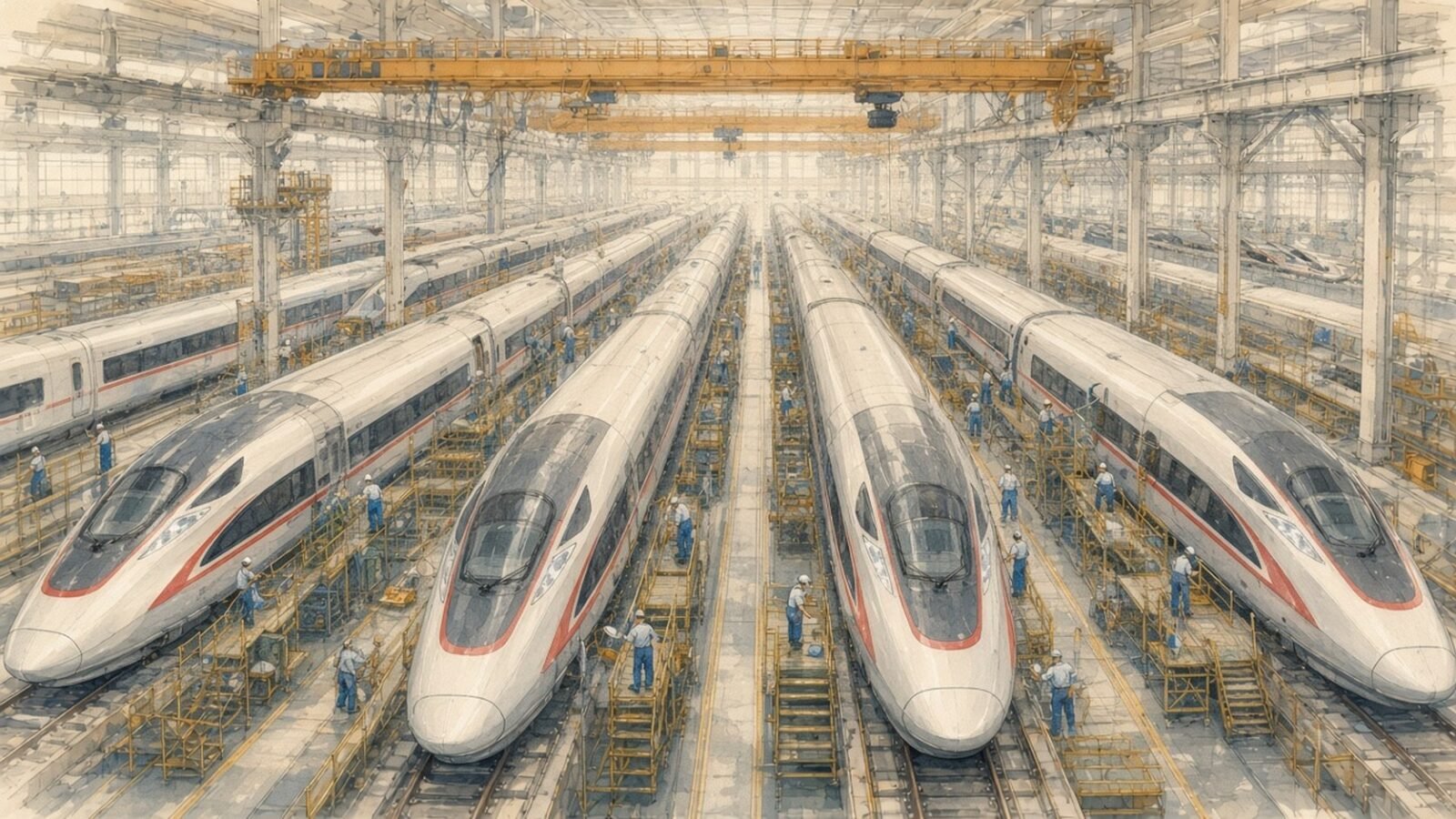
The CRRC factories are the largest train factories in the world. The Qingdao factory — CRRC Qingdao Sifang — produces the Fuxing and Hexie high-speed trains, and is the largest single high-speed train factory in the world. The Changchun factory — CRRC Changchun — produces the Hexie high-speed trains for the northern Chinese market. The Zhuzhou factory — CRRC Zhuzhou — produces electric multiple units for the urban transit market. The Qiqihar factory — CRRC Qiqihar — produces freight locomotives for the Chinese and export markets.
The CRRC factories have a combined workforce of more than 200,000, with the largest factories employing more than 30,000 each. The factories are highly automated — the Qingdao factory uses more than 1,000 robots in its high-speed train production lines — but the Chinese railway equipment industry remains labour-intensive relative to its European and Japanese counterparts. The CRRC is the practical basis of the Chinese rail-equipment industry, and the CRRC is a substantial source of Chinese industrial prestige.
Looking forward
The next decade will be defined by the CR450 — the CRRC‘s planned 450 km/h high-speed train, which is expected to enter service in 2027. The CR450 will be the fastest commercial high-speed train in the world when it enters service, and it will be the first Chinese high-speed train designed to operate at 400 km/h in regular service. The CRRC programme is being supported by a parallel programme to upgrade the Chinese high-speed rail network to support 400 km/h operation, with the Beijing–Shanghai high-speed line scheduled for upgrade by 2027.
The CRRC faces several challenges. The Chinese high-speed rail market is reaching saturation, and the domestic growth rate has slowed from about 15% per year in the 2010s to about 3% per year in the early 2020s. The export market is increasingly competitive, with Alstom and Siemens merging their rail businesses into a single European champion and Hyundai Rotem becoming a serious exporter. The CRRC‘s response has been to invest heavily in next-generation technology — magnetic levitation, hydrogen-powered trains, and autonomous driving — and to expand its after-sales service business. The 2020s will be a more difficult decade for CRRC than the 2010s were, but the company is well positioned to remain the world’s largest train maker.
The Wenzhou collision and the safety reform
The 2011 Wenzhou train collision was the worst disaster in Chinese railway history. On 23 July 2011, two Hexie trains collided on a viaduct near Wenzhou after one train failed to receive a signal to stop in heavy rain. The collision killed 40 people and injured 192, and the wreckage fell from the viaduct onto the ground below. The accident exposed design flaws in the Hexie signalling system — the system had been designed for normal weather and had not been tested for the failure mode that occurred — and prompted a sweeping review of Chinese high-speed rail safety.
The review led to several substantial reforms. The signalling system was redesigned to handle the failure modes that had caused the accident, and the redesigned system was deployed across the Chinese high-speed rail network by 2014. The Ministry of Railways) was abolished in 2013 and replaced by the China Railway Corporation, a separate administrative entity that separated infrastructure ownership from train operation. The maximum operating speed on the Chinese high-speed rail network was reduced from 350 km/h to 300 km/h, a reduction that was lifted only in 2018 with the introduction of the Fuxing.
The safety reforms have substantially improved the safety record of the Chinese high-speed rail network. There has been no major accident on the network since the Wenzhou collision, and the network’s safety record is now among the best in the world. The reforms have also improved the safety of the CRRC trains, and the Fuxing trains have a substantially better safety record than the Hexie trains.
The CRRC factories in detail
The CRRC factories are the largest train factories in the world, and each one is a substantial industrial operation in its own right.
The CRRC Qingdao Sifang factory in Qingdao is the largest single high-speed train factory in the world, with about 18,000 employees and an annual production capacity of about 600 trains. The factory was founded in 1900 as a German-Chinese joint venture and has been producing trains continuously for more than a century. The factory produced the first Chinese-made steam locomotive in 1952 and the first Chinese-made high-speed train in 2007. The factory’s production lines are highly automated — more than 1,000 robots work on the Fuxing production line — but the factory still employs a substantial workforce for tasks that cannot be automated. The factory’s annual revenue is about 50 billion yuan, making it one of the largest industrial operations in Shandong province.
The CRRC Changchun factory in Changchun produces the Hexie trains for the northern Chinese market and exports them to Russia, Kazakhstan, and Mongolia. The factory was founded in 1954 and has been producing trains for more than 70 years. The factory’s workforce is about 15,000, and its annual production capacity is about 400 trains. The factory’s most distinctive product is the CRH380B, which is based on the Siemens Velaro platform but is now substantially Chinese-manufactured.
The CRRC Zhuzhou factory in Zhuzhou is the world’s largest manufacturer of electric multiple units for urban transit, with an annual production capacity of about 5,000 metro cars. The factory’s most distinctive products are the Zhuzhou metro cars, which are exported to more than 30 countries. The factory’s workforce is about 12,000, and the factory’s annual revenue is about 30 billion yuan. The factory has been a pioneer in the development of Chinese-designed metro cars, and its Zhuzhou cars are now a common sight in metro systems from Algiers to Chicago.
The CRRC Qiqihar factory in Qiqihar is the largest freight locomotive factory in the world, with an annual production capacity of about 800 locomotives. The factory was founded in 1936 and has been producing locomotives for more than 90 years. The factory’s most distinctive product is the HXD3 electric locomotive, which is one of the most powerful electric locomotives in the world. The factory’s workforce is about 10,000, and the factory’s annual revenue is about 20 billion yuan.
The CRRC export strategy in detail
The CRRC export strategy has been built around three principles: bundling trains with infrastructure financing, providing comprehensive after-sales service, and building local assembly plants. The three principles are designed to overcome the barriers that have historically prevented Chinese train manufacturers from winning large export contracts, particularly in Southeast Asia, Africa, and Latin America.
The bundling with infrastructure financing is the most distinctive element. The Belt and Road Initiative, launched in 2013, has provided substantial financing for railway projects in countries that might otherwise have been unable to afford Chinese trains. The Export-Import Bank of China and the China Development Bank have provided more than $100 billion in loans for railway projects since 2013, and most of those loans have been tied to the purchase of CRRC trains. The bundling has been controversial — the World Bank and the IMF have argued that it leaves recipient countries with unsustainable debt — but it has been effective in winning contracts.
The after-sales service is the second element. CRRC has established service centres in more than 50 countries, and the service centres provide maintenance, spare parts, and training for CRRC trains. The service centres are staffed by Chinese technicians and by locally hired engineers, and they are designed to provide rapid response to breakdowns. The service network is one of CRRC‘s most important differentiators from European and Japanese competitors, and it has been a key reason for the company’s success in Africa and Southeast Asia.
The local assembly plants are the third element. CRRC has established assembly plants in Malaysia, Turkey, Egypt, South Africa, and several other countries. The local assembly plants are designed to satisfy local content requirements, to reduce transportation costs, and to create local jobs. The local assembly plants have been controversial — they have been criticised for transferring low-value assembly work while keeping high-value engineering and design work in China — but they have been effective in winning contracts.
The HXD locomotive family
The HXD electric locomotive family is one of CRRC‘s most successful products. The family includes the HXD1, the HXD2, the HXD3, the HXD1B, the HXD2B, and the HXD3B, each producing more than 10,000 kW of traction power. The HXD family is designed for heavy-haul freight operations, and the locomotives are used on the main Chinese freight corridors including the Daqin Railway, the Haoji Railway, and the Xinjiang freight corridor.
The HXD1 was developed in partnership with Siemens and is based on the Siemens EuroSprinter platform. The HXD1 is used on the Daqin Railway and other heavy-haul corridors in northern China. The HXD2 was developed in partnership with Alstom and is based on the Alstom Prima platform. The HXD2 is used on heavy-haul corridors in southern China and on the Haoji Railway. The HXD3 was developed in partnership with Bombardier and Hitachi and is based on the Bombardier TRAXX platform. The HXD3 is the most numerous HXD variant, with more than 2,000 units in service.
The HXD family has been a major export success for CRRC. The locomotives have been exported to Australia, Brazil, South Africa, Kazakhstan, and several other countries. The HXD family is also the basis for several specialised locomotives, including the HXD1D passenger locomotive and the HXD2F shunting locomotive.
The CR450 development programme
The CR450 is CRRC‘s planned 450 km/h high-speed train, and it is the centrepiece of the Chinese high-speed rail programme for the 2020s. The CR450 is being developed by CRRC Qingdao Sifang and CRRC Changchun, with engineering support from the China Academy of Railway Sciences. The CR450 prototype was unveiled in 2023 and is currently undergoing testing on the Beijing–Shanghai high-speed line.
The CR450 will have a top speed of 450 km/h and a service speed of 400 km/h, and it will be the fastest commercial high-speed train in the world when it enters service in 2027. The CR450 design incorporates several innovations, including a new traction system based on permanent-magnet synchronous motors, a new braking system based on regenerative and eddy-current braking, and a new aerodynamic design that reduces drag by about 10% compared to the Fuxing. The CR450 will be the first Chinese high-speed train designed to operate at 400 km/h in regular service.
The CR450 programme is being supported by a parallel programme to upgrade the Chinese high-speed rail network to support 400 km/h operation. The upgrade programme includes track realignment, overhead-line upgrades, signalling system upgrades, and bridge reinforcement. The Beijing–Shanghai high-speed line is the first corridor to be upgraded, with completion scheduled for 2027. The Beijing–Guangzhou high-speed line and the Shanghai–Chengdu high-speed corridor are scheduled for upgrade by 2030. The CR450 programme is the most ambitious high-speed rail programme in the world, and it will keep CRRC at the forefront of train manufacturing for the next decade. The CRRC story is a Chinese industrial story: state-led consolidation, technology transfer, indigenisation, and global scale. It has worked, and the trains keep running on time, on schedule, and on more kilometres of track than any other country’s trains have ever done.