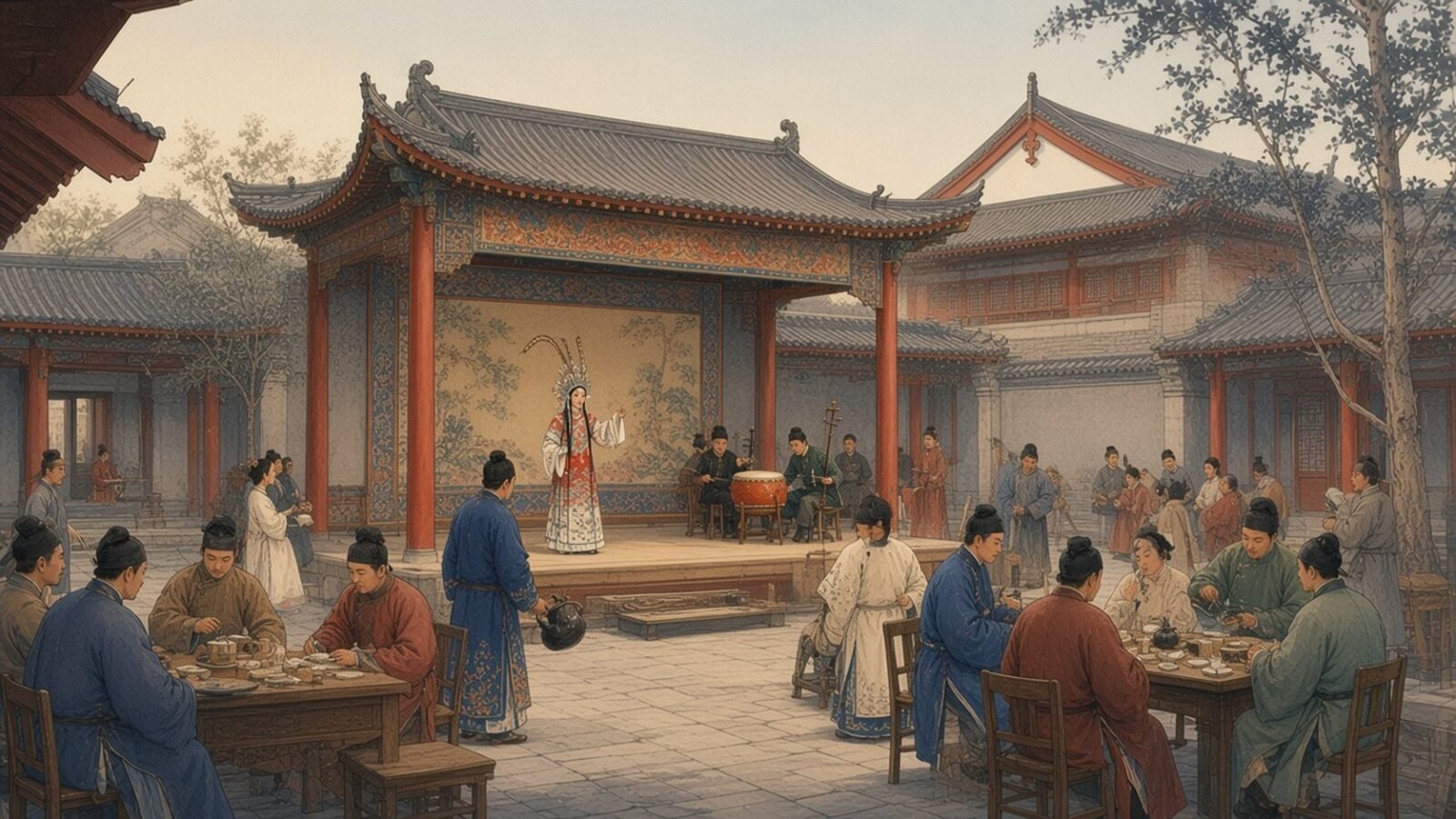
On a winter afternoon in 1913, in a small courtyard theatre on the south side of Qianmen, just outside the old walls of Beijing, a young woman in her early twenties was sitting at a brass mirror in the wings, applying Peking opera lianpu makeup in red and white and black. Her name, on the playbill, was En Xiaofeng (恩晓峰, written variously in the period sources). She was about to sing the lead in a laosheng, an older-male-character role, an act that had been technically illegal in the capital of Peking opera for a hundred and forty years. The ban, imposed by the Qianlong Emperor in 1772, had been lifted in March 1912 by order of the Ministry of the Interior, briefly opened to mixed-gender performance in the spring, and then closed again to mixed performance in the autumn on the public-morality arguments of the capital’s senior Peking opera artists. The all-female troupe in which En Xiaofeng was performing in early 1913 was one of the practical consequences of that compromise. It was not, in the way that some later historians have suggested, the moment when the ban was first broken. It was, more accurately, the moment when the broken ban settled into the shape that would govern Peking opera in Beijing for the next twenty years.
The 1772 ban
The ban on women on the Peking opera stage in Beijing was not the first such prohibition. Qing emperors had issued repeated orders against female performers starting with the Kangxi Emperor in 1671, and the regulation had been reissued several times in the eighteenth century. The 1772 edict of the Qianlong Emperor, however, was the order that held. The Qianlong Emperor is reported in the surviving Qianlong reign regulations to have been particularly troubled by the conduct of female performers in Beijing, and to have considered the presence of women on the stage, in close contact with mixed audiences in unheated theatres, incompatible with the moral order of the capital. The edict ordered all female performers to leave the Beijing theatres and restricted all subsequent Peking opera performance in the city to troupes of male actors playing all roles, including the female roles, known as dan. The male dan actor, who would play a woman with painted face and bound feet and elaborate headdress, became the dominant artistic convention of Peking opera from the 1780s onward. The four great Anhui troupes that brought Hui opera to Beijing for the Qianlong Emperor’s eightieth birthday in 1790, the occasion from which Peking opera is conventionally dated as a distinct art form, were all-male troupes, and the convention they set held for the next century and a half.
The effect of the 1772 edict was not, in practice, to exclude women from Chinese theatrical life. Women performed widely in other theatrical forms, in regional opera traditions in the south, in private domestic performances for the wealthy, and in the small-scale travelling troupes that served rural audiences. Peking opera, however, was the prestige form of Chinese theatre in the nineteenth century, the form in which the great performers of the era, Tan Xinpei, Yu Zhenting, Cheng Changgeng, became famous, and the form that defined what a serious actor was. To be excluded from Peking opera in Beijing was, in that sense, to be excluded from the central canon of the art. The male dan tradition that took the place of female performers in the Peking opera repertoire, the famous nandan (男旦, male-female) school of Mei Lanfang, Shang Xiaoyun, Cheng Yanqiu, and Xun Huisheng, was a brilliant solution to the prohibition, and it remains one of the most distinctive achievements of Chinese theatre. It was also, however, a solution that left the actual women performers of the era in an awkward position, and it is the women’s return to the stage, in the 1870s, in 1912, and in 1913, that is the more important story for the present dispatch.
The 1870s Shanghai 髦儿班
The first sustained breach of the 1772 ban came not in Beijing, where the imperial edict was most strictly enforced, but in Shanghai, where the late Qing state had substantially less control over the city’s social and commercial life. By the 1870s the foreign concessions in Shanghai, the British Concession along the Bund and the French Concession to its south, had grown into the most cosmopolitan urban district in East Asia, with a permanent population of several hundred thousand Chinese, several thousand foreign residents, and a flourishing entertainment industry. The Chinese theatre in Shanghai, which was already a substantial business before the foreign settlement, was a particular beneficiary of the new urban prosperity. The Concession authorities, who relied on the goodwill of their Chinese residents and on the taxes they paid, were less inclined than the Beijing authorities to enforce the Qianlong ban on female performers, and by the 1870s the city’s theatrical scene included small all-female troupes performing for a largely Chinese audience.
These troupes were known by the specific name mao er ban (髦儿班, also written 毛儿班), literally “bangs troupe” or, by some accounts, “young-maiden troupe,” and the name appears to be a pidgin rendering of the Cantonese-derived maor. The troupes were small, typically a dozen or so young actresses plus a small backstage crew, and they performed in the smaller of the Shanghai theatres and at private parties for wealthy families. The repertoire was a mix of Huiju, the Anhui opera that was Peking opera’s parent form, and the new Peking opera that was just then being codified in Beijing. The earliest recorded mao er ban troupe is associated with a man named Li Maoer (李毛儿), a former Peking opera performer who had moved to Shanghai in the early 1870s and is said by the period sources to have founded the first all-female troupe there around 1873. The 1907 Yuezhai Shibao (an early Shanghai news sheet) records that by the 1880s there were at least four substantial mao er ban troupes in Shanghai, and the Ershi Nian Mudi zhi Guai Xianzhuang (Twenty Years’ Strange Things Observed, an 1897 novel by Wu Jingzi) includes a long description of a mao er ban performance that suggests the troupes were by then a regular feature of Shanghai’s entertainment scene.
The mao er ban of the 1870s and 1880s were not, however, a direct continuation of the pre-1772 tradition. The women who performed in them were from a different social background, and they were performing for a different audience. The Peking opera actresses of the late imperial era, in the rare instances when they were tolerated at all, were largely women of the entertainment district, often with a background in singing-girl or courtesan work, and they performed for a mixed-gender audience in private settings. The mao er ban performers of the 1870s were, by contrast, mostly teenage girls from poor families in the Shanghai region, recruited into the troupes as children, trained in the troupe, and performing in commercial theatres under contracts that the period sources describe as closer to apprenticeship than to employment. The 1880s and 1890s were the high point of the mao er ban, but the model was already under strain by the end of the century, as the larger commercial theatres of Shanghai came to favour the emerging troupes of professional actresses who had been trained in the same manner as their male counterparts and were beginning to perform in mixed-gender troupes alongside men.
Li Maoer and the first commercial breakthrough, 1894
The first commercial breakthrough for the new female performers came in 1894, when the Xinhui Theatre (新会茶园, also known as the Meixin Tea Garden 美心茶园) on the Avenue Joffre in the French Concession of Shanghai, opened as the first commercial venue dedicated to female Peking opera performers. The Xinhui was the initiative of a Shanghai entrepreneur named Wang Yaoqing, who had been a partner in the Xinming Theatre in the 1880s and who had concluded, on the basis of the mao er ban’s commercial success in the 1880s, that a properly commercial venue for female Peking opera would draw large audiences in Shanghai’s expanding entertainment market. The Xinhui’s opening in the spring of 1894 was a major event; the audience for the first performance was reported in the Shanghai press to have included most of the senior members of the city’s Chinese commercial and official class, along with a substantial foreign presence. The Xinhui’s first season ran for six months, and the second season for eight, with the performers drawing on the existing mao er ban troupes and a number of newly recruited young women from the Shanghai and Jiangsu regions.
The 1894 breakthrough at the Xinhui is the moment at which female Peking opera performance, in its modern professional form, became a permanent feature of the Chinese theatrical landscape. The Xinhui was not a Peking opera house in the Beijing sense; it was a commercial theatre, and the women who performed in it were professional actresses with multi-year contracts, regular salaries, and a measure of artistic autonomy that the earlier mao er ban performers had not had. The Xinhui was followed, over the next decade, by a number of similar commercial venues in Shanghai: the Xintiandi Theatre in the British Concession, the Dalian Theatre in the French Concession, the Qunxian Tea Garden in the Hongkou district. By 1900, the major Shanghai commercial theatres were all running female Peking opera programmes, and the mao er ban troupes of the earlier generation had been largely absorbed into the new commercial framework. The professional female Peking opera performer of the late Qing and early Republic, with a contract, a salary, and an audience, was now a permanent figure in Chinese theatrical life, at least in Shanghai.
Beijing, however, was a different matter. The Qianlong ban, never fully enforced in Shanghai, remained fully in force in Beijing throughout the late nineteenth and early twentieth century. The 1900 Boxer Rebellion and the foreign occupation of Beijing in 1901 to 1902 briefly disrupted the Beijing theatrical scene, but the ban survived even the foreign occupation. In 1907, the year of the first Chinese all-female theatre company to perform publicly in Shanghai under the new commercial model, there were three publicly visible performances by female actors in Beijing, all of them brief, all of them at small private venues, and all of them promptly shut down by the Beijing police on the grounds of the Qianlong edict. The 1907 attempt was a clear sign that the ban was unenforceable in the long run, but the long run was not yet there. The Beijing ban held for another five years, until the political revolution of 1911 changed the ground on which the regulation stood.
The 1912 lifting of the ban and the 1913 moment
The 1911 Xinhai Revolution and the abdication of the Xuantong Emperor on 12 February 1912 ended the imperial political order that had underpinned the Qianlong ban. The new Republican government of Yuan Shikai, formed in March 1912 under the Provisional Constitution of the Republic, did not automatically invalidate the imperial edicts, but the political climate in which the edict had been issued no longer existed, and the Beijing theatrical community began to organise for change. The petition that lifted the ban was organised by the Peking opera performer Yu Zhenting (俞振庭), a wu-sheng (martial-male) actor and the son of the great wu-sheng performer Yu Jusheng (俞菊笙). Yu Zhenting had spent the late imperial period performing in Beijing and Shanghai, and he had been particularly struck by the commercial success of the Shanghai female Peking opera troupes during a 1910 visit. On his return to Beijing he began to organise a petition to the new Republican authorities for the lifting of the ban, and on 27 February 1912, a fortnight after the imperial abdication, a newspaper article announced that the petition was under consideration by the Ministry of the Interior.
The Ministry of the Interior’s response was cautious but ultimately positive. The new regulations for the management of theatres, which included the formal lifting of the ban on female performers, were approved on 24 March 1912, and the first public performances under the new rule began in Beijing on 22 March 1912, two days before the formal approval, at a small theatre in the Qianmen district that Yu Zhenting had leased for the purpose. The regulation was formally promulgated on 31 May 1912, and the Beijing police issued a public notice on the same day confirming that female performers were now permitted on the Beijing Peking opera stage. The first season of the new era included a number of experienced performers who had come north from the Shanghai troupes, including the laosheng performer En Xiaofeng who appears in the opening of this dispatch, the wu-sheng performers Liang Chunlou and Liang Huanong, the qingyi (青衣, virtuous-female) performer Liu Xikui (刘喜奎), and the huadan (花旦, vivacious-female) performer Xian Lingzhi (鲜灵芝). The Shuangqing She (双庆社, “Double Celebration Troupe”), the troupe Yu Zhenting had organised for the new era, opened at the Xiangchang (香厂) open-air venue in central Beijing in May 1912 with a mixed-gender cast and an enthusiastic reception.
The mixed-gender experiment, however, was short-lived. In the autumn of 1912, under pressure from the senior Peking opera artists of the Beijing establishment, who argued that mixed-gender performance was incompatible with the moral order of the Beijing stage and would damage the artistic reputation of the city’s Peking opera, the police authorities re-imposed a ban on mixed-gender performance, while continuing to allow all-female troupes. The new arrangement, which took effect in late 1912 and was fully in place by early 1913, was the compromise that gave En Xiaofeng and her colleagues their 1913 stage. The capital’s Peking opera scene was now split into three categories: the established all-male troupes, which retained the nandan tradition; the new mixed-gender troupes, which were technically licensed but in practice squeezed out by the autumn ban; and the all-female troupes, which were licensed and flourished. The year 1913, the year in which this dispatch opens, was the year in which the all-female troupe settled into its permanent place in the Beijing Peking opera scene. The mixed-gender era had lasted less than a year, and the all-female era, the era of the 坤班, the era of En Xiaofeng and Liu Xikui, was about to begin.
The Chongya She and the Beijing all-female troupes, 1914-1921
The seven years from 1914 to 1921 were the high point of the Beijing all-female troupe. The first major troupe of the new era was the Chongya She (崇雅社, “Reverence for Elegance Troupe”), founded in 1916 by the Beijing Peking opera artist and impresario Tian Jiyun (田际云, also known as Tian Baoyu 田宝玉), a dan performer who had been one of the few artists willing to perform publicly in a mixed troupe during the 1907 attempt. The Chongya She was the most prestigious of the all-female troupes; its performers included the qingyi Liu Xikui, the huadan Xian Lingzhi, the laosheng Li Guifen (李桂芬) and Xiao Lanying (小兰英), the wu-sheng Liang Chunlou and Liang Huanong, and the laosheng and wu-sheng Zhao Ziyun (赵紫云). The Chongya She’s principal venue was the Chengnan Youyi Yuan (城南游艺园, “Southern City Amusement Garden”), a large amusement park on the south side of Beijing that opened in 1919 and housed a permanent Peking opera stage that the Chongya She used as its home.
Other major all-female troupes of the 1914-1921 period included the Hongshun She (鸿顺社), the Qinghe She (庆和社), the Weide She (维德社), the Taiping She (太平社), and the Gongli She (共利社). By 1920, the period sources record, there were at least ten substantial all-female troupes operating in Beijing at any one time, with a combined roster of more than 1,000 performers. The troupes performed at the Chengnan Youyi Yuan, at the major Beijing theatres in the Qianmen and Dashilanr districts, and at the smaller private venues that served the capital’s growing urban entertainment market. The 1920s saw the most famous female Peking opera performers of the era at the height of their careers: Liu Xikui and Xian Lingzhi, who had been the principal performers of the 1912 mixed-gender experiment, were now the leading qingyi and huadan of the all-female troupes, and their names were familiar to a Beijing public that had not known a famous female Peking opera performer for a hundred and forty years.
The all-female troupe, however, was not, and was never intended to be, a permanent solution to the question of women in Peking opera. The senior Beijing Peking opera artists of the 1910s had accepted the all-female arrangement as a compromise, and they continued to argue for the lifting of the mixed-gender ban. The argument, which was repeated in a number of trade publications of the 1910s, was that the artistic quality of female Peking opera performers was systematically lower than that of the male dan tradition, that the all-female troupes were training young women in an art form that they could never fully master, and that the only proper solution to the women-on-stage question was the integration of the two traditions in a single mixed-gender Peking opera. The argument was not, in the end, a fair one. The all-female troupes of the 1910s produced a number of female performers who, by the standards of the time, were the equals of any of their male counterparts, and the all-female troupes’ repertoire was substantially the same as that of the male troupes. But the argument reflected a real concern about the artistic cost of the all-female arrangement, and the lifting of the mixed-gender ban, which came in the early 1920s under the Beiyang government, was the consequence.
The Tianchan Theatre and Shanghai’s stage, 1916-1930
While the Beijing story was about the struggle over the mixed-gender ban, the Shanghai story was about a parallel but quite different development: the rise of the new commercial Peking opera stage, with the Tianchan Theatre (天蟾逸夫舞台) as its most famous venue. The Tianchan’s first iteration opened in 1916 at the Wing On Building on the Nanjing Road in the British Concession, and was an immediate commercial success; its second, larger iteration, on the Fuzhou Road in the French Concession, opened in 1925 and remained one of the most important Peking opera venues in Shanghai through the 1930s. The Tianchan was the first of the new commercial Peking opera theatres to feature both male and female performers in regular rotation, and it was a major venue for both the established male Peking opera performers of the Beijing tradition and the rising female performers of the Shanghai and Beijing troupes. The Tianchan’s 1930s programmes included Mei Lanfang, the great nandan performer, alongside the female Peking opera performers who had become the most popular figures in the Shanghai entertainment market.
The 1930s were the high point of the female Peking opera in both Beijing and Shanghai. The famous 1934 Shanghai performance of The Drunken Beauty by Mei Lanfang, widely regarded as one of the great performances of twentieth-century Chinese theatre, was given at a Shanghai venue that also hosted regular female Peking opera programmes, and the period’s leading Peking opera critics regularly compared the artistic achievements of the male and female traditions. The 1930s also saw the rise of a new generation of female performers, including the qingyi performers Mei Qiao (梅巧, a student of Mei Lanfang’s father) and the laosheng performer Xun Huisheng (not to be confused with the male dan performer of the same name), who would become some of the most important figures in the post-1949 Peking opera establishment. The female Peking opera performer had, by the 1930s, become a permanent and central part of the Chinese theatrical tradition, no longer a workaround for a ban that had been lifted, but a new and substantial artistic presence in its own right.
The 1949 Communist takeover of mainland China and the establishment of the People’s Republic had, eventually, complex consequences for the female Peking opera tradition. The 1966-1976 Cultural Revolution banned traditional Peking opera performance entirely, in favour of the eight revolutionary model operas, of which only one, the Taking Tiger Mountain by Strategy (智取威虎山, 1958), had a significant female role. The female Peking opera tradition survived in Taiwan, Hong Kong, and the overseas Chinese communities, and re-emerged in mainland China in the late 1970s. The female Peking opera performer of the post-1978 reform era is the inheritor of the tradition that began in the Shanghai 髦儿班 of the 1870s, that the 1912-1913 lifting of the Qianlong ban brought to Beijing, and that the 1930s commercial stage made the central presence in Chinese theatrical life that it remains today.
What the women on stage meant
The women who took the Peking opera stage in the 1870s, in 1912, in 1913, and through the 1930s, were not, by the standards of the time, a single coherent group. The mao er ban performers of the 1870s were young women from poor families, recruited as children and trained in the troupes, performing in small Shanghai venues for a Chinese urban audience. The 1894 Xinhui Theatre performers were a slightly more professionalised version of the same kind of performer, with contracts and salaries but a similar social background. The 1912-1913 Beijing performers were a different generation, often with Shanghai training and Beijing experience, who had chosen to come north to take advantage of the new opening. The 1930s performers were professional artists in a fully commercial theatrical system, with the artistic training, the public recognition, and the working conditions of a serious performing artist. The 1949-1979 period was, in a sense, the establishment of the female Peking opera performer as a permanent and respected figure in the Chinese theatrical establishment, an establishment that survived the Cultural Revolution’s attempt to dismantle it.
The 1913 moment, the year in which this dispatch opens, was the moment in which the new arrangement settled into place. The 1772 Qianlong ban had been the legal framework, the 1912 lifting of the ban was the political moment, and the 1913 establishment of the all-female troupe as the practical compromise was the moment at which the new order was working. The women who took the Beijing Peking opera stage in 1913, En Xiaofeng and her colleagues, were not the first women to perform Peking opera, nor were they the last, nor were they the most famous. They were, however, the women of the moment in which the new order settled, and it is the moment in which the modern Chinese theatrical tradition, with its full cast of male and female performers, took its permanent shape. The story of the women who took the stage in 1913 is, in that sense, the story of the moment when the modern Chinese theatre arrived.
| Date | Event | Place | Principal performers |
|---|---|---|---|
| 1772 | Qianlong Emperor’s edict banning female performers on the Beijing Peking opera stage | Beijing | Establishment of the male dan (nandan) tradition that runs for the next 140 years |
| 1671, 1762, 1772 (and others) | Repeated Kangxi and Qianlong edicts against female performers | Beijing | Pre-1772 baseline; some of the edicts were not consistently enforced |
| 1870s | First mao er ban (髦儿班) all-female troupes in Shanghai | Shanghai (French and British Concessions) | Li Maoer (李毛儿) and his troupe; later the four or five major mao er ban troupes of the 1880s |
| 1894 | First commercial venue dedicated to female Peking opera, the Xinhui Theatre (新会茶园, also Meixin Tea Garden) | Shanghai (Avenue Joffre, French Concession) | Wang Yaoqing as entrepreneur; performers drawn from the existing mao er ban troupes |
| 1907 | Three briefly public performances by female actors in Beijing; all three shut down by the Beijing police | Beijing (private venues) | The 1907 performers are not individually named in the surviving sources |
| 12 February 1912 | Xuantong Emperor Puyi abdicates, ending the imperial political order | Beijing | End of the political basis for the 1772 edict |
| 22 March 1912 | First public performances by women in Beijing under the new Republican regime | Beijing (Qianmen district) | Yu Zhenting (俞振庭) organises the Shuangqing She (双庆社); En Xiaofeng (恩晓峰), Liu Xikui (刘喜奎), and others as the first-season cast |
| 24 March 1912 | Ministry of the Interior approves the new Regulations for the Management of Theatres, formally lifting the Qianlong ban | Beijing | New legal basis for mixed-gender and all-female performance |
| 31 May 1912 | Beijing Police Department issues a public notice confirming that female performers are permitted | Beijing | Public confirmation of the May 1912 regulation |
| Autumn 1912 | Beijing Police Department, under pressure from the senior male Peking opera artists, re-imposes a ban on mixed-gender performance | Beijing | The compromise that produced the all-female troupe era |
| Early 1913 | All-female Peking opera troupes settle into their permanent place in the Beijing theatrical scene | Beijing | En Xiaofeng and the early all-female troupes; the 1913 era |
| 1916 | Tian Jiyun (田际云) founds the Chongya She (崇雅社) in Beijing; the Tianchan Theatre opens in Shanghai | Beijing and Shanghai | Liu Xikui, Xian Lingzhi, Liang Chunlou, Liang Huanong as principal Chongya She’s performers |
| 1914-1921 | Era of the Beijing all-female troupes, with at least ten substantial troupes operating at any one time | Beijing | Chongya She, Hongshun She, Qinghe She, Weide She, Taiping She, Gongli She |
| 1919 | Chengnan Youyi Yuan (城南游艺园) opens in Beijing, with the Chongya She as its resident troupe | Beijing | Liu Xikui and Xian Lingzhi at the height of their Beijing careers |
| 1925-1930 | Tianchan Theatre’s second, larger iteration opens in Shanghai; Shanghai becomes the centre of the commercial Peking opera stage | Shanghai | Mei Lanfang alongside the female Peking opera performers of the 1930s |
References
- Liu, Siyuan (2023). “A New Era for Female Actors: Their Journey to the Beijing Stage.” In: Peking Opera: Historical Material, Social Change, and Contemporary Practice. Springer, Singapore. https://link.springer.com/chapter/10.1007/978-981-95-6280-0_3
- 髦兒戲 article, in the Jendow Chinese encyclopedia, 2024. https://www.jendow.com.tw/wiki/%E9%AB%A6%E5%85%92%E6%88%B2
- Britannica, “Peking opera” entry. https://www.britannica.com/art/Peking-opera
- Mackerras, Colin (1972). The Rise of the Peking Opera, 1770-1870: Social and Economic Factors. Oxford University Press. Reissued by Routledge, 2011.
- Stock, Jonathan P. J. (2003). “The ‘Shanghai School’ of Peking Opera, 1916-1949.” In: Theatre and Society in East Asia. University of Hawai’i Press.
- Sun, Hui (2014). Peking Opera: A Chinese Cultural Icon. Cambridge University Press. https://www.cambridge.org/peking-opera
- Wang, Zheng (1999). Women in the Chinese Enlightenment: Oral and Textual Histories. University of California Press. Contains the chapter on female Peking opera performers of the early Republic.
- Yuezhai Shibao (上海遊戲報) archive, 1897-1901, the Shanghai news sheet that carried the earliest commercial-theatre notices, including those of the Xinhui Theatre. Held in the Shanghai Library.
- Guangxu reign regulations (大清會典事例), 1908 edition, the surviving fragments of which include the Qianlong Emperor’s 1772 edict on Peking opera performers. Held in the National Library of China, Beijing.
- Zhongguo Jingju Nianjian (中国京剧年鉴, China Peking Opera Yearbook), 2014 edition, the most recent comprehensive reference work on the history of Peking opera performers and troupes, including the 1870s-1920s all-female era.