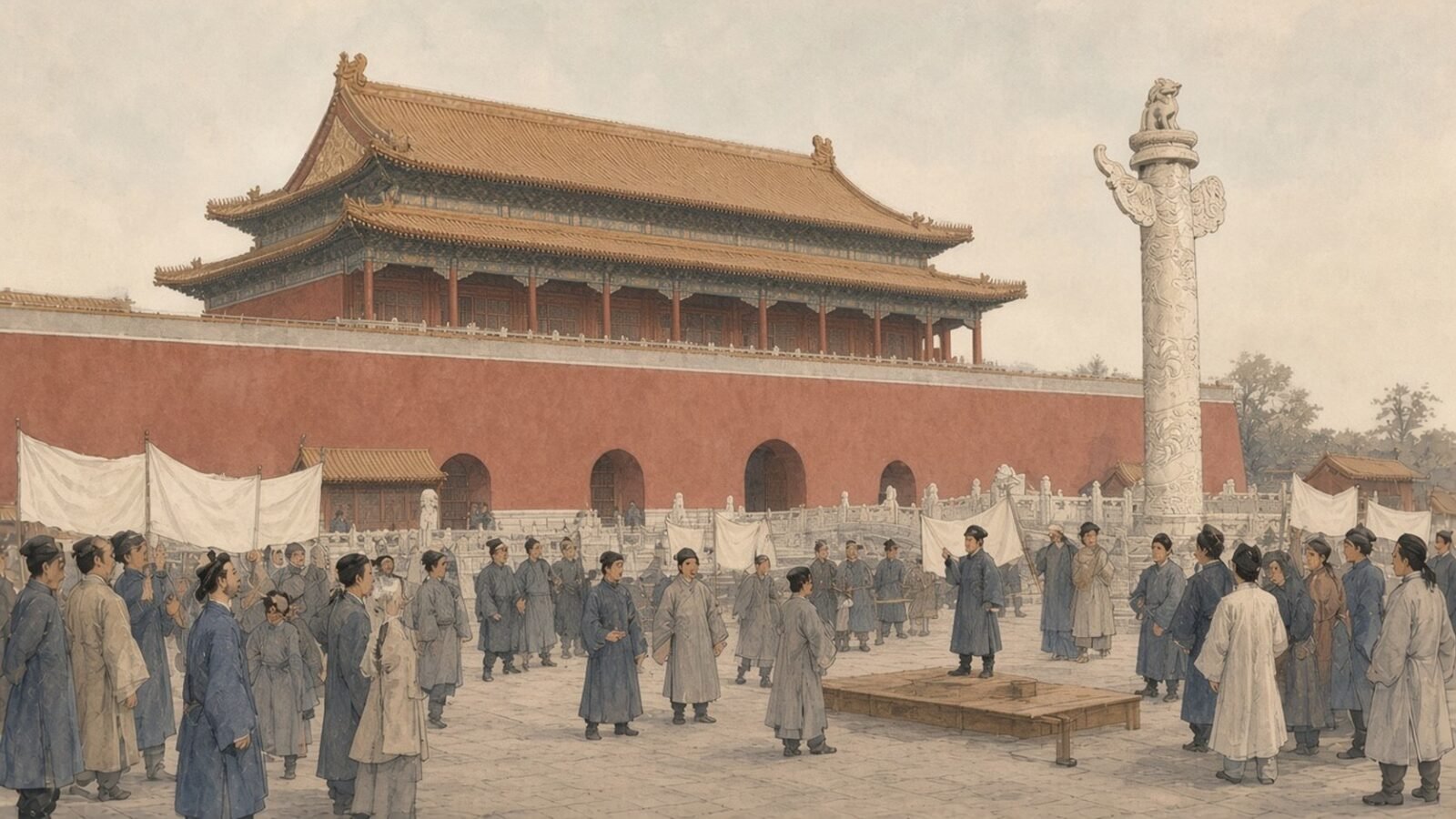
On the morning of Sunday, 4 May 1919, about three thousand students from thirteen Beijing colleges and schools gathered in front of Tiananmen, the great south gate of the Forbidden City, in the kind of late-spring light that falls on the low tiled roofs of the Outer City before the heat of the day. The students carried banners printed on white cloth, set out the night before in the dormitories of Peking University, that read, in classical and in plain speech, “Restore our rights over Qingdao” (还我青岛), “Do not sign the peace treaty” (拒绝签字), “Down with the traitors who sold out the country” (诛卖国贼曹章陆). The crowd was a young crowd. Most of the marchers were under twenty-five. Many were pupils of the recently-arrived Peking University chancellor Cai Yuanpei, or of the New Culture Movement intellectuals who taught at his university, the historian Chen Duxiu, the librarian Li Dazhao, the young philosopher Hu Shi. The march, which the students had organised in three days, would end in fire, in the beating of a Chinese official, in the arrest of thirty-two of the marchers, and in a national crisis that would force the Chinese government to refuse, on 28 June 1919, to sign the Treaty of Versailles. The students were demanding that the peace conference at the end of the First World War give the former German concession of Qingdao, on the coast of Shandong province, back to China, and not to Japan. The students were marching, in short, to defend an expectation that had been the central diplomatic hope of the Chinese Republic for the past four years, an expectation that the victors’ peace would recognise that China, although it had not sent soldiers in 1914, had sent 140,000 labourers to the Western front, had lost 2,000 of them, and had earned, on the strength of that contribution, the right to a square deal.
The treaty that broke a promise
The story of the May Fourth Movement begins in 1914, in a Chinese Republic four years old, governed from Beijing by Yuan Shikai, a former Qing general who had accepted the presidency in 1912 and had tried, in the late autumn of 1915, to make himself emperor. The Republic, in 1914, was at war with one of the Central Powers. Japan declared war on Germany in August 1914, and within a few weeks Japanese forces, with the acquiescence of the British, took the German-leased territory of Qingdao, the port and the rail line that ran inland through Jinan, the capital of Shandong, and on to the junction town of Zhengzhou, where the Shandong railway met the great north-south trunk line from Beijing to Hankou. The Japanese occupation of Qingdao was technically temporary, part of an Allied operation against a German colonial possession, and the Beijing government, which had not yet entered the war, accepted the Japanese action in the spirit of an ally-of-ally. The arrangement was unstable. Japan, in January 1915, presented the Beijing government with the Twenty-One Demands, a list of demands that would, if accepted in full, have reduced the Chinese Republic to a Japanese protectorate. The Beijing government accepted most of the demands, on 25 May 1915, in a series of exchanges that Chinese historians call the humiliation of the National Protection War’s last diplomatic effort. The first group of demands, the ones that were accepted, gave Japan the right to take over the German concession in Shandong at the end of the war, in effect to inherit what the Germans had taken in 1898. The second and third groups, the ones that were deferred, would have given Japan a controlling position in Chinese politics, in Chinese finance, in Chinese policing. China had not lost the war; China had, in 1915, lost the peace that was to follow the war.
China entered the First World War on 14 August 1917, eight days after the British, French, and Russians had, in a note of 23 January 1917, committed themselves to support the territorial integrity of China at the peace conference. The note was, in retrospect, the diplomatic moment on which the May Fourth students would stake their claim. China, the Allies had said, would not lose territory in a war fought for territory. China, the note had implied, would not be asked to give back what it had not taken. The commitment was not in writing as a treaty, and it did not bind the United States, which entered the war in April 1917, but the British, the French, the Russians, the Italians, and the Japanese had signed it, and the Chinese government treated it as a binding promise. The Chinese labour corps, recruited under the War Participation Bureau in Tianjin and the cities of the north, was dispatched to the Western front in 1917 and 1918, working behind the lines in France, in Belgium, in Mesopotamia. The Chinese contribution to the war was, in 1917 and 1918, the central piece of evidence in the Chinese case for a square deal at the peace. The peace conference opened in Paris on 18 January 1919. The Chinese delegation, led by the Foreign Minister Lu Zhengxiang and the diplomat V. K. Wellington Koo, presented a three-part case: the German concessions in Shandong should be returned to China; the Twenty-One Demands of 1915 should be annulled; the foreign leaseholds in China should be reconsidered. The case was, in the eyes of the Chinese public, the test of the Allies’ January 1917 note. The case was, in the eyes of the British and the French, less simple. The British and the French had, in 1917, made a series of secret agreements with Japan, including the Lansing-Ishii agreement of November 1917, in which the United States had acknowledged that Japan had “special interests” in China, and the Anglo-Japanese declarations of 1917, in which the British had recognised Japan’s claim to the German concession in Shandong. The peace conference, in 1919, was not a court of first instance. It was a meeting of victors whose secret diplomacy in 1917 had already pre-empted the Chinese case.
The Chinese delegation learned, in late April 1919, that the peace conference had decided, on 30 April, to award the German concession in Shandong to Japan, rather than to return it to China. The news reached Beijing on 1 May. The British delegation in Paris had, in a memorandum of 14 April, told the Chinese delegation that the British could not support the Chinese case, and that the British would oppose the return of the Shandong concession to China. The French took the same view, on the same grounds: the French had made the same secret commitments. The American delegation, led by the geographer Isaiah Bowman and the diplomat Charles Seymour, supported the Chinese case in principle, but the American delegation was not, in 1919, in a position to override the British and the French, and the American President, Woodrow Wilson, who had arrived in Paris in December 1918 to argue for a just peace, was already being pulled toward the British and the French position on the question of the German concessions. The Chinese delegation, in late April 1919, asked the peace conference to delay a decision; the peace conference refused. The Chinese delegation, on 24 April, asked the peace conference to allow the Chinese case to be heard in person; the peace conference refused. The Chinese delegation, on 28 April, learned that the Shandong decision had been made and that the Japanese had been given the German concession. The Chinese delegation, on 28 April, sent a telegram to the Beijing government, asking the Beijing government to refuse to sign the peace treaty. The telegram reached Beijing on 1 May, in the late afternoon, and the news spread through the Beijing press on 2 and 3 May. The students of Peking University, who had been following the peace conference in the Beijing newspapers and in the May 4 student-organising meetings of the previous week, decided to march.
The students at Tiananmen
The students who marched on 4 May 1919 were, in a sense, the product of a longer movement. The New Culture Movement, which had begun in 1915 with the journal New Youth (新青年) of Chen Duxiu, had been arguing, for the past four years, that the old Confucian order was a dead weight on the new Republic, and that the way to a modern China lay through Mr Science (赛先生) and Mr Democracy (德先生), through the vernacular language (白话文) in place of the classical, through the individual in place of the family, through the rights of women in place of the foot-binding and the concubine. The students of Peking University, who were the natural audience for the New Culture arguments, had read Chen Duxiu’s New Youth and Hu Shi’s “A Preliminary Discussion of Literary Reform” (文学改良刍议) of 1917 and Lu Xun’s “A Madman’s Diary” (狂人日记) of 1918. The students of Peking University had been holding meetings, on 2 and 3 May 1919, in the Peking University library, to plan a protest march on the Allied decision. The students of Peking University, on 3 May, asked Cai Yuanpei, the chancellor, for permission to march, and Cai Yuanpei, who had been a friend of the New Culture Movement, did not refuse. The students of Peking University, on the night of 3 May, printed their banners in the dormitory. The students of Peking University, on the morning of 4 May, gathered at the gate of the university, and marched west, then north, to the square in front of Tiananmen.
The march was, in the standard account of the day, a chaotic thing. The students, in their banners, demanded the punishment of three Chinese officials who had, in the students’ view, sold out the country to Japan: Cao Rulin, the Director of the Communications Ministry and the chief Japanese intermediary in Beijing; Zhang Zongxiang, the Chinese plenipotentiary in Paris; and Lu Zongyu, the Chinese Ambassador to Japan, who had not yet been named. The students shouted slogans. The students, in the square, read a printed statement aloud. The students then marched east, to the house of Cao Rulin at Dongjiaomin Lane, broke into the compound, beat Cao Rulin, set fire to the house, and beat Zhang Zongxiang, who happened to be at the house for a meeting with Cao. The fire was put out by the Beijing fire brigade. Cao Rulin fled. Zhang Zongxiang was beaten and left in the street. The students, in the afternoon, marched to the Legation Quarter and tried to enter the Japanese legation, but were turned back by the police and by the foreign legation guards. The students, in the late afternoon, returned to Peking University. The Beijing police, in the evening, arrested thirty-two students, including the Peking University undergraduates Mei Shiyi, Zhang Guohua, Yang Qingzhong, and the Beijing Higher Normal School students who had joined the march. The arrested students were held at the Beijing police headquarters. The university sent a delegation to negotiate for the release of the arrested students. The negotiations failed. The news of the arrests spread, by telegram and by telephone, to the cities of the Yangtze valley.
The arrests were the catalyst. The students of the other Beijing universities, on 5 May, declared a strike. The students of the Beijing middle schools, on 6 May, declared a strike. The students of Tianjin, Shanghai, Wuhan, Changsha, Guangzhou, and Nanjing, on 7, 8, and 9 May, declared strikes in sympathy. The merchants of Shanghai, on 9 May, began a commercial strike, closing their shops in the foreign concessions. The Shanghai Municipal Council, on 10 May, asked the Beijing government to release the arrested students. The Chinese Chamber of Commerce in Shanghai, on 11 May, called for a national merchants’ strike. The Chinese workers of the Shanghai cotton mills, on 12 May, walked out. The workers of the Shanghai shipyards, the Shanghai iron foundries, the Shanghai railway workshops, the Shanghai printing houses, walked out. The Japanese cotton mills, in the second week of May, closed because the Chinese workers refused to work. The Japanese shipping companies, in the third week of May, suspended the Shanghai-Nagasaki route because the Shanghai dock workers refused to load. The general strike, in the second and third weeks of May, was the first time in modern Chinese history that a Chinese city, on the scale of Shanghai, had shut down its commerce, its industry, and its transport in protest against a foreign diplomatic decision. The general strike, in the second and third weeks of May, was the moment when the May Fourth Movement ceased to be a Beijing student protest and became a national crisis.
The country rises
The government in Beijing, on 5 May, tried to suppress the news. The newspapers of Beijing, in the first days of the crisis, were forbidden to print the names of the arrested students. The Peking University chancellor Cai Yuanpei, on 5 May, resigned in protest at the arrests. The Peking University faculty, on 5 May, voted to strike. The Beijing Higher Normal School, on 5 May, voted to strike. The Beijing students, on 6 May, formed a Beijing Student Union, with representatives from the thirteen Beijing universities, to coordinate the strike. The Beijing Student Union, on 6 May, sent a delegation to the Beijing government to demand the release of the arrested students. The Beijing government refused. The students, in the second week of May, occupied the university buildings and refused to leave. The Beijing government, in the second week of May, sent the Beijing police to clear the universities. The police cleared the universities. The students, in the third week of May, set up the Beijing Student Union headquarters in the rooms of a sympathetic Beijing merchant, and continued to coordinate the strike from there. The students, in the third week of May, sent delegations to the cities of the Yangtze valley to coordinate the national strike. The delegations, in the third week of May, were received by the students, the merchants, and the workers of Shanghai, of Wuhan, of Changsha, of Guangzhou, of Nanjing. The general strike, in the third week of May, was the first time in modern Chinese history that a national Chinese strike had been coordinated across the country’s cities by a single union of student organisations.
The crisis came to a head on 3 and 4 June 1919. The Beijing government, on 3 June, arrested more than a thousand students, including most of the Beijing Student Union leadership. The arrests triggered a wave of worker strikes in Shanghai, in Wuhan, in Changsha, in Nanjing, in Guangzhou, in Tianjin. The Shanghai workers, on 5 June, walked out in support of the arrested students. The Shanghai workers, on 5 June, were joined by the railway workers of the Beijing-Hankou line, who walked out in sympathy. The railway strike, on 5 June, was the first national railway strike in Chinese history, and it stopped the north-south trunk line. The Beijing government, on 5 June, was unable to move troops from south to north or from north to south. The Beijing government, on 6 June, began to back down. The government, on 6 June, dismissed Cao Rulin, Zhang Zongxiang, and Lu Zongyu from their posts. The government, on 6 June, released the arrested students. The government, on 7 June, asked the Chinese delegation in Paris to refuse to sign the peace treaty. The Chinese delegation, on 28 June, refused to sign. The peace treaty was signed by the other Allies, including Japan, in the Hall of Mirrors at Versailles, and the Chinese concession at Qingdao was, on paper, awarded to Japan. China, in 1921 and 1922, negotiated the return of the Shandong concession through the Washington Conference, the nine-power conference of November 1921 to February 1922, which had the effect of returning the Shandong railway to Chinese control and of returning the Qingdao concession to Chinese sovereignty in December 1922. The May Fourth students, in the formal sense, lost the immediate fight. The May Fourth students, in the longer sense, won: the Chinese case at Washington was made by the same delegation, and the same Wellington Koo, and the same argument about the 1917 Allied note. The May Fourth students, in the longer sense, made the Chinese case possible by forcing the Beijing government to refuse to sign the Treaty of Versailles, which in turn made the Chinese claim to Shandong, in 1921 and 1922, a settled diplomatic question rather than a contested one.
The intellectual revolution
The May Fourth Movement, in the standard Chinese account, has two names and two stories. The first story is the story of the protest march of 4 May 1919, the arrests, the general strike, and the refusal to sign. The second story is the story of the New Culture Movement of 1915 to 1921, the vernacular-language campaign, the anti-Confucian critique, the Mr Science and Mr Democracy slogans, the intellectual revolution that gave the protest march of 4 May 1919 its vocabulary. The two stories are usually told together, as the May Fourth Movement in the broad sense, the moment when the old Confucian order and the new republican order met, in the language of the students, in the streets of Beijing, in the diplomatic crisis of the spring of 1919, and produced the intellectual and political generation that would shape twentieth-century China. The two stories, in the standard account, are connected by the students of Peking University, who were at once the natural audience of the New Culture Movement and the organisers of the protest march. The students of Peking University, in the standard account, are the May Fourth generation, the generation that read Chen Duxiu, that read Hu Shi, that read Lu Xun, that read Li Dazhao, and that walked out of the Peking University library on the morning of 4 May 1919 to march on Tiananmen.
The intellectual revolution of 1915 to 1921 was, in its own terms, a revolution in the Chinese language. The classical Chinese of the imperial examination system, the dense, allusive, eight-legged essay of the late Qing, had been under pressure since the late nineteenth century, when the reformers of the Hundred Days of 1898 and the writers of the late Qing vernacular novel had argued that the classical language was a barrier between the writer and the reader, and that the way to a modern Chinese literature lay through the spoken language of the people, the baihua, the vernacular. The vernacular-language campaign of the New Culture Movement, led by Hu Shi in his 1917 essay “A Preliminary Discussion of Literary Reform” and by Chen Duxiu in his 1917 essay “On the Literary Revolution”, was the decisive moment in the long campaign. Hu Shi, a Cornell-trained philosopher who had returned to Peking University in 1917, argued that the classical language was a dead language, that the vernacular was a living language, and that the way to a Chinese literature fit for the modern world was to write in the vernacular. Chen Duxiu, the editor of New Youth, supported Hu Shi’s argument and extended it into a general attack on the Confucian tradition, on the family system, on the old marriage customs, on the foot-binding, on the arranged marriage, on the old hierarchy of the elder over the younger and the man over the woman. Lu Xun, the brother of Zhou Zuoren and a medical student turned writer, published, in the May 1918 issue of New Youth, “A Madman’s Diary”, the first modern Chinese short story, written in the vernacular, in which the narrator, a “madman” who has discovered that his neighbours and his family are cannibals, reads the Confucian classics as a coded invitation to eat the next generation. “A Madman’s Diary” was, in 1918, the central text of the anti-Confucian critique, the moment when the vernacular-language campaign and the anti-Confucian critique met in a single short story, in the form of a fictional diary, in the May 1918 issue of New Youth, and produced the most quoted line of modern Chinese literature: “I suspect that the four-thousand-year cannibalistic history of China is being continued from the ancients through the old text.”
The intellectual revolution was also, in its own terms, a revolution in the Chinese political vocabulary. The slogan Mr Science (赛先生) and Mr Democracy (德先生), the two phrases that Chen Duxiu had introduced in the 1917 editorial of New Youth as a translation of the Western slogans of the Enlightenment, became the central political vocabulary of the May Fourth generation. The two phrases were, in the standard account, a simplification: Science meant the modern natural-science method, the rejection of superstition, the rejection of the old Chinese metaphysical traditions, the rejection of the Confucian cosmology, the rejection of the Buddhist and Daoist cosmology, the rejection of the spirit world, the rejection of the fortune-teller and the geomancer. Democracy meant the modern republican form of government, the rejection of the imperial form, the rejection of the family-as-state, the rejection of the patriarchal household, the rejection of the arranged marriage, the rejection of the foot-binding, the rejection of the concubine, the rejection of the elder’s veto over the younger’s choice of marriage partner, the rejection of the family veto over the young man’s choice of career. The two phrases, in the standard account, were a translation of a Western vocabulary into a Chinese vocabulary, and the translation was, in the May Fourth generation’s view, a liberation. The two phrases, in the May Fourth generation’s view, were a way of naming the things that the old Confucian order had refused to name. The two phrases, in the May Fourth generation’s view, were the way to the modern world.
The people who made it
The May Fourth generation, in the standard account, was a small group of intellectuals who knew each other personally, who met in the rooms of the Peking University faculty, in the offices of the New Youth journal, in the teahouses of Beijing, in the bookshops of Shanghai, and who shaped the intellectual and political life of the Republic in the decade after 1919. The central figures of the May Fourth generation, in the order of their appearance in the standard account, are Chen Duxiu, Li Dazhao, Hu Shi, Cai Yuanpei, and Lu Xun. The central figures, in the standard account, are five people. The central figures, in the standard account, are not all of the same political tendency, and the May Fourth generation, in the longer account, includes a number of other figures who shaped the same decade in different ways: the journalists, the writers, the philosophers, the historians, the economists, the lawyers, the educators.
Chen Duxiu (陈独秀, 1879-1942) was the eldest of the central figures, the editor of New Youth, the chairman of the Peking University literature department in 1917, the founder of the Chinese Communist Party in 1921. Chen Duxiu was born in Anqing, Anhui, the son of a small merchant and minor official. Chen Duxiu had studied in Japan in the early 1900s, had been a revolutionary in the late Qing, had been in prison in 1913 and 1914 for opposing Yuan Shikai, and had founded New Youth in Shanghai in 1915. Chen Duxiu, in 1917, was appointed chairman of the literature department at Peking University, and in the four years from 1917 to 1921 he was the central figure in the New Culture Movement, the publisher of Hu Shi and Lu Xun, the editor of the New Youth editorials on Mr Science and Mr Democracy, the host of the discussions of the May Fourth students. Chen Duxiu, in 1920, became a Marxist. Chen Duxiu, in 1921, organised the first congress of the Chinese Communist Party in Shanghai in July 1921, and was elected the first General Secretary of the Party. Chen Duxiu, in 1927, was dismissed from the leadership of the Party by the Comintern, and was imprisoned by the Nationalist government in 1932. Chen Duxiu, in 1937, was released from prison. Chen Duxiu, in 1942, died in poverty in Sichuan, having been expelled from the Party for a second time in 1929.
Li Dazhao (李大钊, 1888-1927) was the librarian of Peking University in 1918, the head of the Peking University library, the most senior of the May Fourthers who had studied in Japan, the first of the May Fourthers to become a Marxist. Li Dazhao had been a student of the Tokyo Imperial University in 1913 to 1916, where he had read Marx and the Russian revolutionaries. Li Dazhao, in 1918, was appointed head of the Peking University library, and in 1918 and 1919 he was the host of the Marxist study group at the library. The Marxist study group, in 1920, became the nucleus of the Peking Communist group. The Peking Communist group, in 1921, sent three delegates to the first congress of the Chinese Communist Party in Shanghai. Li Dazhao, in 1922, was elected to the Central Committee of the Party. Li Dazhao, in April 1927, was arrested by the warlord Zhang Zuolin in the Beijing legation quarter, and was executed on 28 April 1927, the eighth anniversary of the Shandong decision at Versailles, by hanging from a telegraph pole in the courtyard of the police headquarters. The execution, in the standard account, was the first martyrdom of the Chinese Communist movement, and the date of the execution, 28 April, became, in the standard account, a date of mourning in the Chinese Communist calendar.
Hu Shi (胡适, 1891-1962) was the youngest of the central figures, the Cornell-trained philosopher, the author of the 1917 essay that launched the vernacular-language campaign, the central figure of the liberal wing of the May Fourth generation. Hu Shi had studied at Cornell from 1910 to 1917, and at Columbia in 1917, where he had studied with the philosopher John Dewey. Hu Shi, in 1917, returned to China, was appointed to the Peking University philosophy department, and in the January 1917 issue of New Youth published “A Preliminary Discussion of Literary Reform”, the essay that launched the vernacular-language campaign. Hu Shi, in 1920, published the first major collection of vernacular Chinese poetry, “A Book of Experimental Poems” (尝试集), the first collection of Chinese poems in the vernacular. Hu Shi, in 1930, was appointed president of Peking University. Hu Shi, in 1937, was appointed Chinese Ambassador to the United States. Hu Shi, in 1949, was appointed president of the Academia Sinica in Taiwan. Hu Shi, in 1962, died in Taipei, having been, for forty years, the central figure of the liberal wing of the May Fourth generation, the advocate of Mr Science and Mr Democracy, the opponent of the Marxist wing, the opponent of the Nationalist government, the advocate of the gradualist reform of the Chinese political system.
Cai Yuanpei (蔡元培, 1868-1940) was the chancellor of Peking University in 1917 to 1927, the host of the May Fourth students, the host of the New Culture Movement, the host of the Chinese intellectual and political life of the period. Cai Yuanpei had studied in Germany in the 1900s, had been the Minister of Education of the Republic in 1912, had been appointed chancellor of Peking University in 1917. Cai Yuanpei, in 1917, invited Chen Duxiu to be the chairman of the literature department. Cai Yuanpei, in 1917, invited Hu Shi to be a member of the philosophy department. Cai Yuanpei, in 1917, invited Li Dazhao to be the head of the library. Cai Yuanpei, in 1917, invited Lu Xun to be a member of the literature department. Cai Yuanpei, in 1917, established the principle of academic freedom and tolerance at Peking University, the principle that any serious intellectual or political view could be discussed at the university. The principle, in the standard account, was the institutional foundation of the New Culture Movement and the May Fourth Movement, and Cai Yuanpei, in the standard account, was the central institutional figure of the May Fourth generation. Cai Yuanpei, in 1927, resigned as chancellor of Peking University. Cai Yuanpei, in 1940, died in Hong Kong, having been the central figure of the Chinese intellectual life of the first half of the twentieth century.
Lu Xun (鲁迅, 1881-1936, real name Zhou Shuren) was the writer of “A Madman’s Diary” of 1918, the central figure of the modern Chinese literary tradition, the central figure of the anti-Confucian critique. Lu Xun had studied in Japan in the early 1900s, had been a medical student in Sendai, had abandoned medicine for literature in 1906, had been a writer in Beijing in the 1910s, had been appointed to the Peking University literature department in 1920. Lu Xun, in 1918, published “A Madman’s Diary”, and in the next eighteen years he published the major works of modern Chinese literature, the short stories of “Outcry” (呐喊) of 1923, the short stories of “Hesitation” (彷徨) of 1926, the prose poems of “Wild Grass” (野草) of 1927, the novella “The True Story of Ah Q” (阿Q正传) of 1921. Lu Xun, in 1927, moved to Shanghai. Lu Xun, in Shanghai, became a central figure in the League of Left-Wing Writers. Lu Xun, in 1936, died in Shanghai, having been, for the last years of his life, the central figure of the modern Chinese literary tradition, the central figure of the anti-Confucian critique, the central figure of the critique of the old Chinese society.
What came after
The May Fourth Movement, in the standard Chinese account, was the moment when the modern Chinese political history began. The movement, in the standard account, gave birth to the Chinese Communist Party, gave birth to the reorganisation of the Nationalist Party, gave birth to the May 30 Movement of 1925, gave birth to the Northern Expedition of 1926 to 1928, gave birth to the Sino-Japanese War of 1937, gave birth to the Chinese civil war of 1946 to 1949, and gave birth to the People’s Republic of 1949. The movement, in the standard account, was the central moment of the twentieth century in China, the moment when the old order was definitively rejected and the new order was definitively sought. The movement, in the standard account, was the moment when the May Fourth generation, the generation that had organised the protest march, the generation that had written the May Fourth essays, the generation that had shaped the New Culture Movement, took the leadership of the Chinese political and intellectual life.
The political consequences of the movement were, in fact, less tidy than the standard account suggests. The May Fourth students, in 1919, did not all become Communists. Hu Shi and Cai Yuanpei, the central liberal and institutional figures of the generation, opposed the Communist route. Lu Xun, the central literary figure of the generation, became a fellow-traveller of the Communist movement in the 1930s without joining the Party. The May Fourthers, in the 1920s and 1930s, divided into four political wings: the liberal wing, led by Hu Shi; the institutional wing, led by Cai Yuanpei; the Marxist wing, led by Chen Duxiu and Li Dazhao; and the literary wing, led by Lu Xun. The four wings, in the 1930s, disagreed about the nature of the Chinese state, the nature of the Chinese revolution, the nature of the Chinese national crisis, the nature of the Chinese war with Japan. The four wings, in the 1930s, agreed that the old order had been rejected, agreed that the new order had to be built, agreed that Mr Science and Mr Democracy were the new order’s foundation, disagreed on the means to the new order.
The political consequences that did flow from the movement were, in the standard account, the founding of the Chinese Communist Party in 1921 and the reorganisation of the Nationalist Party in 1924. The Chinese Communist Party, in 1921, was founded in Shanghai in July by thirteen delegates, including Chen Duxiu and Li Dazhao, on the basis of a Marxist programme adapted to the Chinese conditions. The Nationalist Party, in 1924, was reorganised in Canton by Sun Yat-sen with the help of Soviet advisers, on the basis of a programme of alliance with the Communist Party, of alliance with the Soviet Union, of national revolution against the warlords and the imperialists. The two parties, in 1924, formed the First United Front, a period of cooperation between the Nationalist and the Communist parties. The two parties, in 1927, broke apart in the Shanghai massacre of April 1927, when Chiang Kai-shek turned on the Communists in Shanghai. The two parties, in 1937, formed the Second United Front to fight the Japanese. The two parties, in 1946, began the final civil war that produced the People’s Republic in 1949. The May Fourth Movement, in the standard account, gave the Chinese political history the categories of the next thirty years: the rejection of the old order, the search for the new order, the alliance of the Communists and the Nationalists, the war with Japan, the civil war, the People’s Republic.
What May Fourth became
The May Fourth Movement, in the seventy years after 1919, became the central moment of the Chinese national story. The Communist government, in 1949, made 4 May the national Youth Day. The Nationalist government, in Taiwan, made 4 May the national Literature Day. The universities of China, in the 1950s, made the New Culture Movement the central subject of the Chinese intellectual history. The May Fourth generation, in the 1950s, became the canonical figures of the modern Chinese cultural history: Chen Duxiu, Li Dazhao, Hu Shi, Cai Yuanpei, Lu Xun. The May Fourth Movement, in the 1960s, became the moment of the Cultural Revolution’s rejection of the old order, the moment of the Cultural Revolution’s own anti-Confucian campaign. The May Fourth Movement, in the 1980s, became the moment of the Democracy Movement of 1978 to 1989, the moment when the May Fourth generation’s Mr Democracy slogan was reclaimed by the Beijing students. The May Fourth Movement, in the 2000s and 2010s, became the moment of the national memory, the moment when the Republic looked back on its origin. The May Fourth Movement, in 2024, the 105th anniversary of the protest march, was the subject of a national essay competition in China, in which the official theme was the continuing relevance of Mr Science and Mr Democracy.
The May Fourth Movement, in the longer view of the twenty-first century, is the founding moment of the modern Chinese national story. The movement, in the longer view, is the moment when the old Confucian order was definitively rejected, the moment when the new republican order was definitively sought, the moment when the modern Chinese vocabulary of Mr Science and Mr Democracy was definitively coined. The movement, in the longer view, is the moment when the modern Chinese literature in the vernacular was definitively born, in the May 1918 issue of New Youth, in “A Madman’s Diary”. The movement, in the longer view, is the moment when the modern Chinese political history definitively began, in the founding of the Chinese Communist Party in July 1921, in the reorganisation of the Nationalist Party in 1924, in the war with Japan in 1937, in the civil war in 1946 to 1949, in the People’s Republic in 1949. The movement, in the longer view, is the moment when the three thousand students who marched on Tiananmen on the morning of Sunday, 4 May 1919, with their banners printed the night before in the dormitories of Peking University, made the moment that would, in the standard Chinese account, become the central date of the modern Chinese national story. The three thousand students who marched that day, and the larger generation that surrounded them in the Peking University library, in the offices of New Youth, in the teahouses of Beijing, in the bookshops of Shanghai, in the workers’ halls of Tianjin, in the merchant houses of Changsha, in the rural reading rooms of Hunan, in the exile communities of Tokyo, in the diplomatic offices of Paris, made the moment. The moment made the rest.
References
- Chen Duxiu, “On the Literary Revolution” (文学革命论), New Youth, February 1917, the editorial that named the New Culture Movement’s literary programme. https://www.marxists.org/chinese/reference-books/new-youth/index.htm
- Hu Shi, “A Preliminary Discussion of Literary Reform” (文学改良刍议), New Youth, January 1917, the essay that launched the vernacular Chinese campaign. https://www.marxists.org/chinese/reference-books/new-youth/index.htm
- Lu Xun, “A Madman’s Diary” (狂人日记), New Youth, May 1918, the first modern Chinese short story, written in the vernacular. https://www.marxists.org/chinese/reference-books/new-youth/index.htm
- Li Dazhao, “The Victory of Bolshevism” (布尔什维主义的胜利), New Youth, May 1919, the editorial that introduced the May Fourth generation to the Russian Revolution. https://www.marxists.org/chinese/reference-books/new-youth/index.htm
- “The May Fourth Movement” (五四运动), in the China Academic Dictionary of Modern Chinese History. The standard scholarly account of the period. https://www.modernhistory.org.cn/
- Wellington Koo, V. K., The Wellington Koo Memoirs: China and the Open Door Policy, 1917-1922. The Chinese delegation’s account of the Versailles peace conference. https://www.loc.gov/item/2004663442/
- Sciban, Liang, and Edward J. M. Rhoads, trans., “The May Fourth Movement and the May Thirtieth Movement” in The Stele of Mt. Tai: A Translation of the Inscription of the May Fourth Generation. The Peking University Press edition of the May Fourth documents. https://www.pup.cn/
- Schwarcz, Vera, The Chinese Enlightenment: Intellectuals and the Legacy of the May Fourth Movement of 1919. University of California Press, 1986. The standard Western scholarly account of the New Culture Movement. https://www.ucpress.edu/