At a glance
The Northern Song dynasty (960 to 1127) rebuilt and consolidated the imperial civil service examination system that had been inherited from the Sui and Tang in a partly broken form. Over the course of the eleventh century, in particular during the long reign of Emperor Renzong, the examinations were redesigned as a three-tier process held on a triennial cycle, were opened to candidates from a much wider social range, and became the principal route into the scholar-official class that governed the empire. The system did not merely recruit officials. It shaped the social composition of the elite, redistributed the centre of gravity of the Chinese ruling class from north to south, standardised the Confucian curriculum, and produced a literary and intellectual culture whose effects can be traced through the subsequent eight hundred years of imperial history. The Northern Song is the dynasty that gave the examination system its classic form.
1. The Song inheritance: from Sui-Tang experiment to Song reconstruction
When the Northern Song dynasty was founded by Zhao Kuangyin at Chenqiao in the first month of 960 CE, the new emperor inherited from his predecessors a century of experiment with one of the most consequential institutions in Chinese history: the imperial civil service examinations. The examination system, which had been created in embryonic form under the Sui and elaborated under the Tang, had by the end of the Tang been wrecked by war, factional capture, and the corruption of the recommendation system. What the Northern Song inherited was the ruins of an institution, not the institution itself. Over the course of the dynasty, in particular under the long reign of Emperor Renzong (1022-1063), the examination system was rebuilt, standardised, and expanded to a degree that would define the educated class of imperial China for the next eight hundred years.
The exam system, in its fully developed Northern Song form, was the principal means by which a young man of humble family could enter the scholar-official class, the class that governed the empire. The examinations recruited the officials who served as prefects, as circuit intendants, as ministers at court, and as members of the imperial academies. The system did not, in the Northern Song, fully replace the older paths to office – hereditary privilege, military distinction, recommendation by senior officials, and entry through the imperial academies continued to play a role – but it did come to dominate them. By the reign of Emperor Shenzong (1067-1085) the examinations accounted for the majority of new entrants to the upper grades of the civil service, and by the reign of Emperor Zhezong (1085-1100) the proportion was overwhelming. The Song examination system is, for this reason, the historical moment at which the Chinese imperial bureaucracy most closely approached the meritocratic ideal that the institution has always, in retrospect, been understood to embody.
The Northern Song examination system cannot be understood without taking account of what it was a response to. The Tang dynasty had experimented with several methods of recruitment: recommendation by local notables, the submission of literary compositions to the central court, and a system of examinations administered in the capital that had been interrupted by the An Lushan Rebellion in 755 and never fully restored in its original form. By the time of the late Tang, recruitment to the civil service was dominated by powerful families and their networks, and the examination route had become one path among several rather than the principal one. The Northern Song inherited this tangle of practices, and the founding of the new dynasty was, in this respect, an opportunity to redesign recruitment from the ground up.
The first two Song emperors, Taizu (960-976) and Taizong (976-997), set the terms of the redesign. Taizu, who had come to the throne through a military coup and was acutely aware of the dangers of military domination of the state, made the promotion of civilian officials through examinations a deliberate policy. Taizong, who had displaced his elder brother by what was widely understood to be a palace coup, was even more emphatic: he expanded the examinations and gave them a prominence they had not previously enjoyed, culminating in his famous 1063 declaration, attributed to Taizu, that the empire should be governed by civilian scholars and not by military men. The first Song examinations were held in the early years of the dynasty, and the institution grew steadily over the next century. By the reign of Renzong the examinations were held on a regular triennial cycle, with supplementary special examinations held at irregular intervals, and the number of successful candidates per cycle had grown into the low thousands.
The intellectual conditions of the Northern Song examination system were also distinctive. The Tang examinations had tested candidates on a range of literary and rhetorical skills, with particular weight given to the composition of regulated verse in the regulated forms of Tang poetic practice. The Northern Song examinations shifted the centre of gravity. The Confucian classics, and in particular the canonical commentaries associated with the Han commentator Zheng Xuan, became the principal subject of examination. The composition of the jingyi, the policy essay on a classical theme, was added to the tests in the early eleventh century and became the most prestigious form of examination writing. The eight-legged essay, the much-derided form that would later become the stereotype of the imperial examination system, was a product of the Ming and Qing periods, not of the Song; the Song examination essay was a more flexible literary form, closer to a discursive essay on a moral or political topic than to the highly structured later form.
2. The structure of the examinations: prefectural, departmental, palace
The Northern Song examination system operated on a three-tier structure that had been inherited in broad outline from the late Tang and that remained in place, with variations, for the rest of the imperial period. The first tier was the prefectural examination, known as the xiangshi, held every three years in each prefecture or, in some cases, in each circuit. The prefectural examination was open to candidates who had satisfied the local authorities that they were of the right age, the right moral character, and the right social standing. The successful candidates of the prefectural examination were given the degree of xiucai, commonly translated as “licentiate” or “flourishing talent,” and were entitled to proceed to the next stage.
The second tier was the departmental examination, the huishi, held in the capital every three years under the direction of the Ministry of Rites and supervised by examiners appointed by the court for the occasion. The departmental examination was the most important of the three, in the sense that the candidates who passed it received the degree of juren, commonly translated as “recommended man,” and were entitled to enter the civil service at the lowest of the upper-grade posts. The departmental examination was open to all holders of the licentiate degree, and the number of successful candidates was set by the court for each cycle, varying from a few hundred to over a thousand depending on the perceived needs of the service. The departmental examination tested the candidates on a combination of the Confucian classics, the composition of policy essays, and the composition of poetry and prose in the literary forms of the time.
The third tier was the palace examination, the dingshi, held in the imperial palace itself under the personal supervision of the emperor. The palace examination was open to all candidates who had passed the departmental examination in the current cycle. It was the final step, and the one that conferred the highest of the regular degrees, the jinshi, commonly translated as “presented scholar” or “advanced scholar.” The palace examination, because it was held in the palace and presided over by the emperor, carried a particular prestige. The emperor’s role was real: he examined the ranked lists of the successful candidates, sometimes raised or lowered candidates at his discretion, and affixed his name to the final list. The candidates who placed highest in the palace examination, the zhuangyuan, the bangyan, and the tanhua – the top three ranks of the jinshi class – received particular honour and were typically appointed to prestigious posts at court.
The examinations were written, in the Northern Song, on a fixed list of topics drawn from the canonical Confucian texts. The Five Classics – the Book of Changes, the Book of Documents, the Book of Odes, the Spring and Autumn Annals, and the Book of Rites – were the core of the curriculum, supplemented in practice by the Four Books that would later become central to the examination system under the influence of Zhu Xi’s commentary. The candidates were expected to know the canonical commentaries by heart, to be able to reproduce passages from the classics with accuracy, and to be able to compose original essays that applied the moral principles of the classics to the political questions of the day. The examinations tested both, and the relative weight given to classical scholarship and to literary composition varied from cycle to cycle.
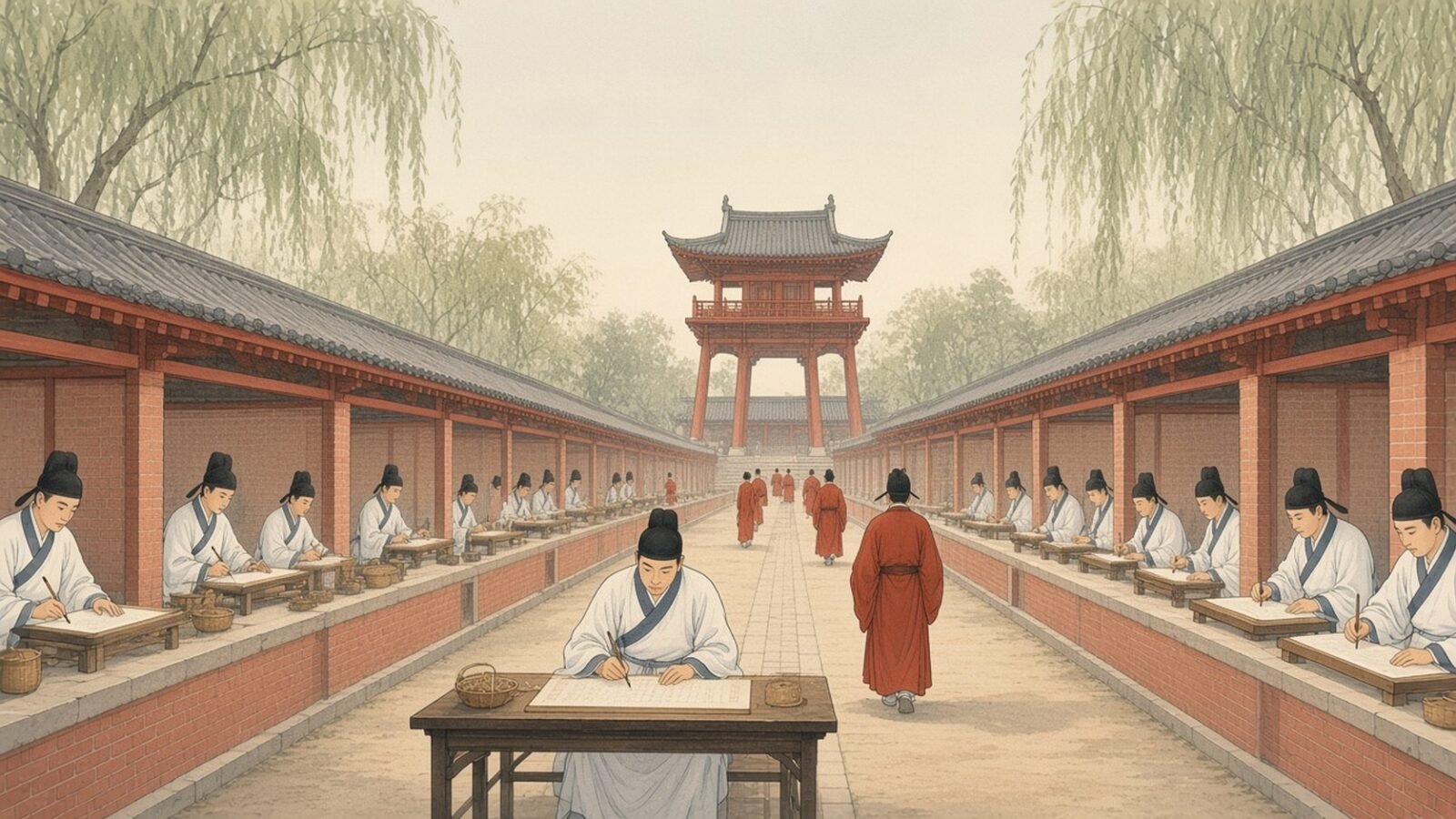
The mechanics of the examinations were elaborate. Candidates were required to enter the examination compound several days before the tests began. They were searched, their belongings were examined, and they were sealed into individual examination cells that consisted of a small wooden platform with a writing desk, a sleeping mat, and a brazier for cooking. The candidates remained sealed in their cells for the duration of the examinations, typically three days for each of the three compositions that constituted the basic examination, with no contact with the outside world. Food was passed in, papers were passed out, and the candidates worked under conditions that were deliberately harsh. The examination papers were identified only by a number that the candidate drew at random, and the examiners who graded them did not know the identity of the candidate until after the grades were assigned.
3. The new composition of the elite: social mobility and the southern shift
One of the most striking features of the Northern Song examination system was its effect on the social composition of the governing class. The Tang elite had been, to a significant extent, an aristocracy of great families whose members entered the civil service through recommendation and through local influence. The Song examinations, by contrast, opened the path to office to a much wider range of families, including families of merchants, of minor officials, and of small landowners whose sons had the resources to study for the examinations but who had no hereditary claim to office. The result was a gradual transformation of the composition of the elite, from an aristocracy of great houses to a meritocracy of examination graduates.
The transformation was uneven and incomplete. Great families continued to produce examination graduates in disproportionate numbers, in part because they had the resources to support the years of study that the examinations required. But the examinations also produced large numbers of officials from less privileged backgrounds, and the proportion of the elite drawn from these backgrounds grew over the course of the dynasty. The examination system also produced a new kind of social mobility: it was possible for a man of humble origins to rise through the examinations to the highest posts at court, and there are several well-documented cases of such rises in the Northern Song. The most famous is the case of Fan Zhongyan, whose early career included periods of genuine poverty but who passed the jinshi examination in 1015 and went on to serve as chancellor and to lead the most consequential reform movement of the middle eleventh century.
The examinations also had a profound effect on the geography of the elite. Under the Tang, the elite had been disproportionately concentrated in the north, in the metropolitan regions of Chang’an and Luoyang and in the great families of the central plains. The Song examinations, which were administered in prefecture and circuit capitals across the empire, redistributed the elite geographically, with the result that the southern provinces, and in particular the regions around modern Jiangxi, Fujian, and the two Huguang provinces, came to supply a disproportionate share of successful candidates. The shift in the geography of the elite from north to south was already underway in the Tang, but the Song examination system accelerated it dramatically. By the late Northern Song, more than half of the jinshi graduates came from the southern provinces, and the proportion continued to grow in the Southern Song and the later dynasties.
The examination system also had the effect of standardising the curriculum. The candidates were required to master a fixed body of classical texts, and the body of texts was, over the course of the dynasty, progressively consolidated. The Five Classics, supplemented by the standard commentaries, were the core of the curriculum throughout the Northern Song. The Four Books – the Analects, the Book of Mencius, the Great Learning, and the Doctrine of the Mean – were given increasing prominence in the late Northern Song, in particular after the publication of Zhu Xi’s influential commentary in the late eleventh and early twelfth centuries. The standardisation of the curriculum had the effect of producing a literate class that shared a common body of knowledge, a common set of references, and a common style of writing. The homogenising effect of the examinations was, in this sense, one of the great shaping forces of Chinese intellectual history.
4. The intellectual culture: the jingyi essay and the Song literary elite
The Northern Song examination system was not merely a system of recruitment. It was also a system of intellectual formation, and the kind of intellectual culture it produced is one of the most distinctive features of the dynasty. The examination essay, in its developed form, was a hybrid of literary and intellectual work: it required the candidate to display mastery of the classical texts, to construct an argument on a classical theme, to demonstrate stylistic skill in the use of parallel prose and elegant allusions, and to show some awareness of the political and moral questions that the examiners were likely to consider important. The essay was, in other words, a test of the candidate’s ability to do the kind of thinking that an official was expected to do, but also a test of the candidate’s ability to display that thinking in a form that was recognisably scholarly.
The Northern Song period saw an extraordinary flowering of the kind of intellectual culture that the examination system made possible. The dynasty produced a series of great scholar-officials who were also major intellectual figures: Ouyang Xiu, who served as an examiner and chancellor and who was also one of the great prose stylists of the period; Su Shi, who failed the palace examination in his first attempt but went on to become one of the great poets, essayists, and calligraphers of Chinese history; Wang Anshi, whose reforms as chancellor drew on a distinctive reading of the classics and whose school of thought dominated the late Northern Song; Zhu Xi, the great synthesizer of Confucian thought whose commentaries on the Four Books would become the basis of the examination curriculum for the next seven hundred years. These figures were not, for the most part, professional intellectuals in the modern sense. They were officials who wrote, and they wrote because the examination system and the literary culture it sustained made writing a central part of what it meant to be a member of the governing class.
The printing press was essential to the working of the examination system. The standard edition of the Confucian classics used in the examinations was a printed edition, and the candidates were expected to have access to printed editions of the standard commentaries and to the printed collections of model examination essays that circulated as guides for the preparation of candidates. The Northern Song was, in fact, one of the periods of the most intensive development of printing technology in Chinese history, with the spread of woodblock printing from the late Tang into a major industry and with the development of moveable type in the late eleventh century. The Song examination system was therefore part of a wider technological and intellectual transformation, in which printed texts became more widely available, literacy became more widespread, and the educated class grew in size and in geographical reach.
The examination system also generated its own distinctive body of secondary literature. Model examination essays were published in printed collections that circulated as aids to candidates. Anthologies of the compositions of successful candidates, including the compositions of the top-ranked candidates in the palace examination, were published as models of good examination writing. Biographical dictionaries of examination graduates were compiled and published. The result was a self-reinforcing literary culture in which the standards of the examination system set the standards of the educated class, and in which the educated class produced the literature that defined what those standards were.
5. Reform and its limits: Wang Anshi and the New Policies
The Northern Song examination system was not, despite the achievements of its early phase, a stable institution. It was the subject of repeated attempts at reform throughout the dynasty, and the reforms it provoked are themselves part of its history. The most consequential of these reform attempts was the New Policies of Wang Anshi, who served as chancellor from 1069 to 1076 and who used his control of the examination system to advance a distinctive programme of policy reform. Wang Anshi’s reforms included changes to the examination curriculum, with greater weight given to the jingyi policy essay and less to the poetry composition, and the introduction of new categories of examination questions that tested the candidates’ grasp of the policy problems of the day. The reforms were controversial and were reversed, in part, after Wang Anshi’s fall from power in 1076. The debate over Wang Anshi’s reforms continued for the rest of the Northern Song and into the Southern Song, and it shaped the intellectual culture of the dynasty in ways that are still debated by historians.
A second strand of reform was the attempt to restrict the influence of local elites on the recruitment of examinees. The Tang and early Song examination system had been vulnerable to the manipulation of the prefectural examinations by local gentry families, who were able to ensure that their own candidates succeeded and that candidates from less well-connected families did not. The Northern Song introduced a number of measures designed to counteract this tendency, including the posting of examiners from outside the local area to supervise the prefectural examinations, the introduction of stricter anonymity in the grading of examination scripts, and the publication of the examination questions and the successful examination essays after each cycle. These reforms had some effect, but the influence of local elites on the examination system was never fully eliminated.
A third strand of reform was the expansion of the imperial academies and the diversification of paths into the civil service. The Northern Song inherited from the Tang the Taixue, the Imperial Academy, which had been a major institution of higher learning in the Tang but which had declined in the late Tang. The early Song emperors revived the Imperial Academy and expanded its enrolment, and a parallel network of prefectural and circuit academies was established across the empire. The academies served both as places of study for candidates preparing for the examinations and as an alternative path into the civil service: students of the academies who performed well could be appointed to office directly, without sitting the regular examinations. The academies were, however, never the dominant path into the civil service; the regular examinations continued to be the principal route, and the academies served primarily as preparation for the examinations.
6. The long aftermath: from Song restoration to the abolition of 1905
The Northern Song examination system did not survive the fall of the dynasty. The Jurchen invasion of 1126-1127, which culminated in the capture of the Northern Song capital at Kaifeng and the flight of the imperial family to the south, disrupted the examination system along with everything else. The Southern Song dynasty, established at Lin’an (modern Hangzhou) in 1127, restored the examination system in its Northern Song form and continued to operate it for the next one hundred and fifty years. The Liao, Jin, and Yuan dynasties that ruled northern China during the Southern Song period maintained their own versions of the examination system, drawing on the Song model. The Mongol Yuan dynasty, which reunified China in 1279, operated a restricted version of the examination system throughout its period of rule, and the Ming dynasty that succeeded it in 1368 restored the examination system in a form that drew heavily on the Song model. The examination system continued to function, with variations, until the abolition of the imperial examinations in 1905.
The legacy of the Northern Song examination system is, for these reasons, the legacy of an institution that functioned, in one form or another, for nearly a thousand years. The examination system shaped the Chinese imperial bureaucracy, the Chinese intellectual tradition, and the Chinese literary tradition. It produced a governing class that was, by the standards of the pre-modern world, unusually meritocratic. It created a common curriculum that helped to unify the educated class across the vast geographical extent of the empire. It produced a body of literature that was, in its own terms, a major achievement of the Chinese literary tradition. And it created a system of intellectual formation that, whatever its limitations, was one of the great institutional achievements of Chinese civilisation.
The limitations of the examination system are also part of its history. The system was, by design, restrictive in its subject matter, and the standardisation of the curriculum that it enforced had the effect of narrowing the range of intellectual inquiry that the educated class could undertake. The system was also, by practice, vulnerable to corruption, and the elaborate precautions against cheating were never wholly successful. The system was, by its place in the social order, the preserve of men, and the absence of women from the examination system is a feature of the institution that any honest assessment must acknowledge. The examination system was, in short, a product of its time, and it had the strengths and the limitations of its time. The Northern Song, in the form it gave to the system, gave it its most fully developed expression.
References
- The Examination System and the Recruitment of Officials in Song China – Robert P. Hymes, in: Journal of the Economic and Social History of the Orient, vol. 26, no. 2, 1983
- This Culture of Ours: Intellectual Transitions in T’ang and Sung China – Peter K. Bol, Stanford: Stanford University Press, 1992
- Song Government and Politics – John W. Chaffee, in: The Cambridge History of China, Volume 5, Part 1: The Sung Dynasty and Its Neighbors, eds. Denis Twitchett and Paul Jakov Smith, Cambridge: Cambridge University Press, 2009
- The Chinese Examination System and the Rise of Modern Chinese Studies – Mengzi Zhang, in: Frontiers of History in China, vol. 4, no. 1, 2009
- The Scholar and the State: Literature and Politics in the Northern Sung – James T. C. Liu, in: The Cambridge History of China, Volume 5, Part 1, Cambridge: Cambridge University Press, 2009
- Sung Dynasty Uses of the I Ching – Edward L. Shaughnessy, Princeton: Princeton University Press, 2014
- China’s Examination Hell: The Civil Service Examinations of Imperial China – Miyazaki Ichisada, New Haven: Yale University Press, 1981
- The Northern Song Capital Kaifeng and the Imperial Examination System – Valerie Hansen, in: Journal of Song-Yuan Studies, vol. 41, 2011
- Printing and Book Culture in the Sung Dynasty – Hilde De Weerdt, in: The Cambridge History of China, Volume 5, Part 1, Cambridge: Cambridge University Press, 2009